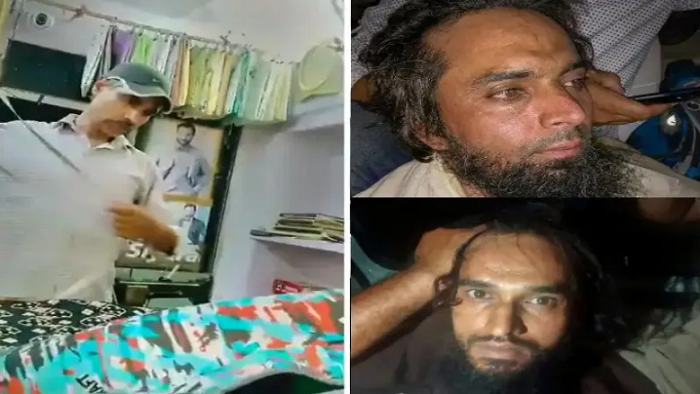
On Tuesday 12th July 2022, the Karnataka police arrested 7 illegal Bangladeshi nationals from the Ramanagara districts. The Bangladeshi nationals were illegally staying in Karnataka and working in a garment company called Link App Garments in Basvanapura village. Fake Indian IDs were found with the Bangladeshi nationals. This gang is said to have entered India through Assam. On getting a tip, the Karnataka police arrested 7 of them and further investigations in this case are going on.
While talking to news agency ANI, Santosh Babu, SP Ramanagara said, “Ramanagara rural police arrested seven Bangladeshi nationals who were living & working here with fake ID proofs. They were working in a garment factory. They had Odisha, West Bengal & Assam ID cards.”
Karnataka | Ramanagara rural police arrested seven Bangladeshi nationals who were living & working here with fake ID proofs. They were working in a garment factory. They had Odisha, West Bengal & Assam ID cards: Santosh Babu, SP Ramanagara (12.07) pic.twitter.com/ysn4pRqiZg
Using these identity cards, they had secured jobs in Karnataka. According to a report by the Republic World, Ramanagara Superintendent of Police Santhosh Babu said, “We got a tip-off about Bangladeshi nationals working in Ramnagara. We have arrested 7 Bangladesh nationals, who were working in a garment factory. They reached Ramanagara on the 1st of June. They had Indian Aadhaar cards. We will question the garment factory owner regarding the criteria on which they had appointed them to the garment company. We are investigating further to trace the network.”
The arrested illegal Bangladeshi nationals have been identified as Sohail Rana, Zulfiqar, Ujjal, Munazil, Mussa Shaik, Raheem, and Arif. According to the police, the Bangladeshis had illegally entered Assam in May this year, and had got Aadhaar cards in their names made through a broker using an address in Assam. From Assam they first went to Doddaballpur in Karnataka, from where they moved to Ramanagara. They secured jobs at a garments factory in Ramanagara. They were staying at a rented place there.
Ramanagar SP K. Santosh Babu said that the all seven persons have admitted that they entered Indian illegally, and they reached Karnataka with the help of a broker. Police have also recovered documents from them proving their Bangladeshi origin. All of them will be shifted to the Bengaluru detention centre after the interrogations. Police teams are searching for the broker that helped them.
It is also being probed whether these people came to Karnataka for jobs only, or had they arrived in India and took the jobs on a different conspiracy.
It is notable that, in May 2022, the Bengaluru police launched an identification campaign to track down Bangladeshi immigrants working as domestic workers, garbage collectors, or ragpickers, and file charges against them if they are found to be illegal immigrants.
On Tuesday, the Central Bureau of Investigation (CBI) lodged a complaint against Lakshadweep MP and NCP leader Mohammed Faizal, his nephew, and others over charges of corruption and irregularities, including an alleged scheme in the shipment of tuna fish to a Sri Lankan business. The CBI conducted searches at six locations related to MP Mohammed Faisal across Delhi, Calicut, and Lakshadweep.
According to the reports, CBI received information relating to irregularities in the procurement of Massmeen (dry tuna fish) from fishermen of Lakshadweep island during the year 2016-2017. Khan reportedly gave false assurance of a higher rate and exported the same through M/s. Lakshadweep Co-operative Marketing Federation Ltd to Sri Lanka. On June 25, a combined surprise inspection was performed at the LCMF Ltd offices in Kavaratti (Lakshadweep) and Calicut (Kerala).
It was revealed that during the fiscal year 2016-17, Mohd Faizal, MP, Lakshadweep, falsely assured to LCMF that a foreign buyer M/s SRT General Merchants Importers and Exporters, Colombo 11, Sri Lanka is prepared to buy Massmeen at a higher rate than the uniform price. In its meeting on November 21, 2016, the Board of Directors of LCMF Ltd then decided to procure the dry tuna from poor fishermen of Lakshadweep Island, and subsequently procured approximately 287 MT of dry tuna from them of various islands of Union Territory of Lakshadweep through relevant co-operative societies of islands.
During this procedure, the LCMF assured the fishermen that they would be paid more than the current rates. The case was handled by MP Anwar, the then-Managing Director of LCMF, without following any rules or procedures and relying solely on the guarantee of Mohd Faizal, MP Lakshadweep. Based on the aforementioned surprise check, a senior CBI official in New Delhi filed a complaint, which indicated that Mohd Abdul Razik of Lakshadweep, a relative of Mohd Faizal, MP, Lakshadweep, was the representative of M/s SRT, Colombo, Sri Lanka in this affair.
All the arrangements were made by Mohd Faizal, MP for Lakshadweep, and he was crucial in establishing the dry tuna exporter M/s Accelerated Freeze Drying Company (AFDC), Cochin, Kerala, through LCMF Ltd. Following that, LCMF Ltd. entered into an arrangement with M/s AFDC, a Cochin-based exporter agency, in which terms of reference for dry tuna export were agreed upon.
However, the project could not materialize due to AFDC’s unwillingness to pay Rs 60 lacs for the first shipment of 10 MT of maasmeen exported to the Sri Lankan business. As a result of the above, the firm M/s AFDC, Cochin experienced a loss of roughly Rs 60 lakhs and did not continue the lifting of additional Massmeen through LCMF, as per the agreement. Finally, although M/s. AFDC suffered a loss of Rs 60 lakhs, the impoverished fishermen of Lakshadweep Islands and LCMF suffered a loss of Rs 9 crores.
It is important to note that amid the progressive reforms brought up by the Lakshadweep Administrator Praful Patel in year 2021, MP Mohammed Faisal had declared that beef-eating was a constitutional right of Lakshadweep people. Patel had floated a number of proposals aimed at ensuring the safety and well-being of residents, along with promoting the islands as a tourist destination on par with the Maldives.
The draft Lakshadweep Development Authority Regulation (LDAR) 2021 also proposed a new law to ban cow slaughter and beef, which is in line with the prevailing law in most of the states in India. Opposing the proposals, MP Mohammed Faisal had said that eating beef was constitutional right of the people of Lakshadweep and that the new proposals were aimed at undermining the ‘Islamic character’ of the island where Muslims constitute 96% of the total population.
A woman in Kuala Lumpur, Malaysia, who was charged with ‘insulting Islam’ by allegedly “acting indecently” while performing at a comedy club pleaded not guilty to the accusation. Siti Nuramira Abdullah, 26, pleaded not guilty to the charge before Judge Siti Aminah Ghazali. She was accused of stirring up religious conflict among Muslims.
The woman was accused of committing the offence of ‘insulting Islam’ by stripping to show herself in a short dress at the Taman Tun Dr Ismail comedy club. She acknowledged being a Muslim and having memorised 15 chapters of the Quran.
Nuramira was charged under Section 298A of the Malaysian Penal Code for producing discord, disunity, or emotions of animosity. If convicted, she faces up to five years in jail. Deputy Public Prosecutor Najah Farhana requested during the hearing today that no bail be granted to the accused since the offence is not bailable.
However, the accused’s attorney, R. Sivaraj, requested a reduced bond, arguing that the bail was merely aimed to assure their client’s appearance in court. The court set bail at RM20,000 with one surety, and the accused was ordered to forfeit her passport until the matter was resolved.
During her open mic stint on stage, the woman wearing a hijab allegedly made derogatory religious remarks and removed her Baju Kurung (Malay dress). Under the outfit, she was wearing a spaghetti-strap dress. On July 9, police arrested the woman following a 54-second video of the show going viral.
The matter has elicited criticism from both the government and the general population. The comedy club’s operations have been temporarily halted by Kuala Lumpur City Hall.
The viral video of the woman is being looked at by the Federal Territories Islamic Religious Department. A fine of up to RM3,000 or a sentence of up to two years in prison are possible penalties for anyone found guilty of insulting or causing contempt for Islam under the Syariah Criminal Offences (Federal Territories) Act of 1997 in Malaysia.
On July 13, the researchers at Network Contagion Lab at Rutgers University-New Brunswick (NC Lab) published a paper on the rise of Hinduphobia on social media and messaging platforms. The researchers found evidence of a sharp rise and evolving patterns of hate speech against Hindus on several platforms.
As per the paper titled “Anti-Hindu Disinformation: A Case Study of Hinduphobia on Social Media”, multiple actors, including white supremacists, 4Chan and other extremists, are widely sharing genocidal Pepe memes against Hindus among Islamist web networks through messaging services such as Telegram and other platforms.
NCRI’s latest paper on “Anti-Hindu Disinformation: A Case Study of Hinduphobia on Social Media.” was released today on KQED/NPR
— Network Contagion Research Institute (@ncri_io) July 13, 2022
With the help of artificial intelligence, the Rutgers researchers were able to analyze over 1 million tweets and found that Iranian trolls were in action on several occasions to spread anti-Hindu propaganda. These actors accused Hindus of perpetrating genocide against minorities in India. Interestingly, similar propaganda against the Hindu community of India is being spread in western countries, and several activists and so-called journalists like Rana Ayyub are extensively fueling the said narrative in their circle.
Prasiddha Sudhakar, a student analyst who worked on the paper, said, “I appreciate the opportunity to bring awareness to this underrepresented subject matter.” She has worked with high school students from the New Jersey Governors’ STEM Scholars program to collect and analyze data.
Joel Finkelstein, the chief data scientist at the NCRI and a senior research fellow at the Miller Center, said, “Educating young people on how to detect open-source hate messaging is a vital first step in helping vulnerable communities prepare for and respond to emerging threats.”
John J. Farmer Jr., director of both the Miller Center and the Eagleton Institute of Politics at Rutgers University-New Brunswick, noted that the bigotry and violence faced by the Hindu population was nothing new. “What is new is the social media context in which hate messages are being shared. Our prior work has shown a correlation between the intensity of hate messaging over social media and the eruption of real-world acts of violence,” he added.
Analyzing Hindu hate on social media and messaging platforms
First of all, it is essential to understand that the Hindu community has been facing discrimination and hate for a long time. In the paper, John Farmer talked about the anti-Hindu moment called the ‘dot-busters’ of the 1980s. He pointed toward a letter that was published in the Jersey Journal in 1987. In the letter, the author talked about attacking Indians who were largely Hindus and forcing them to leave Jersey.
He said, “I’m writing about your article during July about the abuse of Indian People. Well, I’m here to state the other side. I hate them. We are an organization called dot busters. We will go to any extreme to get Indians to move out of Jersey City. If I’m walking down the street and I see a Hindu and the setting is right, I will hit him or her. We plan some of our most extreme attacks, such as breaking windows, breaking car windows, and crashing family parties. They will never do anything. They are a weak race physically and mentally. We are going to continue our way. We will never be stopped.”
Following the letter, multiple attacks had happened on Indians in the Jersey area. Some of the attackers were arrested as well, but they were acquitted as the victims could not identify them during the trial. In short, anti-Hindu propaganda is nothing new, and the Hindu community has been facing it in India as well as in other countries.
What does the data suggest in the current scenario?
According to the Rutgers researchers, there is an alarming rise in anti-Hindu slurs and slogans. They also noticed an increase in the proliferation of anti-Hindu genocidal memes in memes in Islamist, white nationalist, and other extremist sub-networks online. It is noteworthy that, in general, such posts are seen as anti-Indian, but the researchers pointed out that the “specific content of these memes, hashtags and derogatory messages very clearly targets decidedly Hindu symbols, practices, and livelihoods.”
“Hinduphobic tropes — such as the portrayal of Hindus as fundamentally heretical evil, dirty, tyrannical, genocidal, irredeemable or disloyal— are prominent across the ideological spectrum and are being deployed by fringe web communities and state actors alike.”
— Network Contagion Research Institute (@ncri_io) July 13, 2022
The presence of both established and emergent actors spreading anti-Hindu propaganda on social media and messaging platforms for political purposes was also discussed in the paper. The Rutgers report noted, “[The] state actors within Iran often weaponize this discourse to ignite conflict between India and Pakistan.”
Non-state actors like ISIS-K are also involved in such propaganda. The researchers pointed out how the recent attack on Gurudwara in Kabul was linked by ISIS-K to the alleged derogatory remarks against Prophet Mohammed by former BJP spokesperson Nupur Sharma.
The data extracted from different sources ranged from 2019 to 2022. They found that the anti-Hindu disinformation is often masked through the use of ethnic pejoratives, slurs, and coded language such as the word ‘pajeet.’ It was first seen on 4Chan. It is an “ethnic slur, coined as a derisive imitation of Indian names. Typically, pajeet is used to describe Indians on the Internet and, by default, Hindus,” the paper suggested.
It is notable that the word has found its way into extremists’ manifestos as well. The paper reads, “The white supremacist shooter of the Chabad Synagogue in San Diego, 2019, had referenced “pajeets” in this manifesto. This slur has also been used by white supremacists in white nationalist podcasts in reference to violent, murderous fantasies about Indians.” Interestingly, the slang was used extensively when Parag was appointed as CEO of Twitter in late November 2021.
Pepe the frog meme on 26/11, a meme pushing propaganda of treating Hindus like the Police Officer, treated John Floyd, and similar memes have surfaced on social media from time to time.
Source: NCRI
The idea of anti-Hindu hate on social media revolves around describing Hindus as dirty. Words like sh*tskinned, sub-human, and others are commonly used to describe Hindus online. The researcher found that users commenting about “Pajeets,” “Hindus,” and “India” on 4Chan self-reported their locations in the US, India, Canada, UK, and Australia, with the overwhelming majority being located in the US.
Source: NCRI
The hate is widespread on multiple platforms. The paper read, “Accounts titled “Caliphate Revive” call for “Ghazwa-e-Hind,” a violent fantasy by Islamists to colonize India. Similar calls to violence are echoed on Twitter.”
Source: NCRI
The Iranian connection
Furthermore, the researchers observed that state actors also use anti-Hindu tropes as part of information operations for geopolitical influence. Using the dataset released by Twitter, they found that there were over 17 lakhs tweets from state-sponsored Iranian trolls between 2010 to 2021.
Their analysis suggested that they used social media to associate Hindus with extremists who perpetrated violence against minorities. They also tried to cause political unrest in India. Also, the location analysis done by the researchers pointed toward the highly clustered presence of trolls in Pakistan. Some anti-Hindu accounts operate from India as well.
They often talked about India and Hindus during times of geopolitical conflict. For example, when a bomb blast occurred on the Bhopal-Ujjain Passenger train by ISIS, the Iranian trolls ran a disinformation campaign to suggest that the attack was made by “Hindu Extremists.” In August 2017, they ran a hashtag #KashmirDeniesIndia following the unrest caused by the extermination of Hizbul Mujahideen terrorist Burhan Wani.
During the March 2017 Bhopal–Ujjain Passenger train bombing by ISIS, Iranian trolls, pretending to be Pakistani, attempted a disinformation campaign to suggest that the attack was done by “Hindu Extremists,” and attempted to get it trending. pic.twitter.com/IOA4St05nv
— Network Contagion Research Institute (@ncri_io) July 13, 2022
A similar campaign was launched by the Iranian trolls in the aftermath of the Delhi riots of 2020. They ran propaganda to establish that Hindus murdered Muslims on the streets of Delhi in bloodthirsty and brutal ways.
They even disguised as human rights activists, journalists, and humanists. They tagged publications like CNN and MSN to push them to condemn India for anti-Muslim violence. The paper suggested, “Iranian trolls deliberately suggested that Hindus were committing genocide against Muslims while unilaterally portraying Hindus with genocidal bloodlust. Iranian trolls thus use covert influence and hijack social justice rhetoric to promote anti-Hindu disinformation.”
The Rutgers paper on Hinduphobia on social media and messaging platforms can be read here.
Navjot Singh Sidhu has created another controversy even while serving his imprisonment in the Patiala jail. Reportedly, Sidhu had an argument with prisoners locked in his cell, forcing other prisoners to maintain distance with him. The prisoners have accused Sidhu of misbehaving with them. To avoid further clashes, these prisoners are put in other cells now.
Accused by other prisoners of misbehaving, Sidhu alleged that some of those prisoners purchased a few things from the canteen using Sidhu’s canteen card without his permission.
Navjot Singh Sidhu is serving a one-year jail term in Patiala Central Jail in connection with a road rage case, as he was awarded a jail term of one year in the case. The behaviour of jailed Navjot Singh Sidhu has become a problem for his fellow prisoners. Three prisoners lodged with him in the barrack demanded the jail authorities change the barracks. Accordingly, their barracks have been changed.
During interrogation, Sidhu told the jail authorities that when his fellow prisoners had purchased the goods arbitrarily using his canteen card, he prevented them from doing so. On the other hand, the prisoners told the jail authorities that Sidhu was not treating them properly. At present, the jail authorities ended the dispute and changed the barracks of the three prisoners and now two other prisoners are lodged with Navjot Singh Sidhu.
Navjot Singh Sidhu is lodged in barrack number 10 along with other prisoners. When asked about this, the jail authorities confirmed the change of barracks of the three prisoners but remained silent on the complaint regarding Sidhu’s behavior.
Navjot Singh Sidhu, who is in the central jail of Patiala, was accompanied by five other prisoners. Sidhu is not allowed to step out of the barrack due to security reasons. In such a situation, Sidhu was getting goods from the canteen ordered using his card with the help of the prisoners who were detained with him. All of this was running smoothly as the fellow prisoners were coordinating things well.
Some days ago, fellow inmates bought some goods for themselves using Navjot Singh Sidhu’s canteen card. Learning about this, Navjot Singh Sidhu got furious as to why these prisoners purchased using his card without permission. He also argued that the card limit is low. As the dispute stretched further, it was noticed by the jail authorities. The inmates alleged Sidhu of using derogatory language against them and objected to his behaviour. The jail authorities ended the dispute by changing the barracks of the fellow inmates.
Jail Superintendent Manjit Singh said the barrack of the prisoners lodged with Sidhu has been changed but he cannot say anything more than that. As per the rules, other prisoners are locked up with Navjot Singh Sidhu. Earlier Navjot Singh Sidhu was also at the centre of a controversy for the special treatment being given to him by the jail authorities to ensure that he gets a special diet as prescribed by the doctors.
According to reports, four miscreants attacked the police and took away gangster Vinay Shrotia, whom the police had taken to court in the Agra district of Uttar Pradesh. This incident also resulted in the injury of a policeman.
According to the information received so far, the miscreants who attacked are from the Firozabad district. Numerous police teams have reportedly been dispatched to Firozabad, according to reports. It is significant that the accused Vinay was charged by the Barhan police station under Gangster Act. In this case, just as the police arrived on the premises of the Agra court to produce him before the magistrate, the assailants ambushed and snatched him away.
The miscreants pulled out this brazen crime using just bricks, which is embarrassing for the police and the new SSP in the Agra district. The cops have currently barricaded the entire area. According to reports, the miscreants were already present inside the court premises. When gangster Vinay and the police arrived on the premises, the assailants attacked them with bricks. A soldier was injured in this attack and was sent to the hospital for treatment. He has suffered a head injury.
More than 30 criminal cases have been filed against the gangster Vinay Shrotia aka Vinay Sharma, who was freed by his accomplices; around 30 cases have been filed against him in the districts of Firozabad, Agra, and Etah. This includes heinous crimes like dacoity, attempt to murder and kidnapping.
On Wednesday, 13th July 2022, Supreme Court refused to pass an interim order to stop the bulldozer action against anti-social elements in Uttar Pradesh and other states. The court postponed the hearing on the plea against the bulldozer action till August 10.
The Jamiat Ulema-E-Hind filed PILs alleging that authorities in states like UP and MP are using bulldozer action to destroy the homes of people accused in cases like riots. The Supreme Court asked orally if it could issue omnibus orders preventing the demolition of unauthorized structures while hearing these PILs.
SC refuses to pass interim direction staying demolitions across states. While hearing on a plea filed against demolitions in UP, a bench of Justices B. R Gavai and P. S Narasimha says it cannot pass omnibus order preventing authorities from taking action against the violators. pic.twitter.com/50lxATWK2n
— All India Radio News (@airnewsalerts) July 13, 2022
The bench of Justices BR Gavai and PS Narasimha said in their oral observation during the hearing, “Rule of law has to be followed, no dispute. But can we pass an omnibus order? If under the Municipal law the construction is unauthorized, can an omnibus order be passed to restrain authorities?”
याचिकाकर्ता जमीयत उलमा हिंद ने कोर्ट में कहा नियमों का उल्लंघन कर बुल्डोजर चलाए जा रहे हैं। जिन पर आरोप है उनके घर ढहाए जा रहे हैं।एक समुदाय को निशाना बनाया जा रहा है।यूपी ने जमीयत की याचिका पर उठाया सवाल।कहा कार्रवाई नियम मुताबिक हुई है किसी एक समुदाय के खिलाफ नही हुई@JagranNews
The petitioner’s lawyer Dushyant Dave claimed that the government is targeting riot suspects with selective action. Solicitor General Tushar Mehta and counsel Harish Salve appeared for the state. SG retorted saying that there is no other community in India, but there is just the Indian community. He added that the petitioners are creating a sensationalizing hype unnecessarily. Now the matter will be heard next on August 10.
After the allegedly insulting remarks against the Prophet Muhammad by Nupur Sharma, there were violent protests in many cities across the country. The illegal constructions owned by the miscreants involved in these riots were demolished by the local administrations in the states like Uttar Pradesh and Madhya Pradesh. A petition against this action was taken to the Supreme Court by Jamiat Ulema-E-Hind. The apex court has now refused to order an interim stay on such bulldozer action.
On Wednesday, Congress MP Nakul Nath from Chhindwara triggered a controversy by wiping off the tilak on his forehead before he along with his Congress supporters entered a Muslim majority area in his constituency in Madhya Pradesh. Nakul Nath, who is the son of former Madhya Pradesh CM Kamal Nath, was in the Parasia area of Madhya Pradesh for an election campaign.
According to the reports, Nath removed the kumkum tilak which is an important symbol of Hinduism, before he entered the Islamist-dominated area in Parasia, Chhindwara district. He was handed over a handkerchief with which he wiped the tilak off from his forehead. The video of the incident went viral over social media and was criticized by BJP leaders.
BJP Delhi spokesperson Tajinder Pal Singh Bagga tweeted the video and slammed the Chhindwara Congress MP for disrespecting the symbol of Hinduism. “Kamal Nath’s son Nakul Nath removed tilak before entering in ‘their’ area”, he captioned the video.
— Tajinder Pal Singh Bagga (@TajinderBagga) July 12, 2022
Another BJP member posted the video and said that Nakul Nath, by rubbing off the Tilak had exposed the Congress party’s mentality. “Kamal Nath’s son, Nakul Nath did not just remove his tilak before entering this peaceful area, he also exposed the Congress mentality in doing so. People like him are vultures feeding on the innocence of the public to build their castles”, he said.
Kamal Nath’s son, Nakul Nath did not just remove his tilak before entering this peaceful area, he also exposed the Congress mentality in doing so.
People like him are vultures feeding on innocence of the public to build their own castles. pic.twitter.com/6W8MIc2sjf
The video was first posted on Facebook Live by Nakul Nath himself. It soon went viral over other social media platforms enraging the Hindus. Meanwhile, the Congress media cell in-charge K K Mishra defended Nakul Nath and said that he was wiping off the sweat amid the campaign. “The tweet by BJP leaders is politically motivated and that shows their mentality”, he said.
Mishra also added that it is common for any leader to wipe off the sweat during rallies and campaigns and that BJP was using the ‘very common’ incident for their political benefits. Pertinently, the video that went viral over social media was later removed from the Facebook account of Nakul Nath. The video should have remained intact if the leader was just wiping off his sweat and not the Kumkum tilak before entering the Muslim-dominated area in Chhindwara.
On 13th July 2022, the Supreme Court agreed to hear a petition challenging the Karnataka High Court’s verdict regarding the hijab ban in the upcoming week. Earlier on 15th March 2022. the Karnataka High Court said in its verdict that wearing a hijab has not been proven as an essential religious practice in Islam and that educational institutions have the right to mandate a dress code inside their premises.
Along with this, the court ruled that students shall not wear hijab in academic institutions having a predefined uniform dress code.
Following the mention of the case by Advocate Prashant Bhushan, a bench led by Chief Justice of India NV Ramana consented to refer it to an appropriate bench next week, as reported by Livelaw. According to Prashant Bhushan, the plea was filed in March but was yet to be listed.
A major controversy erupted in Karnataka in January 2022 after a Udupi school prohibited hijab inside classrooms. Some Muslim girl students, supported by PFI had appealed against this in the Karnataka High Court. On February 25, the court reserved its decision on the case. Protests, allegations, and counter-allegations occurred in response to the hijab ban.
The Karnataka High Court declared on March 15 that wearing a headscarf does not constitute an essential Islamic practice as the petitioners failed to provide evidence in that regard. The Karnataka High Court dismissed all petitions contesting the hijab ban in Karnataka schools and decided that the rules for the uniform dress were fair and that students can not object to respective dress codes mandated by educational institutions.
A Full Bench of the High Court comprising Chief Justice Ritu Raj Awasthi, Justice Krishna Dixit, and Justice JM Khazi pronounced the decision. The Bench ascertained that the petitioners’ basic rights were not violated by a uniform dress code at educational institutions.
Following that, Muslim students from Karnataka petitioned the Supreme Court to overturn the judgment of the Karnataka High Court. The ruling was contested by six Muslim students from Udupi before the top court.
The Directorate of Revenue Intelligence (DRI), according to a statement made public on Wednesday, conducted searches at the premises of mobile company Oppo India and found evidence of the firm evading customs taxes to the tune of Rs 4,389 crore. Oppo India is owned by Guangdong Oppo Mobile Telecommunications Corporation Ltd, a Chinese company.
Directorate of Revenue Intelligence (DRI) searched mobile company Oppo India & unearths customs duty evasion of Rs 4389 Cr by Oppo India: DRI
During the course of the investigation, DRI searched Oppo India’s office building and the residences of its top managers. This led to the discovery of incriminating evidence that indicated willful misrepresentation in the description of some items imported by Oppo India for use in the production of mobile phones. Due to this miscalculation, Oppo India lied and claimed Rs 2,981 crore in ineligible duty exemption benefits.
The inquiry also revealed that the company had sent money or made arrangements for the payment of “Royalty” and “License Fee” to various international companies, including those located in China, in return for the right to exploit proprietary technology, a specific brand, an IPR licence, etc.
“The said ‘Royalty’ and ‘Licence Fees’ paid by the company were not being added in the transaction value of the goods imported by them, in violation of Section 14 of the Customs Act, 1962, read with Rule 10 of the Customs Valuation (Determination of Value of Imported Goods) Rules 2007. The alleged duty evasion by M/s Oppo India on this account is Rs. 1,408 crores,” the statement reads.
Following the conclusion of the investigation, Oppo was given a Show Cause Notice asking for Rs. 4,389 crores in customs tax. In line with the provisions of the Customs Act of 1962, the Notice also suggests imposing fines on Oppo India, its employees, and Oppo China.
The searches were conducted only days after the Enforcement Directorate (ED) searched more than 40 locations throughout India in connection with a money-laundering investigation. The ED alleged that out of the total sale proceeds of 1,25,185 crores, Vivo India’s nearly 23 affiliated companies, including Grand Prospect International Communication Pvt Ltd (GPICPL), transferred enormous sums to the company and sent 62,476 crores, or nearly 50% of the turnover, out of India, pretty much exclusively to China.