Home Blog Page 3739

Does Amazon-Prime’s new Tamil film deserve the backlash? The ‘Jai Bhim’ controversy

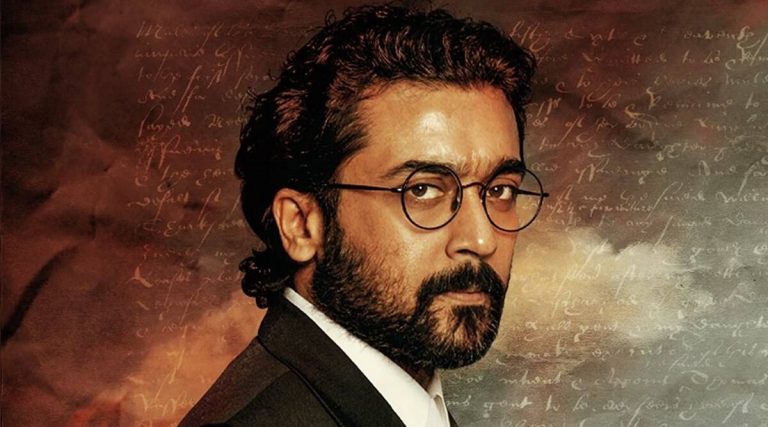
The Kollywood flick ‘Jai Bhim’ (a legal drama), a new kid in the block. The film was launched on Amazon Prime Video (OTT platform) on November 2nd, just in time for Diwali, and received rave reviews. So what is the film ultimately about? The film was inspired by true eventsof a tribal man (Rajakannu) who was wrongly accused and arrested in a theft case and died in custody as a result of police abuse and brutality in Tamil Nadu in 1993 (Case History in the High Court of Madras H.C.P. No. # 711 of 1993).

The film follows his wife Senggeni (original name was Parvathi) and the advocate K Chandru (currently, a retired high court judge) as they struggle for justice to Senggeni, the main protagonist. Advocate Chandru files a habeas corpus petition (Under Article 226 of the Constitution of India) and cite another similar case, and fight for justice. The film has received a resoundingly enthusiastic response from viewers both inside and outside of the country, and it has won the hearts of many because of the tragic real-life incident that occurred in the early 1990s. But does the movie, however, deserve the backlash it received?

The film Jai Bhim has been a source of controversy for many reasons. This write-up is not a movie review per se, however, meant to highlight the controversies and setbacks that are surrounding this movie. Readers who want additional information about the film should not expect to find it here.

On the surface, it looks that the film had a positive message for the masses, but it appears that it has a personal agenda and distinct political purpose hiding beneath the carpet. The attention-grabbing title, ‘Jai Bhim,’ is a slogan popularized by the followers and supporters of Bhimrao Ramji Ambedkar, an Indian academic, social reformer, and the principal architect of the Indian Constitution. Some politicians even claimed that the film’s title was unsuitable. With pictures of Karl Marx, Dr. Ambedkar, and E.V. Ramasamy Naicker (‘Periyar’), the film has the typical hallmark characteristics of ‘porali’ films. According to the promos, all of the characters’ genuine names were used in the film. However, that was not the case here.

The controversies surrounding Jai Bhim

To begin with, Parvathi Ammal was not informed, consulted, and her formal approval was not obtained. The film crew never approached her to show their interest in making a film out of her life’s events, or to try to assess her current financial situation or secure her with proper housing arrangements, or to initially offer financial compensation. Her current living situation was, to put it mildly, dreadful. Several of the critics were under the view that the name Parvathi was purposefully changed to Senggeni, and the protagonist’s caste was altered from Kuravar to Irular to avoid any potential legal consequences. Thus, the film undercut and twisted the Kuravar community’s identity, history, and pride.

The storylines were changed to kindle the emotion and gain the sympathy of the viewers. For example, the village chief was depicted as an arrogant man. However, in reality, he was very kind and helpful to the villagers and the couple, Rajakannu and Senggeni.

Some say, the film negatively painted the Vanniyar caste. The movie was said to have harmed the Vanniyar community’s reputation, thus they demanded an unequivocal apology. For example, the inclusion of ‘Agni kalasam’ (fire pot) and a character named, ‘Gurumoorthy’ who was a harsh, vicious sub-inspector of police. Out of the all available calendars used in the film, an ‘Agni Kalasam’ daily sheet calendar was chosen in a scene, and later it was transformed to a Hindu Goddess after a legal notice was issued against the film for allegedly distorting and maligning the Vanniyar community.

Subsequently, the film director released a letter of regret, but both Suriya and the director made no apology for hurting the sentiments of the Vanniyar community. Following that, when the calendar’s ‘Agni Kalasam’ image was changed to ‘Hindu Goddess,’ numerous Hindus mistook the film crew for causing injustice to all Hindus, reigniting the controversy. They began to wonder, “Why Hindus and why not a neutrally sounding image as a replacement?”.

The Agaram Foundation, which received philanthropic contributions from the public, made a donation of one crore rupees to the Irular Foundation, which sparked more controversy. According to critics, actor Surya never paid the money out of his own pocket. His ethics and integrity were also questioned for not helping Kuravas, who were the actual victims.

Despite the removal of the said scene, the popular Tamil dialogue writer, who framed the dialogues according to the contemporary dialects of the region in question, was involved in the film and has returned his payment, claiming that the film crew had betrayed him because the originally proposed title ‘Eli Vettai (Rat hunting) was changed. He even consulted on possible titles, according to reports.

The real name of the sub-inspector of police who was involved in the custodial torture and death of a member of an impoverished community who was wrongfully accused and framed was “Anthonisami” (a Christian), but he was portrayed in the film as Gurumurthy (a Hindu). The film crew, thus, allegedly and conveniently avoided using the real name of the sub-inspector of police. Additionally, critiques question the use of vanniyar symbolism that was brought into the picture. This is the question the film crew failed to address.

Early on, when Suriya published the Hindi trailer, netizens chastised him for releasing his films in Hindi, pointing out that he was the one who had forcefully condemned the supposed “Hindi Imposition” (#HindiTheriyadhuPoda) when the new National Education Policy was released. In one scenario, a character was slapped in one contentious moment for speaking in Hindi. It also sparked a dispute on social media, with netizens calling it “hypocrisy,” “propaganda,” and “heartbreaking,” stating that it fosters anti-Hindi sentiment, while others defended it, claiming that it must be seen in context with the rest of the film. On this note, actor Suriya has also gotten a flood of support from his fans and fraternities, who have voiced their solidarity in this situation.

Some of the critics felt that the work of litigating lawyer Chandru was overemphasized in the movie (perhaps as a result of his political activities, involvement with left-wing politics during his legal career, and his current political sentiments) but shadowed the contribution of other legal counsels. Throughout the film, there is a lot of communist iconographies. Despite his tireless efforts, KR Govindan, a local CPI(M) leader, was eclipsed in this case.

Caste-based movies in the movie industry

While everyone agrees that someone can be proud of their caste or religion in India, they should not, however, disparage other castes or religions. This film, like many others in the genre, has succeeded in bringing caste and religion to the screen (To name a few, Orey Oru Gramathiley, Paruthiveeran, Pariyerum Perumal, Asuran, Karnan, Soorarai Potru, Draupadi, Rudra Thandavam, and many others). Some films have a positive outlook on ending disparity and segregation, while others are entirely profit-driven and will go to any length to achieve this.

As a result, evaluation of the true intent is crucial. Producing and directing a caste-based film has its own set of benefits to some since it will have an immediate client base, the film will most likely be successful, and the return on investment (ROI) and the breakeven point will be reached at the earliest.

The film crew has done Parvathi Ammal an injustice by not consulting her, obtaining her approval, and failing to pay royalties. Even though the film’s premise was social justice, their objective was utterly failed because Parvathi Ammal, who still lives on the edge, was not fairly compensated. Even after decades of the fateful event, her post-traumatic stress and repressed memories may never have been fully healed. When the news started to spread on social media platforms, in addition to several unknown philanthropists, Raghava Lawrence, a popular socially-conscious Tamil dancer, choreographer, actor, director, composer, decided to assist her financially and construct and gift a house for her.

When the public began questioning the Jai Bhim film crew, Parvathi Ammal was paid a pittance of ten lakh rupees to defend her image and for branding purposes. This isn’t a true sense of social justice. However, the film highlights the need for social awareness and social justice. Would Bhimrao Ambedkar, a well-known social reformer, approve of such conduct if he were still alive? On that note, the movie is a colossal flop. While reviewing the motives of the movie, an inspirational story entitled, “Breaking the Sugar Habit,” which was attributed to Mahatma Gandhi, comes to one’s mind, i.e. “How can we counsel someone on perfection if we aren’t even near to perfection?”

In the Tamil-language film industry (Kollywood), it has become the norm that for a film to succeed, caste and religion must be blended, the film must be controversial, and the film must almost surely be a hit. Caste-based films, particularly in Tamil Nadu, are cash cows. Every producer and director is aware of this. Critics say that some of the people of film industry  simply care about making money and have no regard for people, culture, tradition, morals, or feelings. The movie Jai Bhim is no exception to the rule.

Suriya’s films have included similar themes in recent years: caste politics, linguistic politics, and religious politics. For example, the original hero of one of his earlier films, ‘Soorarai Potru,’ was inspired in part by occurrences in the life of Simplifly Deccan founder G. R. Gopinath, who was a Brahmin. Suriya, who acted as the hero of that movie, on the other hand, is from a lower caste household in the film. Why would he do it? What might have been the motive behind it? Suriya’s works frequently show inequities and disparities, even though he has never said that he is linked with any of Tamil Nadu’s political organizations. People who challenge his political ideologies say that he was biased and will dare not direct a movie on other real-life politically-motivated incidences where human life was lost.

Over the years, some critics pointed to the fact that Davidian ideologies and anti-BJP sentiments (e.g. his views on NEET, Hindi, Centers educational policies) have been expressed by him. Themes or scenes related to Communism and Periyarism (e.g. social justice) can also be seen recently in Suriya’s movies. As a result, critics questioned why he wouldn’t support local film distributors, instead, he chose to sell his picture on Amazon’s over-the-top (OTT) media platform (considered one of the most recognized, powerful, and feared multi-billion-dollar companies in tech and beyond).

What Jai Bhim tells us about social inequality

Injustice in society is a social blight. It is ethically and morally wrong. However, it still exists in large numbers, albeit in isolated instances. The film eventually exposes two things. First, E.V. Ramasamy, the ‘Father of the Dravidian Movement’ and a well-known Tamil Nadu social activist, was unsuccessful (or at least the efforts were not enough) in eliminating social inequality. Secondly, the year of the incidence highlights the failure of Dravidian politics to eliminate caste- and religion-based discrimination over the several decades of ruling in the State of Tamil Nadu. However, critics question the need of a film such as Jai Bhim to remind the people and politicians of Tamil Nadu alike to take the much-needed action. If this wasn’t the motive, what else might be?

The existence of the caste system, which has been constitutionally warranted to protect downtrodden communities. The issue is, many people in power misuse them. If caste system were to be completely abolished, social injustices and inequalities will begin to go away. This, on the other hand, is unlikely to happen anytime soon. Despite the passing of several decades, a sector of society continues to be ‘marginalized,’ and their quality of life never gets improved. In Tamil Nadu, certain Tamil politicians from various political parties, as well as members of the Tamil film industry, work hard to make people aware of caste division for financial gain. People must be integrated, not segregated, using lessons learned in the past. However, this is not what these folks normally do. They show the problem again and again but offer no solution to it.

Supporters of the film Jai Bhim give it glowing accolades, oblivious to the elephant in the room. One thing became clear in a decade defined by the rise of social media platforms: Moving forward, the producers, directors, and studio houses will be held more vigorously accountable for their actions, particularly for irresponsible content, taking polarized positions in terms of caste, religion, language, and political opinions, and much more. Many supporters of this movie are confident that this film is impressive enough to be nominated for some awards. Over the years, many such caste- and religion-based films have become box office hits and have received national and international prizes in a variety of categories, according to history.

The awarding panels’ motivations must be investigated. As a result of their acts, films with comparable themes are still being made. Regrettably, the true core motives shouldn’t be overlooked. While most of us want caste, religious, race, and ethnic differences among Indians, particularly in the State of Tamil Nadu to vanish, any accolades given to films like this that focus on caste and/or religion will indirectly encourage and endorse other producers and directors to jump on the bandwagon and make more caste-based films for making millions by inciting animosity between different groups. We’ll all find out soon enough.

Finally, and most importantly, police brutality continues to be a problem in Tamil Nadu. In the recent past, there have been reports of unlawful assaults, torture, and horrific custodial murders. It is necessary to design and implement more severe standard operating procedures (SOPs), guidelines, standards, frameworks, and methodologies. Proper documentation of the events, periodic training, psychological and mental health counseling, and constant supervision from the higher authorities to the police officers are very much needed to eliminate such issues in the future. Because the perpetrators will jeopardize the reputation of the entire police force in Tamil Nadu, harsh punishment should also be implemented. As a consequence, more transparency and accountability are needed.

Finance Ministry notifies 12 per cent GST to bring uniformity in textiles, apparels, says it will correct duty anomaly: Details

The Finance Ministry of India on Monday said the uniform GST rate of 12 per cent on manmade fibre(MMF) yarns, MMF fabrics and apparel will reduce the reduce the compliance burden of the industry, providing a clarity and settling for once the chronic issues arising from the inverted tax structure.

The changed rates will come into effect from 1st January, 2022. It will help unlock the potential of the MMF segment and emerge as a big job provider in the country, the press note released by the government said. The GST on MMF, MMF Yarns and MMF Fabrics were 18 per cent, 12 per cent and 5 per cent respectively.

“The Textiles & Apparel (T&A) industry was having long pending (first under sales tax then, under VAT and finally under GST regime) demand for removal of inverted tax structure on manmade fibre (MMF) value chain, the press note said, adding, “The taxation of inputs at higher rates than finished products created build up of credits and cascading costs. It further led to accumulation of taxes at various stages of MMF value chain and blockage of crucial working capital for the industry.”

The statement further added that though there was an option of claiming the untilised Input Tax Credit(ITC) as a refund, there were attendant complications and ensuing compliance burden. “The inverted tax structure caused effective increase in rate of taxation of the sector. The world textiles trade has been moving towards MMF but India was not able to take advantage of the trend as its MMF segment was throttled by inverted tax regime,” the note further added.

The statement said the uniform imposition of 12 per cent GST rates will be benefitting and saving a lot of working capital. Besides, the uniformity in GST rates on job work related to dying and printing services will benefit the industry to absorb and recover unutilised ITC.

According to the released statement, a significant portion of MMF products (output) is expected to be exported, which will lend a better scope for encashing the untilised ITC. Also since tax on input will get refunded, on output (export) which will be zero rated, it would not add to cost and make exports competitive.

In addition to this, uniform 12% GST will help the industry having huge portion of piled up opening ITC by enabling them to encash the same progressively.

Highlighting that the differential rates for garment creates problem in compliance of tax regime, it said MMF garment cannot be identified easily and cannot be taxed differently, hence there is need for uniform rate as it would make it simple and since there is so much high potential of value addition in garment segment would absorb the increase in rate in value addition. 

Kejriwal’s ‘free money’ to ’empower women’ only plays to the patriarchal prejudice against women who are already fighting various battles

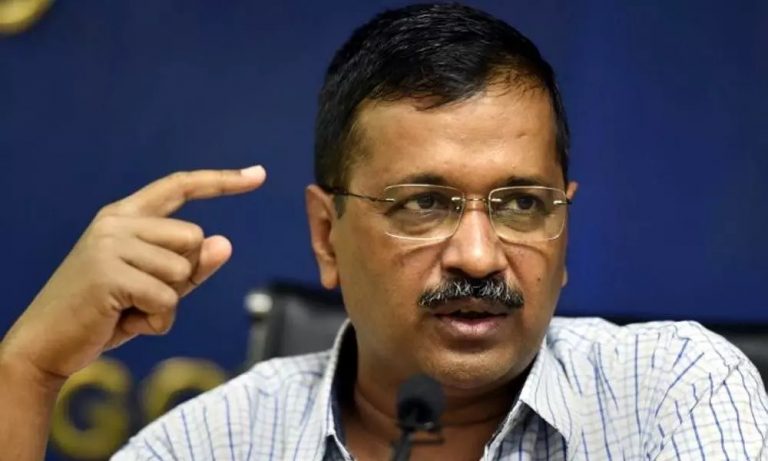
On Monday, Delhi Chief Minister Arvind Kejriwal announced ‘free money’ to all women in Punjab, irrespective of their financial status or requirement, should Aam Aadmi Party come to power in the state.

He promised Rs 1,000 every month to every woman. “Imagine, 18-20 year old girls want to go to college but father does not have money. Now they will be able to go to college when they get Rs 1,000. Many girls wish to buy new clothes but hesitate in asking their father for money. What if father does not give. Now she wont need to go ask her father, she can go to market and buy it. Many housewives are not able to give anything to their children because husband does not give money. Now she won’t have to check her husband’s mood before getting things for her children,” he said.

“She wants to buy a new saree. It has been many years since her husband bought her a saree. Now she will be able to buy the saree with the money this brother will give her. There are old mothers save money by saving Rs 10, 20 to give them to their married daughter secretly when they visit home. Now these mothers will be able to give Rs 1,000 to their daughters saying my son has given the money,” he said.

Kejriwal then claimed that this particular scheme will empower women. “Rs 1,000 is not too much,” he said. He claimed that the money for it will come when he ends transport and other mafia.

Economics of the ‘free money’ scheme

Before we begin to discuss how problematic this scheme is, let me briefly touch upon the economics of this scheme and how absolutely unreal it is to make such promise. Approximate adult female population of Punjab as of 2021 stands at about 1 crore 10 lakh. Rs 1,000 per month, or about Rs 12,000 per year for 1 crore 10 lakh women would be Rs 13,200 crore. And this is just one year. Who pays for this free money? Tax payers, including women (who might also get Rs 12,000 back as free money?).

‘Free money’ is not empowerment

If you listen closely Kejriwal’s speech while announcing the free money, you can see how it is so deeply rooted in patriarchy, the very system women across India and world are fighting day in and day out. All his statements are how women are in complete control of men and it is men who dictate how women should live and how women need men to take care of their needs.

Kejriwal speaks about girls not being able to go to college because father will not give money for college fees and with the free money, the girls will then be able to go to college. So, if higher education is a criteria, why not give subsidy on education? Why not waive off fees for girls if their economic condition is the only reason they’re not able to study further? Also Rs 12,000 per year is not sending any girl to college when the family is already preventing her education. At best, considering the family situation being painted here (severe financial crisis+patriarchy), it will be snatched from her and added to family’s grocery expenses or worse, drugs and alcohol.

He speaks about how girls want to buy new clothes but father may not agree to buy new clothes, but with free money girls will be able to buy new clothes, without having to be dependent on father. Again, it is just accepted and given that women live their lives as per the wishes of the male figure in their lives. Who are these men who don’t let their daughters go to college? Or get them clothes? AAP voters?

Instead, why not promise employment opportunities, self help groups, skilled workforce, seed capital to start their own businesses? How is ‘free money’ better than opportunity to create wealth and further employment opportunities? If the girl earns her own money, she will not only buy the ‘suit’ she wants to but also save some and maybe buy her own house too.

Kejriwal then moves on to housewives who are again subservient to their husbands who never gives money for small expenses or does not buy her a saree. Firstly, let us question whether this is an abusive relationship? Does the husband not do this because he has no money or he does not do it because he’s abusive? If former, perhaps offer them both employment opportunities (always a better option than free money) and if latter, offer her security and safety and ways to get out of abusive relationship. ‘Here, take free money every month and get yourself a saree’ is not really a great idea.

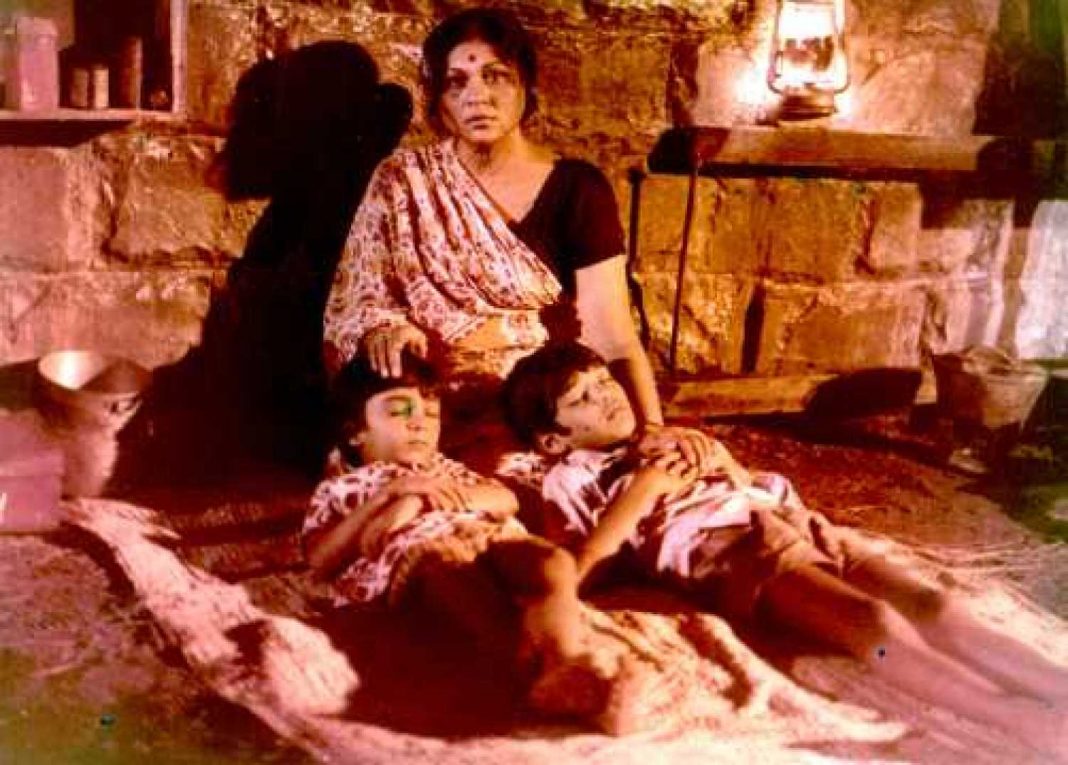
And lastly he speaks about the quintessential filmy boodhi maa who has no money to give her married daughter visiting home.

Nirupa Roy as poor mother in some film

Now, it begs the question whether this married daughter is in Punjab? If yes, isn’t she also getting free money from Kejriwal? If yes, why is she being such a leech and mooching off free money from Kejriwal from her boodhi maa?

Smashing the patriarchy

What is even worse about this ‘free money’ scheme is playing right into the patriarchal society women like you and I are trying to fight each and every day. Right from equal pay to right to equal job opportunities. You know how absolutely normalised it is for women to be asked ‘are you married?’ and ‘do you have children/plan to have children?’ during job interviews? Because those things are considered before hiring women. Men, on the other hand, don’t usually get this question. It is just assumed that even if he does get married, or have children, his efficiency wont get affected. Women, on the other hand, will prioritise children and home and hence are kept away from the top management.

Last evening Kejriwal went on an auto ride in Punjab and then went for dinner at the auto driver’s home. Though eventually it turned out that the said auto driver was an AAP worker. However, the fact that Kejriwal and his gang can be safe when the auto driver or anyone for that matter takes a detour and not get into absolute panic mode is male privilege.

Last weekend, I was walking on a main road near Jawaharlal Nehru University in Vasant Kunj area of New Delhi. A car coming from behind slowed down. My first thought was I was getting kidnapped. Considering the crime rate situation in Delhi, my fears were not misplaced. The car eventually sped off and I did not end up being a victim of any crime, but that’s the difference between being Kejriwal, a man, and me, a woman. A man can take a nap during long commute on metro, cab, bus but a woman wouldn’t. That’s male privilege. And that is what we are fighting every day.

Survival is a struggle. Surviving as a woman even more so. From home to society to work place to even social media – we have to fight prejudice and patriarchy at every step. The Rs 1000 every month free money only adds to the battle. The constant ‘taunts’ one would get to hear because, ‘well, why don’t you sit at home and take the free money instead of using your knees in office?’ The knee jibe is often given to tell women that they think from their knee because unka dimaag ghutno mein hai – I have personally heard this jibe from a qualified chartered accountant, no less.

So when we are already fighting multiple battles on various fronts, why add to our woes? Instead why not create an environment where women feel safe, secured and don’t have to live in a Talibaneque environment where they’ve do depend on the men of the house for their basic needs.

Charity, they say, begins from home. How about having a woman deputy chief minister? Or let a woman be the national convener for Aam Aadmi Party? To put things in perspective, the Delhi government cabinet, where Aam Aadmi Party has 62 out of 70 MLAs in the Delhi Assembly and not a single woman MLA is a minister in the Kejriwal cabinet. Why are women in his government not given more responsible work? Does Kejriwal think women are only interested in buying new suit and saree?

Foreign policy journalist spreads Pakistani propaganda against Group Captain Abhinandan using debunked claims

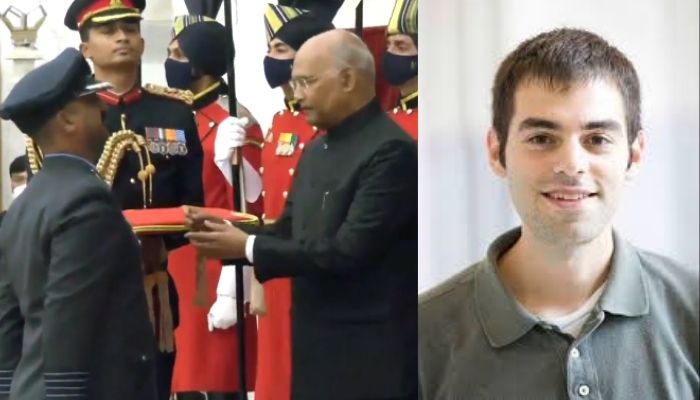
On Monday (November 22), Group Captain (former Wing Commander) of the Indian Air Force (IAF) Ahinandan Varthaman was felicitated with the Vir Chakra award by the President of India, Ram Nath Kovind. He has been accorded the wartime military bravery award for shooting down a Pakistani F-16 fighter jet during aerial combat on February 27, 2019, after the Pulwama terror attack.

On 26th February 2019, India retaliated with an airstrike at terror camps in Balakot. A day later, Pakistan sent its jets, one which Wing Commander Varthaman shot down. In the process, he flew his MiG 21 over to Pakistan-Occupied-Kashmir. He was eventually captured by the Pakistani forces and held in captivity until his safe return to India.

Anti-India propaganda by Michael Kugelman and Foreign Policy

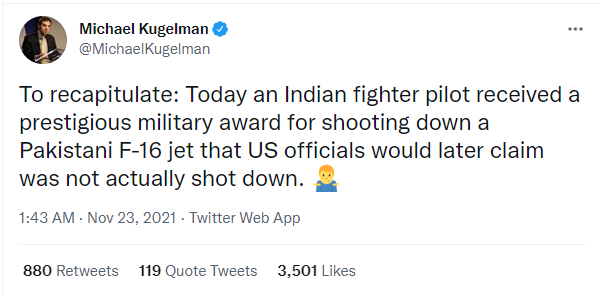
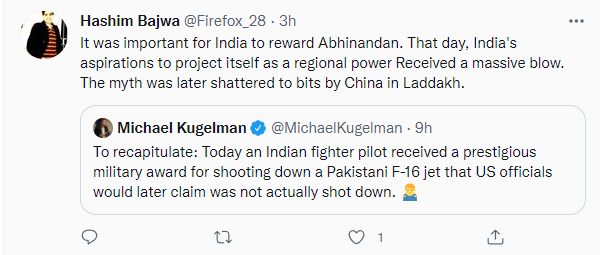
A day after IAF Group Captain Abhinandan Varthaman was awarded the Vir Chakra award, ‘journalist’ Michael Kugelman took to Twitter to cast aspersions about India’s success in shooting down a Pakistani F-16 jet. In a tweet on Tuesday (November 23), Kungelman alleged, “To recapitulate: Today an Indian fighter pilot received a prestigious military award for shooting down a Pakistani F-16 jet that US officials would later claim was not actually shot down.”

Screengrab of the tweet by Michael Kugelman

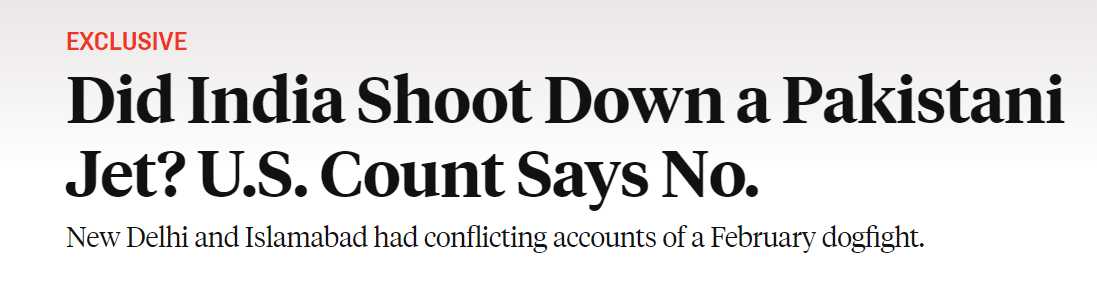
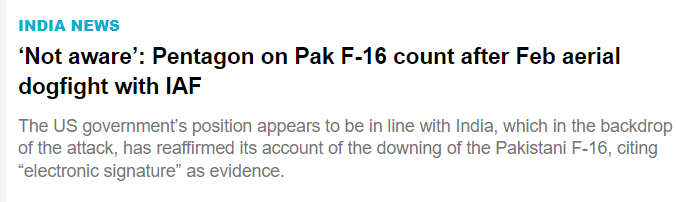
Interestingly, he is the writer of the weekly ‘South Asia Brief’ of Foreign Policy. The American news publication had been at the forefront of a disinformation campaign following the aerial skirmish between India and Pakistan in February 2019. In a bid to discredit India’s stance that a Pakistani F-16 jet was shot down, Foreign Policy published a source-based, exclusive news story titled, “Did India Shoot Down a Pakistani Jet? U.S. Count Says No.”

The contentious article, published on April 9, 2019, alleged, “India’s claim that one of its fighter pilots shot down a Pakistani F-16 fighter jet in an aerial battle between the two nuclear powers in February appears to be wrong. Two senior U.S. defense officials with direct knowledge of the situation told Foreign Policy that U.S. personnel recently counted Islamabad’s F-16s and found none missing.”

Foreign Policy accused the Indian government of misleading the international community. “But the count, conducted by U.S. authorities on the ground in Pakistan, sheds doubt on New Delhi’s version of events, suggesting that Indian authorities may have misled the international community about what happened that day,” the publication cast aspersions on the authenticity of India’s claims.

Screengrab of the contentious article by Foreign Policy

Pentagon debunked fake claims of Foreign Policy

Two days after Foreign Policy published its propaganda news story, the United States defence department dismissed having any knowledge of such a counting exercise of F-16 fighter jets. While speaking to Hindustan Times, a US defence department spokesman said, ” (We) weren’t aware of any investigation like that.”

Screengrab of the news report by the Hindustan Times

The US Defence Department also distanced itself from the claims made by Foreign Policy. It said, “As a matter of policy, the Department does not publicly comment on details of government-to-government agreements on end-use monitoring of US-origin defence articles…It is important to note that since January 2018, the United States government has suspended security assistance to Pakistan.”

Pakistanis target India using the fake news peddled by Michael Kungelman

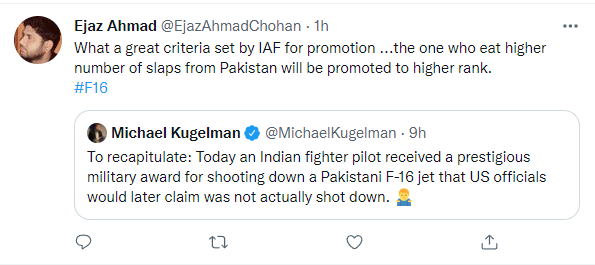
Despite the misleading assertions of ‘Foreign policy’ journalist Michael Kungelman, Pakistanis were quick to exploit the opportunity to further their agenda. One Ejaz Ahmad claimed, “What a great criteria set by IAF for promotion…the one who eat a higher number of slaps from Pakistan will be promoted to high rank.”

Screengrab of the tweet

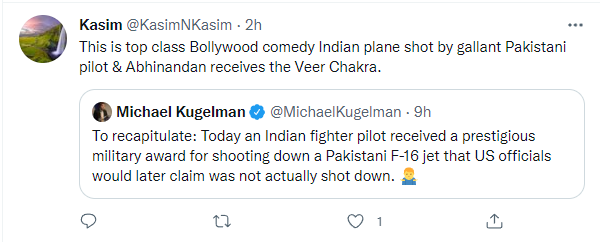
One Kasim had tweeted, “This is top class Bollywood comedy. Indian plane shot by gallant Pakistani pilot and Abhinandan receives the Veer Chakra.”

Screengrab of the tweet

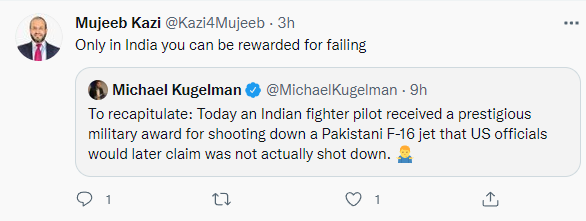
“Only in India, you can be rewarded for failing,” alleged one Pakistani named Mujeeb Kazi.

Screengrab of the tweet

Another Pakistani claimed that it was important for India to reward Abhinandan Varthaman to project itself as a regional power. “The myth was later shattered to bits by China in Ladakh,” he asserted.

Screengrab of the tweet

It must be mentioned that Pakistan Army was forced to release Abhinandan Varthaman due to pressure exerted by the Indian side along with international intervention into the matter. On 28th February 2019, Pakistan PM Imran Khan announced that the country would release Wing Commander Varthaman as a ‘peace gesture’ and on March 1, 2019, he returned to India through the Wagah Border in Atari.

Weak listing of Paytm on stock markets: Here is what could have gone wrong

The current flavor of the season is transition of startups and fintech companies into public listed companies with their ever growing valuations getting the spotlight. We had recently seen the successful listings of startups and digital companies like PolicyBazaar, Nykaa and Zomato. Many like Delhivery, Mobikwik, etc are in the pipeline for their IPOs.

One company, Paytm cannot be ignored at any cost. There was quite the hullabaloo generated during the IPO which was the largest in India’s capital market history. The fervor was such that Paytm’s parent company One97 Communications upped the Initial Public Offering (IPO) size from Rs. 16,600 crore to Rs. 18,300 crore.

Paytm founder and CEO Vijay Shekhar Sharma started his ambitious journey with the Paytm app in 2010 and was slowly capturing users’ attention, although demonetization gave a lion’s share of boost in the success of Paytm’s growth, as all of us witnessed a humongous rise in online payments. Post November 2016, Paytm became a preferred choice for a lot of consumers and merchants for cashless transactions. Paytm seized the moment and scaled up to mark it’s presence as a leading player in the digital transactions ecosystem, thus diversifying further into other avenues like Payments Bank, UPI, E Commerce, Movie ticket booking, etc.

While it is natural for a company to get listed in the equity markets and help retail investors too, to be a part of their economic journey, there seems to be a lot of things that went wrong in the public listing of Paytm.

Investors deep-dive into a lot of things to analyze before buying the shares of any company. The company’s revenue and revenue growth, expense and expense growth, profit, assets and liabilities, Price-earning (PE) Ratio, promoter shareholding, market-cap and such technicals are taken into consideration. These help the investors gauge whether there is something in it for them to invest in the company or not. Each metric serves a different purpose for a different investor.

Cashflow, confidence of promoters, competing companies, growth prospects and all such factors are looked into. Since there was a lot of noise for Paytm, these pointers for Paytm were scrutinized even more granularly.

Factors responsible for PayTM’s disappointing share market debut

The issue price of Rs. 2150 turned out to be quite a spoilsport for Paytm. Since the size of the IPO was the largest in Indian history, the time for it to reach 1.00X subscription also took longer. Experts highlighted that the high valuation seemed to be a mood killer for investors. Another point to ponder was the future prospects of a positive cash-flow.

A decade long presence in the market and still not having a vision of profitability is a challenge in itself, noted experts in many financial research reports. Another point of concern is the growing competition. There are a number of popular apps which support UPI based payments. The consumption behavior of customers/users and merchants can surely be pretty volatile in such a scenario.

Yet another reason that is strongly suspected by analysts as one of the primary causes for the issue’s failure was the receding liquidity in the market. This year had witnessed listing of quite a number of companies, leading investors, both institutional and retail, park their money in profitable prospects. As per Value Research Data, in this calendar year itself, 49 IPOs had raised Rs 1,01,053 crore, in which Rs 62,077 crore was Offer For Sale(OFS). PayTM IPO alone has Rs 10,000 crores as an OFS component, which translates into roughly 16.66 per cent of the entire OFS component of all the listed companies. In layman terms, investors had already invested their lion’s share in the IPOs that preceded Paytm, resulting in a lack of liquidity in the market. This acted as a damper for the Paytm IPO and resulted in its tepid debut.

These points show there were enough red flags for people to avoid the IPO and only those with a very high risk appetite could have placed their applications to buy shares of Paytm.

The result was for everyone to see, on the listing day Paytm showed a tepid and a disappointed performance by opening at a 9% discount and further falling nearly 28% of the initial price. This fall wiped out about 38,000 crore from the market cap. On Monday, 22 November, stock of Paytm fell even more and it last traded at Rs. 1362 in NSE during closure.

The recent bull run of stocks made people dream that markets were invincible, but Paytm listing has forced the investor to wake up and wash their face to come to the reality. Performance of the stock has a lot to do with the technicals and not just hype built around it.

Delhi: A month after infant and his parents were attacked by Islamists in Seelampur, the family awaits justice, alleges police apathy

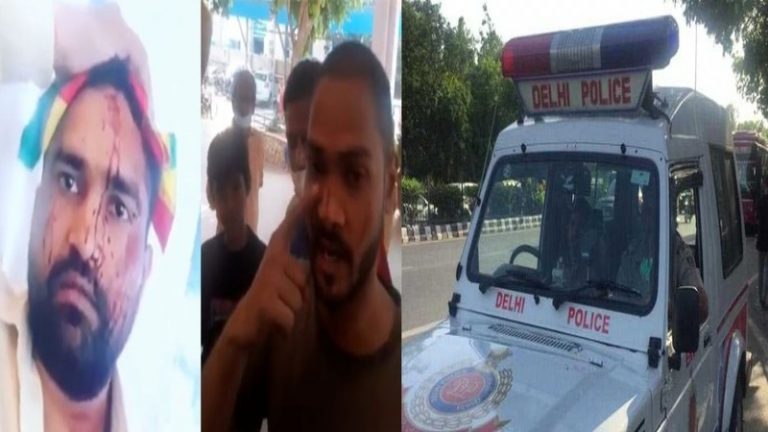
On October 24, after the India-Pakistan T20 World Cup match, Islamists had attacked a two-month-old infant and his parents in Delhi’s Seelampur. The Islamists were celebrating the win of Pakistan over India. When the father of the kid asked the Islamists to lower down the volume, the latter attacked the former using bricks, gunfire, and bombs.

The video of the incident had then gone viral on various social media platforms. Hindu activist group, Kalinga Rights Forum, has written to National Commission for Protection of Child Rights (NCPCR), urging them to take cognizance of the attack.

In the aforementioned case, Ashu aka Aash Mohammad, Rafiq, Sameer alias Mohsin, and Chand Mohammad are mentioned as accused. The Dalit family that was attacked was the target of their wrath. Deepak, who was hurt in the incident, owns a women’s footwear store. During the attack, his two-month-old son, brother Naveen, and 70-year-old father Ramswaroop were also injured.

Its been almost one month since the attack and the beleaguered Hindu family is still awaiting justice. They claim that they are being put under excessive duress to keep quiet about the situation. Concerned for their safety, the victim’s family claims that the police are also refusing to cooperate and are attempting to ignore the incident.

Speaking to OpIndia, Deepak revealed all the problems and injustices they have faced in the last month.

Signatures taken forcefully

Deepak told OpIndia that the Seelampur police had prepared the FIR on their own accord without even discussing or consulting with them. They got his father to sign the FIR forcefully. The victim further said that the police are still pressuring them to keep mum about the case. Deepak accused Seelampur SHO Manoj Kumar of not dealing appropriately with them, citing the involvement of several local officials and criminals.

Police did not take any action regardless of the complaint

Deepak claimed that his brother Naveen had submitted a written complaint to the DCP the day after the incident took place, but to no avail. After this, on October 30, Deepak himself sent a complaint to the Lieutenant Governor of Delhi, DCP North East Delhi and SHO Seelampur, but no action has been taken yet.

Accused threatening the Seelampur Hindu family

Deepak recalled how one of the accused named Chand Mohammad had seized him during the October 24 attack while his brother Ashu aka Aash Mohammad has rained bricks at his home.

Deepak claimed that he was doing his business normally before the incident. However, he now fears for the safety of his family. He revealed that after Sameer alias Mohsin was released on bail, he keeps visiting Deepak’s shop to threaten him.

According to the information available, the hearing on the bail plea of the ​​two other accused Rafiq and Chand Mohammad has also been completed and the court has reserved the verdict.

Bhim Army an Islamist apologists not the voice of Dalits

Miffed by how he has been left to fight his battle all by himself, Deepak said that none of the political parties which rose to fame personating as the voice of Dalits, came forward to help his family. He said that Bhim Army pretends to be for Dalits but in reality, they support the Islamists. “I am a Hindu. I do not need the support of outfits like Bhim Army,” exclaimed Deepak.

Police refutes allegations of Seelampur Hindu family

Deepak’s allegations have been dismissed by Seelampur Police as unfounded and false. Unnecessary things are being done, according to SHO Manoj Kumar, in order to give the matter undue importance. Facts are being distorted and blown out of proportion, said the SHO, denying any communal angle to the incident. He said that the police are investigating the matter impartially, adding that all the four accused were arrested and sent to jail.

OpIndia also tried to contact the higher officials regarding Deepak’s claims. While DCP North East Delhi did not pick up the phone, ACP Seelampur exclaimed: “How can anyone condemn the SHO who filed the case on the first day and imposed appropriate sections”. He added that it was incorrect to assert that the cops are not investigating the case. The cops have complied with all legal requirements, said the ACP.

If what the police are saying is to be believed, it’s difficult to comprehend why the victims would make such allegations. However, OpIndia would immediately update the report once it establishes contact with DCP North East Delhi.

It may be noted that Delhi Police’s DCP North East had tweeted in this matter on October 27 and said that there is no communal angle in the incident.

OpIndia is in possession of the FIR filed in the aforementioned case. In the FIR the reason for the incident is stated as an argument between both parties during a game of kabootar-baazi (a game of pigeon flying). According to the FIR, the accused people were playing a game in which they pelted stones at pigeons to make them fly. When the stone landed in the victim’s family’s house, he resented. This led to an argument that escalated into a fight between the accused and the victim’s family, read the FIR.

Deepak, on the other hand, dismissed the FIR. The Islamists were celebrating the win of Pakistan over India. The Father of the kid asked to lower down their volume and was then attacked by the Islamists using bricks, gunfire, and bombs.

As per the complaint, the Muslims in the Seelampur area were bursting firecrackers to celebrate Pakistan’s win over India. The two-month-old kid was sleeping on the terrace. The father of the kid forbade the Islamists from bursting firecrackers as it would wake up the kid. Irked by the father, the Islamists allegedly started throwing bricks towards the terrace. The father claimed they did firing on the terrace with a motive to murder the kid. They attacked the parents of the kid with sharp weapons that led to deep injuries on the head of the father and another man who had rushed to their rescue.

A video of the father had surfaced on social media platforms in which he claimed that when they made an SOS call to the Police, no one came to save them. They were not provided with basic medical facilities or an ambulance. The father claimed they narrowly escaped from the area.

Kalinga Rights Forum urges NCPCR to take action over attack on 2-month-old Hindu kid by Islamists in Seelampur

It may be noted that the Hindu activist group, Kalinga Rights Forum, had also written to National Commission for Protection of Child Rights (NCPCR), urging them to take cognizance of the attack on a two-month-old Hindu kid and their parents in Seelampur, Delhi by Islamists.

KRF said in the complaint that the family is being punished for being Hindu residing in Seelampur, Delhi. They further added that such inaction by the Police gives Islamists a free hand to initiate attacks and riots, just like the Delhi Anti-Hindu riots of February 2020. The group urged NCPCR to order a probe by the Department of Personnel & Training (DoPT) against the Police for the inaction.

The group also urged NCPCR to file FIR under sections of Juvenile Justice (Care & Protection Act) 2015, UAPA, 307, 505 and 124A of IPC, Explosives Act and relevant sections against the culprits.

Kerala: Police arrest PFI office-bearer in RSS worker Sanjith murder case, identity not revealed yet

0

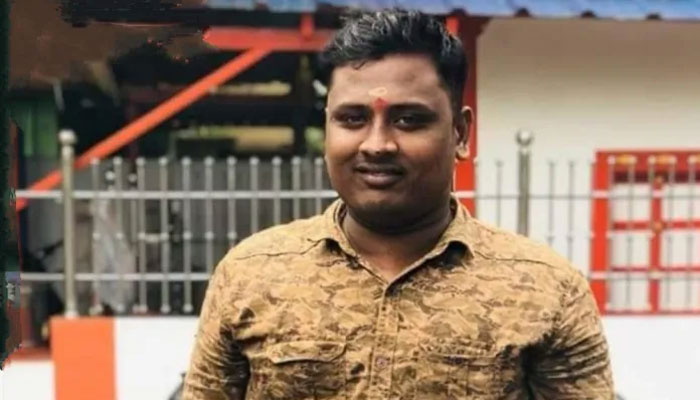
On November 22, Kerala Police arrested an office-bearer of the Popular Front of India (PFI) in connection to the brutal murder of RSS worker A Sanjith at Mambaram, district Palakkad. The Police have not disclosed the identity of the accused.

R Viswanadh, District Police chief, has reportedly informed that the arrested member of PFI was directly involved in the murder. His identity has been kept secret as the identification parade is yet to be conducted as a part of the investigation.

Earlier, late Sanjith’s wife had said she could identify the men who had attacked and killed her 27-year-old husband in front of her on November 15. Reportedly, Police had taken three people into custody during the investigation on Monday.

RSS and BJP had alleged that members of the Social Democratic Party of India (SDPI), which is the political wing of Islamist organization Popular Front of India (PFI). K Surendran, BJP state president, had met Union Home Minister Amit Shah in New Delhi regarding the case. He had requested him to order a probe by National Investigation Agency (NIA) into the broad daylight murder of A Sanjith.

In a letter to HM Shah, Surendran had alleged that so far, 50 RSS-BJP workers have been killed in the state by the Islamists, out of which ten were killed in the last five years.

Meanwhile, SDPI had denied the allegations.

Death of A Sanjith

On November 15, A Sanjith, an RSS worker from Elappully, Kerala, was hacked to death by the Social Democratic Party of India (SDPI) goons. The incident occurred at Ellapully in Palakkad district at 9:30 in the morning. He was travelling with his wife on a motorbike when he was brutally attacked by the SDPI members.

Reports suggest that the assailants came in a car. They stopped his bike and attacked him in broad daylight in front of many people, including his wife. Sanjith was rushed to the hospital in serious condition. He later succumbed to his injuries. On November 18, Police had recovered blood-stained swords suspected to have been used in the murder of the RSS worker.

Amid rumours of divorce, Priyanka Chopra reacts to Nick Jonas’ video, had earlier removed her last name from social media

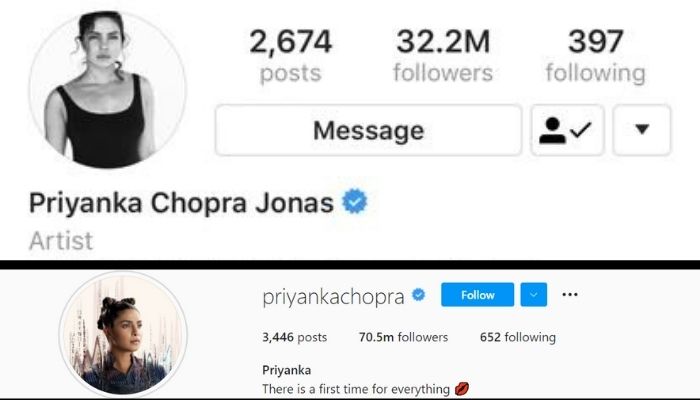
Social media is rife with rumours of divorce between actress Priyanka Chopra and American singer Nick Jonas. The development came after Chopra dropped the surname of ‘Jonas’ from her Instagram handle.

The duo has not made any official confirmation about the alleged split up. The 39-year-old actress is set to celebrate the third wedding anniversary with her 29-year-old husband Nick Jonas. Screenshots of the Instagram profile of Priyanka Chopra had been doing the rounds of the internet.

Priyanka Chopra removes ‘Jonas’ from her name

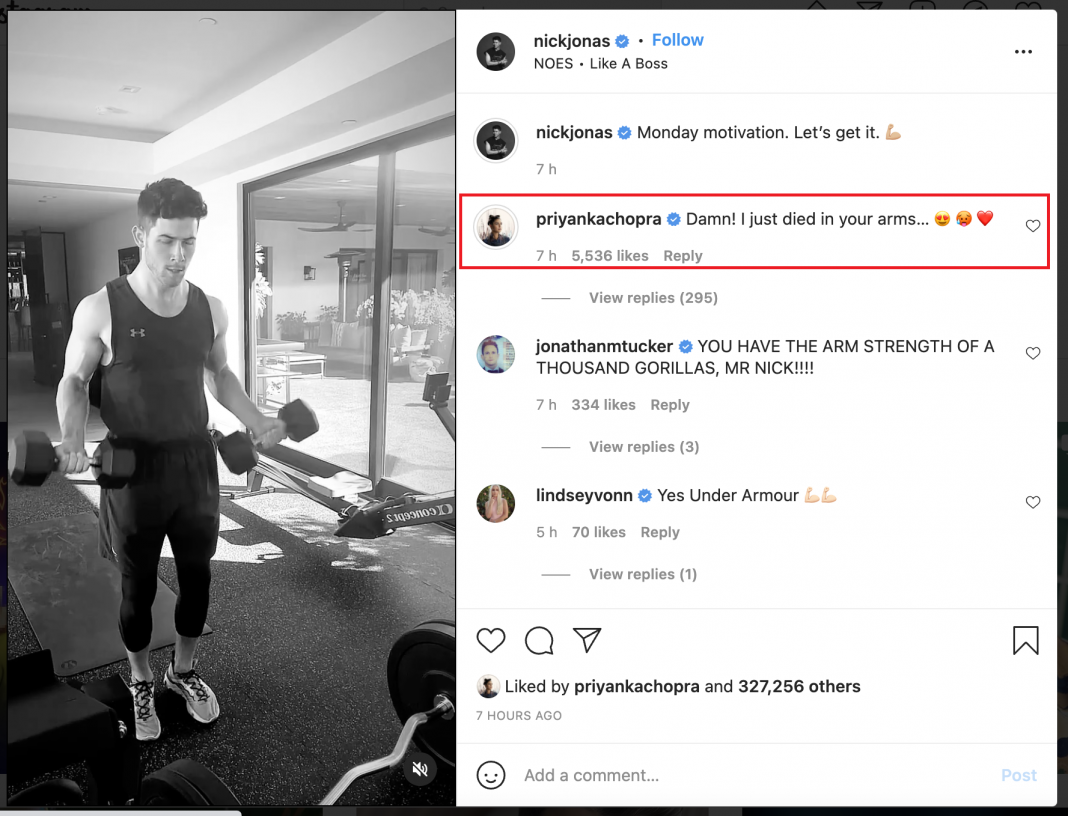
Earlier, Nick Jonas had posted a video of him working out with the caption, ‘Monday. Let’s get it.’ The black-and-white video was uploaded after social media was filled with stories of his divorce with Priyanka Chopra. However, the actress put all rumours to rest with the comment, “Damn! I just died in your arms.” At the time of writing, it had been 7 hours since she posted her comment. Although Priyanka Chopra did not respond directly to rumours of her split-up, her heartwarming comment dispelled the rumours about her alleged separation.

Screengrab of the Instagram post by Nick Jonas

Earlier on November 5, the actress had posted a picture of her alongside her husband to mark the housewarming ceremony of her new residence. “With the blessings of Goddess Mahalakshmi we invite Her grace and abundance into our home. Happy Diwali,” she had posted.

Meanwhile, Chopra’s mother Madhu Chopra has denied rumours of the split.

The actress came under fire in September this year for sporting a ‘mangalsutra’ by the designer brand Bvlgari during a Vogue magazine photoshoot. Her actions had triggered the so-called feminists who have accused her of wearing a symbol of ‘patriarchal oppression. One Twitter user ‘quinboot’ who uses ‘she/her’ pronouns in her bio and identifies herself as a 19-year-old Marxist-feminist, accused Chopra of ‘exploiting’ feminism for personal economic gains.

Meet Prabal Pratap Judev, who followed his father’s footsteps in bringing over 10,000 people back into Hindu fold

1200 people from 400 families have made their ‘Ghar Wapsi‘ in Chhattisgarh and embraced Hinduism after the completion of the Hindu ritual ‘Vedic Gyan Ganga Vishwa Kalyan Mahayagya’ on November 19 and November 20 under the leadership of Prabal Pratap Singh Judev, State Secretary, Bharatiya Janata Party. Through the Yajna which was organized at the Khuntapani village in the Jashpur district of Chhattisgarh, 1200 people returned to Hinduism who had earlier lost their way and fallen prey to conversion carried out by the Christian missionaries and other religions.

This ‘Ghar Wapsi’ in Chhattisgarh brought back memories of the veteran BJP leader Dilip Singh Judev of the Jashpur royal family. Back in his days, Dilip Singh Dev who was a minister in the Atal Bihari Vajpayee’s government helped people who had been converted by the Christian missionaries to return to their original Hindu religion. His legacy is now being carried out by his son Prabal Pratap Singh Judev who is actively involved in rescuing people from the tribal areas from the clutches of Christian Missionaries.

Prabal Judev, in a conversation with OpIndia said, “I have been carrying forward this work since the death of my father. In states like Chhattisgarh, Jharkhand and Odisha, we have got more than ten thousand people return to their original religion Hinduism through such programs. Due to the Coronavirus pandemic, this campaign of ours was stopped for about two years. Now again we are speeding it up. This is a holy work. Country building is work. It was started by my father and I am very proud to be associated with it.”

Prabal Pratap Judev with rural women on the occasion of Bhai Dooj

Notably, there have been frequent reports of opposition to conversion and Christian missionaries from remote areas of Chhattisgarh. When asked about this matter, Prabal Judev said, “Conversion is taking place in the state especially in the tribal areas for years. Despite opposition, the Christian missionaries did not improve. They are converting gullible poor people by luring them, making deals in the name of service, insulting our Hindu gods and goddesses. They are being brainwashed. How long will all this last? Sometimes anger will come to the fore. People will do something to save their age-old culture and heritage. This is the reason why there is constant opposition towards the missionaries now.”

Two reasons of increase in religious Conversion : Congress and Coronavirus

Two major reasons were mentioned for the increase in the cases of conversion in Chhattisgarh. First, the coronavirus pandemic. Second, the existence of Congress in power in the state. Prabal Judev told OpIndia, “Taking advantage of the coronavirus pandemic, missionaries have converted people on a large scale. The Congress government was also helping them. Wherever there is a Congress, for example in Punjab, you see how many Sikhs have been converted, such activities increase. They are running it like an industry for which the funds are coming from Italy.” He further added, “Their policy is clear. Promote appeasement. Let the conversion happen. Convert converts into vote bank and rule. This is the reason for the misery of the Hindus in the entire country wherever Congress ruled.”

Furthermore, David Reeves, CEO of ‘Unfolding World’, an organization working on the mission of translating the Bible into every language, had claimed that churches in India adopted 50,000 villages during the Coronavirus pandemic. Around 1 lakh people were converted to Christianity. Each church was asked to organize prayers in 10 villages. While speaking to ‘Mission News Network (MNN) Online’, Reeves said that during the Corona pandemic, number of churches built in India equaled the number of Churches built in the country in last 25 years. He had said, “Millions of people are now believing in Jesus Christ and coming to the church to pray.”

On how the Christian missionaries worked, Prabal Pratap Singh Judev stated that the missionaries and their teams were active in the tribal areas in a well-planned manner. They kept track on poor families to find out who has the problem. After that, under the veil of solving their problem, the missionaries converted the innocent people. The conversion took place in the name of education, treatment and other reasons. Prabal Pratap said that the missionaries were also involved in grabbing the ancestral property of these tribals. Judev said that he received many complaints in which the land of Korwa people had been grabbed.

Importantly, during OpIndia’s Bihar election coverage, a similar trend was noticed in the rural areas where people were converted by making misleading claims about Hindu gods and goddesses and their scriptures. On our camera, a person associated with the missionary was caught making false claims about Rigveda and Ramayana.

Judev noted that once a person converted, his devotion to Mother India would change which would be then taken advantage of. He claimed this was a conspiracy to break the country and insisted that the work of bringing back people to their original home would also continue. He said that the Christian missionaries were more active in tribal areas like Jashpur, Surguja in Chhattisgarh while Muslim fundamentalists were increasing in areas like Ambikapur. 

He said, “Hindu youth should recognize their country, their culture, their heritage. Understand the importance of this oldest culture in the world. We have to unite to save Hindutva. Hindu is not a symbol of any caste or religion. It is a symbol of nationality. Opposing conversion is not an insult to any other religion. But when someone attacks our religion, we have to stand up for self-defense. We have to tell that neither we will convert, nor will we allow them to convert anyone by greed and pressure.”

Note: Above article originally written in Hindi. You can read it here.

Punjab: Kejriwal has autorickshaw ride and accepts dinner invite, turns out auto driver is AAP worker

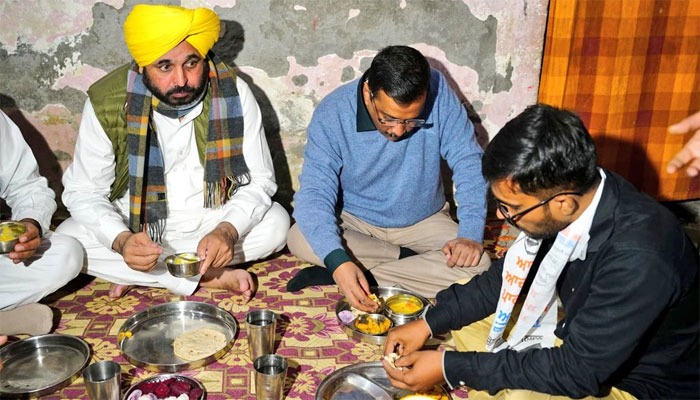
On November 22, Delhi Chief Minister Arvind Kejriwal had dinner at an auto driver’s house in Ludhiana. As per his story, the auto driver had invited him for dinner, and Bhagwant Mann and Harpal Singh Cheema accompanied the Delhi CM. The alleged feel-good story being run by AAP’s leadership has a twist, though. According to Hindi daily Dainik Bhaskar, the auto driver, identified as Dilip Kumar Tiwari, has been associated with Aam Aadmi Party for a long time.

As per the Bhaskar report, Mahendra Kumar Tiwari, elder brother of the auto driver, is a long time member of AAP and has been attending party’s programs regularly. Dilip also attends these programs with his elder brother.

A carefully made video of the entire incident, with emotional background music and special effects, was shared by AAP’s social media handles, showing how the Delhi CM accepted the impromptu invite by a ‘common man’ auto driver for dinner.

Kejriwal was invited by Dilip during a meeting organized by the Punjab unit of Aam Aadmi Party at Punjab Bhawan, Ludhiana. At the meeting, while praising Kejriwal for the work he has done for the auto drivers, Dilip invited him for dinner at his house that Delhi CM ‘graciously’ accepted. He asked if he could bring Bhagwant Mann and Harpal Singh Cheema along, to which Dilip agreed and requested him to travel in his auto to the house.

Kejriwal praised the food.

After having the meal at Dilip’s house, Kejriwal praised the food and said it was the same as he likes, without chillies. The reports suggest after getting photographs clicked with the family members, Kejriwal and his team left in the Innova Crysta vehicle donning Delhi number that was, interestingly, already parked outside Dilip’s house before Kejriwal arrived.

The meeting with auto-taxi unions

AAP had called leaders and members of several auto and taxi unions for the meeting in Ludhiana. Reportedly, a large number of auto and taxi drivers had reached for the meeting. They presented the problems in front of the Delhi CM and alleged they were harassed by the RTA, Traffic Police and Punjab Police personnel in Punjab. They further complained government departments impose challan worth thousands of rupees on them. Kejriwal appealed to the auto drivers to put up party’s posters on their autos to help AAP come into power and promised he would resolve all the issues they have been facing in the state.

Channi also wooing auto drivers in Punjab

As the assembly elections are approaching quickly in the state, the political parties have started to gear up for campaigning. Punjab Chief Minister Charanjit Singh Channi also met auto drivers in Ludhiana on Monday and had a conversation over tea with them. He promised the auto drivers that his government would issue new registration certificates and waive off pending challans. The Punjab state Assembly elections are scheduled for early 2022. Former CM Capt Amrinder Singh has already disowned Congress and formed a new party.

There are speculations that he might join hands with Bharatiya Janata Party. Long alley of BJP in the state, Shiromani Akali Dal had snapped ties with the party last year after Agriculture laws were enacted. SAD has formed an alliance with Bahujan Samaj Party to contest elections in the state.