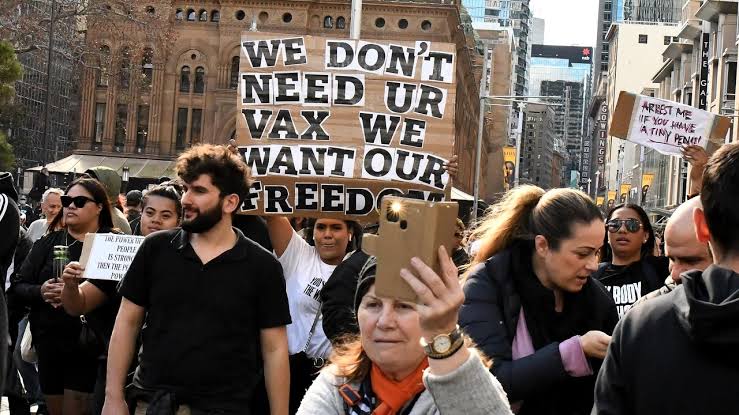
The sweeping restrictions imposed in Australia to blunt the coronavirus outbreak continues to face stiff resistance from anti-lockdown proponents, who have recently intensified their demonstrations against the government.
The Victoria Police in Melbourne clashed with construction workers protesting against vaccine passports and shutdowns who hurled objects and charged at the law enforcement officials. Visuals from the streets of Melbourne display a complete pandemonium as protesters march their way on the streets defying police orders and government mandates.
Victoria police retreat as construction workers protesting vaccine passports & shutdowns throw projectiles & charge. pic.twitter.com/M3TXErfM7H
The protests by construction workers marks the biggest protests in the country over Covid mandates thus far. The protesters were demonstrating against mandatory vaccinations and other restrictions.
Right now in Melbourne, Australia the most severe clash to date between workers and the state over mandated jabs as thousands of unionized construction tradesmen take the streets.
Law enforcement authorities in Australia reportedly resorted to firing rubber bullets to control the mob. The protesters set off flares and allegedly threw urine at reporters. Some sites would be shut down for a duration of two weeks due to the clashes, authorities said.
Several cities across Australia, especially Melbourne and Sydney, have witnessed widespread protests against the draconian shelter-in-home strictures imposed by the government. Restive population have hit the street, in defiance of the law, carrying out demonstrations and protest marches to convey their discontent against the restrictions.
Violent protests erupt in Australia over draconian lockdown restrictions
Last week on Saturday, violence erupted in Melbourne and Sydney after thousands of anti-lockdown protesters gathered on the streets to protest against restrictions imposed by the government in the wake of a renewed bout of COVID-19.
The protests were carried out on a day when the state recorded 535 new cases and 1 death due to COVID-19, around 1,000 protesters defied the stay-in-home orders and gathered in the north-eastern suburbs of Richmond and Hawthorn to mark their opposition to the new set of restrictions enforced to tame the outbreak.
However, protests quickly turned violent as clashes broke out between demonstrators and law enforcement officials. Victoria Police on arrested 235 people and three officers were admitted to hospital following the violent skirmishes between the police and the anti-lockdown protesters in Melbourne’s inner city.
Videos of the protests show protesters indulging in riotous behaviour, assaulting police officers and throwing objects, including plastic bottles, cones, at the officials deployed to control the demonstrations. Likewise, chaotic scenes from the streets of Sydney and Brisbane were also witnessed on Saturday last week.
After chafing under weeks of authoritarian restrictions imposed by the government, anti-lockdown protesters have resolutely launched demonstrations to force the authorities to lift the curbs. The protests have come at a time when Australia is grappling with an increasing surge of COVID-19 caseloads, driven by the more transmissible Delta variant, with both Sydney and Melbourne, and the capital Canberra, in strict lockdowns. On Saturday, a total of 1,882 new coronavirus cases were reported, most of them in Sydney.
Australia introduces strict measures to curb COVID-19 outbreak
Earlier this month, in order to curb Covid and secure safety health measures, the Government in Australia had adopteddrastic measures that could be termed as direct threats to liberal democracy and freedom. Australians were worried that the government is going to compromise democratic freedom to maintain emergency restrictions in these Covid times.
The Australian Parliament had passed a draconian bill by the federal government, the Surveillance Legislation Amendment (Identify and Disrupt) Bill 2020 (Identify and Disrupt Bill), which gives unprecedent power to the police to “identify and disrupt suspected online criminal activity”. The new law gave the Australian Federal Police and the Australian Criminal Intelligence Commission sweeping powers to modify or delete the data of suspected offenders, collect intelligence on criminal networks, and take control of online accounts of suspected offenders.
The law also allowed police to force anyone, including tech companies, to hack accounts of suspected people to modify, add, copy, or delete data of people under probe, and they will be protected from civil liability for such activities. But if they refuse to help the police, they can face imprisonment for up to 10 years. Authorities can force companies and hackers to alter, copy and delete data, intercept and modify communications, surveilling networks, and change account credentials.
Congress party and its supporters seem to harbour inexplicable hatred against Gujarat and Gujaratis. It appears like their aversion for PM Modi and Amit Shah has spilt over to ordinary Gujaratis as the party leaves no opportunity to slight the citizens of the western state.
Days after a huge consignment of drugs originating from Afghanistan and transported via Iran was detected at Mundra Port in Gujarat, the Congress party has come out all guns blazing against the state and its residents, insinuating that Gujarat offers a safe passage for smugglers to get the contraband imported in India.
Social media campaign by Congress to vilify Gujarat and Gujaratis
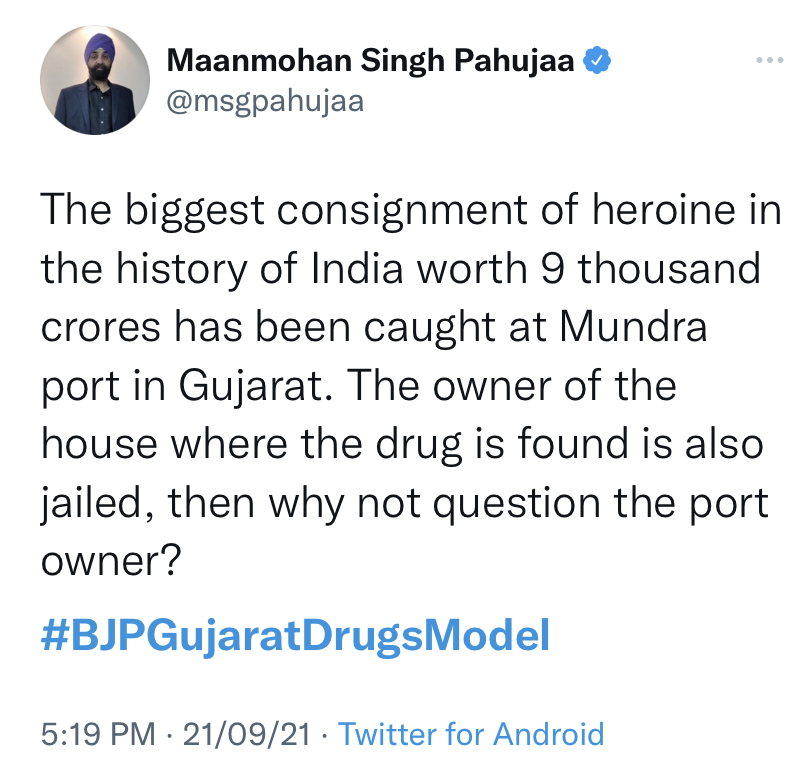
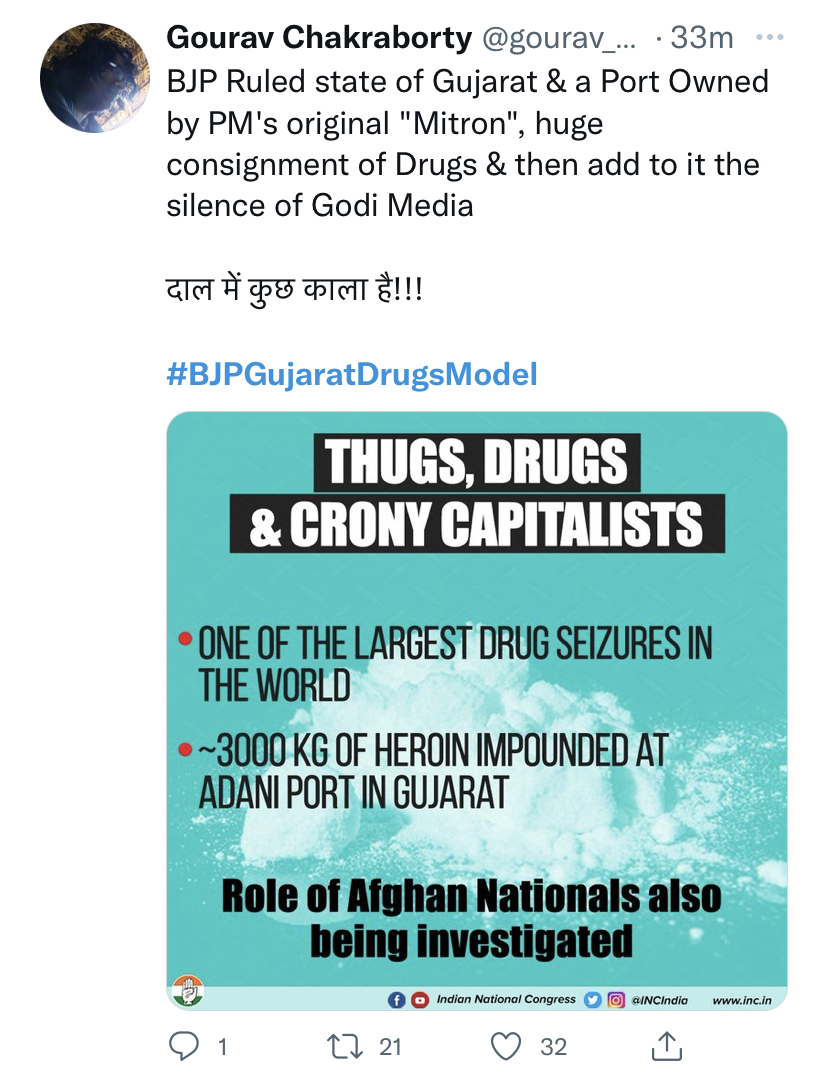
A hashtag #BJPGujaratDrugsModel is being run on Twitter, with several verified Twitter handles of Congress party units and functionaries tweeting it to cast aspersions on Gujaratis of being the facilitators of drug smugglers. The slander campaign is launched months before Gujarat goes to poll in 2022.
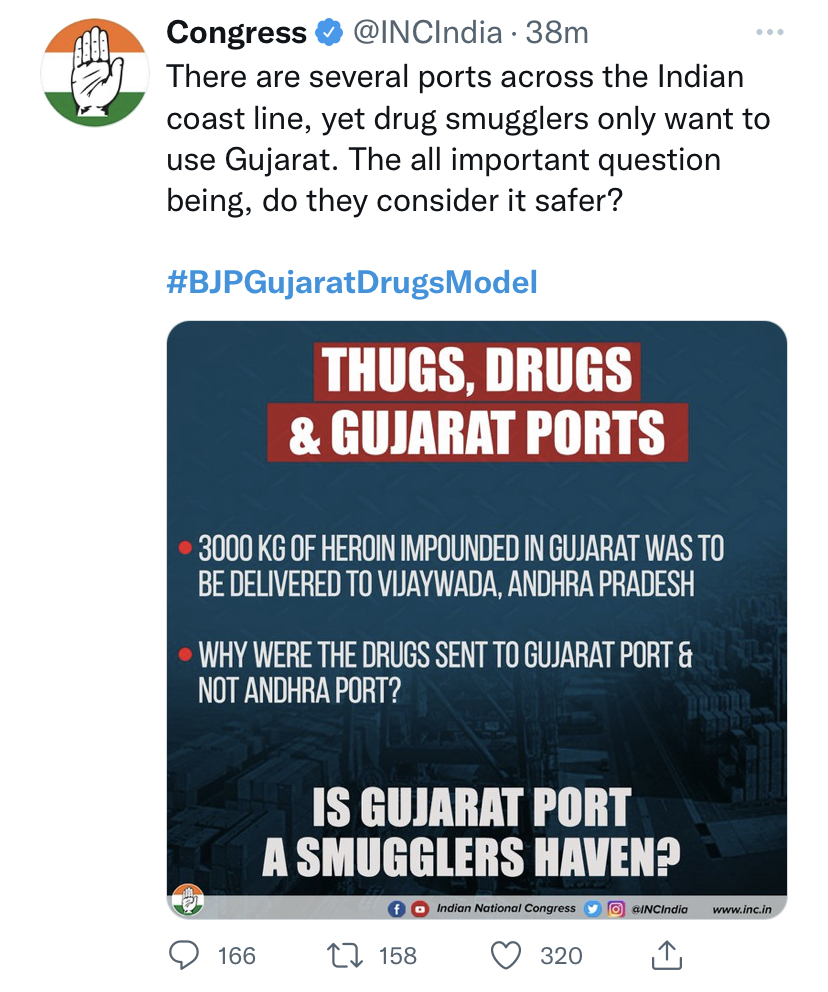
“There are several ports across the Indian coastline, yet drug smugglers only want to use Gujarat,” the official Twitter account of Congress tweeted along with sharing an infographic that maligned Gujarat as a “smuggler haven”.
Source: Twitter
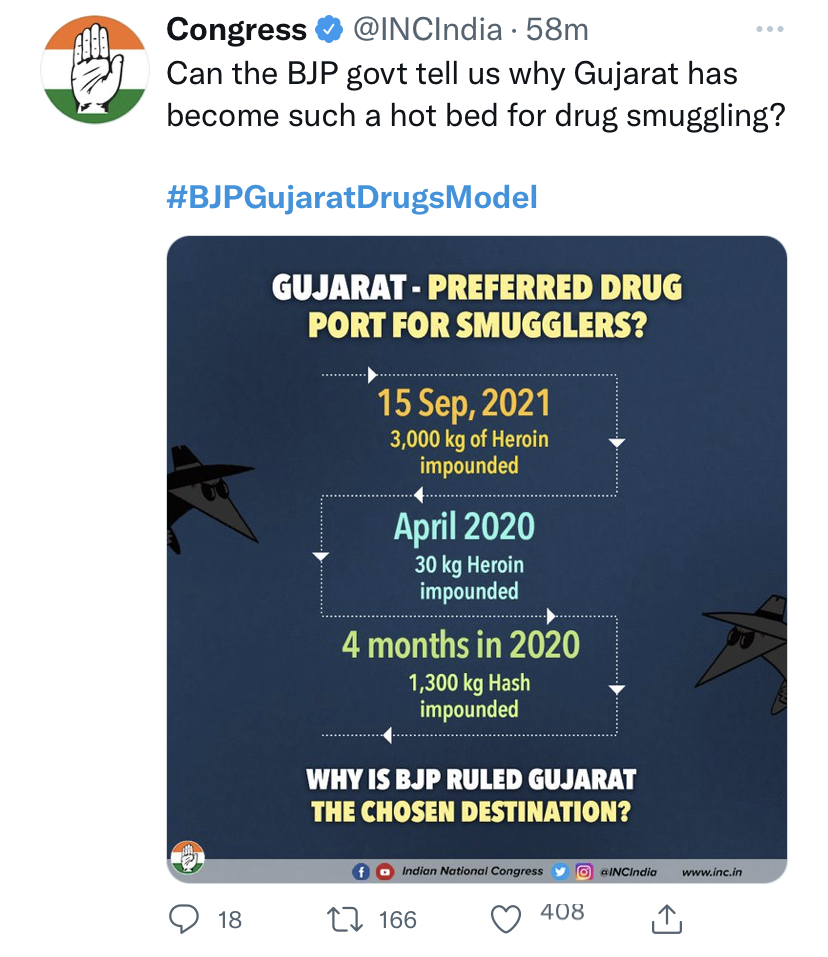
Another tweet by official account of Congress included yet another infographic to assert that Gujarat is a gateway of smuggling drugs in the country.
Source: Twitter
Similarly, Congress functionaries and other Twitter accounts associated with the Congress party also participated in the social media campaign to defame Gujarat.
Source: Twitter
Source: Twitter
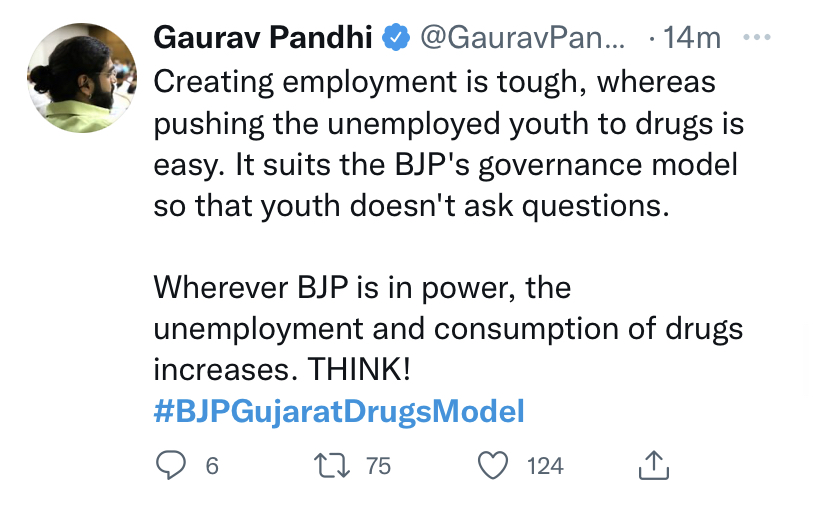
Habitual fake news peddler and Congress leader Gaurav Pandhi also eagerly participated in the party’s campaign to slander Gujarat and Gujaratis. Without providing evidence to substantiate his claims, Pandhi asserted that under BJP rule, consumption of drugs increases, which is essentially equivalent to accusing Gujaratis of being drug addicts since Gujarat is ruled by the BJP.
Source: Twitter
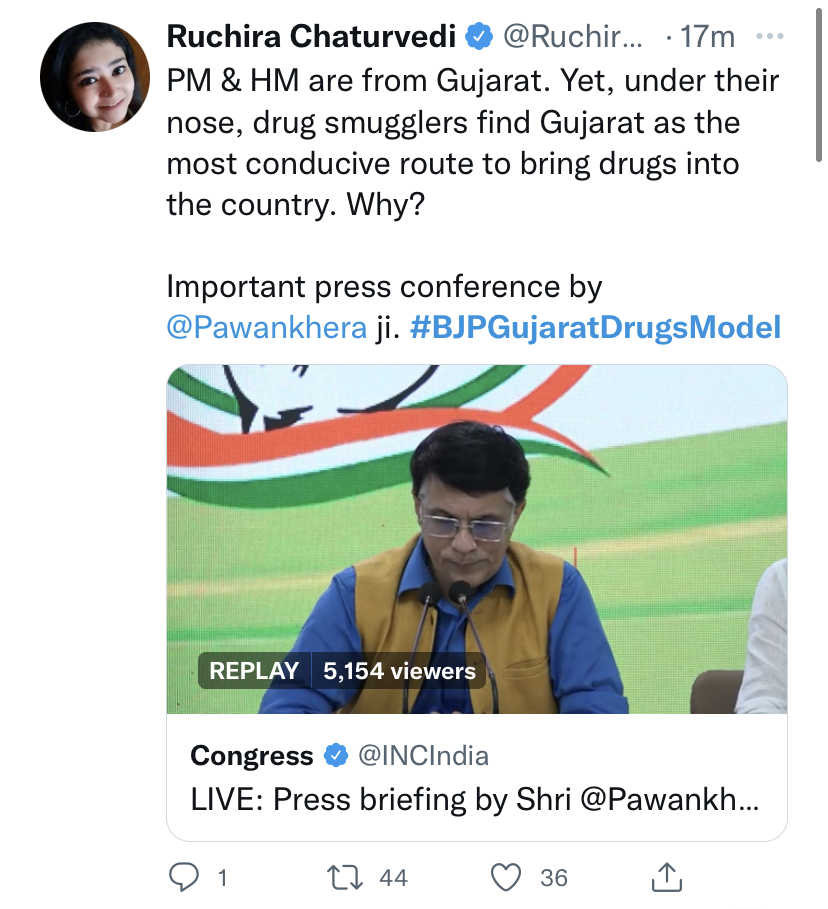
Besides, Congress even convened a press conference to assert that Gujarat provides conducive route for drugs to be smuggled in to India. The press conference was addressed by Congress spokesperson Pawan Khera who alluded that people in Gujarat are morally corrupt to have allowed their state to be used for smuggling drugs in the country.
Source: Twitter
Like most of their arguments and contention, Congress’ smear campaign against Gujarat and Gujaratis seems to have no logical grounds and is based on perhaps pathological hatred for the state that catapulted PM Modi and Amit Shah to the national politics.
Even so, Congress’ questions regarding the drug seizure in Gujarat have been utterly ludicrous. It has asked why smugglers preferred Gujarat’s coast and not Andhra’s. The answer to this is quite simple. It is possibly because Gujarat lies on India’s west coast and is closest to Afghanistan/Iran, the source country of drug consignment.
For the container to reach the Andhra coast, it would have had to traverse through the Arabian Sea, Indian Ocean and the Bay of Bengal. Such long-distance sailing would have involved greater risks of being caught by coastal guards than the risks involved in transporting the container to nearby Gujarat. One assumes that Congress and its leaders are well aware of the geographical advantage Gujarat presented to the smugglers, but in their pathological hatred for the state, they overlooked such facts and proceeded to vilify it.
Congress even highlighted that Gujarat has been one of the states where drugs consignments have been routinely caught. Yet again, it is a testament to the integrity of the authorities guarding the coastal areas of Gujarat that drugs transported from outside India are not allowed to be smuggled into the country and caught at the checkpoints.
If Congress supporters are to be believed, the managing authorities are to be blamed if any contraband is seized from their respective premises. By this logic, the Kerala government must be responsible for all those people who stuff their backside with gold and get caught every day. Similarly, perhaps Arvind Kejriwal and Uddhav Thackeray are to be blamed if criminals are caught for smuggling illegal items in Delhi or Mumbai.
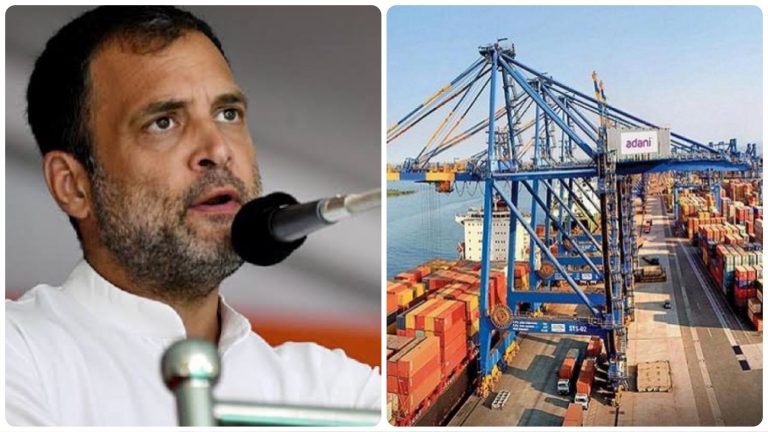
While Congress supporters continue with their campaign to slander Gautam Adani and his business group for the seizure of drugs at Mundra Port, it is worth noting that the ship that carried the contraband was from Iran and the containers that held the drugs were from Afghanistan. The ship was caught just after entering the Indian waters. As per reports, DRI officials were alerted about the drugs and the operation was carried out over several days to finally seize the major heroin shipment.
Past incidents when Congress has insulted Gujarat
Nevertheless, at the heart of this vilification campaign is the visceral hatred that Congress and its leaders harbour for Gujarat and Gujaratis. Interestingly, it comes at a time when the state is gearing up for assembly elections in 2022. But it has not stopped Congress from disparaging the state and its residents.
As such, the party has a storied history of insulting Gujarat. Earlier in February 2021, Senior Congress leader and Wayanad MP Rahul Gandhi while campaigning in poll-bound Assam expressed his hate for Gujaratis, stating that he will take money from Gujarat tea traders and give them to the tea garden workers in Assam.
Speaking at a public meeting, Rahul Gandhi had claimed that Assam tea workers get paid Rs 167 per day wage while ‘traders in Gujarat’ get tea gardens. He did not give any proof to back his claims. He ‘promised’ that should Congress come to power in Assam, the workers will get Rs 365 per day wage. “Where will the money come from? It will come from Gujarat’s traders”, he claimed.
This was not the first time the Gandhi scion had slighted Gujaratis. During an election rally in the run-up to the 2019 elections, Rahul Gandhi had mocked an entire community in Gujarat by saying, “Nirav Modi, Lalit Modi, Narendra Modi… how come they all have Modi as a common surname? How come all thieves have Modi as a common surname?”
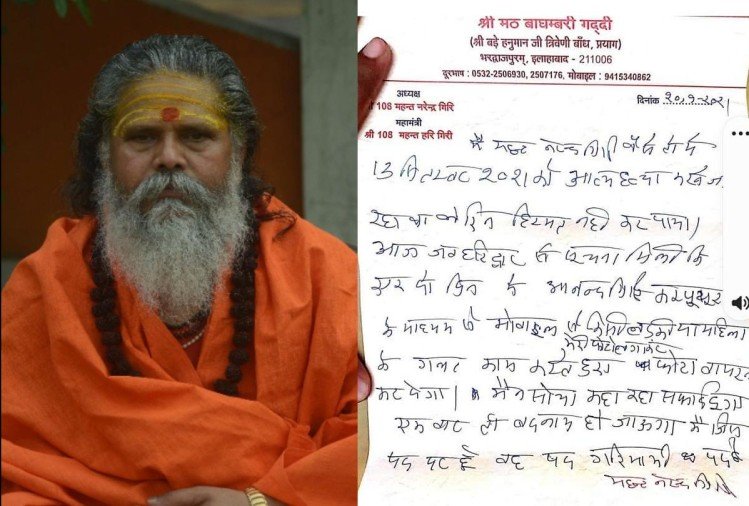
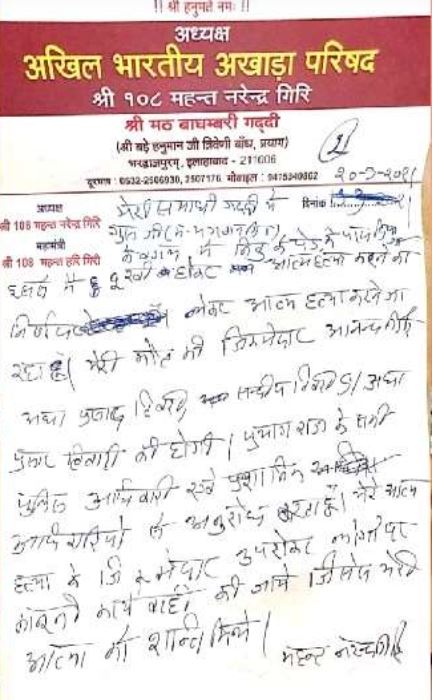
The purported suicide note written by the deceased Akhil Bharatiya Akhada Parishad president Mahant Narendra Giri emphasises that the Mahant was being blackmailed, which forced him to take the drastic step. The letter reveals that the seer had been contemplating ending his life since a week ago. The suicide note was initially dated September 13, 2021, which was later scratched off and changed to September 20, 2021.
Akhil Bharatiya Akhada Parishad president Mahant Narendra Giri was found dead in Baghambari Mutt in Uttar Pradesh’s Prayagraj on Monday, September 20.
The purported suicide note written by Mahant Narendra Giri (source: Jagran)
Moreover, the 7-8 page long suicide note held the now arrested Swami Anand Giri, Aadhya Tiwari and Sandeep Tiwari as the accused who pushed the seer to end his life. The note read that Anand Giri and others had “threatened and forced” him to commit suicide.
“Anand Giri, Aadhya Tiwari, Sandeep Tiwari should be held responsible for my death,” the Mahant had mentioned in his suicide note. He also wrote that the three even tried to kill him.
Mahant Narendra Giri urged Prayagraj police to take legal action against the three so that he could die a peaceful death. The note further mentioned how Swami Anand Giri, the seer’s closest disciple had mentally traumatised him and tried to tarnish his reputation.
Swami Anand Giri circulated morphed videos and photos of Mahant Narendra Giri
According to Times Now there are a few morphed videos and photos in circulation, which are being considered the reason behind the suicide of the Mahant. The Uttar Pradesh police are probing these videos and photos which had brought disrepute to Mahant Narendra Giri.
“Anand Giri made the photo viral which showed me doing wrong things. How many people would I convince otherwise! It would only tarnish my reputation further. That’s why I am going to commit suicide,” Narendra Giri wrote in the letter, citing the morphed pictures and videos which Swami Anand Giri had reportedly circulated to defame the Mahant.
Narendra Giri had added in his suicide note that Anand Giri had made untrue, false, fabricated allegations against him. “Since then I have been living under mental pressure. I have always lived with dignity in the society, but Anand Giri defamed me in a wrong way,” he noted.
The role of some local political leaders in the seer’s death is also under the scanner of the police, Times Now further reported.
Uttar Pradesh police arrests Swami Anand Giri and two others from Haridwar
A day after the purported suicide of the seer, the Prayagraj police filed an FIR against his closest disciple Swami Anand Giri and two others at the George Town police station and detained them in connection with the seer’s death. Anand has been booked under Section 306 of the IPC (Abetment of suicide), according to the copy of FIR.
Reportedly, Swami Anand Giri was Narendra Giri’s most devoted protege until they fell out in May after the latter was expelled from the Niranjani Akhara over accusations of financial irregularities.
Uttar Pradesh CM Yogi Adityanath assures the culprits would not be spared
Uttar Pradesh CM Yogi Adityanath, who reached the Baghambari Math on Tuesday to pay his last respect to Mahant Narendra Giri, assured that the culprits would not be spared. The Uttar Pradesh CM said: “The post-mortem will be done tomorrow. The culprit will not be spared. Several pieces of evidence have been collected regarding the incident. A team of senior police officials is investing the case.”
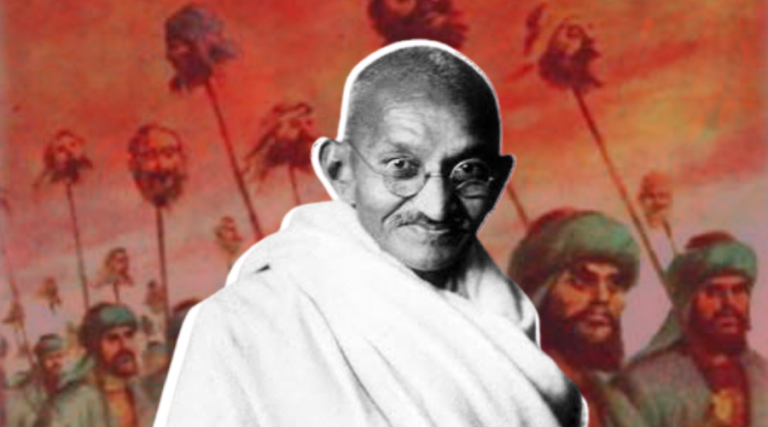
The support of the Indian leaders to the Khilafat movement (1919-1924) was a blow that India perhaps never recovered from. The Khilafat movement was one by Indian Muslims to support the Caliphate in Turkey. Essentially, the Indian leaders, especially Mohandas Karamchand Gandhi thought that by extending support to the Khilafat movement, he would get Indian Muslims to fight against the British and participate in the non-cooperation movement. He thought that Indian Muslims would join the nationalist movement en masse if he supported their demand for an Islamic caliphate.
What followed was mindless fanaticism by the Moplah Musalmans that resulted in the brutal murder of over 10,000 Hindus, the rape of thousands of Hindu women and the desecration of temples that Hindus held sacred. During the Malabar massacre in 1921, the Moplah Muslims went on a murder frenzy killing Hindus in the most brutal manner. On one particular incident on the 25th of September 1921, the Moplah Muslims massacred 38 Hindus by beheading them and throwing them in the well. It has been documented by the district collector of Malabar at the time how even after 2-3 days, several Hindus who were beheaded and thrown in the well were crying out for help.
The Malabar massacre of 1921 was not the only time Moplah Muslims had unleashed genocide against Hindus. In the book written by the then Deputy Collector Diwan Bahadur C. Gopalan Nair, he has documented over 50 incidents of communal strife when the Muslims of Malabar had heaped atrocities against Hindus. Despite the history, the Indian leadership’s response at the time was shameful, to say the least. Mohandas Karamchand Gandhi had extended unquestioning support to the Khilafat movement by the Malabar Muslims in the hopes that it would turn Muslims into ‘nationalists’ resulting in them fighting the British empire in unison with Hindus.
Either MK Gandhi was oblivious of the history of atrocities or he knew and chose to be naive – that aspect is only left to our inferences considering our history books hardly critically analyse the Malabar massacre of Hindus or the role of the Khilafat movement in the growth of radical Islam in India. However, his intentions are clear from a speech he made when he, along with Shaukat Ali visited Calicut. It was on the 18th of August 1920 that ‘Mahatma’ Gandhi delivered a speech at Calicut addressing the spirit of non-cooperation and the question of Khilafat.
Gandhi said that he believed that Indians would succeed if they understood the spirit of non-cooperation and that the Governor of Burma himself had said that the British continue to rule India not by force but due to the cooperation by the people. He exalted people to not tolerate the wrongs of the government.
“The Imperial Government have knowingly flouted religious sentiments dearly cherished by the 70 millions of Mussalmans”, he said. Mohandas Karamchand Gandhi said that he had understood the question of Khilafat in a ‘special manner’ and he was convinced that the British Government had wounded the sentiments of Mussalmans as they had not done before. “The Gospel of non-cooperation is preached to them and if they had not accepted it, there would have been bloodshed in India by this time. I am free to confess the spilling of blood would not help their cause. But a man, who is in a state of rage, whose heart is lacerated does not count on the results of his actions. So much for Khilafat wrong”, Gandhi said.
Justifying the violence by the Indian Muslims being unleashed on Hindus, Gandhi said, “I propose to take you for a moment to Punjab, the northern end of India and what have both governments done for Punjab? I am free to confess again that the crowds in Amritsar went mad for a time. They were goaded to madness by a wicked administration but no madness on the part of the people can justify the spilling of innocent blood and what have they paid for it? I venture to submit that no civilised government would have made the people to pay the penalty that had been inflicted on Punjab. Innocent men were passed through mock trials and imprisoned for life”, Gandhi had said.
While addressing the Moplah Muslims, he invoked the Jallian Wala Bagh massacre by the British and talk about how the government of the day did not take action to whitewash the crimes committed by the Moplah Muslims.
Right after talking about the Jallianwala Bagh and justifying the violence by the Muslims by saying that they were somehow justified in the violence they had unleashed because the “religious sentiments” had been hurt by the British, he went on to talk about the “cause of Mussalmans and Islam”. Gandhi suggested that participation in the non-cooperation movement was the way to avenge the insult to Islam by the British and if the movement is properly adopted, it will end in victory.
He then asks, “Are the Mussalmans of India who feel the great wrong done to them prepared for self-sacrifice? If we desire to compel the government to the will of people, as we must, the only remedy open to us is non-cooperation”.
Most problematically, Gandhi said, “If the Mussalmans of India offer non-cooperation to Government in order to secure justice on the Khilafat, it is the duty of every Hindu to co-operate with their Moslem brethren”. It is to be kept in mind that this speech was made in August 1920 when the Muslims had already started to massacre Hindus in their demand to establish a caliphate and in their support for the caliphate in Turkey.
After asking Hindus to cooperate as the Muslims massacred them, Gandhi exalted the “unity” between Hindus and Muslims. He said, “I consider the eternal friendship between Hindus and Mussalmans as infinitely more important than the British connection. I, therefore, venture to suggest that if they like to live with unity with Mussalmans, it is now that they have got the best opportunity and that such an opportunity would not come for a century. I venture to suggest that if the government of India and the Imperial Government come to know that there is a great determination behind this great nation in order to secure redress for the Khilafat and Punjab wrongs, the government would then do justice to us”.
It is extremely interesting to note how Gandhi equated the wrongs committed in Punjab against patriotic Sikhs with the Khilafat movement which was essentially one to fight for an Islamic Caliphate in Turkey and also to establish one in India. This attempt to legitimise the demands of Indian Muslims for an Islamic caliphate led to untold atrocities against Hindus while Gandhi spun dreams about Hindus (who were being persecuted) attempting to stay united with their own persecutors. By putting the onus of this elusive unity on the Hindus, Gandhi told the Hindus that it was their national duty, essentially, to be killed, tortured, raped and humiliated with a smile on their face.
After talking about the “first step of non-cooperation” which was limited to rejecting everything that the British offered, Shaukat Ali addressed the Calicut Muslims specifically on their demands regarding the Khilafat movement.
As can be seen from the first speech of Gandhi in Calicut, he had clearly put the onus of unity on the Hindus who were being massacred. In fact, the question of unity in this speech was not addressed in terms of India’s interest in pushing the British out, but in terms of the establishment of an Islamic rule.
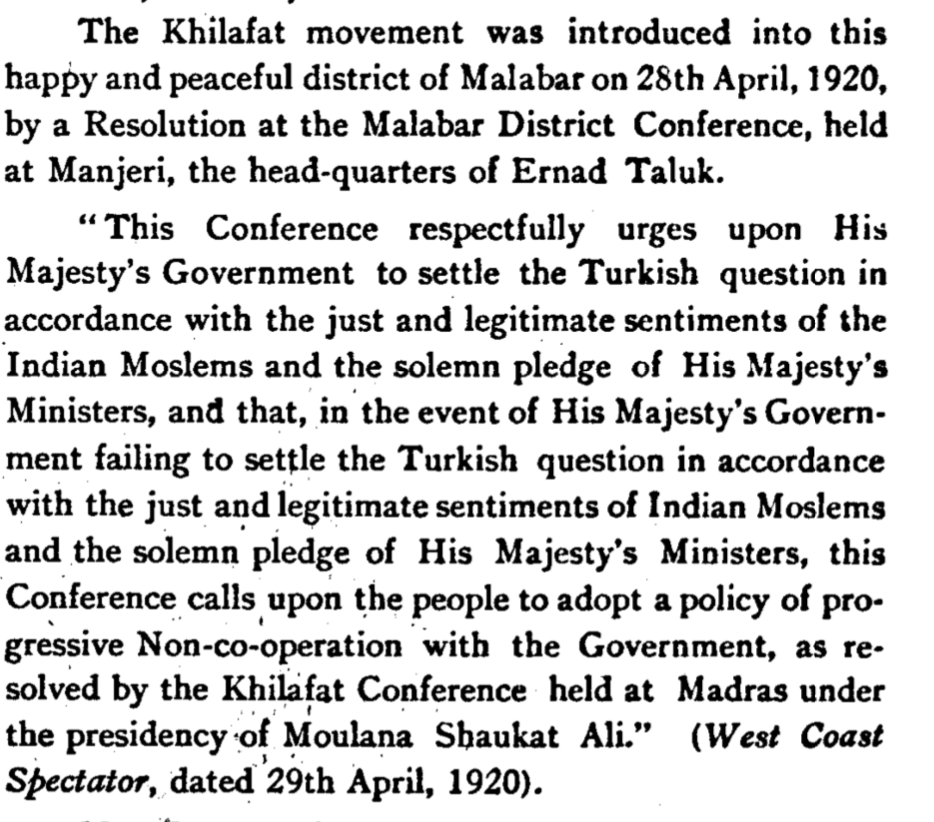
While Gandhi made this speech on the 18th of August 1920, on the 28th of April 1920, the Khilafat movement was officially launched. A resolution at the Malabar District Conference was held at Manjeri, the headquarters of Ernad Taluk.
Screenshot from the book by Gopalan Nair
The Malabar massacre of Hindus by the Muslim hoards around the 20th of August 1921. Mohandas Karamchand Gandhi travelled to Calicut again the 15th of September 1921 evening. The speech was delivered on Triplicane Beach, Madras.
While thousands of men were being slaughtered, women were being raped and children were being slaughtered, Mohandas Karamchand Gandhi told Hindus that they essentially had an obligation to remain “non-violent”. While the Moplah Muslims were massacring Hindus because of their Muslim fanaticism, Gandhi blamed the government for angering the Muslims enough that they became “indisciplined and violent”.
Here is what the Madras Mail wrote about MK Gandhi’s speech in Calicut on the 16th of September 1921 (Some relevant portions have been highlighted):
It was open to the Government, at powerful as they were, to invite the Ali Brothers and the speaker to enter the disturbed area in Malabar and to bring about calm and peace there. Mr Gandhi was sure that if this had been done much of the innocent blood would have been spared and also the desolation of many a Hindu household. But he must be forgiven if he again charged the Government with a desire to incite the population to violence.
There was no room in this system of Government for brave and strong men, and the only place the Government had for them was the prisons, He regretted the happenings in Malabar. The Moplas who were undisciplined had gone mad. They had thus committed a sin against the Khilafat and their own country. The whole of India today was under an obligation to remain non-violent ern under the gravest provocation. There was no reason to doubt that these Moplahs were not touched by the spirit of Non-co-operation. Non-cooperators were deliberately prevented from going to the affected parts. Assuming that all the strain came through Government Circles and that forced conversions were true, the Hindus should not put a strain on the Hindu-Moslem Unity and break it.
The speaker was however not prepared to make such an assumption. He was convinced that a mark who was forcibly converted needed no “Prayaschitham.” Mr Yakub Hassan had already told them that those who were converted were inadmissible into the fold of Islam and had not forfeited their rights to remain in the Hindu fold. The Government were placing every obstacle in the way of the Congress and Khilafat workers to bring relief to desolate homes and were taking no pains to carry relief themselves. Whether the Government gave them permission or not it was their clear duty to collect funds for the relief of sufferers and see that these got what they required, They did not yet know fully what measures the Government were going to take to repress the strength and rising of the people in this land. He had no reasons to disbelieve the testimony given to him yesterday that many young men were insulted because they wore Khad-dar caps and dress. The keepers of the peace in India had torn khaddar vests from young men and burned them. The authorities in Malabar had invented new measures of humiliation if they had not gone one better than those in the Punjab.
While the Malabar Muslims were slaughtering Hindus, raping women and forcefully converting Hindus, Mohandas Karamchand Gandhi insisted that they had committed a sin against the “Khilafat movement” and not the Hindus. In fact, he went ahead and insisted that Hindus must remain “non-violent” in the face go “extreme provocation”.
Further, Gandhi said that even if it were true that the Muslims were converting Hindus by force, the Hindus must not let this “put a strain on the Hindu-Moslem unity and break it”. Of course, for Gandhi, the rapes, murders and forced conversions were not breaking the unity but Hindus, who were being persecuted, could potentially break that “unity” by getting mildly angry about their own persecution.
It is evident that despite the genocide, the Indian leadership which prominently included Gandhi asked the Hindus to get slaughtered with a smile on their face and extended unbridled support to a movement that sought to establish Islamic rule. The Malabar genocide of Hindus that followed should be attributed directly to leaders who displayed exemplary cowardice and catapulted to the barbaric Muslims of the times and sacrificed Hindu lives at the altar of ‘unity’.
The top leadership of European Union is miffed with US President Joe Biden for misleading France and keeping other European nations in the dark over its new alliance with the United Kingdom and Australia in the Indo-Pacific, Politico reported. Mincing no words, the EU’s top leaders brusquely panned Joe Biden for his disloyalty to the transatlantic alliance.
The remarkable admonition of the new US President does not augur well for the relationship between the United States and Europe, which has otherwise been longstanding and has survived vicissitudes of time.
EU Council President slams Joe Biden for continuous disregard of European allies
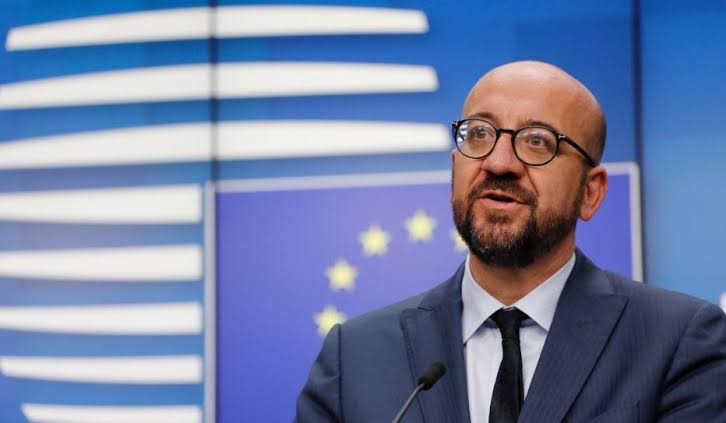
European Council President Charles Michel was displeased with America’s unilateral decisions of late and did not hold himself back in slamming the US president.
“With the new Joe Biden administration, America is back. What does it mean America is back? Is America back in America or somewhere else? We don’t know,” Michel told reporters in New York, as world leaders convened for the high-level debate of the U.N. General Assembly.
By not informing European Nations about the new strategic tie-up in the Indo-Pacific region, Michel averred, Biden had dishonoured the agreement reached by leaders after hours of deliberation at the G7 summit in Britain in June to remain united in pushing back authoritarian regimes, especially China.
“The most basic principles for an alliance are loyalty and transparency,” said Michel, adding, “We are observing a clear lack of transparency and loyalty.”
He further added that a discussion over the rift with the United States will be discussed among the 27 EU heads of state when they convene over dinner on October 5 in Slovenia, ahead of a summit focused on the Western Balkans.
Michel said the dispute between the two sides is not limited to French economic interests alone but to a greater pattern of callous indifference to interests of European allies by four US presidents, starting with George W. Bush.
“Obama with charisma, very polished, took important decisions in Syria with negative consequences for Europe, and we could observe also a lack of coordination, of consultation between the United States and European governments,” Michel said.
In Trump’s case, Michel said it was abundantly clear that he was not in favor of the European integration, that for him Europe did not matter.
European Commission President Ursula vo der Leyen seeks explanation from Joe Biden
Similarly, European Commission President Ursula von der Leyen also expressed her consternation at the treatment of France which she termed “unacceptable” and asked Biden to provide an explanation over it. France had last week accused Australia and the United States of lying over a ruptured Australian contract to buy French submarines, saying a grave crisis was under way between the allies.
“A great many number of questions still remain unanswered. One of our member states has been treated in a manner that is grossly unacceptable, so we would like to what happened and reasons behind it,” Leyen said while asking the United States to clarify before continuing with business as usual.
Leyen’s comments came a week before the planned first meeting of a new EU-US Trade and Technology Council in Pittsburgh, underscoring the palpable tensions between the two sides going into an event that was initially touted as a convention that would exhibit the renewed policy partnerships between Brussels and Washington.
US-Australia-UK forge a new alliance to counter China; France fumes over losing submarine contract
U.S. President Joe Biden revealed last week a new alliance, including Australia and Britain that would deliver an Australian fleet of at least eight nuclear-powered submarines. The alliance was dubbed as AUKUS and pegged as a coalition to keep in check an authoritarian China.
However, the new alliance was forged at the expense of France, which lost a contract it had signed with Australia in 2016 for a dozen conventional diesel-electric submarines. The deal with French majority state-owned Naval Group was worth at least $66 billion and the work was currently underway.
France’s Foreign Minister had last week denounced the US-Australia deal as “duplicitous and disdainful”, declaring that a crisis is at hand among the Western allies. France has even recalled its ambassadors to the United States and Australia, making its fury known to its western allies. France has also pulled out of defence talks that were scheduled to take place this week in London.
The 10-day grand festival of Ganesh Chaturthi did not end well for the residents of Raipur. Just ahead of Ganesh visarjan, the municipality had imposed several restrictions and ‘Covid guidelines’ owing to the ongoing pandemic.
The municipality had released a notification detailing multiple restrictions while assuring to offer complete support. In its release, it urged the public to conduct Ganpati visarjan only at a few dedicated spots chosen by the municipality and also offered support to conduct the visarjan.
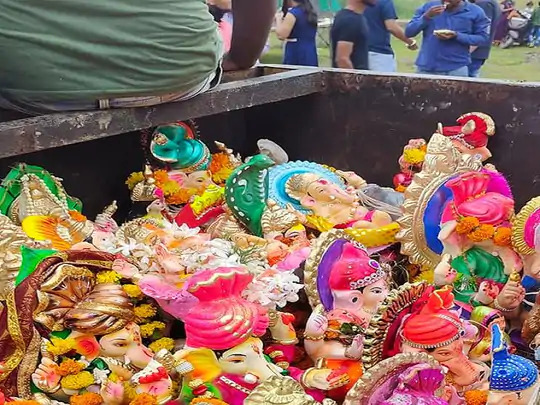
However, on Monday a video went viral on social media where the municipality workers were seen carrying the Ganesh idols in unclean garbage trucks. In another video that garnered sharp criticism, the municipality workers can be seen throwing the Ganesh idols into the pond from the truck stationed at least 10 feet away.
Upset with the incident, the locals protested and sloganeered in front of mayor Aijaz Dhebar.
‘Raipur municipality should not have taken the responsibility’
As per the issued guideline, the municipality went around collecting small idols of Ganesh idols from home to conduct visarjan at an artificial pond created at Mahadev ghat.
Garbage trucks used to carry Ganesh idols. Image Source: Dainik Bhaskar
For this, the municipality made use of garbage trucks hurting the sentiments of the devotees. Local opposition corporator Meenal Choubey lashed out at the municipality saying ‘why did they take the responsibility when they were incapable of fulfilling it?’
“People who worshipped the idol for ten days could have participated in the visarjan themselves. But since the municipality had assured complete support, they trusted them with the ritual and handed over the murtis to them. However, there was no arrangement or management for the festival by the municipality,” said a BJP leader.
Several other BJP leaders like Mrityunjay Dubey protested against disrespect meted out by the municipality workers post which the workers apologized and assured to be careful.
Mayor assures action
Action has been initiated against three municipality workers who have been suspended from duty. After being gheraoed by the enraged public, Dhebar has assured to look into the matter. He also promised the public to work towards the management.
In April this year, Dhebar’s nephew was caught violating Covid-19 norms and threatening a cop when opposed. Reportedly, he had dialled his uncle to come to his rescue after misbehaving with the cops.
On September 17 this year, the New Zealand cricket team abandoned their tour of Pakistan over security concerns. The announcement was made just an hour before the start of the 1st ODI match. The ‘B’ team of New Zealand was scheduled to play a 3-match ODI series against Pakistan in Rawalpindi, followed by a 5-match T20 series against them in Lahore.
However, the last-minute snub was fuelled by security concerns that were raised by the Intelligence alliance of the US, Australia, UK, Canada and New Zealand (also called the Five eyes). It led to a major embarrassment for the Pakistan Cricket Board (PCB) and the Pakistani government. Former cricketer Shoaib Akhtar even accused the NZC of destroying the country’s cricket with just one decision. Three days later on September 20, the England and Wales Cricket Board (ECB) pulled the plug on their tour in October.
Ahead of the upcoming T20 World Cup in UAE, the England Men’s team was scheduled to play 2 back-to-back T20Is on October 13 and 14 in Pakistan. On the other hand, the Women’s team was scheduled to play 2 T20Is and 3 ODIs. However, ECB followed the footsteps of New Zealand, leaving the Pakistanis high and dry. This is, however, not the first time that a series with New Zealand was cancelled over security threats. Almost 2 decades ago, NZC found itself in a similar situation.
2002 Karachi bombing and New Zealand Team
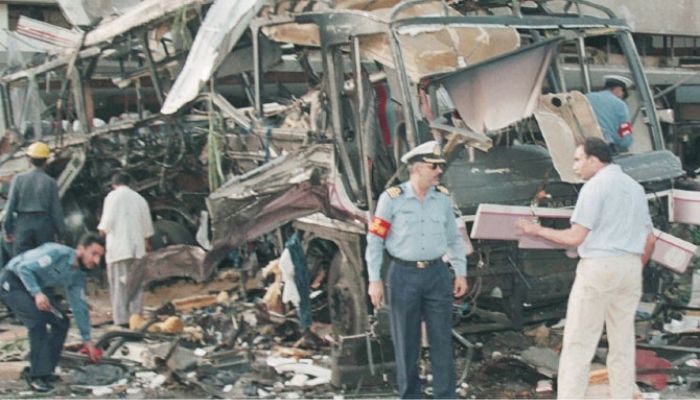
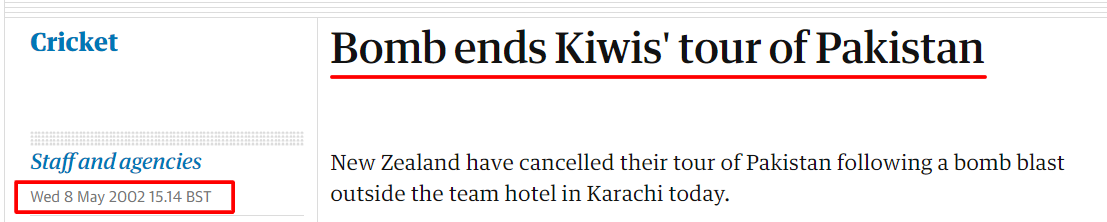
On May 8, 2002, a massive explosion took place inside a bus that was parked outside the hotel of the visiting New Zealand team in Karachi, reportedThe Guardian. The deadly bomb blast claimed the lives of 12 people and injured 34 others. Out of the 12 deceased, about 10 of them were defence technicians from France. The New Zealand cricketers had a narrow escape. Martin Snedden, the Chief Executive of NZC, decided to cancel the second test match that was scheduled to begin on that day in Karachi.
During a press conference, he remarked, “I will now arrange to have the team immediately fly out of Pakistan and return home to New Zealand. I don’t think this was a decision that was a difficult one to make quickly. The safety of our players is always a major priority. I have spoken to Brigadier Rana of the Pakistan Cricket Board and conveyed our decision to him. Our main priority now is to bring the players home safely to their families.”
Screengrab of the article published in The Guardian
Prior to the terror attack, aspersions were cast about the security arrangements in Pakistan in the context of the 9/11 attacks. The New Zealand team nevertheless came following assurances by the then Pakistani government and review of plans by NZC authorities. However, the security agencies in the country could not prevent the bomb blast that was believed to be carried out by a suicide bomber. Waqar Younis, who was the captain of the Pakistani team, however, understood the impact that the terror attack would have on the future of cricket in the country.
“Thanks be to God that all the players and the officials of both the teams are safe. But cricket will suffer badly in Pakistan. We are helpless and can’t play cricket in these conditions which is sad for cricket lovers in Pakistan as well as for the teams. We wait to see what measures the Pakistan Cricket Board will take for the future cricket,” he had said then. Sindh police chief Kamal Shah had tried to pin the blame on India and the Al-Qaeda forces in Afghanistan. “We cannot rule out the involvement of al-Qaeda, but our suspicions are across the border. I am pointing towards India,” he had claimed.
Terror attack on the Sri Lanka Team in 2009
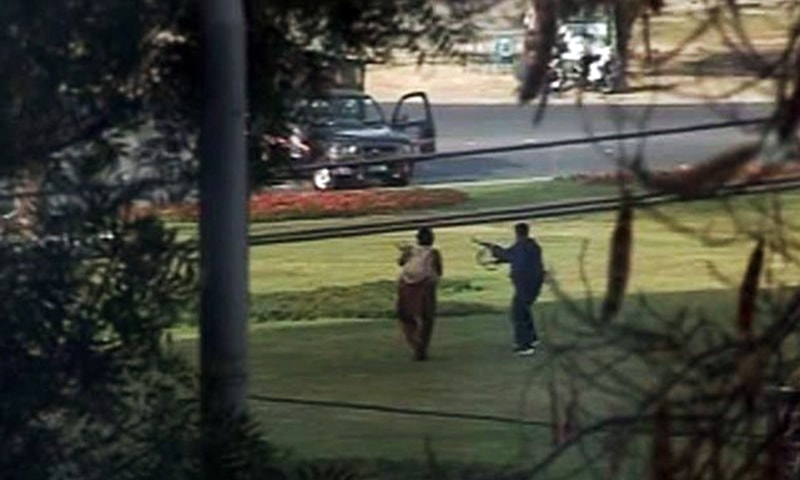
While Pakistan continues to blame India for stalling the development of cricket in the country, the truth remains that the Pakistani army paid the price for providing a safe haven to terrorists. 7 years after the New Zealand team narrowly escaped the Karachi bombing, the visiting Srilankan side came in the line of a deadly terror attack on March 3 in 2009. The visitors were en route to the Qaddafi stadium in Lahore for Day 3 of the 2nd tests when the attack took place. The target of the terrorists was the convoy of the Sri Lankan team.
Terrorists firing at the convoy of Sri Lankan team, image via Reuters
Equipped with guns, hand grenades and RPGs, the Islamic terrorists stormed the Liberty Chowk in Lahore and opened fired at the convoy of cricketers. The driver of the bus sustained gunshot wound but managed to steer the bus to safety. In the deadly attack, about 7 people were killed and 20 others were injured (including 7 Sri Lankan players). “For some reason, I moved my head to get a better view and a split second later I felt a bullet fizz past my ear into the vacant seat,” recounted Sri Lankan cricketer Mahela Jayawardene.
He thanked the bus driver for saving his life and that of the team members. “We owe the team bus driver our lives for his remarkable bravery in the face of direct gunfire … Had he not had the courage and presence of mind to get the bus moving after the initial attack then we’d have been a far easier target for the terrorists,” Jaywardene said. In the aftermath of the attack, Lahore police officer Haji Habibur Rehman tried to pin the blame on India and its Intelligence agency Research and Analysis Wing (R&AW) by citing a non-existent Intelligence input from the Punjab government. His claim was rubbished by the police chief Khawaja Khalid Farooq.
Future of cricket in Pakistan
In the aftermath of the Taliban’s takeover of Afghanistan, Pakistanis have come out in support of the radical Islamist outfit. The fanaticism also found resonance with the incumbent Imran Khan government. Reuters reported that the government had decided to send ISI chief to Afghanistan to help the Taliban reorganise their military. It also intended to provide necessary training to the Taliban, largely made up of Pashtun fighters trained in Pakistan madrasas.
As such, the possibility of a security threat in Pakistan, which has been harbouring UN-designated terrorists, cannot be ruled out. However, instead of cleaning their mess, Pakistanis are busy peddling conspiracy theories of India’s involvement. Following a dual snub by New Zealand and England Cricket Board, the domestic cricket season of Pakistan lies in tatters.
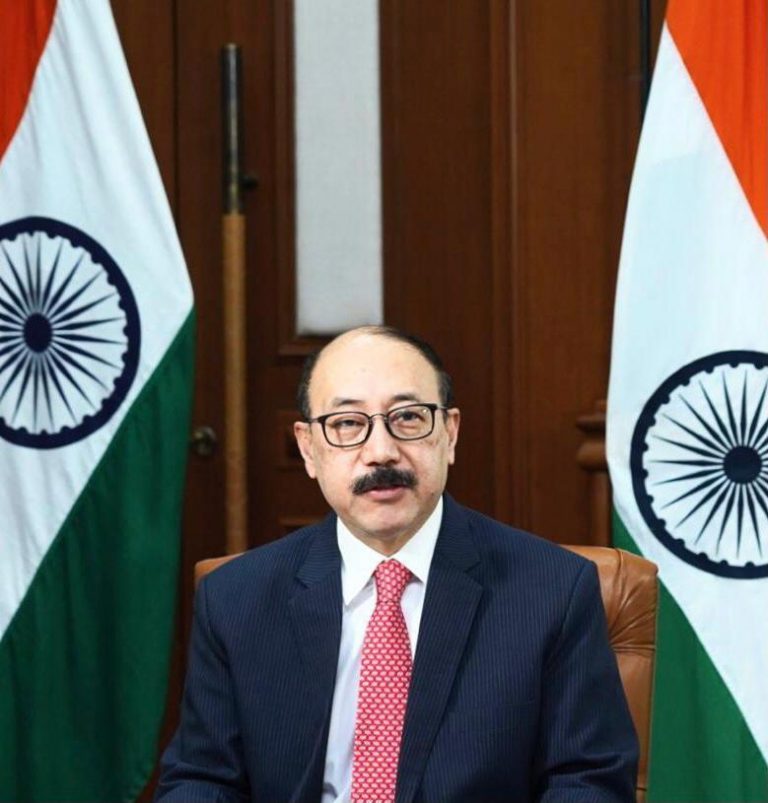
Foreign Secretary of India Harsh Vardhan Shringla criticized UK’s approach on vaccines and its new policy on vaccines in a press conference. He expressed concern over the recent measures taken by the UK government on Covishield and its non-recognition in the UK which would impact Indian citizens travelling to the UK.
He said, “The non-recognition of Covishield is a discriminating policy and impacts our citizens travelling to the UK. The External Affairs Minister has raised the issue strongly with the new UK foreign secretary.”
New Delhi's warning to UK over its non-recognition of Indians vaccinated with #CovishieldVaccine: "These are reciprocal measures and I think If […] we don’t get satisfaction, we would be within our rights to impose reciprocal measures.” #AstraZenecahttps://t.co/VPNBr5E1Bf
Secretary Shringla said that India found the non-recognition of the Covishield vaccine as discriminatory and indicated that reciprocal measures might have to be taken. He also mentioned that Covishield is a licensed product of UK government, manufactured in India and that 5 million vaccines were also given to govt of UK.
“I am told that the External Affairs Minister has been given the assurance that the issue will be resolved… the minister said that this issue should be resolved as soon as possible,” Shringla said.
According to reports, the United Kingdom put forward new vaccine rules which would view all vaccinated Indians as ‘unvaccinated’. The step also requires Indians regardless of their vaccination status to undergo mandatory screenings upon arrival.
Suneela Garg, Member Lancet Commission, of the COVID India task force said on the matter, “The COVISHIELD has been approved by WHO and if anyone, be it a person from Europe or India faces a problem even after getting vaccinated, then this issue should be discussed at the highest level by the government of India. This is a vaccine diplomacy issue.”
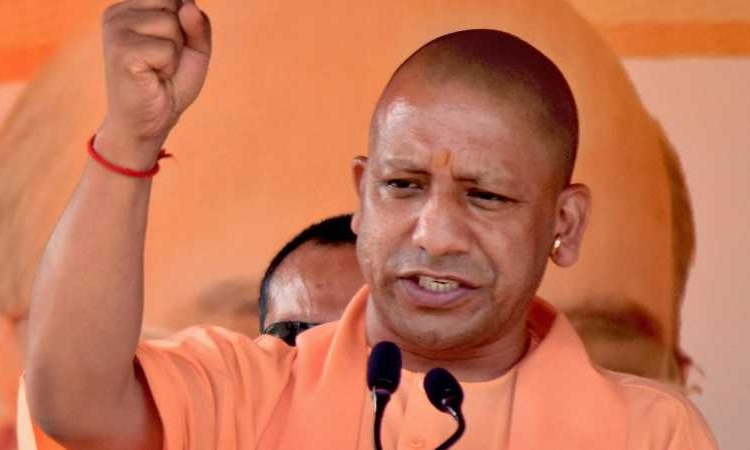
Uttar Pradesh Chief Minister Yogi Adityanath is on a two-day visit to Ayodhya, Varanasi, Ghazipur and Jaunpur. Speaking at a public event at Jaunpur, the UP CM accused the opposition of following a ‘Main Aur Mera Khandaan’ (just me and my family) policy in their previous governments.
According to reports, CM Yogi Adityanath spoke at an inauguration event held at Jaunpur where he said that while the BJP worked for Sabka Saath Sabka Vikas, the opposition only believed in ‘Mai Aur Mera Khandan’ policy.
CM Yogi said that the BJP is focused on equality, bringing peace and development for everyone while the previous governments in the state only focused on increasing the wealth of their party leaders.
Taking a dig at Samajwadi Party, CM Yogi Adityanath said, “BJP is working with the objective of ‘Sabka Sath, Sabka Vikas’ and providing equal opportunity to everyone. Earlier it was ‘Mai Aur Mera Khandaan’. When people of UP were suffering, they (SP and BSP) were organizing functions of singing and dancing.”
BJP is working with the objective of 'Sabka Sath, Sabka Vikas' and providing equal opportunity to everyone. Earlier it was 'Mai or mera khandan'. When people of UP were suffering, they (SP and BSP)were oragansing functions of singing and dancing: UP CM Yogi Adityanath in Jaunpur pic.twitter.com/sGwOrSHwRp
CM Yogi criticized the opposition saying that when BJP worked to provide equal opportunities to everyone, the opposition only worked for themselves. Yogi Adityanath accused that the opposition only followed ‘Mai Aur Mera Khandaan’ strategy that only benefitted the ruling party leaders and their family members.
Yogi Adityanath also blasted the opposition over their stance on Ram Mandir saying “The wait of 500 years ended on Aug 5, 2020, when PM Modi laid the foundation stone of Ram Mandir. Would SP and BSP ever have done so?”
CM Yogi asserted that the BJP stays away from caste politics and held the opposition responsible for spreading falsehood on sensitive matters.
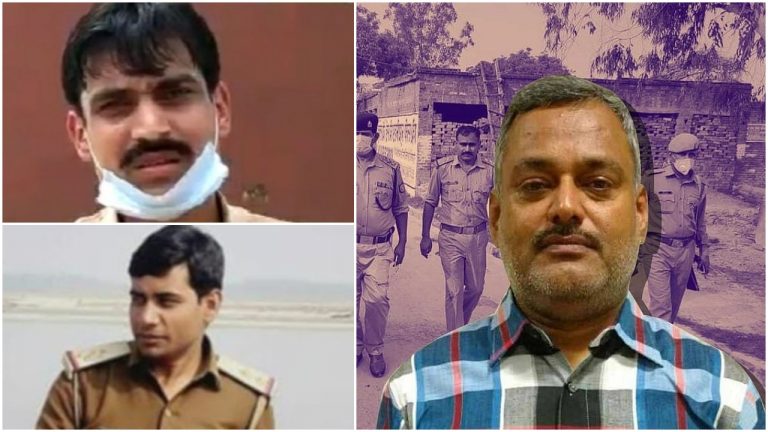
The Allahabad High Court has on Tuesday, September 21, refused to grant bail to two policemen namely suspended Chaubeypur Station Officer Vinay Kumar Tiwari and Beat Officer Krishna Kumar Sharma, Live Law has reported. The two police personnel are facing charges of conspiracy in connection with the Bikru ambush case in Kanpur in July 2020, in which eight policemen were killed by notorious gangster Vikas Dubey.
While denying bail, the single-judge bench of Justice Pradeep Kumar Srivastava remarked, “Who will police the police”, the famous statement made by Justice VR Krishna Iyer during a hearing 40-years-ago.
“About 40 years have passed, but, that question is still there with a bigger question mark”, the Court observed.
“Such policemen tarnish the image, name, and fame of police and it is necessary that suspicious police personnel should be taken to task and their conduct should be regularly monitored for which a mechanism should be evolved, and if it exists already, the same should be geared up at different levels”, the court added.
Two policemen accused of leaking information to Dubey’s aides
The two suspended policemen were accused of leaking information about police action to gangster Vikas Dubey prior to the encounter in Kanpur. Tiwari and beat in charge of Bikru KK Sharma, were not only suspended soon after the encounter but also arrested on charges of fleeing the encounter site and putting the lives of other policemen in danger.
They were booked under sections 147, 148, 149, 302, 307, 504, 506, 353, 332, 333, 396, 412, 120B, 34 IPC, section 7 of Criminal Law Amendment Act, and section ¾ of Explosive Substances Act.
Both the SIs had allegedly tipped off Vikas Dubey about the impending police raid.
The 2020 Bikru ambush conducted by the aides of notorious gangster Vikas Dubey
The police team comprising of 15-16 personnel had carried out the raid on July 3, 2020, based on a complaint from Rahul Tiwari, who had lodged a case against Vikas Dubey on charges of attempt to murder.
As the police team reached the spot, they were ambushed by Dubey’s men who were prepared with arms on the roof of a building and continuously shot at them. Shockingly, the criminals had already stationed a JCB machine on the road to block the police team.
Eight police personnel, including Deputy SP Devendra Mishra, were killed and six cops were injured in the police raid.
The Uttar Pradesh police, working at the behest of the Yogi Adityanath government had relentlessly pursued the Vikas Dubey case to dig out the names of the police personnel who had been hand-in-gloves with the slain gangster. In July 2020 the Uttar Pradesh government had ordered that a Special Investigation Team (SIT) will probe into the crimes committed by the dreaded gangster and his alleged links with police personnel.
Vikas Dubey killed in an encounter
Gangster Vikas Dubey, who was arrested from Ujjain, Madhya Pradesh on July 9, 2020, was killed in an encounter in Kanpur in the early morning of July 10 last year. According to reports, the encounter broke out between Vikas Dubey and the Uttar Pradesh Special Task Force (STF) after the gangster tried to flee from the overturned vehicle that was bringing him from Madhya Pradesh.