Chennai city cyber-crime police on Saturday arrested Tamil actress and model Meera Mithun from Kerala for passing derogatory remarks against the Scheduled Caste community. Mithun has been booked under 7 sections of the Indian Penal Code (IPC).
A video of Mithun creating ruckus over her arrest and accusing police personnel of harassing her has gone viral on the internet. In the video, the police officials reportedly ask Mithun to surrender her phone. It was shots moments before her arrest.
மீரா மிதுன் கேரளாவில் கைது. பட்டியலினத்தவர்களை அவதூறாக பேசியதால் மத்திய குற்றப்பிரிவினர் கைது செய்தனர்.
Meera Mithun sparks outrage after she asked SC film makers to be “chucked out” of the industry
The controversy erupted after Mithun was found making disparaging remarks against members of the SC community. During an interview with a YouTube channel, Meera said that the scheduled caste film workers should be “chucked out” of the industry.
“I am not speaking ill about members of the SC community. But the members of the community face problems mostly because they are involved in illegal activities and crimes. No one will unnecessarily speak ill of someone without any reason,” said Meera while asking for the community members to be “chucked out”.
“In the film industry, SC directors and other people of the community do cheap things. It is time to chuck out all the SC directors and other people from the film industry. In one instance, a director from Paraiyar (SC) community took the first look at my movie,” she alleged. The video had gone viral and sparked outrage after it was widely shared on many social media websites.
After the video had gone viral on social media, it was shared by VCK Chief and MP Thol Thirumavalavan where he asked for the arrest of Meera Mithun. On Saturday last week, the VCK leader, former MP Vanni Arasu and several other organisations in Tamil Nadu have lodged police complaints against the actress.
Reportedly, the actor was booked under sections 153, 153A(1)(a), 505(1)(b), 505 (2) of IPC, and several sections under the SC/ST Prevention of Atrocities Act. The Tamil Nadu Untouchability Eradication Front is a co-complainant in the petition against her.
Bhartiya Kisan Union (BKU) leader Rakesh Tikait seems to have elaborate plans up his sleeves to cast a pall over India’s 75th Independence celebrations this year. In the last week of July, Tikait announced that the farmers, protesting against the three farm laws passed by the government last year, will hold a tractor rally to Ghazipur border on August 14 and 15 where they will unfurl the national flag on Independence Day.
He further added that the tractors will go from two districts. “We will go by tractors to Ghazipur border on August 14 and 15. On August 15, we will hoist the flag. Tractors from two districts will go. We did not remove the national flag on January 26,” Rakesh Tikait said.
The announcement to carry out yet another tractor rally appears to be a desperate move by the farmer leader to revitalise the flamed-out farmers’ protests that has now rolled into their ninth month.
‘Farmers’ have been camping on the different borders of the national capital since November 26 last year against the three newly enacted farm laws: Farmers’ Produce Trade and Commerce (Promotion and Facilitation) Act, 2020; the Farmers Empowerment and Protection) Agreement on Price Assurance and farm Services Act 2020 and the Essential Commodities (Amendment) Act, 2020.
There has been an extended round of talks between the farmers and the central government but the former’s intransigence has prevented any meaningful progress in resolving the standoff between the two sides.
With the central government holding onto their ground and refusing to cave into the extortionist demands by the protesting farmers, who want nothing less than a complete rollback of new farm laws, Tikait has studiously chosen the occasion of India’s Independence day to conduct a tractor rally and mobilise support for the wilting farmers’ protests.
The significance of mounting a rebellion on the 75th Independence day
The day on which the tractor rally is to be conducted is of particular significance, given that it marks the 75th anniversary of India’s Independence. August 15 is symbolic for Indians, as it is the day on which in 1947 India came into being as a free sovereign country, no longer under British imperialist rule.
For over 2 centuries, Indians were subjugated by their British colonisers beginning in 1757. The British gained control over the country by the victory of the English East India Company at the Battle of Plassey.
The history of India is riddled with prominent events of retaliation, uprising and agitation, which eventually drove the Britishers out and forced former viceroy, Lord Mountbatten, to free India on August 15, 1947, after giving the mandate to transfer the power to Indians. The day also marked the partition of British-ruled India into two countries, India and Pakistan.
Every year, Independence Day is celebrated with much fanfare, especially in the national capital, where the incumbent Prime Minister hoists the flag and addresses the nation from the ramparts of the historical site of Red Fort in Delhi. The function is attended by various other dignitaries, as well as students from different parts of the country. During his address, the Prime Minister pays tributes to the Independence movement fighters. In his speech, the Prime Minister also usually highlights the past year’s achievements, raises important issues and puts forth his vision for the upcoming year.
Therefore, it is not a mere coincidence that Rakesh Tikait has called on for a tractor rally to be held on a day when the country is celebrating the 75th anniversary of its independence. The symbolism of carrying out a rally on the auspicious occasion of India’s independence day, in defiance of the democratically elected government, and to oppose the laws legislated by it cannot be overstated.
By choosing the independence day for mobilising a tractor rally, Tikait not only seeks to sanctify the ongoing protests but also aims to draw national, and perhaps, even international attention towards the farmers’ stir continuing at different border sites along with the national capital.
A protracted round of talks has yielded little headway to resolve the ongoing standoff between the central government and the farmers’ representative. The obstinacy displayed by Rakesh Tikait and other leaders has added to the unceasing impasse.
Anyone who has been involved in high-level negotiations can attest to the fact that they are seldom straightforward. Success requires patience and sustained efforts. It also requires ingenuity, openness to going beyond conventional means, and the willingness to show flexibility to achieve common ground.
However, Tikait and other representatives of farmers have made it amply clear that they have little interest in striking a meaningful negotiation with the Centre over the farm laws. They are steadfast in their demand that the central government revoke the three farm laws, failing which they will continue to protest not just along borders of the national capital but across the country.
Tikait has even travelled to many parts of the country and rallied support for the farmers’ protest. Not only do the protests happening along the Delhi borders pose a threat of powering yet another devastating wave of coronavirus, but they also have, by several accounts, already caused huge losses to the tunes of crores to the public exchequer by blocking the transport of goods and caused general inconvenience to the people.
And yet, Rakesh Tikait and his associates continue to hold the central government to ransom and pressurise them into conceding to their demands. There seems to be a concerted attempt on the part of Tikait and other farmer leaders to use protests as an intimidatory tool to threaten the Centre into submission.
Such sustained and ceaseless attempts to hustle the Centre into revoking three farm laws amounts to subversion of the democratically elected government. The government has been elected through a constitutionally sanctioned electoral process. The constitution bestows on it the mandate to legislate and enact laws. However, this authority was effectively undermined by the treasonous protests carried out by Rakesh Tikait and other leaders.
The political significance of organising a protest rally on India’s Independence day is therefore hard to miss. The goal, it seems, is to mount a rebellion against the central government, with the independence day being used as yet another occasion to stir up public opinion against the Centre.
Tikait’s treasonous antics and his utter disregard for India’s cherised democratic norms
While Rakesh Tikait might defend his antics by attributing them to their rights to oppose legislated laws, the past incidents and Tikait’s obduracy suggest that protesting against the farm laws is their only agenda. One does not need to go any farther than last month to realise the motives harboured by the farmer leaders in continuing their protest.
On July 14, 2021, Tikait proclaimed that the farmers would march up to the Parliament and carry out a sit-in protest outside the building to oppose the farm laws. This was announced at a time when the Monsoon session was underway at the Parliament. He even suggested that they would have their own Parliament at the Jantar Mantar.
India’s Parliament exemplifies its most representative and democratic institution. It is the sanctum of contemplation that delivered the Constitution, the keystone of our Republic. By announcing a siege to it, Tikait had once again revealed his disregard for electoral democracy and his penchant for using pressurising tactics to force the government to toe to his line.
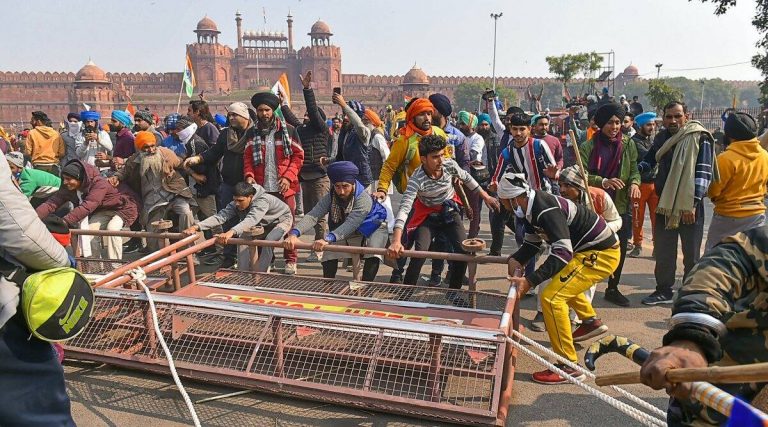
Before that, in January 2021, a tractor rally carried out on India’s Republic Day turned violent as rampaging protesters breached barricades and ran amok on the streets of the national capital. They even stormed the iconic monument Red Fort—another symbol of India’s democracy—and desecrated it by unfurling religious flags from its ramparts.
The uncanny similarity between the Republic Day rebellion and the US Capitol Hill insurrection
The desecration of the Red Fort had uncanny symmetry with the insurrection at the US Capitol Hill that took place 20 days before, on January 6, 2021, when a legion of rioters scaled the walls of the hallowed US Capitol building, occupied and vandalised it for several hours. The mob had sought to overturn the 2020 presidential election results by disrupting the joint session of Congress assembled to count electoral votes that would formalize President-elect Joe Biden’s victory.
Just like the mob in the United States that stormed the US Capitol Hill did not achieve its stated goal, the rebellion mounted by Rakesh Tikait and his followers on India’s Republic Day failed in its endeavour, although the “show of strength” through the tractor rally did result in a ruckus on the streets of Delhi, with protesters indulging in arson, vandalism and desecration of public property. The intention of the mob in Delhi was not very different from the objectives harboured by the mob in the United States: to delegitimize the elected government and use the strength of the mob to overturn a public mandate.
The rioters in the United States are being charged with sedition and other serious crimes It would be fitting and appropriate that the rioters and vandals in India are pursued with similar charges, lest inaction would embolden them to persist with their anti-national activities. Treason, as per India’s constitution, is defined as levying war against the country or adhering to the enemies of India and aiding them in their nefarious schemes. Sedition, on the other, is a broader term for disloyal behaviour against the government.
Why Tikait and his supporters should be tried for treason
What we have witnessed and are witnessing from the past few months, the so-called protesters seem bent on throwing the country into disarray by discrediting the elected government and mounting a rebellion against them. In this way, they are directly or indirectly, advertently or inadvertently, helping the enemies of the country, who would want to see India denuded of strong leadership and be embroiled in an inner turmoil.
As we have witnessed in the past, countries like China are lurking around, waiting for an opportunity to mount their offensive while the country is busy with its internal issues. Last year, when India was occupied with its coronavirus outbreak, Chinese soldiers stealthily moved in eastern Ladakh, thinking that they could capture the Indian territories as India was busy combating the contagion that first emerged in the central Chinese city of Wuhan. The move later culminated into a tense standoff along the border, with the troops of both sides indulging in a bloody scuffle at Galway Valley friction point. Therefore, it cannot be denied that the antics of Tikait and his supporters are helping the enemies of the country and undermining the elected government of the day.
When the tractor rally on Republic Day convulsed Delhi and resulted in unprecedented chaos and disorder, there’s every reason to expect that the tractor rally scheduled to take place on independence day would yield similar results. It is time that the government throws caution to the winds and bell the cat by prosecuting Tikait and his lumpen supporters for treason.
There are some moments in history which are etched across memories for all eternity. The moments not only impact those living through the tumultuous times but the lives of generations and generations are affected even after centuries have passed.
Terrible things can last for mere days but their impact continues to reverberate for decades, if not centuries. Such moments become a platform for collective sorrow, guilt and serve as the foundation for national mourning and share memory.
One such tragedy was the Direct Action Day. 75 years have passed since the terrible events of 1946 but still, a day does not go by when it does not impact current events. Indeed, there is simply too much tragedy embedded in those memories for them to be forgotten so lightly.
It was on the 16th of August, 1946 that Mohammed Ali Jinnah gave a call for nationwide protests demanding the creation of Pakistan. It led to the 1946 Calcutta Killings and the genocide of the Bengali Hindu community. Soon, it spread to the rest of the country and culminated with the Partition and the terrible partition riots.
After all these years, the 16th August is to be celebrated as ‘Khela Hobe Divas’ by Mamata Banerjee and the Trinamool Congress. One would have expected a Bengali Hindu of all people to be aware of the tragedy that marks the occasion but Mamata Banerjee, clearly, has other plans.
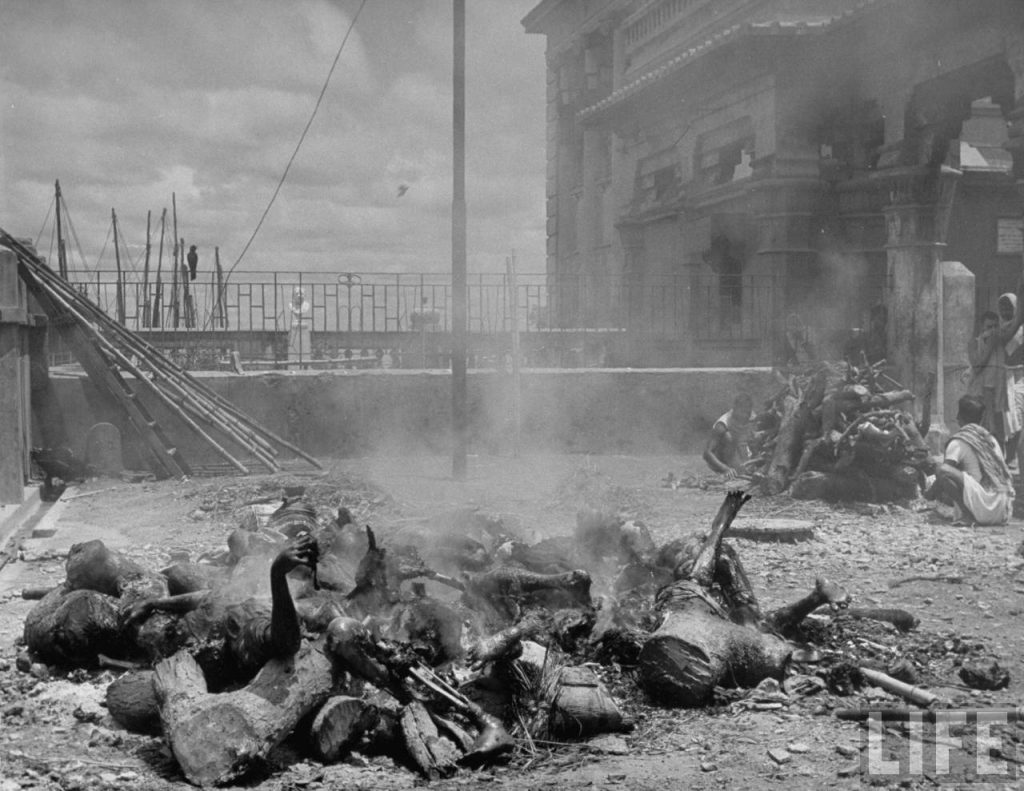
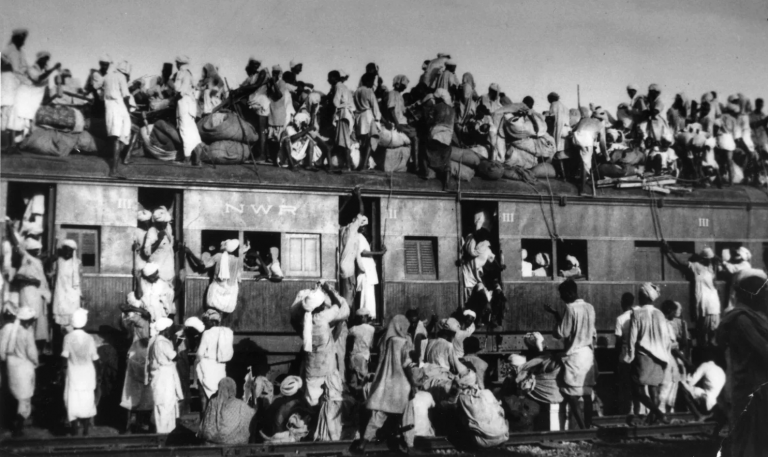
Scenes after the Calcutta Killing, Direct Action Day (source: oldindianphotos.in)
The fates of every single Indian has been affected by the events of that era, either directly or indirectly, and it has shaped and continues to shape the destiny of Independent India. Children lost their parents, mothers lost their sons, husbands lost their wives and the sacred land of Bharata was soaked with the blood of the innocent.
Direct Action Day also culminated with the greatest migration of population in modern history. And the impact of that migration on Indian history could not ever be overestimated. For instance, the Naxalbari Movement that began in West Bengal was the consequence of a series of violent protests and riots led primarily by the migrant Bangladeshi Hindu community that had crossed over to India in the aftermath of evidence, who were treated as trash by the then Nehru Government.
Lal Krishna Advani, one of the core figures of the Ram Janmabhoomi Movement, has his roots in Sindh. The Northeastern region of the country witnessed a significant influx of Bangladeshi Hindu refugees and with that, the linguistic battles and terrorist movements in the region received a significant boost.
There are other ways in which the events of Direct Action Day has definitively shaped the history of India but most of all, the contribution of the horror that Hindus had to suffer during those dark times still impacts their political inclinations and their social life.
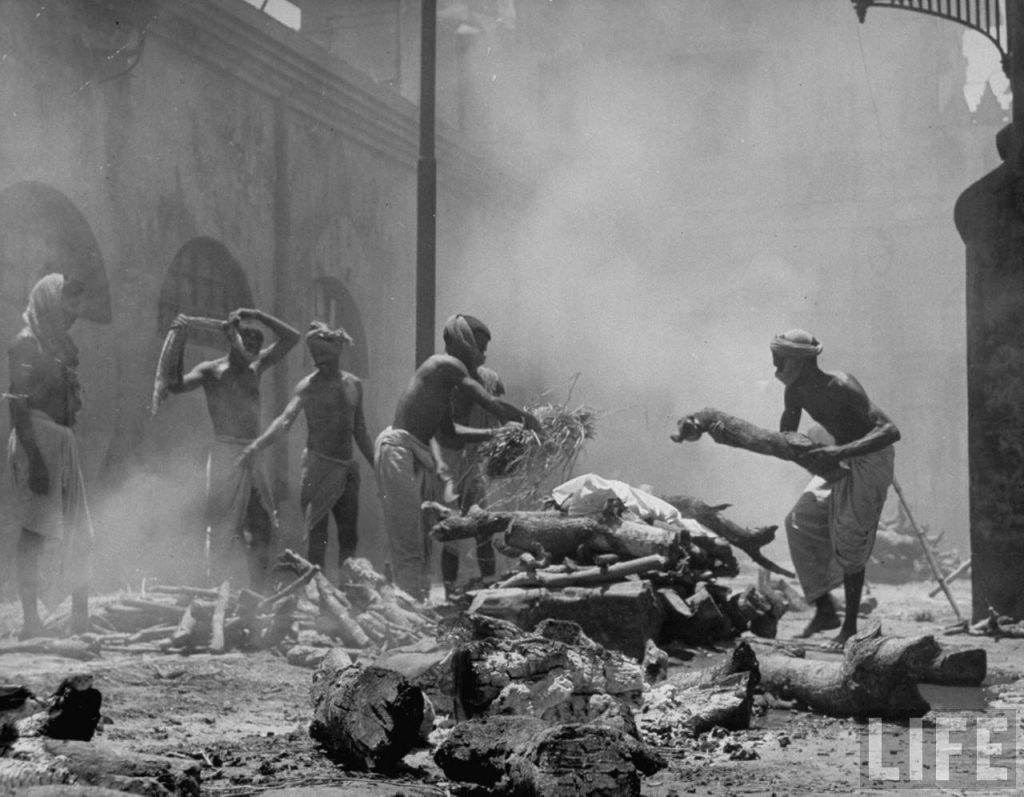
Scenes after the Calcutta Killing (source: oldindianphotos.in)
The paternal grandparents of this author himself crossed over to India right after independence. During the last days of my late grandmother, when her cognitive abilities had significantly declined, she would often say that she wants to go home. And we would tell her that she was home. But she would remain adamant and nothing would convince her otherwise.
It was only later that we realised that she was referring to her home in Bangladesh, a home that she was forced to leave and she could never return to. When I shared the particular story on social media, I realised that the phenomenon appeared to be far more common that I previously assumed it to be.
Quite a few others, mostly from the Bengali Hindu community, recounted how they experienced the same with their grandparents. Nevertheless, the point is, there were horrors Hindus experienced during that era and the memory of an ancestral land one could never return to has molded the national conscience.
Under such circumstances, it is especially important to trace the events that led to Direct Action Day. Such events are not borne in a vacuum but are the climactic end to a kinetic force that has been building momentum for years and decades. It is the crescendo of a cacophony of delirious tragedy that sparks endless misery and a horror that does not cease to be. Thus, it is important to trace it to where it all began, the beginning of the series of events that cascades into a genocide.
Direct Action Day: The Two Nation Theory
Unlike what has become the dogma of the Indian Secular State, historical divisions between Muslims and Hindus have existed since the very first encounters between the two communities. There was a very distinct feeling of ‘otherness’ that existed between both sides.
The Islamic invaders could not ever comprehend the Hindu faith in the multiplicity of the divine and Hindus could not ever consent to the other’s predisposition towards iconoclasm, consumption of beef and their way of life. Conflict was inevitable, and not merely a conflict that was limited to land resources. It was a conflict over theological differences, cultural expressions and religious faith. It was a War for the Gods.
However, even after centuries of warfare, and the inclination of Islamic invaders to spread their faith through the edge of their swords, a sentiment that was largely alien to Hindus, Islam could not definitively conquer the heartland of Hindudom. Whatever Hindus lost, they won it back and the damage was largely limited to the peripheries of Hindudom.
The entry of the British in the civilizational warfare between the two communities created a third front and that third front eventually came to dominate the Indian subcontinent. But even that third front was not enough to remove the differences between the two historically divergent communities.
Thus, the independence movement essentially represented three forces going against the British Empire. The Indian Independence Movement was not a ‘secular’ movement against the British regime. There were essentially three forces vying for power over the Indian subcontinent.
There was the Hindu Right, there was the Anglophile senior Congress leadership and then there was the Islamist faction seeking their share of the pie. Unfortunately for the Hindu Right, the most popular Hindu leader of the time, Mohandas Karamchand Gandhi, was securely on the side of the anglophiles and thereby, their position was significantly weakened.
We know this to be true because of the events of the past. The transfer power eventually occurred between the British regime on one hand and the anglophiles and the Islamists on the other, thus leading to the creation of the Indian Secular State and the Islamic Republic of Pakistan.
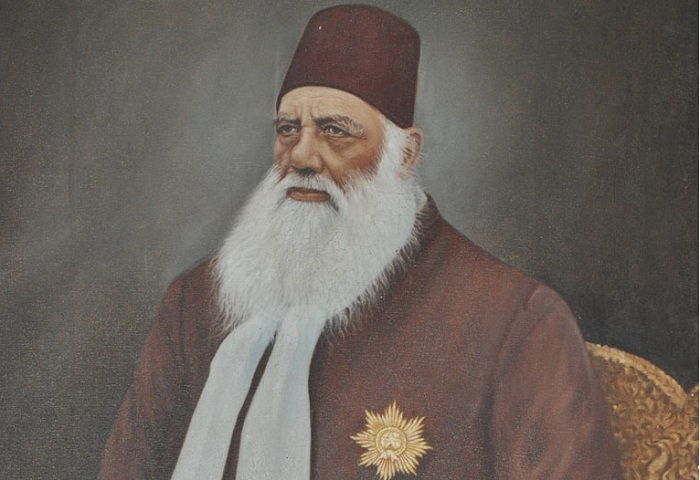
Syed Ahmad Khan: The founder of Aligarh Muslim University
The origins of the Islamist faction can be traced back to the Islamic Empires that existed before, and it is the accomplishment of the invaders that the Muslims of the late 19th century and early 20th century still relied on for inspiration. Similarly, the Hindu Right can be traced back to the Hindu Empires and Kingdoms of yore, the Marathas and the Rajputs and others.
Of course, the ‘first war of independence’ in 1857 were fought between the descendants of these kingdoms and empires against the British. Thus, the memory of those empires significantly contributed to the vision that these factions harboured for themselves and their position in history that they deemed to occupy.
Syed Ahmad Khan (source: Cultural India)
Such a worldview, of two different nations, was first articulated by Syed Ahmad Khan, the founder of the Aligarh Muslim University. He said as far back as in 1876, “I am convinced now that Hindus and Muslims could never become one nation as their religion and way of life was quite distinct from each other.”
Seven year later, he said again, “Friends, in India, there live two prominent nations which are distinguished by the names of Hindus and Mussalmans…To be a Hindu or a Muslim is a matter of internal faith which has nothing to do with mutual relationships and external conditions…Hence, leave God’s share to God and concern yourself with the share that is yours…India is the home of both of us…By living so long in India, the blood of both have [sic] changed.”
Of course, it has now become fancy among ‘secular’ political circles to deny Syed Ahmad’s proclamation of two nations and attribute it to Vinayak Damodar Savarkar instead, so that the Islamist contribution to the events of Direct Action Day can be whitewashed.
The Partition of Bengal
Prior to the Partition of India along religious lines, one province of British India was already made to undergo such a partition four decades ago. We are obviously referring to the Partition of Bengal, 1905.
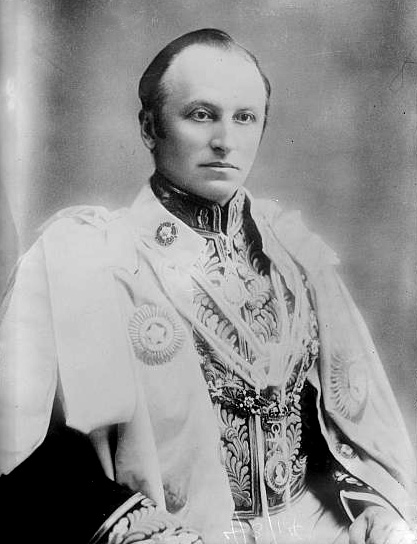
While Lord Curzon, the then Viceroy of India, claimed that it was purely administrative reasons, he soon let the cat out of the bag when he pointed out to the citizens of East Bengal that he saw the newly created province as ‘Muslim’.
Indeed, Bengal was split into two and East Bengal was joined with Assam and West Bengal with Bihar and Odisha. It had a two-fold impact. It created a ‘Muslim’ state, according to the words of Lord Curzon himself, and simultaneously, it made Bengali Hindus a minority in their own land, as they were then outnumbered by Biharis and Odiyas.
The Bengali Hindu elite, or Bhadraloks as they were called, was one of the most influential communities in the political circles of that era. Netaji Subhash Chandra Bose, one of the most formidable foes the British had to face, was a quintessential ‘Bhadralok’.
Lord Curzon, Viceroy of India during Partition of Bengal
‘Bhadraloks’, although it means ‘Gentlemen’, has traditionally referred to the landed Hindu elites of Bengal. While the term is often misconstrued as a caste-specific term, the fact of the matter is that since the initial days, the term has undergone great changes in its meaning and now it simply means just that, ‘Gentlemen’.
It is the elite class of Bengali Hindu society that every Bengali aspires to, regardless of their caste. And the term is used for everyone who occupies the elite class of Bengali Hindu samaj, regardless of their caste.
The Partition of Bengal, by reducing the Bengali Hindu community to a minority in the Bengal province, was designed to undermine the influence of Bhadraloks. As such, there was great resistance against the same and soon, it turned into a resistance at a national level.
After much resistance, which often employed violence as a tool against oppressors, the British regime had to roll it back six years later. Muslim leaders of the time had enthusiastically supported the partition while Hindus opposed it. And the reversal of the same caused much anguish to the Muslim leaders of yore.
The Success, and Failures, of the Partition of Bengal
After the rollback of the Partition of Bengal, the capital of British India was transferred to Delhi, which was perceived to be more secure than Kolkata. Historians have noted that had the Brits refrained from pushing through the harebrained scheme, then they could have avoided a lot of trouble that came their way.
The move also meant that the Bhadraloks of Bengal adopted a hardline stance towards independence and issues between Hindus and Muslims. On the other hand, Muslims who espoused the two-nation theory, and that was practically every Muslim leader of the time with influence, tasted their first success which would only galvanise them in the future.
Also, the national movement against the Partition of Bengal meant that the Muslim leaders concluded that the Indian National Congress was a vehicle for Hindu interests and that their desire for supremacy will not be accommodated within the Congress fold.
It is only a few years after that we see a clear wedge appearing between the Congress and the Muslim leaders of the time.
The next phase of events that led to Direct Action Day
The next phase of events, which led even the Hindu Right to conclude that the differences between the leadership of two communities could not be reconciled, began with the abolition of the Caliph of the Ottoman Caliphate.
The Khilafat Movement, which was launched in India, to demand the restoration of the Ottoman Caliph, gained widespread support of the Indian Muslim community. The movement exacerbated the already existing differences between the two communities and made Hindus intrinsically aware of the threat of Islamic radicalism.
Soon after, there was the Moplah genocide of Hindus as well. Undoubtedly, although the official demand for a separate Islamic state was made much later, there were sufficient indications it was a distinct possibility since the 1920s.
The momentum culminated with the Pakistan resolution of 1940 but there were a lot of events that happened between 1918-1940 that deserve much greater elaboration.
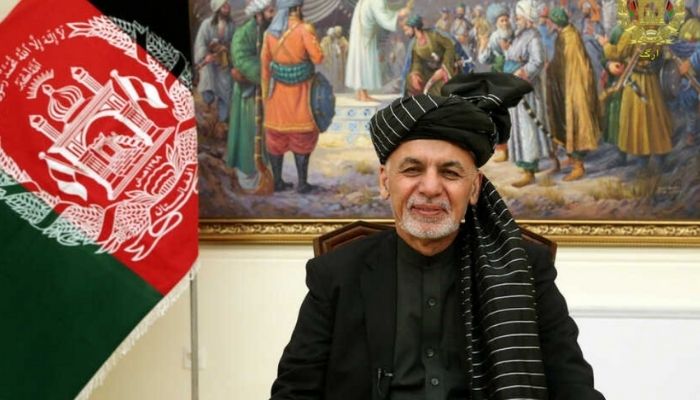
On Saturday (August 14), Afghan President Ashraf Ghani made his first public appearance after the Islamist terror outfit, Taliban, intensified its offensive and got hold of key territories. Dozens of border crossings and provinces have fallen into the hands of the Taliban since the US announced to withdraw its troops by August end.
In a pre-recorded message, the Afghan President called for the remobilisation of armed forces, following their crushing defeat at the hands of the Taliban. He emphasised that it was the topmost priority of the Afghan government. Ashraf Ghani said, “Under the current situation, remobilizing of the security and defence forces is our top priority and required measures are underway for this purpose.”
Afghan President Ashraf Ghani, in first public remarks in days after major Taliban advance:
– Remobilisation of armed forces top priority – Holding consultations with local leaders and international partners pic.twitter.com/5Lz5EwUIcu
He also informed that the government is in touch with ‘local leaders’ and ‘international partners’ to resolve the ongoing human rights crisis. The Afghan President said, “I know that you are concerned about your present and future but I assure you as your president that my focus is to prevent further instability, violence, and displacement of my people. To do this, I have started widespread consultations within and outside the government, with political leaders and international partners and I will soon share the results with the people.”
The president said that he will not allow the imposed war on Afghans to bring further killings, loss of the gains made in the last 20 years, destruction of public property and continued instability.
Afghan President refuses to resign as speculated
It was earlier being speculated that the President would tender his resignation today and leave the war-torn country with his family. But, contrary to the assumptions, Ashraf Ghani did not resign from the post of President. It must be mentioned that the Pakistani Prime Minister Imran Khan, known to be sympathetic to the Taliban cause, had earlier claimed that the Islamist terror outfit would not negotiate until Ghani left Office.
Afghan President Ghani hasnt resigned as was being speculated. He just talked about instability in the country. https://t.co/3cYm4OaT6v
On Friday, Afghan Vice-President Amrullah Saleh informed about a high-level national security meeting chaired by President Ashraf Ghani. He informed, “It was decided with conviction and resolve that we stand firm against Taliban terrorists and do everything to strengthen the national resistance by all means and ways. Period, We are proud of our ANDSF (Afghan National Defense & Security Forces).”
In today’s meeting on national security chaired by Prz @ashrafghani it was decided with conviction & resolve that WE STAND FIRM AGAINST TALIBAN TERRORISTS & DO EVERTYHING TO STREGNTHEN THE NATIONAL RESISTANCE BY ALL MEANS AND WAYS. PERIOD. We are proud of our ANDSF.
In Afghanistan, the Taliban offensive has resulted in a massive humanitarian disaster. In the last two months, the resurgent Taliban have gained more territory in Afghanistan than at any time since they were ousted from power in 2001. According to reports, the escalation of the war in the last two months has displaced over 60,000 households across war-torn Afghanistan’s 34 provinces. At least 17,000 families have sought refuge in Kabul, the Afghan capital, which is also under siege by Sunni Pashtun rebels.
The incredible speed at which the Taliban has been grabbing large swaths of land in Afghanistan since the US and NATO forces announced their withdrawal from the war-torn country after 20 years of presence, raises concerns about how long the Afghan government will be able to hold control of the remaining areas of the country. According to reports, nine provincial capitals and three towns have been captured by the terrorist group on Tuesday alone.
According to Reuters, US intelligence analysis says that at this rate, Taliban militants could isolate Afghanistan’s capital in 30 days and possibly take it completely over in the coming 90 days. Islamist groups currently control around two-thirds of Afghanistan, with 11 provincial capitals under their control or on the verge of doing so. As the Taliban capture more areas, imposing Islamic Sharia law and executing opponents, civilians from those areas are rushing to the capital.
Rwanda President Paul Kagame could not control his emotions after Premier League team Arsenal suffered a humiliating defeat against the newly promoted side Brentford on Friday.
On Friday, Rwanda President Paul Kagame, a die-hard fan of Arsenal FC, took to Twitter to let out his frustration against the club management due to the continuous disappointing performance by the English soccer team. Kagame was left gutted after the Gunners suffered a 2-0 defeat against Brentford on the first day of the Premier League.
Mikel Arteta’s side was defeated by the newly-promoted side Brentford with goals from Sergi Canos in the 22nd minute and Christian Norgaard in the 73rd minute at Brentford Community Stadium.
Following the loss to Brentford, the Rwandan President poured his pain on his social media page by calling out the management, saying that the club’s fans do not deserve that.
“What?? It’s football, it’s a loss for Arsenal against Brentford. Brentford deserved to win and they did. The game itself aside, Arsenal and the fans don’t deserve to kind of get used to this….NO!!! I say this as one of the big fans of Arsenal. The change has taken too long to come,” Paul Kagame wrote.
What?? It’s football,it’s a loss of Arsenal at/to Brentford. Brentford deserved to win and they did. The game itself aside Arsenal and the fans don’t deserve to kind of get used to this….NO !!! I say this as one of the big fans of Arsenal. The change has taken to long to come!
After another disappointing performance by the English soccer team, Kagame wondered why Arsenal does not have a working plan, especially when it comes to buying new players.
“It’s been a struggle of about decade(s) – ups and downs – more downs until this point. Can’t we have a plan that really works? One part to look at is how we deal in the market – players we buy to execute the plan. The touch & go mentality does not bring change,” he tweeted.
It’s been a struggle of about decade(s) -ups&downs-more downs until this point. Can’t we have a plan that really works?? One part to look at is how we deal in the market- players we buy to execute the plan. The touch&go mentality does not bring change.
It is worth mentioning that Rwanda is one of the sponsors for Arsenal FC. Rwanda has paid an undisclosed amount as a fee to extend its sponsorship deal with Arsenal FC as the government intends to boost its tourism prospects through partnerships with European football clubs.
The Rwandan head of state also stated that Arsenal fans should not accept mediocrity, insisting those in charge of the club understand the problem and take the burden.
“A team has to be built with a purpose to win win win. So that when we lose…it was not to be expected!” Kagame continued.
We just must NOT excuse or Accept mediocrity. A team has to be built with purpose to win win win. So that when we lose….it was not to be expected! I am sure we all know on whose shoulders the heaviest burden rests. I hope they know too or even accept it!!! End
“I am sure we all know on whose shoulders the heaviest burden rests. I hope they know too or even accept it,” Kagame said, ending his series of tweets expressing disappointment over Arsenal’s ongoing collapse.
Three persons have been arrested by the Uttar Pradesh police after the residents of Kacchi Basti area in Kanpur allegedly beat up a man in the middle of the road over the allegation that he was forcing a Hindu woman to convert to Islam.
According to reports, a man identified as Afsar Ahmad was allegedly roughed up by the residents of Kanpur and allegedly made him chant “Jai Shri Ram” over suspicion that he was forcing a Hindu woman to convert to Islam. The incident had taken place at the Kacchi Basti locality in the Barra area of Kanpur on Wednesday.
The purported video of the incident had gone viral on the internet, in which some people were seen allegedly beating Afsar Ahmad while his five-year-old daughter pleaded with them to let her father go.
कानपुर: वरुण विहार में कुछ दिन पहले एक महिला द्वारा मुस्लिम युवक पर जबरन धर्म परिवर्तन कराने का आरोप लगाया गया था, जिसके बाद बजरंग दल के लोगों ने युवक की जमकर पिटाई की थी, मासूम बच्ची लगातार लगा रही थी पिता को बचाने की गुहार लेकिन पुलिस बनी रही मूकदर्शक।#UttarPradesh#UPPolicepic.twitter.com/NLSicpNOCw
Reportedly, the residents of the Kacchi Basti had thrashed Ahmad, an e-rickshaw driver, accusing him of raising anti-national slogans. The police had rescued Ahmad and taken him and his daughter to a police station.
Following the incident, Kanpur Police Commissioner Asim Arun had said the three men were arrested on Thursday night for allegedly attacking Ahmad. The police added that one of the arrested, Aman Gupta, has affiliation to the Vishva Hindu Parishad (VHP). The police had registered a case based on a complaint filed by the victim.
Kanpur: Dalit Woman accuse Afsar Ahmad of forcefully converting Hindus
However, the residents of the neighbourhood have revealed that the man was beaten up for pressurising Hindus to convert to Islam. A woman, who is a Dalit, has alleged that Afsar Ahmad was pressuring her to convert to Islam. She said that she had approached the police and registered a complaint, however, no action was taken.
As police failed to act against her complaint, she went to the Bajrang Dal and met the outfit’s district organiser Dilip Singh. The Hindu activist also reportedly confirmed that the Bajrang Dal interfered after the woman accused Ahmad of forcefully converting her to Islam.
“Two days ago, we filed a complaint of religious conversion with the police, but they did not take any action on it. Since the police did not take any action, today, we took action,” Dilip Singh said.
Dalit woman had accused Muslims of the area of stalking and harassing her daughter
According to Swarajya journalist Swati Goel Sharma, the residents who thrashed Afsar Ahmad were mostly Dalits. The journalist added that the attack case is connected to another case complaint filed by a Dalit woman accusing some neighbouring Muslim youths of stalking and harassing her minor daughter.
At the heart of the recent Kanpur case where a Muslim man was beaten and asked to chant Jai Shri Ram by a crowd comprising mostly Dalits, is a police case where a Dalit woman complained against some neighbouring Muslim youths of stalking and harassing her minor daughter pic.twitter.com/YeJEtxBvus
Earlier, the police had said that the assault on Ahmad was linked to a dispute between two families belonging to different communities who live in the slum where the incident took place.
According to the journalist, Afsar Ahmad is said to have had no role in the harassment case, and he happens to be a relative of the Muslim men who were booked in the case filed by the Dalit woman. She added that two of the three men arrested were Dalits.
The poor man who was beaten up – Afsar – is said to have had no role in the harassment case. He happens to be a relative of the Muslim men who were booked under IPC 354 (Outraging modesty of women)
On Friday, all the three accused were released on bail by police as they were booked under IPC sections which had a jail term of fewer than seven years.
Joseph R. Biden Jr. has begun his innings as President of the United States with possibly the worst, most humiliating military defeat for America in history. But you would not know it if you looked at CNN.
Most transformative president since Roosevelt? Yes, as America begs with Taliban to spare its Embassy in Kabul, what better than to compare Biden to the president who defeated the Nazis and liberated the whole of Europe? What should we call America’s retreat from Afghanistan? A Normandy landing in reverse?
Because of their geographical situation, Americans are not used to attacks on their own soil by foreign enemies, at least not since the 20th century. They have Canada to the north and Mexico to the south, both friendly and subservient nations. In the mid-1800s, the US realized that keeping European colonial powers out of the Americas was in their best interest. This resulted in the ‘Monroe doctrine,’ which states any outside intervention on the American continent (whether North America or South America) is essentially an attack on the United States itself. America worked out all its territorial disputes early and always in its favor, such as during the 1846 US-Mexico war, when the short-lived Republic of Texas, along with most of modern day California and New Mexico were absorbed into the union.
From the Atlantic coast to the Pacific, America came to believe that they owned all the land in between. In this stretch, wherever they encountered Native American nations, they destroyed them all. This cultural belief came to be known as ‘manifest destiny.’
So when 9/11 happened, Americans had no frame of reference to describe it. Except for comparisons to Pearl Harbor. After Pearl Harbor, the US sent its troops to every continent. They knocked out the Japanese in Indochina, the Nazis all across North Africa and Western Europe. They ended the Nazi regime, put its leaders on trial for war crimes and had them hanged. Then, they organized a massive reconstruction program (Marshall plan). They reconstituted western Europe with stable democracies throughout.
We are just a few weeks short of the 20th anniversary of the 9/11 attacks. Where does America find itself? Begging with the Taliban. Most transformative president since Roosevelt, you see…
Of course, the author of that article on CNN is one Jeffrey Sachs, who as you can see, is some academic leech at Columbia who knows which side his bread is buttered. His bootlicking is pathetic, but hardly uncharacteristic for CNN, the New York Times, NBC, CBS or the Washington Post. In fact, in America’s privileged liberal circles, bootlicking Biden is now a highly competitive sport. If anything, “Professor” Jeffrey Sachs will have to do a lot better to polish his resume. How about comparing Biden to generals Eisenhower or Patton?
One can compare this to Vietnam, but the Afghanistan defeat is even worse than that. In Vietnam, America managed to achieve a decent interval of about two years between troop withdrawal and the fall of the South Vietnamese regime in Saigon. At least, there was a ceasefire at the moment when US troops were leaving Vietnam. Here, the enemy isn’t even waiting for the Americans to withdraw before rampaging across the country. In Vietnam, Kissinger worried over the shame of losing to what he considered a “third class peasant state.” Here, America has lost to something much worse.
Why did this happen? Failure of strategy? That whole thing about Afghanistan being the ‘graveyard of empires’?
Don’t let the elites at CNN or Columbia fool you with such myths. America failed in Afghanistan because it was a hopelessly corrupt superpower getting eaten up on the inside by its own elites. The official cost of the Afghanistan war is $900 billion over at the Department of Defense. Where did this money go? How come the Afghan military, supposedly trained and supplied by America, is folding before Taliban without even a fight?
I will tell you where the money went. It went into the pockets of defense contractors, who have more lobbyists deployed in Washington than military personnel that the US ever deployed in Afghanistan. In fact, the US military is not even what you might think it is. The official death toll in Afghanistan is 2,442 personnel. But that does not include some 4000 Americans who were fighting for “private security contractors” employed by the US government. Yes, they look like soldiers, they use tanks and everything, but they are not government soldiers. Yes, they in America outsourced the war itself. And, by the way, the Pentagon does not track the deaths of these “private security personnel.”
If you are picturing only the big defense contractors and weapons manufacturers in your head, you are wrong. Even a small supplier who hands out pens, notebooks and literature for mediapersons at Pentagon press conferences hopelessly inflates the cost. The American taxpayer pays up. The gravy train stops at every station, where the driver and the guard open the locks for the chest to be raided.
Who says America lost in Afghanistan? The elites made a killing.
At the peak of World War 2, the US was producing more than one complete ship a day. Seriously, look it up. They called them “Liberty ships.” Try doing that today.
In diplomacy, the most difficult balancing trick is to frame your foreign policy in moral terms. Everyone nation negotiates in their own self interest. That may sound clever, but it is really a trade off. One reason the US has so many allies around the world, while China does not, is that the US has been successful in framing its policy in terms of moral principles. As America leaves Afghanistan in the lurch, what does it do to their credibility? Why should anyone ever trust the US again?
Especially, all the Indian liberals, who shake their fist at Modi government, are you watching? Are you watching as the liberal American government abandons the people of Afghanistan? Where is your Kamala Harris, or even better, the great humanitarian Meena Harris? Remember how Meena couldn’t sleep because police used water cannons in Delhi? What does Meena Harris have to say on Afghanistan now? Perhaps I need to buy a shirt or key chain or some such merchandise from Meena’s online store before she’ll say…
Tell me why, as an Indian, I should trust a single word in the New York Times or Washington Post. Why should I believe your Freedom House and its so called democracy and press freedom index? How do I know you liberal elites feel for me? You are letting the barbaric Taliban carry out mass executions of your allies in Afghanistan.
So when I see India criticized on the front page of the New York Times, I can only wonder about your interest in my country. What do you have in mind for India? Regime change?
Trump was straight with everyone else. He said ‘America first.’ It was literally in his campaign slogan. He saw the Afghan war was not in America’s interest and so he decided to end it. But what do I make of liberal elites, who pretend to be running some international humanitarian regime?
You elites have plundered the ordinary American taxpayer. And you took the sons and daughters of the poorest Americans and sent them to fight halfway around the world, in Afghanistan, in Iraq and everywhere else. You sold contracts for the war and didn’t even keep track of how many of your own died there. Now, when you are through, you leave the Afghan people to the barbaric Taliban and run away. You don’t care about ordinary Americans, nor about Afghan civilians, nor about the prestige of your country. Instead you rub your noses in front of Biden and flatter him with comparisons to Roosevelt. And I am supposed to believe that this corrupt bunch cares for the welfare of my country?
A resurgent wave of coronavirus has the United States in its grip as COVID-19 caseloads have seen a steady uptick, especially in the southern states.
According to figures released by the Centers for Disease Control and Prevention (CDC), the average number of new Covid-19 cases in the USA has risen to 110,000 per day, about 25,000 more than a week ago. It’s the highest average since early February. The US on August 13, 2021, reported a staggering 1,86,840 COVID-19 cases, taking the 7-day case average to 1,28,537.
The latest coronavirus surge is driven by the highly transmissible Delta variant, which has already ravaged India, Australia and many other countries. CDC officials claim 93 per cent of confirmed COVID-19 cases in the United States are due to the Delta variant.
Overall, 36 million COVID-19 cases have been reported in the United States since the start of the pandemic last year. Deaths related to COVID-19 in the United States have now surpassed 617,000.
The resurgence of the coronavirus outbreak in the United States is powered by the unprecedented number of cases recorded in the southern states, including Alabama, Nevada and Texas.
The US may also witness a spike in COVID-19 related hospitalisations and deaths over the next four weeks, the country’s public health agency CDC has warned.
The US Centers for Disease Control and Prevention (CDC) published ensemble forecasts on Wednesday pegging 9,600 to 33,300 new confirmed COVID-19 hospital admissions likely reported on September 6 and 3,300 to 12,600 new deaths likely reported in the week ending September 4.
As per a report published by CNN, eight southern states account for 15 per cent of the total hospitalisations seen in the United States. These states are Alabama, Arkansas, Florida, Georgia, Louisiana, Nevada, Mississippi and Texas. Between them, the combined total makes up 51 per cent of the total patients, despite the region accounts for 24 per cent of the nation’s population.
Southern US states see a sharp rise in COVID-19 related hospitalisation, with Texas being worst-hit
Texas is among the worst-hit states with the recent bout of coronavirus outbreak as the frontline workers are overwhelmed and critical equipment stretched dangerously thin. Apparently, the surge is also driven in the states with relatively low vaccination rates, with Texas ranking in the bottom third of the country for vaccinations.
In Austin, the state’s capital, city and county officials issued an emergency alert system over the weekend to inform residents with the warning that the hospital situation is critical, as the number of available intensive care unit beds in a metro area rapidly dwindled into single digits. Authorities fear that if the current trend persists, Austin might witness a record number of deaths due to COVID-19.
A tent set up at Lyndon B. Johnson Hospital in Houston, Texas
The situation in Texas has reached such a stage that the hospitals in the state are now preparing tents in anticipation increased number of patients. However, the hospitals still face a shortage of manpower to attend to all the patients, and it will become worse when they start admitting patients in the tents also.
However, COVID-19 cases in Florida swelled despite having vaccinated 71 per cent of its adult population with at least one shot. On Tuesday this week, the state broke the record again for hospitalisations at 15,169. For weeks, the state was significantly below the national average.
CDC revises its infection numbers for Florida after combining cases reported on multiple days into one
Misinformation has also added to the rising panic amidst a new spike in coronavirus cases. On Monday this week case, the CDC misreported the number of infections reported in Florida over the span of three days and portrayed it as cases registered for two days. CDC reported 56,633 infections over two days and divided it into two days for a record 28,317 and 28,316, surpassing the previous mark of 23,903 Friday. However, the numbers were later corrected, with the CDC issuing a clarification that they had mistakenly combined infections reported on multiple days into one.
In the revised count, the CDC said the total cases’ increase is 56,393, including 21,487 Saturday and 19,584 Sunday. On Monday, it said the two-day total was 56,633. Adding to the further confusion, it listed the three-day total as 56,386. The cumulative total is 2,782,060.
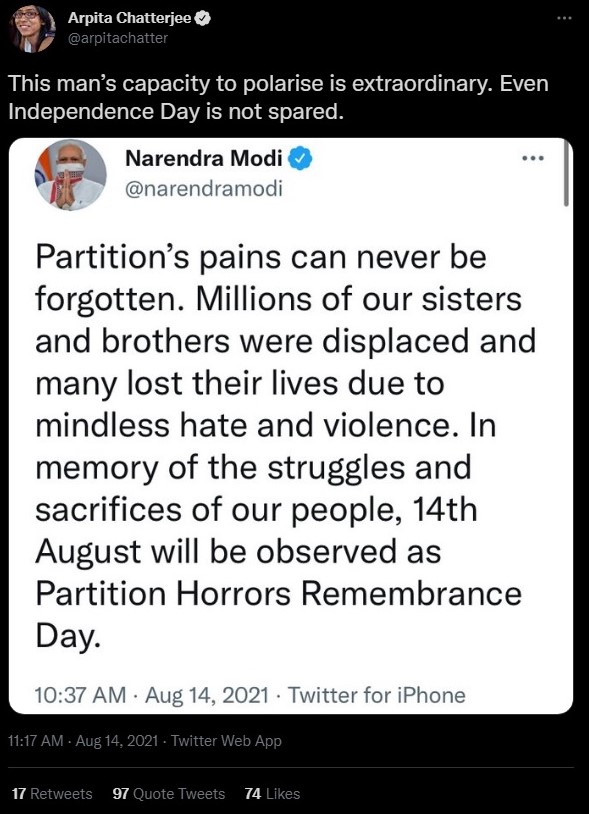
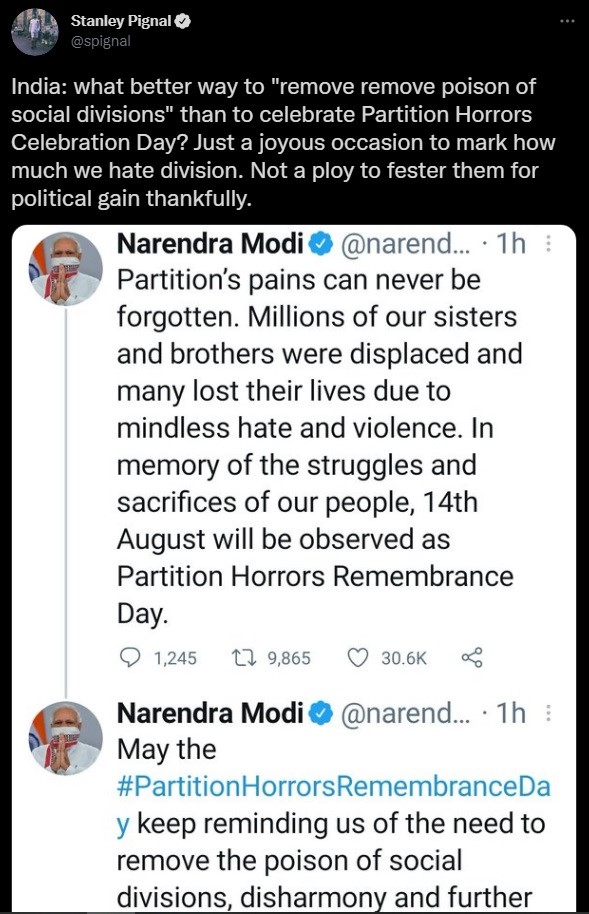
Prime Minister Narendra Modi announced on Friday that the 14th of August, henceforth, shall be recognized as ‘Partition Horrors Remembrance Day’. It is the first time in the history of Independent India that the horrors of the partition of the country in 1947 has received institutional recognition from the highest seat of government in the country.
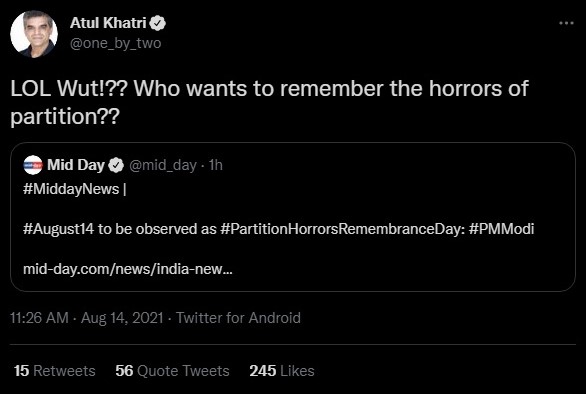
Naturally, certain people are not too happy with the development. Atul Khatri, apparently comedian, but terribly unfunny if he is indeed one, questioned who even wanted to remember the horrors of partition, in a tone that mocked the Prime Minister of India.
Source: Twitter
Apart from the comedian, there was also a former journalist who took offense at the recognition of the horrors of partition. She accused Prime Minister Modi of polarising Independence Day through the Partition Horrors Remembrance Day.
Source: Twitter
Then there was the Stanley Pignal who claimed that Prime Minister Modi was celebrating “Partition Horrors Celebration Day”. It appears he does not realise that people do not celebrate horrors, they recall them with solemn remembrance as a memory of the tragedy that they were forced to endure.
Source: Twitter
Of course, there are some Pakistanis who are not pleased as well. But that is only to be expected as the date collides with their independence day. Nonetheless, there is good reason why people of a ‘secular’ bent are not happy with the official recognition of the horrors of partition.
The foundation of Indian Secularism is built atop the corpses of Hindus who were raped, massacred and butchered during the Independence Era. Post-independence, we were fed a heady cocktail of Congress propaganda that valourised their struggles against the British, and totally negated the fact that they were utterly incompetent at preventing the atrocities committed against Hindus.
In order for their political careers to succeed, the Congress tried extremely hard to create an ‘alternative history’ for the citizens of India where the horrors of partition were relegated to the dustbins of history.
Instead, Jawaharlal Nehru was presented as Marvel’s Iron Man without the suit and Mohandas Karamchand Gandhi as the second coming of Jesus Christ. Even those who had actively participated in the horrors were either pardoned or accommodated into the newly created Indian Union.
But be that as it may, the partition of the country affected every single Indian, whether directly or indirectly. And after 74 years, we have crores of citizens who are descendants of those who had to endure the horrors at the time and of those who had to flee their native land and migrate to India to secure a better future.
A tragedy of that scale could never be washed away. With the passage of time, however, maintaining a silence over the horrors of partition has become a cornerstone of Indian Secularism because, apparently, speaking of the tragedy would ‘spark communal disharmony’ and ‘hurt Muslim sentiments’.
On one hand, it is claimed that Indian Muslims had nothing to do with partition and on the other hand, it is claimed that speaking of the horrors would cause communal disharmony. It just does not make any sense, but then, neither does Indian Secularism.
As a wise man once said, “What began as a tragedy shall end as a farce.” According to Indian liberals, Islamists worldwide are always the victims and never the aggressors and therefore, we must not broach any subject that might portray them in a negative light.
Denial of the tragedy of the Hindu community is, obviously, the cornerstone of the brand of Secularism liberals espouse. They fail to realise that the reason why Indians hate Pakistan is due to the events of the partition era. They fail to realise that the dream of Akhand Bharat is so alluring to so many because a significant section of Indians have their ancestral lands in places that today lie in Bangladesh or Pakistan.
They fail to realise that mere pages of history books cannot silence the cries of millions and millions of people. Prime Minister Modi only paid homage to those who had to endure torture beyond recognition during the partition of the country. And in doing so, he has institutionalised a part of our history that has remained buried for far too long. It was long overdue, indeed, but it is better late than never.
Serum Institute of India’s chairman Dr Cyrus Poonawalla, father of CEO Adar Poonawalla, has lauded Prime Minister Narendra Modi while reminiscing how life was not easy for vaccine makers before his regime, as he had to “fall on the feet” of bureaucrats and drug controllers to get required permissions for vaccine launch.
The founder-chairperson of the Pune-based Serum Institute of India (SII) was speaking after receiving the prestigious Lokmanya Tilak National Award 2021 on August 13 (Friday). He was conferred with the award for his contribution to the health sector as well as the vaccine production in the country.
‘Licence-raj’ curtailed under PM Modi’s regime, no need for ‘maska polish’: Serum Insitutue’s Cyrus Poonawalla
The SII chairman said during the event that unlike earlier, there is no need to do ‘maska polish’, referring to appeasing officers in charge, under PM Modi’s regime. This, he said, is the reason why Serum’s Covishield was launched so quickly.
“Serum Institute was founded in 1966 the morning after my marriage with Villoo, my dear late wife, to whom I dedicate this award. Fifty years ago, the industry faced hardships in getting basic facilities like power, water and getting permission from bureaucrats. It had to face harassment from bureaucrats…I was not supposed to say this,” he said recalling the governmental and bureaucratic hurdles during the UPA regime.
He hailed PM Modi for curtailing the prevalent “licence raj and “red-tapism”. Dr Cyrus Poonawalla added: “Transport and communication were also great problems and challenges that were faced by my staff and fellow directors…It was a long journey and a very painful one, which has now become very rewarding. I had to fall at the feet of bureaucrats and drug controllers, etc, to get permission. But I must stress that difficulties, red tape are much reduced now under the Modi government.”
Appreciating how PM Modi has encouraged the sector and assisted it to grow, the chairman of Serum Institute of India, the world’s largest vaccine maker by the volume of doses it produces every year, further said: “Certainly, one of the major reasons why we could launch our vaccine so quickly was forthcoming grant or permission, encouragement to industries as the licence raj has come down considerably. We have got a drug controller, who responds in the evening even after office hours. There is no need for ‘maska polish’ now”, added Dr Poonawalla.
Cyrus Poonawalla dedicated the award to his late wife Villoo and said that he has received numerous awards in the United States, the United Kingdom, but the Lokmanya Tilak award is very special to him.
Congress created hurdles for Serum Institute and others during the swine flu epidemic
For the uninitiated, Cyrus Poonawalla, who is the father of SII CEO Adar Poonawalla, founded the Serum Institute of India in 1966. Ever since the pandemic broke out necessitating countries to roll out vaccines that prevent COVID-19 on an urgent basis, Cyrus Poonawalla’s Serum Institute has been at the forefront of India’s fight against the Coronavirus pandemic.
The world’s largest vaccine maker boosted mass production and helped immunise millions of people around the world with substantial government support under the Modi regime. SII presently produces 6.5 crore Covishield dosages per month (developed by Oxford-AstraZeneca).
However, the situation was entirely different when the country was hit with Swine influenza’s 2009 pandemic. At that time, the UPA government had left Serum Institute of India and other firms in the doldrums, despite its assurance of authorized marketing commitment (AMC) to procure H1N1 vaccines.
Congress, left-liberal lobby at the helm of creating vaccine hesitancy in India
After successfully derailing plans to mass vaccinate the people against swine flu, the Congress party along with its vicious lobby held on to the agenda of hindering India’s vaccination drive against Coronavirus. Fuelled by a collective hatred for PM Modi, they targetted the vaccine manufacturers in a bid to demoralize them.