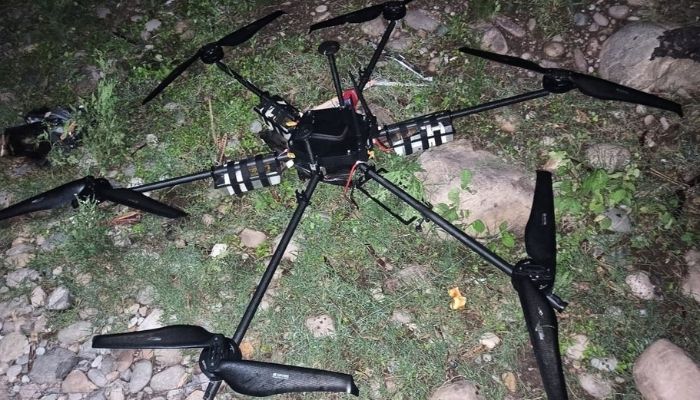
On Friday (July 22), the Jammu and Kashmir police shot down a Pakistani drone, carrying 5kg of explosives, at Kanachak near Jammu.
As per reports, the police have recovered the ‘almost ready to use’ Improvised Explosive Device (IED) attached to the drone. The cops confirmed that the drone shot down this time was similar to the one used to target the Indian Air Force (IAF) station on June 27. ADG Mukesh Singh said, “We have recovered the same threads and it is now confirmed that a similar drone had dropped the payload at IAF station.”
While speaking about the incident, Singh added, “Thursday night, we got specific inputs of terror outfit Jaish-e-Mohammad dropping some payload via a drone in Akhnoor sector. We acted swiftly upon the input and laid an ambush. Around 1 am a police team shot down a drone, well packed with five kg IED, which was almost ready to be used. Preliminary analysis of the drone revealed that it was a hexacopter with six wings and a flight controller and GPS.” He informed that only a wire had to be connected to the IED in order to detonate it.
Jammu and Kashmir: A drone was shot down in Kanachak area and explosive material was recovered. pic.twitter.com/amPKBVVq77
According to ADG Mukesh Singh, the serial number of the flight controller of the shot drone resembled another drone that was destroyed in the Hiranagar sector of Kathua last year. “It establishes beyond doubt that the terror group has procured many flight controllers with similar series for the purpose of installing them in drones,” he said. Singh emphasised that the drone, shot in Kanachak, was made using parts procured from China, Hong Kong, and Taiwan. Such drones can carry 10-12 kg of payload and travel up to 20 kms. The drone, destroyed by Jammu and Kashmir police, had entered 6-7 km within the Indian border.
We had deployed team near Akhnoor based on specific info. Around 1am, a drone was detected. When its was lowered to drop payload, police team started firing & shot it down. Payload weighing around 5 kg was IED in an almost prepared condition: Mukesh Singh ADGP, Jammu zone pic.twitter.com/gcHuSaeSr5
Pakistan masterminded drone attack on IAF’s strategic assets
On June 27, the Indian Air Force tweeted that two low-intensity explosions took place in the technical area of Jammu Air Force Station. The blasts took place at around 1:42 AM on Sunday and were so powerful they could be heard till 1 km distance. The drone dropped the bombs at a location close to the Helicopter hangar. The IAF suspected that these attacks were intended to target the strategic assets of the Indian Air Force located inside the airbase.
However, the forces managed to intercept and thwart the second attack minimizing the damage successfully. The other blast caused minor damage to the roof of a building while the other exploded in an open area. There was no damage to any equipment, the IAF said. The Indian Air Force had begun an investigation into the matter is in progress along with civil agencies. The technical area was sealed.
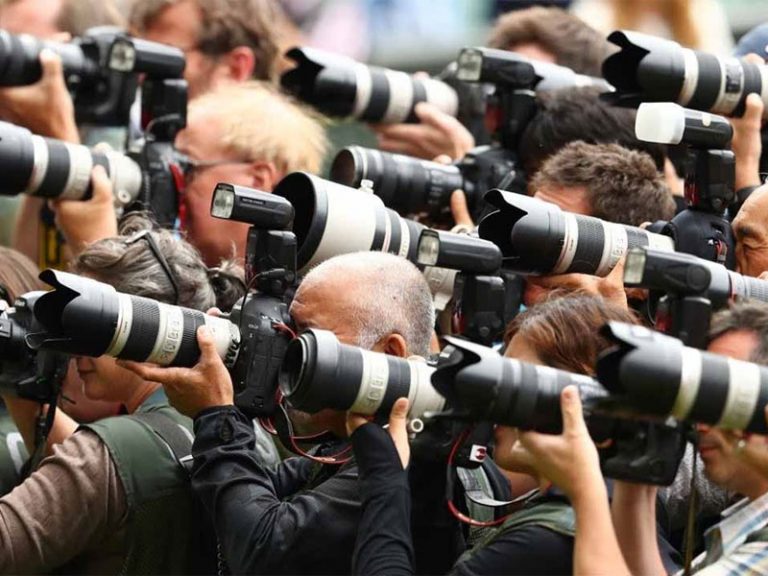
It has been almost 15 years since I first held the camera as a hobby. Being in the field as a professional photographer for few years and shifting the genre of work completely to writing, I have the experience of both the person behind the camera and the one who is looking at the results. There was a time I did some street photography, and that was the time when I, for the first time, felt the dilemma that everyone talks about. Even as a professional photographer, there was always a chance that I may offend someone, and I did miss some shots that could have been amazing if seen from my perspective.
Photojournalism and the fine line of ethics
The profession of a photojournalist is the most loved and hated one at the same time. A single shot can bring you both immense love and overwhelming hate from different sections of society. To be honest, in photojournalism, there is no grey area. It is either black or white. You cannot be neutral while looking at someone’s work in this field.
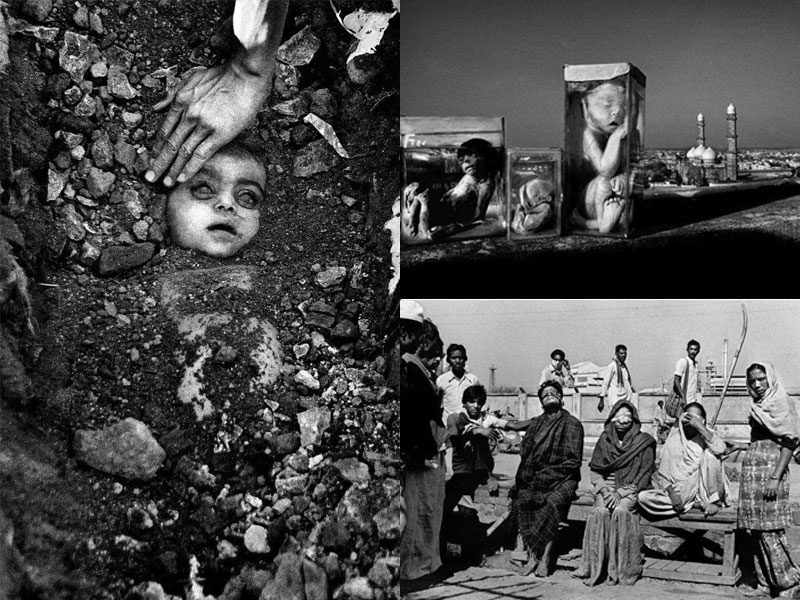
When I started writing this op-ed, the first name that came to my mind was one of the most famous photojournalists in the history of independent India, Raghu Rai. I know him as the person who brought the pain of the victims of Bhopal Gas Tragedy in front of the people. His iconic coverage of the tragedy made it possible for the people of the rest of the world to see how much devastation that one night had brought.
A few years back, I got a chance to attend a lecture by Raghu Rai. During the lecture, he discussed the coverage he had done after Bhopal Gas Tragedy. He said at that time, there was no time to think. He was numb and clicking photos continuously. “It was my job, and I was doing it dedicatedly,” he said. One of his shots, the last rites of a dead unknown child, became one of many heart-wrenching faces of the tragedy. If it was not for Raghu Rai and his fellow photojournalists who were on the ground, we might never know how big the tragedy was.
He once said about the photograph, “It was a heart-rending situation. His was an innocent face, and usually, when you see a dead person, their eyes are closed, but that child had his eyes wide open, and his family members were giving the last caress to him.” But can coverage of one tragedy justify the scenario that is being created in today’s time?
It is not possible for me alone as a photographer and a writer to justify the stand of every party involved. To make sure I understand the viewpoint of a photojournalist and other photographers, it was my duty, as a photographer, to talk, discuss and understand the viewpoints. I spoke to four photographers, learned their views and spoke to them about what they think about the ethics in photojournalism and if there should be a line.
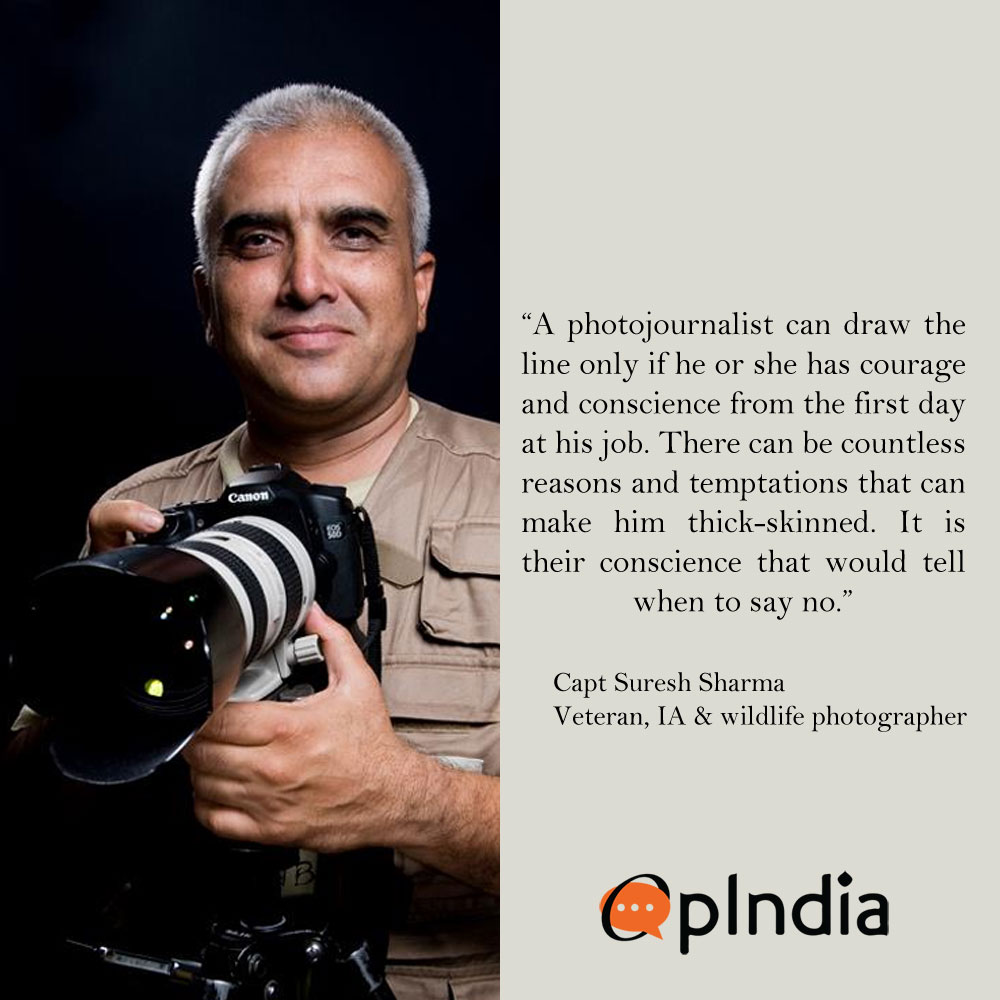
Capt Suresh Sharma, Veteran, Indian Army and Wildlife Photographer
Capt Suresh Sharma is an Indian army veteran who has served in peacemaking operations of the Indian Army in Sri Lanka. He is a wildlife photographer, snake rescuer and nature conservationist. I have known Captain for a very long time, and when it comes to ethics, I do not think there is anyone better than an Army officer to talk about how important they are.
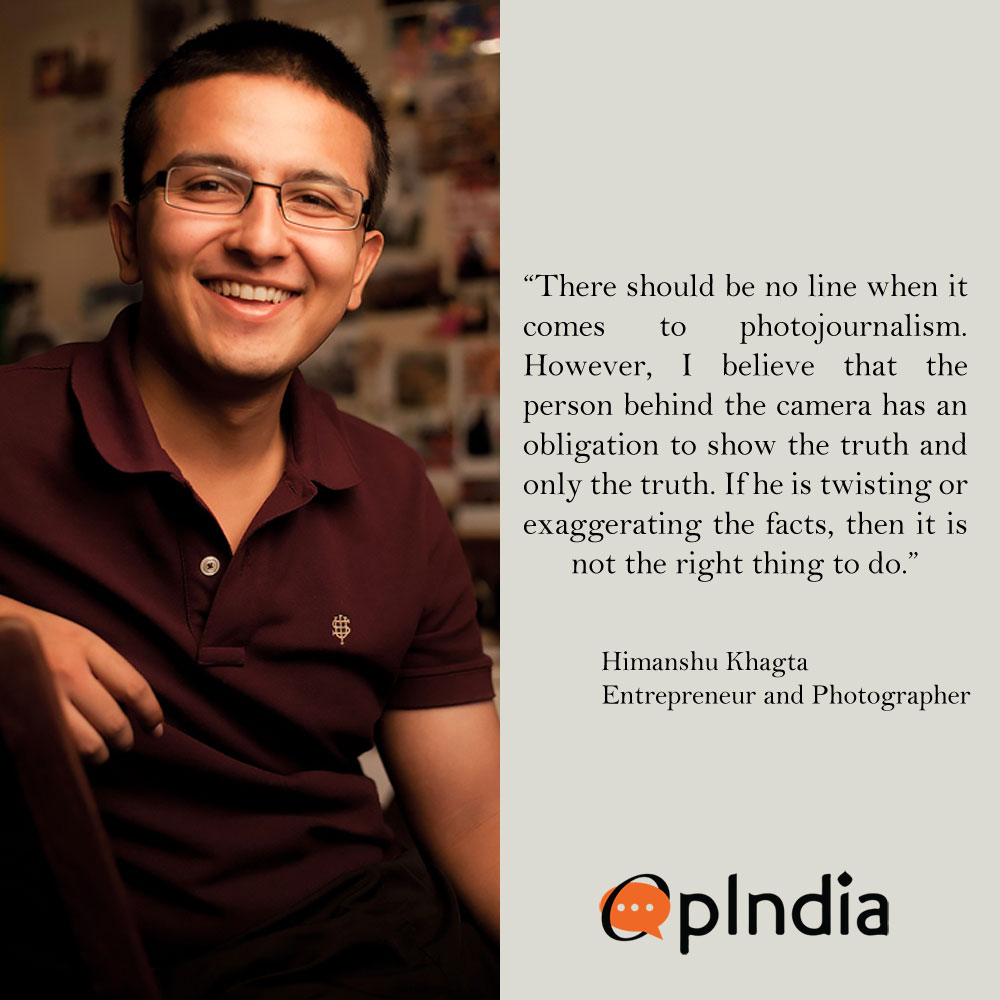
Himanshu Khagta, Entrepreneur and photographer.
Himanshu Khagta is one of the best photographers I have come across. His work as a travel photographer across the Himalayan region has attracted praise from all across the world. Currently, he is working as an entrepreneur selling apples and other produce from his farm and as a photographer. He spends most of his time in Shimla, Himachal Pradesh.
Vijay Singh Bainsla, Political Leader and Photographer by passion
Vijay Singh Bainsla is known as the face of the Gurjar community. Though he is best known as a political leader in Rajasthan, many do not know he is a brilliant photographer by passion for over two decades. Knowing him on a personal level for a long time gave me a perspective about the clarity he has about professionalism and ethics in any field, including politics.
Raminder Pal Singh, Freelance photojournalist
Raminder Pal Singh is a well-known photojournalist from Amritsar. Raminder has worked with a European photo agency for 16 years, and now he works as a freelance photojournalist. Talking to a photojournalist gives you a perspective that you might have been missing all that time. During the 30-minute conversation we had about the field of photojournalism and how he felt losing a fellow photojournalist to terrorists explained a lot about what goes in their minds while being on one of the most challenging jobs.
As I move forward, I would quote them often to explain what ethics say and how they and I interpreted them. However, one thing that is clear before proceeding ahead is photojournalism is not possible without ethics.
Ethics in photojournalism as defined by experts
Let us talk about the ethics that have been written and explained repeatedly for the photojournalists. These ethics, if followed diligently, will cancel the over-sensationalising of the news reports forever. But, unfortunately, the scene is entirely different everywhere.
Respect the truth
The first rule is to respect the truth. The first and foremost duty of a photojournalist to do is to show the truth and nothing but the truth. Raminder put up a crucial point while our discussion that photojournalists cannot be biased. They cannot have opinions. When a photojournalist goes into the field, the only aim should be to show the truth, cover it, and return. During the shoot, there should be no opinions running in your mind. There are consequences to revealing the truth, and he or she must be prepared to face them.
Sources are must
You must double and triple check the source before you submit the work. If the details of the incident are not verified and documents as they are, it can create a major law and order problem in the state. A photojournalist has the power to create the narrative. However, he or she should not do it. A non-biased explanation of the event with the photograph is what a photojournalist should submit.
The source must be traceable
If you are saying ‘xyz’ did ‘abc’ in the description as informed by ‘ijk’, the source should be traceable. There should be proof of anything and everything you are submitting. How editors and writers are going to interpret what you have clicked is not in your hand. But whatever is in your hand should be non-biased at any cost.
Do not create a photograph, click a photograph
As a commercial photographer, you can set up the studio as you please. However, when you are in the field, things are different. Himanshu said that though there must be no line in photojournalism as facts must come out in public, “if the photojournalist is twisting the facts by any means with the photographs, it is against the ethics.” There have been countless incidences in the past where so-called editorial photographs went viral, but in the end, it was revealed that they were staged. In that case, the photojournalist had committed an unethical practice that should be condemned.
It is essential that photojournalists follow a sense of responsibility. If someone is in distress, it is your utmost duty to help them especially if no one is around to help. However, in my opinion, if there are enough helping hands who have already come forward to provide the support required, you may step back and do your job from a distance. Show the tragedy and the heroes who come forward to help to ensure every aspect of the story is covered.
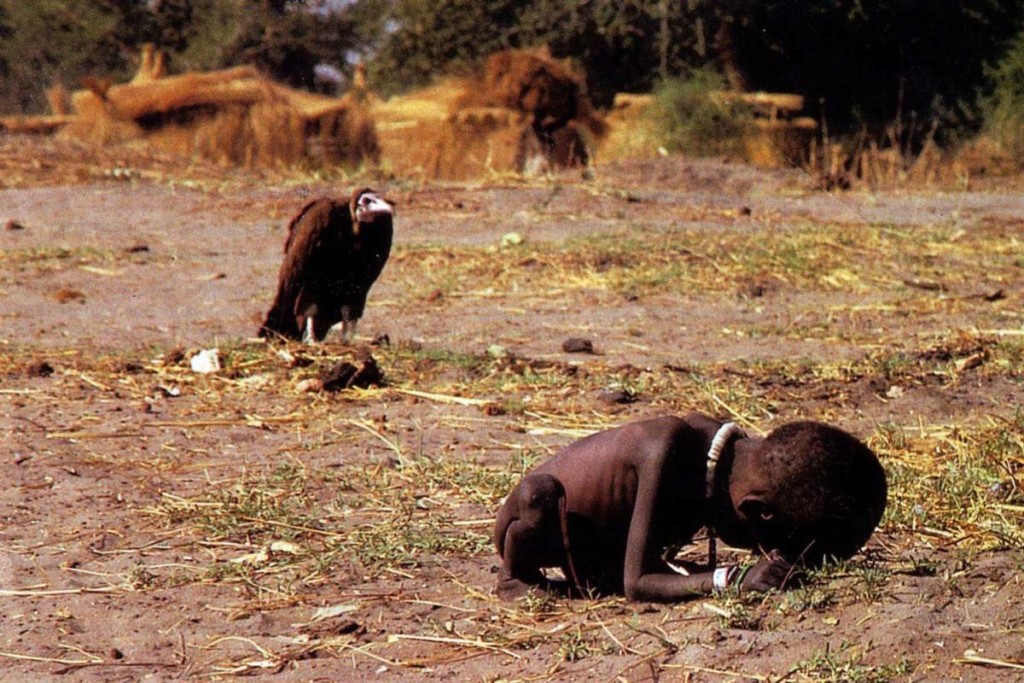
Here, the example of the infamous photograph by Kevin Carter of a malnourished child in 1993 in Sudan will be the perfect example. In the shot, the child, who was trying to reach the UN centre to get food, collapsed on the way. A vulture could be seen in the shot, waiting for the child to die. Carter won Pulitzer Prize for the photograph. However, it is believed that the heaviness that this particular shot brought to his life led to his suicide. The child, who was thought to be a girl and later found to be a boy, survived. He was identified as Kong Nyong, who survived the famine but later died of fever in 2007. On the one hand, Carter was praised for the photograph, but on the other hand, he faced severe criticism.
The vulture and the little girl by Kevin Carter
Respect the personal space
One of the most important aspects of photojournalism is to respect personal space. Raminder, as a photojournalist, has faced a dilemma countless times. He said when he went to cover the arrival of mortal remains of dead soldiers or covered someone’s death or moment of grief, “there were many moments when I missed shots. I was asked by many not to stop. I have seen a lot of photojournalists pushing their ways to shoot photographs. But I could not do it. If someone ever asked me to stop, I stopped.”
He added, “I have seen a lot of photojournalists unable to stand a grief-filled environment. Some couldn’t stand the sight of blood.” He narrated the story of the time when he went to cover the arrival of the mortal remains of a soldier for the first time. “I was overwhelmed by the emotions around me. There was a moment when I had to sit down to control my emotions. For me, respecting the sentiments of the family holds utmost importance. If they tell you to stop, the best thing you can do is to walk away and let them grieve.”
Treating the subjects with respect and dignity is what every photojournalist should practice. Intruding in someone’s personal space should be avoided unless there is a justifiable and pressing reason for their public disclosure. There had been countless moments when national and international media covered last rites in the past. In recent times, the last rites of Late Sushma Swaraj, Late Atal Bihari Vajpayee, Late Rishi Kapoor and several other leaders and celebrities were covered by media, and many became part of the event while watching it from home.
So the question that one may ask is how last rites of one person are okay to telecast, but people outrage when the same happened during the second wave of Covid-19? The issue in the latter is the way those images were presented. One cannot forget and forgive Annie Gowen for calling photographs of Covid-19 deaths “stunning”. Interestingly, she said she used the word in the context of “shocking”. If you live in India, ask anyone to use stunning in a sentence, and he/she will use it positively. Using a word that is used as something good or positive in a negative sense is not someone who holds such an ‘esteem’ post would do unless there were an agenda behind it. Sadly, Gowen is not the only one to take advantage of the tragedies during the second wave of Covid-19. Indian journalists were among the frontrunners to cover dead bodies and that too in a very vulture-like way.
Do not push for superficial consent or permission
As a photojournalist, there is always a desire to get the ‘best shots’ of the situation irrespective of what the subjects may think. In general, it is believed, and many times followed, that one must take the subject’s permission to click a photograph. It gives a sense of satisfaction to the photographer that he or she is doing the right thing. However, Captain Suresh believes that in many cases, the subjects do not have the courage or presence of mind to say no to the photographer.
He said, “One should never make an attempt to take permission of someone who won’t say no out of courtesy but will certainly take away some fun or comfort of his.” A family enjoying a picnic in a garden during the winter season may seem a brilliant subject to a photojournalist. A photograph of the family with the caption “In the age when no one has time, a family was seen enjoying quality family time” may attract a lot of praise. However, in most cases, families do not like getting intruded on by photographers. Taking their permission will only be a cover for something you should not have done in the first place.
The family may permit you to click, and you may sell the photograph for a good amount, there will always be a hidden grudge against you for intruding on their privacy. Thus, “Never push a person for permission even though it looks courteous but only superficially,” Captain Suresh added.
Captain narrated a story from one of his trips to Pushkar Cattle Fair. He said, “An old man had just started having his meal sitting on the ground in the sand. Almost 15 to 20 photographers encircled him from two sides – it was funny and hurtful to watch these photographers like vultures, half on one side and another half on the other side – they were almost shouting – Babba Iddhaar dekhna, the moment he would see on the left the right bunch of photographers would shout – Baba Idhar dekhna…without any patience and respect for his mealtime. After a few such turns and twists to his neck, he lost his cool and got up and threw his plate on the ground and screamed – Roti bhi khane do… Baba idhar dekh udhaar dekh … (At least let me eat, Baba look here, baba look there).”
“I knew one day photographers would lose respect in the field, and at Pushkar, they have already, and in most other places, photographers are disliked and discouraged. I stopped going to Pushkar as it’s no fun to be a photographer there. On my arrival, I used to roam around without a camera for two days and choose men and camels whom I would find charming for photos shoot by enjoying tea with them and break bread. I used to carry milk and veggies for them. Patience and respect your subject. Never shove your camera into their life,” he added.
Do not try to change the course of an event
A photojournalist must present the facts as they are. There should be no attempt to twist the facts in someone’s favour. Let me give you a very recent example. There was a report that a police officer allegedly assaulted a woman in Uttar Pradesh. The photo went viral on social media in a matter of hours. However, the truth was not what it looked like in the image. The woman had pulled the police personnel from his collar and tried to play the victim. Similarly, there had been countless incidents where photos represented a different story just because the caption was misleading. As a photojournalist, you should not indulge in such activities.
Be careful with the captions
Vijay Singh Bainsla was clear about the fact that when it comes to photojournalism, the only thing that photo must show is the truth. Though Bainsla echoed what Khagta said about not having a limit to what photojournalists show, he also agreed that if the photojournalist is trying to twist the facts, he is cheating on his/her profession. “You cannot distort the facts. If something has happened in a way, you must show it without creating a story in your mind. Let the readers interpret it in the way they want to.”
Raminder talked about several examples that gave a clear picture of how a photojournalist should caption the photographs. He said, “Imagine you clicked a photograph of a child eating ice cream. In that case, you cannot say ‘Child enjoying ice cream’. How can you be sure that the kid enjoys eating ice cream? The caption must be ‘Child eating ice cream’. Let the viewers decide if the kid is enjoying it or not.
“Similarly, if someone is walking in the rain and you clicked a photograph, the caption cannot be ‘man/woman enjoying the rain’. What if the person had a tragedy at his/her house? How can you be sure that person is not crying while walking in the rain? The caption must be ‘man/woman walking in the rain’. Nothing more or nothing less,” he said.
Do not set up a situation or modify the image that may hide the truth
How many times have you come across a staged photograph? To be honest, you see such images every day in commercials. However, when it comes to photojournalism, the photographs must be more or less SOTC, i.e. Straight Out of The Camera. News agencies do allow their photographers to colour correct the images before submitting them but manipulating an image is not permitted.
One of the examples that I can think of is from 2014 when Narciso Contreras, A Pulitzer Prize-winning photographer, was fired by the Associated Press news agency after he admitted to removing another photographer’s camera from one of the photographs of a Syrian rebel. He used a technique called cloning in which a part of the scene is picked from another photograph in order to hide a portion of the photograph.
Similarly, in 2013, Nikon had to pull down an award-winning photograph by Yu Wei after they realised that it was a manipulated photograph. The caption of the photograph suggested Wei captured the image when he noticed a plane in mid-air while shooting through a window, but in reality, it was quite visible that the aircraft was added later to the photograph.
Also, staging a photograph is strictly prohibited when it comes to photojournalism. While commercial, wedding and studio photographers can ask subjects to pose as per their choice, you cannot do so as a photojournalist. You must not tell the subject to change expressions, pose, or location as it may change the tone of the message the situation should project.
Remember the iconic photograph of Ashok Parmar (alias Ashok Mochi) posing as a rioter during the 2002 riots? India Times, in a report, revealed in 2016 that that post was a staged one. Parmar had said, “I had a beard which was making me look like a Muslim. I tied a saffron cloth around my forehead to save myself. Meanwhile, a photographer (Sebastian D’Souza from Mumbai Mirror) approached me asked me to pose like a rioter. I picked up an iron rod to show how angry I am. The next day I saw myself on the front page of almost all publications. Since then, I became the villain and face of Gujarat riots across the world. The photo landed me in jail for 14 days. Later, I was acquitted by a lower court because there was not a single bit of evidence to show my participation in the massacre.”
Interestingly, Parmar was not even part of the riots. He was a “broken heart” back then whose girlfriend had left him a few days before the Godhra incident happened. Photographer Sebastian D’Souza allegedly asked him to pose. It was a staged photograph. That photograph of Parmar should not have happened. There are countless such photographs that were staged and projected the wrong message to the viewers.
Share all the information with the editor to avoid misinterpretations or wrongful use
One of the jobs of the photojournalist is to provide correct and unbiased information about the photograph to the editor. It is his/her duty to convey what exactly happened at the scene and not include any interpretation or ideology depicting the details. It helps in providing the right context to the image. If a photojournalist fails to provide the information, the photos can become disastrous in no time.
Wrong publication can put you in trouble
How agencies can manipulate the stories that photographs should represent can easily be depicted by one of the cases where a staged photograph that was clearly marked as a staged by the photographer went viral on social media as an original incident. A photographer in Saudi Arabia staged a photograph of a child sleeping in the middle of two graves.
AFP quoted the photographer Abdulaziz Alotaibi, who staged the image, saying, “the aim had been to take a distinctive picture that would remain in people’s minds.” It was shot near the port city of Yanbu as part of an art project themed around orphaned children. It featured his 9-year-old nephew, Ibrahim Alotaibi. The photograph somehow went viral as a child from war-struck Syria “who had lost his both parents.” The same thing happens to hundreds and thousands of other photographs that were clicked with different intentions but ended up representing a whole other story just because the agency chose to do so.
The reasons behind the ‘kill the conscience’ mode
Some photojournalists have described the profession as something similar to vultures. They thrive on stories that can become a sensation. However, how far is it fair to blame the photojournalists? Captain Suresh believes not all photojournalists are willing to kill their souls to shoot photographs. He said, “There can be a number of reasons that push a photojournalist to become soul-less and thick-skinned. The first reason is the temptation to get awarded and become famous. Not all photojournalists do well in their field, and they need that ‘one shot’ that could make them famous overnight. The temptation to get that shot sometimes makes the photographer thick-skinned or say a dead soul. They stop listening to their conscience and do whatever it takes to get the shot.”
The other reason, he said, “The blame goes to the editors and the bosses. There is so much pressure to bring TRP and readership that the bosses and the editors push the photojournalist to bring ‘spicy stories’ on their desks. For such editors, it does not matter how far the photojournalist has to go or how inhumane he has to behave with the subject. For the photojournalist, as a matter of fact, the situation becomes a matter of being ‘on the job’ or ‘out of a job’. If he says no, repeatedly, the editor will hire someone else.”
Who earns from the photos?
Himanshu talked about a very important aspect of photojournalism. He said, “Most of the photojournalists in the field are on monthly salary packages. They do not get a cut from the sale of the photographs that have been put in the marketplace. If the photograph is being sold from the account of an agency with a by-line to the photographer, there is a chance that the photographer is getting nothing other than a name from the sale. In such cases, blaming the photographer entirely for making money from someone’s misery would not be right. If he or she has presented the facts correctly, but the agency decides to sell it for a hefty amount online, it is the agency that must get the blame for making out-of-proportion profits.” In my opinion, the photographer, in some incidents should be blamed for being inhumane.
The two sides of the coin
There is always going to be two sides to the coin. Every photograph will get praise and criticism. If the photojournalist has shown the truth, his conscience will remain clean no matter how much hate he or she gets. However, if there is a slight chance that his or her ideology, faith or belief has anything to do with the composition of the shot, the blame gets directed to the photographer. There is a lot of difference between saying, “A man got lynched by a mob” and “A man from ‘a community’ got lynched by ‘another community’. The former gives the information, and the latter narrates the ideology. The former is the job of the photojournalist. The latter is in the hand of the writers, editors and readers.
Should tragedies become subject?
To make the answer as simple as possible, yes and no. Yes, because the world must know what has happened. No, because not everyone is capable of visualising the tragedy and capture it in an unbiased way. Covering tragedy must not become sensational news. It should not become the topic of debates monetising someone’s misery. I talked to a Bhopal Gas Tragedy survivor to get his views on the coverage that famous photographers like Raghu Rai did at that time. Mohammad Safdar Afaque was only four years old when the disastrous accident happened that killed thousands. The city, the survivors are still struggling with the consequences of the tragedy that had happened over 36 years ago.
Left: Burial of unknown child – Right top: An aborted foetus when the tragedy struck – Right bottom: Blinded by the gas leak. Copyright: Raghu Rai
When I asked him about his opinion on the coverage, if it should have happened and if it gives the actual picture, he said, “These are a limited exhibition of what actually Bhopal dealt with that time and still dealing with it. 3rd Dec is a historical date that has changed this city’s fate; economy, infra, politics, culture all changed due to this; as the focus changed to health and safety. Union Carbide factory still exists as a monument, but it has affected generations, not individuals. People suffered undefined losses. Compensation becomes a source of income for few but has not reached 100% who deserve it.”
He further added, “These photos might tell you a glimpse of what happened, what is happening, and are iconic for sure. Personally, I believe if these photographs were not there, the world might not even know about this incident.” Safdar believes coverage of a tragedy holds utmost importance. However, the story does not end there. How people came out of it, how they survived, how much they suffered and who emerged as the real heroes should be documents too. He said, “This is an incomplete picture that does not show the stories of real heroes who have risked their lives to save others. Though the aftermath has been covered for years, I still believe that what we are going through because of that one incident is mostly undocumented.” Safdar added that the incident was not limited to what happened on that day. The consequences, the horror and the wounds are still there not only on the bodies but on the souls.
My last two cents
Nowadays, coverage is mostly limited to show sensational negativity. Some may think that photographs of burning pyres were essential to show the world how much India has suffered. But, at the same time, it is the responsibility of those who shot the disaster to show how we emerged as heroes. It is their duty to show how India fought back and now doing everything to avert a tragedy like the second wave of Covid-19. It is their responsibility to show that e are getting back on our feet after the devastating second wave. It is their duty to tell the stories of the phoenixes who emerged as heroes from the ashes of the disaster. It is their responsibility to weed out those who profited from the tragedies and shame them.
It is their responsibility to tell the world the struggles of those who lost their loved ones but in a humane way. Those photographs of the burning pyres were never “stunning”, and they never would be. Moreover, there is a matter of consent. Did their families consent to their loved ones’ pictures being taken? Probably not. Was that ethical simply to show India in a negative light? Probably not.
The world, the photojournalists, the editors, the businessmen, the “activists”, and the leaders who called it stunning or those who saw it as an opportunity to mint money must understand that when tragedy hits you in the face, the world would not be sympathetic because of what they did when others suffered.
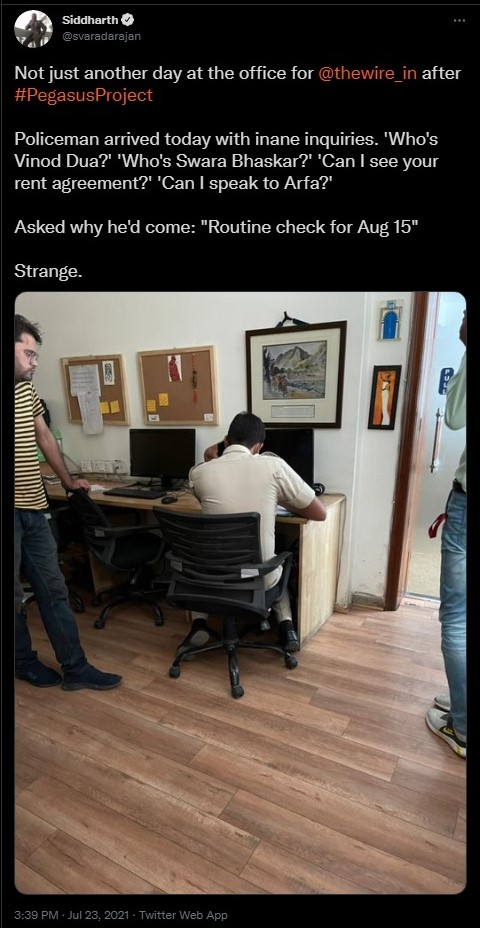
Siddharth Varadarajan, the founding editor of The Wire, revealed on Twitter that the office of the left-wing propaganda portal was visited by a policeman on Friday with specific inquiries. According to him, the police asked questions regarding actress Swara Bhasker and fellow propagandists Vinod Dua and Arfa Khanum Sherwani.
Source: Twitter
According to Siddharth Varadarajan, the policeman said that he had come for regular inquiries ahead of the 15th of August, the Independence Day. Earlier, The Wire had been served with a show-cause notice by Kashmir Police over fake news.
The Kashmir Police accused The Wire of indulging in “misrepresentation of facts, sensationalism, concocted mixing of facts with opinion of some unknown experts”. The portal was also accused of engaging in a media trial.
Vinod Dua, known peddler of fake news, had been helped by a Union Minister recently when he was suffering from Covid-19. Union Minister Hardeep Singh Puri had arranged medicines for him during distress. An FIR was registered against Dua in 2020 for peddling fake news and creating public nuisance.
Arfa Khanum Sherwani is a propagandist who often serves as an apologist for Radical Islam. She had once insinuated that the destruction of the Bamiyan Buddhas by the Taliban was inspired by the demolition of Babri Masjid.
Sherwani was also one of the liberal propagandists who had helped peddle the mythical narrative of a hate crime when a Muslim man was thrashed by other Muslim men over a personal matter. She had falsely claimed that the man was thrashed for refusing to chant Jai Shri Ram.
Police visited the Wire office because it has no signboard
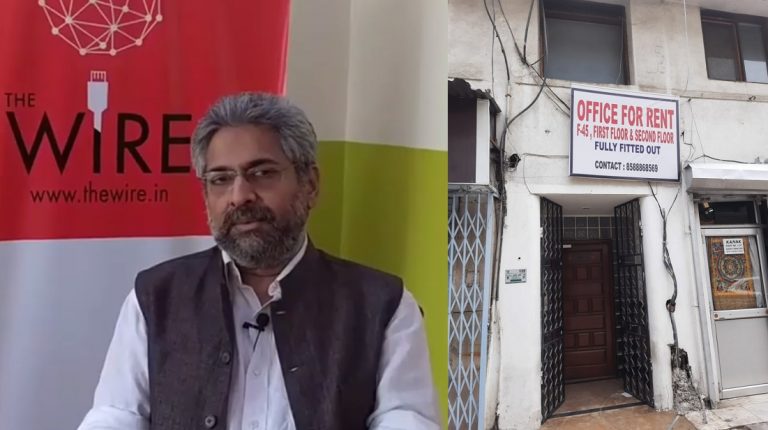
After the tweet by Varadarajan, the official Twitter account of DCP New Delhi informed that the Wire office was checked as part of routine precaution ahead of Independence Day. The DCP also said that there is no signboard outside the building informing the building that it houses The Wire, and therefore they went to check what is inside the office. They also posted a photograph of the entrance of the office which says ‘Office for Rent’, and there is no mention of The Wire.
In the run up to Independence Day,security and anti-terrorist measures such as tenant verification,checking of guest houses etc are being taken throughout Delhi.Local beat officer had gone to verify an office which didn't bear any signboard at the entrance. Please see the photo. pic.twitter.com/tmQObWIXmq
Delhi police said that ahead of Independence Day, security and anti-terrorist measures such as tenant verification, checking of guest houses etc are being taken throughout Delhi. As part of this exercise, a local beat officer had gone to verify an office that does not have any signboard at the entrance.
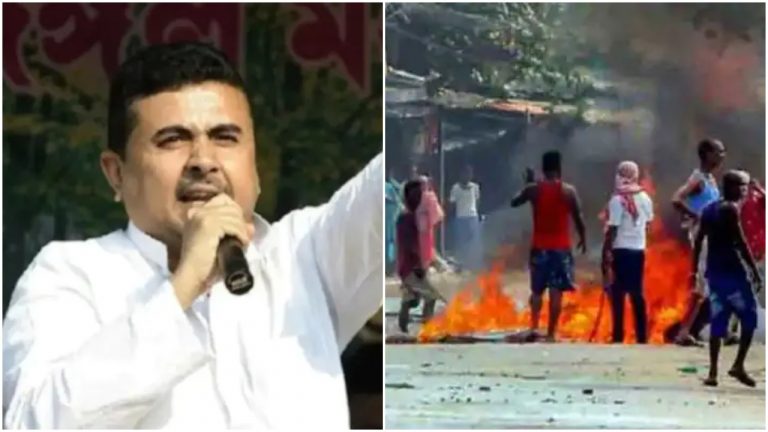
On Friday, West Bengal BJP leader Suvendu Adhikari met Union Home Minister Amit Shah to apprise him about the continuing political violence unleashed by Trinamool Congress workers against BJP cadres in the state.
According to the reports, Suvendu Adhikari, the Leader of Opposition in the West Bengal Assembly, said that the post-poll carnage is not over in the state nearly two months after the assembly elections. Suvendu also said that he met Union Home Minister Amit Shah to discuss the grave situation in the state and added that Home Minister Amit Shah is currently assessing the situation.
Post-poll violence is still going on (in West Bengal). As a Leader of Opposition, I met Home Minister in this regard and he’s assessing the situation: Suvendu Adhikari, BJP pic.twitter.com/3QY3Jjn9li
Suvendu Adhikari’s meeting with Home Minister Amit Shah comes days after BJP leaders had staged a protest against the ruling TMC party over the post-poll violence in West Bengal. BJP Bengal President Dilip Kumar led the protest at Rajghat, Kolkata.
The BJP protested against Mamata Banerjee-led government after 38 of its workers were killed in West Bengal since the TMC, led by Mamata Banerjee, came to power in the state on May 2.
Post-poll violence in West Bengal eclipsed 1946 Calcutta killings: Suvendu Adhikari
Earlier on Wednesday, Suvendu Adhikari, paying his tributes to those killed in the political violence unleashed by the TMC, had said that the continuing violence in the state for the past two months has eclipsed the great Calcutta killings of 1946.
The BJP leader said TMC goons have killed more than 30 party workers since May 5, when the Mamata Banerjee government returned to power in the state for the third time. Observing Shahid Shraddhanjali Divas in memory of the workers killed in the violence, the BJP strongman also said that the observations made by the NHRC in its report on post-poll violence have “shaken the world”.
“We expect the judiciary to take action after taking into consideration the NHRC report, which has just exposed the tip of the iceberg. Such a report will put anyone with a sane mind to shame. What happened in Bengal over the past two months has eclipsed the great Calcutta killings of 1946, Noakhali riots and the Sikh killings,” he said.
In its report, after visiting 311 spots in 20 days and carrying out an extensive inquiry in the matter, the National Human Rights Commission had concluded that the current situation of the state is a manifestation of the “Law of Ruler”, instead of “Rule of Law”. It added that the loss of faith in state administration among victims is very evident.
‘Cancel culture’ has become the norm on social media. Celebrities are targeted by left-wing outrage mobs over past tweets or some comment they have made or anything else they might have done to attract their angsty tantrums.
In recent times, the outrage appears to have consolidated around the lines of caste. Not too long ago, ‘stand-up comedians’ and actresses were attacked on social media for unsavoury, arguably offensive, comments against BSP supremo Mayawati. That phase created quite a stir and numerous left-wing individuals were forced to apologise for the tweets and comments they made in the past.
However, that has since then transformed into something infinitely more troubling. Suresh Raina was targeted on social media for asserting his Brahmin identity during a commentary. He made the comment as a passing remark and did not appear to think too much of it. Following that, however, he was targeted on social media by the left-wing outrage mob. Soon enough, Ravindra Jadeja was also targeted for taking pride in his Rajput identity.
The matter escalated quickly and Yuvraj Singh and Ravichandran Ashwin were also dragged into the matter. The argument appeared to be that Suresh Raina should not be proud of his Brahmin identity. While the logic of it remains unclear, what was clear is the fact that the outrage mob genuinely believe that Brahmins should eternally be ashamed of their identity while they piled on to them relentlessly.
The outrage mob appears to have forgotten that not everyone has a humiliation fetish and those who do are in the micro-minority, even though they might have a disproportionately high representation in the left-wing camp.
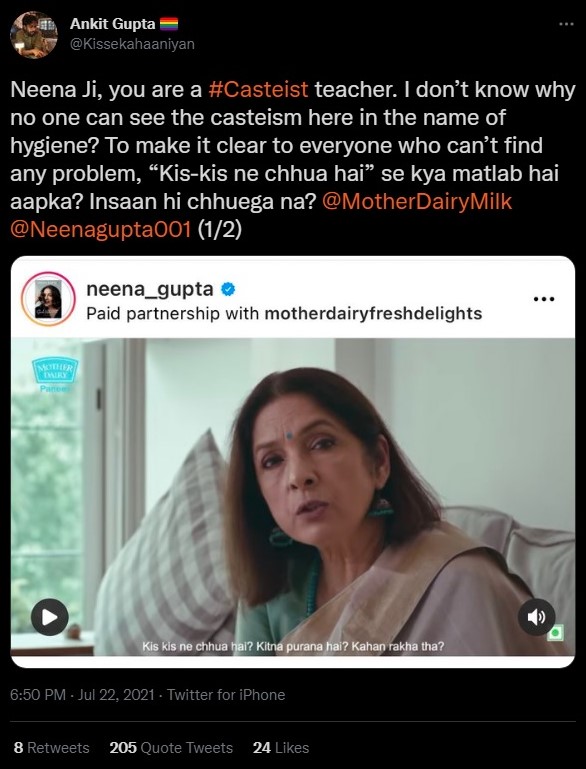
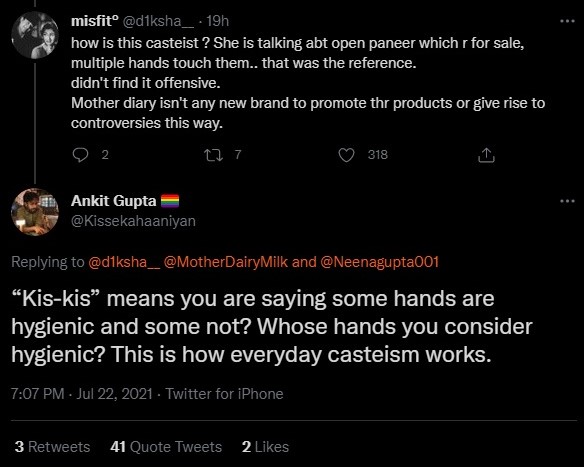
The outrage against Suresh Raina had not died yet that the outrage mob has latched on to another issue, this time, their target is actress Neena Gupta and the subject of their ire is an advertisement of a paneer brand. The particular lines from the ad that has sparked outrage is one where Neena Gupta asks the audience if they knew which people had touched the unpacked variety of paneer.
Source: Twitter
Quite clearly, the ad wanted to drive home the message that unpacked paneer was unhygienic because it is exposed to germs from various people but the outrage mob managed to twist it into a casteist message. The assertion appears to be that the ad was somehow hinting that the paneer might have been touched by people of so-called ‘lower castes’ and therefore, people should not purchase it.
However, that was clearly not the message of the ad. The ad only said that the paneer might have been touched by those who do not maintain a necessary hygiene, and such people can belong to any caste. Indeed, the outrage appears to be extremely condescending towards ‘lower castes’ as it appears to say that only ‘upper castes’ care about maintaining hygiene.
Source: Twitter
Apparently, the ad that spoke of the importance of hygiene is somehow evidence of ‘everyday casteism’. It does not make sense at all but making sense is not the priority of the mob, outrage is.
Neena Gupta and Suresh Raina become target of clout chasers
What we see here is a pristine example of clout-chasing. A ‘clout chaser’ is a person who attempts to garner popularity be feeding off the fame of others. There are two ways to do it, of course. One is by groveling before others more able than them, so that they can benefit from their association with them.
The other, which can be seen in this particular instance, is attempting to gain influence by throwing muck at others who are more popular and thereby, creating a sphere of influence for themselves as leaders of the anti camp.
Most of the people outraging, here, are virtually nobodies. Therefore, they attempt to establish themselves as an authority and garner clout by tarnishing Neena Gupta and Suresh Raina’s reputation. One hopes members of the mob are smart enough to realise that there was nothing casteist about the ad at all and yet, they did it anyway because it is his only chance at gaining some clout.
A perverse incentive structure
It is easily perceivable that the tactics adopted by the mob here is remarkably similar to the ones adopted by radical leftists in the United States of America. It is not surprising since Indian liberalism is western progressivism with a time lag.
Like radical leftists in USA, who label everything as racist and patriarchal and misogyny, individuals must resort to more and more extreme stances in order to distinguish themselves from the mainstream liberals. Radicalism is provided incentives by the existing structure as ‘standing out’ of the horde is the only way to make a separate space for oneself in the cacophony.
If a person says the same thing as everyone else is, he is unlikely to succeed in creating his own band of followers. He has to come up with something new in order to prove that he is a ‘true liberal’, a true ‘anti-casteism’ warrior so that he can then accuse others in the mainstream of not being ‘anti-casteist’ enough, thereby creating a separate space for himself to occupy.
Thus, we have trolls seeing casteism in a goddamned paneer ad that speaks of hygiene. Since others of his ilk have occupied the rest of the positions, it was the one of the few options left available to him to create his own space. And he jumped on to it like a fish to water.
In the world of social media, such antics are rewarded. It does not matter how radical one is in his or her approach, the individual will always find followers behind them if they are willing to stand by their opinions. And if they are not, someone else will come and occupy the space that was created.
The outrage against Suresh Raina: Why Brahmins are a convenient target
Indian liberals wholeheartedly buy into the oppressor-oppressed interpretation of human societies that is so popular in the western academia. Since their Indian counterparts perennially seek their approval, they force-fit the narrative into the Indian context without even bothering to evaluate if it really applies.
Consequently, Brahmins are accused of all kinds of crimes that their ancestors are supposed to have committed. Yes, atrocities were indeed committed against people of ‘lower castes’ and it would not do to engage in denial of history.
But circumstances throughout history have been a lot more complicated than simply an oppressor-oppressed version of events. But Brahmins are a convenient target for the left-wing outrage mob because they can be used to turn away entire Jaati groups from Hinduism.
Brahmins can be the portrayed as the ‘enemy’ to rally the ‘lower castes’ against, who have fissures and divisions within themselves as well. But when the hatred can be externalised towards a different caste, it can serve as a bulwark for unity among the in-group.
Consequently, the ‘lower castes’ can be driven into the arms of missionary groups and others, and thereby, weaken Hinduism further. The pot of caste animosity can be kept boiling so that India can never present a united front against external threats. That has always been the agenda.
Consequently, something as innocuous as Brahmins taking pride in their caste identity is portrayed as an attack against Dalits. Someone taking pride in their identity is not an attack against anyone else and cannot be construed as such, unless of course, the intention is malicious in itself.
Does the outrage mob really believe the ad was casteist?
It is extremely unlikely that the troll actually believes the ad was casteist. Most likely, he levelled the accusation because there is no risk of adverse consequence for him but the potential for gains is infinite. But if he actually believes the ad was indeed casteist, then it might be a good time to consult a mental health professional.
Hygiene is an intrinsic aspect of all human societies. Everyone, regardless of their caste, has specific ideas about basic hygiene which they go to great lengths to maintain. No caste has a monopoly over hygiene. Therefore, it is extremely derogatory on Ankit’s part to insinuate that an ad emphasising on hygiene is anti-‘lower caste’.
People of ‘lower castes’ would undoubtedly be angered by such insinuations, as they should be. However, the left-wing outrage mob is least bothered by calumny. All they care about is their agenda and whether they stand to gain clout through their allegations.
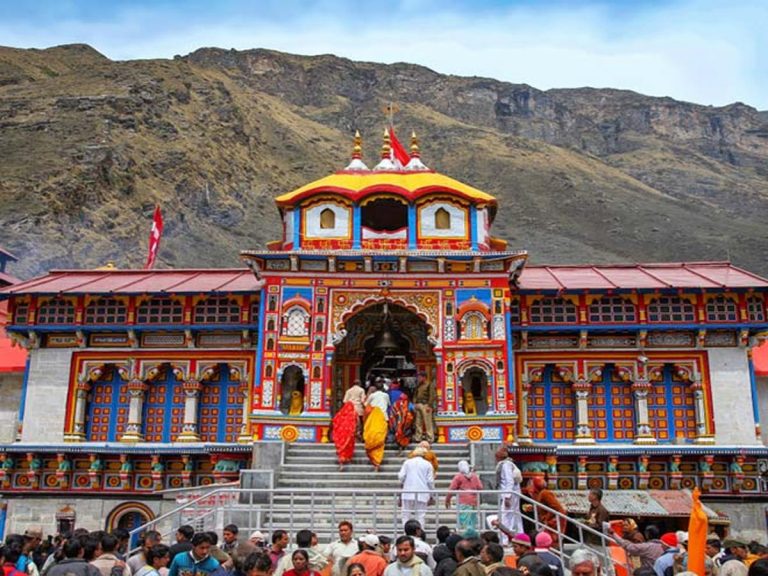
Earlier yesterday, reports of Namaz being offered on Bakrid at one of the holiest sites of Hinduism, Badrinath, created quite a flutter on social media websites, with users demanding a probe into the matter as to how non-Hindus were allowed to offer Namaz inside the premises of a hallowed Hindu shrine.
What was the controversy about?
The controversy that fuelled outrage on social media websites relates to rumours that claimed 15 labourers offered Namaz at the Badrinath Dham in the holy town on the occasion of the Bakri Eid on July 21 (Wednesday). Soon thereafter, the reports spread like wildfire on the internet, drawing flak from people on social media, who felt hurt that one of the foremost Hindu pilgrim shines was used by Muslims to offer namaz.
The raging controversy also came to the notice of Hindu organisations and members of Vishwa Hindu Parishad (VHP) and Bajrang Dal even met Uttarakhand Cabinet Minister Satpal Maharaj on Wednesday and submitted a memorandum, raising objections to Muslims performing Namaz in the holy town of Hindus and demanding a probe into the same.
They expressed displeasure saying that when Hindus devotees are not being allowed to visit the holy shrine due to the COVID-19 pandemic, then how can Muslims be allowed to offer Namaz, that too at a place which is considered extremely sacred by the Hindus.
Police refutes claims of namaz being offered inside Badrinath temple
Meanwhile, the local police had already taken cognisance of the online outrage on July 21 when the rumours of temple premises being used to offer namaz started doing the rounds on the internet. They launched an investigation into the matter and later released a statement, refuting the allegations and asserting that namaz was not offered inside the premise of Badrinath Dham as being alleged in various media reports.
In its press release that was shared by the official Twitter account of Chamoli police yesterday, it urged the people to refrain from believing such unverified claims circulating on various social media platforms. The press note read that the Muslim labourers working as construction workers building a parking lot close to the temple offered Namaz inside a closed space without using loudspeakers and without the presence of any cleric or Maulvi.
They also followed the Covid protocol of wearing masks and maintaining social distancing, it added.
कृपया अफवाहों से बचें बिना सत्यता को जाने कोई भी खबर साझा ना करें।
As the controversy swelled despite their clarification a day before, the Chamoli police yesterday shared a video clip in which the Superintendent of Police, Chamoli, Shri Yashwant Singh Chouhan stated that the police have not found any evidence to substantiate the claims which did the rounds on social media. Confirming that the Namaz was not read in a public place, Chouhan said: “Chamoli police request all of you, please do not share any misleading news without verifying the facts”.
पुलिस अधीक्षक चमोली श्री यशवंत सिंह चौहान महोदय द्वारा श्री बद्रीनाथ धाम के सम्बन्ध में वायरल सूचना के सम्बन्ध में दी गयी विस्तृत जानकारी।
चमोली पुलिस का आप सभी से निवेदन कृपया बिना तत्थयों की पुष्टि किये कोई भी भ्रामक खबर साझा ना करें। pic.twitter.com/9dCgOzpW5X
Besides the rumours that Muslim labourers offered namaz inside the temple premises, it was also alleged that they had defied COVID guidelines. A report published by Dainik Jagran claimed that a complaint was registered against the 15 labourers for flouting Covid norms. Chamoli police, however, clarified that the offering of the Namaz was a private affair, and the workers had adhered to all covid protocols while doing the same.
Though the police confirmed carrying out an investigation, there was no mention of any case being registered against the labourers. Chamoli police said that in case, during the investigation, it is revealed that Covid protocols were flouted, then appropriate action would be taken under the Disaster Management Act.
The facts of the matter: Namaz offered not inside the Badrinath shrine but at an enclosed parking, 700 metres away from the revered Hindu shrine
Contrary to the rumours that were floating on social media websites, the said labourers did not offer namaz inside the temple premises of Badrinath Dham. Instead, it was offered 700 metres away from the temple premises. An FIR has also been lodged in connection with the unlawful assembly of people during the pandemic.
As per social media user Alok Bhatt, who was also an advisor to former CM Trivendra Singh Rawat, a parking facility is under construction at Sri Badrinath Ji, about 1 kilometre before the temple premises, near ISBT Hospital. It is a part of the project called “Astha Path” that was approved by the central government in 2018, to face-lift the temple premises in the holy town of Badrinath.
One contractor named Harendra Pawar was tasked with the responsibility of the completion of the project. Among the labourers employed, 15 Muslim workers working on the project offered namaz inside the 1st level of the parking facility, which is already completed.
SP Chamoli informed that parts of under-construction parking lot has been enclosed, in which the labourers currently stay. They had offered Namaz at the same enclosed space. There were no photographs of the Namaz and no formal arrangement was made, he added.
Facts 4. No video or photo of namaz is available & no one is sure of it being a reality 5. Still police acted on suspicion & filed a case under act for unlawful assembly during pandemic (surely folks will shout at this but 295A is not applicable here pic.twitter.com/gKzqj7xZpj
Bhatt also highlighted how it could be an attempt to malign the sacred Badrinath temple as no photos or videos of Namaz being allegedly offered inside the temple premises were shared. He further added that the rumours of a Maulvi being called to offer Namaz has already been rubbished by the Chamoli police.
Propaganda 3. A Maulvi was called -claim refuted by @chamolipolice via SP Chamoli 4. Per police, there is no evidence of namaz being offered and still it has, in keeping with the importance and sacred nature of our dham, acted and filed FIR pic.twitter.com/gKzqj7xZpj
Responding to the concern raised by some social media users regarding the demographic changes and influx of outside labourers, Bhatt said the issue is serious in nature and has been raised by him and others on many occasions and it needs to be dealt with at a society level.
Bhatt also shared a copy of the FIR that has been registered later for covid protocol violation against the contractor and some of his workers who were found gathering at a place and violating social distancing norms.
Badrinath Dham is considered one of the holiest places in the Hindu religion. One of the 108 Divya Desams, the Badrinath temple is part of Char Dham also referred to as “the four abodes”, consisting of the pilgrimage circuit of Yamunotri, Gangotri, Badrinath and Kedarnath. It is also a part of the Chota Char Dham, comprising of the pilgrimage circuit of Badrinath, Rameswaram, Dwarka and Puri. Badrinath temple was re-established by Adi Shankaracharya in the 8th century as part of his mission to enliven Hinduism.
A Coronavirus-positive man was detained for boarding a Citilink flight using the disguise of a woman in Indonesia. The flight was bound from the Indonesian capital of Jakarta to Ternate.
As per reports, the accused was identified by his initials ‘DW’. Since the man was diagnosed with the Wuhan Coronavirus, it implied that he couldn’t board the Citilink flight. As such, DW wore a full-face veil (niqab), boarded the flight using his wife’s passport and negative RT-PCR report. He was successful in fooling the airline and security authorities at the Halim Perdana Kusuma Airport. Although his plan looked full-proof, he made a crucial mistake on board the flight.
When he went to use the washroom, he was dressed in female attire. However, he came out in regular men’s clothes and raised the suspicion of the stewardess on the flight. She immediately notified the airport authorities, who were waiting to nab DW once the flight landed at Ternate. Accordingly, the accused was detained at the Ternate airport. On being tested for Covid-19, the results came as positive. The Ternate City Covid-19 Handling Task Force was summoned to escort DW to his house in protective gear. After the self-isolation period, the police have expressed their intent to arrest the man.
While speaking about the incident, Covid-19 task force head Muhammad Arif informed, “The airport immediately contacted the Ternate City Covid-19 Handling Task Force team to evacuate the man while wearing personal protective equipment (PPE), and then taking him in an ambulance to his house (in Ternate City) to self-isolate, where he will be supervised by Task Force officers.” The development comes at a time when the country is witnessing a rapid increase in Coronavirus cases.
Rising Coronavirus cases in Indonesia
The situation is so grim that the Centers for Disease Control and Prevention (CDC) has placed Indonesia under a Level 4 travel health notice. It implies that travel to Indonesia must be avoided, given that it has a very high level of Coronavirus cases. As of July 22, Indonesia has reported 5,61,384 active cases and a total of 72,000 fatalities. A slow vaccination programme has been cited as the leading cause of the spread of the Delta variant in the country. Since Indonesia is reporting close to 50000 cases each day, Garuda Indonesia that runs Citilink airlines has restricted travel between July 19-25.
Actor and producer Sachiin Joshi has won a legal case against Raj Kundra, Shilpa Shetty and Satyug Gold- the company of which the couple were the ex-directors. The Bombay High Court has directed the company to hand over 1 kg gold to Joshi, along with Rs. 3,00,000 as a cost towards legal proceedings.
In January this year, Joshi had filed a case of fraud, cheating and other charges against Shilpa Shetty, Raj Kundra and few more officials of Satyug Gold Pvt Ltd (SGPL) including current directors Ganpati Chaudhary, Mohammed Saifi with the Khar Police Station in Mumbai.
Joshi who had purchased a five-year gold plan sold as ‘Satyug Gold Scheme’ was promised a certain fixed quantity of gold redeemable after the lock-in period. However, on the non-receipt of the gold after six years of investing, Joshi was forced to file a case against the celebrity couple who were not just the ex-directors of the company but had also promoted it extensively.
Pronouncing the verdict in Joshi’s favor, the court has directed Satyug Gold to hand over Joshi’s 1 kg gold to him and also pay him a sum of Rs 3 lakh as a cost towards legal proceedings.
According to the scheme launched by Raj Kundra, an investor who bought a certain sum of gold at the then current rates with full advance payment would be entitled to a Satyug Gold Card, redeemable in stages with attractive discounts. The discount rates were 15% after two years, 26% after three years, 30% after four years and 37% after five years.
Joshi had purchased One kg gold for nearly Rs 18.58 lakhs in March 2014 at the then prevailing rates. It would be redeemable on or after March 25, 2019 at the promised discount on presentation of the Satyug Gold Card to the SGPL. However, when Joshi attempted to redeem his one-kilo golden asset on the due date, he found that the SGPL office in Bandra Kurla Complex was shut.
During media interactions, Sachiin Joshi said, “My legal battle was merely a representation of many of the investors of Satyug Gold who have invested in the gold scheme at a discounted rate, only to never receive the gold.”
“I was asked to pay 25 lakh on an 18,57,870 lakh gold purchase after six years of my hard-earned money lying with a company. Imagine the state of the common man who must have invested believing a celebrity who endorsed a company as its Chairman!” he added.
Insinuating that Kundra’s arrest was a result of bad karma, Joshi further said, “We got our 1 kg gold and 3 lakh of fine that they had to pay us for making us go through this legal process where they were at fault since the very beginning and yes about the cheque bounce case, we will win that too as it was stopped not bounced as we didn’t see any transparency in their dealings. I am glad karma finally caught up with Kundra.”
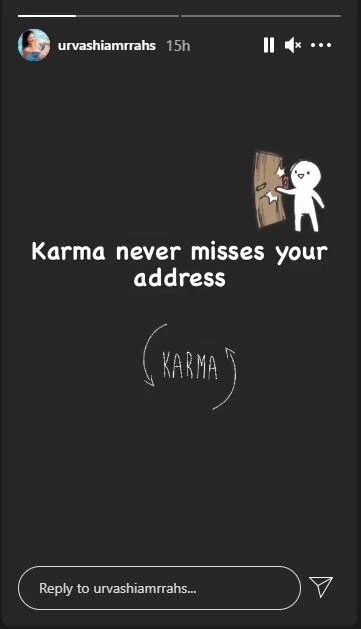
Joshi’s wife too had shared a cryptic message on her message saying, “Karma never misses your address” after Kundra’s arrest in the pornography case.
Screenshot of Urvashi’s Instagram story
Joshi accused the celebrity couple of cheating
The actor cum producer had filed a case against the celebrity couple and the company in the first half of 2020 as well.
However, Shilpa Shetty had brushed off the allegations made against her and her businessman husband claiming they were “baseless”.
Shetty reacting to the controversy that broke out blamed Joshi for non-payment. “We have even deposited 1kg gold for which Sachiin Joshi is yet to pay the demurrage charges legally applicable. Not many know, we also have a cheque bouncing case in court against this serial defaulter,” she had told in an interview with IANS..
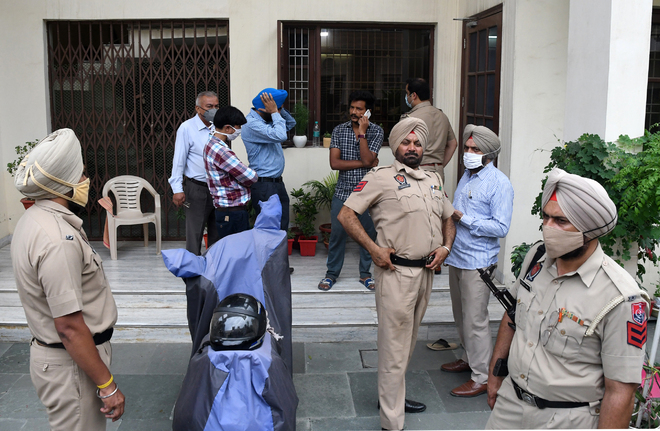
The regional manager of Muthoot Finance Jaydev Goyal’s house was looted in broad daylight at gunpoint in Punjab’s Zirakpur district. Four thieves brandishing guns and swords barged into Goyal’s home on Thursday.
Goyal, who had retired from the post of DGM of Union Bank and now working as a regional manager at Muthoot Finance, had already left for his office at the time of the incident. His 60-year-old wife Naresh Rani, 40-year-old son Kapil Goyal and a maid were present in the house when a group of four robbers entered his home one by one and held his family captive.
The four robbers arrived on two bikes around 11.30 am and after taking the family members and the maid hostage, searched the house for about two and a half hours. They fled after looting cash, silver and gold jewellery from the house.
The thieves who first disconnected the internet connection of the CCTVs installed held Goyal’s wife and maid captive at gunpoint. Goyal’s son Kapil was also intimidated using a sword. They threatened Goyal’s wife to hand over all the cash and jewellery or they would kill her son. They also snatched their mobile phones and kept them in the refrigerator.
As per reports, the robbers looted 30 tolas of gold jewellery and silver utensils worth lakhs, Rs 20,000 cash and also stole god’s jewellery and cash kept as an offering from the temple. Incidentally, they left back Rs 3 in the temple in the house.
Traumatized by the loot, Goyal’s family informed him immediately as soon as the accused fled on their bikes after a two and half hour search. Rushing home, Goyal immediately informed the police after which the SP (Rural), DSP and the SHO of Zirakpur police station reached the spot.
A forensic team also arrived to collect fingerprints and carry out further investigation. Additionally, a manhunt has been launched to nab the perpetrators.
Goyal was thankful that the thieves did not cause much harm to his family through his son was slapped and his wife tied up by the robbers. His wife who is an asthma patient is still mortified by the incident.
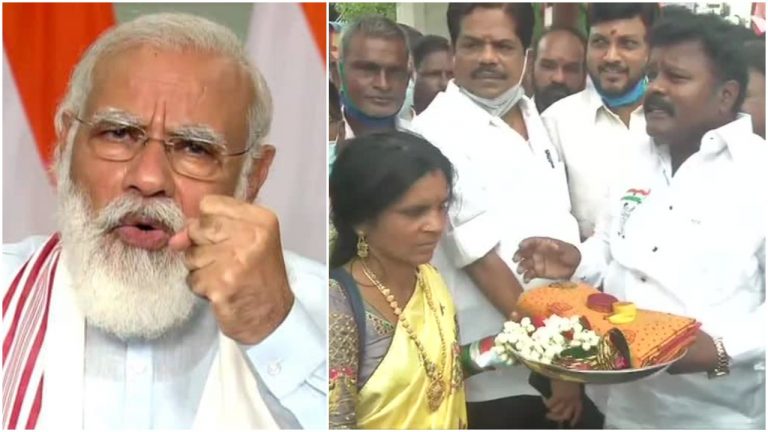
The Tamil Nadu Congress displayed its blatant sexist bias and misogyny as its party workers protested, asking Prime Minister Modi to wear sarees and bangles, alluding that he is not ‘man enough’ to run the country on July 22.
As per reports, Tamil Nadu Congress had organised a protest march on Thursday against the Modi government over the Pegasus Spygate controversy. During the protests, the Congress workers resorted to sexist attacks by offering sarees and bangles to PM Modi.
Tamil Nadu Congress in their protest march offer saree and bangles to PM Modi and the BJP who they say are not masculine enough to run the govt. (over snooping scandal) #sexistpic.twitter.com/V47kDLHtcv
The Congress workers insinuated that BJP and its party leaders are not ‘masculine enough’ to run the government. Congress workers were seen protesting with traditional thalis in their hands, loaded with an assortment of feminine items: new saree, bangles, jasmine garlands, and other things that are customarily gifted to brides.
This was a surprising display of the mentality of the senior leadership of Congress, a party which was once headed by Indira Gandhi, India’s first female Prime Minister and currently has Sonia Gandhi as the interim president.