Jamil Takla alias Qureshi (38) wanted in several offenses such as attempt to murder, murder and cattle theft, jumped from the fourth floor of his residential building in Bhiwandi to evade arrest.
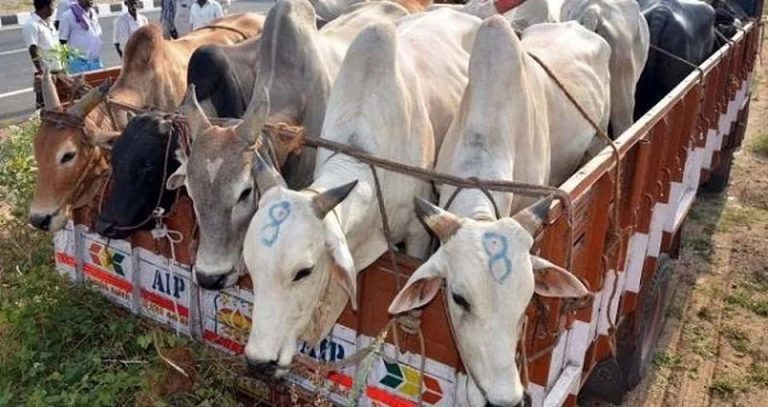
A team of police from the Thane crime branch along with the Gujarat unit on July 2, around 3 pm, went to arrest Takla, a resident of Kasai Wada of Nizampura. A group of 10 policemen went in hunt of him while the remaining team stationed themselves outside the chawl. As per a Gujarat police official, Takla was wanted in a case registered at a police station in Gujarat where he allegedly helped change registration plates of a vehicle suspected to have been used for cattle smuggling.
As per reports, when the police knocked on the door of the accused’s house, his family refused to answer the door. Subsequently, when they opened the door, Takla ran and jumped off the window, the official said.
It is imperative to note that reportedly this wasn’t the first time that Takla had jumped off the building to evade arrest. His previous attempts were successful when he landed safely, however, this time it proved fatal.
In a fit of rage, family members of the accused and local residents rioted and assaulted the cops blaming them for the death of Takla. Subsequently, a video has gone viral on social media where a mob can be seen attacking the cops.
Gujarat cops had come to Bhiwandi to arrest Jamil, wanted in a criminal case in Valsad. Jamil jumped out of his home on 4th floor and died. Peaceful locals beat up the cops. Attackers of police should be very severely punished. pic.twitter.com/ZraQ79w7lW
Due to the assault three cops have suffered injuries.
“We have registered an FIR for rioting and assaulting a public servant. We have arrested nine men so far,” informed senior inspector V C Dolas of Nizampura police station.
Takla was wanted for cattle smuggling
Valsad district superintendent of police Rajdeepsinh Zala in an interview to Indian Express said, “Last Tuesday (June 29), we found a deserted Innova in Dungara area of Vapi town in Valsad. While tracing the owner of the Innova, we found the location of the main accused, Jamil alias Takla, who has been booked earlier at Vapi police station for bovine smuggling. A team of local crime branch comprising three officers and constables reached Bhiwandi on Friday and the crime branch officials in Thane were cooperative. Our team was then sent to a nearby restaurant in Bhiwandi to have lunch, while Thane police sent their officers to the area for verification of the accused. This is when the incident took place. No one from Gujarat police was involved in the operation.”
Sharing additional information, Inspector J N Goswami from the Valsad crime branch said, “The Innova was found at a deserted spot in Dungara area with a punctured tyre on June 29. CCTV footage obtained showed five to six persons leaving the car on the roadside and fleeing on foot. Upon checking the registration of the vehicle, we found the number plate to be fake. An FIR was filed at Dungara police station. Then we traced the original owner of the car and got a vehicle sale agreement from him and traced it to Jamil.”
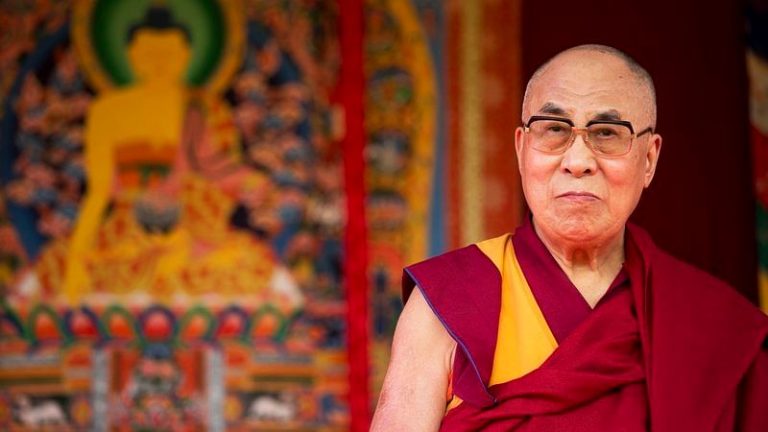
Tibetan spiritual guru Dalai Lama turns 86 today, with his followers around the world extending their greetings and celebrating the venerated leader’s birthday amidst the shadow of the resurgent coronavirus outbreak.
Dalai Lama XIV or Tenzin Gyatso as he is known with his worldly name was born on 6 July 1935 to a small farming family in the small hamlet of Taktser, Amdo, which is in northeastern Tibet. Barely at the age of two, then named Lhamo Dhondup, he was declared the reincarnation of the previous Dalai Lama XIII, Thubten Gyatso.
The Dalai Lamas are believed to be manifestations of Avalokiteshvara or Chenrezig, the Bodhisattva of Compassion and patron saint of Tibet. Bodhisattvas are enlightened beings who have postponed their own nirvana and chosen to take rebirth to serve humanity.
The current Dalai Lama began his religious education when he was 6, and by the time he reached 16, he had assumed the role of the political leader of Tibet. The region of Tibet was under a relentless assault of China, ordered by then Premier Mao Zedong, who wanted to bring the region under Chinese control. The invasion sparked an uprising against Beijing’s rule but it did not dampen China’s spirits from relentlessly pursuing its agenda of capturing the Tibet region.
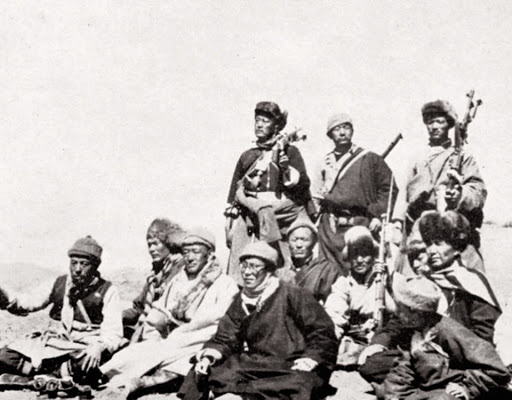
Dalai Lama pictured with his escape party in March 1959, Image via m10memorial.
Then in 1959, China moved to act against Dalai Lama, the face of the Tibetan resistance movement. Sensing imminent danger, Dalai Lama surreptitiously fled to the Himalayan town of Dharamshala, India, where he has lived in exile ever since.
In many ways, Dalai Lama’s dramatic escape to India was a watershed moment, not just in the Tibetan struggle against the Chinese occupation but also in the evolution of the relationship between India and China. Even after 62 years of his escape to India, the Tibetan spiritual leader continues to remain a thorn in the side of China and a major cause for its hostility towards India.
On the other hand, Dalai Lama’s entry into India heralded a large scale influx of Tibetan refugees in India. Tibetans facing persecution in China and who wanted to persist with their resistance against its forcible occupation came to India and continued their resistance campaign under the auspices of their foremost spiritual leader. These Tibetans and their offsprings continue to live in different parts of the country to date.
On his 86th birthday, it is worth revisiting the dramatic journey that Dalai Lama undertook to escape the sweeping and impending Chinese crackdown in his now occupied motherland.
The great escape: Dalai Lama outwits China and makes an arduous journey through the Himalayas to reach India
In 1959, even as the Chinese repression intensified in Tibet, the Chinese Army surprisingly held up an olive branch to the Dalai Lama, asking him to attend a Chinese dance troupe. Lama was the foremost Tibetan leader and considered by an overwhelming majority as the linchpin of the Tibetan resistance and commanded unmatched respect and admiration among the masses.
The invitation seemed innocuous but when he was asked to visit the Chinese military headquarters without soldiers or armed bodyguards, according to his official biography, the Tibetans thought something pernicious is afoot.
After years of altercation with the Chinese and being acutely aware of the tricks and stratagems used by them to trounce their opponents, the affable overture seemed too good to be true. As a consequence, on the day of the performance, thousands of protesters swarmed outside the Dalai Lama palace in Lhasa to keep him from being kidnapped, arrested or assassinated.
In the following days, the agitation intensified as Tibetans mobilised and organised themselves to fight the advancing Chinese forces. The Dalai Lama’s advisor, the State Oracle, sensibly suggested he flee.
So on March 17, 1959, disguised as a soldier, Tibet’s spiritual and political leader, then 23, slipped through the crowds outside his palace and embarked upon a tortuous journey towards safety and asylum. He embarked upon the treacherous path of crossing the prodigious Himalayas on foot with a retinue of his trusted soldiers and cabinet members. His entourage included his mother, sister, younger brother and several top officials. They travelled only at night to avoid detection from prowling Chinese guards.
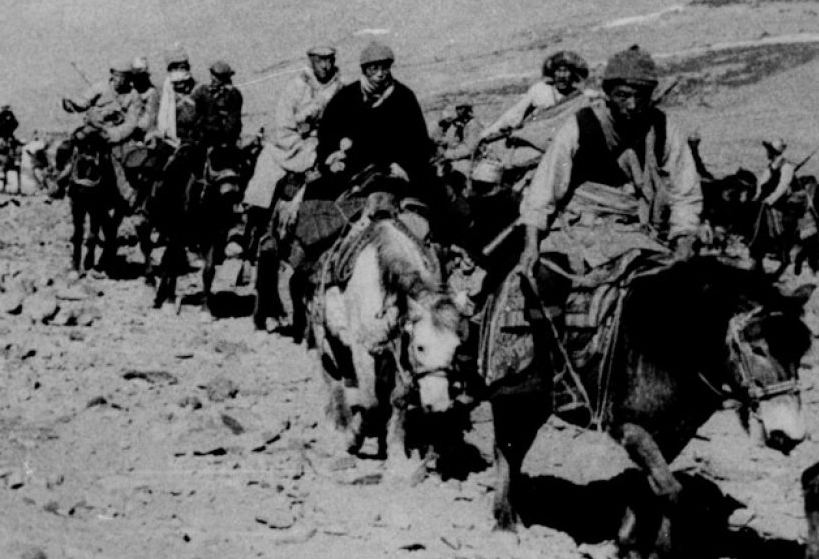
According to various accounts, the entourage travelled for days and nights on end, without stopping, on foot and horseback. They carried a month’s supplies by mules and used a single boat made of yak skin to cross the 1,500 feet wide Brahmaputra river.
Dalai Lama’s entourage, image via Dalailama.com
It took two weeks for Dalai Lama and his group to reach India. During this time, it was widely believed that the 14th Tibetan spiritual leader has been killed by the marauding Chinese forces. His followers across the world were resigned to the fact that they might not see Dalai Lama again. But on March 31, 1959, after completing a dangerous trek and crossing the gigantic Himalayas, Dalai Lama surfaced in India and demanded autonomy for Tibet.
Former Indian PM Jawaharlal Nehru almost slept when Dalai Lama was discussing with him about applying for an asylum in India
Days after arriving in India, the Dalai Lama was weighing on the option of applying for an asylum request in India. In this regard, he met Prime Minister Jawaharlal Nehru to gauge his attitude about a formal request for asylum. But, the Dalai Lama was taken aback by Nehru’s frosty reception. The Indian Prime Minister made it clear to the Tibetan spiritual leader that he would not make any commitments that would harm India’s relationship with China.
According to Dalai Lama’s autobiography, Nehru’s attitude betrayed that he had already made up his mind on asylum requests even before commencing the discussion. He was reportedly so uninterested in having discussions with the Tibetan leader that he was on the verge of dozing off.
“At first he listened and nodded politely. But . . . after a while he appeared to lose concentration as if he were about to [fall asleep],” the autobiography noted about how Nehru cold-shouldered the Dalai Lama.
The Dalai Lama explained that he had taken all steps to reach a reconciliation with China, but having failed in cutting ice with the Chinese, he was seriously considering the option of staying in India rather than return to Tibet. This reportedly made Nehru realise the gravity of the situation. He understood what the Tibetan spiritual leader was asking for, but reiterated his stance that India cannot support him.
India granted the Tibet leader asylum on April 3, 1959, and permission to establish a government-in-exile in the northern hill station of Dharamsala, already a sanctuary for thousands of Tibetan exiles fleeing Chinese repression. From there, the Dalai Lama launched an international campaign to reclaim Tibet, gradually easing this into an appeal for greater autonomy.
Dalai Lama continues to remain a thorn in the flesh for the Chinese
Nevertheless, the Dalai Lama has been a source of great torment for the Chinese. Authorities in China, to this day, fear the reach and respect that the Dalai Lama continues to command in the restive region of Tibet. China continues to raise objections to his visits to Arunachal Pradesh, a state under the sovereign control of India that China often claims is “Southern Tibet” and a part of its country. Although the Dalai Lama has given up his political role in 2011, China fears that the Dalai Lama holds enough sway in Tibet to spark an uprising against the Chinese subjugation.
The Dalai Lama has steadfastly advocated a pacifist approach to resolve the intractable relationship of Tibet with China, but the authorities in Beijing have always held a suspicious view of the Tibetan leader’s intentions. Like in Xinjiang, where China is presiding over a cultural genocide of Uyghur Muslims, they have been persecuting Tibetans and the pious devotees of the Dalai Lama in Tibet.
This has occasionally sparked a wave of demonstrations, most recently with the spate of self-immolation protests against China’s heavy-handed approach in Tibet. Since February 27, 2009, when Tapey, a young monk from Kirti Monastery, set himself on fire in the marketplace in Ngawa City, Ngawa County, Sichuan, there have been over 156 cases, where monks, nuns and ordinary people self-immolated in Tibet protesting against the Chinese repression.
In 2012, the Dalai Lama had said he does not encourage such protests but praised the courage of those who had set themselves on fire to make their grievances heard and blamed the Chinese for perpetrating a cultural genocide in Tibet.
Dalai Lama criticized by left-leaning liberals for exhibiting views that do not conform to their outlook and donating to the PM CARES Funds
Like China, its admirers back in India also share the same amount of antagonism for the supreme Tibetan leader. The Dalai Lama has been routinely subjected to criticism for expressing views that do not jibe with the liberal-communal worldview.
In 2019, Dalai Lama was branded as ‘Islamophobhic’, ‘racist’ and ‘xenophobic’, because he opined that Europe should belong to Europeans and that the larger strategic objective should be to return the Muslim and African refugees to their own lands after providing them with adequate training so that they can improve affairs in their own countries.
More recently, the Dalai Lama was targeted by a section of left-leaning liberals because he contributed to the PM CARES Fund for the country’s fight against the Chinese coronavirus. In April this year, the Tibetan spiritual leader in exile, Dalai Lama, had pledged to donate to the PM Cares Fund from the Dalai Lama Trust. The announcement was a welcome move to strengthen India’s fight against the pandemic. But the spiritual leader, who has been living in India since 1959, was soon subjected to online abuse.
National Commission for Protection of Child Rights (NCPCR) chairperson Priyank Kanoongo has written to Jammu and Kashmir DGP Dilbag Singh asking him to investigate the complaint received by the statutory body from a Delhi based activist group Kalinga Rights Forum (KRF) against Twitter India, accusing it of allowing Jihadist organisations to use the platform to promote terrorism in India.
Earlier in the day, OpIndia reported that KRF had filed a complaint with NCPCR against Twitter India MD Manish Maheshwari and its Public Policy Manager Shagufta Kamran, for “conspiring and promotion of terrorism using Kids against India & allowing terror organisations to use Twitter to facilitate recruitment activities for terrorism in Union Territories of J&K and L showing small kids as the face of terror organisations”.
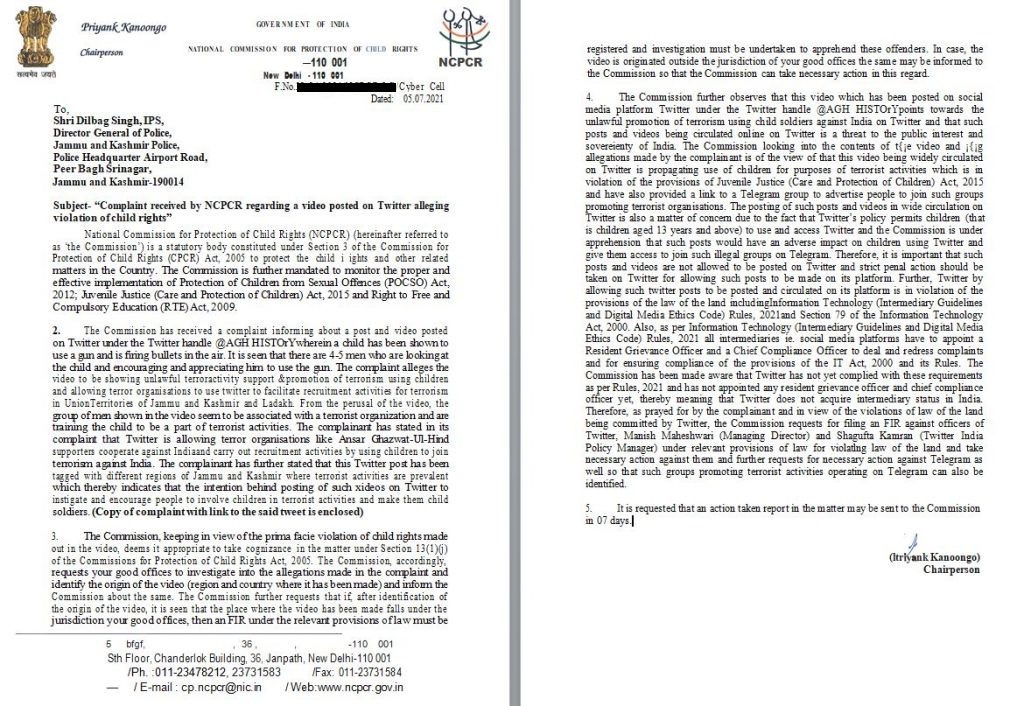
It was after KRF flagged the issue, the statutory body took cognisance of the case and wrote to the DGP of Jammu and Kashmir: “The commission has received a complaint informing about a post and video posted on Twitter under the Twitter handle @AGH HISTOrY wherein a child is shown to use a gun and is firing bullet in the air. It is seen that there are 4-5 men who are looking at the child and encouraging and appreciating to use the gun. The complaint alleges the video to be showing unlawful terror activity support and promotion of terrorism using children and allowing terror organisations to use Twitter to facilitate recruitment activities for terrorism in UnionTerritories of Jammu and Kashmir and Ladakh”, read the NCPCR letter.
Screengrab of the letter written by NRCRP to Jammu and Kashmir DGP asking to take action against Twitter and Telegram
The statutory body furthers that keeping in view the prima facie violation of child rights made out in the video, it deems it appropriate to take cognizance in the matter under Section 13(1)(j) of the Commissions for Protection of Child Rights Act, 2005 and asks J and K police to investigate into the allegations made in the complaint and identify the origin of the video and inform the commission about the same. It says that if found that the video has been shot at a place that falls under the jurisdiction of J and K police, then n FIR under the relevant provisions of the law must be registered and investigation must be undertaken to apprehend these offenders.
In case, the video is originated outside its jurisdiction, then the J and K police should inform about the same to the statutory body, read the letter.
NCPCR slams Twitter for not complying with new IT Rules 2021
Taking strong objection to such posts and videos being circulated online on Twitter, NCPCR wrote that this is a threat to the public interest and the sovereignty of India.
In the letter, NCPCR slammed the microblogging site, saying that this video being widely circulated on Twitter is propagating the use of children for purposes of terrorist activities which is in violation of the provisions of the Juvenile Justice (Care and Protection of Children) Act, 2015. It also opined posting such posts and videos in wide circulation on Twitter is also a matter of concern due to the fact that Twitter’s policy permits children (that is children aged 13 years and above) to use and access Twitter. It said that the commission is apprehensive that such posts would have an adverse impact on children using Twitter and give them access to join such illegal groups on Telegram.
“Therefore, it is important that such posts and videos are not allowed to be posted on Twitter and strict penal action should be taken on Twitter for allowing such posts to be made on its platform”.
Bringing up the issue of the social media giant not complying with the new regulations of the IT Rules 2021, NCPCR wrote that this act was also in violation of the provisions of the law of the land including Information Technology (Intermediary Guidelines and Digital Media Ethics Code) Rules, 2021and Section 79 of the Information Technology Act, 2000.
It said that the Commission has been made aware that Twitter does not acquire intermediary status in India as it has not yet complied with these requirements as per Rules, 2021 and has not appointed any resident grievance officer and chief compliance officer yet.
NCPCR orders action against Twitter India and messaging app- Telegram
Saying so, the statutory body ordered the filing of an FIR, as demanded by the activist group, against Twitter India MD Manish Maheshwari and its Public Policy Manager Shagufta Kamran under relevant provisions of law for violating law of the land.
It also asked the authorities to take action against Telegram, which along with Twitter is guilty of providing a platform to the terror organisations to operate against India and carry out recruitment activities by using kids for radicalisation, brainwashing of kids to join terrorism against India.
NCPCR also directed the J&K authorities to identify the terror groups which are promoting terrorist activities on Telegram and take appropriate action against them.
The statutory body concluded the letter by asking authorities to send a report, specifying the actions taken in the matter, to the Commission within 7 days.
OpIndia reports about the complaint filed by activist group with NCPCR against Twitter India
Earlier in the day, OpIndia reported that in its complaint to the National Commission for Protection of Child Rights (NCPCR), Kalinga Rights Forum alleged that Twitter India is facilitating terror organisations like Ansar Ghazwat-Ul-Hind supporters to operate against India and carry out recruitment activities by using kids for radicalisation, brainwashing of kids to join terrorism against India by providing them with a platform.
Speaking on how Twitter India is helping terrorist ideologies by providing the terror groups with a platform to spread their messages, recruit members, gather intelligence and also engage with their networks, the Delhi based activist group wrote that Twitter India allows terrorist supporters to post videos which show small children holding AK-47s, shooting in the air while other terrorists closely watch and instruct the kid how to shoot the gun.
The activist group shared the link and the archived link of the Tweet posted by AGH HISTOrY, going by Twitter handle @Rainbow35886147, wherein a small child is being taught how to use an AK-47 by terrorists. The activist group claims that AGH HISTOrY is a supporter of the Islamist terrorist organisation Ansar Ghazwat-ul-Hind, a Kashmiri wing of Al-Qaeda that is active in the Indian union territory of Jammu and Kashmir.
“By allowing such posts on the microblogging site, Twitter India is conspiring against India and abetting and supporting anti-India terrorist organisations to carry out terror attacks against India”, read the complaint.
It added that the terrorist supporter, AGH HISTOrY has brazenly mention links to the Telegram groups in its Twitter posts and asked fellow terrorist supporters to join these groups.
OpIndia had reported that the statutory body had taken cognisance of the complaint and was in the process of drafting a notice, ordering action against Twitter India.
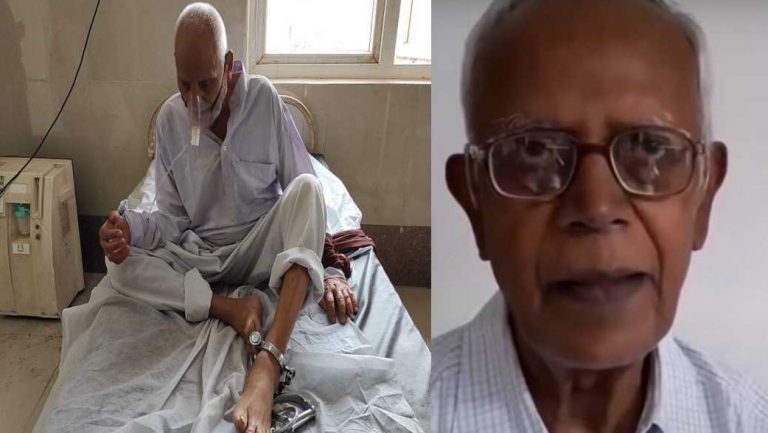
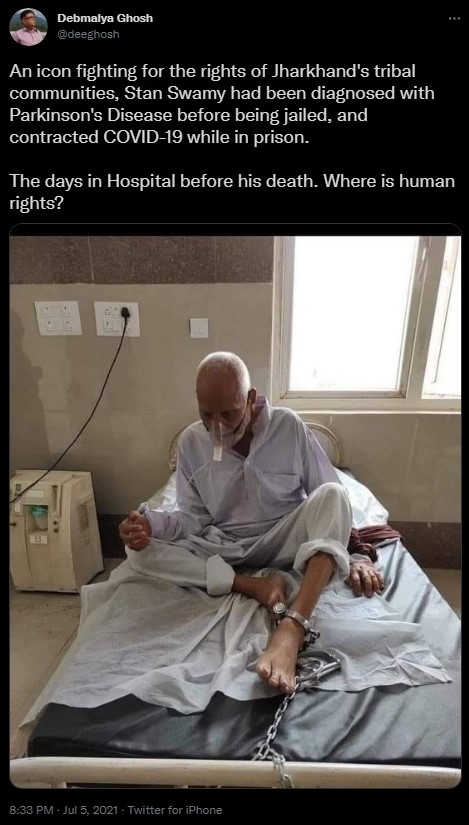
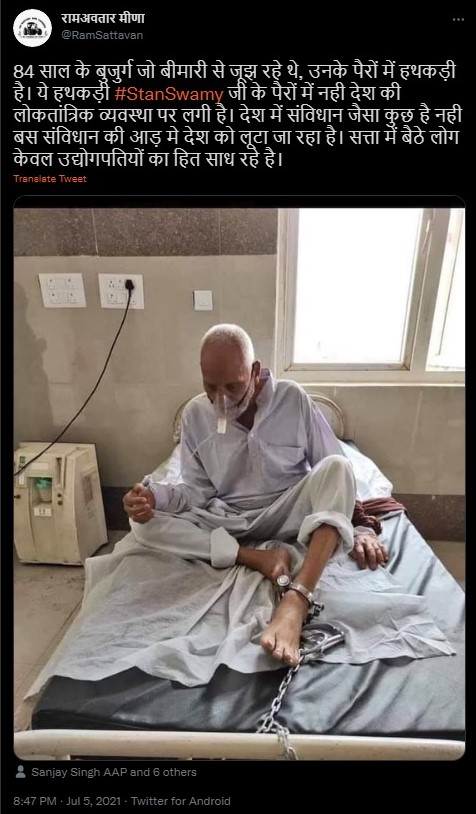
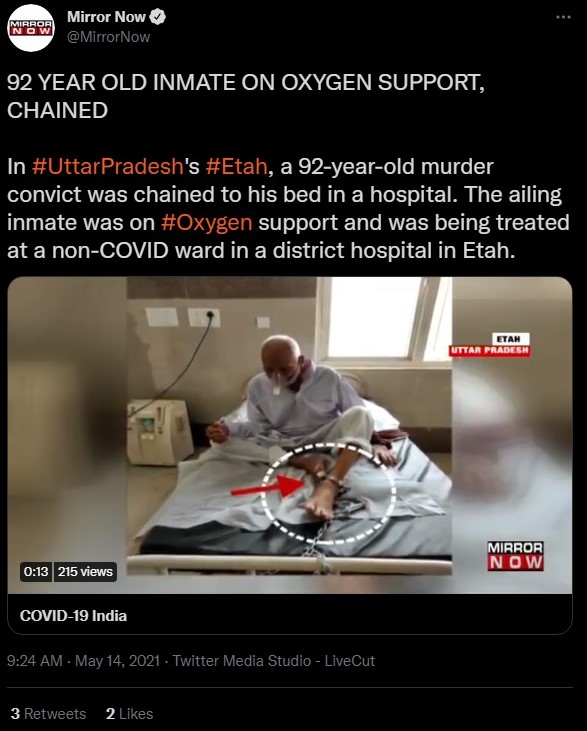
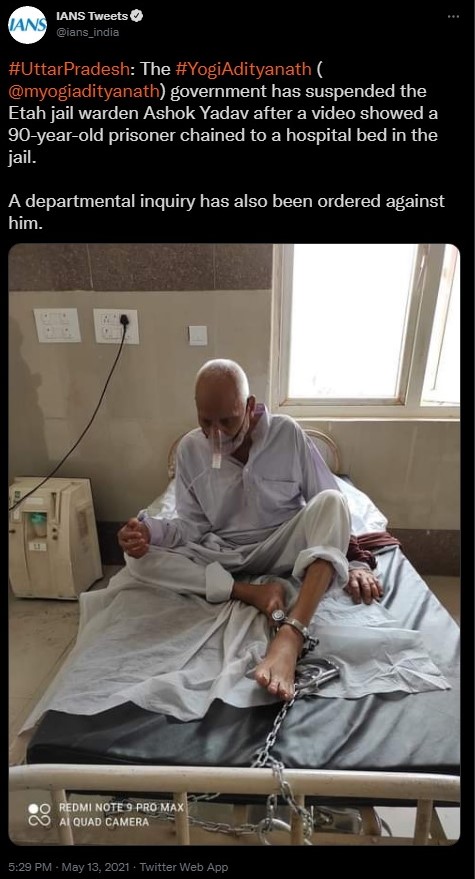
The image of a convicted criminal from a hospital bed in Etah, Uttar Pradesh is being circulated online with the claim that the photograph actually shows Stan Swamy during his last days before he passed away on Monday.
Fake news doing the rounds
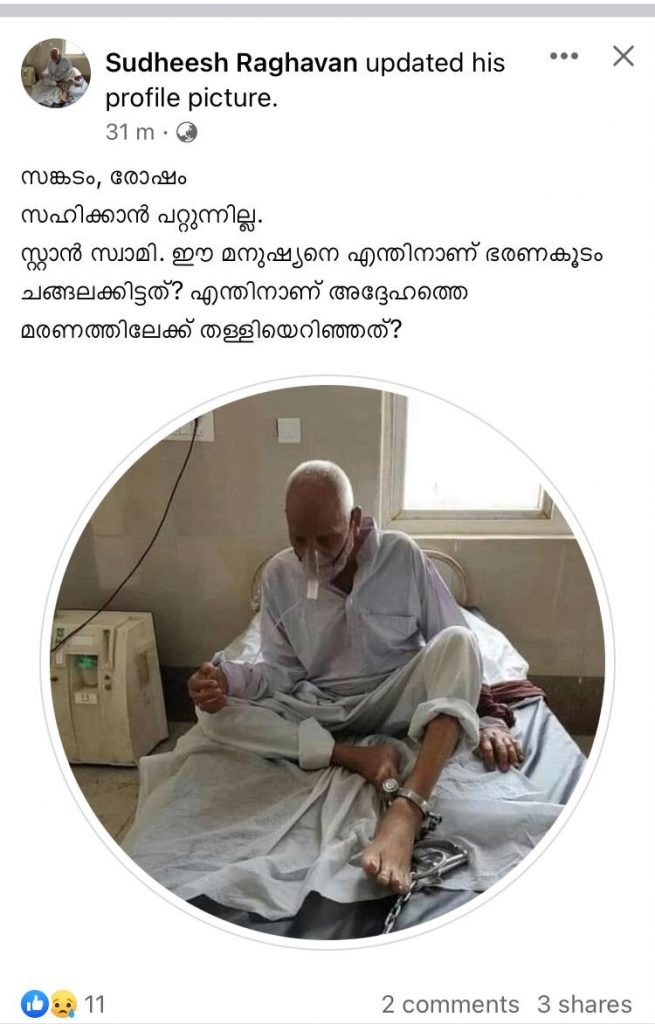
Others are also sharing the image with the same claims, asking where his human rights are.
Source: Twitter
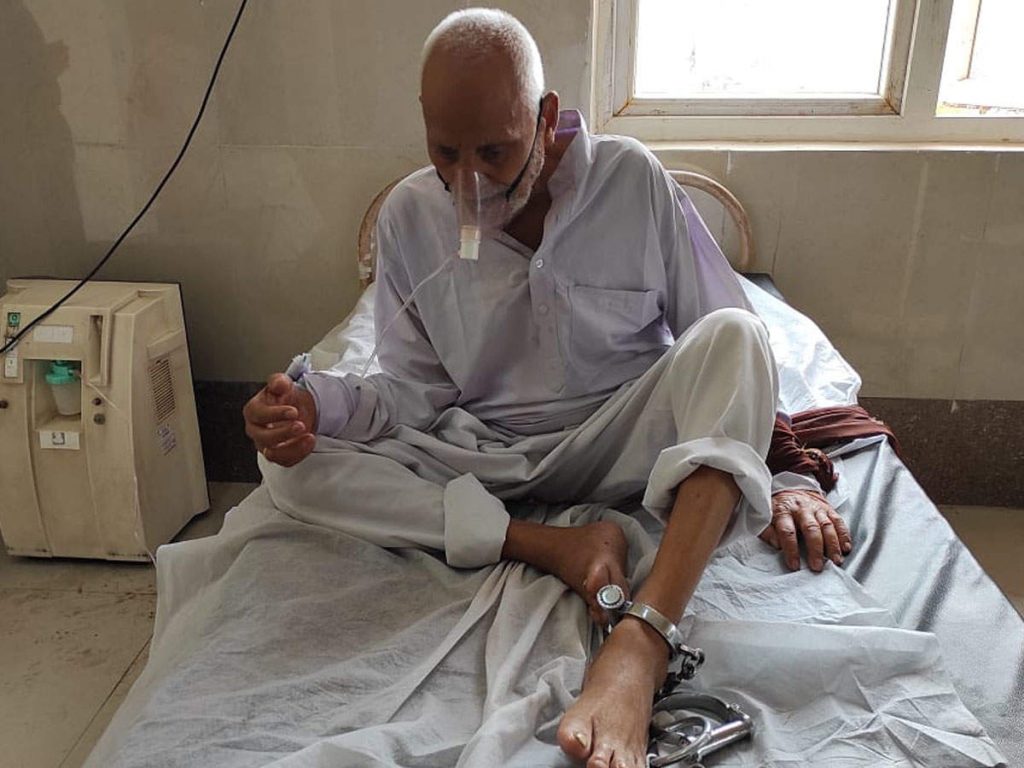
The photograph shows the person with his legs chained to the bed.
Source: Twitter
The photo is not of Stan Swamy
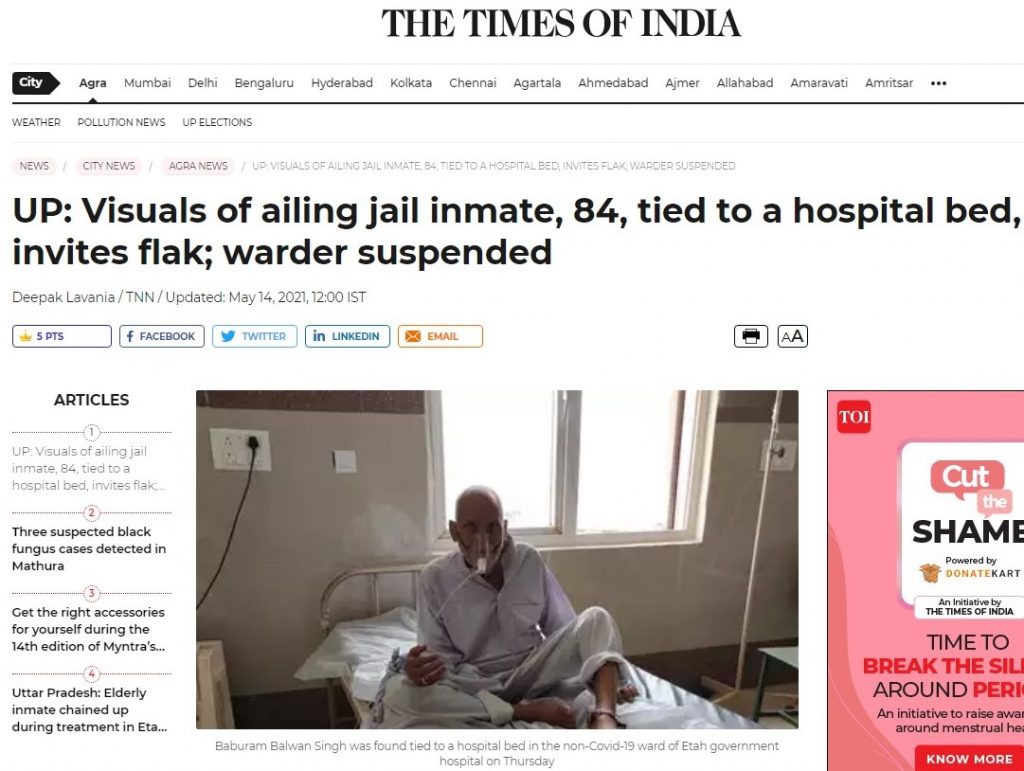
The person in the photo, however, is not Stan Swamy but convicted murderer Baburam Balwan Singh. A cropped version of the photograph was published in a report by the Times on India on May 14, 2021. The photo had surfaced on social media and had sparked anger due to the age of the old man. Consequently, an inquiry was ordered and director general (prisons) Anand Kumar was suspended, reported TOI.
Source: TOI
Kuldeep Singh Bhadauria, the jailor, had said, “He was taken to a government hospital on Sunday due to breathing problems and was referred to Aligarh. But there was no bed available there, so he was brought back to Etah, where he was admitted at the district hospital’s non Covid-19 ward. It is not clear under what circumstances he was tied to the bed. The entire matter is being investigated.”
Dr. Umesh Tripathi, Chief Medical Officer (CMO) of Eta district, stated, “Following a primary investigation, it surfaced that the patient was tied to bed by the jail staffer. I came to know about the entire matter through social media. The jail inmate is suffering from lung infection. He is being provided suitable treatment.”
The man in the photograph is Baburam Balwan Singh (Source: TOI)
Baburam Balwan Singh was convicted of murder earlier this year. He is reported to be a resident of Kulla Habibpur village. There are other media reports which prove that the person in the photograph is not Stan Swamy.
Source: Twitter
The media had also reported that the jail warden had been suspended by the Yogi Adityanath government.
Source: Twitter
Bhima Koregaon accused dies
Father Stan Swamy, an accused in the Bhima Koregaon ‘Urban Naxal’ case, has passed away, his lawyer informed the Bombay High Court when the Court took up his bail plea. According to his counsel, Stan Swamy suffered a cardiac arrest early morning on Saturday at 4:30 a.m., following which he passed away. The counsel demanded a judicial inquiry into the matter.
Furthermore, prior to his death, the accused received adequate treatment at the Holy Family Hospital in Bandra, where he had himself chosen to receive treatment after the Bombay High Court had directed him to be treated at the JJ Hospital.
The anti-corruption tribunal of the International Cricket Council on Monday handed over a 7-year ban from all cricket to former Sri Lankan performance analyst Sanath Jayasundara after he was found guilty of breaching the ICC anti-corruption code.
The case pertains to an attempt made by Sanath Jayasundara to bribe Sri Lanka’s then sports minister Harin Fernando in January 2019 to “influence improperly the result, progress, conduct or any other aspect of an international match”.
The tribunal found Jayasundara guilty of two charges: Article 2.1.3—offering bribes or other rewards to the country’s sports minister to contrive in any way or otherwise influence improperly the result, progress, conduct or any other aspect of an international match and Article 2.4.7—obstructing or delaying an ACU investigation into possible corrupt conduct under the anti-corruption code.
“Jayasundara’s attempt to bribe a Minister is serious offence while the efforts to cover up his tracks and the lack of remorse are massively disappointing,” Alex Marshall, general manager of the ICC’s integrity unit, said in a statement.
“We won’t tolerate corrupt conduct in our sport and my team will be relentless in preventing such behaviour. This ban should serve as a deterrent for anyone who may be tempted along the wrong path,” the statement further said.
The ban is backdated to 11 May 2019, the day when Sanath was provisionally suspended under corruption charges. According to the reports, Fernando reported the alleged attempted bribe to the ACU at the time of it taking place, less than a month after he took charge as the sports minister in December 2018.
Jayasundara had been associated with Sri Lanka Cricket for a long time. He had worked with Sri Lanka’s Under-19 team, along with his responsibility at the board’s Brain Centre. He was also employed with the men’s national team in the past.
Meerut police are in the lookout for a minor youth, the son of kachori seller Tehseem in Shyam Nagar, Meerut, Uttar Pradesh who fled after throwing piping hot oil on another minor youth, Naushad, after the latter opposed opening the shop amidst lockdown. In the incident that reportedly transpired on July 4 (Sunday) afternoon, the victim has suffered severe burn injuries on his face, neck and chest. He was rushed to a district hospital, where he was treated for his injuries.
Based on the complaint filed by the victim, a case has been registered at the Lisari gate police station in Meerut. The police are investigating the case and a search team has been sent to look for the accused, who fled immediately after the incident.
According to the police, the accused minor is the son of the owner of the Kachori shop, Tehseem. On Sunday afternoon, Naushad went to the shop to buy kachoris. When Naushad reached the shop, he got into an argument with the son, which soon culminated into a brawl. Naushad also complained about masks.
This enraged the Halwai’s son, who then took a ladle full of piping hot oil from the frying pan meant for frying the kachoris and threw it on Naushad.
As people started gathering hearing the victim’s screams, the accused purportedly fled the spot. The Meerut police are in the lookout for the accused minor, the son of the kachori shop owner, who has been on the run ever since the incident took place.
Speaking about the incident, the victim’s family claimed that Naushad’s entire face has been badly burnt. Luckily his eyes were spared. Meanwhile, Meerut City SP Vineet Bhatnagar confirmed that the incident was a fallout of an argument between the minors. He said that further legal action is being taken in this matter.
A prank played by two female relatives of a woman went horribly wrong, leading to loss of three lives, one among them an infant only hours old.
On Saturday last week, the police hunt for the Facebook friend of a woman who abandoned her newborn child for him ended when they discovered that the Facebook account was run by two of her female relatives, both of whom committed suicide for the fear of caught by the police and embarrassment over their prank having gone wrong.
Earlier this year, in January 2021, an infant was found abandoned in a heap of dry leaves in Kollam district of Kerala. The infant later died in a hospital. Soon thereafter, the police launched a probe to get to the bottom of the case.
A detailed probe into the matter, which included collecting DNA samples of women, led police to one Reshma, 22, who was the biological mother of the baby. She was arrested in June for the death of the newborn.
Reshma, 22, who hailed from Kalluvathukkal village in Kollamth, had abandoned her baby in a pit near a rubber plantation minutes after the newborn’s birth. Reshma confided in the police that her Facebook friend had put a condition that he would not accept her with another child.
“She had not revealed to her husband or other family members that she was carrying,” said ACP Y Nizamudheen who led the probe.
Reshma’s husband had moved to the Gulf four months ago and had returned after being informed about his wife’s arrest.
The police investigation revealed that Reshma was using a SIM card bought by her cousin Arya, who was summoned following the arrest. The police suspected Arya’s role in the case after Reshma informed them that she was asked by her Facebook ‘friend’ to abandon her baby.
But a day after the notice, Arya (23) and Greeshma (22), the daughter of Reshma’s sister-in-law, went missing. Their dead bodies were later recovered from a waterbody in the locality where they lived. The two were close friends.
“We got a breakthrough from Greeshma’s lover. Greeshma had told her lover that they were pranking Reshma and things had gone out of hand… after police issued summons, Arya had confessed to her mother-in-law the story about Reshma’s Facebook lover and the SIM used by her. After the mother-in-law went for NREGS work, Arya jumped into the river along with Greeshma,’’ Nizamudheen said.
The central government has told the Delhi High Court, Monday, that in spite of 3 months time granted to all SSMIs (significant social media intermediaries) to comply with the IT Rules 2021, having expired on May 26, Twitter Inc has failed to fully comply with the same, news agency ANI reported.
In its affidavit, Centre tells Delhi High Court, “In spite of 3 months time granted to all SSMIs (significant social media intermediaries) to comply with the IT Rules 2021, having expired on May 26, Twitter Inc has failed to fully comply with the same.” pic.twitter.com/nTrGgPkIeH
The affidavit was filed by the central government after Twitter India filed a reply, Saturday, against a plea seeking action against the microblogging site for its failure to appoint a Resident Grievance Officer as directed under Rule 4 of the Information Technology (Intermediary Guidelines and Digital Media) Rules, 2021.
IT Rule 2021 mandates appointment of Indian grievance officer, Twitter hires California-based officer for India
In its affidavit, Twitter India had told the Delhi High Court that the social networking platform is in the final stages of hiring a full-time resident grievance officer in accordance with the new IT Rule. Though the microblogging site stated in court on Saturday that it is in the process of appointing a full-time resident grievance officer, that too in accordance with the new IT Rule, the fact is that Twitter has appointed its California-based global legal policy director Jeremy Kessel as the new grievance officer for India. However, the new IT Rules call for an Indian resident for the role.
IT Rules 2021
The Information Technology (Intermediary Guidelines and Digital Media Ethics Code) Rules 2021 were issued in February this year to bring transparency into the working of social media companies and have already been given 3 months time to comply with the new regulations.
The Information Technology (Intermediary Guidelines and Digital Media Ethics Code) Rules 2021, which came into effect from May 25, mandates the social media intermediaries with more than 5 million users and providing messaging services to identify the first originator of problematic content that may harm the country’s interests. The companies should also appoint an Indian grievance officer to deal with the complaints.
The non-compliance with rules will result in these platforms losing the intermediary status that provides them immunity from liabilities over any third-party data hosted by them. In other words, they could be liable for criminal action in case of complaints.
Even though other social media platforms such as Facebook, Instagram and Whatsapp have complied with the new laws, Twitter had last month asked the government for an additional three months for the same.
Government of India sends final notice to Twitter, latter remains nonchalant
On June 5, the Indian Government had issued a final notice to social media behemoth Twitter for compliance with the new Information Technology (Intermediary guidelines and Digital Media Ethics Code) Rules, 2021.
In a strongly worded letter, the Ministry of Electronics and Information Technology warned the social media giant that such non-compliance with India’s new IT rules will lead to unintended consequences, including Twitter losing exemption from liability as intermediary available under Section 79 of the Information Technology Act, 2020. It said despite sending two notices, Twitter, in a brazen display of defiance, has not complied with the new digital rules.
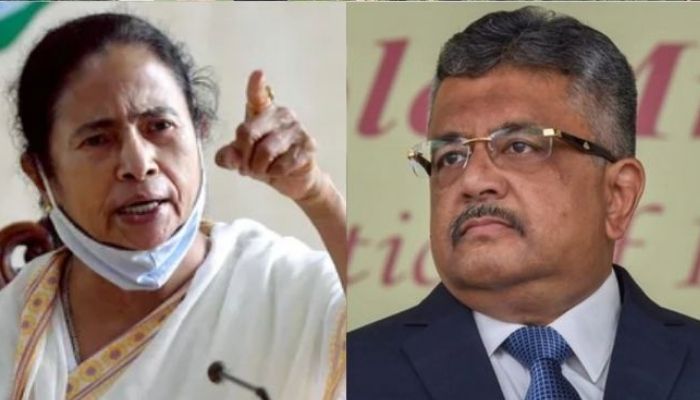
In a letter addressed to the President of India Ramnath Kovind, TMC leaders Mahua Moitra and Sukhendu Shekhar Ray demanded the removal of the Solicitor General of India (SGI) Tushar Mehta for allegedly meeting Suvendu Adhikari. It must be mentioned that Adhikari is an accused in the Narada sting case and Sharadha chit fund case.
The letter said, “The Solicitor General of India is the second highest law officer of the country after the Attorney General of India and advises Government of India and its various organs and in crucial legal matters such as Narada and Sarada cases. Such meeting between an accused in grave offences, with the learned Solicitor General who is advising such investigation agencies by whom the said accused is being investigated, is in direct conflict of interest with the statutory duties of learned Solicitor General of India.”
To preserve the sanctity of the post of Learned Solicitor General of India, removal of Mr Tushar Mehta is of utmost importance.
In that regard, we have written to the Hon’ble President of India seeking his urgent intervention to initiate the necessary steps on this matter. pic.twitter.com/mhMucRuV8u
— All India Trinamool Congress (@AITCofficial) July 5, 2021
It concluded, “Meeting between Suvendhu Adhikari in grave criminal offences and the SGI who is advising the very investigating agencies who are investigating & prosecuting such an accused person reeks of impropriety & is blatant conflict of interest.” Accusing the Solicitor General of India of ‘grave impropriety’, the TMC leaders claimed that his alleged meetup cast doubts on ‘professional integrity.’ The letter further added, “To make matters worse, this meeting took place subsequent to an equally improper meeting between Mr Adhikari and Home Minister of India, Mr Amit Shah.”
TMC Leaders Write To Prime Minister Narendra Modi
Earlier, Trinamool Congress leaders such as Derek O’ Brien, Sukhendu Sekhar Ray, and Mahua Moitra had written to Prime Minister demanding the sacking of the Tushar Mehta. “The Solicitor General of India the second-highest law officer of the Country after the Attorney General of India and advises the Government of India and its various organs in crucial legal matters. such as Narada and Sarada cases,” they claimed.
“Such meeting between an accused in grave offences, with the Learned Solicitor General who is advising such investigating agencies by whom the said accused is being investigated, is in direct conflict of interest with the statutory duties al the Learned Solicitor General of India. We have, therefore, reasons to believe that such a meeting has been organised to influenre the outcome of matters where Suvendu Adhikari is an accused, using the high offices of the Learned Solicitor General,” the letter informed.
The TMC leaders concluded, “In order to avoid any doubt in the mind of the public at large, as to the integrity and neutrality of the office of the Learned Solicitor General of India, we approach you to initiate necessary steps for removal of the Sri. Tushar Mehta from the post of the Solicitor General of India.”
It is notable here that recently, TMC MLA Ashok Kumar Deb, who is the head of Bar Council of West Bengal, had written to the CJI requesting the removal of the Chief Justice of Kolkata HC, accusing him of bias.
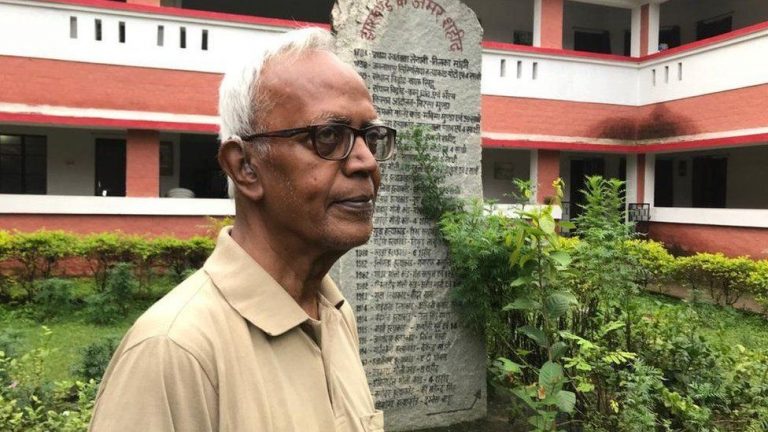
Stan Lourduswamy, commonly known as Stan Swamy, an undertrial prisoner in the Bhima Koregaon violence case, died on Monday at 1:30 pm, a month after being admitted to a Mumbai private hospital. He was 84 at the time of his death.
The accused was undergoing treatment at the Holy Family Hospital in Mumbai after his condition deteriorated in May. Swamy had been in jail for nine months in connection with his involvement in the Bhima Koregaon case. He suffered from Parkinson’s disease and was put on ventilator support on Sunday after suffering a heart attack on Saturday.
Who is Stan Swamy?
Stan Swamy was an Indian Roman Catholic priest, a member of the Jesuit order. He fashioned himself as an activist of sorts, allegedly fighting for the rights of the tribals. Stan, who hailed from Trichy, Tamil Nadu, studied theology and completed his masters in Sociology, in the 1970s, from the Philippines, where he participated in demonstrations and protests against the administration.
Later on, he served as the Director of the Indian Social Institute in Bengaluru from 1975 to 1986. Following this stint, he continued his activism in Jharkhand. Swamy participated in protests, ostensibly for the rights of tribals, in several parts of the country, most notably Jharkhand. Stan Swamy is the founder member of Vistapan Virodhi Janvikash Andolan (VVJA), a pan-India platform that claims to campaign against human rights violations caused by the displacement of Adivasi people, Dalits, and farmers from their lands.
Elgar Parishad-Bhima Koregaon Case
Stan Swamy had been involved in anarchic activities for quite some time, however, the chickens finally came home to roost when he was accused as one of the co-conspirators of the violence that erupted at the Elgar Parishad in 2018.
The Elgar Parishad-Bhima Koregaon case pertains to an event organised at Shaniwar Wada called Elgar Parishad on December 31, 2017. The following day, i.e January 1, 2018, large scale violence broke out at Bhima Koregaon, where lakhs of Dalits had gathered to celebrate the 200th anniversary of the Battle of Bhima Koregaon, won by the British Army—comprising mostly soldiers from the Dalit community—against the Peshwas in 1818.
An FIR was filed in connection with the violence on January 8 after which Pune Police kickstarted a probe into it. According to the police, arrested ‘activists’ claimed that the event was organised as part of alleged Maoist activity and the accused were members.
The Pune police continued the probe in the matter for 2 years after which the investigation was transferred to the National Investigation Agency in January this year. The agency said that incriminating documents and letters were found on the devices of some of the accused, tying their links to the banned CPI(M) group.
Soon after, the case was transferred to the NIA. The Pune police had arrested another nine supposed “intellectuals”, including Sudha Bharadwaj, Rona Wilson, Surendra Gadling, Mahesh Raut, Shoma Sen, Arun Ferreira, Vernon Gonsalves, and Varavara Rao for inciteful speeches.
Stan Swamy was a key conspirator in the Elgar Parishad Bhima Koregaon violence case : NIA
According to the NIA, Stan Swamy was a key conspirator in the Bhima Koregaon Elgar Parishad case of 2017, which witnessed violence, stone-pelting, and arson at Shaniwar Wada in Pune. He was arrested on October 8 and produced before the Special Court in Mumbai the following day. Interestingly, he was never put under police custody and was instead remanded to judicial custody at Taloja Central jail. The NIA had informed that all legal formalities, including medical examination, were undertaken.
As per the Central investigative agency, Stan Swamy was a ‘hard-core CPI (Maoist) activist’ who had received funds from other Maoists for furthering the activities of the banned outfit. He was also the convenor of PPSC, an organisation that was alleged to be a front organisation of CPI(M). “Incriminating documents related to communications for furthering the activities of the banned terrorist organisation CPI (Maoist) were seized from his possession,” the NIA emphasised.
Swamy had conspired with Maoists to overthrow government: Special Court
Soon after Stan Swamy was arrested for his involvement in the Bhima Koregaon violence case, the left-liberal lobby went into overdrive to fight for his bail. However, earlier this year, the special NIA court refused to grant bail to the Jesuit priest, maintaining that prima facie Stan had hatched a “serious conspiracy” with the members of banned Maoist organisation to plunge the country into chaos and overthrow the government.
Rejecting the bail plea of Stan Swamy, the special judge DE Kothalikar cited the email correspondence between the activist and his co-accused, observing that Stan and others he communicated with were referred to as “comrades”, and that Swamy had received Rs 8 lakhs from one comrade, Mohan, allegedly for the furtherance of Maoist activities.
Was Stan Swamy denied straw-sipper by NIA while in Taloja jail? Facts
In November 2020, while the usual suspects were busy making a case for Stan’s clemency, citing his advanced age and severe ailments as grounds for granting him mercy, Stan filed an application before the NIA court, accusing the central agency of seizing his straw and sipper.
The central agency rubbished the claims and issued a statement, stating that Stan Swamy had falsely claimed in an application before the NIA court that his straw and sipper have been withheld by the NIA.
NIA informed, “NIA duly filed its reply in the Court on the scheduled date i.e. 26/11/2020 stating therein that NIA had conducted his personal search in presence of independent witnesses and no such straw and sipper were found. The Hon’ble Court rejected Swamy’s application and has issued necessary direction to the jail authorities on 26th November 2020 to provide him straw and sipper.”
NIA stated that when Stan Swamy’s personal search was undertaken in presence of two independent witnesses no such straw or sipper was found on him as claimed by him.
The NIA informed that since the accused was placed under judicial custody at Taloja prison near Navi Mumbai, the matter rested between him and the jail authorities who fall under the jurisdiction of the Maharashtra State Administration.
“The reports claiming that NIA recovered straw and sipper from accused Stan Swamy and sought 20 days from the court to respond to Stan Swamy’’s plea to allow him a straw and sipper in Taloja Central Jail, are false, incorrect and mischievous as NIA neither recovered any straw and sipper from the accused nor sought 20 days to file a reply in said application,” it emphasised.
Stan Swamy provided medical facilities till last
Earlier in May, National Human Rights Commission asked Maharashtra government to ensure every possible medical treatment for him. After he contracted COVID-19 infection, he was shifted to Holy Family hospital in Bandra in May. On Sunday, after his health faltered, the NHRC again wrote to Maharashtra government to ensure proper medical treatment to him. However, after suffering cardiac arrest on Saturday, he was put on ventilator on Sunday and he breathed his last on July 5th.