Home Blog Page 4439

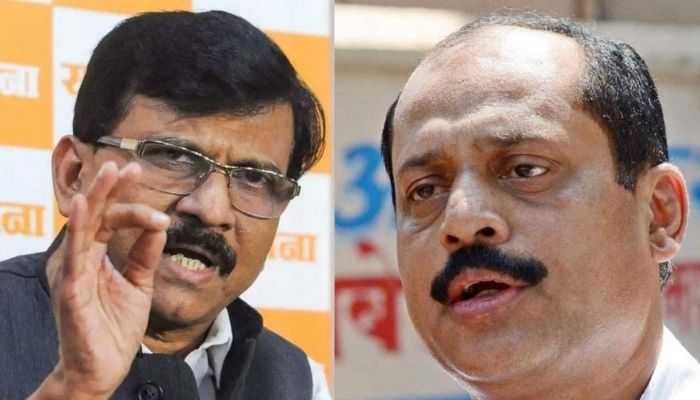
Sanjay Raut takes a U-turn on Sachin Vaze after showering praises on him: Here is what he said

Two weeks after hailing tainted cop Sachin Vaze as ‘honest and capable officer’, Shiv Sena leader Sanjay Raut claimed that he had expressed his apprehensions about Vaze to party leaders during his reinstatement to the Maharashtra police force.

During a TV interview on Monday (March 29), the Shiv Sena leader said, “When there was plan to reinstate Sachin Waze into the Maharashtra police force, I had informed some leaders that he could create problems for us. His behaviour and style of working could lead to some troubles for the government.” He further added that he cannot name the party leaders but they are ‘well aware’ of the conversation.

Sanjay Raut said that he knew Sachin Waze as he had been a journalist for a long time. The Shiv Sena leader emphasised, “This whole incident of Waze’s activities and controversies thereafter taught a lesson to the MVA government. It was good in a way that it happened and taught us some lessons.” On being asked about Maharashtra CM Uddhav Thackeray backing Sachin Vaze, Raut claimed that he was not aware of the tainted cop’s activities.

Sanjay Raut bats for Sachin Vaze

Earlier on March 14, Raut claimed that Sachin Vaze was a very honest and capable officer. “He has been arrested in connection with gelatin sticks that were found. One suspicious death also occurred. It’s Mumbai Police’s responsibility to investigate the matter. No central team was needed,” he claimed.

His statement on March 14 contradicts his current stance that he had informed party leaders of the potential trouble that Sachin Vaze could cause to the Maharashtra government. It must be mentioned that Sachin Vaze was reinstated at 4 a.m on June 6, 2020, after 16 years of suspension in a custodial death case. Sachin Vaze was arrested by the NIA on March 13 for his alleged role in planting the explosives-laden car outside Ambani’s house. He has been accused of planning Hiren Mansukh’s murder as well.

BBC, with history of anti-Hindu bias, attempts to take Hinduism out of Holi and Islamise the festival of colours: Details

The “secular-liberal” media establishment, having attempted to ‘secularise’ every aspect of Hindu culture and traditions, are now trying not only trying to downplay the Hindu roots of ‘Holi’ but also have taken a step ahead to give an Islamic touch to the Hindu festival. At the forefront of it this time around is the BBC.

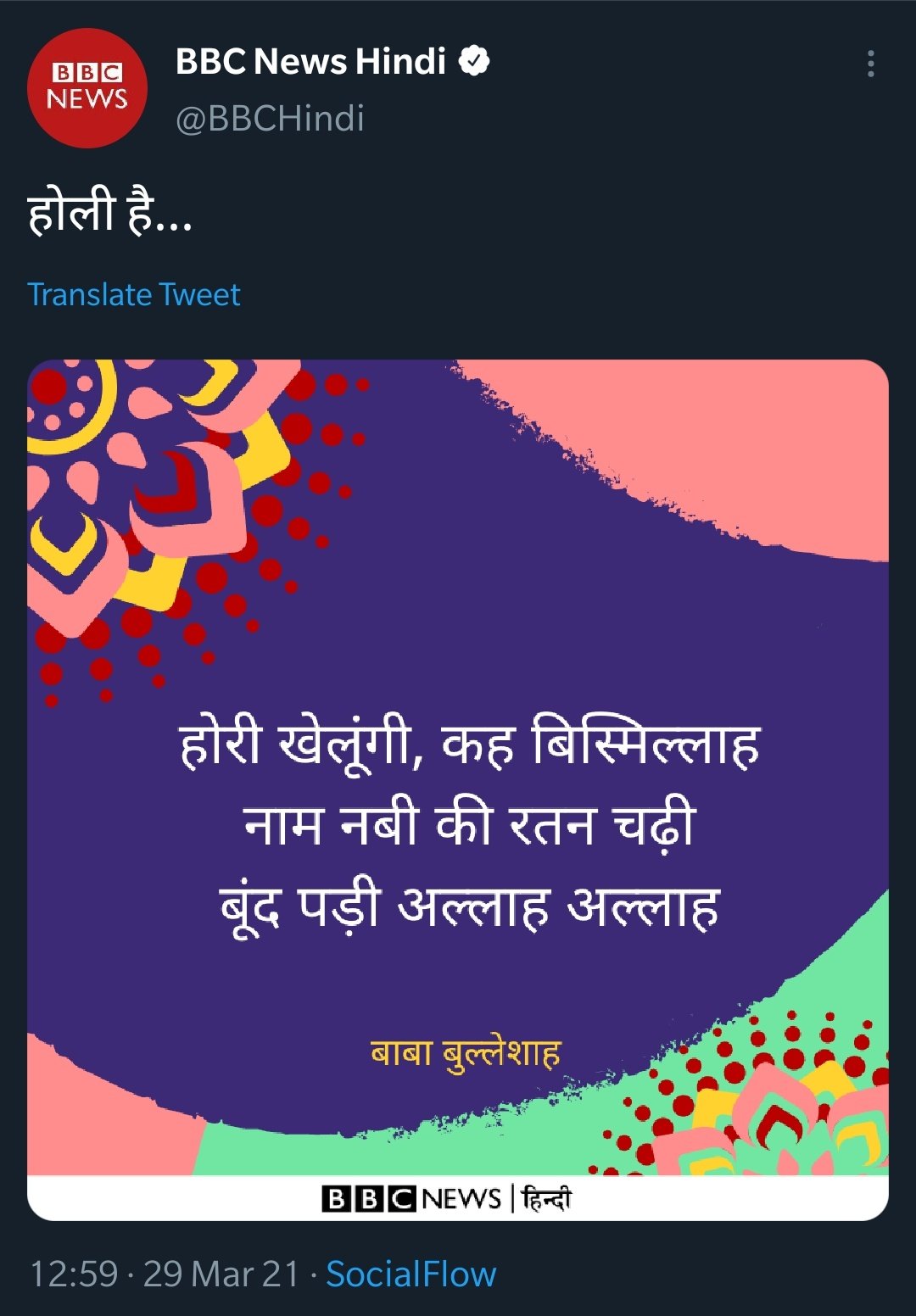
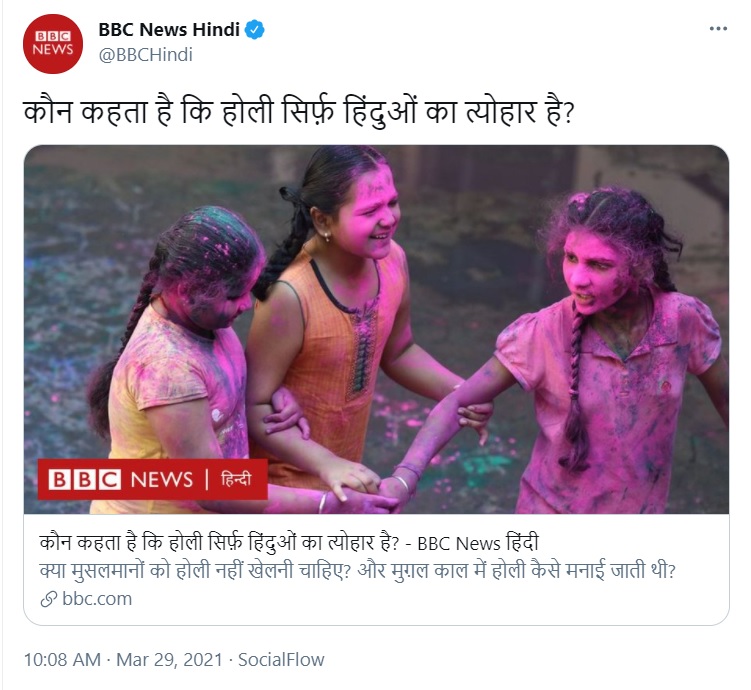
The British public broadcaster BBC took to social media to Islamise the Hindu festival. BBC Hindi shared an Islamic couplet by Baba Bullehshah to undermine the Hindu roots of the festival of colours.

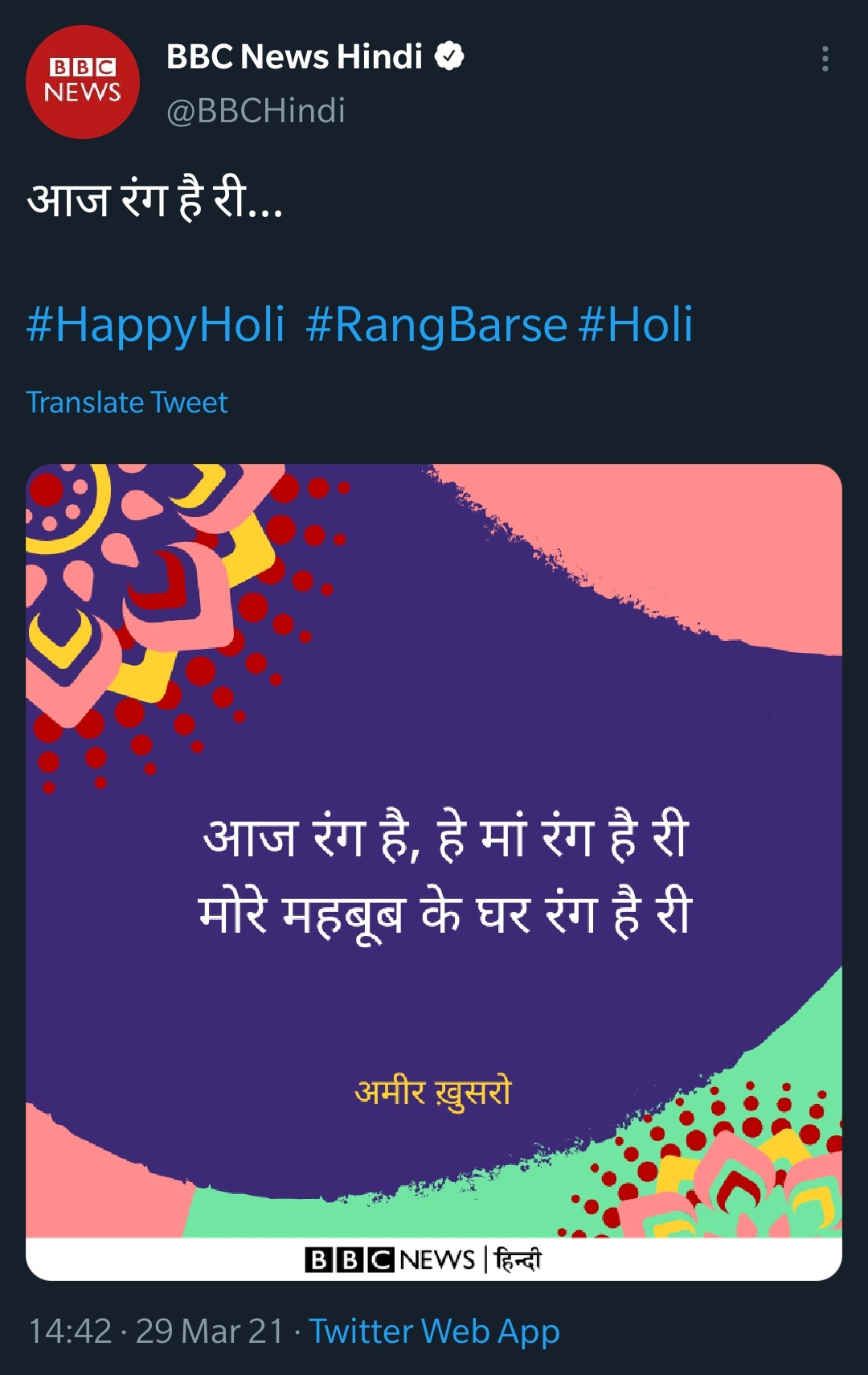
The British broadcaster, however, did not stop there. BBC Hindu shared the lines of the poem ‘Aaj Rang Hai’ written by Amir Khusrau, a 12th-century Islamic court poet.

BBC Hindi also shared an article that questioned the Hindu roots of the festival. The article written by self-proclaimed historian Rana Safvi, titled, “Who said Holi is just a Hindu festival?” declared that Holi was not just a Hindu festival but also a tradition followed in the Mughal era.

A concerted attempt appears to be underway to Islamise all aspects of Hindu celebrations and appropriate Hindu festivals to downplay their cultural and religious linkage. After Diwali, the secular propagandists have now come for another Hindu festival – Holi.

BBC anti-Hindu bias

BBC has a long history of anti-India and anti-Hindu bias. Their coverage of the Delhi Riots garnered great condemnation from people across the board. Their coverage of Kashmir has also been extremely one sided against India in the past.

Only recently, BBC provided platform to a British writer to fuel the Sikh-Hindu divide. On another instance, a caller on one of its radio shows abused PM Modi and his mother in extremely foul language.

‘Love Jihad is a fact’, says Kerala Catholic Bishops Council’s spokesperson after Congress(M) leader’s statement

CPM and LDF are caught in a conundrum after LDF ally Kerala Congress (M) leader Jose K Mani issued a statement on ‘Love Jihad’. In a TV interview, Mani stated, “Love jihad has again come up as an issue. Society has apprehensions about it. As the issue has emerged again, the apprehensions about it should be cleared.”

This statement has sparked controversy in the ruling left alliance just ahead of the Assembly election, reported the Indian Express.

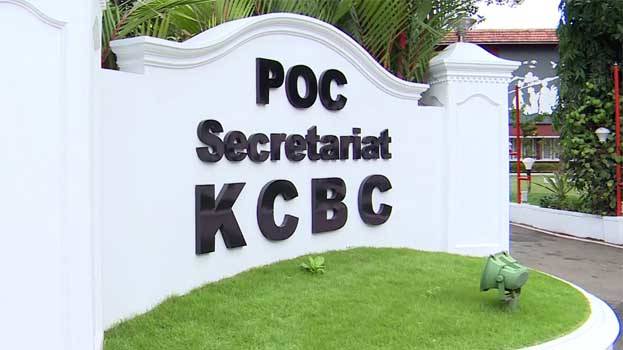
To add to it, Kerala Catholic Bishops Council (KCBC) has expressed its support to Jose K Mani, an ally for his statement on Love Jihad.

KCBC spokesperson, Fr Jacob, commenting on the issue demanded, “CPM and other major political parties should reveal their stance on the matter.” He added, “Love Jihad is a fact. I am happy about the practical response from Kerala Congress (M) chairman Jose K Mani”, as per a Mathrubhumi report.

Disgruntled with the Chief Minister’s denial of the existence of Love Jihad, he added, “The Chief Minister claims that Love Jihad does not exist. He is making such a statement over his political agenda. The church and the public are worried about Love Jihad. The government and political parties are bound to solve the issue.”

Clarifying his stance on willful inter-religion marriage, he said, “The church is not against marriage between people who belong to different religions. But the church opposes making someone forcefully follow a religion.”

Fr Jacob alleged that only Muslim League denies the existence of Love Jihad.

Jose Mani is contesting elections from Pala, a constituency that has a sizable chunk of Catholic votes. Jose is up against sitting legislator and NCP (Kerala) leader Mani C Kappan who enjoys mass following. However, the Catholic Church in Kerala has been consistently voicing against “love jihad”. They also have sought BJP’s support for the same.

While the other parties are silent on the issue, BJP in its manifesto released last week has promised to bring legislation to counter ‘Love Jihad’.

Meanwhile, Congress leader Shashi Tharoor attacked BJP on this issue and said that the BJP can only offer communalism, scare-mongering over ‘Love Jihad’ and hate-filled politics of division which will not succeed in a pluralist state like Kerala.

Kerala goes into voting on April 06 and the counting of votes will take place on May 02 along with Tamil Nadu, Puducherry, West Benagl and Assam.

People will be driven out of State if BJP comes to power: After audio of her pleading with BJP leader went viral, Mamata Banerjee resorts to fear-mongering

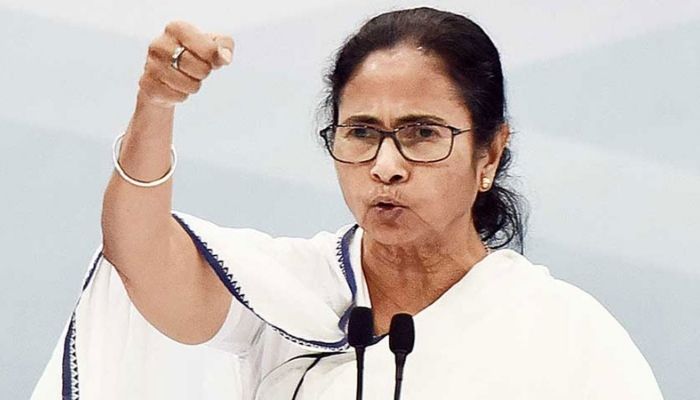
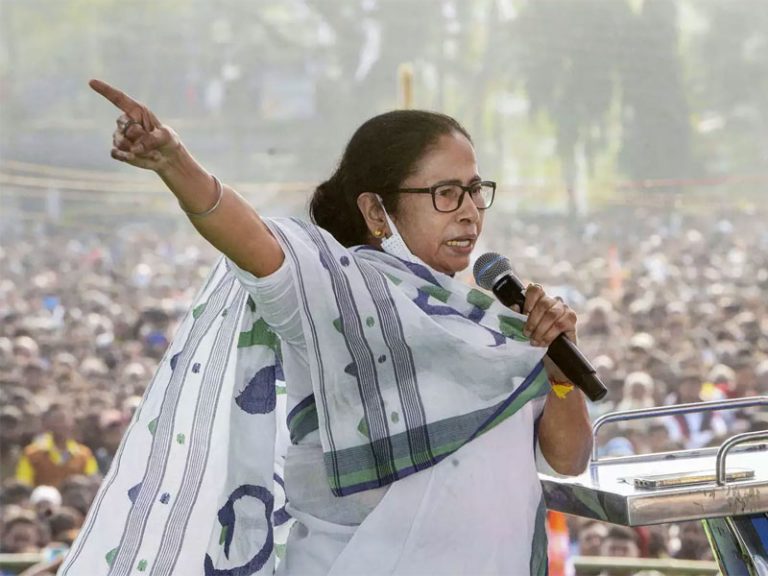
Amidst the ongoing Assembly elections in West Bengal, Chief Minister Mamata Banerjee resorted to fear-mongering during an election rally in Nandigram.

While addressing the public gathering, Mamata Banerjee said, “BJP ke vote dile apna ke desh theka tariya deba (If you vote for the BJP, then, they will drive you out of the State).” She claimed that BJP’s rise to power would result in ‘outsider goons’ taking over Bengal.

Baira thaka goondara aisa bangla ke dhokhol kora nibe, Banglar sanskriti ke dhokhol kore nabe, banglar asthitya dhokhol kore nabe.(Goons from other States will come here and take over Bengal, destroy its culture and identity),” the incumbent West Bengal Chief Minister alleged. While drawing a contrast with the BJP, she claimed that voting for the TMC will result in in-home delivery of free ration.

Video Courtesy: Youtube/ABP Ananda

Furthermore, Mamata Banerjee lured voters by highlighting the government schemes, which are supposedly implemented by the Trinamool Congress-ruled State government. Her election rally in the Nandigram Vidhan Sabha constituency comes two days after an audio clip of her conversation with BJP district Vice-President Pralay Pal went viral online. She was heard pleading with the BJP leader to help her win elections and rescue the TMC, ahead of polling in Nandigram on April 1.

‘Outsider vs Bengali’ rhetorics of Mamata Banerjee

In a bid to rake up Bengali sentiments, the Trinamool Congress had attacked several BJP leaders by dubbing them as ‘outsiders’ in the land of Bengalis. In November last year, Mamata Banerjee urged people to ‘resist outsiders’. She remarked, “If some goons from outside come to our state and terrorise you, all of you should unite and resist them. I promise we will stand by you. We believe in peace. But few people come to the state only during the elections to terrorise others. We won’t allow them to have a free run here.”

In December last year, she again reignited the debate around ‘Bengali vs Outsider.’ She said, “Remember, BJP is not a party of Bengal but it is a party of Delhi and Gujarat. They should return to those states. Don’t trust the BJP or believe them. If you want to fight elections in Bengal, do it without bringing outsiders.” She continued to take potshots ahead of the election with ‘outsider jibe’ as well.

Mamata Banerjee tells women to beat up BJP workers with utensils, calls herself Royal Bengal Tiger: Details

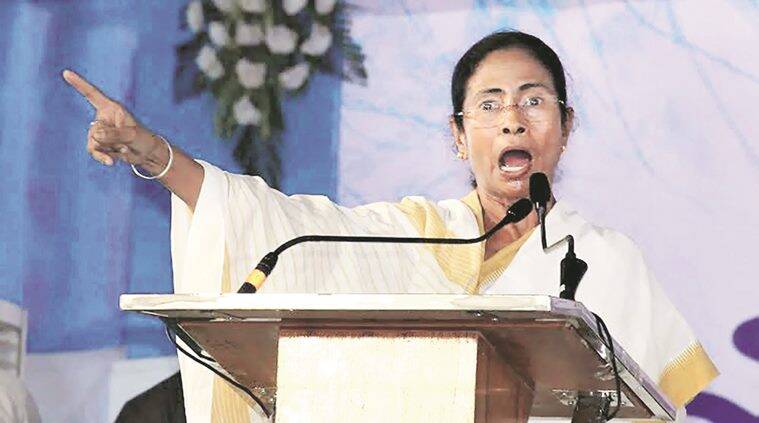
Mamata Banerjee has declared herself a Royal Bengal Tiger while campaigning in Nandigram ahead of voting for the constituency on the 1st of April. She also advised women to beat up BJP workers and said that she will respond like a lion.

She further claimed, without evidence, that she was attacked by goons from Uttar Pradesh and Bihar. Mamata Banerjee injured herself in Burulia recently in an incident that was ruled to be an accident in a report by the Election Commission itself.

That, however, has not prevented Mamata from accusing the BJP of attacking her. “No one from Nandigram attacked me but you brought goons from UP, Bihar. We want a free and fair election. If they come, women should beat them up with utensils,” she said.

The West Bengal Chief Minister also appeared to threaten people while leaving. She said, “Cool Cool Trinamool, vote paabe Jora phool (Jora flower, TMC’s symbol, will get the vote)” but then proceeded to add, “Tarpor dekhe nebo, thik aachhey? Maathay jeno thake (We will take care of them after the vote, okay? Remember that)”.

The context of the words are unclear but it is clear that she is speaking of taking care of BJP workers after the vote.

Mamata Banerjee has been extremely eccentric remarks of late. Recently, she claimed that Prime Minister Modi had gone to Bangladesh to campaign for West Bengal assembly elections and therefore, his visa should be cancelled.

She also claimed that the visit violated the model of code conduct while implying that there is nothing wrong if a Bangladeshi actor campaigns for Trinamool Congress during elections.

Panic in TMC camp? After raising the EVM bogey, TMC delegation urges EC not to deploy centre forces from BJP ruled states in Bengal

Just after the first phase of polling in West Bengal, TMC seems to be getting jittery about its prospects in the state. After raising the EVM bogey, a delegation of Trinamool Congress (TMC) leaders have now met Election Commission and urged them not to deploy armed police forces from UP, MP, Bihar, and any other BJP/NDA ruled state.

TMC said in its plea that Madhya Pradesh CM Shivraj Singh Chouhan, Uttar Pradesh CM Yogi Adityanath, Cabinet Minister of Bihar Syed Sehnawaz Hussain and other BJP leaders are star campaigners in West Bengal elections and MP Police and UP Police report to CM Chouhan and CM Yogi, respectively. Therefore, to ensure no partisan activity during the elections, armed forces from these states or any state where BJP/NDA is in power should not be deployed in West Bengal on election duty.

This bizarre request from TMC comes after the first phase of polling where BJP is set to do remarkably well. According to Amit Shah, BJP is set to win 26 out of 30 seats in the first phase of polling where Jhargram and Jangalmahal voted. The increased panic in the TMC camp seems to be a direct consequence of them losing grip over power in the state.

If pollsters are to be believed, BJP is set to comfortably form the government in the state, wresting power away from Mamata Banerjee led TMC.

It is pertinent to remember that merely a few hours after the voters began to exercise their ballot in the first phase, the jittery Trinamool Congress Party (TMC) had started peddling the ‘EVM hacked’ bogey.

The ruling TMC party, which is, this time, fighting for its survival in the state, took to Twitter to raise the false bogey of ‘EVM malfunctioning’. It said the voters in the Kanthi Dakshin assembly seat have been making a shocking claim that “they voted for TMC but VVPAT showed them the BJP symbol”. It asked the Election commission to immediately look into the matter. “THIS IS SERIOUS! THIS IS UNPARDONABLE!” exclaimed ruling TMC.

Preventive custody of anti-social elements in Purba Medinipur

The residents of Purba Medinipur will cast their votes in the second phase of Assembly Elections in West Bengal. TMC has alleged that BJP workers indulged in large scale violence during the first phase of elections that led to grave injuries to many people. They also alleged that BJP workers were involved in several instances of booth capturing, rigging and jamming. Thus, EC should issue an order to take any such anti-social elements into preventive custody.

Central ministers and leaders from other States are bringing ‘outsiders’ to West Bengal – Subrata Mukherjee

During a press conference after meeting with Election Commission, TMC leader Subrata Mukherjee alleged that the central ministers and leaders from other states are bringing ‘outsiders’ to West Bengal in the name of security.

‘Suvendu Adhikari is harbouring criminals in Nandigram’ – alleged TMC

In a letter to EC, TMC has alleged that BJP’s Suvendu Adhikari, a contesting election in Nandigram against Mamata Banerjee, has harboured criminals who are non-residents of Nandigram.

They mentioned five locations in their letter, including hotels, lodges and houses of BJP leaders at Nandakumar High Road, EN Public School in Paloimore, lodges and guest houses in Chandipur, Kali Podo Se’s home, Haripur, Ram Chowk and other locations. They said that local police had been informed about the locations.

Assembly Elections in West Bengal

Phase 1 of the Assembly elections in West Bengal were held on March 27. The next phase of voting will take place on April 1. In the second phase, all eyes will be on Nandigram, where CM Mamata Banerjee is contesting the election against Suvendu Adhikari, who left TMC and joined BJP in December 2020. The elections in West Bengal were divided in eight phases. Results will be announced on May 2.

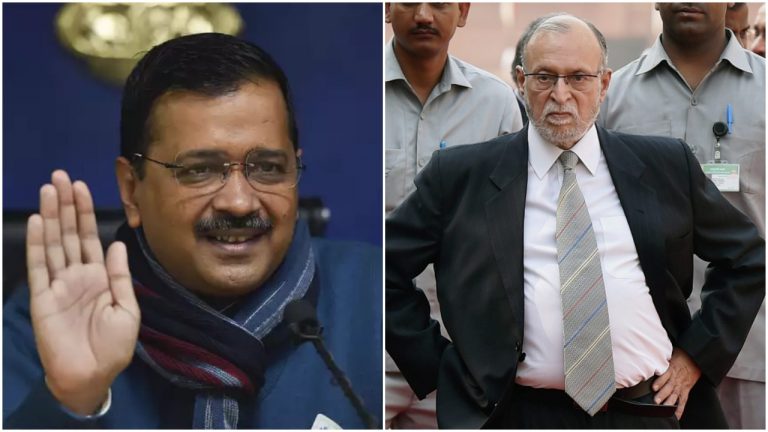
Government of NCT of Delhi (Amendment) Bill, 2021 becomes law after Presidential assent: Read how it alters the power equation in Delhi

The President of India Ram Nath Kovind on Sunday gave assent to the Government of National Capital Territory of Delhi (Amendment) Act, 2021, which enhances the powers of the Lieutenant Governor and limits the elected government’s power in Delhi.

The centre had passed the GNCTD (Amendment) Bill, 2021 in the Lok Sabha on last Monday and later in Rajya Sabha on Wednesday.

The centre had introduced the Government of National Capital Territory of Delhi (Amendment) Bill, 2021 in the Parliament to amend the Government of National Capital Territory of Delhi Act, 1991, that provided a framework for the functioning of the Legislative Assembly and the government of the National Capital Territory (NCT) of Delhi.  

The new law seeks to amend certain powers and responsibilities of the Legislative Assembly and the Lieutenant Governor.

What is the Government of National Capital Territory of Delhi Act, 1991?

Delhi is a Union Territory with a legislature, and it came into being in 1991 under Article 239AA of the Constitution inserted by the Constitution (Sixty-ninth Amendment) Act, 1991.

Subsequently, the Government of National Capital Territory of Delhi Act, 1991, was enacted by the centre to supplement the provisions of the Constitution concerning the Legislative Assembly and a Council of Ministers for the territory of Delhi. As per the existing Act, the Legislative Assembly has the power to make laws in all matters except public order, police and land.

The act also outlined the powers of the Assembly, the discretionary powers enjoyed by the L-G, and the duties of the CM with respect to the need to furnish information to the L-G.

However, several flaws in the GNCTD Act, 1991, hindered the smooth functioning between the Delhi government and the L-G. In the previous act, there was no structural mechanism to ensure the time-bound implementation of the rules. Also, the law did not have clarity about what proposal or matters need to be taken up with the L-G before issuing any directive.

The earlier provisions also gave rise to conflict between the elected government in Delhi and the L-G often, resulting in governance deficit in Delhi.

LG-Delhi Government conflict:

The conflict between the Lieutenant Governor and the Delhi government has time-and-again given rise to a constitutional crisis in Delhi. The lack of clarity in the 1991 act had resulted in the ambiguous interpretation of the provisions of division of powers between the L-G and the Delhi government.

To make it more complex, a five-judge Supreme Court Bench, in 2018, had held that the L-G’s concurrence is not required on issues other than police, public order and land, thus giving more powers to the elected government. The apex court had also added that decisions of the Council of Ministers will, however, have to be communicated to the L-G.

In its judgement, the apex court said that L-G was bound by the aid and advice of the council of ministers. However, in the same verdict, the Supreme Court also pointed out that the elected government must keep in mind that Delhi is not a state.

Following the judgement, the elected government in Delhi altogether stopped sending files on executive matters to the L-G before the implementation of any decision.

To rectify the flaw and to give effect to the interpretation made by the Supreme Court in the issue, the Centre introduced new amendments to the GNCTD Act, 1991.

What are the provisions under the new law?

The GNCTD (Amendment) Act, 2021 seeks to end the ambiguity regarding the time-bound implementation of the laws and the confusion surrounding matters where LG consultation was necessary. The new law will amend Sections 21, 24, 33 and 44 of the 1991 Act.

According to the statement of objects and reasons of the bill, the amendment will give effect to the interpretation made by the Supreme Court, that seeks, inter alia, “to clarify the expression “Government”, which in the context of legislation to be passed by the Legislative Assembly of Delhi, shall mean the Lieutenant Governor of the National Capital Territory of Delhi”.

“The said bill will promote harmonious relations between the legislature and the executive, and further define the responsibilities of the elected government and the L-G, in line with the constitutional scheme of governance of the National Capital Territory of Delhi, as interpreted by the Supreme Court,” the statement of objects said.

Further, the GNCTD (Amendment) Act, 2021 seeks to give primacy to Delhi’s lieutenant governor (L-G) over the elected government in Delhi. In other words, it seeks to clarify that the “government” in Delhi means the “Lieutenant Governor”.

The new law states that the Delhi assembly continues to make laws on all subjects in the state list and concurrent list except public order, police and land. Under the new law, the Delhi government will now have to seek the lieutenant governor’s opinion before any executive action after the passage of the bill.

The new law says, “When a bill has been passed by the legislative assembly, it shall be presented to the lieutenant governor and the lieutenant governor shall declare either that he assents to the bill or that he withholds assent therefrom or that he reserves the bill for the consideration of the president.”

The amended law gives discretionary powers to the L-G even in matters where the Legislative Assembly of Delhi is empowered to make laws. The GNCTD (Amendment) Act, 2021 also ensures that the L-G is “necessarily granted an opportunity” to give her or his opinion before any decision taken by the Council of Ministers (or the Delhi Cabinet) is implemented.

Most importantly, the new law also bars the Assembly or its committees from making rules to take up matters concerning day-to-day administration, or to conduct inquiries in relation to administrative decisions.


Maharashtra CM Uddhav Thackeray tells Chief Secretary to prepare for lockdown amidst rising Covid cases in the state

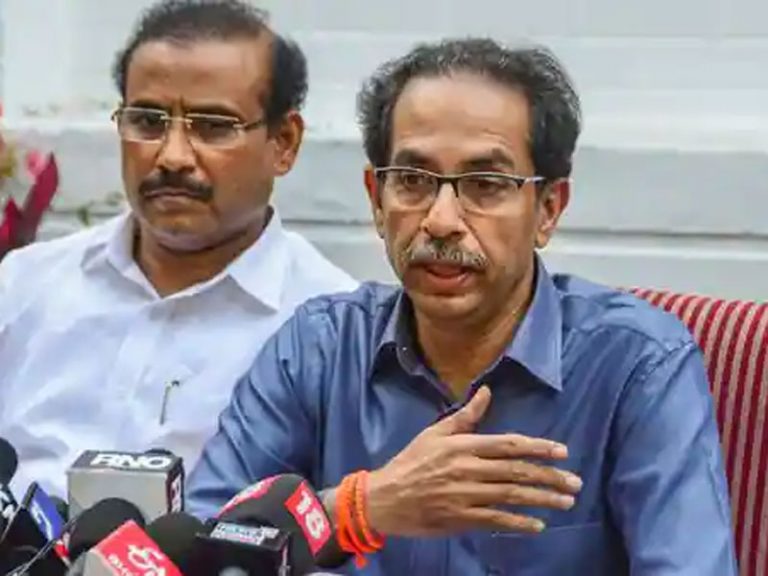
On March 28, Maharashtra clocked 40,414 new Covid-19 cases. The alarming situation in the state pushed Chief Minister Uddhav Thackeray to ask Sitaram Kunte, Chief Secretary, to immediately prepare a plan for a lockdown as a last resort to control the situation.

Thackeray showed concern over the rising number during the meeting and said, “The government was trying hard to keep the economy afloat amid the pandemic. However, several factors are not being considered seriously.” Public Health Minister Rajesh Tope was also present at the meeting.

CM said that the health of the people is the government’s top priority. “Hence, the chief secretary should plan a lockdown strategy to ensure that the supply of essential commodities, including food grain and medicines, and health services, are not hampered. This is what we have to do if people are not following the (Covid) norms,” he added.

Maharashtra lockdown plan: Businesses not following 50% attendance norm

During the meeting, CM Thackeray said that the state had restricted business establishments to allow only 50% of the employees to come to the office. However, the norm is not being followed in private establishments. He further added that citizens are not following the precautions. Thus, the state has to take the necessary steps. He said that citizens are not wearing masks, marriage halls are packed beyond the permitted number of guests, and social distancing norms are not being followed.

Death of Covid patients due to lack of oxygen

As per reports, at least seven patients have died in Nagpur (4) and Dhule (3) due to an alleged shortage of oxygen in hospitals. The hospitals in Nagpur are in desperate need of critical supplies, especially medical oxygen, as the demand has increased five-fold due to a surge in critical patients. Following the death of three patients, Nagpur Municipal Corporation (NMC) has issued a show-cause notice to the hospital and initiated an inquiry. The other twenty patients have been shifted to other hospitals.

Alarming spike in Covid-19 cases in Maharashtra

In the last 15 days, the number of cases has risen at an alarming pace in the state of Maharashtra. Over 3.9 lakh people were tested positive during that period. Mumbai clocked 6,933 cases in a single day on Sunday, making it the highest ever tally recorded in the state.

Dr Shashank Joshi, a member of the task force to curb the rising number, said that lockdown would be the last resort. He said, “Lockdown is the last resort, but we have to consider it because the healthcare infrastructure is crumbling. There are no beds available in the private sector and public-sector beds, too, are filling fast.”

Maharashtra stands at the top as the most-affected state in the country. As per the Ministry of Health and Family Welfare, nearly 27,13,875 cases have been reported from the state, with more than 3,25,901 active cases. The state has reported 54,181 Covid-19 deaths. On Sunday, 40,414 cases were reported in Maharashtra. 108 people died due to the Covid-19 pandemic in the last 24 hours.

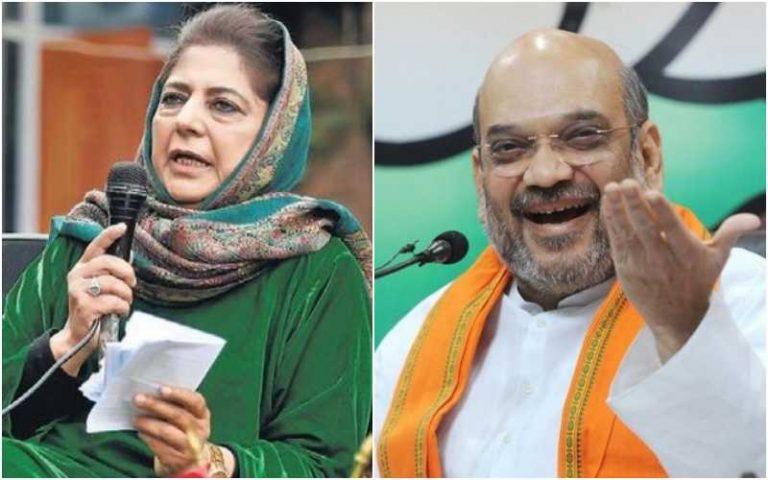
Mehbooba Mufti says she was denied a passport because CID deems her ‘detrimental to the security of India’

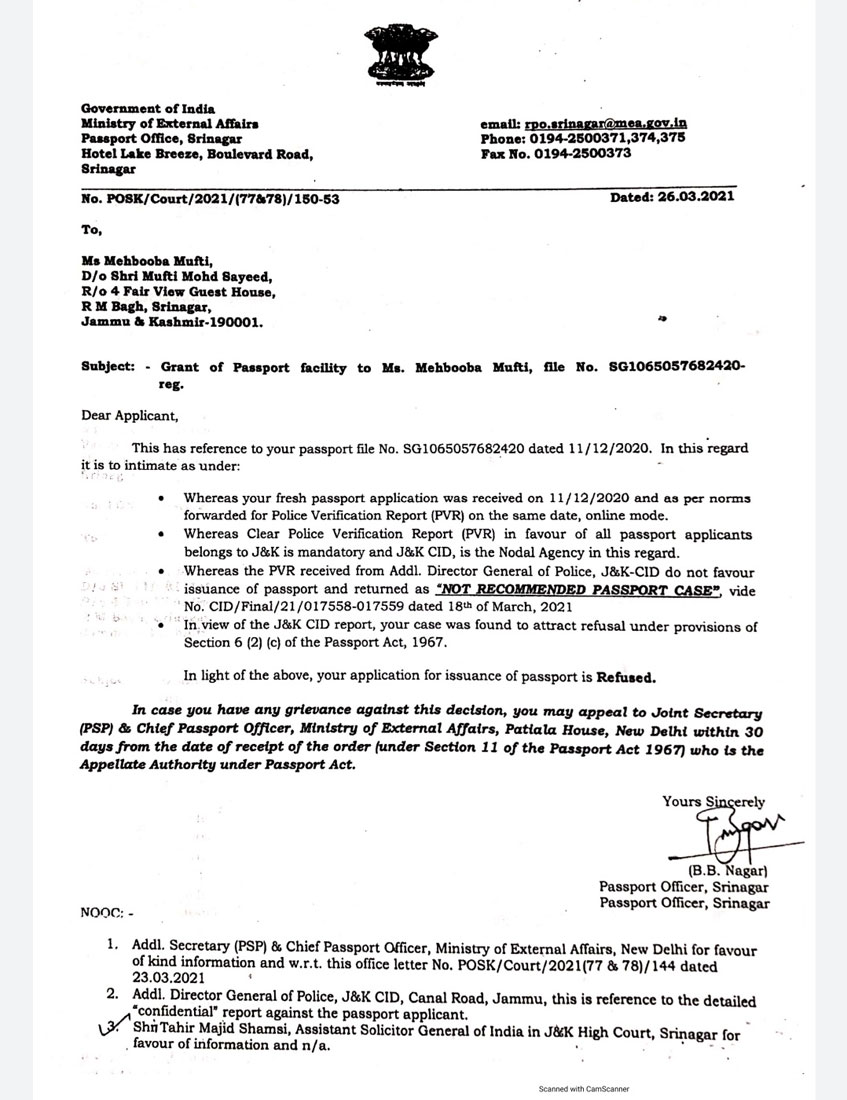
On March 29, former Chief Minister of Jammu and Kashmir Mehbooba Mufti said on Twitter that she had been denied a passport by the government of India, citing national security. In the tweet, she said, “Passport Office refused to issue my passport based on CID’s report citing it as ‘detrimental to the security of India. This is the level of normalcy achieved in Kashmir since Aug 2019 that an ex-Chief Minister holding a passport is a threat to the sovereignty of a mighty nation.”

Mufti also posted a snapshot of the letter sent by the Passport Office, Srinagar. In the letter, it was mentioned that the request was denied based on the Police Verification Report (PVR) received from the Additional Director General of Police, Jammu and Kashmir CID. The PVR was returned to the passport office with the remark “Not Recommended Passport Case”.

Letter issued by Passport Office (Image: Twitter/AzaanJavaid)

The passport was denied by the CID under Section 6 (2) (c) of the Passport Act, 1967. Section 6 of the Passport Act deals with the refusal of passport and travel documents. The sub-section (2) clause (c) states that the passport authority shall refuse to make an endorsement for visiting any country if the departure of the applicant from India may, or is likely to, be detrimental to the security of India.

Under Section 11 of the Passport Act, 1967, Mufti can appeal to the Passport Office, Ministry of External Affairs, New Delhi, against the refusal of issuance of passport by the Passport Office, Jammu and Kashmir within 30 days of the receipt of the letter.

J&K Police had informed the High Court about the ‘adverse report’ by CID

On March 25, while hearing a petition filed by Mehbooba Mufti in Jammu and Kashmir High Court, the court was informed by the Jammu and Kashmir Police that the issuance of the passport was opposed based on the ‘adverse report’ received from CID. The report submitted in the High Court by the Police stated that Mufti cannot be issued a passport because the CID sees security issues.

As per reports, Mufti had applied for a fresh passport on December 11, 2020. Her previous passport had expired on May 31 last year. Speaking on the issue, Police officials said that “an adverse report” has been filed against her by the Criminal Investigation Department (CID), but refused to elaborate, saying the matter would be taken up before the high court.

Mufti was released from detention in October 2020

On October 13 last year, PDP Chief Mehbooba Mufti was released from detention. She was detained with several other political leaders from Jammu and Kashmir in August 2019 when Union Home Minister Amit Shah had announced the abrogation of Article 370.

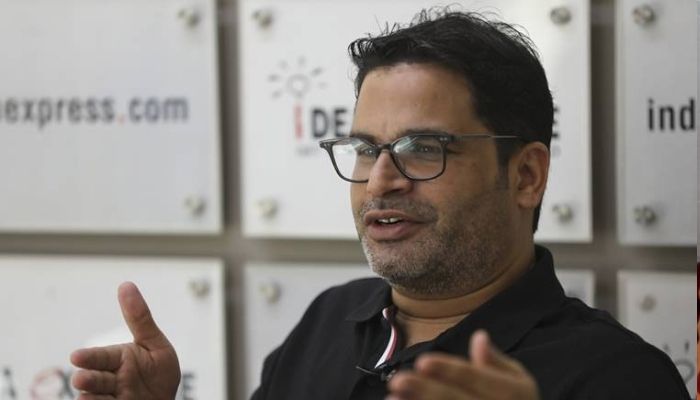
Prashant Kishore vows to quit job as ‘election strategist’ if BJP crosses 100 seats in Bengal. Here is what he said

Amidst the ongoing Vidhan Sabha elections in West Bengal, election strategist Prashant Kishor has vowed to quit his profession if BJP gets more than 100 seats.

In an interview with the Indian Express, Kishor said, “Around November-December last year, there was a lot of hype being created around the BJP, that they are going to sweep the state, get 200 seats etc. So, it was important for us to say publicly that this is not true… There is no way that in December the BJP was in a position to be winning 200 seats.”

He said that he stood by his earlier assessment that BJP can not cross the double-digit mark. “And, in our assessment, they would struggle to enter triple digits, and I stand by that remark. If they do, I will cease to exist as a political aide to anyone. I must quit this space, and quitting this space does not mean Twitter; I won’t do this work ever,” he announced.

Prashant Kishor also claimed that BJP has a 5-pronged strategy for the West Bengal State Legislative elections. According to him, the strategy includes polarisation, discrediting Mamata Banerjee, collapsing the Trinamool Congress, PM Modi’s popularity and the vote of Scheduled Castes.

Prashant Kishore earlier announced to quit Twitter if BJP crossed 100 seats

Prashant Kishor, the election strategist to Mamata Banerjee, claimed in December last year that the BJP will get less than 100 seats. He had announced that he would quit Twitter if the BJP crossed the double-figure mark. He had also challenged BJP leaders to announce that they would relinquish their positions if they failed to get 200 seats.

On December 21, 2020, he tweeted, “For all the hype AMPLIFIED by a section of supportive media, in reality, BJP will struggle to CROSS DOUBLE DIGITS in WestBengal. PS: Please save this tweet and if BJP does any better I must quit this space!” His announcement came, following BJP heavyweight leader Amit Shah’s visit to West Bengal and the defection of 9 TMC MLAs and one MP.