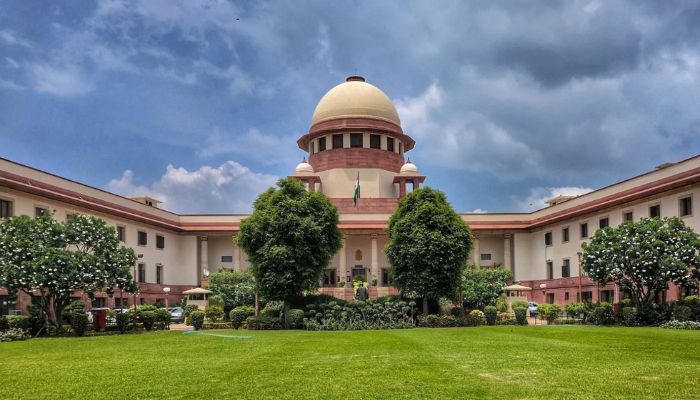
On Thursday (1st April), all Judges of the Supreme Court unanimously agreed to publicly make available the declaration of their assets.
The apex court reportedly decided to boost public confidence in the Judiciary and promote transparency. The decision was taken during a full-court meeting held on Thursday.
The Judges decided to disclose their assets to the Chief Justice of India (CJI) and the declarations would be uploaded on the official website of the Supreme Court.
#BREAKING In a full court meeting held on April 1, supreme court Judges decide that they shall disclose their statement of assets, which will be stated on the Supreme Court Website. The technicalities are being looked at #SupremeCourtpic.twitter.com/XnJwhd2knB
The specifics of the matter will be finalised in due course of time. The development comes weeks after a large pile of unaccounted currency notes was recovered from the residence of Delhi High Court Judge Yahwant Varma.
It must be mentioned that all Judges of the Supreme Court have declared their assets, but they are not available for public access.
The Background of the Controversy
On 21st March, reports emerged that Delhi Fire Services found a pile of cash at Delhi High Court Judge Yashwant Varma’s official residence during a firefighting operation. Reports further suggested that Justice Varma was not at his residence at the time, and an internal inquiry was initiated by the Supreme Court of India. Justice Varma also faced transfer to Allahabad High Court.
However, within 24 hours, the Supreme Court issued a clarification that the collegium’s decision to transfer Justice Varma was not linked to the alleged incident. However, an internal inquiry was confirmed.
Notably, Delhi Fire Services (DFS) ‘denied’ finding any cash during the firefighting operation. Later, DFS chief Atul Garg stated that he had never told any media outlet that firefighters did not find cash at the scene.
When asked why his name was being quoted in the reports, Garg replied, “I don’t know why,” adding that he had already sent a clarification to the media outlets carrying the statement.
The current issue has reignited the discussion over declaring assets by judges, which is currently only optional as per the Supreme Court’s resolution from 1997.
Judges in the Indian judiciary system are required to declare their assets. But there is a catch. It is done internally to the Chief Justice of India, and these asset details are available to the public only on a voluntary basis. That means, if a judge does not want the people of India to know about his or her assets, it is at their discretion.
The practice of internal declaration was established by a 1997 Supreme Court resolution. Public disclosure is not mandatory, which has been reflected by the court’s emphasis on privacy under the Right to Information (RTI) Act, 2005. The stance has also been upheld in several key rulings, including in 2019, that allow disclosure only if a larger public interest is demonstrated.
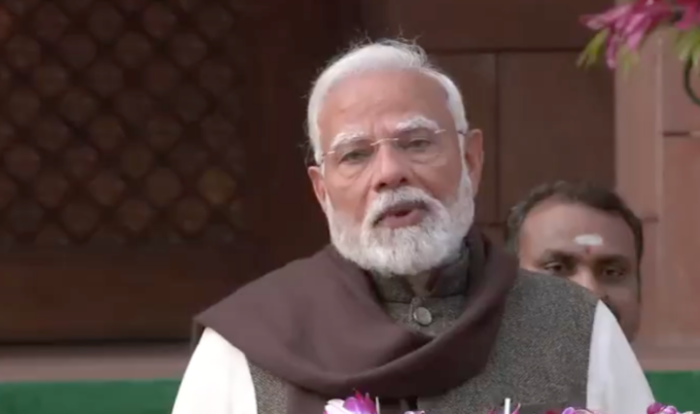
Prime Minister Narendra Modi on Friday said that the passage of the Waqf (Amendment) Bill of 2025 was a “watershed moment” and that this would help the marginalised, who have been “denied both voice and opportunity.”
“The passage of the Waqf (Amendment) Bill and the Mussalman Wakf (Repeal) Bill by both Houses of Parliament marks a watershed moment in our collective quest for socio-economic justice, transparency and inclusive growth. This will particularly help those who have long remained on the margins, thus being denied both voice and opportunity,” PM Modi posted on X.
Highlighting the importance of debate and dialogue, the Prime Minister expressed gratitude to all the MPs who contributed to strengthening the Waqf (Amendment) Bill and the Mussalman Wakf (Repeal) Bill.
“Gratitude to all Members of Parliament who participated in the Parliamentary and Committee discussions voiced their perspectives and contributed to the strengthening of these legislations. A special thanks also to the countless people who sent their valuable inputs to the Parliamentary committee. Yet again, the importance of extensive debate and dialogue has been reaffirmed,” the PM said.
Pointing out that the newly amended Waqf bill would safeguard people’s rights, the Prime Minister said that the “lack” of transparency and accountability in the Waqf system had harmed the interests of Muslim women and Pasmanda Muslims.
“For decades, the Waqf system was synonymous with lack of transparency and accountability. This especially harmed the interests of Muslim women, poor Muslims, Pasmanda Muslims. The legislations passed by Parliament will boost transparency and also safeguard people’s rights,” he added.
He said that the central government was committed to prioritising the dignity of every citizen.
“We will now enter an era where the framework will be more modern and sensitive to social justice. On a larger note, we remain committed to prioritising the dignity of every citizen. This is also how we build a stronger, more inclusive and more compassionate India,” PM Modi said.
Meanwhile, Rajya Sabha leader of opposition (LoP) and Congress chief Mallikarjun Kharge attacked the union government after the parliament passed the Waqf Amendment Bill 2025, saying that the government had taken a “negative stand.”
“It is their interpretation, we kept our views on the bill in front of them (government). They have taken a negative stand, and they are taking it forward,” Kharge told reporters.
Congress MP Ranjeet Ranjan said that it is “unfortunate” that the Waqf Amendment Bill 2025 has been passed.
“The bill is not in the best interests of the nation, constitution…The intention with which they have made amendments to the waqf amendment bill shows that they are not helping. They are just targeting a particular community…The bill is not right,” Ranjan added.
The Parliament passed the Waqf Amendment Bill 2025 in the early hours of Friday after a marathon and heated debate.
Rajya Sabha Chairman Jagdeep Dhankhar said, “Ayes 128 and Noes 95, Absent zero. The Bill is passed.”
The House sat beyond midnight to pass the legislation.
Union Minority Affairs Minister Kiren Rijiju accused the opposition parties of trying to mislead people on the Waqf Amendment Bill and said it will benefit crores of people from the Muslim community.
Replying to the over 12-hour-long debate on the bill in Rajya Sabha, Rijiju said several suggestions made by the Joint Parliamentary Committee had been incorporated in the revised bill.
Rijiju said that the Waqf (Amendment) Bill, 2025, will be renamed as the UMEED (Unified Waqf Management Empowerment Efficiency and Development) Bill.
Lok Sabha, which took up discussion on the Waqf (Amendment) Bill on Wednesday, passed it past midnight after a marathon debate.
The government introduced the revised bill after incorporating the recommendations of the Joint Parliamentary Committee, which examined the legislation introduced in August last year. The bill seeks to amend the Act of 1995 and improve the administration and management of waqf properties in India.
The Bill aims to overcome the shortcomings of the previous act and enhance the efficiency of Waqf boards, improving the registration process and increasing the role of technology in managing waqf records.
(This news report is published from a syndicated feed. Except for the headline, the content has not been written or edited by OpIndia staff)
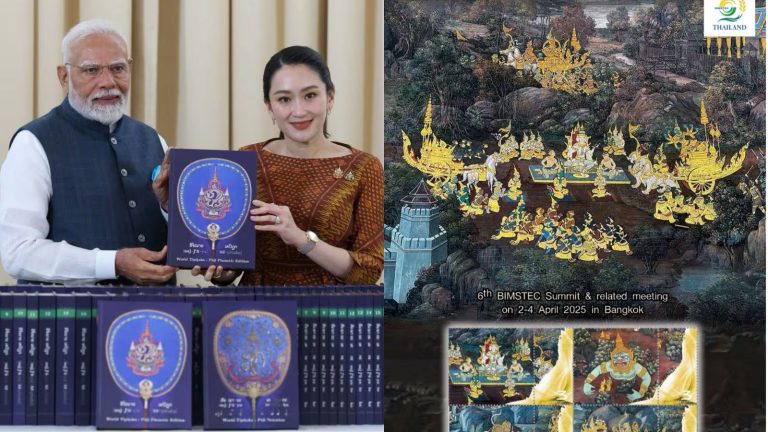
Thailand on Thursday released a special stamp based on the Ramayan mural paintings from the 18th century to commemorate Prime Minister Narendra Modi’s visit to the country. PM Modi is in Thailand for the BIMSTEC summit being held from April 2-4.
The mural shows scenes from the 18th century ‘Ramakien’, Thailand’s national epic, influenced by the Valmiki Ramayan.
PM Modi, while expressing gratitude to the Thai government for introducing the commemorative stamp, highlighted how both India and Thailand have a “centuries-old relations connected through our deep cultural and spiritual ties.”
“India and Thailand’s centuries-old relations are connected through our deep cultural and spiritual ties. The spread of Buddhism has connected our people. From Ayutthaya to Nalanda, there has been an exchange of intellectuals. The tales of Ramayana are a part of Thai people’s lives,” PM Modi said.
“The influence of Sanskrit and Pali are reflected in language and traditions even today. I am grateful to the Thailand government that during my visit, a commemorative stamp, based on Ramayana mural paintings from 18th century, was issued,” he added.
“A strong cultural & civilisational bond. As a special gesture to mark PM @narendramodi ‘s Official Visit, Government of Thailand released an intricately designed iStamp depicting Ramayan murals painted during the reign of King Rama I,” MEA spokesperson Randhir Jaiswal also posted on X.
??-??| A strong cultural & civilisational bond.
As a special gesture to mark PM @narendramodi’s Official Visit to ??, Government of Thailand released an intricately designed iStamp depicting Ramayan murals painted during the reign of King Rama I. pic.twitter.com/9eJX5FGGAa
Earlier today, adding new vigour to the bilateral friendship PM Modi had a productive meeting with his Thailand counterpart Paetongtarn Shinawatra, with the two leaders discussing various areas of bilateral cooperation.
The two leaders agreed to elevate the bilateral ties to a Strategic Partnership. India and Thailand also exchanged memorandums across a range of sectors.
The MoUs include Joint Declaration on the Establishment of India-Thailand Strategic Partnership.
Sagarmala Division of India’s Ministry of Ports, Shipping and Waterways and Fine Arts Department, Ministry of Culture, Thailand exchanged MoU for development of National Maritime Heritage Complex (NMHC) at Lothal, Gujarat.
A MOU was also signed between National Small Corporation Ltd (NSIC) and Office of Small and Medium Enterprises Promotion (OSMEP) of Thailand on co-operation in the field of Micro, Small and Medium Enterprises.
The Ministry of Development of North Eastern Region (MDONER) and Thailand’s Ministry of Foreign Affairs exchanged a MoU. A MoU was also exchanged between North Eastern Handicrafts and Handlooms Development Corporation Ltd. (NEHHDC) and Thailand’s Creative Economy Agency (CEA).
Earlier today, the Indian community in Bangkok welcomed PM Modi with chanting of prayers, showing a deep-rooted cultural bond that continues to flourish.
From Thailand, PM Modi will leave for Sri Lanka for a two-day visit.
A 24-year-old US national was arrested for illegally going to the Northern Sentinel Island in the Andaman and Nicobar Islands on 31st March. The man named Mykhailo Viktorovych Polyakov was reportedly arrested by the Criminal Investigation Department (CID) for attempting to venture into the forbidden island without authorisation.
This is not the first time that Polyakov has attempted to enter the island. According to police, Polyakov made a similar attempt in October last year during his visit to Port Blair. He tried to survey the island using an inflatable kayak. However, he was prevented by the hotel staff from going there. He later came to visit the island in January this year, planning to enter the island through a motorboat. This time, he also visited the Baratang Islands and allegedly videographed the Jarawa tribe illegally.
Polyakov left a can of Coca-Cola and a coconut for the Sentinelese people
Polyakov, whose father is of Ukrainian origin, reportedly reached Port Blair on 26th March and attempted to enter the Northern Sentinel Island from the Kurma Dera beach. He left the Kurma Dera beach around 1 pm on 29th March in a boat. He was carrying a coconut and a can of Coca-Cola to offer to the Sentinelese people. He managed to reach the northeastern shore of the island by 10 am on 30th March. He surveyed the area using the binoculars, hoping to locate any inhabitants. He stayed offshore for about an hour, blowing a whistle to unsuccessfully attract the attention of the Sentinelese people. Polyakov also reportedly stayed on the shore for a few minutes. He left the Coca-Cola can and the coconut there, collected some sand samples and filmed the area before getting back on his boat. He returned to Kurma Dera beach by 7 pm when he was seen by a local fisherman. He is currently in the custody of the police and is being interrogated at the direction of the court. His arrest was communicated to the Ministry of External Affairs and the US Embassy.
“We are getting more details about him and his intention to visit the reserved tribal area. We are also trying to find where else he had visited during his stay in the Andaman and Nicobar Islands. We are questioning the hotel staff where he was staying in Port Blair,” DGP HS Dhaliwal told PTI. The authorities seized several items from his possession, including an inflatable boat and an outboard motor or OBM, and a GoPro camera containing footage showing him landing on North Sentinel Island. Polyakov is said to have used a GPS navigation though his journey. The police said that Polyakov planned his voyage in detail by researching the sea conditions, tides and the accessibility of the Northern Sentinelese island from the Kurma Dera beach. Polyakov has been booked under the Foreigners Act, 1946 and the Andaman & Nicobar Islands (Protection of Aboriginal Tribes) Amendment Regulation, 2012, based on the complaint of the Tribal Welfare Officer of Tirur, Pronab Sircar, at the Ograbraj police station.
The forbidden island and the tribe that abhors contact with the outside world
Under the Protection of Aboriginal Tribe (Regulation), 1956 and Regulations under the Indian Forest Act, 1927, travelling or accessing the Northern Sentinelese island is strictly prohibited. The island houses the vulnerable Sentinelese tribe, which is famous for being hostile to outsiders. They have a history of killing people who tried to enter their island or establish contact with them. The Indian government has declared Sentinel Island a protected area to preserve the tribe and safeguard them from diseases to which they are not immune. The Sentinelese tribe is said to be the world’s last pre-Neolithic tribe.
The islanders want to be left in isolation. To respect their wish, and to protect them from outside diseases, Government of India has strictly banned access to the island for everyone.
In November 2018, an American evangelist, John Allen Chau, was killed by the Sentinelese people after he entered the island illegally, wanting to convert the tribe to Christianity. Chau’s notes revealed that he was planning to establish the “kingdom of Jesus” on the island. In 2006, two Indian fishermen, Sundar Raj and Pandit Tiwari, who were sleeping on their boat, which they had tied near the Northern Sentinel Island after poaching, were killed by the Sentinelese people after their boat drifted to the shore of the Island.
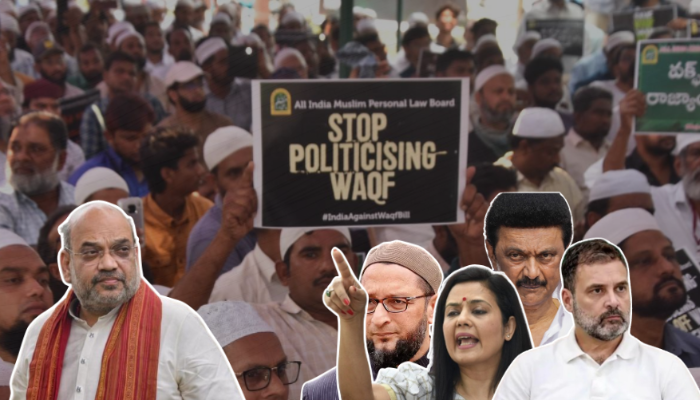
On 2nd April the Lok Sabha passed the Waqf (Amendment) Bill after more than 12 hours of intense discussion between the opposition’s I.N.D.I. Alliance and the ruling Bharatiya Janata Party (BJP)-led National Democratic Alliance (NDA). It was approved with 288 votes in favor and 232 against. Now, the bill is expected to be introduced in the Rajya Sabha on 3rd April.
The bill was initially presented in Parliament last year, provoking backlash from the opposition and was later referred to a Joint Parliamentary Committee, chaired by BJP MP Jagadambika Pal, for review. The JPC undertook a massive public outreach exercise that has rarely been seen before. Reportedly, the committee received a staggering 97,27,772 memoranda from citizens and organisations.
The consultations, which included prominent Muslim organisations such as Darul Uloom Deoband, Jamiat Ulama-i-Hind, and Jamaat factions, spanned 10 cities across India. During these visits, the Committee interacted with 25 State Waqf Boards, local civil society groups, and legal experts.
The bill has moved past its first hurdle in the lower house as it encountered intense resistance from opposition parties, Muslim leaders, and their entire ecosystem which engaged in unwarranted fear-mongering, propaganda, and incitement to provoke the second largest majority in the country.
Predictably, the development only aggravated the Opposition and their vote bank, who expressed their dissatisfaction and persisted in their unfounded accusations and rhetoric against the bill. Their efforts to prevent the bill and stall it in the Lok Sabha were unsuccessful as they relentlessly advanced their vested agenda of spreading false information.
Muslim appeasement and Opposition’s propaganda
Raebareli Lok Sabha MP Rahul Gandhi who skipped the debate but arrived right before the voting called the bill “a weapon aimed at marginalising Muslims and usurping their personal laws and property rights.” He claimed that the BJP, RSS (Rashtriya Swayamsevak Sangh) and their partners are attacking Constitution. He added that at present, their aim is directed towards Muslims but they plan to target other communities in the future.
“The Congress party strongly opposes this legislation as it attacks the very idea of India and violates Article 25, the Right to Freedom of Religion,” he declared. It is hardly surprising that this opinion is expressed by the Gandhi scion, whose political party granted outrageous authority to the Waqf after independence. Furthermore, it is essential to note that the Waqf is not a religious institution, as pointed out by union minister Lalan Singh, but rather an organization that caters to the interests of Muslims. Therefore, there is no infringement or assault on religious freedom in any form.
The Waqf (Amendment) Bill is a weapon aimed at marginalising Muslims and usurping their personal laws and property rights.
This attack on the Constitution by the RSS, BJP and their allies is aimed at Muslims today but sets a precedent to target other communities in the future.…
Tamil Nadu’s Dravida Munnetra Kazhagam (DMK) government which earlier passed a resolution against the bill in the state assembly and demanded its withdrawal, has threatened to approach the apex court against it. “Passing the bill in such a manner, with the help of a few alliance parties, is an attack on the Constitution of India and an act of sabotaging religious harmony,” alleged Chief Minsiter MK Stalin. He, along with MLAs from the DMK and the I.N.D.I. Alliance, donned black ribbons as a form of protest. “I wish to inform the assembly that DMK will file a case in the supreme court against the bill,” Stalin announced.
The BJP rammed through the anti-minority #WaqfAmendmentBill past midnight, ignoring united opposition.
This brazen move undermines constitutional values and secularism.
All India Majlis-e-Ittehadul Muslimeen’s president Asaduddin Owaisi dramatically tore the bill, comparing his gesture to Mohandas Karamchand Gandhi’s stand against unfair laws. Interestingly, he had done the same with a copy of the CAA Bill in the lower house, earlier. “This Waqf Amendment Bill is an attack on the faith and worship of Muslims,” he claimed during the latest debate.
“This bill is an attack on Muslims. The Modi government has started a war on my freedom. My mosques, my Dargahs, my Madrasas are on target. This government is not revealing the truth. This bill violates Article 14: Equal Protection. Limitations will be imposed. By doing so, the encroacher will become the owner and a non -Muslim will administrate the Waqf Board. This bill also violates Equality For Law,” he augmented the rhetoric with his unsubstantiated charges during the debate.
The sole restriction proposed by the bill pertains to the unreasonable claims of the Waqf on government, private and religious properties, including Hindu temples which does not seem to resonate well with the leader.
लोकसभा में Waqf Amendment Bill पर मेरी स्पीच। इस सरकार ने मुसलमानों पर ऐलान ए जंग कर दिया है।pic.twitter.com/nh6IIiPymp
All India Trinamool Congress (AITC/TMC) MP Mahua Mitra declared a moral victory for the opposition, highlighting that the bill was passed with a “slim margin of just” 50 votes. “There is only a fifty vote gap difference here and you realise just how unpopular and against the mandate of the public this bill is. It is only because of the party whip and the two allies that they have managed to get through by the skin of their teeth,” she boasted.
“It is a very dark day in India’s secular democracy, where the government has brought a bill which is unfair and against the fundamental rights. The amendments are sending a very chilling effect to the Muslim community,” the politician added. She maintained that the bill sends a clear message to Muslims that “you are not an equal citizen of India, know your place, your rights are not the same as ours.” She added, “Never felt so sad, so ashamed as I did in Lok Sabha yesterday.”
Her comments are not unexpected, considering that her party leader and West Bengal Chief Minister Mamata Banerjee has a history of blatant Muslim appeasement for vote bank politics quite similar to other opposition parties. “I like Muslims, no? I will go there (iftar) a hundred times. ‘Je goru dudh dei tar lathio khete hoi’ (If a cow gives milk, one has to be prepared for its kicks also),” she infamously conveyed in 2019.
The Waqf Bill tells every Indian Muslim “You are not an equal citizen of India, know your place, your rights are not the same as ours.” Never felt so sad, so ashamed as I did in Lok Sabha yesterday. pic.twitter.com/FarVL8HVr2
Samajwadi Party MP Mohibullah Nadvi claimed, “A worse law than this has never been made for Muslims in this country.” He alleged that it has been enacted in disregard of the Constitution and added that “very serious questions will be raised in the country regarding this bill.”
#WATCH | Delhi | #WaqfAmendmentBill passed in the Lok Sabha; Samajwadi Party MP Mohibullah Nadvi says, "…A worse law than this has never been made for Muslims in this country. This bill has been passed by ignoring the Constitution…very serious questions will be raised in the… pic.twitter.com/UJBiXfORhW
Likewise, another MP of the party, Zia ur Rahman Barq wanted the bill to be withdrawn and charged that the centre has been trying to impose restrictions on the Muslim community. He declared that Muslims are not the servants but owners of the country, during the debate. He is grandson of controversial SP leader, late Shafiqur Rahman Barq, who was the former MP from Sambhal.
Malvinder Singh Kang, an MP for the Aam Aadmi Party (AAP), charged that the central government, dominated by the Bharatiya Janata Party, was “managing” other NDA partner parties to pass the law. “I think a few people have compromised for their personal interests as the majority of the people in the country didn’t agree with this bill. I think that the central government has been successful in managing things as the BJP doesn’t have the majority on its own. This legislation has been passed by going against the sentiments of Muslims in the country,” he insisted.
#WATCH | Delhi | #WaqfAmendmentBill passed in Lok Sabha; AAP MP Malvinder Singh Kang says, "I think a few people have compromised for their personal interests as the majority of the people in the country weren't agreed for this bill. I think that the central government has been… pic.twitter.com/Ueyk4UWdIh
Aazad Samaj Party (Kanshi Ram) head and MP Chandra Shekhar Azad claimed, “We will continue our fight against the bill and take to the streets as we did during the farmers’ protest.” He asserted that the struggle will persist until the government retracts the bill, similar to how they rescinded the three farm laws. “The Waqf (Amendment) Bill is against the Constitution and Muslims,” he added. Significantly, these protests resulted in massive violence in Delhi on 26th January 2022, Republic Day.
#WATCH | Delhi | #WaqfAmendmentBill passed in the Lok Sabha; Aazad Samaj Party—Kanshi Ram, Chandra Shekhar Azad says, "…We will continue our fight against the bill and take to the streets as we did during the farmers' protest. We will continue our fight until the government… pic.twitter.com/9hHw6f2Nx7
Interestingly, Muslim leaders, along with the opposition, anticipated that the Janata Dal (United) led by Nitish Kumar and the Telugu Desam Party headed by Chandrababu Naidu would resist the suggested changes to the Waqf Act, as they enjoy backing from the Muslim community in their respective regions. However, these expectations were not realized, leading to increased frustration among them.
AIMPLB plans to move court
Maulana Khalid Rasheed Farangi Mahali, a member of the All India Muslim Personal Law Board (AIMPLB), stated that they would contest the Waqf (Amendment) Bill in court if it is approved by the Rajya Sabha. “If this bill is passed in Rajya Sabha, we will challenge it in court. We are confident that we will get justice and relief in this matter based on constitutional facts,” he threatened.
He further mentioned, “We had hoped that JD(U) and TDP might oppose this bill as both these parties were supported by the Muslim community in their respective states. We also think that it would have been better if other parties had opposed this bill with more facts and figures. The opposition opposed and raised their objections to this bill,” but added, “The members of the Opposition voiced their opinions, but some other members should also have mentioned facts in greater detail.”
The AIMPLB has been orchestrating large demonstrations against the bill in multiple parts of the countries. It emphasised, “The Waqf Amendment Bill 2025 is a sinister conspiracy aimed at depriving Muslims of their Mosques, Eidgahs, Madrasas, Dargahs, Khanqahs, Graveyards, and charitable institutions. If this bill is passed, hundreds of Mosques, Eidgahs, Madrasas, Graveyards, and numerous charitable institutions will be taken away from us,” in a letter asking nationwide Muslims to wear black arm bands during final Friday prayers of Ramzan.
The bill was earlier referred to by the board as a “direct attack on the Muslim community” and as opening the door for the usurpation of Waqf property. We do not want the situation to worsen, but you (the government) want conflicts in every street and neighbourhood, especially over mosques and cemeteries. We want to see a developed India, but in these circumstances, our dream cannot come true,” AIMPLB general secretary Fazlur Rahim Mujaddidi threatened. The board, prior to this, even warned that if the Waqf Amendment Bill were to be enacted, the entire country would transform into a situation akin to Shaheen Bagh.
Similar fear-mongering during anti-CAA protests resulted in anti-Hindu Delhi riots
The alarming fabrications and deceitful narratives are neither unexpected nor unprecedented. However, they serve as a chilling reminder of the events that transpired during the anti-CAA (Citizenship Amendment Act) rallies, which ultimately escalated into the violent attacks on Hindus in Delhi in 2020. Initially, the center faced the allegations of enacting a law rooted in religious discrimination that excluded Muslims. This situation later evolved into a narrative portraying the government’s actions as anti-Muslim, with claims suggesting that they would be removed from the country after the NRC’s (National Register of Citizens) implementation, while Hindus would be granted citizenship under the CAA.
Contrary to the lies peddled, the CAA was not about Indian citizens at all, Muslims or otherwise.
It is worth mentioning that no draft of the NRC has been released to date. The CAA specifically includes non-Muslim refugees, as they are the only group subjected to religious persecution in the three Islamic countries of Pakistan, Afghanistan, and Bangladesh, as has been repeatedly demonstrated by ample evidence.
The regular process for application of citizenship and arrival into India was not changed at all. Any Muslim citizens of the above-mentioned countries can still apply for Indian citizenship under the regular laws. The CAA was only a one time measure for the non-Muslim refugees from the above-mentioned nations, who have already been living in India for years.
The truth, however, was pushed to the background as agenda reigned supreme, with political parties, Muslim leaders and their entire ecosystems repeating the same misleading information to stir unrest in the country against the Modi government, specially during the United States President, Donald Trump’s visit. They conspired for months and their nefarious desire came to fruition when Hindus faced an assault by Islamists in the national capital.
Their intention was to diminish India’s standing in the international arena and blame the central government, BJP leaders as well as Hindus for it. The actions of the opposition are steering the nation towards a scenario reminiscent of Shaheen Bagh, where public roads are seized by the Muslim community under the guise of protest, which inevitably leads to violence.
Meanwhile, the opposition parties fully endorsed these demonstrations, with their leaders frequently participating in the rallies and delivering speeches at these events. They raised slogans such as “say no to CAA,” “save our democracy” and “save our Constitution,” in the parliament. They claimed the CAA as an infringement on the Constitution and an attack on the rights of Indian Muslims, much like their response to the present bill.
Mamata Banerjee had committed to vehemently oppose the CAA if she deemed it discriminatory against specific communities in India or if it infringed upon their existing citizenship rights. She denounced the Waqf (Amendment) Bill as a “conspiracy” aimed to seize Muslim properties and polarize the community, during a protest in Kolkata. Last year, TMC MP Kalyan Banerjee stated that a piece of land would be considered “Waqf property” if Muslims performed Namaz on it.
Should his outrageous statement be accepted, what umultuous outcomes could potentially follow and would it not further complicate the already precarious situation? Furthermore, would he apply it to himself as well? Such blatant remarks aimed at securing Muslim votes exacerbated an already volatile situation during the anti-CAA agitation and the approach appears to be consistent this time as well.
Further instigation to create unrest
The Aam Aadmi Party, which assumed control of the Delhi Waqf Board in 2015 and temporarily removed its authority for six months, stood in blind opposition to the Waqf Amendment Bill. Party officials asserted that the BJP-led government wanted to push the bill through forcefully. Notably, the party was also against the CAA and its national convenor and former Delhi Chief Minister Arvind Kejriwal contended that a breakdown of law and order would ensue, which would subsequently cause a surge in thefts, robberies and rapes due to the migration of Hindus and other minorities to India.
“The Delhi Chief Minister has lost his temper after his party’s alleged corruption got exposed,” Union Home Minister Amit Shah had responded to the remark. The former even wanted to jail Pakistani minorities (Hindus and Sikhs) because they protested outside his residence while his government facilitated the Rohingya Muslims.
“CAA is divisive and based on Godse’s thought that wanted to reduce Muslims to second-class citizens. Give asylum to anyone who is persecuted but citizenship must not be based on religion or nationality. Along with NPR (National Population Register)-NRC, CAA is meant to only target Muslims, it serves no other purpose. Indians who came out on the streets to oppose CAA, NPR, NRC will have no choice but to oppose it again,” Asaduddin Owaisi reiterated the same threats and falsehoods following the notification of the CAA. His language and intentions remain unchanged with the introduction of the current bill as well.
The Samajwadi Party even pledged to provide pensions to those who protested against the Citizenship Amendment Act (CAA) if they are elected to power at both the state and national levels. “If our party comes to power at the Centre and in UP, they (protesters) will be given pension as they have struggled to save the Constitution and the democracy,” Leader of the Opposition in the Uttar Pradesh Legislative Assembly, Ram Govind Chaudhary, declared in 2020.
Dharmendra Yadav, an MP from the Samajwadi Party, participated in a demonstration opposing the Waqf Amendment Bill last year and affirmed that his party fully supported the Muslim community, regardless of whether the issue escalates to parliament, the judiciary or public protests. Akhilesh Yadav also announced that his party will strongly oppose the bill, asserting that it aimed to deprive Muslims of their constitutional rights and confiscate their properties.
Clearly, similar to how the Citizenship Amendment Act was not directed agains the Indian Muslims, there is no indication in the provisions of the bill that the government plans to ‘take over’ Waqf property.
The OG (Original Gangster) of vote bank politics, Indian National Congress opposed the bill furiously. Priyanka Gandhi Vadra, joined the student protests at India Gate against the CAA, declaring the government to be “anti-poor,” in 2019. According to her, the government wanted all Indians to queue up and prove their citizenship, just like they did during demonetisation. On the other hand, Rahul Gandhi in 2021 announced that he will not impose CAA in Assam if his party won the assembly election.
“There is a long list of laws among which five laws will be absolutely repealed. Take it from me, I am the chairman of the manifesto committee. I wrote every word of it, I know what the intention was. The CAA will be repealed, not amended. We have made it clear,” Senior Congress leader P Chidambaram asserted that the law would be struck down if I.N.D.I. Alliance is voted to power in the centre, in 2024.
During the “Bharat Bachao Rally” at Ramlila Maidan, Sonia Gandhi urged people to take to the streets in protest against the Modi administration. She emphasized that both the Congress party and the populace must be prepared to make significant sacrifices to safeguard India, declaring this moment as an “aar paar ki ladai” (the decisive battle) and encouraging individuals to be ready for any “qurbani” (sacrifice). Some victims later attributed the Delhi riots to her incendiary remarks.
In its Lok Sabha election manifesto, the DMK even vowed to restore Article 370 in Jammu and Kashmir and to refrain from implementing the Citizenship (Amendment) Act and Uniform Civil Code if its coalition was elected to power.
The opposition effectively depicted the CAA as a grave injustice towards Muslims that needs to be eliminated and a similar narrative is currently being developed regarding the Waqf (Amendment) Bill.
Furthermore, the vile threats of Islamist leaders including Maulana Tauqeer Raza Khan and Mohammad Adeeb, the chairman of the All India Muslim Civil Rights unequivocally indicate how they want to stoke violence akin to those witnessed during the anti-CAA protests.
“Kisi ke baap ki aukaat nahin ki who hamari sampati jabt kar sake (no one has the guts to take over our property). The day we come on the streets, your soul will tremble. Our youth are not cowards. We have kept our youth under control, but the day they go out of control, you won’t be able to stop them,” Khan had warned while Adeeb threatened, “You inform Jagdambika Pal that he should pass the bill, and then see what happens to him. We’ll show them consequences.”
Same game plan has been activated
The Congress, along with the Samajwadi Party, DMK, and other ‘secular’ parties have persistently described the Waqf Amendment Bill as “unconstitutional,” “anti-Muslim,” and even “anti-democracy.” Nevertheless, their objections are not supported by any credible arguments. The intense rhetoric, appeals for national protests and fear-based tactics are reminiscent of the atmosphere preceding the anti-CAA protests, which led to the anti-Hindu riots in Delhi in 2020 or the unrest that came to the fore during farmers’ protest.
The pattern of protests surrounding the anti-Waqf Amendment Bill highlights a recurring strategy that employs constitutional critique and fear to mobilize Muslims. This method pushes them to view the bill as an affront to their community and to resist it vigorously through various means, including protests, propaganda, legal avenues, and even taking to the streets.
At present, the administrative reforms proposed in the bill are being misrepresented as an infringement on the religious liberties of Muslims, despite their aim to enhance the efficiency of Waqf Boards and reduce corruption. Previously, Islamo-leftists capitalized on fears of detention centers and revocation of citizenship, while now they are invoking concerns over property confiscation and the erosion of Muslim autonomy to escalate public anger.
The political opposition to bill mirrors the reaction to the Citizenship Amendment Act. In each scenario, unfounded and malevolent narratives have been perpetrated to inflame communal discord and instigate Muslims, projecting legislative changes as a dire threat to their rights and identity. Nonetheless, the bill is on the verge of being enacted, and similar to the CAA, it will be mandatory for all citizens, irrespective of their faith, to comply with this directive.
Just like Amit Shah rightly retorted, “Who are you threatening? This bill is going to be passed by Parliament and will apply to all. The coming law will be an enactment of govt of India and every citizen will be obliged to comply with it,” when opposition benches shouted that Muslims would not accept the amendments in the Waqf Act.
If you think that only the family of Chandan Gupta of Kasganj is in danger, then you are wrong. If you think that the danger is limited only to Nupur Sharma, then you are wrong. If you think that after the murder of Kamlesh Tiwari, Kanhaiya Lal Teli, Umesh Kolhe, the danger of ‘sar tan se juda’ (sir’s body being cut off) has ended, then also you are wrong.
Those Hindus who sing the songs of the so-called Ganga-Jamuni tehzeeb, who raise the slogan of Jai Bhim-Jai Meem, who see secularism in the Mughals, are also in danger. Because all Hindus are infidels. The role of tags like liberal, leftist, Dalit thinker, secular is limited to getting your name registered a little lower in the list, that is all.
This danger is not limited to only a few streets, villages, cities, districts, states. This danger is as far away from you as the time it takes for a Muslim to become a part of an Islamist mob. Realizing this danger, governments (if they are not appeasers) can make strict laws to keep us safe. They can assess the danger to a person/family and provide them security.
But it is not possible for the government to provide security to every Hindu. It is also not possible to provide lifelong security to a person/family which is surrounded by such dangers. Doing so will also make the life of that person/family difficult.
In such a situation, the question arises that what should we Hindus do? What should the person/family do who is being hunted by Islamic fundamentalists? It is difficult to give a complete answer to this. But by taking forward the model of the way Hindus of Kawardha have protected Durgesh Dewangan‘s family, we can definitely reduce this danger to a great extent.
What happened in Kawardha
In 2021, the saffron flag hoisted on the Karma Mata temple in Kawardha, Chhattisgarh, was torn and thrown away by Islamic fundamentalists. A youth named Durgesh Dewangan was brutally beaten up for protesting against this. Stones were pelted on Hindus. At that time, the Congress government was ruling in the state under the leadership of Bhupesh Baghel. Local MLA Mohammad Akbar was an influential minister of that government.
Its effect was also seen in police action. Hindus were allegedly beaten up even after being brought to the police station. Durgesh Dewangan was not even traced for several days. It is also alleged that Islamic fundamentalists were roaming the streets with swords. Leaders of Hindu organizations were prevented from reaching Kawardha by imposing curfew and use of force. If local Hindus are to be believed, this suppression of Hindus had the full support of Mohammad Akbar. Mohammad Akbar had the protection of Bhupesh Baghel. From Kawardha to Raipur, there was no one in the system who would listen to the plight of Hindus.
Dharm Dhwaj Chowk is a symbol of self-confidence of Hindus
Today, there is a BJP government in Chhattisgarh. Kawardha MLA Vijay Sharma is the Deputy Chief Minister of the state. The public has already shown their anger against Mohammad Akbar and his patron Bhupesh Baghel in the 2023 assembly elections. In current situation, you may not realize what kind of danger the Hindus of Kawardha were living in after that incident of 2021 till the election results came out. What kind of dangers Durgesh Dewangan and his family were facing every day.
I went to Kawardha about a year after that incident of 2021. At that time, Hindus had built a Dharma Dhwaj Chowk near Karma Mata Temple with their self-confidence. A 108 feet high saffron flag was fluttering. Just a few steps away from this was Durgesh Dewangan’s father’s shop of potatoes, onions and spices. Bajrangbali was visible prominently on the shutter of the shop and Ram’s name was written on the signboard. As soon as I reached the shop, I was greeted with ‘Jai Shri Ram’. Believe me, I too could not appreciate the dangers looming over the Hindus there at that time. I also felt that the incident of 2021 was perhaps not as horrific as it appeared after watching the video from there and talking to the people of Kawardha on the phone.
Hindus became the protective shield of Hindus
But when I started talking to Durgesh Dewangan’s family and local Hindus, I came to know that Hindus were suppressed in a much worse way in 2021 than we knew. Their voices were crushed. Even after a year, the process of intimidating Hindus continued. The police remained a mute spectator.
Durgesh’s father Santosh Dewangan had told OpIndia, “The MLA has to fulfill his duty. When my son was beaten up, Akbar’s (MLA Mohammad Akbar) son was also with the attackers. Now we are being pressured to compromise.” Santosh Dewangan told that after that incident, on one hand his son was not traceable, on the other hand police guards were posted outside his house. Not for the safety of the family, but so that the members of the victim’s family could not meet anyone and no one could meet them.
Kabirdham district working president of Vishwa Hindu Parishad Kailash Sharma had told OpIndia that the attack on Hindus was carried out in a planned manner. Then, at the local level, whoever stood up for Hindus was suppressed at the behest of Mohammad Akbar. The result was that even after a year, Hindus were scared.
Among the Hindus who were arrested at that time was today’s Deputy CM Vijay Sharma. Santosh Dewangan told that ever since Sharma has come out of jail, not a single day passes while he is in Kawardha, when he does not come to enquire about the condition of his family. Even when he is out of Kawardha, he remains in touch with his family through phone.
According to Dewangan, the officials of VHP and other Hindu organizations also regularly care for victims like him. He had told OpIndia that this support of Hindus amidst threats and dangers is a big strength for his family. Due to this, his life has become normal, he is able to run the shop without any worry. Some other victim Hindus who spoke to OpIndia also confirmed receiving similar support.
What does this security model of Kawardha tell us
The direct message for us Hindus in this security model of Kawardha is that you can’t rely solely on the government and the system. We should not expect external help. If we start worrying about each other’s safety on a regular basis at the local level, then we can change the situation in any adverse situation. We can make the life of the Hindu family surrounded by danger as normal as possible. Instead of sitting at home with the fear of being killed, we can inspire them to do business without any worry in the same market, where they became the target of the fundamentalists, to earn a living for their family, .
Anyway, the truth is that it is in our hands to reduce the threat of Islamic fundamentalism. It is in our hands to become each other’s security shield. Because as long as Islamists exist, as long as Hindus are infidels, this threat can only be reduced, removal of the threat completely is not possible.
On the 2nd of April 2025, the Waqf Amendment Bill was passed in the Lok Sabha after a 12-hour-long heated debate. During the debate on the Waqf Bill, Union Home Minister Amit Shah delivered a historic speech and launched scathing attacks on opposition leaders for politicising the bill to appease their Muslim vote bank. Here are the key highlights of HM Amit Shah’s speech.
Non-Muslim members not to be involved in religious activities of Waqf Board, Waqf is a religious matter, but Waqf Boards and properties are not religious institutions: HM Amit Shah
During his speech, Minister Shah said that there is no provision for involving non-Muslims in the administration of religious institutions, and they do not wish to create such provisions. He also accused the opposition of spreading misconceptions, claiming that this Bill is being introduced to interfere with the religious activities of Muslims and the properties they have donated. He asserted that the opposition is trying to create fear among the minority community to build its vote bank.
The Union Home Minister said that the role of non-Muslim will be solely to ensure that the administration of charity-related matters is being conducted per the regulations. Amit Shah said that the Waqf in India functions like a trust, where there are trustees and a managing trustee. In Waqf, there are Waqif (donor) and Mutawalli (administrator), who are followers of Islam. He also emphasised that while Waqf is a religious matter, the Waqf Board or Waqf properties themselves are not religious institutions. According to the law, a Charity Commissioner can be from any religion, as they are not managing a trust; their responsibility is to ensure that the Board operates in compliance with charity laws. Shri Shah emphasized that this is an administrative matter, not a religious one.
Speaking in the Lok Sabha on the resolution to approve the Proclamation issued under Article 356 regarding the President's Rule in Manipur. https://t.co/ihgiuFlFqh
“Waqf Act and Board came into effect in 1995. All the arguments about the inclusion of non-Muslims are about interference in the Waqf. First of all, no non-Muslim would come into the Waqf. Understand this clearly…There is no such provision to include any non-Muslim among those who manage the religious institutions; we do not want to do this…This is a huge misconception that this Act will interfere with the religious conduct of Muslims and interfere with the property donated by them. This misconception is being spread to instil fear among minorities for their vote bank,” Amit Shah said.
“You (Opposition) would break this country…Through this House, I would like to tell Muslims of the country that not even one non-Muslim would come into your Waqf. This Act has no such provision. But what would the Waqf Board and Waqf Council do? To catch the people selling off Waqf properties and drive them out, to catch those who lease off their properties for 100 years in the name of Waqf. The income of Waqf is dropping, the income with which we have to do development for minorities and push them forward, that money is being stolen. Waqf Board and Council will catch that,” he added.
Amit Shah said that a person can donate only property that belongs to them and cannot donate property that belongs to the government or any other individual.
He said changes have been made only in provisions related to the Council and Board in the 1995 Act, which deal with administrative tasks.
“Where will non-Muslim members be included? In the Council and Waqf Board. What would they do? They won’t run any religious activity. They would only look after the administration of property donated by someone under Waqf Law, whether it is being done as per law, whether the property is being used for the intent with which it was donated,” he added.
Amit Shah also took a jibe at RJD supremo Lalu Prasad Yadav, whose party is part of the INDIA bloc. “When amendments to the Waqf were introduced in 2013, Lalu Prasad Yadav stated that he wanted a strict law and wanted to put those in jail who were stealing. Narendra Modi has fulfilled Lalu Prasad Yadav’s wishes,” the Home Minister said.
Home Minister highlighted numerous cases of arbitrary ownership claims made by Waqf Boards on lands, temples, private institutions across the country
HM Amit Shah further stated that if the Waqf law had not been amended in 2013, this bill would not have been necessary. However, before the 2014 elections, in 2013, the Waqf law was drastically altered overnight for the sake of appeasement, which led to the allocation of 123 high-profile properties in the Lutyens’ Zone of Delhi to Waqf. The Delhi Waqf Board transferred the land of Northern Railways to Waqf.
“Had Waqf not been amended in 2013, this (current Amendment Bill) Bill would not have been needed. Everything was going well. But there were elections in 2014, and overnight in 2013, the Waqf Act was turned extreme for appeasement. As a result, the Congress government handed over 123 VVIP properties in Lutyens Delhi to Waqf when elections were just around the corner, just 25 days away,” he said.
#WATCH | #WaqfAmendmentBill | Union Home Minister Amit Shah says, "…Had Waqf not been amended in 2013, this (Amendment Bill) Bill would not have been needed. Everything was going well. But there were elections in 2014, and overnight in 2013, the Waqf Act was turned extreme for… pic.twitter.com/mfI0iv4vtK
In Himachal Pradesh, land was illegally converted into Waqf property and used to build unauthorized mosques. In Tamil Nadu, 400 acres of land belonging to the 1500-year-old Tiruchendur temple were declared Waqf property. According to a report from a committee in Karnataka, 29,000 acres of Waqf land were leased for commercial use. “Between 2001 and 2012, in the name of Waqf, properties worth ₹2 lakh crore were leased to private institutions for 100 years,” Minister Shah said.
He also mentioned that the High Court in Bengaluru had to intervene to stop the acquisition of 602 acres of land. In Honwad village in the Vijaypur area of Karnataka, 1500 acres of land were made controversial, and this land, worth ₹500 crore, was leased to a five-star hotel for just ₹12,000 per month.
“All this money is meant for the welfare of poor Muslims, not for the plundering of the wealthy,” Shah said.
He further spoke about cases involving Waqf Boards wrongfully claiming ownership of Hindu temples and Christian properties. “In Karnataka, a claim was made on the Dattapeeth temple. In Taliparamba, an attempt was made to seize 600 acres of land based on a 75-year-old claim. Even properties belonging to the Christian community were seized. Many churches in the country have opposed the Waqf Bill because they see it as a means to win the sympathy of the Muslim community. However, in four years, even the Muslim brothers will realize that this bill is actually in their benefit,” Shah asserted.
The Home Minister also mentioned that in Telangana, a claim was made on 1700 acres of land worth ₹66,000 crore. A similar case emerged in Assam, wherein a claim was made on 134 acres of land in the Morigaon district. Fourteen Marla land related to a Gurudwara in Haryana was handed over to Waqf, and the Chandrashekhar Azad Park in Prayagraj was also declared Waqf property. In Maharashtra, a claim was made on the Mahadev temple in Vadange village, and in Beed, the Waqf Board forcibly took 12 acres of land from Kankaleshwar.
Amit Shah also emphasized that the Modi government formed a joint committee, which held 38 meetings, engaged in 113 hours of discussion, consulted 284 stakeholders, invited online suggestions before drafting the law, and now a debate extending for 16 hours has been held over the Waqf Bill.
This is the law of the government of India and is binding on everyone: Amit Shah responds to opposition’s ‘Muslim nahi maanenge’ threats
During HM Shah’s speech, the opposition MPs were heard saying that the Muslim community of India will not accept the Waqf Amendment Bill. Minister Shah highlighted the threat issued by one of the opposition MPs and strongly asserted that the Waqf Amendment Bill is a law of the Indian government passed by the Parliament and is binding on all.
A member here said that minorities will not accept this law. What is this—an attempt to threaten? This is a law passed by Parliament, and everyone must accept it. What does it even mean to say that you won’t accept the law? How can anyone claim that they will not abide by it? This is a law of Bharat Sarkar, and it will be binding on everyone. It must be accepted,” Shah said.
Shah also took a veiled dig at Congress leader and ‘constitution book poser’ Rahul Gandhi and said, “Waving the Constitution has suddenly become a trend. But according to this very Constitution, how can any decision, whether by the government or a private institution beyond the judgment of the honourable court? The courts of this country cannot be denied access to such decisions. Where will citizens take their grievances? Where will those whose land has been taken away go? This will not be allowed. You did this for vote-bank politics, and we reject it. This cannot continue. If anyone has grievances, they should go to the court, and the court will deliver justice.”
Notably, the Waqf Amendment Bill passed in the Lok Sabha with 288-232 votes amid criticism from the opposition parties, including Congress, AIMIM, SP and others, The Opposition parties mounted an attack against the government, claiming that Waqf is an essential practice to Islam and therefore the Bill is against the Constitution. The government, in their strong reply, countered the charge. Pertinently, the Bill also does away with the draconian Section 40 of the Waqf Act 1995, which allowed the Waqf Board to claim properties overnight, including Hindu villages, temples, etc
Uttar Pradesh Chief Minister Yogi Adityanath on Thursday criticised the functioning of the Waqf board, accusing them of attempting to “capture land” in Prayagraj.
Yogi Adityanath’s statement backed the necessity of the Waqf Amendment Bill, 2025, which was passed in the Lok Sabha yesterday.
Yogi Adityanath said that during the Maha Kumbh, the Waqf board was making “arbitrary statements” that the land belongs to them and questioned whether the board is a “Land Mafia board.”
Attending a programme organised on the occasion of Nishadraj Guha Jayanti in Prayagaraj, CM Yogi Adityanath said,”Some people did not want a mythological place like Prayagraj to gain its identity because their vote bank was important for them… In the name of Waqf, they had tried to capture the land here in Prayagraj and other cities as well. When we were organising Maha Kumbh, the Waqf Board was making arbitrary statements that the land of Kumbh in Prayagraj is also Waqf land. Is it the Waqf Board or the ‘Land Mafia’ Board?”
Yogi Adityanath thanked PM Modi and Home Minister Amit Shah for “putting a check” on the Waqf board and said that the bill will be passed in the Rajya Sabha as well.
“We have already wiped the mafia out of Uttar Pradesh… We are grateful to Prime Minister Narendra Modi and Home Minister Amit Shah for putting a check on the Waqf Board and doing welfare work by passing this important act in the Lok Sabha. Today, it will be passed in the Rajya Sabha as well,” Yogi Adityanath said.
Union Parliamentary Affairs Kiren Rijiju on Thursday moved a motion for consideration of the Waqf (Amendment) Bill of 2025 and the Musalmaan Wakf (Repeal) Bill in the Rajya Sabha.
The Waqf (Amendment) Bill, 2025 is tabled in the Rajya Sabha, a day after it was cleared with a majority in the Lok Sabha. The Lower House witnessed a 12-hour debate, after which the Bill was passed with 288 in its favour and 232 against it.
The bill seeks to amend the Act of 1995 and improve the administration and management of waqf properties in India. It aims to overcome the shortcomings of the previous act and enhance the efficiency of Waqf boards, improving the registration process and increasing the role of technology in managing Waqf records.
(This news report is published from a syndicated feed. Except for the headline, the content has not been written or edited by OpIndia staff)
As the Parliament passed the Immigration and Foreigners Bill, 2025 on Wednesday (2nd April), the Opposition parties staged a walkout in the Rajya Sabha to protest against the Bill. The Opposition demanded that the Bill, which was cleared in the Lower House last week, be sent to a Parliamentary panel for review.
During the discussion over the Bill in the Upper House, Congress MP and Senior Advocate Abhishek Manu Singhvi vehemently opposed the Bill and alleged that the legislation sends a message that all foreigners are “potential criminals”. “I oppose this bill and seek substantial changes in its pernicious character. It is clearly designed for ulterior motives by a control freak government bent upon sending out a message of fear through the architecture of omniscient, Orwellian surveillance for foreigners,” said Singhvi.
Defending the Bill, Union Minister of State for Home, Nityanand Rai, said that the law was introduced by the government after a three-year study. He said that the legislation welcomes foreigners coming to the country for education, tourism, development work or research, etc. “We will not stop or oppose experts coming to India… If anyone is studying here or undergoing medical procedures, they have to provide information online. We must know where they are staying…we did not know the whereabouts of people earlier, as no records were maintained in the past,” explained Rai.
During the discussion on the Bill in the Lower House on 28th March, Union Home Minister Amit Shah asserted that the country is not a ‘Dharamshala’. He said that the Bill will allow the government to track the whereabouts of foreigners entering the country and will help in strengthening national security. “To bolster national security and economy, to make our universities global, to lay the foundation for R&D, and to make this country the best in 2047, this Bill is very important… Whoever enters our territory, when, for what time period, and with what intent, it is important for us to know. We will track in detail the entry of each foreigner in India,” the Union Home Minister said.
Categories of visa, application process and the concerned authorities
The Immigration and Foreigners Bill, 2025, has repealed the Passport (Entry Into India) Act of 1920, the 1939 Registration of Foreigners Act, the Foreigners Act of 1946, and the 2000 Immigration (Carriers’ Liability) Act, 2000. The Bill regulates the entry, immigration, stay, and exit of foreigners in India. It has streamlined the visa system and has simplified the application process for tourists, students and skilled professionals. It classifies visas based on the purpose of visit, viz., tourist, student, employment, business, medical, research, religious, journalist, refugee/asylum and transit. The rules for visa requirements, duration of stay and visa renewal conditions differ for each category.
The application for an Indian visa can be made online or through Indian embassies or consulates. All the visa applicants are required to undergo a criminal record check. An additional security clearance is needed for high-risk applicants.
Under the new law, foreigners arriving in the country will be required to report their presence to the Registration Officer. Earlier, the foreigners were required to report to an authority prescribed by the central government. The Act also envisages a Bureau of Immigration, which will perform immigration functions. The composition of the Bureau of Immigration will be decided by the Central government.
Foreigners staying in India beyond 180 days will be required to register with the Foreigners Regional Registration Office (FRRO) within 14 days of arrival. Also, if information furnished by foreigners upon their arrival in India, like address, employment status, etc, needs to be changed, they must report to the FRRO.
The Bill empowers the Central government to make provisions for prohibiting, regulating and restricting the entry or departure of foreigners in certain situations. It also ensures the accountability of the keepers of accommodations where foreigners are residing by making it mandatory for them to furnish the information regarding such foreigners to the Registration Officer.
Provisions for punishments
Any activity undertaken by a foreigner in violation of the visa conditions may attract punitive action or deportation. The punitive measures for visa violations or trying to enter India illegally include fines, visa cancellaions, deportation, and blacklisting. The law has introduced more stringent penalties for overstaying a visa. Any foreigner trying to enter India without a valid passport will face imprisonment up to five years or a fine, or both. In certain cases, including serious criminals activities, the authorities can deport or blacklist an illegal immigrant. Deportees who try to gain illegal entry into India will face 10 10-year jail term and a lifelong ban.
The central government instituted operations against illegal immigrants
The Immigration and Foreigners Bill, 2025, comes at a time when the central government has intensified its operations against illegal immigrants across the country. The government has been creating a database by identifying the illegal immigrants, including Bangladeshis and Rohingyas, who entered the country illegally or overstayed their visas. In February this year, Union Home Minister Amit Shah directed authorities to speed up their operations against the entire network assisting Bangladeshi and Rohingya illegal immigrants in entering and staying in the country through forged documents. Hundreds of illegal Bangladeshis and Rohingyas have been nabbed by the authorities over the last three months across the country for illegally entering and residing in the country. Several of these illegal immigrants have been found indulging in serious criminal activities, causing a law and order situation in the country. The authorities are also cracking down on the human traffickers or agents who assist these illegal immigrants in illegally entering the country. The Immigration and Foreigners Bill, 2025, is a step in the direction of strengthening law and order and national security.
US tariffs provide Indian exporters with a competitive advantage over rival nations, said SC Ralhan, the President of the Federation of Indian Export Organisations (FIEO), adding that the movement is ‘quite favourable’.
The FIEO President expressed optimism about the impact of the tariffs on Indian exports, noting that while India faces a tariff of around 27 per cent, this remains manageable compared to the higher tariffs imposed on competing nations, particularly China.
The import tariffs imposed on peer Asian economies are more compared to the tariff rate of 27 per cent on India could be an advantage to us, he added.
“We have an advantage in that whatever the advantage China had with cheap raw materials, that advantage is gone. I think this is good,” Ralhan said, adding that Indian manufacturers have an opportunity to increase the trade share.
He further stated that industries in countries like Turkey would be more adversely affected, given the disparity in tariff rates.
“Despite initial concerns, India’s position remains strong, and this presents a crucial opportunity for Indian exporters to enhance production quality and maintain consistency in supply. Orders from the US are expected to start flowing to India soon,” he added. “This is a high time for the Indian exporters to increase their production quality,” he added.
On the domestic front, Ralhan emphasised the need for government intervention to support Indian exporters.
He urged policymakers to facilitate the modernisation of small- and large-scale industries by reducing tariffs on energy-efficient and high-productivity machinery imports.
“They should either reduce the tariff on the import of machines which are more productive. I think that will help the Indian exporters to increase their production and make up with the quantum of orders we are expecting from the US,” he said.
On April 2, US President Trump announced a widespread imposition of tariffs on countries worldwide. In February, soon after taking charge for the second time, Trump outlined a new trade policy focused on fairness and reciprocity and said that the US would implement reciprocal tariffs, charging other countries the same tariffs they impose on American goods.
As per the announcements, the import tariffs on other major countries are China (34 per cent), the European Union (20 per cent), Vietnam (46 per cent), Taiwan (32 per cent), Japan (24 per cent), India (26 per cent), the United Kingdom (10 per cent), Bangladesh (37 per cent), Pakistan (29 per cent), Sri Lanka (44 per cent), and Israel (17 per cent).
Under the imposed tariffs, goods from India will face a 27 per cent tariff on steel, aluminium, and auto-related goods and no tariffs on pharmaceuticals, semiconductors, copper, or energy products.
(This news report is published from a syndicated feed. Except for the headline, the content has not been written or edited by OpIndia staff)