Home Blog Page 4771

Dhulagarh riots: When police remained complacent with Muslim mobs ransacking Hindu homes in West Bengal

0

It has been four years since the small town of Dhulagarh in West Bengal witnessed one of the horrifying episodes of communal violence. The day was December 13, 2016. It was the occasion of Eid Milad-un-Nabi (the birthday of Prophet Muhammad).

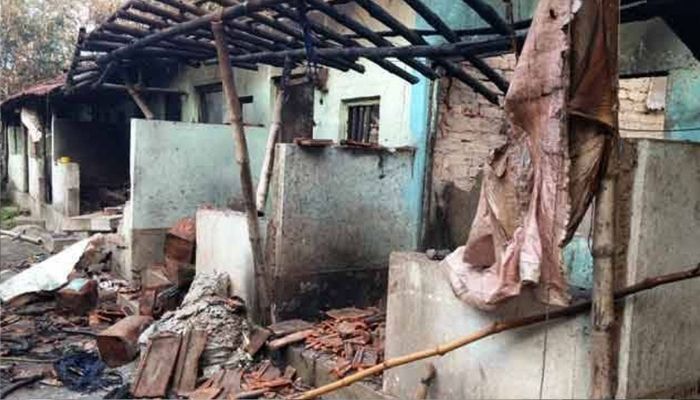
On the fateful day, a large group of Muslims took out a procession to commemorate the day. They alleged that the procession was stopped and stones were pelted at them near Annapurna Club at Dewan Ghat. And thus followed a tale of violence and arson. The Muslim mobs went on a rampage, forcing local Hindu families to flee the town.

The Islamist mob specifically targetted the Hindu-dominated Pollepara and Banerjeepara localities. They hurled country-made crude bombs at Hindu homes, looted the houses for cash and jewellery and later set them on fire. And the carnage continued unabated, despite police deployment. It is pertinent to remember that Dhulagarh is located just 25 km from the State Secretariat, Nabanna, in Howarth.

Hindus recount the horror of Dhulagarh riots

A local Hindu, Lakshmi Mallya narrated, “Nothing is left. We are looted of all our belongings. They (Muslims) ransacked and vandalised our houses and eventually set them on fire. We could not save a single penny from our houses, only managed to save our children and ran for life.”

Another Hindu man, Manna, whose house was vandalised by the rioters lamented, “We can’t live here anymore so we have taken shelter in our relatives’ place. Police came that day but when we were attacked even the cops ran away.” He is a barber by profession and runs a family of three. His wife, Seema, said that the Muslim mob stole ₹65,000 cash and a laptop that they had bought for their son.

A 32-year-old woman, Subhra Khanra, had to flee her house and take refuge in the local temple, after the mob ransacked her house, stole jewellery and set it ablaze. She said, “They were carrying petrol and kerosene in drums and had come fully prepared. After looting our jewellery and money they set everything else on fire. Where will we go now?”

Police stood as mute spectators, recounted Hindu victims

While speaking to India Today, another victim, Maitri Mondal informed that she had heard the violent mob yell ‘Pakistan Zindabad’. They entered her house and set it on fire. Her son, who was to appear for board exams in February of 2017, had his books converted into ashes. She narrated how the police did not do anything when the rioters went on a rampage. “For five hours, they created mayhem and the police came when everything was lost. Not a single minister has visited us yet,” Mondol lamented.

Another Hindu man, victimised by the Dhulagarh riots, stated, “When the police came, we were told to leave our houses in two minutes! They didn’t even stop the mob from vandalizing our homes. They kept looting and burning as the police stood as silent spectators.” Although the police had registered cases of rioting and arrested 65 people, the victims of the violence and the Opposition BJP had questioned the role of police in preventing the damage.

Muslim appeasement by Mamata Banerjee

The Trinamool Congress has often faced social media backlash for its Muslim appeasement and blatant attempts to trivialise and downplay atrocities against Hindus in the State. She had denied any instance of rioting in Dhulagarh and blamed social media for rumour mongering.

“In the last 15 days, social media is running wrong information on an incident which did not take place at all…In order to break a news, one must not act irresponsibly. If something has really happened then you (media) have every right to report but I think a field survey must be conducted,” she had claimed. This was despite the fact that the government had already announced a compensation of ₹35,000 for the victims and the process of disbursement had begun.

While being well-aware that the perpetrators belonged to the Muslim community, Mamata Banerjee restricted coverage of the incident by the media. The TMC government restricted the entry of media persons in Dhulagarh and even filed a First Information Report (FIR) against three employees of Zee News, including Sudhir Chaudhary for supposedly promoting ‘enmity’ between communities. It must be mentioned that Zee News was the first to uncover the incident.

Law and order situation in west Bengal remains unchanged

It has been 4 years since the Dhulagarh riots. However, the law and order situation, under the Mamata Banerjee regime, has shown little to no improvement. In May this year, shocking visuals of Telinipara, where communal clashes took place, after Hindu houses were set on fire had gone viral on social media.

Locket Chatterjee, BJP MP from Hooghly took to Twitter to inform that while she tried to call the CP of Chandannagar Police, Dr Humayun Kabir, he did not take her calls. She alleged that the West Bengal state administration had been a mute spectator as Telinipara burned. She further stated that she was prevented from going to Telinipara amid allegations of widespread communal violence and looting wherein police also facilitated perpetrators.

Victimisation of Hindus continue from Dhulagarh to Delhi

However, nothing seems to have changed since the Dhulagarh riots. The conscience of India is still shaken with the scars of the recent anti-Hindu riots of Delhi, wherein Muslims mobs went on a rampage, killing 52 people. The visual imagery of Mohammed Shahrukh Pathan intimidating a police officer and the horrifying image of IB officer Ankit Saxena’s hand sticking out a ditch sends chills down the spine. While the Delhi police swung into action and contained the orchestrated riots within 2 days, the same wasn’t true for the ill-fated Hindus of Dhulagarh.
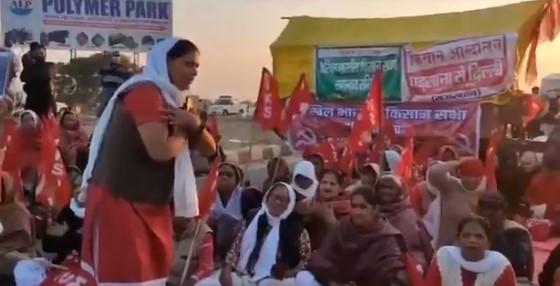
Watch: Left Front’s farmer wing asks PM Modi to die at farmer protests, sings ‘Modi mar jaa tu’

Protesters at the ‘farmer protests’ have been making some extremely problematic comments and statements throughout. Apart from individuals such as Yograj Singh who have made hate speeches at rallies, others have also made controversial comments. Now, a video is doing the rounds on the internet where protesters can be heard in a song asking Prime Minister to die.

It is not clear where the video was captured. But a banner of the All India Kisan Sabha (AIKS) with the Communist hammer and sickle in the background can be spotted. The AIKS is a a Left front organisation with two factions, one associated with the Communist Party of India and the other with Communist Party of India (Marxist).

The women protesters can be heard singing ‘Modi mar jaa tu’ with lines that go ‘Desh bech ke kha gaya, Modi mar jaa tu’ (You have sold the country, Modi, go die). We cannot confirm when the video was captured. But there is a banner at the back which says Gharsana to Delhi. Gharsana is in Rajasthan.

Farmer protests has leaders with Naxal sympathies

IANS reported that the Ekta Ugrahan of the Bharatiya Kisan Union (BKU-Ekta Ugrahan) is the largest represented group at Delhi’s borders. Almost two-thirds of those gathered there are reported to be their members. It is the same group calling for the release of ‘Urban Naxals’ involved in the Elgar Parishad case and Islamists arrested in the Delhi Riots case.

Lawyer and coordinator of BKU, N.K. Jeet is reported to have said on December 10, “It is our conscious decision to support these accused. The Naxal movement was always a farmers’ movement all over India. Releasing these accused is a demand of the BKU. We made it part of the memorandum to the government related to the farm laws.” He had also reportedly said, “Naxalism has helped the tribal people claim their rights.”

Hundreds sick but refuse Coronavirus tests

Hundreds of protesters participating in the ‘farmer protests’ at Singhu Border could be infected with the Wuhan Coronavirus. They are sick but they have refused to take the test for the virus. Authorities are worried that there might be many asymptomatic carries present at these protests. The exact number of protesters that are sick is not known but unofficially, the number is pegged at 300.

Deputy Commissioner Sonipat, Shyam Lal Punia, said, “We have set up two Covid-19 counters at Singhu Border and are regularly screening the protesters. Ten teams of doctors and paramedical staff have been deployed. An average of 70 to 90 people are visiting us every day who have been diagnosed with fever, muscular pain, or increased blood pressure.”

“We are regularly monitoring the situation. The patients are not ready for the Covid-19 tests. We distributed 50,000 masks but they are neither following the social distancing nor wearing the masks. The senior citizens say Covid-19 is nothing,” he added.

“Suno Suno Suno”: Watch video of administration announcing attachment of former SP leader Arif Anwar Hashmi’s property

0

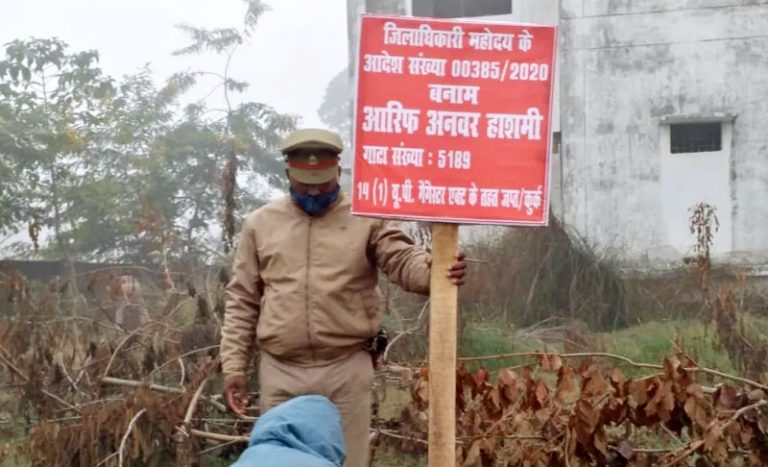
Former Samajwadi Party MLA Arif Anwar Hashmi was declared a history-sheeter in November by the Uttar Pradesh government. The two-time former MLA from Utraula is currently spending time in jail. The UP administration has started attaching his property. On December 11, the administration attached property belonging to Hashmi worth 50-crore, including four luxury cars, under the Gangster Act.

A video of the announcement by the administration has gone viral on social media. In the video, an announcer can be heard starting with “suno suno suno”, and giving details of the attachment of the properties. The announcement was accompanied by the beating of drums, giving a dramatic effect to the process.

Hemant Kutiya, Superintendent of Police, said in a statement, “Property of Hashmi worth over Rs 50 crore has been attached under the Gangsters Act. AG Hashmi Degree college, Utraula; National Mahavidyalaya, Rehra Bazar; National Modern Inter College; and AG Hashmi Inter College, Sadullah Nagar were among those attached by the administration.” He further stated that that four luxury vehicles worth over Rs 65 lakh were also seized.

Arif Anwar Ansari was declared a history-sheeter in November

There are two criminal cases filed against Hashmi. In November, a history sheet was opened in his name, and a case under the Gangster Act was registered. “The attachment of property is done if it is attained by illegal means,” Kutiya added. As per the reports, first case against Hashmi was registered in 2018. On 5th September 2020, Arif Anwar Hashmi was jailed for fraud. During his stay in jail, eight new cases of cheating were registered against him. In all these cases, he was accused of illegally occupying government and private land. The first case of fraud against Hashmi was registered in 2018 at Rehra Bazaar Police Station. A case of forgery has also been registered against him in Khorade Police Station in Gonda.In October, he was declared the kingpin of a land mafia gang.

What does the law says?

As per Section 14 of the Gangster Act, the district magistrate has the power to attach property, both moveable and immoveable, in case there is a reason to believe that the accused gangster acquired the property as commission for an offense triable under the law. It will be the booked person’s responsibility to prove to the administration that the attached property(s) was not accumulated by illegal means, and they have to present evidence to support the claim.

Republic TV CEO remanded to two days police custody by Mumbai Court after arrest in fake TRP scam case

0

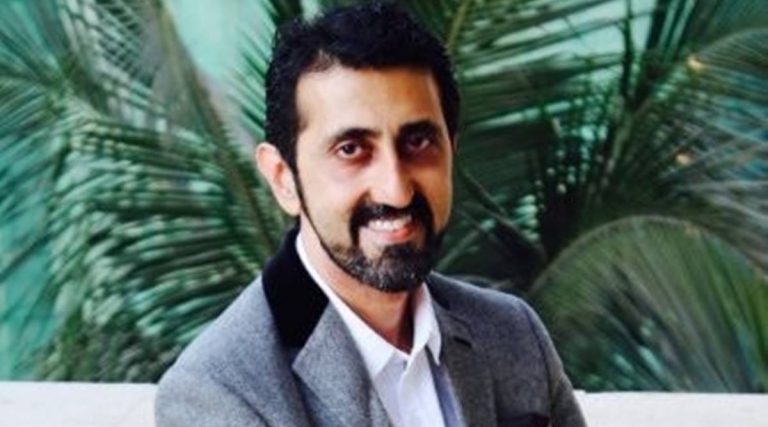
Republic TV CEO Vikas Khanchandani has been remanded to two days police custody by the Chief Metropolitan Magistrate Court Mumbai on Sunday in connection with the fake TRP scam case. He was arrested by the Mumbai Police earlier in the day as part of its continued campaign against the news network.

Vikas Khanchandani and Chief Financial Officer Sivasubramanian Sundaram had moved Sessions Court on Thursday seeking anticipatory bail. The arrest of Republic TV CEO interestingly comes just a day ahead of his interim bail hearing, that was scheduled to be heard on Monday.

The applicants had alleged, “The entire interrogation of the applicant was an exercise to pressurise him, intimidate him and essentially harass him into churning out falsehoods to implicate ARG and Arnab Goswami. The applicant fears that, despite having continuously co-operated, he will be arrested in the case for the sole reason that he did not spin mistruths, despite the incessant pressure deployed and unparalleled levels of harassment meted out to the Applicant, to enable the pre-determined, pre-judged and baseless narrative of the respondent so as to implicate a news organisation that has been seeking accountability from the respondent.”

“The malice of the respondent became evident from the manner in which the Crime Branch has been conducting their investigation in the TRP manner. After a lapse of almost two months from being first summoned in relation to the said FIR, the Applicant for the first time in December has now started receiving notices under Section 41A of CrPC, under the false pretext that there were grounds to question the Applicant,” they had added.

Fake TRP scam

On the 8th of October, Mumbai Police Commissioner Parambir Singh held a press conference where he categorically stated that Mumbai police have been alerted about a new racket involving false television rating points (TRP).

Param Bir Singh had specifically mentioned that Hansa Research had filed a complaint with the police. Interestingly, in this FIR that was filed by Hansa Research, Republic TV was not mentioned even once. The channel that was mentioned several times was India Today.

27 years ago, BKU leader Tikait had led massive protests demanding the same farm reforms Punjab farmers are protesting against now

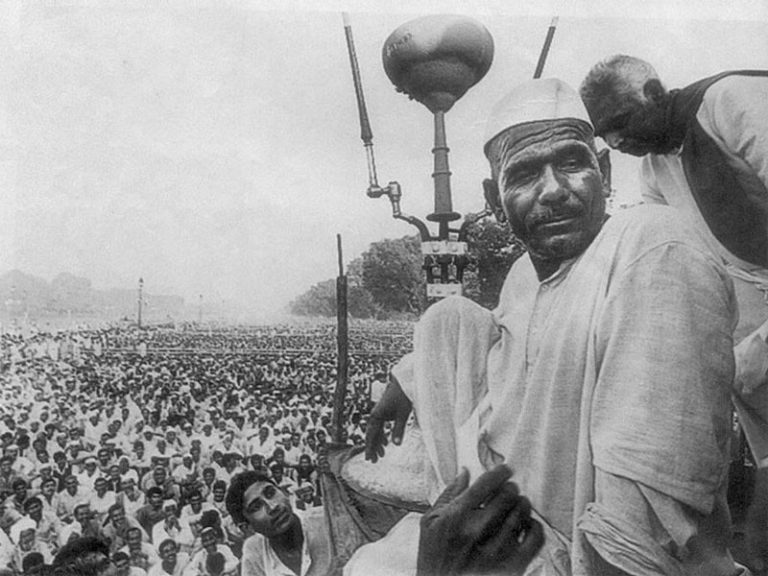
27 years ago, Mahendra Singh Tikait from Uttar Pradesh was the face of farmer’s protests. In 1993, Tikait and four other BKU leaders had met then-PM Narasimha Rao on Rao’s invitation. Tikait had asked the government to permit farmers to sell their products anywhere in the country. He demanded that the farmer should be able to sell the produce to the buyer who is ready to pay the best price. There should be no compulsion on selling the produce to the licensed buyer of a government authorized market.

Secretary, Agriculture Ministry, MS Gill, also met Tikait and other BKU leaders. At that time, the PV Narishmna Rao had shown an inability to fulfill the demands completely. Tikait revolted against the government and led protests to satisfy his demands, but that could not happen. He also demanded that the price of wheat should be decided based on the price of 1967.

Markets opened for farmers 11 years after Tikait died

In the recently passed Agriculture laws, the government has allowed the farmers to sell their products anywhere in the country. It took twenty-seven years and determined PM Modi-led government bring reforms in the Agriculture laws. Mahendra Singh Tikait could not witness the fulfilment of his demands, as he had passed way in 2011. However, the same BKU is now protesting against the laws that are in sync with the ‘original’ Tikait’s demands 27 years ago. BKU’s ties with AAP supremo Arvind Kejriwal has also come to light.

Who was Mahendra Singh Tikait

Born in 1935, Tikait was one of the most famous farmers’ leader in Independent India’s history. Hailing from village Sisauli in Muzaffarnagar District of Uttar Pradesh, Tikait was President of the Bharatiya Kisan Union. For his work done for the farmers, he was often termed as the ‘second messiah’ of the farmers.

Tikait’s name made it to the headlines for the first time when he demanded electricity bill-waiver for farmers in Muzaffarnagar in 1987. In 1988, his stature became larger-than-life when he led a farmers’ protest in Delhi. Then-Prime Minister Rajiv Gandhi-led government had to face the wrath of over five lakh farmers who took over Delhi for seven days. At that time, the protesters did not step back even after police opened fire at them that resulted in the death of two farmers Rajendra Singh and Bhoop Singh.

At that time, Tikait had said, “PM has behaved like an enemy. The displeasure of farmers will cost him dearly.” The farmers’ agitation was so intense that the government had to change the program’s venue on the death anniversary of former PM Indira Gandhi. The protests ended after the government agreed to all 35 demands laid down by Tikait.

Hundreds sick at ‘farmer protests’ but refuse to be tested for Coronavirus, 20 admitted to hospitals: Reports

0

Hundreds of protesters participating in the ‘farmer protests’ at Singhu Border could be infected with the Wuhan Coronavirus, India Today has reported. They are sick but they have refused to take the test for the virus. Authorities are worried that there might be many asymptomatic carries present at these protests. The exact number of protesters that are sick is not known but unofficially, the number is pegged at 300.

Deputy Commissioner Sonipat, Shyam Lal Punia, said, “We have set up two Covid-19 counters at Singhu Border and are regularly screening the protesters. Ten teams of doctors and paramedical staff have been deployed. An average of 70 to 90 people are visiting us every day who have been diagnosed with fever, muscular pain, or increased blood pressure.”

“We are regularly monitoring the situation. The patients are not ready for the Covid-19 tests. We distributed 50,000 masks but they are neither following the social distancing nor wearing the masks. The senior citizens say Covid-19 is nothing,” he added.

Senior Medical Officer (Sonipat) Anvita Kaushik had said earlier, “Our district’s medical vans and teams have been deployed at Singhu border. They (protesters) are getting medicines from us for cough, fever and other health problems, but are are unwilling to undergo COVID-19 test.”

Bhartiya Kisan Union-Ekta Ugrahan Punjab general secretary Sukhdev Singh had said that farmers have gathered there to protest and not for Coronavirus testing. BKU-Ekta Ugrahan is the same group that was demanding the release of ‘Urban Naxals’ arrested in the Elgar Parishad case and Islamists accused in the Delhi Riots case.

As per the report, 20 critically ill protesters have been referred to hospitals. At the same time, five protesters at Bahadurgarh and one at Singhu Border have died. Their cause of death is not known. Authorities are worried due to the social distancing norms being flouted and masks not being worn. Furthermore, medicines are being distributed without prescriptions at Singhu and Tikkri borders by certain volunteers who have opened counters.

There is a significant section of protesters between 60 and 80 years of age with comorbidities, including high blood sugar, heart diseases, high blood pressure and asthma. They are in the highest risk category. The government has appealed for them to return to their homes but the protesters are refusing to relent. Earlier, two police officers posted at protest site near Singhu Border had tested positive for the virus.

Arvind Kejriwal pulls a ‘fast one’ again, to observe ‘one-day fast’ in solidarity with ‘farmers’ protest’

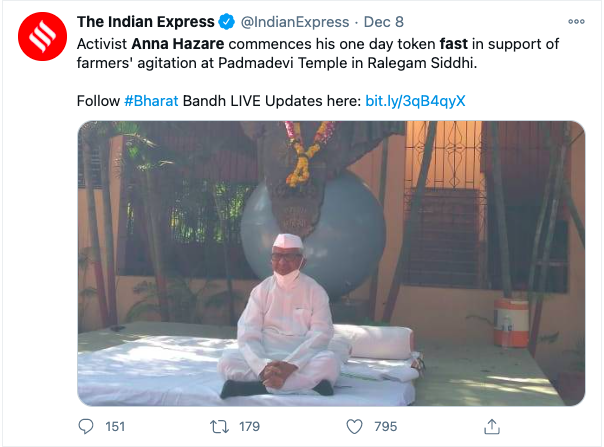
Protests are here and like clockwork, the usual suspects are out to pull a fast one on them. Few days ago activist Anna Hazare, who led anti-corruption movement that culminated into Aam Aadmi Party, had announced his ‘one day fast’ from Ralegaon Siddhi to support the farmers.

Anna Hazare fasting

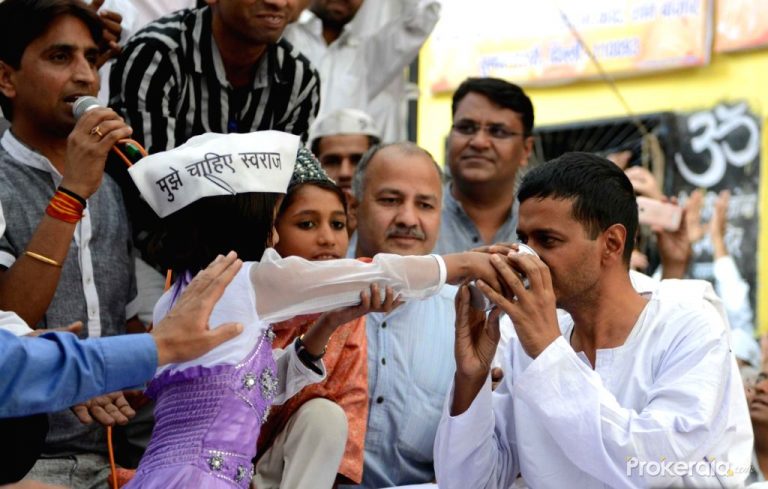
Now, his protege Arvind Kejriwal, who suffers from extreme amount of FOMO (Fear Of Missing Out), has decided to go on a one-day fast too. He has asked AAP workers and supporters to also fast for a day and also urged public at large to fast for a day in ‘support of farmers’. The fast is to be observed on 14th December, 2020, Monday.

Kejriwal has pulled a fast one before

Kejriwal and his team have taken to such ‘fasts’ before. Just days after the Pulwama terror attack, Arvind Kejriwal decided to go on a fast. Not to protest against the Pakistan-sponsored terror attack or such but for ‘full statehood’ of Delhi. Except, just a day after India carried out airstrikes in Balakot, destroying Pakistan terror camps, Kejriwal ‘withdrew’ his fast because of ‘prevailing Indo-Pak situation’.

However, the ‘prevailing Indo Pak situation’ right after the terror attack did not come in way of Kejriwal when he announced the indefinite fast on Saturday, February 23, less than 10 days after the terror attack. Neither did the ‘prevailing Indo Pak situation’ come in way of him rushing to Puducherry to show solidarity by sitting on a dharna with Puducherry chief minister who was protesting against the implementation of the traffic safety rule of wearing a helmet.

Yes, he sat on a dharna against implementation of traffic safety rule.

The great ‘hunger strike’ of 2018

Prior to that, in June 2018, Kejriwal’s team of Manish Sisodia and Satyendra Jain had gone on a hunger strike after Delhi government officers objected to alleged roughing up of Delhi Chief Secretary by AAP leaders. At same time, Kejriwal had again started his campaign for separate statehood to Delhi claiming it to be a ‘freedom struggle’. A protest carried out by the party’s supporters displayed posters with highly insensitive slogans. At that time, Kejriwal was battling the bureaucracy, Prime Minister Modi, the BJP, the Lieutenant General of Delhi to paint himself as a victim while simultaneously conspiring to form an alliance with the Congress for 2019 General Elections.

Chaos reigned supreme in Delhi as AAP supporters struggled to hold protests without seeking any permission from Delhi Police.

When ‘fast’ made him CM for first time

Ahead of voting in Delhi 2013 Assembly elections, Kejriwal went on a fast.

In December 2013, soon after formation of Aam Aadmi Party, Arvind Kejriwal fought Delhi state assembly elections. While BJP got 31 seats and was single largest party, it was short of majority. Aam Aadmi Party with 28 seats, formed minority government with Congress support. Kejriwal had based his entire election campaign to fight against the Congress’ corruption. For becoming the chief minister, he joined hands with the same Congress.

And soon after, he resigned as chief minister to contest elections against Narendra Modi from Varanasi who was the BJP’s PM candidate.

Kejriwal, of course, lost.

First fast as AAP Supremo

After breaking up with his one-time mentor Anna Hazare, Kejriwal, who had by then already formed the political party, decided to go on fast against the inflated electricity and water bills in Delhi.

His indefinite fast had lasted 15 days. Interestingly, Anna Hazare was also fasting at around same time and on a nation-wide fasting tour.

Pre-AAP fast

Before he formed political party and had to fast solo, he had Anna Hazare for company. In June-July 2012 he regularly went on fast.

Kejriwal defying modern science while fasting.

This time, however, Kejriwal is fasting against the central government’s farm laws after his own government notified one of the three laws he is protesting against. It is also just a coincidence that Punjab, where Aam Aadmi Party is the primary opposition, is having its legislative assembly elections in little over a year.

Tale as old as time.

UK Labour MP tweets in support of Khalistani terror organisation, deletes after outrage saying her staff member posted the tweet

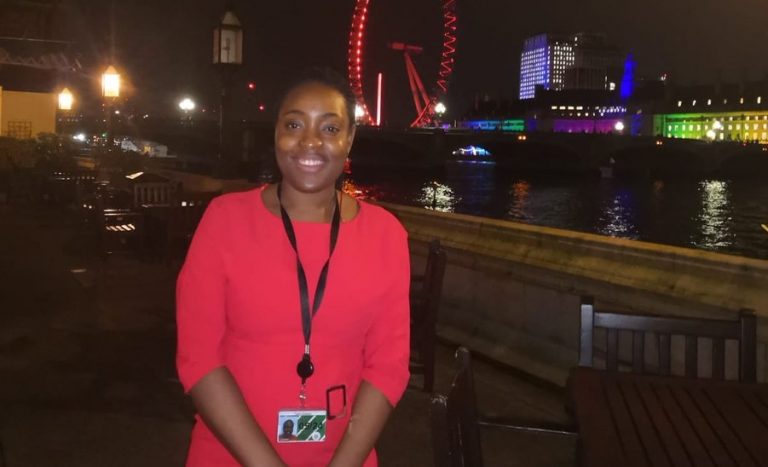
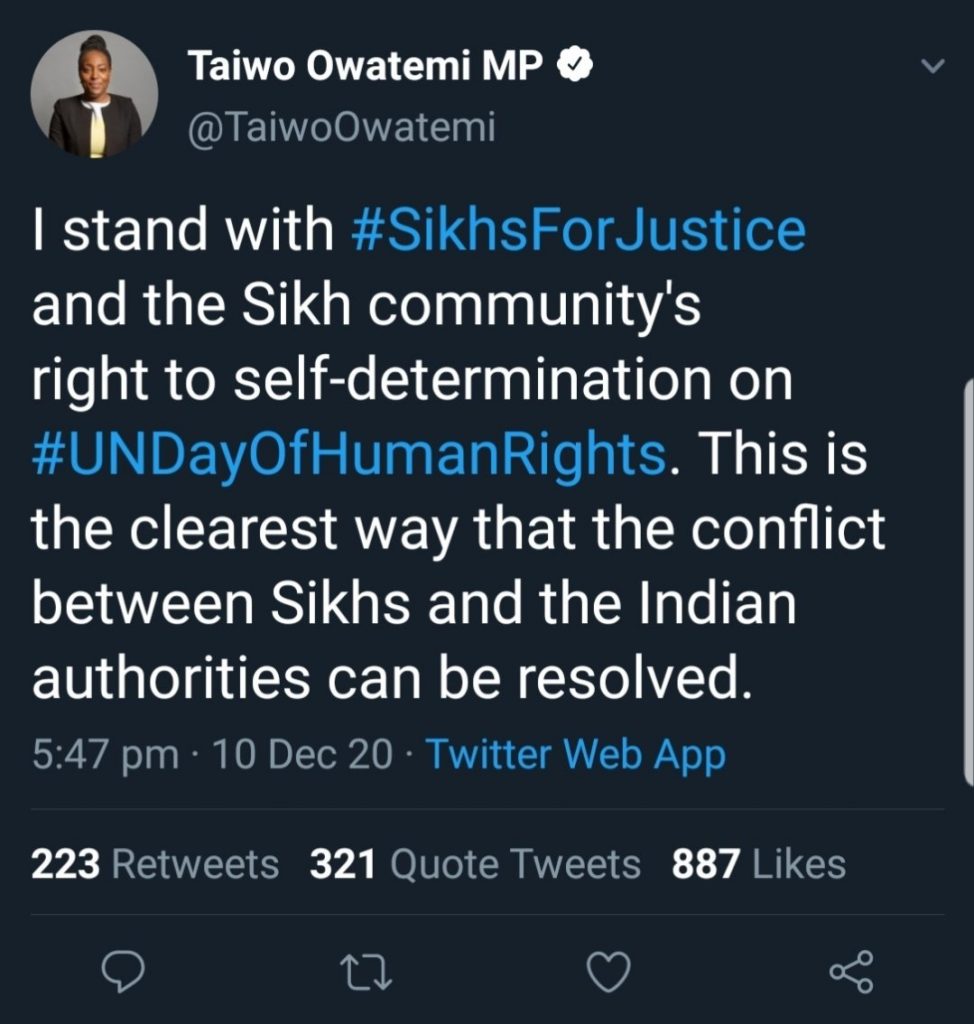
On December 10, Taiwo Owatemi, Labour MP for Coventry North West, had tweeted in support of Sikhs for Justice, a secessionist organisation demanding Khalistan, a separate country for Sikhs. She said, “I stand with #SikhsForJustice and the Sikh community’s right to self-determination on #UNDayOfHumanRights. This is the clearest way that the conflict between Sikhs and the Indian authorities can be resolved.” The tweet was in favour of a separate nation for Sikhs. Later, she deleted the tweet after sharp criticism.

Reaction on her tweet supporting SFJ

The Labour MP received sharp criticism for her tweet across the platform. While some netizens called her ignorant, others suggested that she is promoting separatism.

Owatemi says her staff member posted the tweet

After deleting the tweet, Owatemi wrote on Twitter that her staff member who manages her social media account posted it without her knowledge. She said, “A small number of individuals emailed me to post a suggested tweet supporting Sikhs for Justice. Unbeknown to me a staff member who helps to run my social media posted the tweet. This has now been deleted. I sincerely apologise for any offence caused to any of my constituents.”

Sikhs for Justice deemed as a terrorist organization by India

Sikhs for Justice (SFJ) was banned by the Indian government on July 10, 2019, under the Unlawful Activities (Prevention) Act for anti-India activities on July 10, 2019. India had declared the founder of Sikhs for Justice, Gurpatwant Singh Pannu, a terrorist in July 2020. In the same month, 40 websites of SFJ were blocked by the Indian government. SFJ has been trying to lure Punjab’s youth for Referendum 2020 and create unrest in the region. Pannu had recently released a video in which he said that SFJ would give money to farmers who are participating in the ongoing protests in Delhi.

Protesting ‘farmers’ have ties to Maoists, sympathise with ‘Urban Naxals’ and some have ties with Kejriwal too: Reports

0

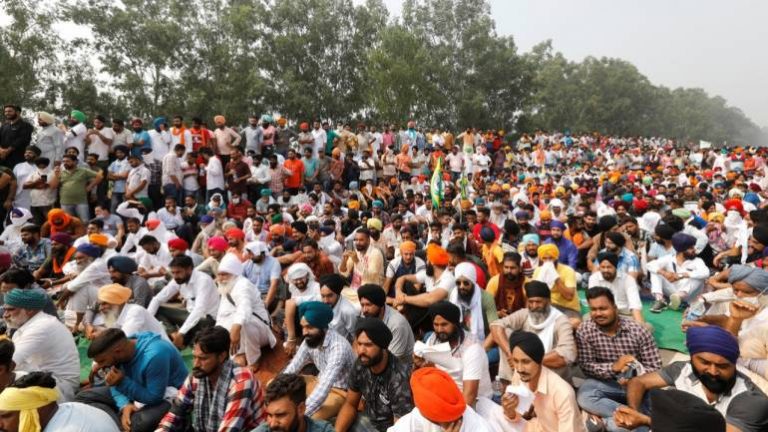
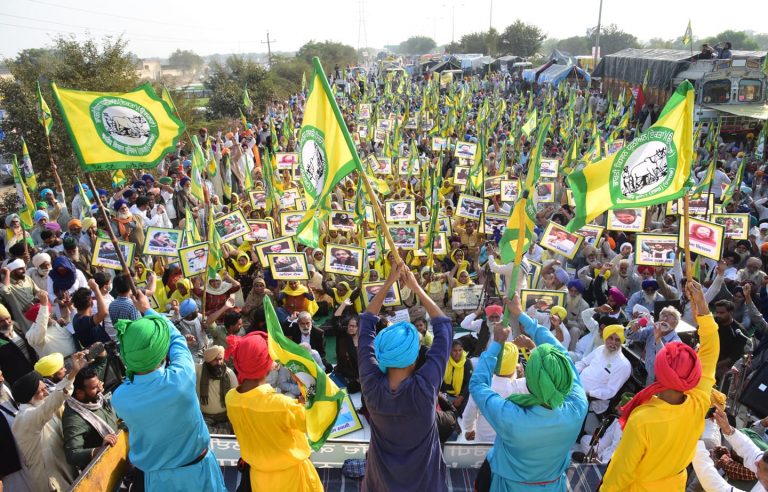
Political observers have noticed that there has been an attempt from the very beginning to hijack the ‘farmer protests’ to achieve political objectives. Khalistani elements have been extremely vocal during these protests and elements abroad have been trying to ride piggy back on the protests against the farm laws.

As it turns out, the protesters do have links to opposition political parties. All India Kisan Sangharsh Coordination Committee chief Sardar VM Singh turned out to be a Congress leader accused in 8 different cases. He also has assets worth crores. Now, IANS has published a series of reports where they have the exposed the political links of the leaders of the ‘farmer protests’.

IANS reported that the Ekta Ugrahan of the Bharatiya Kisan Union (BKU-Ekta Ugrahan) is the largest represented group at Delhi’s borders. Almost two-thirds of those gathered there are reported to be their members. It is the same group calling for the release of ‘Urban Naxals’ involved in the Elgar Parishad case and Islamists arrested in the Delhi Riots case.

Lawyer and coordinator of BKU, N.K. Jeet is reported to have said on December 10, “It is our conscious decision to support these accused. The Naxal movement was always a farmers’ movement all over India. Releasing these accused is a demand of the BKU. We made it part of the memorandum to the government related to the farm laws.” He had also reportedly said, “Naxalism has helped the tribal people claim their rights.”

Other such elements include Surjit Singh Phool, Darshal Pal, Ajmer Singh Lakhowal and others. Pal is the 70-year old Punjab president of Krantikari Kisan Union who is alleged to have connection to pro-Maoist groups. The IANS report says, “He also has close association with various pro-LWE activists in the state, including Joginder Singh Ugraha, Jhandha Singh Jethuke, Sukhdev Singh Kokri Kalan (state general secretary, BKU-Ekta Ugrahan), Satwant Singh Wazidpur (Inqlabi Lok Morcha which is pro-CPI/Maoist), Surjit Singh Phool, Buta Singh Burjgill (state presidnet, BKU-Dakaunda which is also pro-CPI/Maoist).”

Pal is also reportedly a founding member of People’s Democratic Front of India (PDFI). Other members include Varavara Rao, Kalyan Rao, Medha Patkar, Nandita Haksar, S.A.R. Geelani and B.D. Sarma. As we had reported earlier, according to a study prepared by Dr Marri Channa Reddy Human Resource Development Institute in Hyderabad, PDFI was a part of Tactical United Front (TUF) formed by the Maoists, to consolidate and expand its position.

Phool is 75 years old and is the president of BKU-Krantikari. He was reportedly booked under UAPA during the UPA regime in 2009. He was accused of having ties with Maoists and placed under “intensive interrogation” in an Amritsar jail.

According to intel reports, Delhi Chief Minister Arvind Kejriwal has close ties with Gurnam Singh Chaduni, farmer leader from Haryana and founder of BKU/Gurnam. Nirbhay Singh Dhudike (State President), Kirti Kisan Union, had his house raided by Jalandhar Police in 2009 to determine his ties with arrested CPI-Maoist Cadre Jai Prakash Dubey.

Thus, as it appears evident, the protests are witnessing heavy involvement from anti-social elements. Massage parlours and a gym has propped up at these protest sites. Public roads have been turned into a picnic spot by baking and distributing Pizzas to the so-called protestors.

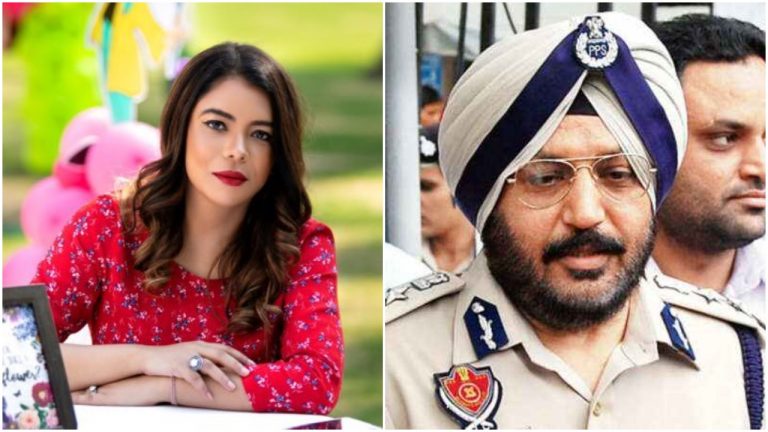
The Wire’s Rohini Singh blames union govt for Punjab DIG quitting in ‘solidarity’ with farmers’ protest. But here’s the catch

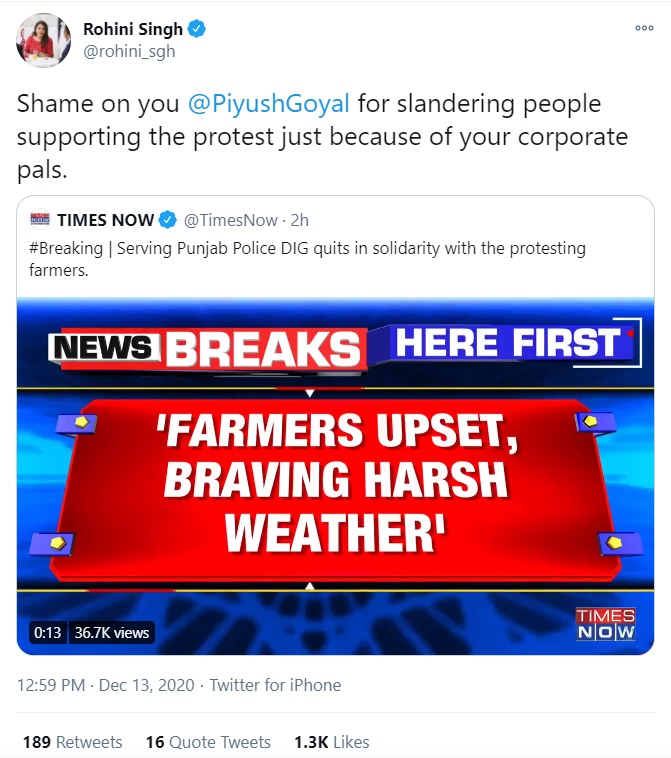
Rohini Singh, who claims to be a ‘journalist’ at far-left portal ‘The Wire’, on Sunday took to Twitter to do what she does best – peddling misinformation on social media. The self-proclaimed journalist shared a Times Now report that claimed that a Punjab Police officer allegedly quit from his job to express his solidarity with the protesting ‘farmers’.

Singh, who has been forefront at putting out misleading information pertaining to the protests carried out by the alleged farmers, attempted again to peddle half-truth pertaining to the details of the resignation of suspended Punjab DIG (prisons) Lakhminder Singh Jakhar and went to blame Modi government for the same.

Rohini Singh, attacking the Modi government, claimed that it was Union Railway Minister Piyush Goyal that was responsible for the resignation of Punjab DIG Lakhminder Singh Jakhar. Singh claimed that it was shameful of Piyush Goyal for slandering people who supported the protest just because of his ‘corporate pals’.

Rohini Singh’s attack on Piyush Goyal comes after the Union Minister had exposed the links of Naxals and far-left elements in the society attempting to hijack the ongoing ‘farmer protest. Lamenting over such an expose by the Union Minister, Rohini Singh targeted Piyush Goyal for discrediting the so-called farmers’ protests.

In her efforts to do so, Rohini Singh went on to insinuate that people like Punjab DIG (Prisons) Lakhminder Singh Jakhar, who according to her was an upright citizen and a man with impeccable integrity, are the real supporters of the ‘farmers’ protests. However, in hurry to project that the so-called farmers’ protests as a legitimate one, Rohini Singh seems to have deliberately ignored to state full facts pertaining to Lakhminder Singh Jakhar and controversies surrounding him.

Who is Lakhminder Singh Jakhar?

Lakhwinder Singh Jakhar, who is now hailed across the liberal media for resigning from his post to join farmers protest, was the Deputy Inspector General (Prisons) in Punjab. However, in May this year, Lakhwinder Singh Jakhar was suspended from the service after he became accused in a corruption scandal.

The Punjab government had carried out a preliminary inquiry into the allegations by Deputy Superintendent Vijay Kumar against the controversial DIG. Kumar had alleged that during a visit on April 7, Jakhar and his staff demanded a monthly bribe and while he paid Rs 10,000, one of the jail warders paid Rs 3,000 to the DIG’s driver. The inquiry recommended action against Jakhar and a charge-sheet was filed.

Not just corruption charges, in 2012, Lakhminder Singh Jakhar was issued contempt notice by a Patiala court for refusing to execute the death warrants of Balwant Singh Rajoana, a Khalistani terrorist convicted in former Punjab CM Beant Singh’s murder. The court had also slammed the officer for obstructing the administration of justice.

Six months after suspension, DIG Jakhar has now submitted his resignation claiming that he was doing so to protest against the contentious farm laws.

However, the likes of Rohini Singh, who claims to be the epitome of ‘neutral’ journalism, rather than questioning the intent of Jakhar’s sudden resignation that too amidst a corruption scandal, instead hails him to be the real representative of the so-called farmer protests.