HuffPost India is shutting down its operations from the 24th of November. An announcement on its website reads, “As of November 24 HuffPost India will no longer be publishing content. For more great global content, please visit HuffPost.com. We thank you for your support and readership.”
HuffPost India website
“I have vivid memories of growing HuffPost into a major news outlet in its early years, but BuzzFeed is making this acquisition because we believe in the future of HuffPost and the potential it has to continue to define the media landscape for years to come,” BuzzFeed Chief Executive Officer Jonah Peretti said in a statement. Peretti was one of the co-founders of HuffPost 15 years ago. As part of the deal, Verizon also acquired a minority stake in Buzzfeed.
The decision comes days after BuzzFeed acquired HuffPost from the latter’s parent company Verizon. It is not clear whether the decision of HuffPost India to shut shop is related to the merger. According to new rules set by the Union Government, FDI in digital news is capped at 26%. The move is intended to limit “foreign influence and interference in India’s domestic affairs, check Chinese and other overseas funding in news sites” and “create a level-playing field for all media”.
It is pertinent to note that on the 16th of November, the Government had asked news aggregators and digital media to submit information regarding their compliance status with regards to foreign investment within one month. Entities which exceeded the 26% would have to seek approval from the Ministry of I&B to bring down the foreign investment to 26% by the 15th of October, 2021. The new rules also mandate that any entity that seeks to bring new foreign investment must seek prior information from the Union Government.
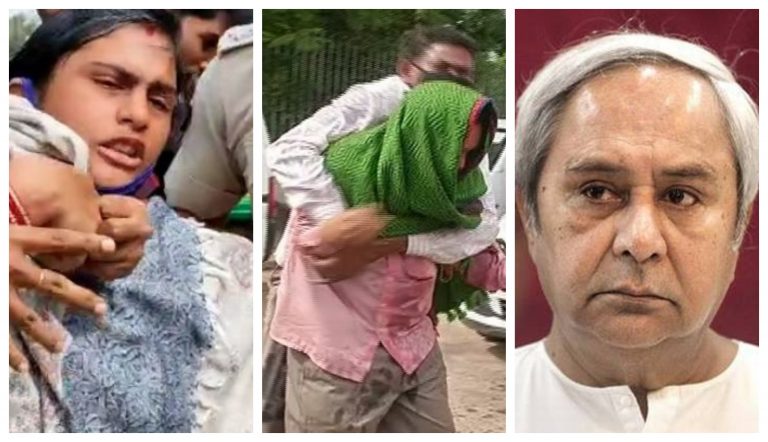
A couple tried to self-immolate outside the Odisha assembly today, reportedly seeking justice for their daughter. The couple that has been identified as Soudamini Sahu and Ashok Sahu belonging to Jadupur village in Nayagarh district of Odisha, tried to pour kerosene on themselves and self-immolate near the high-security zone outside the Assembly.
The couple was stopped right in time by the security personnel present outside the Assembly after they saw the couple carrying a kerosene bottle as they got off an auto-rikshaw. The couple was later sent to Capital Hospital for a health check-up. According to reports, the couple resorted to this after they were failed by the police and the administration.
Had approached the NHRC and the High Court
According to reports, the couple had a five-year-old daughter who was kidnapped in July this year and 10 days later her remains were found in the backyard of their house. The couple alleged that neither the police nor the administration helped them as the suspect was from the ruling Biju Janata Dal (BJD). A case was registered by the police but no arrests were made. They had also approached the National Human Rights Commission (NHRC) and the Orissa High Court in the hope of getting justice. After the security personnel prevented the couple from self-immolating, Saudamini reportedly took the names of some influential persons behind the death of her daughter. “The culprit kidnapped my little girl and dumped her body and used chemicals to decompose it”, alleged the girl’s father.
Culprit allegedly close to Minister Arun Sahu
The couple had named one Babuli Nayak from their village as the suspect in the complaint filed by the police. Alleging harassment by police officials, the couple said that their daughter was killed by people close to BJD Minister Arun Sahu and that they were driven out of the village for demanding action against the culprits. They alleged that the killers had gauged out their daughter’s eyes and kidneys.
The 5-year-old child’s remains, with bones and body parts chopped off, was dumped at the couple’s backyard 10 days after the kidnapping. The family has been alleging that it is possible that she was killed for her organs. In October, the couple had claimed that the murderers of their daughter had also tried to kill them while they were in the hospital.
Umasankar Das, DCP Bhubaneswar, said that the couple had grievance regarding the investigation of the case lodged in Nayagarh Sadar police station and so they were made to speak to SP Nayagarh, thereafter, they left for their home.
Opposition parties have started attacking the ruling BJD over the issue. As the assembly is currently in session, MLAs have raised questions about adequate security arrangements around the state assembly.
Ahead of the Greater Hyderabad Municipal Corporation (GHMC) elections, BJP MP and Bharatiya Janata Yuva Morcha (BJYM) President Tejasvi Surya has slammed the ruling TRS government in Hyderabad, Telangana.
On Tuesday, Tejasvi Surya and other party leaders marched to the Osmania University to pay respect to those individuals martyred during the Telangana movement, a mass movement that eventually resulted in the formation of the state.
Surya complained that the BJP supporters were stopped at the gates by the Hyderabad police, at the behest of TRS leader KC Rao. The BJP leader informed on Twitter, “We wanted to pay respects to Telangana movement’s martyrs at Osmania University. But KCR has closed its gates. BJYM threw open the gates & marched inside to salute Telangana’s heroes. Telangana isn’t private jagir of KCR family. It belongs to the common youth & BJYM stands with them”
We wanted to pay respects to Telangana movement’s martyrs at Osmania University
But KCR has closed its gates@BJYM threw open the gates & marched inside to salute Telangana’s heroes
Telangana isn’t private jagir of KCR family. It belongs to common youth & BJYM stands with them pic.twitter.com/bexB490X6c
Tejasvi Surya, who was seen bowing down to pay his respect for the martyrs of the Telangana movement, reiterated in his tweet, “BJYM is the power of the youth of India! No fences, no barricades, no police force can stop us from doing the right thing. The more you try to stop us, the more powerful will be our fight back! Jai Telangana!”
BJYM is power of youth of India!
No fences, no barricades, no police force can stop us from doing the right thing.
The more you try to stop us, the more powerful will be our fight back!
In videos and images shared by Tejasvi Surya, BJP supporters could be seen throwing open the gates and marching into the University premises to pay respect to the martyrs of the Telangana movement. “Try how much ever you want, KCR Garu, but you can’t stop BJYM from paying respects to Telangana martyrs. You are in power today because of the sacrifice of thousands of common students of Telangana. Please don’t forget their sacrifices!” he emphasised.
Try how much ever you want, KCR Garu, but you can’t stop BJYM from paying respects to Telangana martyrs.
You are in power today because of sacrifice of thousands of common students of Telangana.
In a blistering attack against AIMIM chief Asaduddin Owaisi and his younger brother Akbaruddin Owaisi, Tejasvi Surya said that the Owaisi brothers kept development out but allowed only illegal Rohingya immigrants to come to Hyderabad.
Speaking to the media, Surya said, “It is laughable that Akbaruddin and Asaduddin Owaisi are speaking of development. They haven’t allowed development in old Hyderabad, the only thing they allowed is Rohingya Muslims. Every single vote to Owaisi is a vote against India & everything that India stands for.”
Surya continued slamming Owaisi, comparing him to the founder of Pakistan, Mohammad Ali Jinnah. He said, “Asaduddin Owaisi speaks the language of rabid Islamism, separatism and extremism which Mohd Ali Jinnah was also speaking.” “They say give us 15 minutes and we will show Hindus their place. We don’t want such Razakars to come back in the power. If you vote for Owaisi here he becomes strong in Maharashtra, Karnataka, Bihar and Uttar Pradesh,” Surya said.
The Ministry of Electronics and Information Technology, Government of India (MeitY), has issued an order to ban access to 43 mobile apps under Section 69A of the Information Technology Act.
The Government blocked the apps based on the inputs stating these apps were engaging in activities that are prejudicial to sovereignty and integrity of India, defence of India, the security of the state, and public order. Indian Cyber Crime Coordination Center, Ministry of Home Affairs has submitted a comprehensive report based on which the Ministry of Electronics and Information Technology decided.
Ministry of Electronics and Information Technology, GoI (@GoI_MeitY) issued an order today under section 69A of the Information Technology Act blocking access to 43 mobile apps in India.
The Government has blocked four apps of Alibaba Group Holding Limited, also known as Alibaba Group, that are AliSuppliers Mobile App, Alibaba Workbench, AliExpress – Smarter Shopping, Better Living, and Alipay Cashier. Out of these, AliExpress, the Chinese e-commerce app, has gained immense popularity among Indian users because of its cheap products since its launch in India in 2016. Many Indian small-scale sellers were also buying products from AliExpress in bulk.
List of apps blocked by Government of India
Suppliers Mobile App
Alibaba Workbench
AliExpress – Smarter Shopping, Better Living
Alipay Cashier
Lalamove India – Delivery App
Drive with Lalamove India
Snack Video
CamCard – Business Card Reader
CamCard – BCR (Western)
Soul- Follow the soul to find you
Chinese Social – Free Online Dating Video App & Chat
Date in Asia – Dating & Chat For Asian Singles
WeDate-Dating App
Free dating app-Singol, start your date!
Adore App
TrulyChinese – Chinese Dating App
TrulyAsian – Asian Dating App
ChinaLove: dating app for Chinese singles
DateMyAge: Chat, Meet, Date Mature Singles Online
AsianDate: find Asian singles
FlirtWish: chat with singles
Guys Only Dating: Gay Chat
Tubit: Live Streams
WeWorkChina
First Love Live- super hot live beauties live online
Rela – Lesbian Social Network
Cashier Wallet
MangoTV
MGTV-HunanTV official TV APP
WeTV – TV version
WeTV – Cdrama, Kdrama&More
WeTV Lite
Lucky Live-Live Video Streaming App
Taobao Live
DingTalk
Identity V
Isoland 2: Ashes of Time
BoxStar (Early Access)
Heroes Evolved
Happy Fish
Jellipop Match-Decorate your dream island!
Munchkin Match: magic home building
Conquista Online II
India had banned apps twice before in 2020
On 29th June, 2020, the Government of India blocked access to 59 mobile apps including TikTok. In July, the Government banned 47 apps that were operating as clones of the previously banned apps. On 2nd September 2020, the Government further blocked 118 mobile apps including PubG under the provisions provided by Section 69A of the Information Technology Act.
In a major relief for actor Kangana Ranaut and her sister Rangoli Chandel, the Bombay High Court granted them interim protection from arrest and directed the Mumbai Police to not take any coercive action against the duo in connection with an FIR filed against them for their alleged communal tweets.
#NewsAlert – Relief for Actress Kangana Ranaut and her sister Rangoli.
The court, however, has asked Kangana Ranaut and her sister Rangoli Chandel to appear before Mumbai Police on January 8 for recording their statement.
A division bench of Justices S S Shinde and M S Karnik was hearing a petition filed by Ranaut and her sister. The court observed that three summons were issued by the police and the same need to be honoured.
Representing Chandel and Ranaut, advocate Rizwan Siddiquee then assured the court that his clients will appear before the Bandra police in Mumbai on January 8 from 12 pm to 2pm for recording of their statements.
Justice Shinde also questioned as to why “sedition” charges were invoked in the case.
“Why is the sedition section invoked? Why are we treating citizens of our country like this?” Justice Shinde said. The High Court said this would be discussed in detail during the next hearing.
Kangana Ranaut and sister Rangoli move Bombay HC seeking to quash the FIR filed against them
Earlier yesterday, actor Kangana Ranaut and her sister had moved the Bombay High Court seeking to quash the FIR lodged against them by the Mumbai Police for allegedly “trying to create hatred and communal tension” through their posts on social media.
The FIR was filed against the duo pursuant to the orders passed by the Bandra magistrates court asking the police to carry out a probe against Ranaut and her sister following a complaint registered against them.
Ranaut had filed the plea seeking to stay the summons issued against them to appear before the police for questioning, and also a direction to the police to not take any coercive action against the two sisters.
Last week, the Mumbai Police had issued summons to Bollywood actor Kangana Ranaut and her sister Rangoli to record their statements on November 23 and 24 for allegedly promoting enmity between two communities.
Kangana and Rangoli accused of sowing discord between communities in an FIR filed by Mumbai Police
The police had filed an FIR against Kangana and Rangoli under IPC sections 153A (promoting enmity between different groups on grounds of religion, race, etc), 295A (deliberate acts hurting religious sentiments) and 34 (common intention). Along with these, TIPC section 124A- sedition was also slapped on the duo.
According to complainant Sayyed’s lawyer, the complaint alleged that Ranaut has been defaming Bollywood for the last two months by calling it a “hub of nepotism”, “favouritism” etc through her tweets and television interviews.
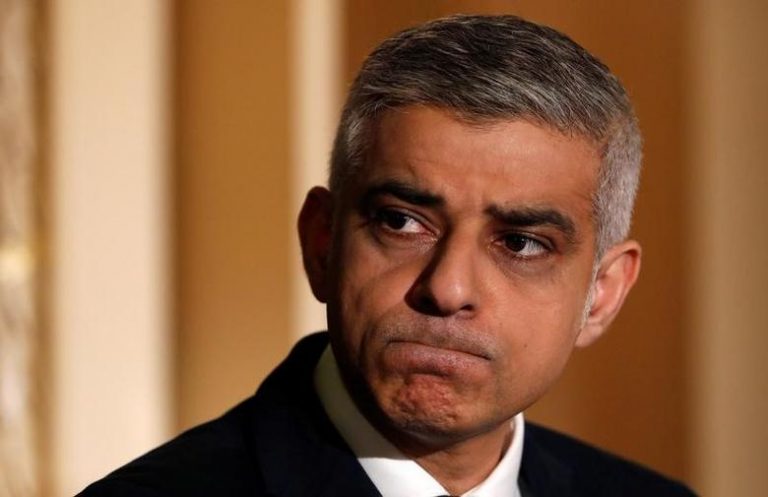
Mayor of London Sadiq Khan has demanded that the ‘minorities’ in London should first get vaccinated. Khan has demanded the Black, Asian, Minority, Ethnic groups (BAME groups) in London to be given priority in the distribution of the vaccine. In a video shared by Khan on Twitter on November 17, he claimed, speaking to BBC Radio London, that the BAME groups were disproportionately affected by the virus.
The positive news around COVID19 vaccine development is hugely encouraging.
But there is still some way to go, and it’s vital that when we have a vaccine that is approved for use that the most vulnerable members of our society are first to benefit.pic.twitter.com/hUQ0vwhNRD
Sadiq Khan told that the National Health Service (NHS) and the Public Health England were working up criteria to decide the who would be inoculated first. He said that basically the distribution is done by age but he had asked for considering some additional factors for deciding the criteria. He said that the BAME groups suffered more in terms of deaths due to COVID-19 during the early phases of the pandemic in March, April, May and June.
He said that in London people were more hesitant to take the vaccine as compared to other parts of the country. “In London, there is a greater hesitancy taking a vaccine than other parts of the country. When you look at the take up of smallpox, polio, MMR, HPV- it’s less in London than other parts of the country”, said Khan. For this reason, Khan said that it was important to take the people of London in confidence and make sure the vulnerable people get the vaccine first as they are more at risk of losing lives to the virus.
Khan asks for the opening of shops and businesses ahead of Christmas
Khan had recently demanded the opening of shops and businesses in London in a safe and COVID-19 secure manner ahead of Christmas. “While this is certainly not going to be a normal Christmas, it is more important than ever that no-one has to spend it alone. It is important plans are devised to allow people to spend the festive period with loved ones after such a tough year, but this must be done in the safest way possible”, he said. However, he warned that the Christmas period should not reverse the progress made in controlling the virus.
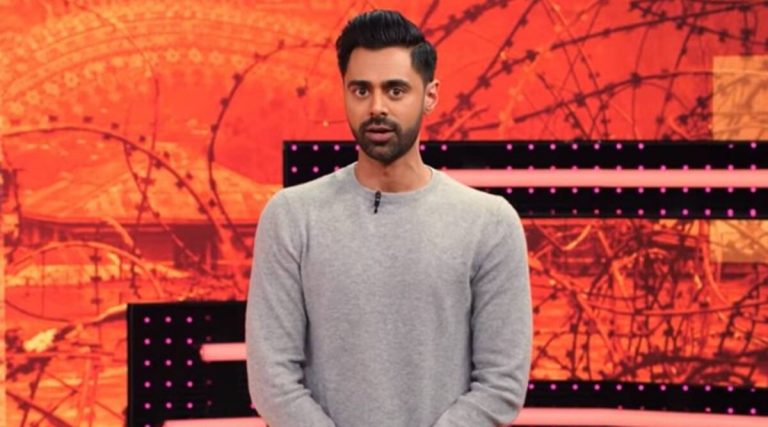
Allegations of mistreatment of ‘women-of-colour’ at the sets of the ‘Patriot Act with Hasan Minhaj’ have now surfaced on social media. The women who had previously worked on the show have decided to come forward with their stories of mistreatment. Sangeetha Thanapal, activist and writer, has documented the allegations in an article on her account at Medium.
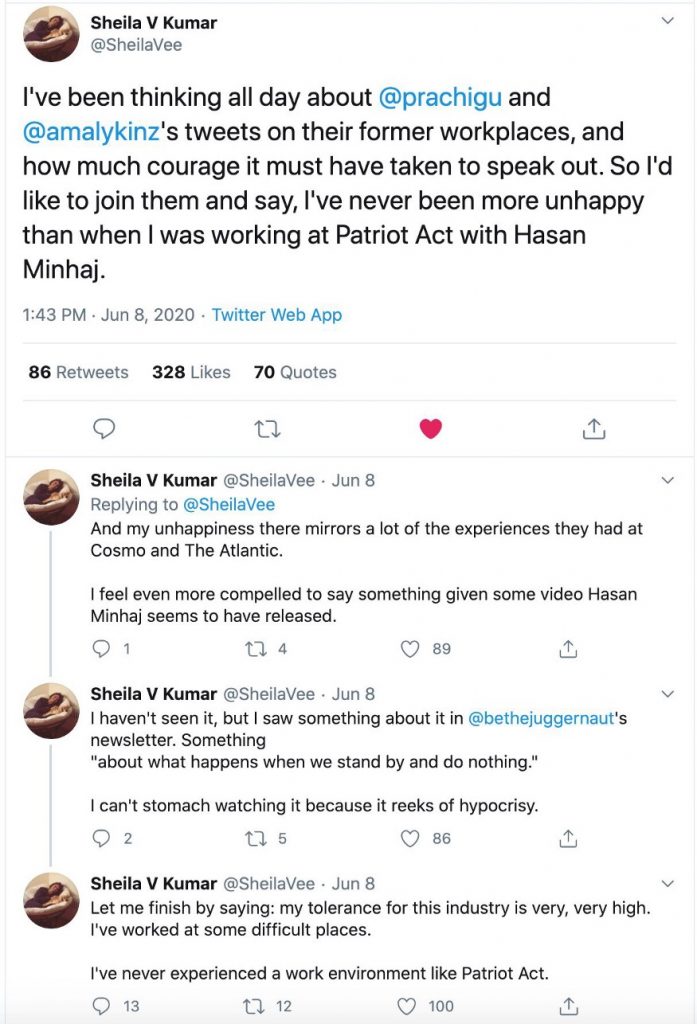
Sheila V Kumar, a former producer on the show, had to protect her account on Twitter after narrating her experience. Sangeetha says, “That is understandable. After all, Minhaj is beloved by the “woke” Desis, and the social justice crowd in general. She was making herself a target by telling the truth.”
“I’ve never been more unhappy than when I was working at Patriot Act with Hasan Minhaj,” Sheila V Kumar wrote narrating her experience. She concluded with the words, “My tolerance for this industry is very, very high. I’ve worked at some difficult places. I’ve never experienced a work environment like Patriot Act.”
Image Credit: Sangeetha Thanapal
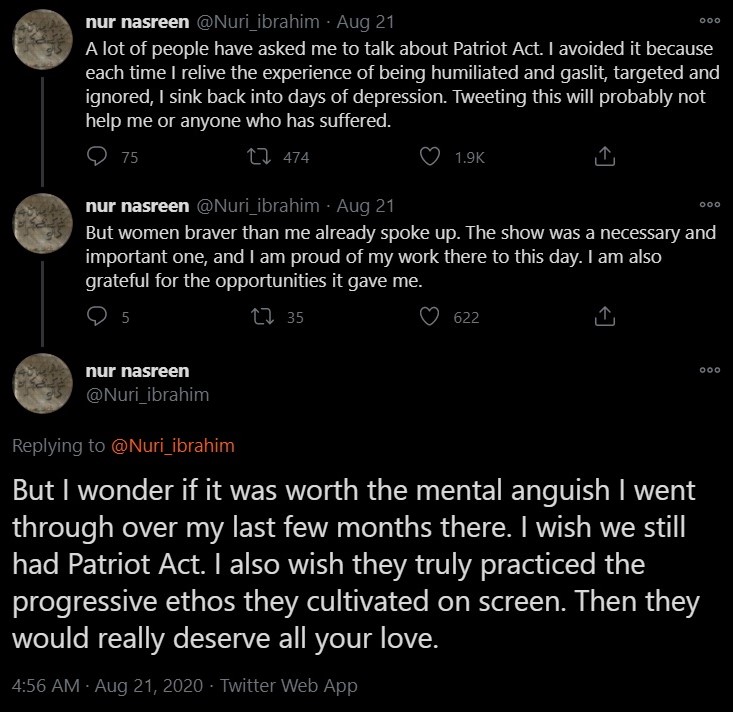
Pakistani news producer and writer Nur Nasreen echoed similar sentiments as Sheila V Kumar. According to Nasreen, she was “humiliated and gaslit, targeted and ignored” and she falls into depression every time she recounts the experience of working at the Patriot Act with Hasan Minhaj.
“I am proud of my work there to this day. I am also grateful for the opportunities it gave me. But I wonder if it was worth the mental anguish I went through over my last few months there,” she stated. “I wish we still had Patriot Act. I also wish they truly practiced the progressive ethos they cultivated on screen. Then they would really deserve all your love,” added Nasreen.
Nur Nasreen is a Pakistani writer
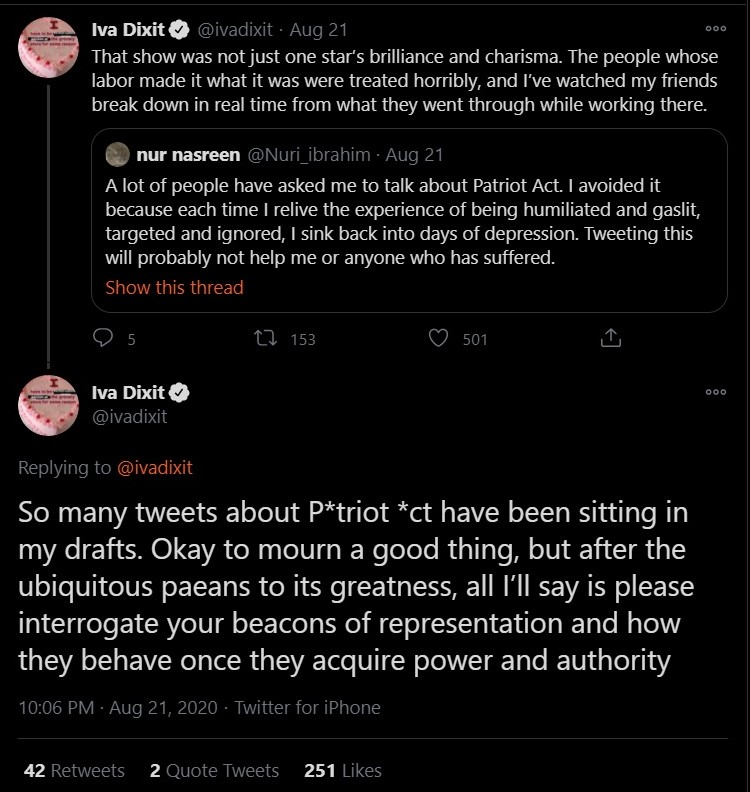
New York Times writer Iva Dixit came forward to reveal the ordeal her friends were forced through. She said, “The people whose labor made it what it was were treated horribly, and I’ve watched my friends break down in real time from what they went through while working there,” before going on to add, “all I’ll say is please interrogate your beacons of representation and how they behave once they acquire power and authority”.
Iva Dixit speaks out
Pointing towards the hypocrisy of how Hasan Minhaj has been treated thus far, Sangeetha said, “Where are all the progressive Desi organisations that lauded his episode on Modi but had nothing to say about women leaving his show in tears?” She went on to further criticise who she calls ‘Woke Desis’.
“Woke Desis seem to be really selective in the types of Brown people they target. They will attack Tamil women but are silent about light-skinned North Indian men. Minhaj’s power and reach have made it so that he is near-untouchable, so much so that women openly talking about how they were treated did not get even one article in any of the many Desi mags that abound on the internet,” wrote Sangeetha.
Shireen Ahmed, activist and writer, commenting on the article by Sangeetha, said, “Patriot Act was the first show that I watched and felt seen as a journalist and as a Brown Muslim woman. Sadly, the tweets that came out in the summer did not surprise me. I am thankful to the women who spoke up. I hear you, and I appreciate what you did. I believe you.”
People have also come out and said that Hasan Minhaj needs to address the issue in public. As Shireen Ahmed pointed out, “Dismissing and disregarding these women is not a great look.”
Hasan Minhaj postures himself as a progressive in public life. His show Patriot Act was cancelled by Netflix recently for unknown reasons. Minhaj has also claimed that he was not allowed at the Howdy Modi event last year in September because of his ‘critical’ views on PM Modi. But later, it was revealed that he had not registered himself for the event as a media person and hence he could not enter the venue with a camera. Minhaj was offered a seat in the audience but he refused.
In January 2020, I shared the story of Abhinav Goswami, who decided to bring to America the gifts of ancient India — extraordinary health, ethical A2 dairy products, Vedic education and more. His dream is to build or facilitate 108 Gaushalas all over the world. You can read it here; in fact, I recommend that you read it before you proceed with this article.
The story went viral and I was inundated with emails asking to know more about Abhinav’s plans and wishing him every success in the journey. In November 2019, Abhinav hardly knew anyone in Houston but in a matter of months, he could count hundreds of people in America who were eager to be a part of his journey to create a Vedic ecosystem.
With an IT consulting job in hand, Abhinav managed to gather enough resources to buy a four-acre farmland with an attached house in Cypress, Texas about 24 miles northwest of Downtown Houston. It came with a lily pond and a barn.
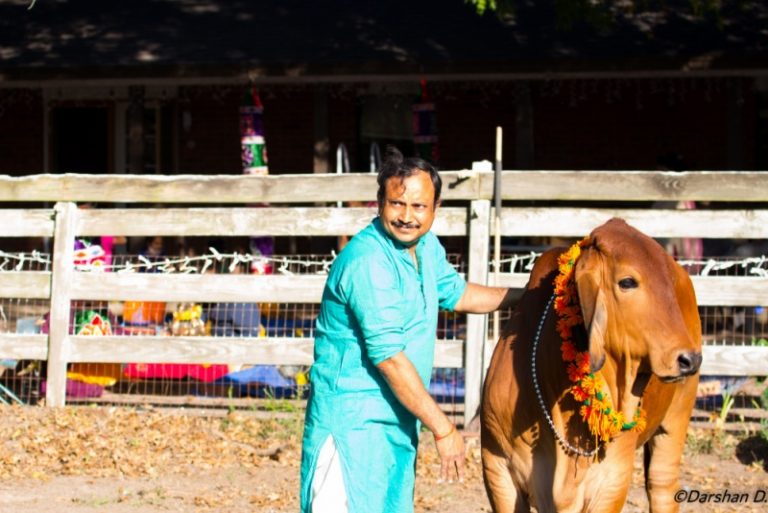
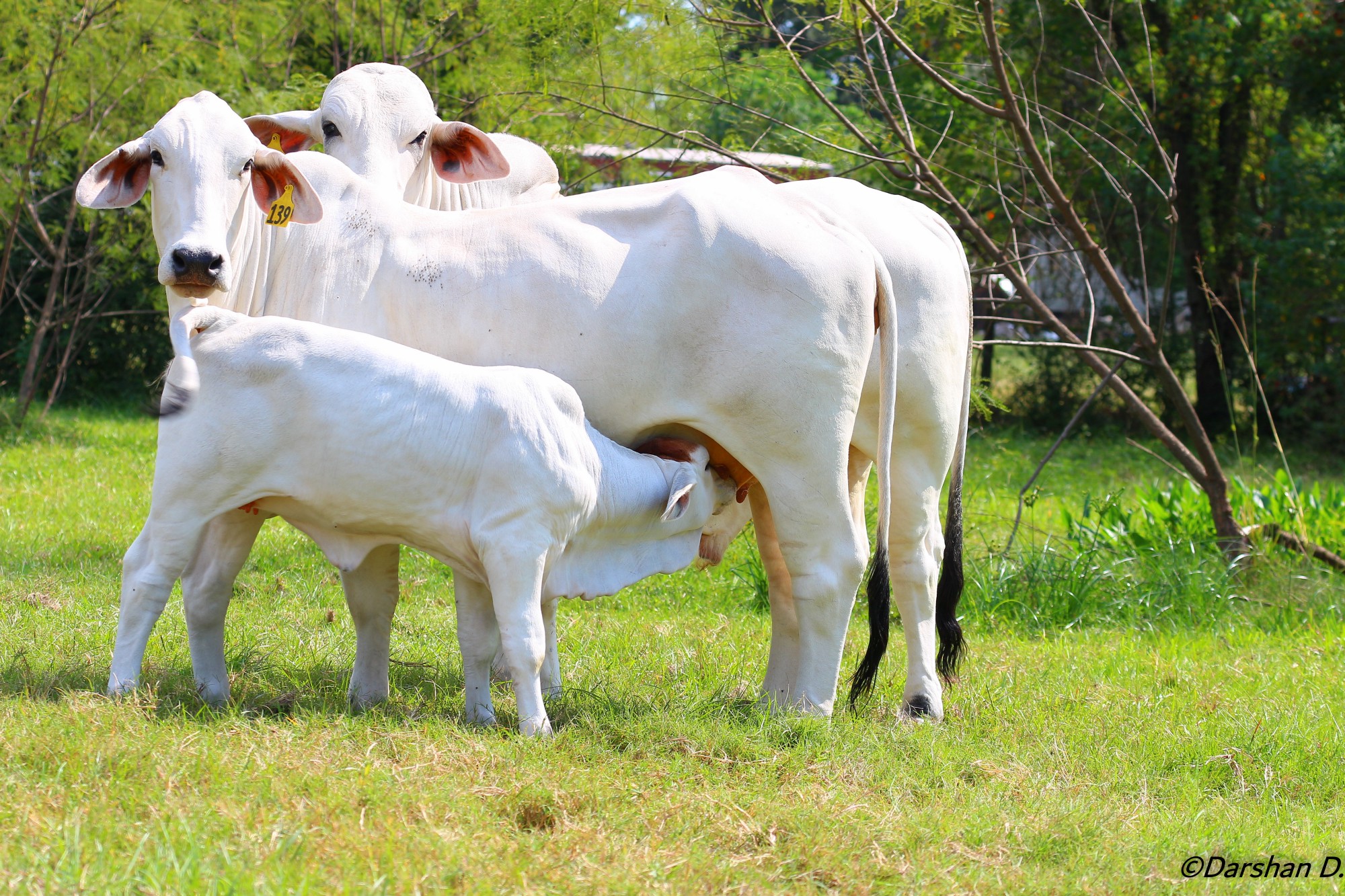
Photo: Darshan Dharmadhikari
Photo: Darshan Dharmadhikari
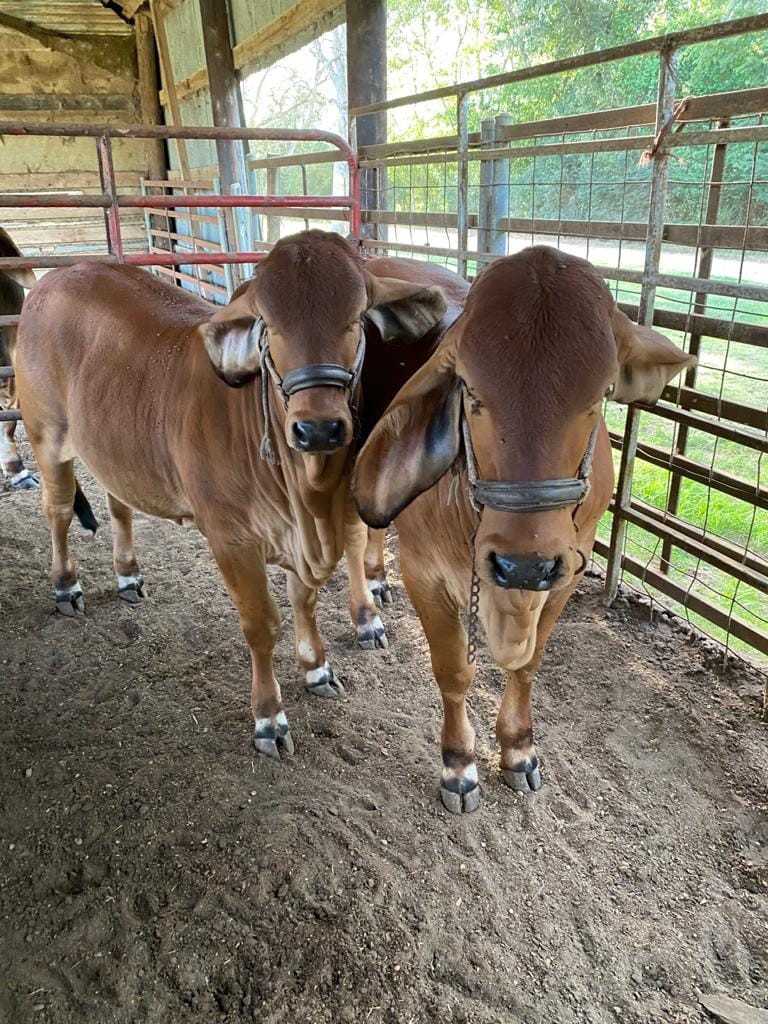
Abhinav’s children began to attend schools nearby while wife Pratibha toiled to keep the grihastha fires burning. Even before he bought furniture for the house, Abhinav got busy in making enquiries about the native Indian cattle breeds available in America. Most of the Indian breed cows in America are raised only for slaughter. These breeds known as Brahman cows originating in India were first imported into the US between 1854 and 1926 because they were hardy and resistant to disease as well as insects. They did not produce copious amounts of milk like the Holstein and other “dairy cattle”, therefore they were quickly consigned to the “beef cattle” category.
“It is horrifying to think of our gau mata being reared for slaughter here,” said Pratibha. “There is no compassion; they are just regarded as a food with no sentience, no Atman,” she reflected.
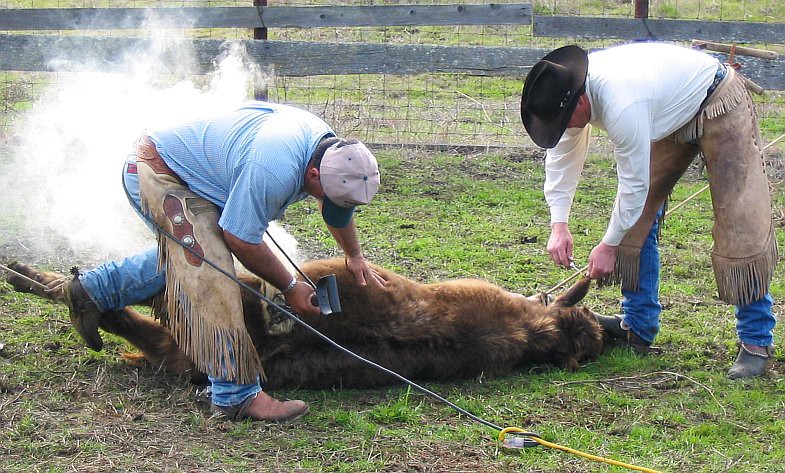
Unlike India, where horned cows and bulls move freely, in America, the cattle are “dehorned” by a painful process. “There are machines that pull out their horns,” informed Abhinav. It is an extremely painful process that is hardly alleviated even with painkillers. Nowadays, a different process called disbudding is used to remove horn buds in younger animals before they grow into horns. Even this is not without pain. The cattle are also branded on their ears and bodies with numbers using hot irons in order to identify the owners of the animals. The numbers are literally burned into the flesh.
Horned cows are quite common in India.
In August 2020, Abhinav’s family finally brought home a bull, a cow and a female calf, all belonging to the Tharparkar variety of Indian cows. They named them Chaitanya, Gauri and Nandini. To their surprise, the animals were not as human- friendly as the cows of the same breed they knew in India. In fact, they were fearful and moved away at the sight of humans. They stuck close to one another and refrained from even approaching their feed.
Photo: Darshan Dharmadhikari
“If we went to one side of the field, they went to the other; we had not seen cows behaving like this in India,” said Pratibha. The cows would wait until dark and then approach the feeding area. It took weeks for the realization to dawn on them that their new owners had no intention to hurt them. “The only things they have got from humans in this part of the world are pain and suffering,” observed Abhinav. “The dehorning, the branding, the forcible milking, the slaughter — it is hardly surprising that the cows here find it hard to develop trust,” he said.
Soon, Abhinav and Pratibha began posting videos and documenting their experiences on the Facebook page of Texas Gaushala which was eagerly followed by fans who wished to know what the cows were doing. The skipping and prancing of Nandini the calf won many hearts.
Photo: Darshan Dharmadhikari
Photo: Darshan Dharmadhikari
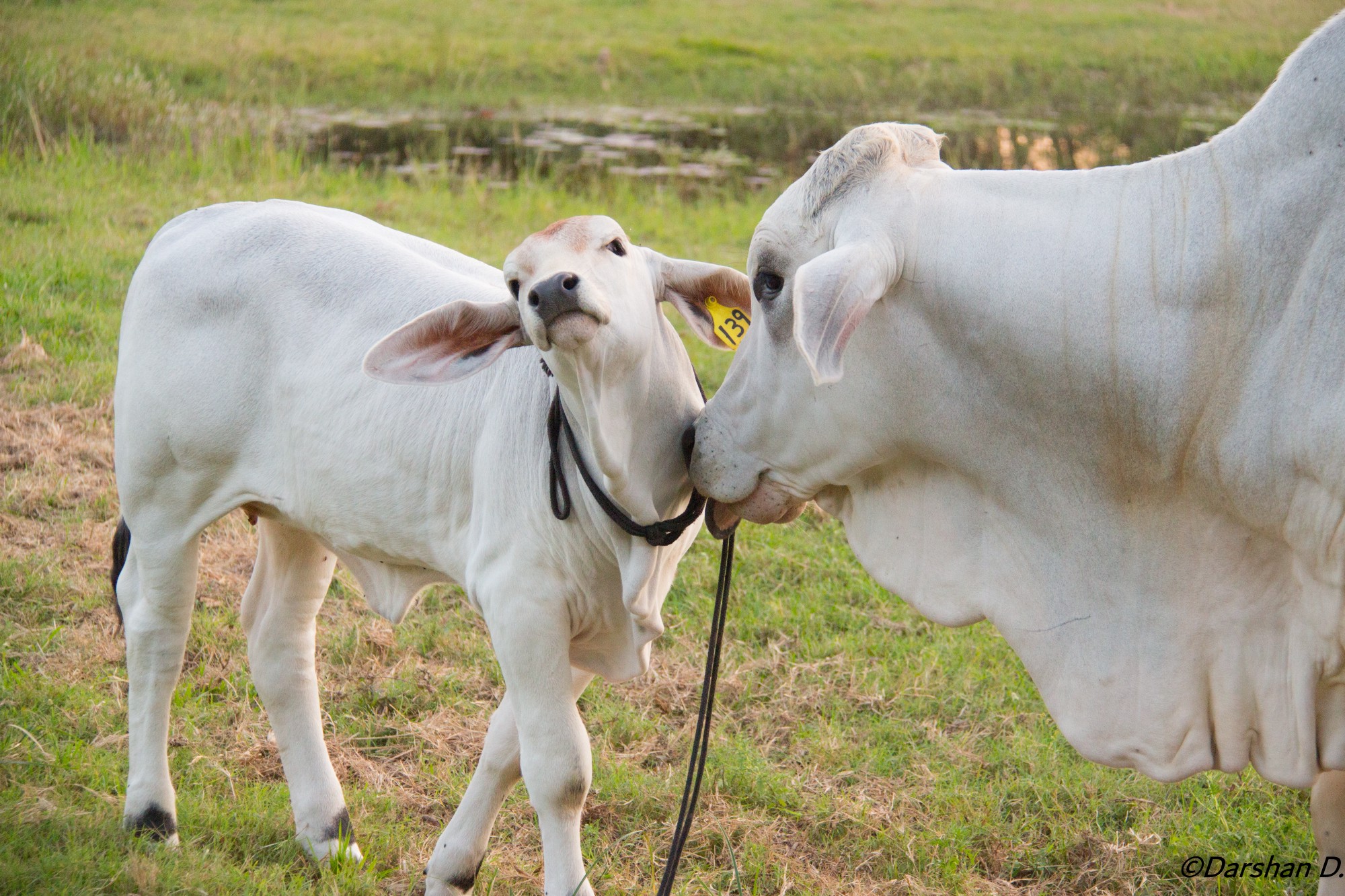
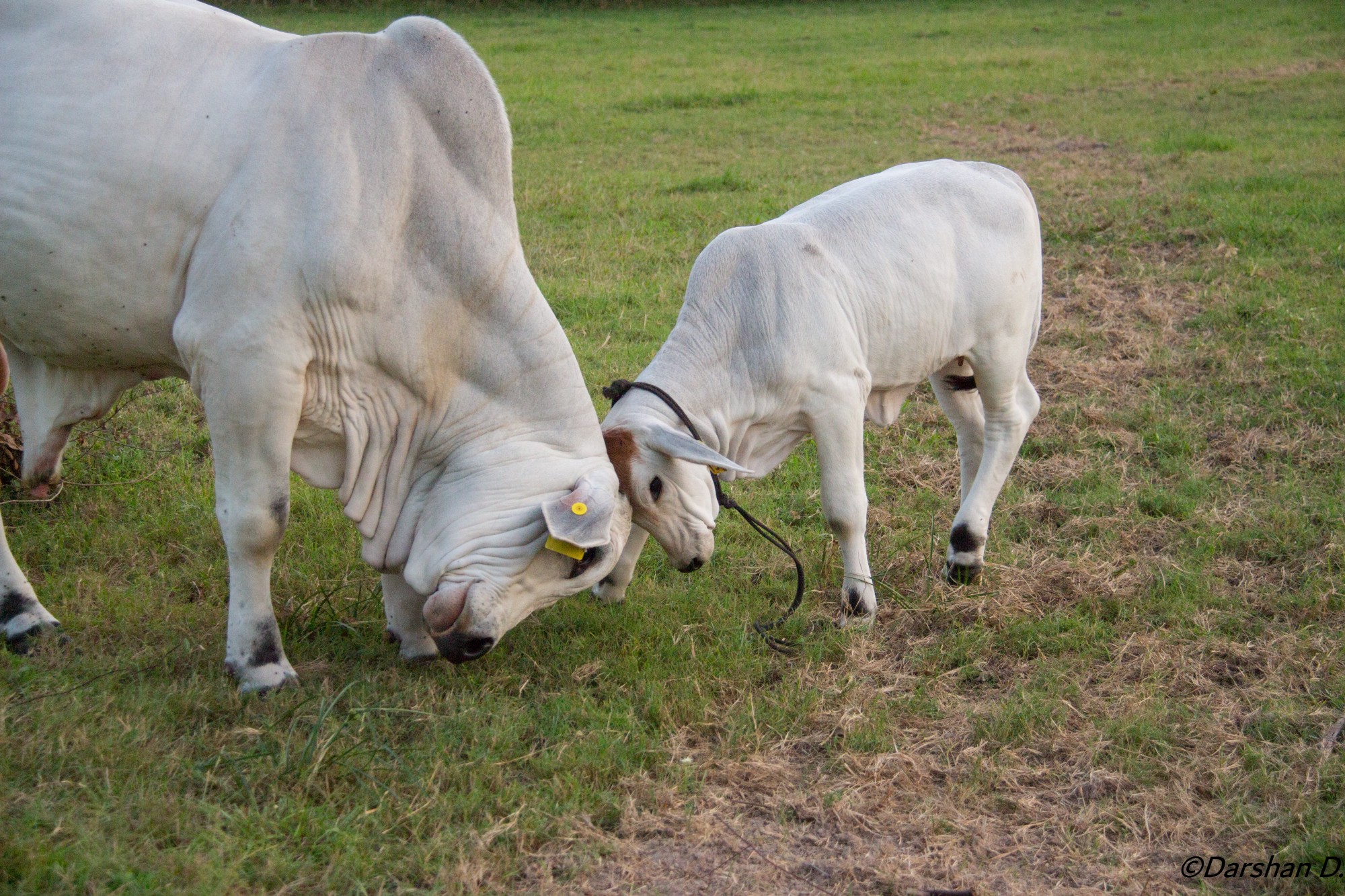
Gauri, her mother was possessive about her baby and would make aggressive gestures if anyone tried to touch her.
Photo: Darshan Dharmadhikari
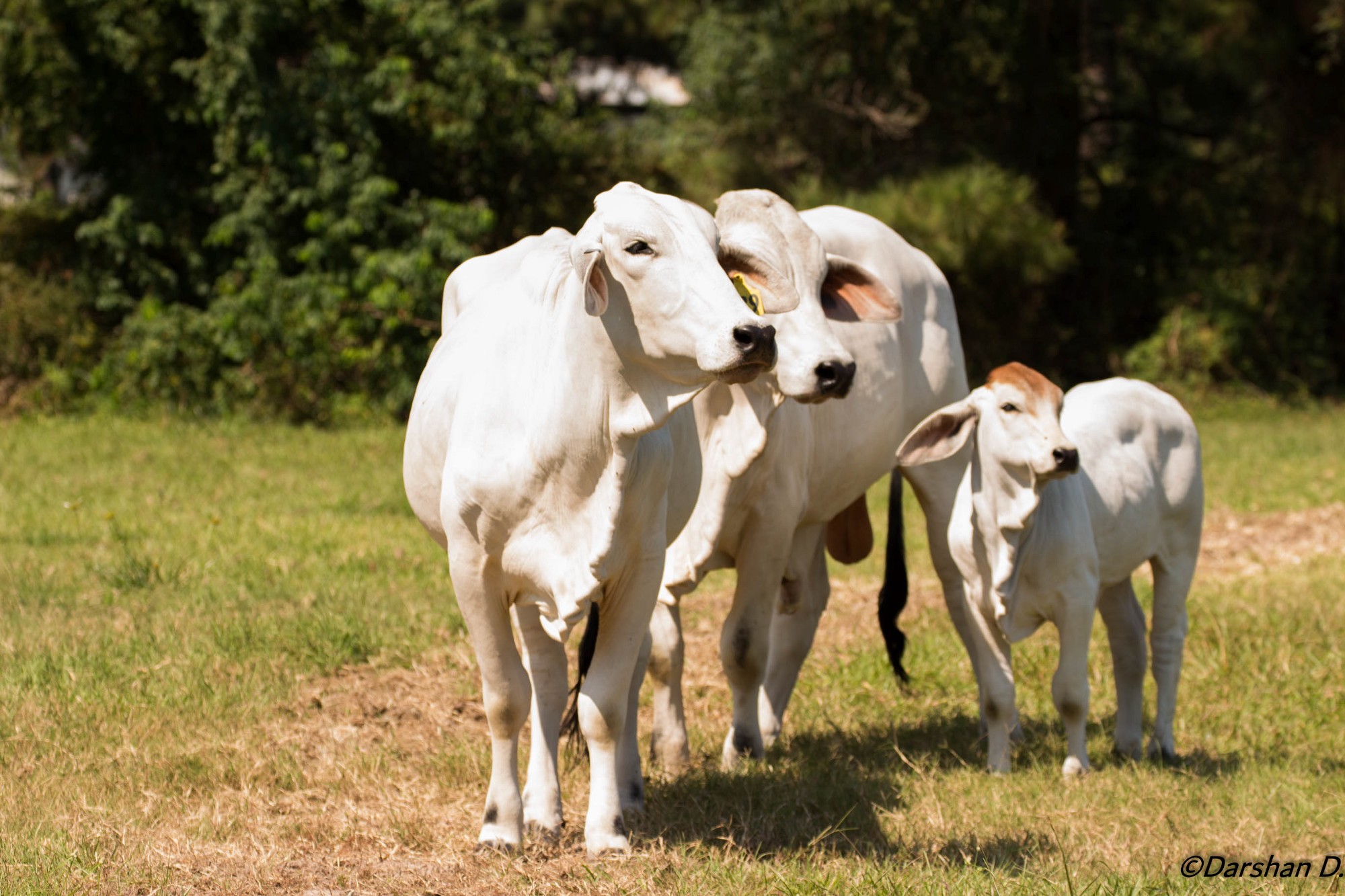
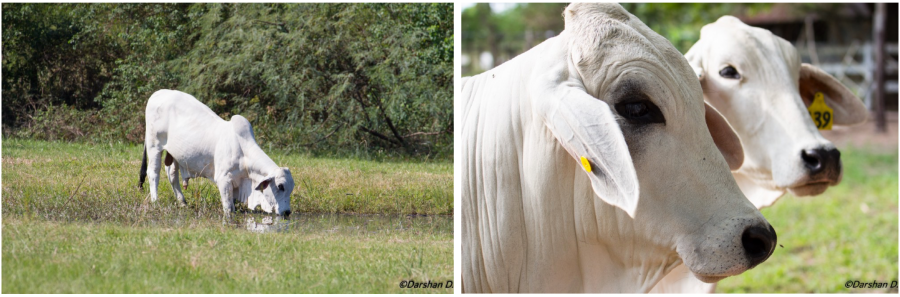
Chaitanya, the bull had a majestic look with piercing eyes that had a lining of dark black as if someone had applied kaajal (kohl) on them. All three were creamy-white in colour with the trademark folds of skin on the neck and stood out against the green landscape.
Photos: Darshan Dharmadhikari
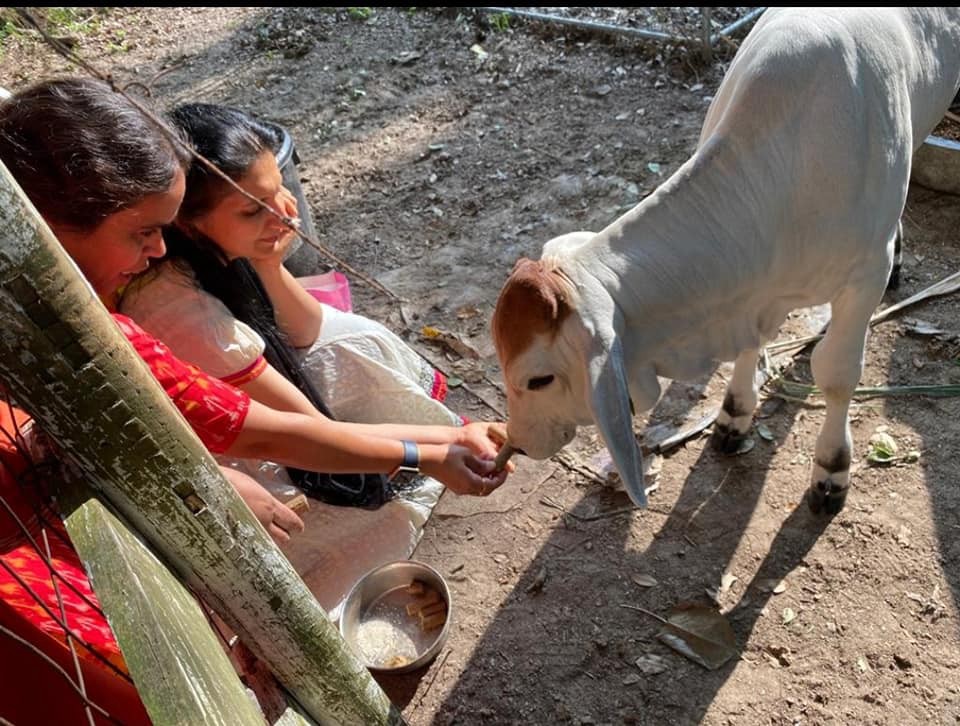
Pratibha did everything to please the animals — she tried to give them food that cows loved back home in India — jaggery, roti, daals and so on. But the Indian-American cows shunned Indian food! They prefered the store-bought cow feed that they were used to eating.
Even hard rock begins to wear out under the sheer perseverance of flowing water. Slowly and surely, the constant stream of affection showered by the Goswami family began to have an impact on the cattle. The calf was the first to become friendly and began to frequently come closer to the Goswami family members. The two adults also slowly overcame their distrust to sometimes take their feed right from the hands of their masters.
Photo: Darshan Dharmadhikari
And then a time came when they allowed even visitors to come close to them. Abhinav believes that if every Indian bought a cow and donated to a gaushala somewhere, there would be no cow-torture and cow-slaughter in America.
Texas Gaushala began to attract attention. Volunteers offered to come and help with various tasks in the farm and also bonded with the cows.
Soon Pratibha found herself managing several Whatsapp groups for volunteers. There was a great deal of cleaning to do in the barn. The soil had to be levelled for planting flowers and vegetables. Many wild shrubs and weeds had to be removed. It was arduous labour under the hot Texan sun. But everyone knew that it would lead to something amazing.
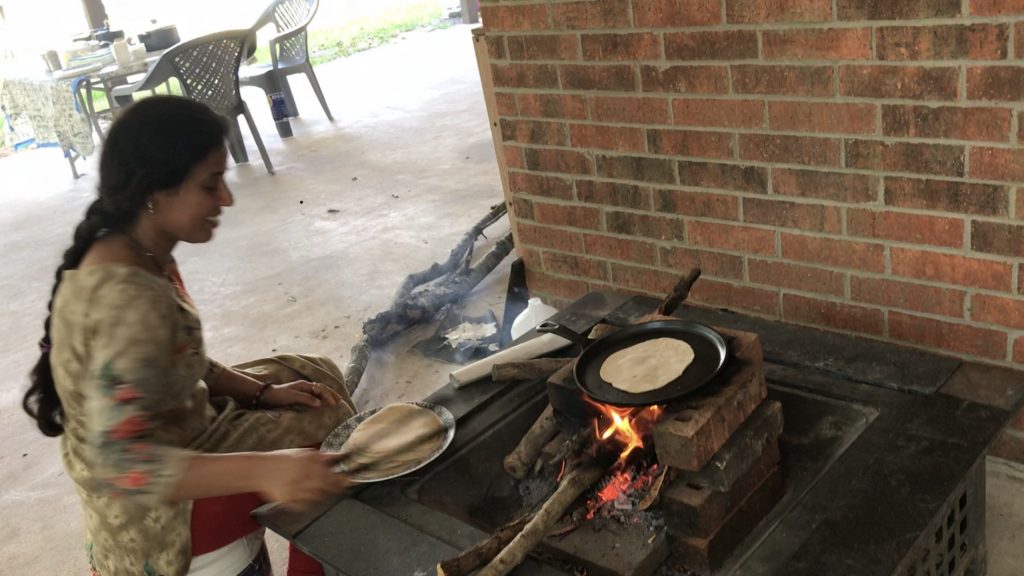
Abhinav set up a chulha (clay stove) behind the house where one could make roti (round flatbread) in Indian village style. Dry twigs, branches and even cow dung cakes were used as fuel. Friends and volunteers often dropped in during the weekends to have delicious Indian meals accompanied by the traditional rotis. It was a dream-come-true for Indians irrespective of which state of India they hailed from. When my husband and I were treated to the fresh, inflated rotis emerging from the chulha, and ate while gazing at the cows in the distance, we were transported to timeless India. I watched with astonishment when Abhinav walked away to give the first roti that came off the chulha to the cows. This was exactly what was prescribed in Hindu Shastras! Among the five Mahayajnas that householders have to perform is the Bhuta Yajna which involves the offering of food to animals, birds, insects and beings of the invisible world.
Meanwhile, two individuals, one in Russia and one in California (who happened to read my Medium article on Abhinav in January 2020) decided to donate one cow each to the gaushala. This time Abhinav selected two brown cows from the Sahiwal breed. They were named Asha and Kamala. The new cows made themselves comfortable faster than the first ones had, and soon they were all feeding and wandering together.
“They might be just five cows but I get the satisfaction that we saved them from slaughter,” said Pratibha.
The cows were still not being milked. Both Abhinav and Pratibha were unwavering in their decision to not use force. “Getting cow’s milk requires tapasya,” said Abhinav. “Until the cows willingly allow us to take their milk, we will wait,” he added. “And even when they get old, this is their home.”
But milk is just one of the gifts given by cows. Dried cow dung has been used as fuel, manure, an ingredient in Panchagavya (Ayurvedic formulation), pesticide, antibacterial cleaner and plaster for millennia in India. It is the stuff of folklore. Pratibha and her children lost no time in collecting cow dung and drying them into cakes of various sizes. It was hard work. Since the cows were free to walk all over the estate, they could drop their dung anywhere, which meant that collecting it involved a great deal of walking.
During one of my walks with Abhinav, he pointed out that wherever the cows had dropped their dung, the grass around it had grown in thick clusters. It was indeed true! There were clumps of grass sticking out in different parts of the meadow. Suddenly I remembered the thick grass clusters I had seen in childhood but never thought about the phenomenon. How oblivious we are of the subtle workings of nature.
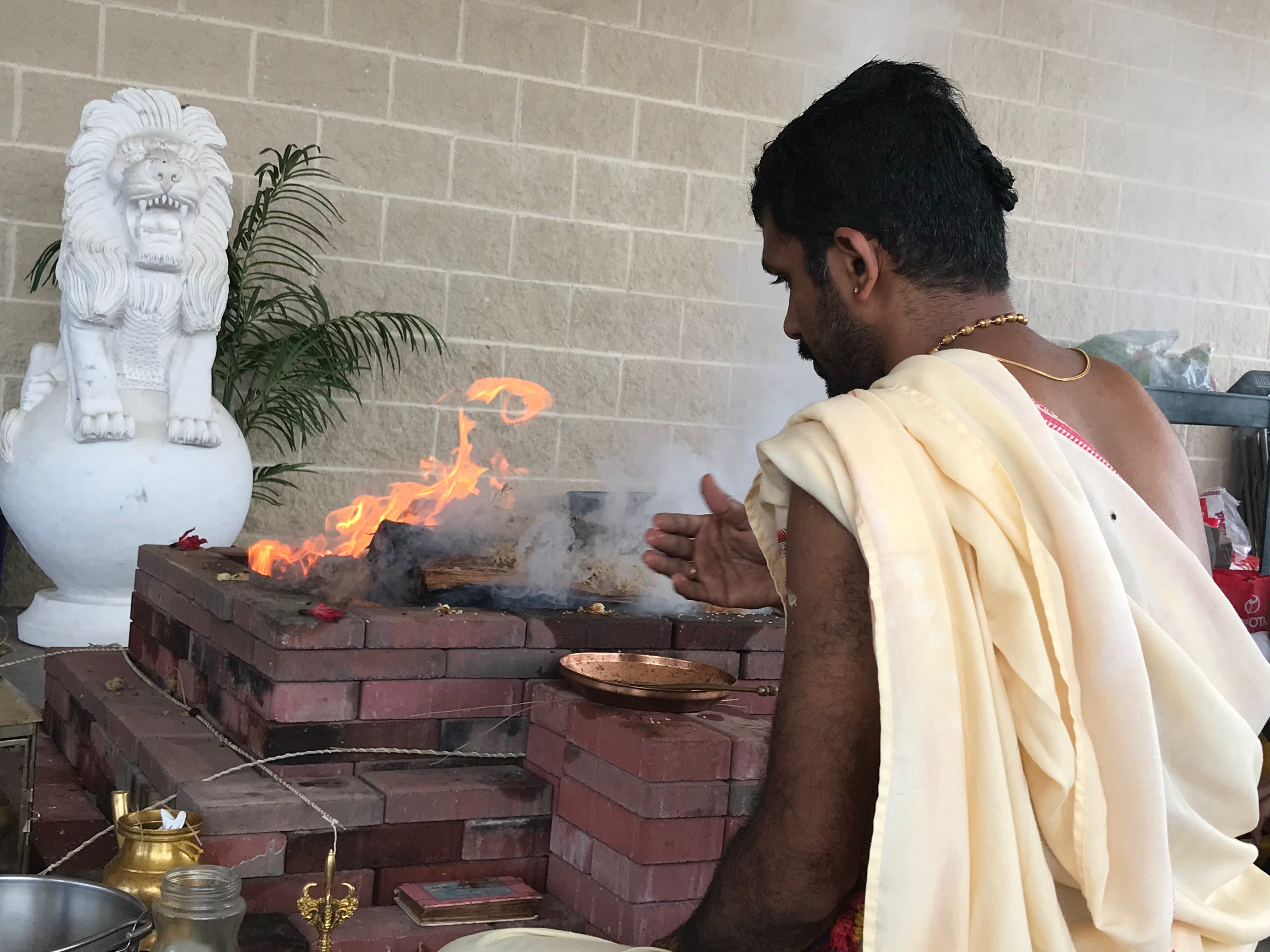
Once the flyers announcing the sale of cow dung cakes were circulated, many Hindus began placing orders to buy them from mid-October. Gomaya (cow dung) is considered very auspicious to use in yajna or fire ceremonies. During the Navaratri festival, many individuals and temples perform yajna. The Gomaya from Texas Gaushala was donated by many Hindus to temples.
“Until now, we were only using Gomaya substitutes in our yajnas; we are glad there is a gaushala now to supply us with real Gomaya,” said the priest of Sri Krishna Vrundavana, a Hindu temple in Houston. Orders began to come even from other parts of the US.
As more and more people learned about Texas Gaushala, Pratibha was flooded with calls from people who wished to drop in to see the cows, feed them, do seva for them, pick up cow dung cakes and so on. Some would drop in unannounced, even on weekdays which became rather inconvenient. Soon, Pratibha framed rules for visiting. Only weekends were kept open for visitors. She noticed that many loved to linger and did not feel like leaving.
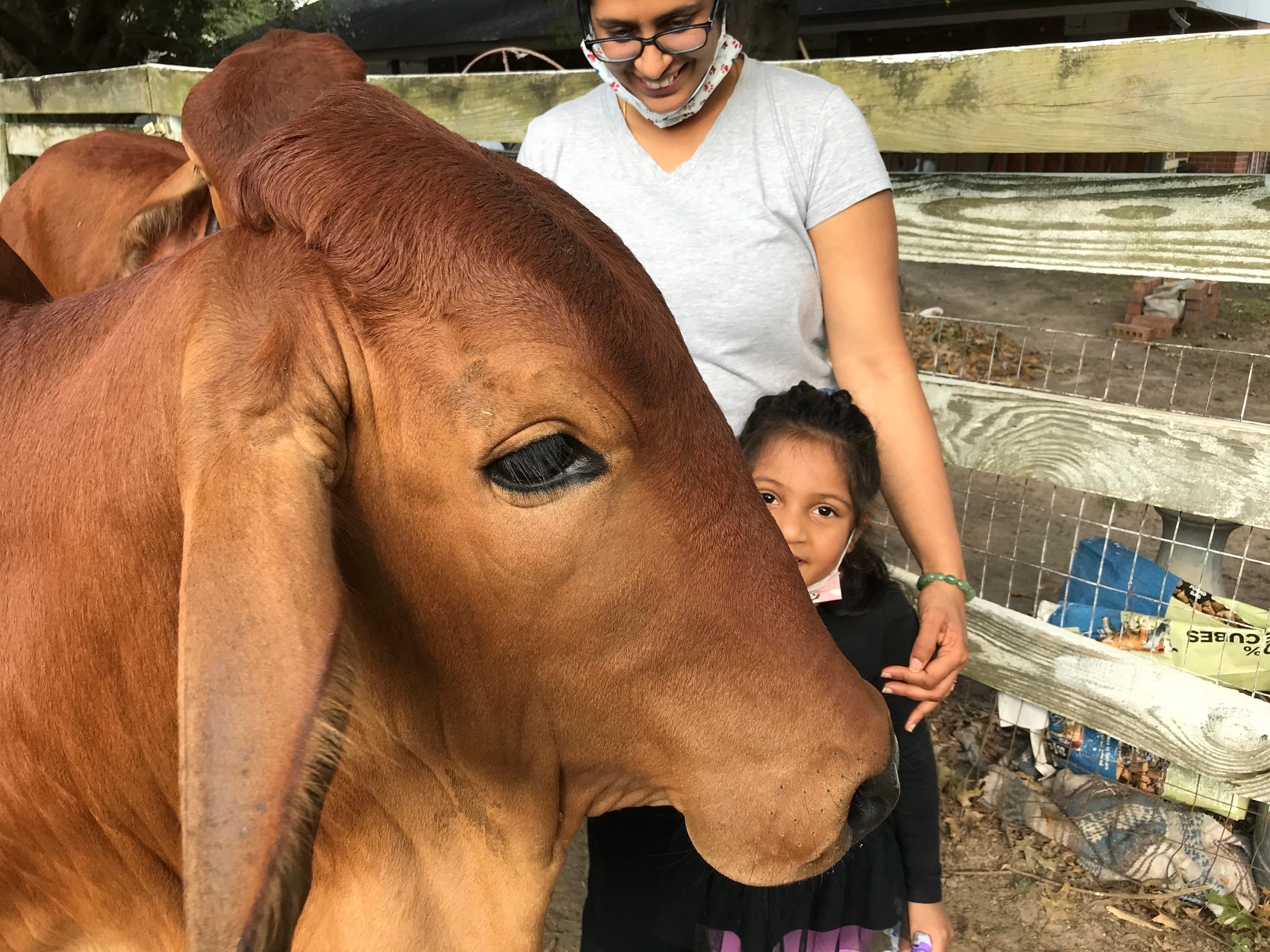
Perhaps the most touching sight was of urban children bonding with cows — children who knew nothing about Gau Mata or what she symbolized — they instinctively touched and reacted with joy.
Meanwhile, some donors came forward to propose the idea of building a Pitru Dham at the extreme corner of the estate. Making specific food offerings to one’s departed parents, grandparents, great-grandparents and other ancestors and following other pitru rituals are considered extremely important in Vedic society. Elaborate pitru rituals are performed every year by millions of Hindus. Pitru yajna is one of the five Mahayajnas that householders have been prescribed. The others are Rishi Yajna, Deva Yajna, Bhuta Yajna and Manushya Yajna. Bhuta Yajna, the offering to animals was mentioned earlier in this article.
However, living in America, it is extremely hard to maintain authenticity in the rituals. This is because the food offerings have to also be made to the ancestors through the medium of creatures such as cows, birds, dogs, and even fish. Despite the many Hindu temples found in America today, one cannot find the actual ambience needed to perform Pitru rituals. But in Texas Gaushala, the cows are already there. Birdhouses will soon attract birds. The lily pond will have fish and ducks. If things go as per plan, Texas Gaushala will be a trendsetter with its facilities for performing an ancient ritual with deep significance.
A small open-air theatre cum classroom is also being built near the grazing land of the gaushala in which discourses on Bhagvad Gita, Bhagwat Purana and various other Dharmic subjects can be held. I am hoping that classical music concerts will also be staged. What if Shri Hari Prasad Chaurasia ji himself played the flute here and the cows came closer to listen— my mind began to paint a picture of paradise. There are plans to build a number of huts in which families can come to spend a Vedic weekend at the gaushala. As the demand grows, more land can perhaps be purchased around the estate.
Among the many people who wrote in response to my article on Abhinav in January was Ryan F Beylikjian, an ex-coastguard who was studying Regenerative Organic Agriculture at the Maharishi International University Fairfield, Iowa. He wished to spend three months at the Gaushala and complete one of the practical components of his course. Abhinav informed him that he did not have facilities for lodging. But for Ryan with his mobile trailer, that was no problem. He drove from Ohio right to the Gaushala and began to live in a tent on the estate with an additional room in the barn to keep his belongings. The Goswami family generously shared meals with him and let him use their facilities at home for a month before other arrangements could be made.
Abhinav bought a tractor to till the land. When the tractor was delivered, a puja was performed on the vehicle in typical Hindu fashion. After all, tools, instruments and vehicles are treated as sacred objects by traditional Hindus.
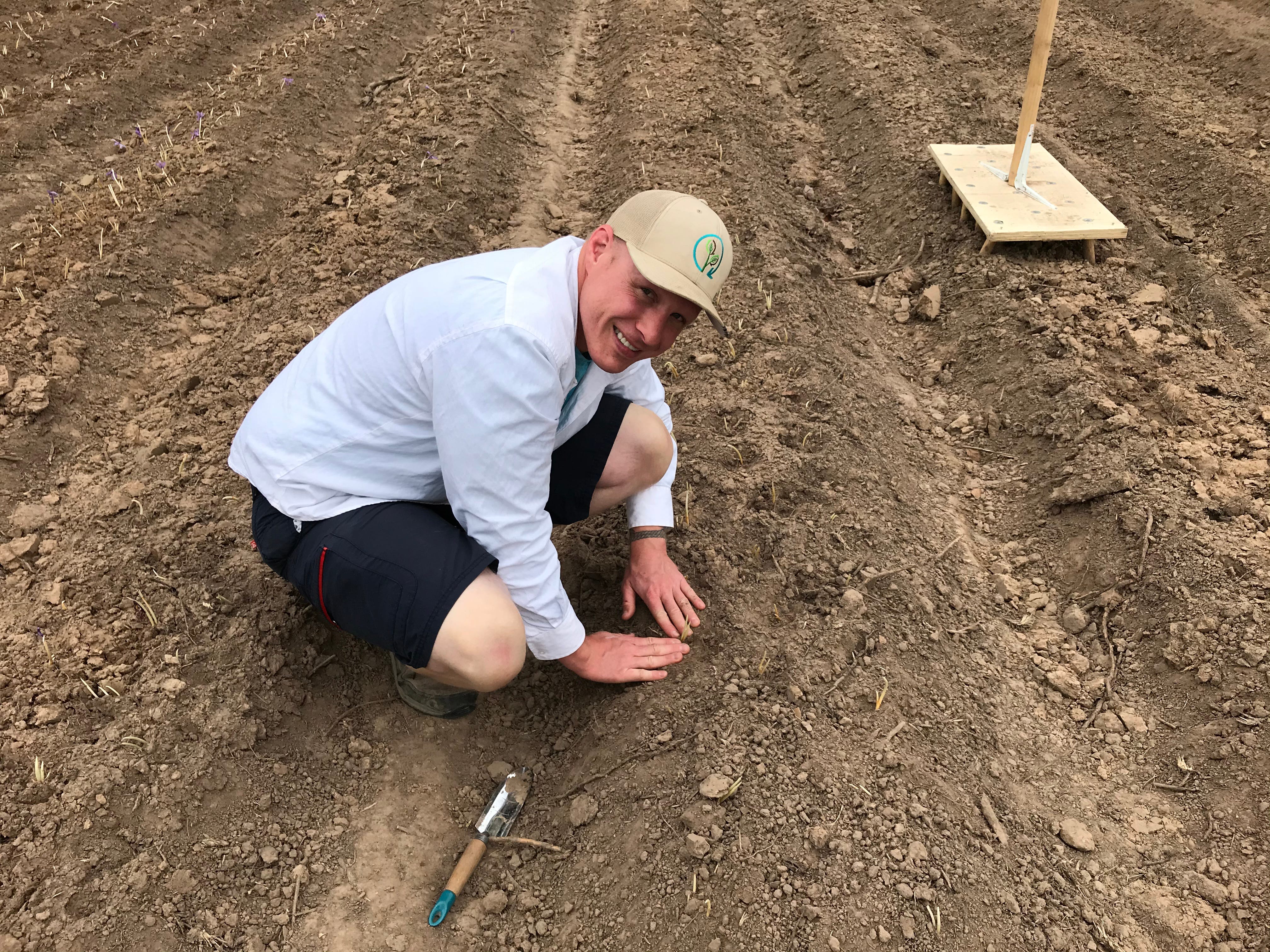
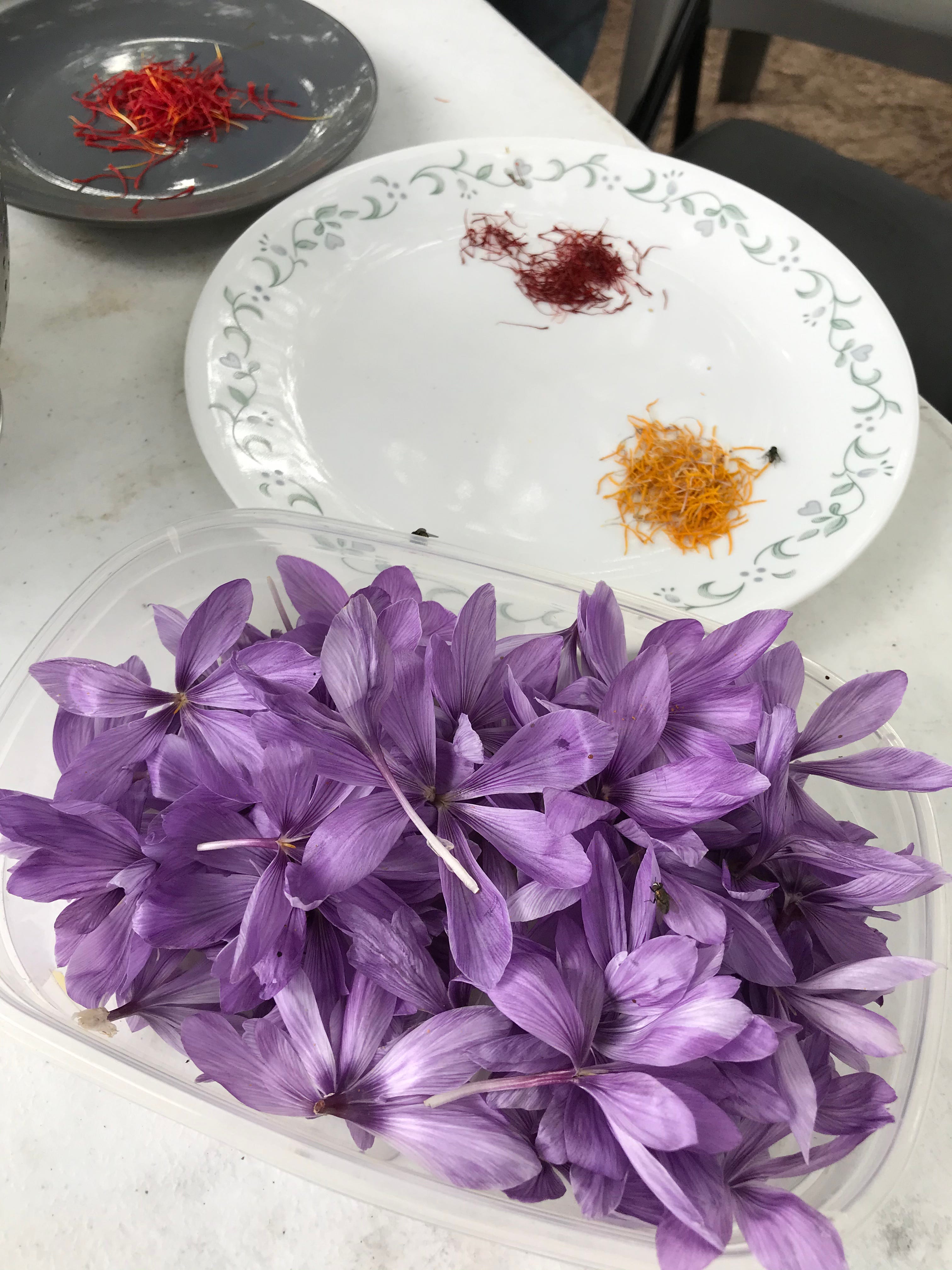
With Ryan’s help, Abhinav embarked on his project of growing selected crops in one part of the estate. He decided to experiment with saffron which is the world’s most expensive spice and is also an important ingredient in Ayurvedic formulations. Extraneous shrubs and foliage were first removed from the selected area. Rows of beds were laid out and holes were punched into the soil with the help of volunteers.
Photo: Darshan Dharmadhikari
Fed up with the single-hole dibblers in the market, Ryan did some improvisation and built a multi-dibbler which could quickly punch 15 holes at one time for planting the saffron bulbs. He and Abhinav engaged in many discussions on sowing practices and Ryan keenly documented Abhinav’s techniques.
To everyone’s astonishment, the saffron grew quickly and could be harvested within a week’s time. The possibilities seemed to be endless.
The festival of lights — Deepavali was approaching. Pratibha began to make diyas (lamps) out of Panchagavya. The lamps sold out in no time.
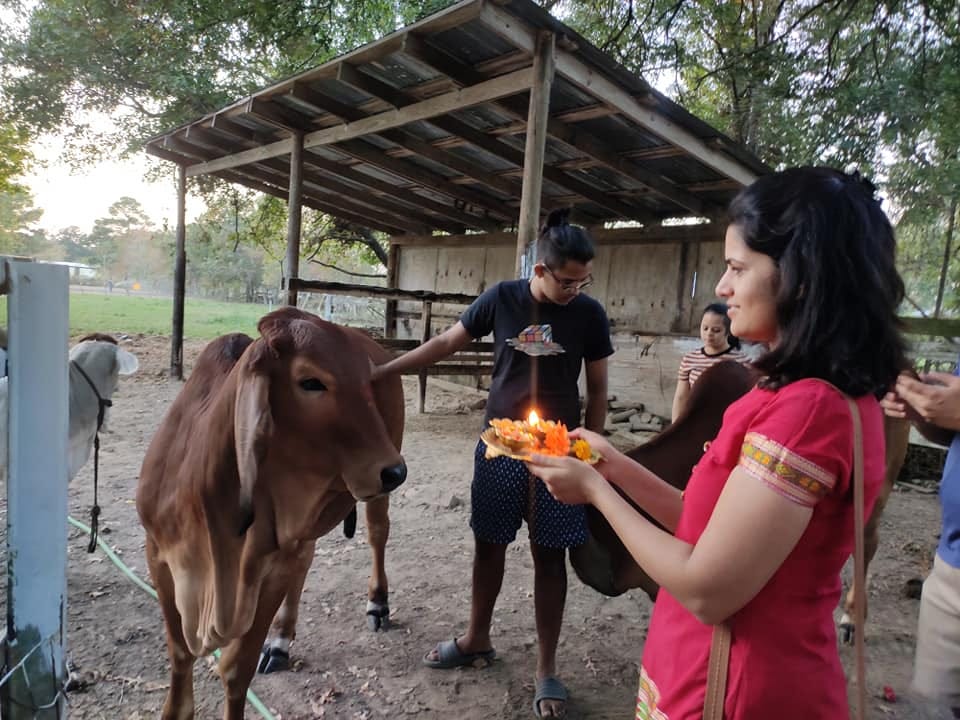
On the first day of Deepavali, many families landed up at Texas Gaushala in order to perform Gau Pooja. This is a ritual in which cows are honoured as givers of many life-giving gifts — as mothers and nurturers. In ancient times, cows were regarded as wealth. Even possessing just one cow was enough to sustain a family and be free of disease.
It was now time for the grandest festival that the Goswamis liked to celebrate — the Govardhan Puja which comes every year on the fourth day of Deepavali. It is associated with Bhagwan Krishna who lifts up the Govardhan mountain in order to shelter his devotees from torrential rain. In India, the festival comes at a time when winter is about to step in; there’s usually a nip in the air. The markets overflow with both summer and winter vegetables; thus the bhog prepared to offer to Krishna consists of mostly vegetable dishes typically 56 dishes (chhapan bhog).
I had only heard about the Govardhan Puja but never witnessed one so it was with great excitement that I shopped for vegetables to prepare the bhog I would offer. Eventually I used eleven different vegetables to prepare the dish. Onions and garlic were, of course, a no-no as they were disallowed in bhog. I prayed it would turn out right because I had not tasted it while cooking as per bhog rules.
People turned up in good numbers at Texas Gaushala to celebrate the festival, each bringing a bhog dish which ultimately added up to more than a hundred dishes! Volunteers had created an elaborate Krishna out of cow dung as per tradition and they decorated it with colours and a variety of accessories. The atmosphere was like nothing I had experienced before. It was like India but not like India. It felt familiar but yet so new!
The puja was performed by a Narayan, a volunteer who doubled up as priest.
The parikrama was led by the oldest person present while Abhinav sang traditional songs. Most people present were unfamiliar with the songs native to Vrindavan and Mathura. Perhaps, the coming years will create an interest in learning folk songs.
Abhinav has also received enquiries from a psychologist who wishes to experiment with cow therapy. In recent times there has been much focus on therapeutic contact with animals such as horses, goats, dogs, cats and dolphins. In October, BBC carried a new piece mulling on cow hugging as a new wellness trend. People reported benefits from leaning against cows, giving them a rub, hugging them and even getting licked by them. But the spiritual presence of cows has been known to Indians for millennia. In the ancient gurukulas of India where students lived in the ashrams with their gurus, one of their tasks was to tend to cows. Spending time with cows gave them deep spiritual insights. Even today, the gurukulas in India often have an attached gaushala where the children frolic with cows.
Vaidika Bharata Gurukula in Uttar Pradesh
It all begins with a cow according to Abhinav. “We tend to think that for the Vedic ecosystem to revive, we need to teach our children Sanskrit, teach them the Vedas, teach them shlokas, take them to temples, and conduct various ceremonies but actually, all you need is a cow,” he explained. “Other things follow naturally and before you know you it, you are a part of a Vedic ecosystem.”
It all begins with a cow according to Abhinav. “We tend to think that for the Vedic ecosystem to revive, we need to teach our children Sanskrit, teach them the Vedas, teach them shlokas, take them to temples, and conduct various ceremonies but actually, all you need is a cow,” he explained. “Other things follow naturally and before you know you it, you are a part of a Vedic ecosystem.”
All his life, Abhinav wanted to wake up at the holy hour of Brahma Muhurta but his busy working lifestyle did not allow him to do that. Yet, when he started his first gaushala in Aligarh, his eyes would miraculously open at the holy hour without even trying. And like magic, things started happening — it was if the cow was pulling together those same invisible strands that had once made India into a spiritual, cultural and economic powerhouse.
“You are creating something big,” I told Abhinav. “You’ve no idea of the enormity of what you are doing. You are connecting everyone to Gau Mata, to soil, to Yoga, to Mahayajnas, to knowledge, to the world’s most ancient civilization…and all in America!”
“But I am not the doer! I am just the instrument! It is Krishna. He lights up the path for me and I just walk on it. I meet people. Things happen. When did I ever do anything?”
This article was first published on Medium and has been reproduced here with the author’s consent
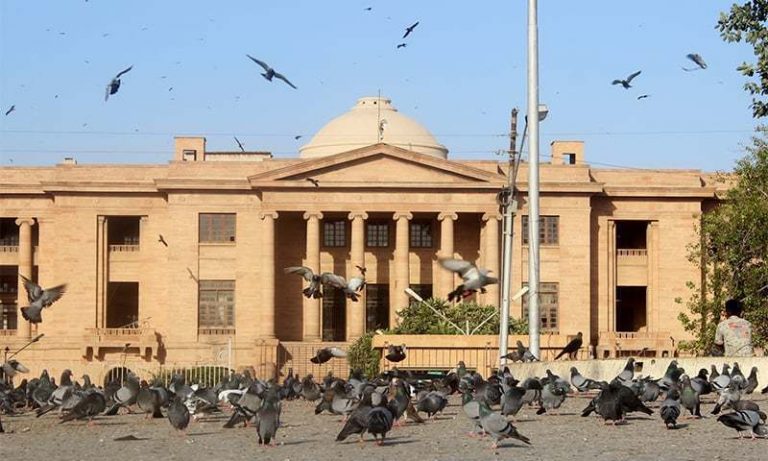
The Pakistan High Court which had earlier, in a shocking decision, granted custody of 13-year-old Christian girl named Arzoo, who was kidnapped, raped and converted to Islam, to her 44-year-old abductor Ali Azhar, has now again ruled in favour of her perpetrator.
Ruling out the rape angle from the case, the Pakistan HC dismissed the case and granted relief to the culprit. Arzoo has been sent to a women shelter home where the Pakistani court said she could live until she turns 18. Pakistani activist Rahat Austin took to Twitter to share the court ruling.
Arzoo a 13-year-old Christian girl abducted, raped, married off to a 44-year old Muslim man. Today in Sindh High court, case dismissed, she is sent to women shelter where court says she can live till she is 18-year-old. All culprits are released as Judge said its not a rape case pic.twitter.com/HiVd52UcCE
Court grants custody of 13-year-old Christian girl to her abductor
On October 30 we reported that the Pakistan court has granted the custody of a 13-year-old girl Christian girl to her 44-year-old abductor, Ali Azhar. The minor girl was kidnapped from her residence in Karachi’s Railway Colony on October 13. She was then forced to convert to Islam and marry her abductor.
Journalist Bilal Farooqi had uploaded the birth certificate of the abducted girl, issued by the Sindh government, wherein the date of birth is mentioned as July 31, 2007. Despite evidence that the victim is a minor, the Court had directed the abductor to keep the minor girl based on an affidavit signed by her under duress.
Moreover, the Sindh High Court had directed the SHO (Station House Officer) to not make any arrest and instead provide protection to the forcefully married couple, to prevent harassment.
Earlier, Ali Azhar had provided a fake marriage certificate, which stated that the girl was 18 years old and not a minor.
The girl’s mother, Rita, had earlier made an emotional appeal to rescue her daughter from the clutches of Ali Azhar who was allegedly threatening Arzoo’s family following the minor’s abduction.
According to reports, several Christians and social activists had staged a protest outside the Karachi Press Club on October 24, demanding the enforcement of the Sindh Child Marriage Restraint Act.
It is pertinent to point out that the Sindh provincial Assembly had enacted the Sindh Child Marriage Restraint Act in 2014, thereby barring child marriage and imposing a punishment of up to 3 years for the adult men.
Atrocities against minorities in Pakistan continuing with impunity
Abductions, forced conversions and forced marriages of girls and women from the minorities background has become a serious concern in Pakistan. Prime Minister Imran Khan has often assured that Pakistan will take strict against anyone targeting minorities, but this practice has continued for years with impunity.
Earlier this year, India had lodged a strong protest over the abduction of minor girls belonging to the minority Hindu, Sikh and other communities of Pakistan. This action was taken by Govt of India after two consecutive cases of abductions of minor Hindu girls in Pakistan were reported. According to reports, two Hindu girls named Shanti Meghwad and Sarmi Meghwad were abducted in Pakistan on January 14. The girls are residents of Umar Village, Tharparkar, Sindh, Pakistan. On the next day, another Hindu minor girl named Mehak Kumari was abducted from the Jacobabad district of Sindh province in the country.
Later, radical Islamists and clerics in Pakistan had demanded the beheading of Mehak Kumari, who was abducted, converted to Islam and forcibly married to a Muslim man, for leaving Islam. In a video which then went viral on Twitter, few radical Islamists and clerics of Pakistan were heard blaming 14-year-old Mehak of murtad, or an act of Apostasy, and are demanding death punishment, accusing her of insulting Islam.
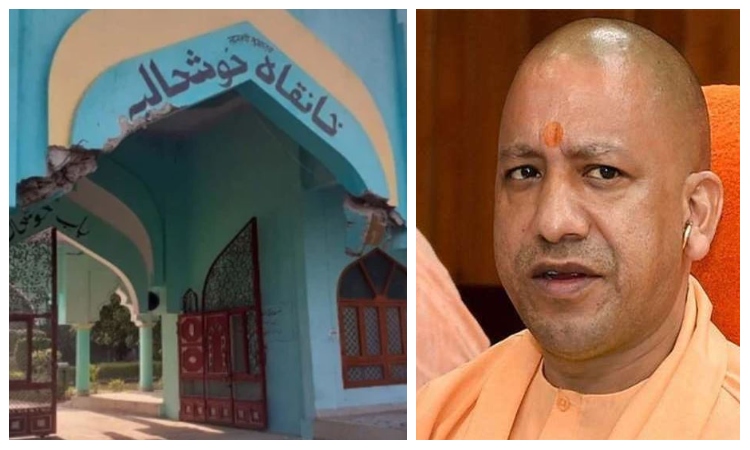
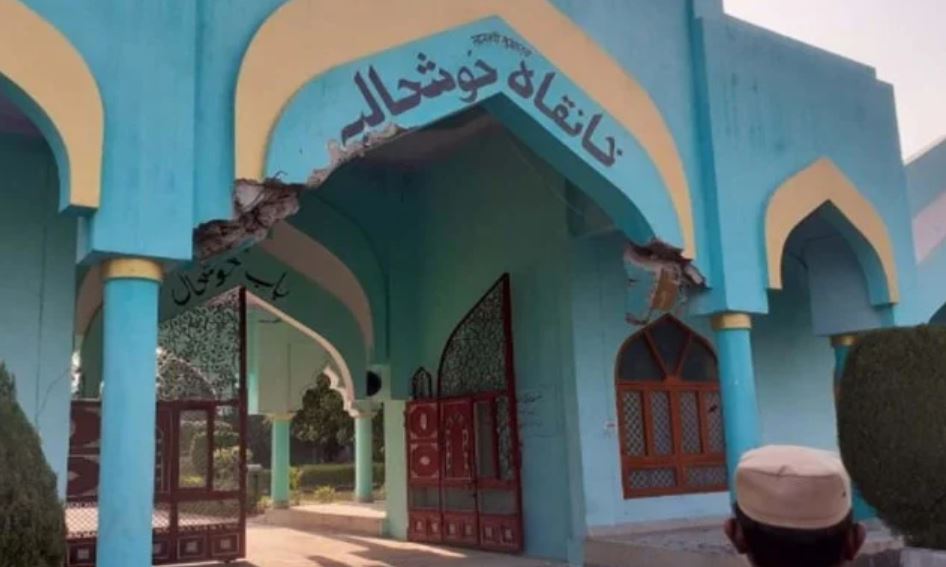
In an operation against illegal encroachment on Government land, the Yogi Adityanath Government has begun the work of demolishing illegal construction on 100 Bighas of Forest Department land by one ‘Pir Khushal Miyan’, located in Bihargarh village falling under the jurisdiction of Bhopa police station, Muzaffarnagar in Uttar Pradesh.
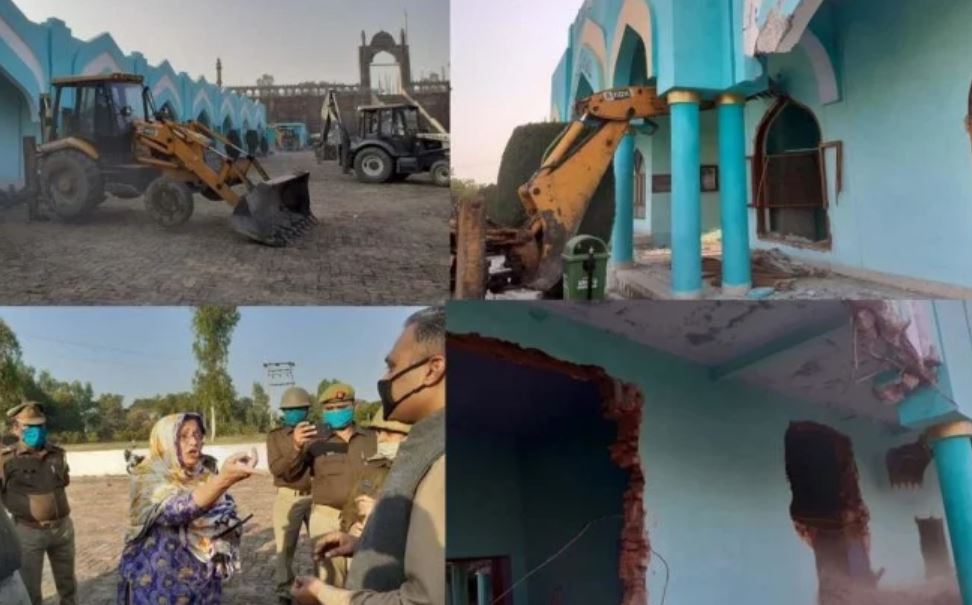
Apart from the mosque and a shrine dedicated to late Pir Khushal Miyan, the authorities have so far demolished the complex houses, a Chillahgah (prayer house) and around 50 rooms of a lavish residential complex of the Islamic preacher’s family. The demolition drive began on November 11 (Wednesday).
The preacher had built fort like structures, with dozens of rooms and halls on the forest department land.
According to reports, the structure was constructed by Pir Khushal in a reserved forest area and was declared illegal by the forest department. On this forest department land, this Pir of Pakistani-origin had built a mosque surrounded by a fort-like structure with almost 400 rooms. Pir Khushal, who died in the year 2017, came to India in 1964 from Pakistan and acquired 100 bighas of land near one of the most revered ancient Hindu religious sites- Shuk Teerth or the Shukratal in Muzaffarnagar on lease. The lease expired in 2016. The forest department then issued a notice to the family living in the complex asking them to vacate but they refused.
The property constructed by Pir Khushal on 100 bighas of Forest Dept land being razed by UP Govt, image source: Amar Uajala
The administration sprung into action after a letter written by Union Minister of State Dr Sanjeev Balyan to the DM ordered the authorities to get the land belonging to the Forest Department vacated at the earliest. Accordingly, the forest department issued a notice to Pir Khushal’s family to vacate the land. Even after the notice, when the land was not vacated, the administration started the demolition process on November 11.
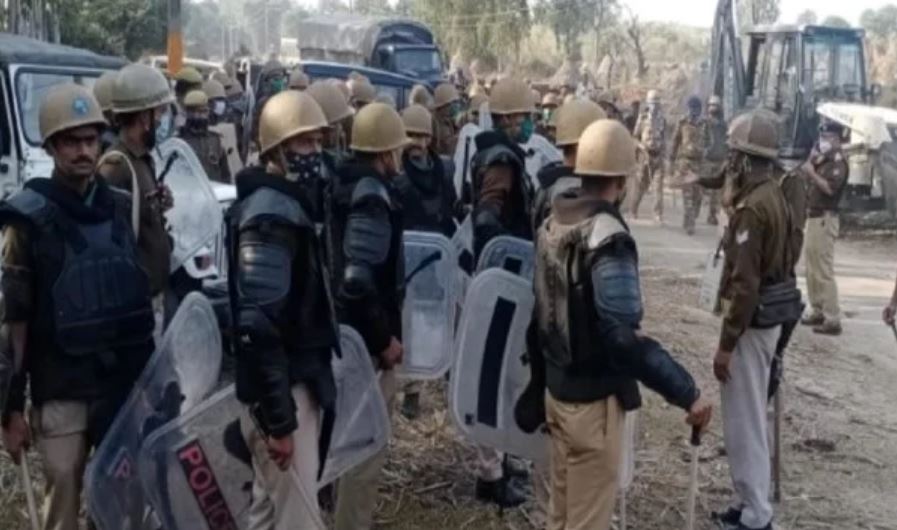
As per a report by the Hindi daily Amar Ujala, on November 11, ADM administration Amit Singh, DFO Suraj Kumar, SP Dehat Nepal Singh RAF, PAC, along with police from Kakrauli, Janasath and Meerapur police station reached the Chillagah in Bihargarh at around 2 pm.
Source: Amar Ujala
Though the officials cited the completion of lease time given by the Forest Department and the order of the High Court saying that the construction was done illegally, Khushal’s wife Nazia Afridi opposed the demolition.
Source: Amar Ujala
UP police book the wife of late Pir Khushal Miyan and two others for occupying a forest land illegally
Apart from carrying out the demolition process, the authorities have also registered a case against three for allegedly occupying a forest land illegally. The case was registered against the widow of the late Sufi preacher Khushal Miyan and two others at Bhopa police station on November 19 (Thursday), PTI reported.
Pir Khushal Miyan carried out illegal fuel trade under the then SP and BSP governments
According to reports, Pir Khushal Miyan rose to fame in Uttar Pradesh during Bahujan Samaj Party chief Mayawati’s regime. May influential politicians, as well as government officials, visited the Pakistani preacher regularly. People from many Islamic countries also used to visit him during odd hours, which raised suspicions about his manoeuvres. He is also known as ‘Kala Badshah’ among his followers.
In March 2009, CBI had arrested Pir Khushal and his wife from Ghaziabad under the violation of FEMA, but no action was taken against him. Some reports claim that Pir Khushal, who was politically well connected carried out illegal fuel trade from within his fort. Local villagers narrate how truckloads of LPG gas cylinders and at least 3 to 4 tanker trucks carrying diesel were transported in and out of Khushal’s property every month. However, under the then Samajwadi Party and Bahujan Samajwadi Party rule, Khushal remained safeguarded.
Yogi Adityanath Govt tightening its noose on land-mafia
Now, in its effort to curb against the menace of land mafia in Uttar Pradesh, the Yogi Adityanath government has been tightening its noose on such encroachers. Besides launching an anti-land mafia portal in 2017, where people of the state can file their complaints against any illegal occupation in lands belonging to any private or government institutes and setting up of anti-land mafia task force to check illegal land grabbing in the state, Yogi Govt also identified more than 1.5 lakh people who have encroached upon government land.
It has been carrying out demolition drives on the property acquired illegally by many influential persons in the state including people like Samajwadi Party leader Azam Khan and dreaded gangster-turned-politician Mukhtar Ansari. The UP government had also bulldozed illegal constructions done by gangster Vikas Dubey.