Home Blog Page 4849

AAP govt’s u-turns are back, on odd days, COVID-19 is past its peak in Delhi, on even days, CM wants to lockdown markets

Aam Aadmi Party supremo and Delhi CM Arvind Kejriwal is back to doing what he has mastered for so many years. A day after the Delhi Health minister assured that the third wave of Covid-19 has passed its peak in the national capital and there is no need for a lockdown, Arvind Kejriwal takes a complete u-turn seeking Centre’s nod to impose lockdown in Covid hotspots markets in Delhi.

Arvind Kejriwal demands imposing lockdown in Delhi

According to reports, the Arvind Kejriwal-led government will send a fresh proposal to the Centre seeking its permission to impose lockdown across market areas to control the rising coronavirus cases. “Will send a proposal to the central government for permission to close markets if crowds don’t decrease as the shopping areas have the potential of becoming Covid-19 hotspots,” the chief minister said on Tuesday. 

He also informed that the government has sent a proposal to L-G wherein it has recommended that only 50 people be allowed to attend wedding functions. The earlier limit was 200.

Delhi health minister claims no need for imposing lockdown

This statement from the CM comes as a surprise as only yesterday, Delhi Health Minister Satyendar Jain had remarked that the Delhi government has no plans to reimpose lockdown since the third wave of coronavirus has already peaked out in the city.

Talking to reporters, he said the virus cannot be contained through a lockdown and that people should protect themselves by wearing face masks. Asked whether lockdown would be reimposed in Delhi, Jain said, “No chance.”

“I can tell you that the peak of the third wave is gone,” he added.

This is when Delhi has been witnessing a spurt in coronavirus cases since October 28 when the daily rise breached the 5,000-mark for the first time and crossed the 8,000-mark. Though the city has reported lower numbers in the last two days, this is being attributed to a decrease in the number of testing. However, Delhi remains the highest contributor to India’s Covid-19 caseload.

Amit Shah once again steps in to help Delhi emerge from the Covid-19 mess

As was the case in the month of August, when the Delhi government had been blaming the ‘outsiders’ for the rise in the number of Coronavirus cases and Amit Shah had to step in to pull out the Kejriwal government from the mess, this time too, the central government stepped in and announced a slew of measures including arranging 300 additional ICU beds, doubling the RTPCR tests daily, and a house-to-house survey to check the rising cases in the national capital.  

Union Home Minister Amit Shah stated that some of the hospitals under the municipal corporations will be converted into dedicated COVID hospitals. Also, doctors and paramedical staff have been called in to increase the manpower. According to the MHA, around 75 paramilitary doctors and some 250 paramedics have already arrived in the city from Gujarat, Rajasthan, Madhya Pradesh, and other states.

Arvind Kejriwal government again blames ‘outsiders’

Interestingly, instead of doing something concrete to control the pandemic, the Arvind Kejriwal led government has always made bizarre excuses to justify their inadequacy in handling the situation in the city. Blaming outsiders for the drastic increase in the number of coronavirus cases in the city seems to be a popular excuse. Yesterday too, health minister Satyendar Jain stated to media that Delhi is recording more number of positive cases because ‘outsiders’ have been getting their tests done in Delhi. Jain claimed that 25-30% cases in Delhi are because people who are not residents of the city are getting their tests done here and the government cannot refuse them.

Bihar Assembly does not have a single Muslim MLA from ruling alliance for the first time since independence. Here is why

With the Bihar Assembly elections done and dusted, resulting in yet another victory for the NDA and a stinging defeat for the Mahagathbandhan, disgruntled propagandists are already weaving a spurious narrative to discredit the hard-fought victory by the JDU, BJP and other affiliate parties of the NDA and casting a pall on their triumph.

Many of the so-called intellectuals who wished to see the “secular” Mahagathabandhan alliance of the Congress party, RJD and others to win, are having a hard time fathoming the unpleasant reality. After running a polarising campaign against the JDU and BJP in the run-up to the Bihar elections, demonising PM Modi, BJP and JDU as anti-Muslims, they have now resorted to passing the buck on the winning coalition for not having a single MLA from the Muslim community.

“Bihar has for the first time since Independence got a ruling coalition without a single MLA from its largest minority community,” tweeted Arfa Khanum Sherwani, a journalist with the leftist online rag ‘The Wire’. Sherwani shared a report from ‘The Telegraph’ that attempted to cast the NDA alliance as ‘anti-Muslim’ for not getting a single Muslim MLA to the Bihar Vidhan Sabha.

Several other left-leaning “intellectuals” and pliant media portals, too, have toed this line to continue their demonisation of the BJP and its allied parties as against the interests of Muslims. This line of thought jibes with their larger propaganda that BJP is working assiduously to disenfranchise the Muslims of the country.

This is naturally done to trigger a fear psychosis among the Muslims of the country so that they can be mobilised to vote en masse against the BJP and its allies. The same methods were tried when the BJP abolished Article 370 in Jammu and Kashmir and when it passed the Citzishenship Amendment Act last year. A concerted attempt has been made by the leftists to portray the BJP as a party that is antithetical to the Muslims. By doing so, they are trying to salvage their preferred parties—Congress and other leftist parties—who have been shunted to the fringes of the Indian political landscape.

However, while the media organisations and leftist ideologues pin the blame of the zero Muslim representation in Bihar Assembly elections on the JDU-BJP alliance, it is worth noting if there are any merits to the arguments made here or they are just strawman arguments put forth to conceal the stark truth.

On the surface, it does appear true that not a single Muslim MLA from the winning coalition has made it to the Vidhan Sabha. But the devil lies in the detail. One of the biggest coalition partners of the NDA alliance, JDU fielded 11 Muslim candidates in the fray for the recently concluded Bihar Vidhan Sabha polls. However, not a single of them won to make it to the Bihar Legislative Assembly.

Performance of Muslim candidates fielded by JDU in the Bihar Assembly elections

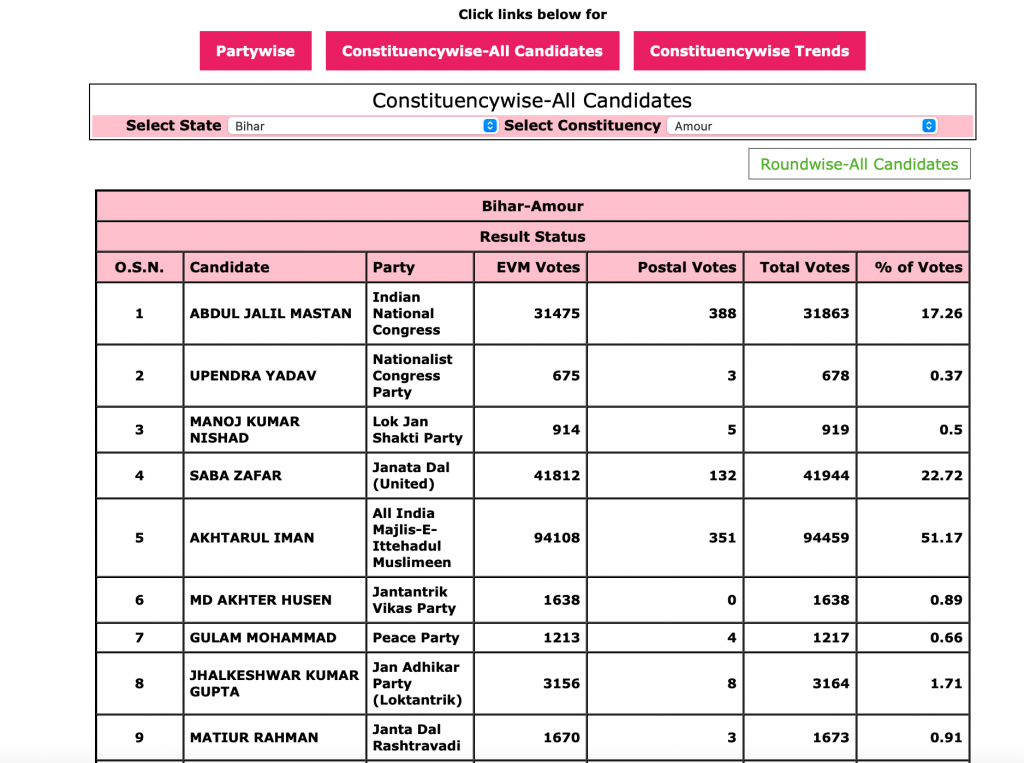
Saba Zafar contested the Amour Vidhan Sabha constituency seat for the JDU and secured 22.72 per cent votes. However, she lost to the AIMIM candidate Akhtarul Iman who racked up a stunning 51 per cent of the vote share.

Source: Election Commission

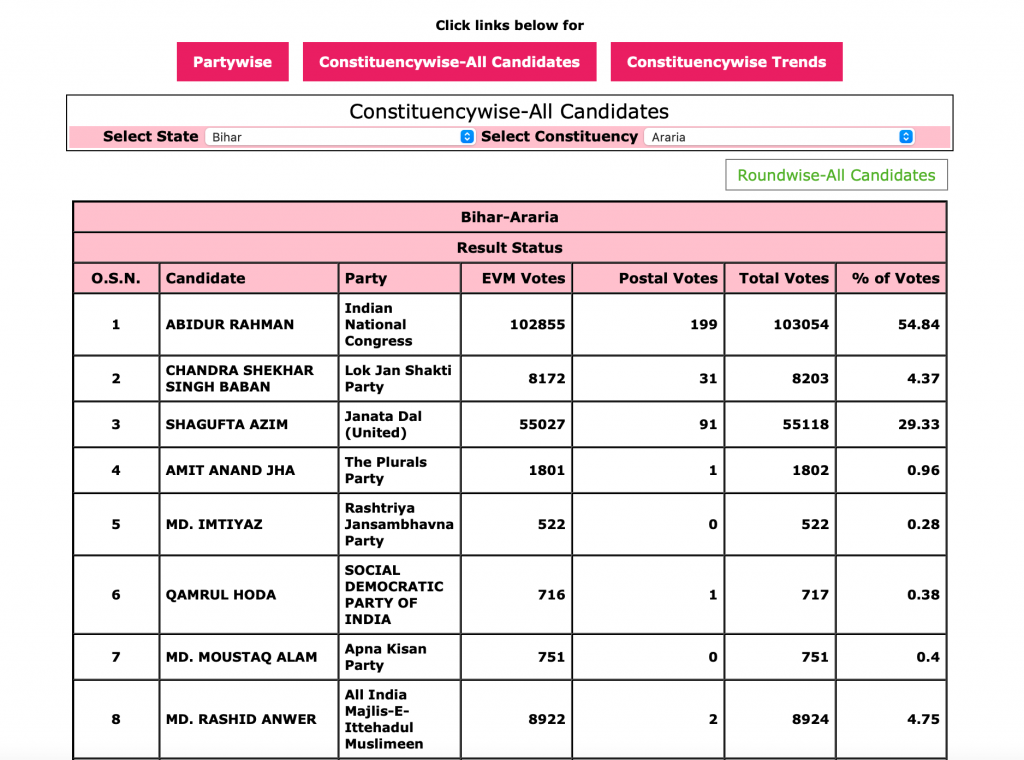
In Araria, the Congress party candidate Abidur Rahman scored a comprehensive victory over the JDU candidate Shagufta Azim. Rahman polled nearly double the vote that Azim could manage to get.

Source: Election Commission

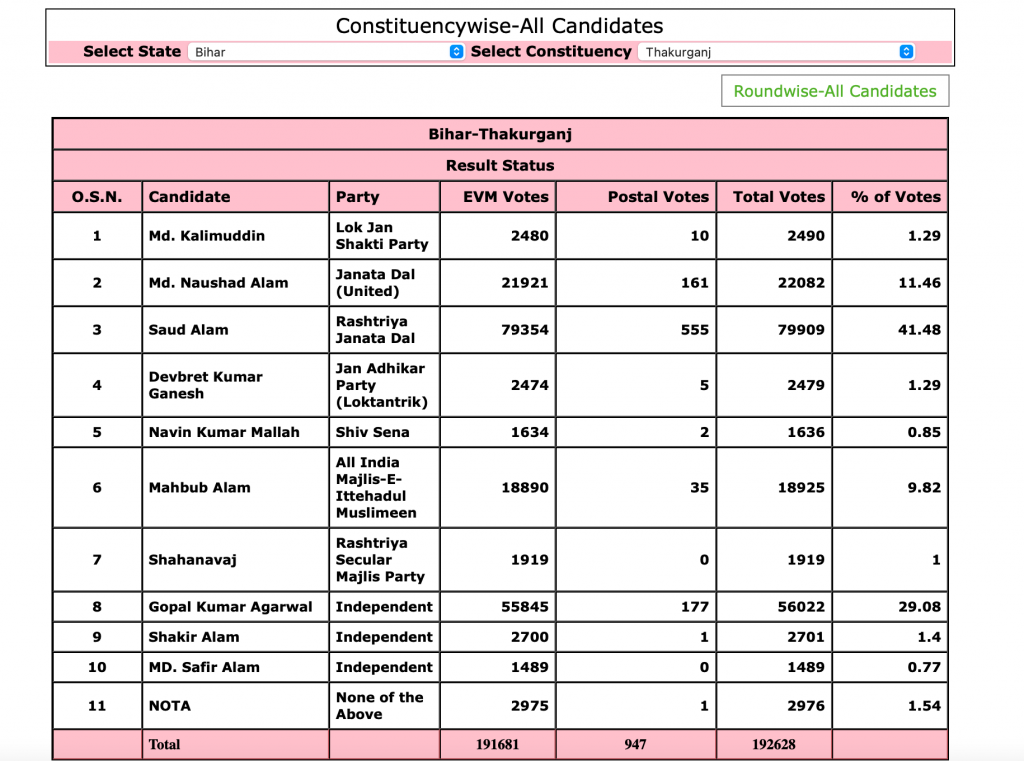
JDU’s Md. Naushad Alam in Thakurganj could manage to garner a paltry 11.46 per cent of vote share while his RJD counterpart Saud Alam polled a stunning 42 per cent vote share and won the Vidhan Sabha seat.

Source: Election Commission

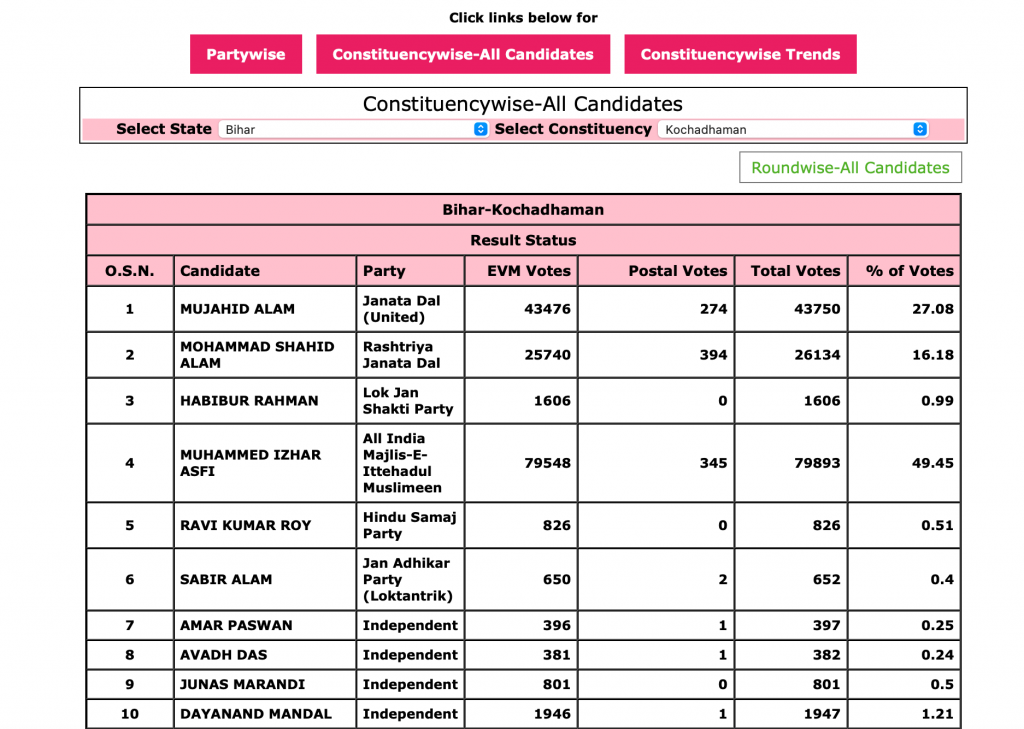
The story of Kochadhaman for the Muslim candidate fielded by JDU was likewise depressing. Mujahid Alam of the JDU lost to AIMIM candidate Muhammad Izhar Asfi, who swept the elections with almost 50 per cent vote share.

Source: Election Commission

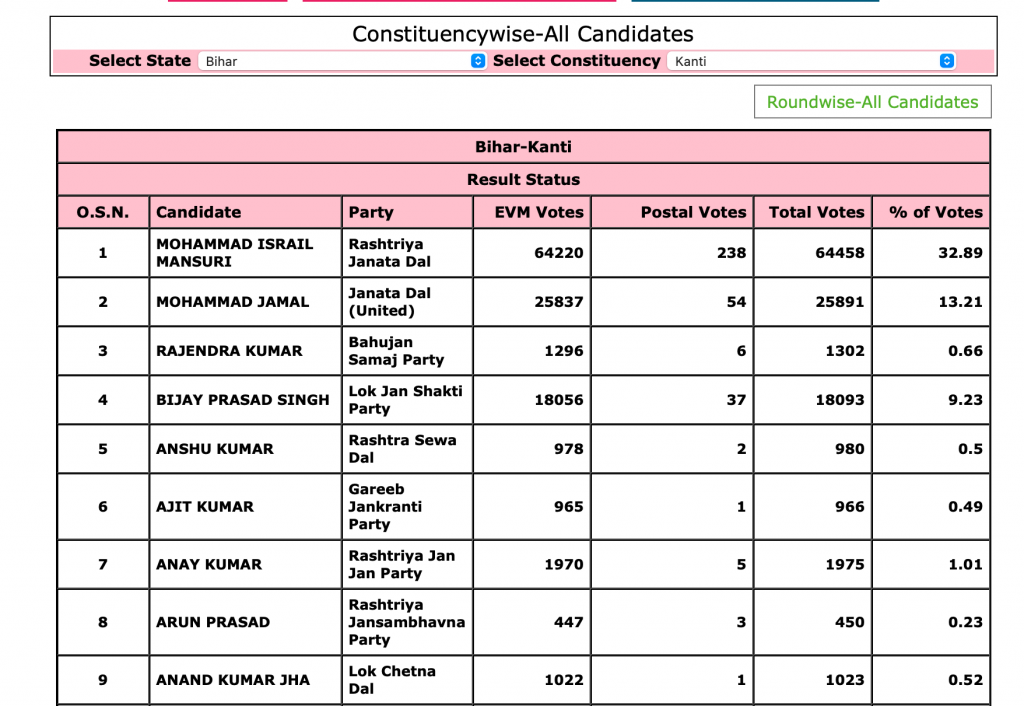
In Bihar’s Kanti, RJD candidate Muhammad Israil Mansuri trounced the JDU candidate Mohammad Jamal.

Source: Election Commission

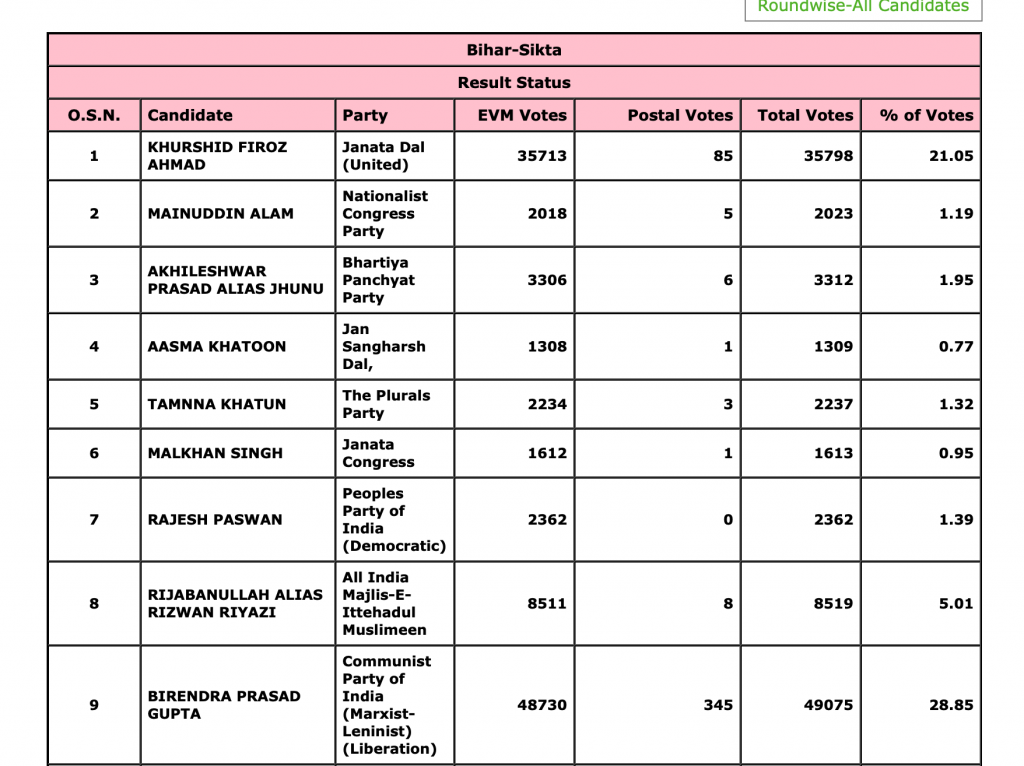
Khurshid Firoz Ahmad of JDU from Sikta Vidhan Sabha constituency trailed by a margin of about 14,000 votes to the CPI(MLL) candidate Birendra Prasad Gupta.

Source: Election Commission

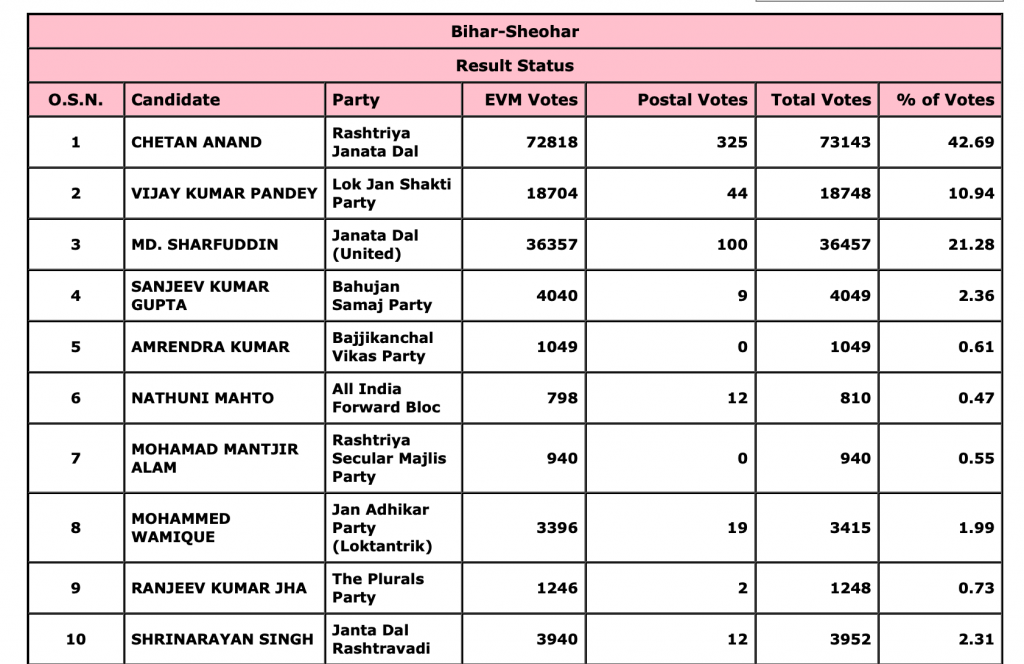
Another Muslim candidate from the JDU, Md. Sharfuddin lost to the RJD candidate Chetan Anand in the Sheohar constituency.

Source: Election Commission

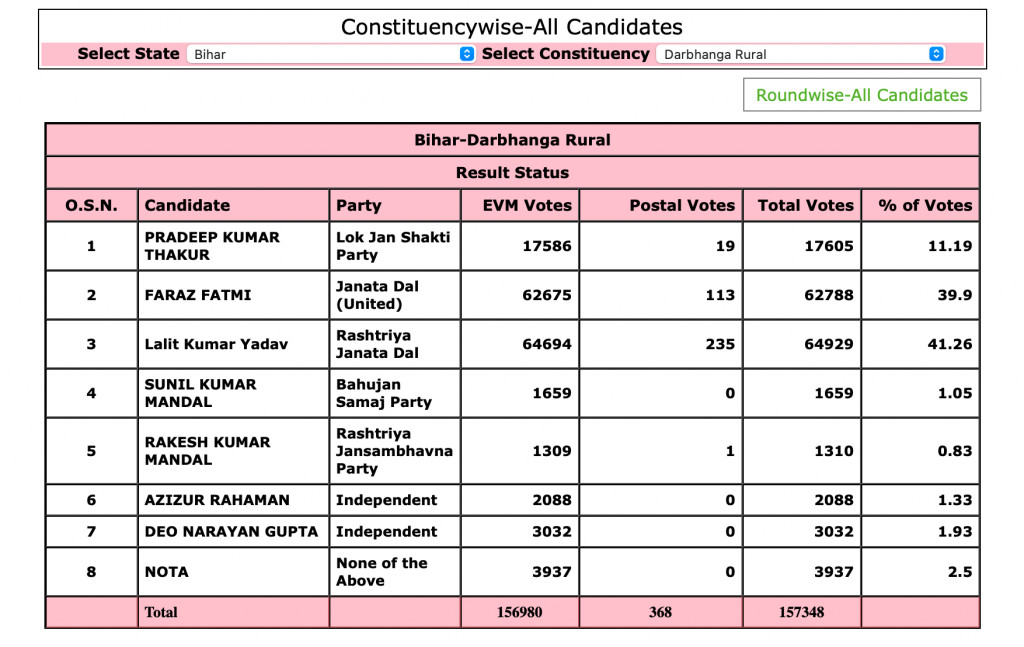
The Darbhanga Rural constituency saw a close electoral tussle between the RJD candidate Lalit Kumar Yadav and JDU’s Faraz Fatmi. However, in the end, Yadav emerged victorious, with a lead of just several thousand votes over Fatmi.

Source: Election Commission

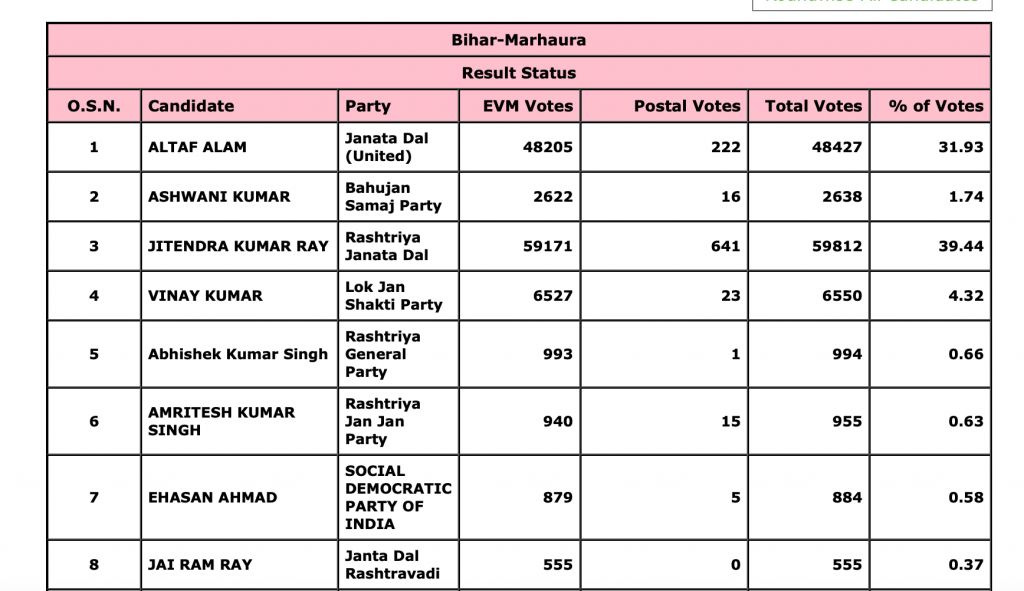
In Marhaura district, Jitendra Kumar Ray of the RJD defeated Altaf Alam of the JDU by a handsome margin.

Source: Election Commission

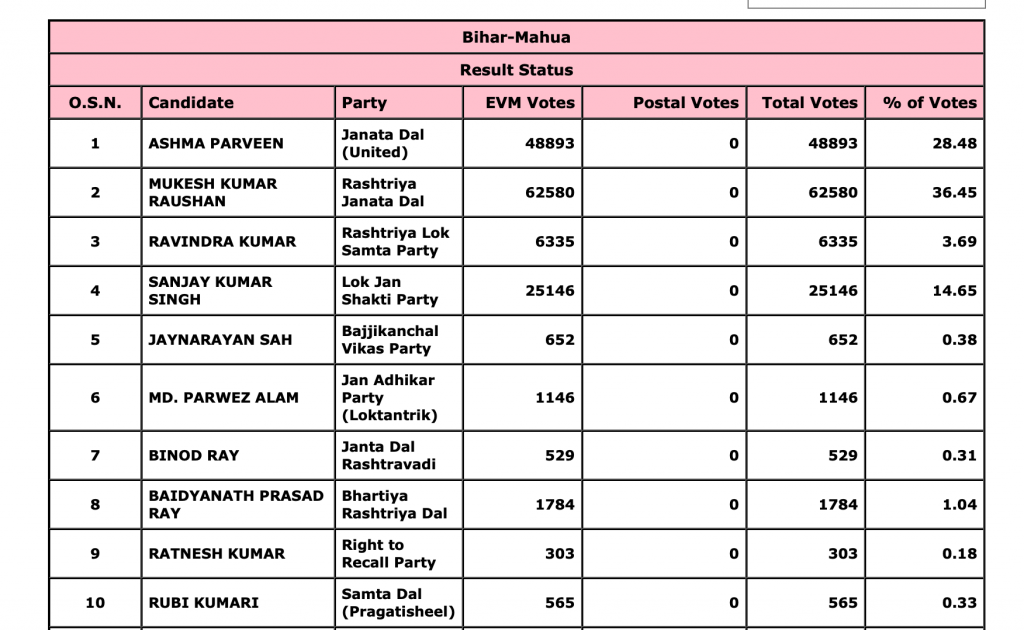
The election result in Mahua was no different from Marhaura. Here too, Mukesh Kumar Raushan handed over a resounding defeat to JDU’s Muslim candidate Ashma Parveen.

Source: Election Commission

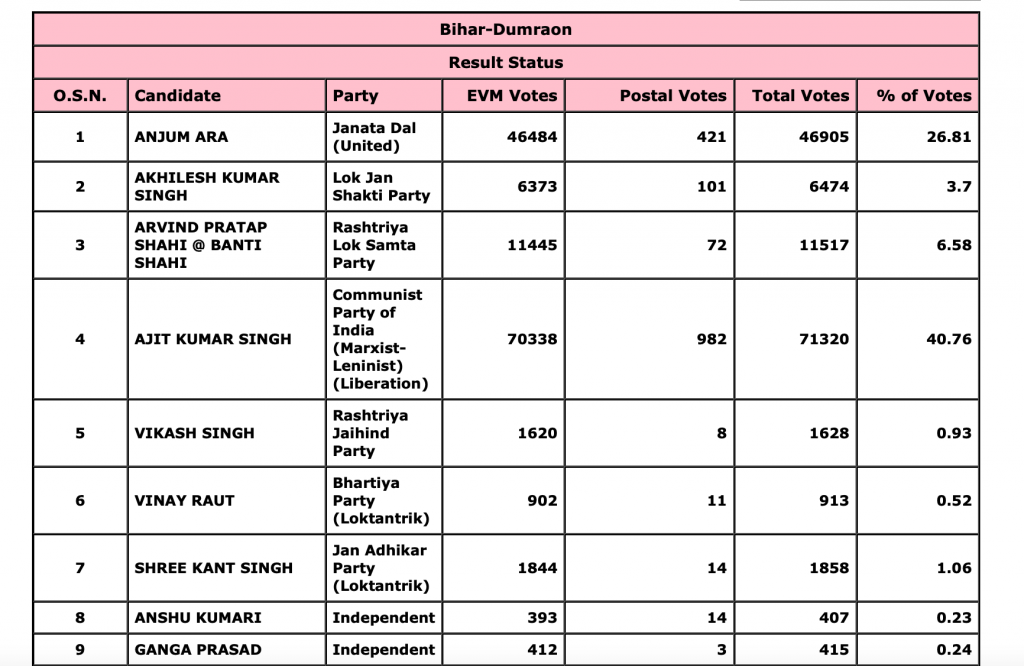
In Bihar’s Dumraon, CPI(MLL) candidate Ajit Kumar Singh won the elections, defeating Anjum Ara of JDU by a comfortable margin.

Source: Election Commission

Political parties prioritise the winnability of candidates

As it is clear from the above results, none of the Muslim candidates fielded by the NDA alliance partners managed to win the assembly elections. The JDU sent 43 members to the Vidhan Sabha. Had all the 11 Muslim candidates from the JDU won the elections, they would have had 54 seats in the Assembly, and a staggering 20 per cent of them would have been Muslims.

However, this was not to be the case as the Muslim candidates failed to inspire the votaries in their constituencies to come out and support them. There is a complex dynamic at work in the elections and based on this dynamic, candidates are chosen by the respective political parties to fight the elections. In essence, this is the crux of the numerous electoral victories scored by the BJP. They have stressed on the winnability of the candidate rather than placing importance on seeking validation from “secular” quarter, as any political party would.

Political parties select candidates that are most likely to win the elections. Selecting a large number of Muslim candidates but not getting even a single one of them to the Legislative Assembly is not a very wise strategy. Therefore, the fearmongering about the lack of Muslim MLAs from the NDA in the Bihar Assembly is severely misguided. Because quite clearly, it was not due to a lack of candidates. Furthermore, their absence will be compensated abundantly by the elected representatives of the AIMIM.

It is ought to be remembered that in recent times, liberals have been promoting the idea of separate reserved electorates for the Muslim community, an idea that was rejected by the Constituent Assembly itself. The idea was rejected because it was held responsible for the partition of the country itself. The current fearmongering about the lack of Muslim NDA MLAs in Bihar appears to be part of a larger agenda to rake up that demand.

Pakistan plans ‘advance booking’ of Coronavirus vaccine, top govt adviser had supported Chinese vaccine over Pfizer’s

0

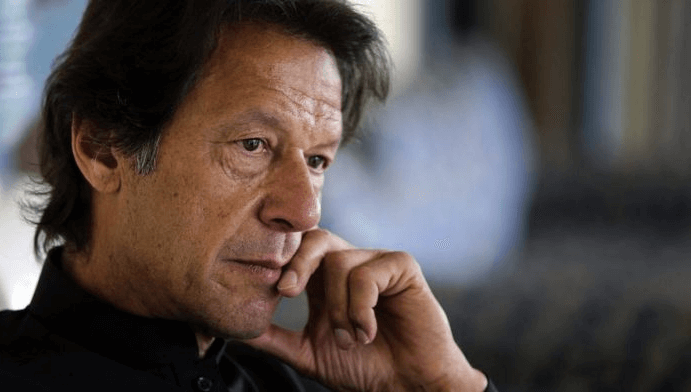
Prime Minister of Pakistan, Imran Khan, has cleared the decks for the advance booking of the coronavirus vaccine. According to a senior Pakistani official, PM Imran Khan gave his approval for the pre-booking of coronavirus vaccine, after which concerned authorities have approached two manufacturers.

Parliamentary Secretary for Health Dr Nausheen Hamid confirmed the development, stating that the government has finalised two major pharmaceutical companies to source coronavirus vaccine.

Curiously, the government has not revealed the names of the two pharmaceutical companies from which the country’s coronavirus vaccine will be sourced. It is notable to mention that clinical trials of two vaccines produced by Chinese manufacturers are already underway in Pakistan.

Top Pakistani government adviser supports Chinese vaccines over the likes of Pfizer’s

While the names of the pharmaceutical companies whose coronavirus vaccines have been approved by Pak PM Imran Khan remains a secret, it is pertinent to note that the top government adviser Dr Atta-ur-Rehman had extended his support for the Chinese vaccines over the Pfizer vaccine, hailed across the world for its reported 90 per cent efficacy.

Rehman, the chairman of the Pakistan Prime Minister’s Taskforce on Science and Technology, had last week claimed that Pfizer vaccine was not suitable for Pakistan because of its sub-zero storage requirements.

In an interview with Geo Pakistan, Rehman said, “In my opinion, the vaccine produced by Pfizer is not suitable for Pakistan because it needs to be kept at -80 °C temperature, which is a big problem for a country like Pakistan, where the cold-storage facilities are not as robust as the developed countries.”

In contrast, Rehman backed the two Chinese vaccines, whose clinical trials are underway in Pakistan. He claimed that the coronavirus vaccines produced by the Chinese manufacturers can be transported in “normal temperatures”, which he believes makes it better “suited” for Pakistan and third-world countries.

Rehman’s assertion came a day after vaccine candidate produced by American pharmaceutical corporation Pfizer and Germany’s BioNTech was found to be 90 per cent effective in treating coronavirus.

Pakistan’s poor fiscal situation might prompt Islamabad to go with Chinese coronavirus vaccines

However, some analysts believe that Pakistan’s possible rejection of the above two vaccines is grounded partly in its close ties with China and the high costs of procurement of the vaccines produced by the American and the German company. Pakistan is teetering on the edge of a financial collapse, surviving only by the loans granted to it by Beijing. In such a scenario, going for the western vaccines may raise the hackles of China and result in the very likelihood of Chinese retribution against Pakistan, hurtling it towards catastrophic financial disaster.

The economic failure staring at Pakistan is also evident in the appeal made by the Science and Technology minister Fawad Chaudhry, who urged the United Nations to discourage any effort to “monopolise” the Pfizer vaccine and ensure its availability for poor countries as well. He made the appeal while speaking at the World Science Day for Peace and Development event organised by UNESCO.

China, on its part, has treated Pakistan as its laboratory and Pakistanis as guinea pigs, carrying out trials of its under-progress coronavirus vaccines on Pakistani citizens. Beijing, which had endured a severe beating in its reputation in the wake of coronavirus pandemic outbreak, that was reported first in the central Chinese city of Wuhan, has a point to prove to the western world about its technological supremacy in dealing with the pandemic. China would want to demonstrate the efficacy of its produced vaccines by the means of Pakistan.

Amit Shah calls out the ‘Gupkar Gang’ and Congress, warns against their attempts of ‘global gathbandhan’ over India’s national interests

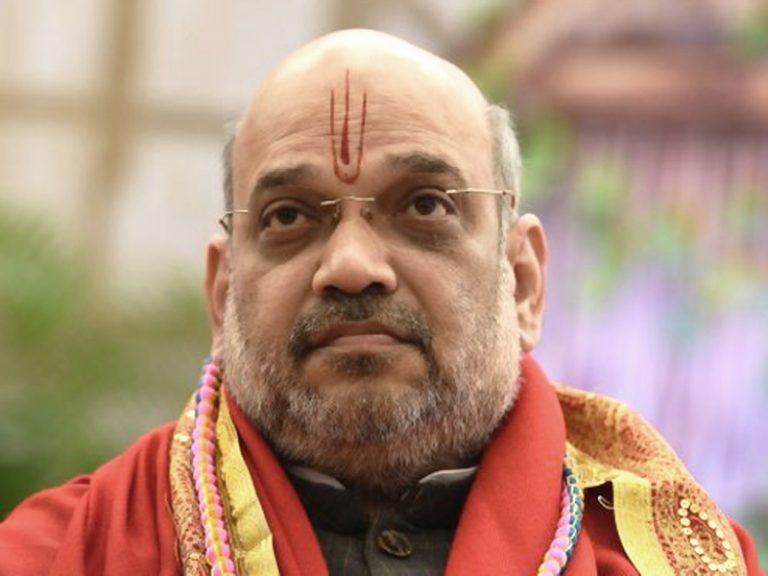
In a series of tweets, Home Minister Amit Shah on Tuesday launched an attack on People’s Alliance for the Gupkar Declaration alias ‘Gupkar Gang’.

Congress should make its stand clear.

In his tweets, HM Shah said that the Gupkar Gang is going ‘global’ and wants foreign forces to intervene in Jammu and Kashmir, an internal matter. Pointing out to the disrespect towards India’s sovereignty and national flag that some leaders of the alliance have displayed, Shah asked Sonia and Rahul Gandhi if they agree with the point of view of their alliance in J&K. Mufti had said that the Indian flag means nothing to her if the Indian government does not restore the flag of the erstwhile state of J&K.

Congress has decided to contest the J&K District Development Council elections in alliance with the ‘Gupkar gang’. Shah urged the Congress leaders to make their stand clear in front of the people of India about the anti-India statements made by the Gupkar leaders.

Gupkar alliance wants to take J&K back to the era of terror

Shah said that the ‘Gupkar Gang’ wants to take Jammu and Kashmir back to the era of terror and turmoil. “They want to bring back Article 370, which was anti-Dalit, anti-women, and anti-tribals”, he added.

‘Gupkar gang’ wants international powers to intervene against our national interests: Shah

Shah said that Jammu and Kashmir have been, is, and will always remain an integral part of India. “Indian people will no longer tolerate an unholy ‘global gathbandhan’ against our national interest. Either the Gupkar Gang swims along with the national mood, or else the people will sink it,” he added. The home minister cautioned against any ‘global gathbandhan’ that is support from foreign powers to further a separatist agenda in Jammu and Kashmir.

On several occasions, Farooq Abdullah has stated that China should rule Jammu and Kashmir and not India. Previously, he wanted Pakistan to take control of Jammu and Kashmir. He urged China and Pakistan to intervene and help his party restore Article 370 in Jammu and Kashmir. Even Congress leaders have urged Pakistan to help to topple NDA-led central government in the past.

The People’s Alliance for Gupkar Declaration or PAGD is a regional and mainstream political party’s alliance in Jammu and Kashmir that includes National Conference, People’s Democratic Party, People’s Conference, Awami National Conference, CPM, CPI, and J&K People’s Movement. Now Indian National Congress has joined hands with them for the upcoming elections. The group came into existence on October 15, intending to restore the special status of Jammu and Kashmir that Article 370 had provided it.

From whitewashing Islamist violence to plain denial and rewriting history, Swara Bhasker has come a long way

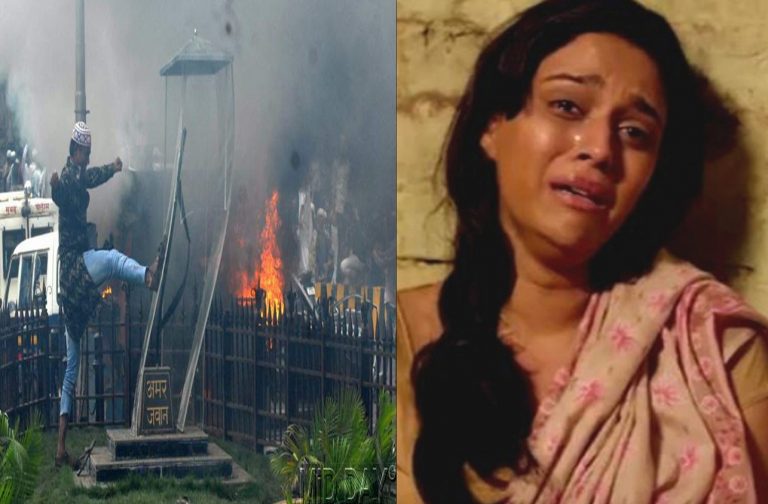
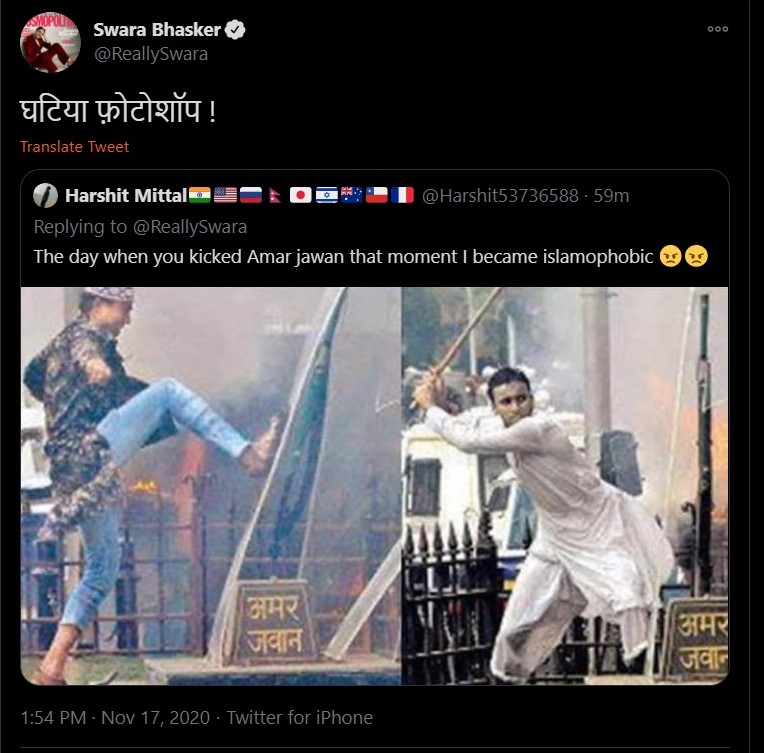
Integrity and truth have never been the allies of Bollywood actress Swara Bhasker. From whitewashing Islamist violence and radicalism to now engaging in plain denial of it, the entertainer has come a long way. On Tuesday, Swara Bhasker claimed that photographs of Islamists attacking the Amar Jawan Memorial during the Azad Maidan riots in Mumbai are ‘photoshopped’.

Swara Bhasker made the preposterous claim while responding to a comment made by a user on Twitter. “Cheap Photoshop” was the comment she made when the user remarked that photographs such as these had turned him into an ‘Islamophobe’. The only problem is that the photographs are not photoshopped and not even liberal media outlets have been shameless enough to claim that they were.

Swara Bhasker claims Azad Maidan riots photographs are ‘photoshopped’

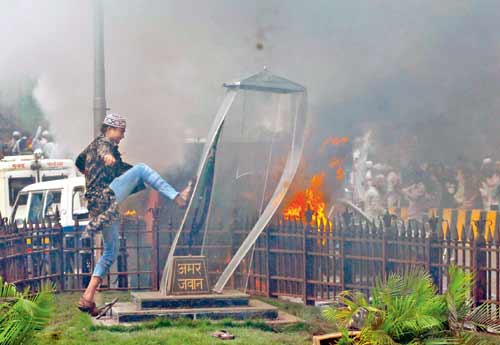
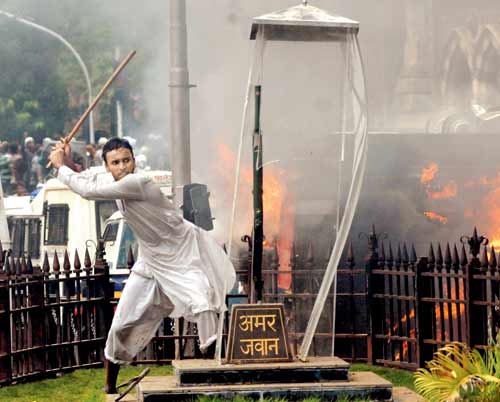
The now-famous photographs were clicked by Mid-Day photographer Atul Kamble on the 11th of August, 2012. The Azad Maidan Riots broke out after the Islamist organisation Raza Academy called for a demonstration in protest against the Rakhine riots in Myanmar. The Rohingya Muslims are believed to have suffered much damage during the said riots.

One of the two photographs clicked by Mid-Day photographer Atul Kamble

It really needs to be emphasized here that no one disputes the authenticity of these photographs. The intense violence and rioting occurred before the full view of the public and Azad Maidan riots remain a blot on the history of Mumbai even after all these years. The Raza Academy faced severe criticism even though liberals have been trying hard to whitewash their sins.

The second photograph captured by Atul Kamble

But not even liberals have been shameless enough to deny outright that the violence occurred or allege that these photographs are inauthentic. Swara Bhasker has really marched into territory hitherto uncharted by any other individual with regards to the Azad Maidan Riots. Of course, it could very well be that she is so out of touch with reality that she is truly clueless about the violence that ensued in 2012.

But given the manner in which she lectures everyone else about everything else, it appears unlikely that it is the case. It is far more likely that Swara Bhasker genuinely believed that she could get away with making such an absurd claim. Perhaps she relied on social media platforms to come in to her rescue and label every tweet disagreeing with her as ‘disputed’. But clearly, she is not remotely as important as the US President.

Meanwhile, other journalists are actually ‘liking’ that tweet by Swara Bhasker. Screenshots have emerged where Arfa Khanum Sherwani, another propagandist that whitewashes Islamist violence for The Wire, could be seen hitting the ‘like’ button on the fake news tweet. Since then, however, the entertainer has offered a correction for her shameful denial and admitted that the photographs are, in fact, not photoshopped. But her initial denial of it reveals a lot about her worldview.

All of this does reveal, however, how utterly clueless and out-of-touch our celebrities are with the realities of public life. If someone could seriously claim that photographs of the Azad Maidan Riots, what is next? The day is not far when some of them will claim that not a single Muslim mob rioted in the aftermath of the passage of the Citizenship Amendment Act. Oh wait. They already do that.

The instinctive urge of the liberal to deny every manner of wrongdoing by Islamists and claim that it is ‘fake news’ spread by ‘Islamophobic bigots’ is perfectly captured by Swara Bhasker in that moment. It also reveals that if they could have their way, they would also deny that beheadings in France ever occurred or the existence of Islamic terror organisations themselves.

But we already knew that given the manner in which liberals deny the genocide of Kashmiri Pandits and the genocides Hindus have suffered in the past under barbaric Islamic regimes. However, it is only Swara Bhasker who demonstrated the shamelessness required to outright deny outright that the Amar Jawan Memorial was attacked during the Azad Maidan riots.

Mumbai Police issues show-cause notice to Republic TV Editor, demands signing a bond for ‘good behaviour’

0

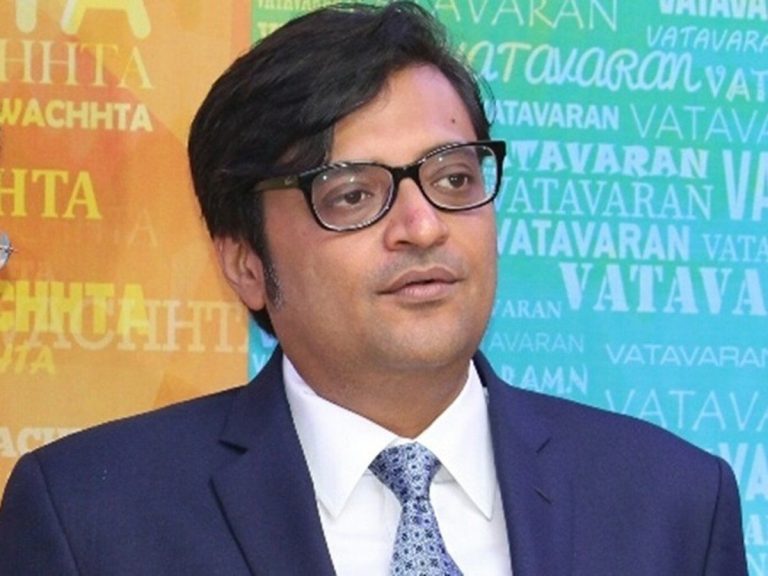
In a new development, the Mumbai police have served a show-cause notice to the Republic TV Editor-in-Chief Arnab Goswami for allegedly making ‘communal statements’ in the aftermath of the Palghar lynching case and Bandra migrant overcrowding incident. He had reportedly been asked to appear before the Special Executive Magistrate and Assistant Commissioner of Police (Worli) at 4 pm on Sunday.

While continuing with the witch-hunt against Republic TV Editor, Mumbai police have demanded Goswami to sign a bond for ‘good behaviour.’ Invoking Section 108 of the Code of Criminal Procedure (CrPC), Assistant Police Commissioner (Worli) Sudhir Jambavdekar had demanded the signing of a bond to ensure good behaviour.

The Assistant CP exercised his power as an Executive Magistrate which empowers him to demand ‘security for good behaviour’ from someone, suspected of publishing communally sensitive material. As per reports, Arnab Goswami has been directed to show cause as to why he should not pay the bond value of ₹10 lacs for a one-year-period with a guarantor, who is well-known in society and capable of controlling Arnab’s behaviour.

Supreme Court grants bail to Arnab Goswami

On November 11, a Supreme Court bench comprising of Justice Chandrachud and Justice Indu Malhotra hearing the petition said that Bombay High Court made an error in rejecting the application for grant of interim bail on technical grounds. Granting the bail to Arnab Goswami, the apex court also directed the Raigad police to ensure the compliance of the order of release of Arnab Goswami forthwith. Goswami was arrested last week by the Mumbai Police after it had reopened 2018 abatement of the suicide case of an architect, Anvay Naik.

The Supreme Court also asked Arnab Goswami and two other accused to execute a personal bond for an amount of Rs 50,000 for release on interim bail. Justice Chandrachud, hearing the plea had made scathing observations saying, “If we don’t interfere in this case today we will walk on path of destruction. If left to me I won’t watch the channel and you may differ in ideology but Constitutional courts will have to protect such freedoms”.

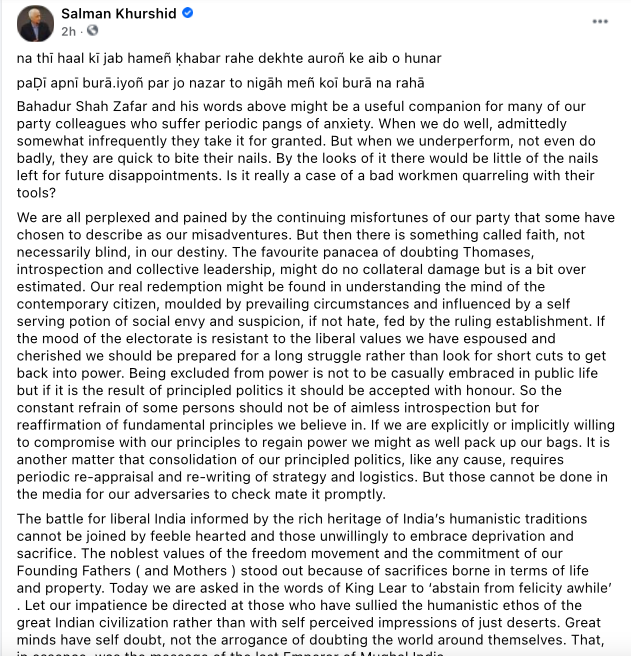
Voters are not ready for ‘liberal values’: Congress Salman Khurshid blames people for his party’s repeated election loss

After losing the Bihar Assembly elections, Congress leader Salman Khurshid has put the blame on the voters. Khurshid, whose name has recently come up in the Rs 3,600-crore AgustaWestland scam said that the voters in Bihar ‘resisted liberal values’.

Khurshid said in a Facebook post that “If the mood of the electorate is resistant to the liberal values we have espoused and cherished we should be prepared for a long struggle rather than look for short cuts to get back into power.” In a long post, Khurshid praised the last Mughal emperor and also indirectly targeted Congress leaders who are criticising the party and its leadership after the repeated election debacles.

Khurshid’s Facebook post

Sharing some advise of ‘introspection’ for his party colleagues who “suffer periodic pangs of anxiety”, Khurshid wrote, “When we do well, admittedly somewhat infrequently they take it for granted. But when we underperform, not even do badly, they are quick to bite their nails. By the looks of it there would be little of the nails left for future disappointments. Is it really a case of a bad workmen quarreling with their tools?”

In that post, he also advised the same ‘party colleague’ to refrain from criticising the Congress, saying, “It is another matter that consolidation of our principled politics, like any cause, requires periodic re-appraisal and re-writing of strategy and logistics. But those cannot be done in the media for our adversaries to checkmate it promptly.”

At a time when the party should introspect about performing so poorly in the elections, the Congress party, as usual, is looking outside for reason for the reasons for their defeat. It has become a norm for the opposition parties, including Congress, to blame to either raise fingers at the election process, usually by finding faults in EVMs, or to the declare the voters not mature enough to recognise the so-called liberal parties’ worth. Congress has been trying really hard to return to power by forging all sorts of alliances with other parties but nothing seems to work for the grand old party. Congress’ performance has been equally humiliating in the bypolls held in Gujarat, Manipur, Uttar Pradesh and Madhya Pradesh.

Earlier, another Congress office-bearer had termed the Bihari people as ‘poor and greedy’, for not voting Congress to power.

People don’t consider Congress as an alternative: Kapil Sibal

Recently, Senior Congress leader, during a rare moment of truth, admitted that people no longer consider Congress as an effective alternative. Speaking during an interview after losing the Bihar Assembly elections, Sibal said it was clear from the Bihar Assembly elections as well as the by-elections held in several states that people did not consider Congress party as an effective alternative. “In some of the constituencies in Uttar Pradesh, the Congress candidates in the by-elections notched up less than 2% of the votes cast. Three of our candidates in Gujarat lost their deposits”, said Sibal asking the party to introspect for its consistently bad performance in elections.

The Dravidian Movement and the Devadasi Abolition Act: Did a ‘Brahiminical conspiracy’ oppose reforms to the practice as alleged?

The Dravidian movement has long claimed the mantle of progressive politics in Tamil Nadu. Among their claims in support of women’s emancipation was their contribution to the passing of the Devadasi Abolition Act.

This is portrayed as a change brought about by the sustained campaign of the Dravidian movement towards ending this practice. However, as Historian and writer Ma Venkatesan has studied, the truth is quite different.

Historical Background

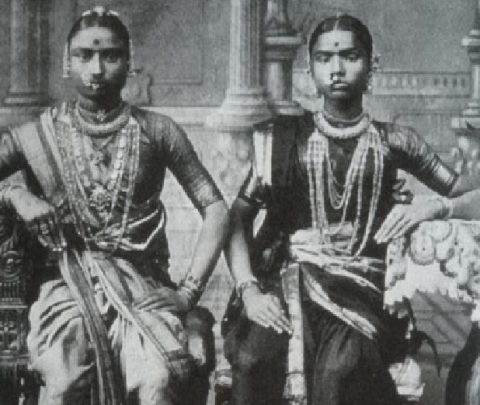
All over India, there was the practice of dedicating young women exclusively to the service of the temple. They were symbolically married off to the presiding deity of a temple. Their services were in the form of various work related to the functioning of the temple. The main function was to provide music and dance performances as offerings to the deity. Their duties were not restricted only to this function.

They had a say in the administration of the temple and had roles in managing the flower arrangements, decorations and the conduct of the festivals. Manickavasagar, the Saiva Saint, describes their duties as a composite of

  • Singing and performing auspicious songs, primary among them being songs related to ritual and devotion. Artistic compositions were for festive occasions in the temple.
  • Offering incense and camphor in ritual
  • Adorning the temple for festivals
  • Suspending garlands of flowers and precious materials.

There were two categories of such dedications to the temple – one was a higher-status devadasi, who was given a land grant from the temple’s endowment, also known as inam lands. These were similar to craftsmen, priests in socio-economic status due to their minor landholdings.

Another category were those women who had been dedicated to singing and performance of other folk arts. They were supported on a share of the pooled village harvest. In earlier times, the devadasis were relatively well-off, enjoyed a high status and were independent enough to give endowments and gifts of their own.

An inscription of the time of the Chola ruler, Rajaraja III (1226 CE) at Thiruvizhimalai temple describes how the king rectified grain acquisition by transferring the responsibility from two Sivabrahmanas who had misappropriated grain to the devaradiyar (devadasi) of the temple.

Another inscription describes a Devadasi woman as Anukki Pattalinangai, the term anukki denoting her relationship as a partner of the Chola ruler Rajadhiraja I, who contributed gold, jewels and covered the roof of the shrine in gold in her own capacity.

While they were considered wedded to the deity and nitya-sumangalis, or always auspicious, they did not have to be celibate. They took consorts from landed upper castes. Some were even consorts of royal men. The 12th Century Kamikagama calls them daughters of Shiva. In Saivaite temples, this Agama describes a ritual of initiation by the Sivacharya or Priest of the Temple by touching them on their head with a staff.

Women thus initiated were called Shirodandini or Talaikkoli in Tamil. This matches with description of the Chief Devadasi as Talaikkoli in inscriptions. The 7th Century Shivadharmottara, a Upagama text that codifies practice of Shaiva temple worship, describes their status as servants of Shiva, who, by virtue of their service are assured a place in Rudra’s world. This same assurance is given to their offspring also.

There is evidence that this was a widespread practice across the Greater Indosphere, including in Cambodia.

There is no evidence that formal marriage was denied to these dedicated women. The word used is ganika or courtesan, but a nuanced view indicates that they had no obligation to remain unmarried. European travellers’ accounts before the colonial period give no evidence of large-scale exploitation of these women.

During Vijayanagara times, the system of two-fold categorization of public women continued – the devadasis who were dedicated to ceremonial functions at temples and courtesans who were entertainers and informal companions of nobles and royalty.

Over time, the system had degenerated to such an extent that many of them, along with artisans and priests, lived in penury. Part of the reason must have been the devastation of the Indian countryside during the 17th and 18th Century and the impoverishment of the temple economy. We get a glimpse of the processes at work from the records of Thomas Roe, the English traveller to the court of Jehangir.

By this time, the temple economy had deteriorated to such an extent that he records only dancing girls for entertainment and pleasure purposes. A similar process was carried over the long years of deterioration of the temple economy in Southern India between the 16th and 18th Centuries. During the colonial administration, their unconventional lifestyle attracted the curiosity of the Christian Europeans. To British eyes, their lifestyle must have been seen as a deviation from Christian norms.

From the mid-century onwards, Indians started getting Western education in larger numbers and those with Western education were at the forefront of public opinion. By this time, the devadasi system was seen as an abhorrent practice and these women considered to be living in sin.

In an era where women were cloistered and restrictions placed upon their movement, public appearance and education, these women who performed in public, had agency in owning and disposing of property and were free in their choice of life partners caused no end of consternation to the English-educated public.

That said, the social practice had also degenerated to such an extent that the women were entirely dependent upon their consorts, now patrons for their livelihood. Their social status was much degraded and many women were now susceptible to exploitation.

Their children did not have acceptability in society and were often subject to social discrimination. Even in Madras, schools would sometimes refuse to admit children from devadasi families.

The way forward to solve this social discrimination seemed to be to outlaw the practice of dedicating women to the devadasi life. Even at that time, there was opposition, mostly from within the community itself and among traditionalists who were loath to let go of a custom from very old times.

The colonial British government which did wish to impose its writ on native customs, was content to let this be resolved within the Hindu community itself. However, by the second and third decade of the 20th Century, opinion makers and influencers in India were of the unanimous opinion that the custom had to go and that the communities from which the Devadasis came from should be turned towards the same kind of marriage and lifestyle customs as the rest of the Hindu community.

Land and Devadasis

Among the primary concerns of the colonial British administration was to maximize resource and revenue extraction from their Indian dominions. One aspect of consternation to the British administration was the large bank of inam lands. In ‘Castes of Mind’ Nicholas Dirks described his study of land ownership patterns in early 19th Century Pudukkottai. 70% of the cultivable land was inam lands.

Of these, 70% was lands given as inam to artisans, artists, temples, Brahmins, mathams, annadhana chatrams, traveller choultries and shrines for Muslim saints and the remaining 30% for members of the administration, guards, servants and military retainers. He further proposes that even in highly militarized states, only 50% would have been inam lands for military purposes. Thus, 25% of inam lands would have been earmarked for artisans, dancers, musicians and village officials

Form this, we get a picture where in pre-colonial times, native Hindu kingdoms set aside close to 15% of land for the purpose of the native economic system centred around the temple. Given this information, it is no surprise that the devadasis were highly regarded and were able to make endowments by themselves.

Every time a woman was dedicated as a devadasi, it was obligatory to make a settlement upon the family of inam lands. This would be from the common land of the temple or from a patrons’ personal property. It is possible that one of the motivations for the atrocity literature produced and the campaign against the practice was the British administration wanting to keep more lands under the taxable net.

Voices of Reform

Some of the most articulate voices for change came from within the community itself. The most articulate voices for preservation of the practice also came from within the community, notably the dance performer and public intellectual Balasaraswati.

Here we present two of the individuals who called for reform.

Dr Muthulakshmi Reddy

We must spend some time on the life story of Dr Muthulakshmi Reddy, one of the remarkable personalities of social life in Madras of the early 20th Century. She was born to a Brahmin father, a College Principal in the then Pudukkottai State, a minor principality in today’s Tamil Nadu, and a mother from the Isai Velalar community.

Contrary to social convention, she was educated in school, then she made her way to Madras to study Medicine and qualified as the first woman House Surgeon in the Madras Maternity and Ophthalmic Hospital. She married a man of her choice, Dr Sundara Reddy from a different caste at the age of 28. She was the force behind such lasting philanthropic endeavours as the Avvai Home for Orphaned Girls, Adyar Cancer Institute and opened the way to provide scholarships for Dalit girls and a hostel for Muslim girls to pursue studies. She worked against trafficking of women for sex work.

Among her major concerns was the state of women in her community. She was particularly forceful in her argument to abolish the devadasi system. In 1927, the Women’s India Association nominated her to the Madras Legislative Council as Vice President. It is in the Council that she brought the Bill to abolish the devadasi practice in 1930. We will discuss the events related to this Bill in a later section, where we shall evaluate a key claim of the Dravidian movement.

Muvalur Ramamirtham Ammal

Muvalur Ramamirtham Ammal had a far harder path in life than Dr Muthulakshmi. She was from an economically backward family and had been dedicated to a devadasi temple by her parents, even though her clan did not have a tradition of women joining temple service. The inam properties and marginal financial security this brought was an attraction in the desperately poor rural India of the late 19th Century/early 20th Century.

She gave up her devadasi position and married to lead a regular family life. She joined the Self-Respect Movement at the time that EV Ramasamy broke away from the Congress. In 1936, she wrote a novel – Dasgalin Mosa Valai or Mathi petra minor, which in English translation means The treacherous net of the Devadasis or the Wisdom gained by the Minor. It is an ideological account of scheming devadasi women who snare rich young men for money. It contrasts their behaviour with that of ‘reformed’ devadasis who have married and begun to lead a respectable life.

She stayed in the Self-Respect movement until 1949, and saw the passing of the Devadasi Abolition Bill in 1947.

Abolition of Devadasi practice

While we have described some of the key activists that worked towards the abolition of the Devadasi system in Madras Presidency, let us look at the situation in other parts of India.

Mysore State 1909

The earliest opposition against the devadasi system in Mysore State came from the Maharaja himself. Nalwadi Krishna Raja Wodeyar IV, took over the reigns of administration in 1902. He began to build a reputation as an administrator, patron of the arts and social change agent. His solution for the injustices in the devadasi system and the poor social position of these women was to outlaw it altogether. In 1909, he signed a Royal decree outlawing the practice of gajja puja – a ritual performed to dedicate a woman as a devadasi and symbolically marry her to the deity.

Travancore and Cochin 1930

Due to the intervention of the Maharani of Travancore Pooradam Thirunal Sethu Lakshmi Bayi, who in 1930 was the Regent of Travancore, ruling on behalf of her nephew the Maharaja Chitra Tirunal, the Travancore Kingdom banned the practice of devadasi dedication.

The Kingdom of Cochin followed suit soon.

The First attempt in Madras Presidency 1930

In 1926, the third elections to the Madras Presidency Legislative Council were held. The Swaraj Party, a breakway faction of the Indian National Congress, despite not having a majority, was asked to form the Government. This election expanded the Legislative Council by 5 nominated seats to include women.

Dr Muthulakshmi Reddy was pressed by her colleagues at the Women’s Indian Association, led by Kamaladevi Chattopadhyay, to accept a nomination to the Legislature. As part of her brief, she decided to move the House to pass a new Bill she had drafted.

She recounts in her memoir – ‘My Experience As a Legislator’ – the positive response her proposal received from various quarters, including Gandhi writing in Young India, from women of the Devadasi community in Cochin, from members of the Telugu Kalavantulu community and from Erode Municipality, which at the time was led by Balasubburayulu Naidu.

She also mentions the positive reception accorded to it by Sir Krishnan Nair of the Justice Party, the Ministerial Group or the ruling Swaraj Party, Congress Party members. The Law Member Sir CP Ramasamy Iyer was appreciative of the motion but had misgivings about the feasibility of making the motion a practical legislation.

Eventually, the Bill was defeated on technicalities, which included a dilatory motion made by Sir Krishnan Nair himself.

Bombay Devadasis Protection Act, 1934

In 1934, the Bombay Presidency brought about a bill to protect women from the devadasi custom by means of an order from the Bombay High Court. It made it an offence to dedicate women to the custom.

Madras Devadasis (Prevention of Dedication) Act, 1947

In 1947, as part of the devolution of powers to Indians, Madras Presidency was placed under a Premiership. Omandur Ramasamy Reddy of the Indian National Congress became the Premier. Under his leadership, progressive legislation – Madras Temple Entry Authorization Act 1947 that gave free and universal access to temples to all Hindus, regardless of case and Devadasi Dedication Abolition Act of 1947, which finally abolished the Devadasi system were passed.

Conclusion

The prevailing narrative is that the Devadasi system was nurtured by the Brahminical order and sustained by dominant castes for the purpose of sexual slavery of poor and marginalized women. This narrative fails to take into account historical status of devadasi women, the participation of multiple castes in the system or the gradation in caste within the devadasi community itself.

That this was a popular custom and had no codified sanction in the core Dharma Shastras is ignored in the discourse. The Dharma Shastras cognize the existence of devadasi or public courtesans and temple artistes. Over time, especially with the withering away of the temple economy, the function of courtesan and temple artiste converged. Narratives influenced by Victorian Christian mores further gave a fillip to the worsening social status of these women.

It may be noted that Dr Muthulakshmi was encouraged to pursue an education by her Brahmin father, stayed at PS Krishnaswamy Iyer’s Madras home while a young medical student or that the Brahmin leaders of the Congress Party welcomed the removal of this system.

The Dravidian ideologues also claim that Brahmin Diwans influenced the rulers of Princely States to sustain the Brahminical order. The truth of those claims aside, the Diwans of Mysore in 1909 were Madhava Rao Patankar and Ananda Rao Thanjavurkar, both Deshasta Brahmins from Thanjavur and the Diwan of Travancore in 1930 was Subramanya Iyer.

Of note, too, is the fact that the two bills against the devadasi system were both passed when the Justice Party was not in power. Nor was the Self-Respect Movement of any significance in influencing either legislation. The times were in favour of this social change. Any opposition to this came from within the community itself.

Now, we come to the event which is offered up as clinching evidence that it was a Brahminical system that established and sustained the devadasi practice. Satyamurti, the Congress/Swarajya leader is said to have claimed that women dedicated to the devadasi practice were guaranteed to enter heaven by virtue of their position. Dr Muthulakshmi is said to have retorted – ‘Then why don’t you dedicate women from your community to this devadasi system?’

First, we do not know the provenance of this particular story. It makes no appearance in Dr Muthulakshmi’s own memoirs. Another version of this story is of Dr Muthulakshmi remarking to Satyamurty – ‘So far it has been women from our community that have sung in public, now it will be the turn of your women’.

The second is most plausible, given that Satyamurthy and Muthulakshmi had known each other for decades in 1929, having been classmates in the FA class at Maharaja’s College, Pudukottai. This might have been no more than a minor discussion, as opposed to being a heated debate. In any case, Dr Muthulakshmi’s words would prove prophetic, as a 10-year-old D K Pattamal from a conservative Dikshitar family had begun to perform in just this time period.

D K Pattamal paved the way for a generation of Brahmin women to perform Carnatic music on stage. Brahmin men had begun to perform music publicly a generation earlier. In a few years, a lady called Rukmini Devi from a conservative Brahmin family took up sadir and reformulated the art to Bharatanatyam, a marker of high culture.

It also led to the next Dravidian accusation of Brahmins having cornered the sphere of high culture to themselves. We will examine this claim at a different time.

References

  • Hindus In Social Reform” Part 6 in Vijaya Bharatam
  • In Perennial Oppression: Internalized Ideologies of the Devadasis K A. Geetha Journal of International Women’s Studies, 5th World Conference on Women’s Studies, Bangkok, April 2020
  • Pg 391 History Of Early India From The Origins To AD 1300 – Romila Thapar
  • Rudraganikas: Courtesans in Siva’s Temple? – Some Hitherto Neglected Sanskrit Sources – Dominic Goodall Cracow Indological Studies Vol. XX, No. 1 (2018), pp. 91–143
  • https://www.latestlaws.com/wp-content/uploads/2015/11/Tamil-Nadu-Devadasis-Prevention-of-Dedication-Act-1947.pdf
  • ‘My Experience As a Legislator’ Pages 108 – 120 Dr Muthulakshmi

How come MIM did not face the “outsider” jibe in Bihar?

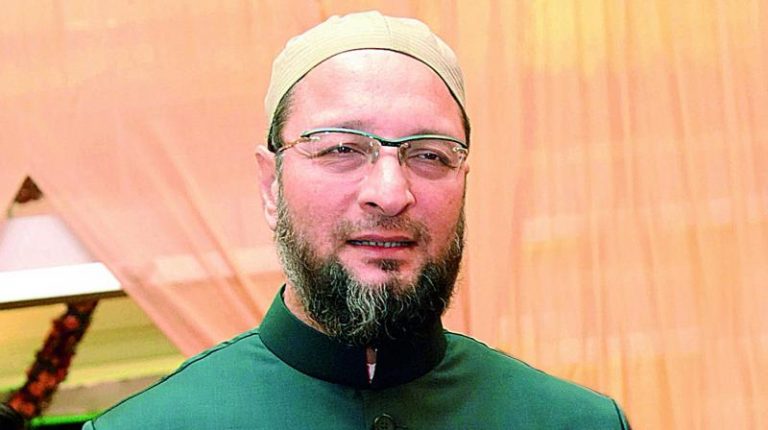
A very curious thing happened in the recent Bihar elections. A party that is known mostly around Hyderabad managed to win five seats. All the way from Telangana. The JMM from neighboring Jharkhand contested elections as part of the RJD led Mahagathbandhan but still didn’t win any. Nobody knows if the Trinamool Congress, from neighboring Bengal, even contested anything.

On the face of it, you could say that this is good for national integration. It is good that voters of Seemanchal have embraced with open arms all the ideas on bijli, sadak, paani, education, employment and health that Mr. Owaisi has brought from Hyderabad. Why should it matter where he is from?

And yet, there is something unique about the success of MIM. If indeed Indian democracy has matured so much, why isn’t it rubbing off on any other party? The MIM, for instance, has seats in Maharashtra. The Shiv Sena also contested elections in Bihar but lost deposits on all seats. How come the people of Bihar were not inspired by the ideas of “best CM”?

What is different about the appeal of MIM that parties like Shiv Sena or JMM or TMC don’t have?

In Indian elections, one of the most difficult tags to overcome is that of being an “outsider.” Elections are all about connecting with people. Our nation is so diverse that anyone with even a slightly different regional, linguistic, dietary or even caste background is bound to trip up somewhere.

You must have seen the accusing headlines. The BJP accused of Hindi imposition in southern states. BJP accused of imposing dietary restrictions in the North East. BJP accused of being outsiders in Bengal and so on.

Even the BJP. Even with the massive nationwide appeal of PM Modi, the BJP is regularly tripped up by the diversity of India. All parties, big or small.

Except MIM. They don’t seem to trip. Mr. Owaisi snaps his fingers and voters of Bihar begin relating with him seamlessly. They say he is going to Bengal next. Parties like the TMC seem terrified by this prospect. Why?

Think about it. Why would TMC worry that MIM might take their votes away?

Why is the most entrenched party in Bengal so scared of a party from Hyderabad? Are they similarly scared that the ruling TRS from Telangana might come and take their votes? What about DMK or ADMK? If MIM can suddenly start eating up TMC votes, why not Chautala’s INLD from Haryana?

Let us assume that Mr. Owaisi is only bringing good ideas on bijli-paani-sadak from Hyderabad. Surely then some party from say Haryana or Karnataka could come and entice voters of Bengal with another set of good ideas on development.

Let us also assume that Mr. Owaisi is a master communicator. This year, he very likely mastered the local customs of Bihar and appealed to them in a way they could understand. In six more months, I suppose he will be able to master the local customs of Bengal and appeal to them in a way they can understand. Outstanding achievement. Superhuman almost.

Or is there another explanation? Could these assumptions be flawed? Is it possible that MIM’s voters in Bihar and potential voters in Bengal are able to see a common thread that goes beyond regional variations?

What could be common between the old city area of Hyderabad, Aurangabad in Maharashtra, Seemanchal in Bihar and Malda-Murshidabad in West Bengal? What could be this common thread? Does anyone know?

Like I said, this is very good for national integration. Let us hope that everyone starts seeing common threads, not just the people in certain areas. Why should this maturity remain limited to a few segments of the population? Let it spread. Nothing more liberal than that, right?

This Bengal election, let all parties, including the “liberal” ones, agree not to accuse any Indian political leader of being an outsider in Bengal. Not on the basis of language or dietary habits or regional origin. We are all Indians. We are all insiders everywhere in India. And we should all see the common threads. Why should only Seemanchal see a common thread with the old city of Hyderabad? Let Kolkata also see the common thread with Varanasi. Deal?

Sameet Thakkar, arrested for ‘baby penguin’ remark, finally released from jail, a day after receiving bail

0

Sameet Thakkar, who got arrested for posting tweets against CM Uddhav Thackeray, his son Aditya Thackeray and Nitin Raut, was granted bail on Monday by a metropolitan magistrate in Mumbai’s Esplanade court. However, he was released only on Tuesday well past noon, his sister Sneha Singhvi informed on social media.

According to Sneha Singhvi, his family had been waiting outside the jail since 8 AM waiting for his release. The court had ordered his release on cash bail or Rs.25,000 or a PR bond of Rs.20,000. Chandansingh Shekhawat, Thakkar’s advocate, said yesterday that he would get released from jail after completing formalities on Tuesday morning.

Earlier, Thakkar also approached Supreme Court seeking release on bail with his counsel Mahesh Jethmalani. The Supreme Court had rejected his application and asked Thakkar to approach the appropriate forum. Advocate Rahul Chitnis appearing for the Maharashtra government, stated in Supreme Court that they would not oppose Thakkar’s bail as his interrogation is over.

Arrest of Sameet Thakkar

Sameet Thakkar, a Nagpur resident, got himself in soup after posting tweets against the Thackerays and Nitin Raut. Three cases were registered against Thakkar in Nagpur, VP Road police station Mumbai, and BKC Cyber Police. He approached Bombay High Court to get bail and requested the court to quash all FIRs against him. The court provided him protection from the arrest but asked him to cooperate in the investigation.

He was first arrested on October 24 by Nagpur Sitabuldi police and spent nine days in custody. He was rearrested on November 2 after the court granted him bail. BKC police then arrested him on November 10 after he got bail on November 9. He was finally granted bail in the third case on November 16.