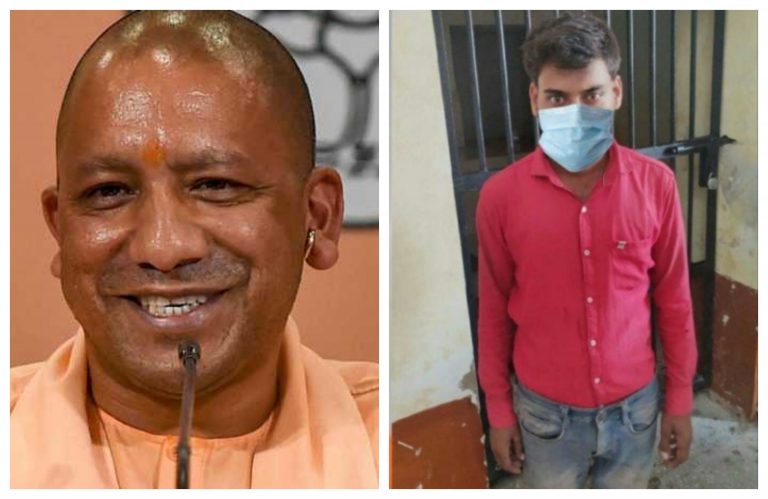
The person who had sent threats to kill Uttar Pradesh Chief Minister Yogi Adityanath has been arrested by the UP Police, as reported by Amar Ujala. The culprit has been identified as Amarpal who drives a truck and belongs to Etawa, informed Hazratganj police station SHO Anjani Pandey. He was arrested by the police from Lucknow today.
According to the police, the culprit said that he had sent those threat messages under intoxication when questioned by the police. He denied having any connection with anyone.
The culprit had sent threat messages against CM Yogi on Wednesday on the UP Police number. In the messages, he had demanded the release of jailed BSP MLA Mukhtar Ansari. He had threatened that if Ansari was not released within 24 hours, the Uttar Pradesh government will be wiped out by September 25. A case was registered against the culprit by SHO Anjani Pandey. The had started a look-out for the culprit after the threat messages were received. The police were investigating the number from which the messages were received.
Imprisoned BSP MLA Mukhtar Ansari is lodged in jail. Recently, the Uttar Pradesh government had demolished some illegal properties belonging to Ansari and had also seized the properties worth over 3 crore belonging to close aides of Ansari.
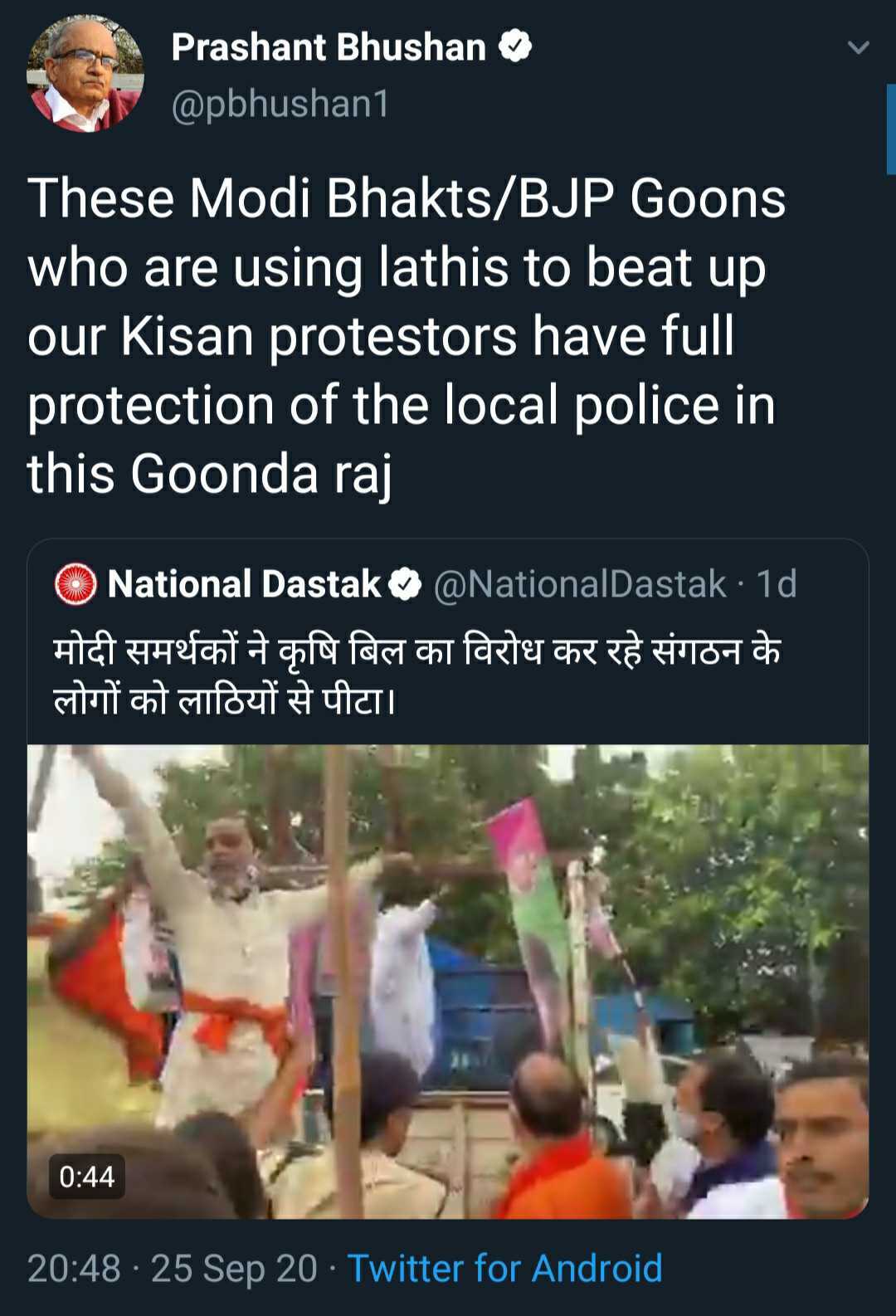
A purported video of alleged BJP workers assaulting a few members of Pappu Yadav’s Jan Adhikar Party in Patna, Bihar has gone viral on social media platforms.
The attack allegedly took place when JAP leader Pappu Yadav was taking out a tractor rally in Patna to protest against the agriculture bills passed by the Modi government.
A news portal named ‘National Dastak’ had tweeted a video of the so-called attacks by the BJP workers against the anti-farm bill protestors in Patna, Bihar. Posting the video of the incident, the news organisation had claimed that Modi supporters had attacked a few people with sticks for opposing the agricultural bills.
In the 90-sec carefully-edited video, it can be seen that a group of people, alleged to be BJP workers, were climbing a vehicle carrying JAP posters to thrash party workers with sticks.
As soon as the video of the purported incident became viral on the internet, the members of the ‘liberal-secular’ establishment jumped on to the scene to peddle misinformation about the entire incident to insinuate that the BJP workers had attacked the members of opposition parties for protesting against the farm bills.
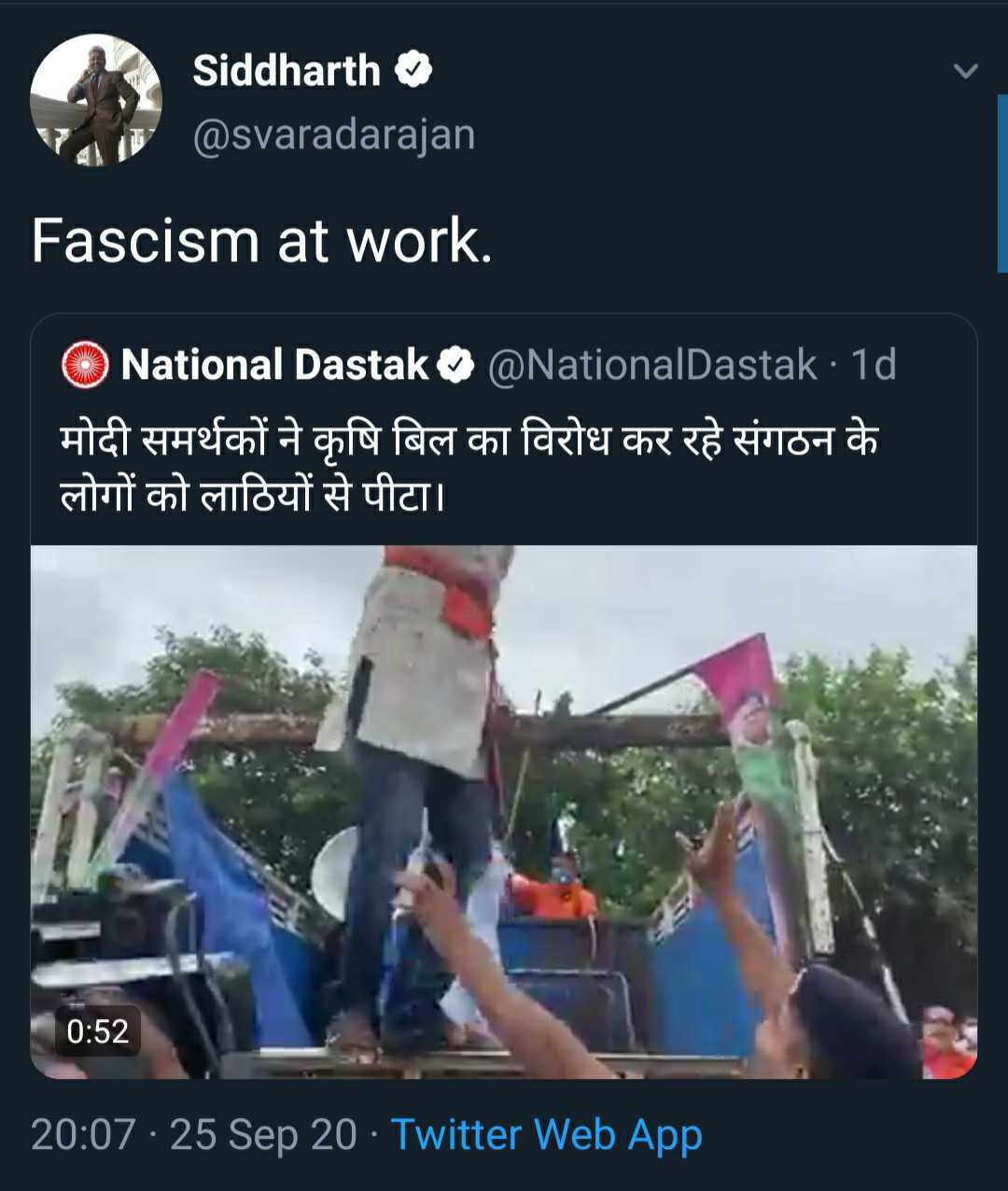
The founding editor of the far-left website ‘The Wire‘ -Siddharth Varadarajan, who has a history of peddling information on social media platforms, posted the video shared by National Dastak and went to claim that the attack by the BJP workers against opposition workers was nothing but ‘fascism at work’.
Image Source: Siddharth Varadarajan
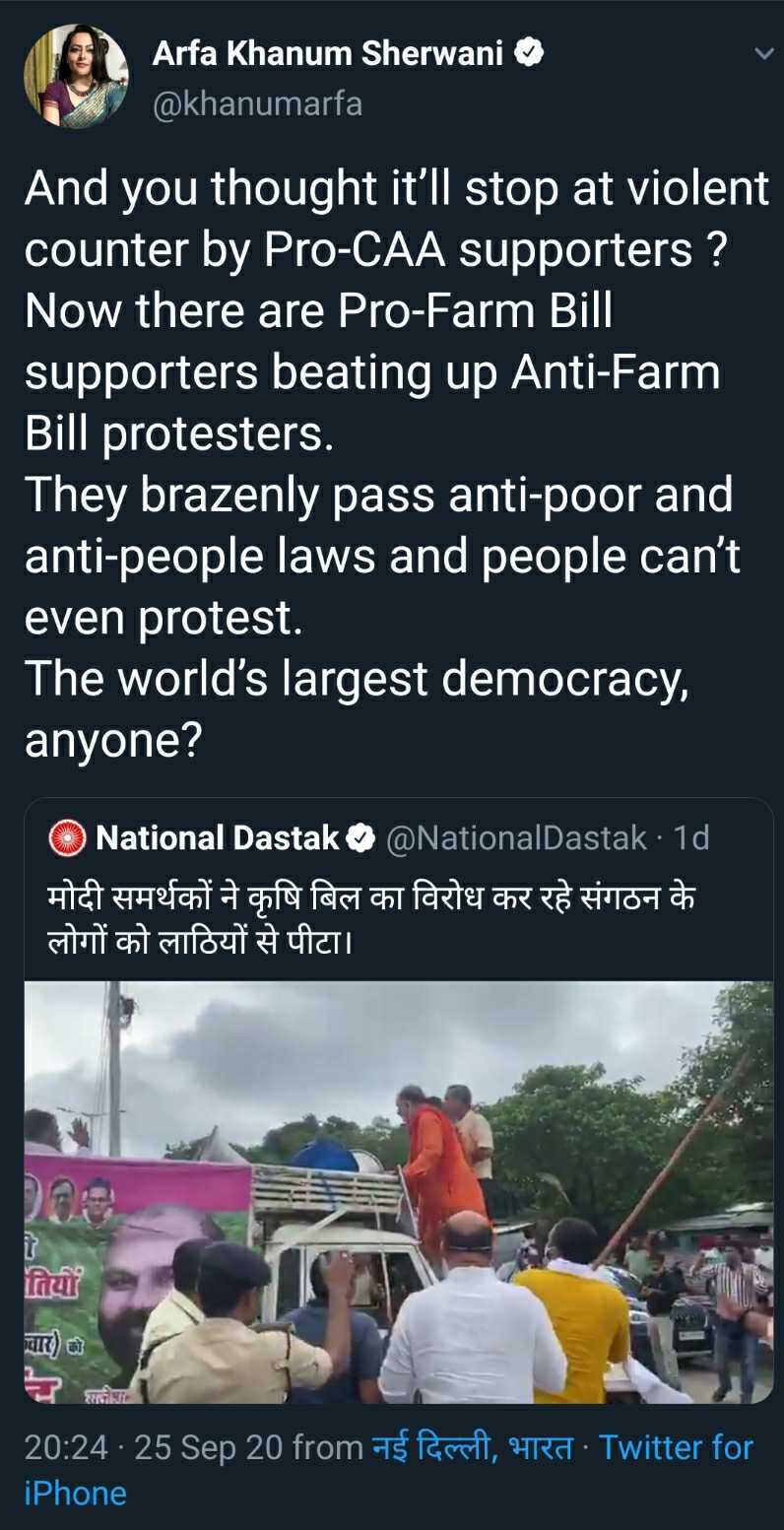
Another self-proclaimed ‘journalist’ and Islamist – Arfa Khanum Sherwani, following the footsteps of her editor at ‘The Wire’, too posted the same misleading video to claim that the pro-farm bill supporters were attacking the anti-farm bill supporters.
Bringing an equivalence between the Anti-CAA and anti-farm bill protests, Arfa Khanum Sherwani – a known anti-Hindu and anti-BJP crusader, hinted that the pro-farm bill supporters had attacked the anti-farm bill protestors just like they did to the anti-CAA protestors. Sherwani asked whether people are not allowed to protest against the ‘passing of anti-poor and anti-people laws’.
Image Source: Arfa Khanum Sherwani
Prashant Bhushan, the serial fake-news peddler and a convict in the contempt of court case, yet again shamelessly took to social media to spread his anti-BJP agenda.
Prashant Bhushan said the so-called protesting ‘Kisans’ (farmers) were beaten up by a few people, to whom he referred as ‘Modi Bhakts’ and ‘goons, in the presence of the local police.
Image Source: Prashant Bhushan
However, in a hurry to attack the BJP government and push their anti-BJP agenda ahead of the Bihar assembly elections, the far-left ‘activists’ like Varadarajan and Bhushan resorted to push forward carefully-edited videos that depicted BJP workers as the attackers and the opposition party workers as some sort of victim.
Fact-check
OpIndia has recovered a video of the farmers’ protest that was organised in Bihar Patna’s by Pappu Yadav where the alleged incident is said to have taken place.
In the below, one can see that a group of opposition party leaders were trying to forcefully enter inside the BJP office located in Veerchand Patel road in Patna. The angry anti-farm bill protestors were seen slamming the gates of the BJP office. The Bihar police can be seen pushing away the JAP members, who had allegedly attacked the BJP office in Patna.
Following the attack on the party office, the BJP workers rushed onto the streets to defend themselves from the anti-farm protestors. They climbed on the JAP vehicle allegedly belonging to the JAP members and clashed with the party workers during their act of defence.
It can also be seen that the opposition party workers had created a traffic jam on the streets of Patna. Some BJP workers, who were defending the JAP attack against the party office was also heard saying “Narendra Modi Zindabad”, “BJP Zindabad”.
Instead of reporting both sides of the incident, the so-called ‘neutral’ journalists like Siddharth Varadarajan and Arfa Sherwani deliberately ignored the initial attack on the BJP workers and pushed half-truths regarding the incident to falsely state that it was the BJP workers who had attacked the JAP workers in the first place during the anti-farm bills.
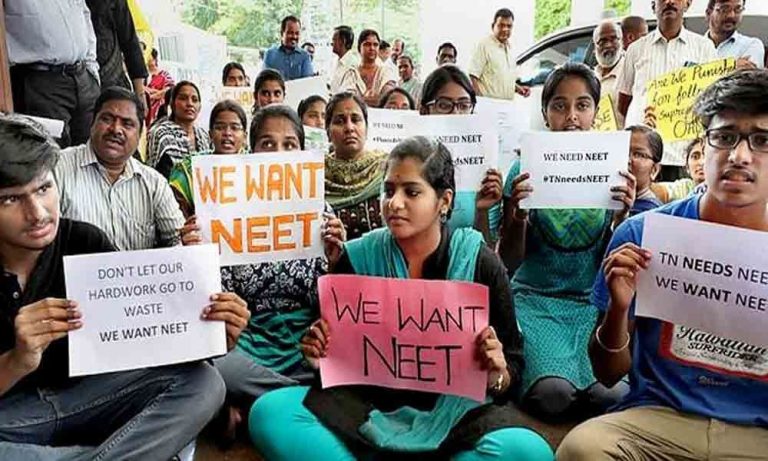
In this section we look at the numbers and the economics of higher education, with special focus on the State of Tamil Nadu, since it is much more advanced along the curve of private players in higher education. The intention is to derive an economic solution for the issue of NEET protests and the seeming unfairness of the selection process.
The 2015-2016 All India Survey on Higher Education, an exercise conducted by the Union Ministry of HRD found 799 Universities, 39071 colleges and 11923 Stand Alone Institutions listed on AISHE web portal across India.
78% Colleges are privately managed; 64% Private-unaided and 14% Private aided. Andhra Pradesh & Telangana have more than 80% Private-unaided colleges and Tamil Nadu has 76% Private-unaided Colleges.
Total enrolment in higher education has been estimated to be 34.6 million with 18.6 million boys and 16 million girls.
Tamil Nadu had 2466 colleges and 35 colleges per lakh of eligible population, ie, the 71.8 lakh individuals in the age group 18-23.
A vast majority of the enrolments is in undergraduate courses – 79%. Across India, only 7.4% of students are enrolled in Diploma courses, majorly in Technical, Nurse and Teacher Training. So, the core market for the education sector is the market for undergraduate 3 and 4 year Bachelor’s degrees.
Before we proceed further, a couple of definitions.
Gross Enrolment Ratio in Tertiary Education = no of people of age 18-23 years enrolled in college vs total number of people in that age group
Eligibility Enrolment Ratio = no of people who of age 18-23 years enrolled in college vs total number of people in that age group who have completed higher secondary school.
India’s GER is 27% while Tamil Nadu’s GER is 49% – 49.8% for males and 48.3% for females. This implies that more than 34 lakh students are enrolled in colleges and 26.8 lakhs in undergraduate courses.
The number of high school matriculates in the last 8 years is tabulated below:
Year
Passed Students in lakhs
2020
7.2
2019
8.07
2018
8.1
2017
8.23
2016
7.61
2015
Not Available
Assuming similar passing numbers and percentages, we arrive at a total number of 45 lakh individuals between the ages of 18-23 that have cleared the 12th examination. Of these, 34 lakh are in college and a further 17 would have completed undergraduation, implying a EER of 100%.
Given reducing drop-out rates and increasing prosperity, we can see the GER go up to 60% in the next decade. This implies a growth rate in addressable market of 20% over 10 years. However, given Tamil Nadu’s low TFR, this growth may moderate to no more than a 15% gain in addressable market share.
Clearly, in the face of a static market, the only choice for a provider in this space is to migrate to higher value segments – that is professional courses that fetch higher fees.
High Value Segments – Engineering
In the academic year 2017-2018, 10 Government Engineering Colleges, 3 Government-Aided Engineering Colleges, 17 Constituent Colleges of Anna University and 550 Self-Financing Engineering Colleges were operating in Tamil Nadu. The number of self-financing colleges grew from 498 in 2011-2012 to 550 in 2017-2018. Of these, 65% of seats in non-minority colleges would be allocated under the Anna University Single Window counselling system and 50% in minority colleges.
For minority colleges, there is a further restriction that 25% of the seats or half the seats in minority self-financing category would have to be filled with students from minorities only.
This means that 35% of seats in general institutions and 25% of seats in minority institutions are available for allotment as per management’s discretion.
The DOTE regulations restrict fees in Government Quota to a maximum of Rs 55,000 per year and in management quota to Rs 87,000 per year. This may be contrasted with typical fees of 25,000 – 30,000 per year for an arts and science degree that is not part of a Liberal Arts program.
While there are 550 self-financing colleges, in recent years, enrolment rates in engineering programs have been very poor; less than half the approved seats were filled in 2019. If this is the situation in Government quota, the situation is equally poor in management quota, where formerly highly sought-after courses of Computer Science and Electronics now go begging.
Between 2005 and 2015, the vast majority of students enrolled in these courses in the hope of securing a placement in an IT company. Over the years, recruitment has dried up, with only the IT Services majors recruiting consistently. Even among the majors, recruitment rates have been very unpredictable. 2017 saw fresh offers of 40,000+, while 2018 saw only 10,000 odd and again perking up in 2019 with 40,000 offers.
As the IT majors move to fixed pricing, longer tenures for junior employees and build out platform-based services, they are no longer relying on a headcount-based growth paradigm. This affects the fresher hiring and thereby prospects for engineering graduates.
Between poor admission rates, regulations and public scrutiny on the practice of collecting capitation fees from students admitted in management quota, many engineering colleges are cutting back on programs, reducing headcount and diversifying to other areas.
Colleges and Politics
The private education market in Tamil Nadu is dominated by politicians or powerful individuals connected to political parties. Wealth of politically powerful individuals through inheritance and rent-seeking crony capitalism is invested in land. An important means of safeguarding land is to transfer property rights to a trust and utilize the land for educational institutions.
A recurring feature in the country side of Tamil Nadu is the sight of huge buildings and a vast bank of land many kilometres away from an urban centre by the side of a highway. Operating a college in such a location offers many opportunities to maximize the investment in land and buildings, in the form of cafeterias, canteens, transport services, all of which have a captive market in the form of college students.
One of the authors has come across a politically well-connected individual who is also from a dominant land-owning caste who runs educational institutions catering to nearly 5000 students. In a vast campus of hundreds of acres, the controlling family runs and engineering college, arts and science college, matriculation school and a residential CBSE school. Besides the usual transport and catering operations, the family also owned poultry and dairy farms, the produce of which has a ready market in the catering operation.
Given the sunk costs and the saturated market, education entrepreneurs are now looking at a new market.
Medical Studies
The premium segment in the education market is the MBBS degree. In lesser order of importance are other associated degrees for Dentistry, Clinical Practice and traditional Indian systems of medicine.
Given the paucity of doctors and increased demand for medical services due to rising incidence of chronic lifestyle diseases, MBBS seats are highly sought after.
After an MBBS, an MD or MS degree has become a necessity for doctors to recover the costs of the MBBS degree. Since the available capacity in India for medical education is scarce, the demand is fulfilled by China, Phillipines, Kyrgyzstan, Poland and Russia. 4000 students go abroad for studying medicine each year. This is a Rs 2000-2500 crore per year opportunity overall.
Tamil Nadu has a total of 3050 approved seats for MBBS. There are 23 Government Colleges, 2 Government Aided, 12 Self-Financing Colleges. Of these, 520 seats are available for self-financing colleges under management quota and another 220 seats under NRI category.
The Government quota seats in self-financing colleges are given by means of common counselling and the colleges cannot charge more than Rs 3.85 lakhs per year. For management quota seats, colleges are allowed to collect 22.5 lakhs per year for regular seats and even higher for NRI quota.
Medical Council of India guidelines place a demand of running a 300-bed hospital for an approved intake of 50 students per year and progressively increasing up to 1100-bed teaching hospital for an approved intake of 250 students per year. There is also an additional restriction on the occupancy rate. Given the long list of regulations, this is a prized source of income for many vested interests in Government.
Since the demand for services from teaching hospitals is low, the college often treats patients at very low costs in order to keep occupancy at mandated levels. In private communications with practising medical professionals, we gather that the total cost of running a 300-bed hospital runs into a sum of Rs 100 crores per year. Of this, at least Rs 50 crores has to be subsidised by the college.
To even recover the costs of running the college, a college must collect at least Rs 1 crore in capitation fees for each admission in management quota.
The educational institution can turn a profit only if it also provides post graduate courses. Colleges were using their own selection criteria to allot seats, ie, sell them to the highest bidders. Now, with the introduction of a standardised test like NEET, this introduces scrutiny.
Between 2006 and 2018, grade inflation became institutionalised in Tamil Nadu’s public exams. The introduction of Samacheer Kavi, with a watered-down syllabus in 2010 meant that even students that got through the management quota had high scores of 85% and above. Now, with standardised, nation-wide tests being administered, the scores are being brought under scrutiny and questions are being raised as to the vast gap in scores of students being admitted to Government colleges vs students admitted into private universities.
If NEET score criteria are applied to private colleges without distinction between Government and management quotas, it will sound a death knell for the medical education industry.
50% of the high fee yielding seat capacity is held by 2 politicians, both of whom belong to the DMK’s political formation and the remaining is held by individuals with political connections across parties.
We hope that this analysis will yield an insight as to the reasons behind the protests against NEET in Tamil Nadu.
Finding a Solution
Now that we have an idea of the situation, let us attempt and frame a problem for which a solution must be sought.
The problems that we seek solutions for are:
The supply-demand mismatch in MBBS seats.
Making the supply of MBBS seats profitable, to enable private providers to close the gap that Government providers cannot.
Ensure that merit is not compromised in selection of candidates
Ensure social justice is not compromised, enough seats are available at affordable prices and reservation norms are fulfilled
To ensure that the first requirement is fulfilled, there must be a gradual increase in number of seats and build-up of capacity both in Government medical colleges as well as private colleges. Setting up new medical colleges with one Government college for each district, and increase seats by 10% per year with an aim to double the availability of Government college seats in 5 years.
Similarly, the Government must engage with private players to define the optimal number of total seats and the ratio of Government vs management quota in such a manner that private medical colleges are able to make a profit even at an overall cost of Rs 30 lakhs for a MBBS degree.
A simple back of the envelope calculation would show the split of seats that could achieve all four goals across India
Seats in Government colleges – 45,000 from the current 23,000
Government quota seats in private medical colleges – 25,000 from the current 17,000
Management quota and NRI seats – 40,000 – at a annual cost of 7.5 lakhs per seat, this would imply an income of Rs 15,000 crores per year, which could go towards subsidizing 9 lakh beds in teaching hospitals.
This must be done without allowing management and NRI quota seats to be allotted to students that score less than 40% in the qualifying examination. A standardized set of evaluations administered at the end of the MBBS degree will also help in avoiding dilution of quality in qualifying doctors.
A cost of Rs 30 lakhs overall will also create a space for banks to step in with loans. The same cycle has played out in the engineering education segment. The rise of a large number of engineering colleges and reduction in cost of education created a market for education loans. The boom-bust cycle in IT jobs and dependent engineering degrees having played out, bankers are facing rising NPAs and education loan defaults.
Taking lessons from the engineering education industry, the increase in seats must not follow the same rate of growth but rather allow the market to grow in a slower fashion, so that the risk of NPAs is lower.
At the same, we must also plan for cyclical growth and slowdown in medical education markets. Failing to do so will only result in increase in financial malpractice and reduction in availability of qualified doctors.
To summarize, a gradual increase in capacity for MBBS seats to roughly twice the numbers of today all-India and continue with the existing quota system will have the following effects
Reduce the per-seat cost of a management quota MBBS degree to Rs 30 lakhs over four-and-a-half years.
Create a market for medical education loans
Improve the scores of students admitted under management quota, since a much larger pool of people will be able to apply under this quota.
This will have an impact in improving availability of medical services and increasing the per capita physician availability rate.
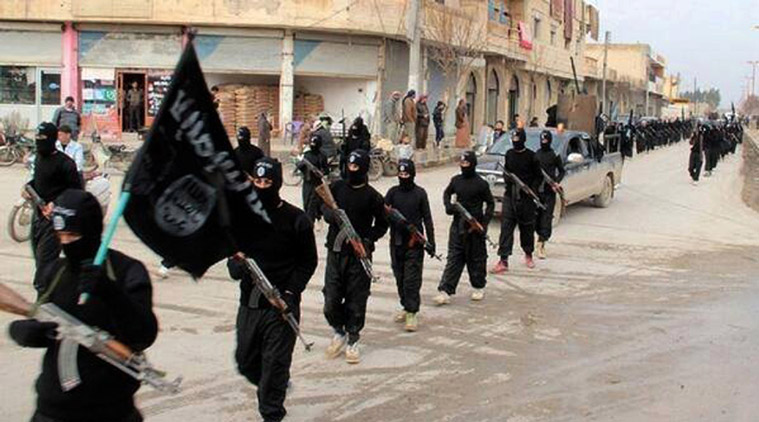
A Kochi court on Friday found an Indian national trained by ISIS in Iraq in 2015 guilty of hatching a criminal conspiracy to wage war against the Indian and Iraqi governments.
Subahani Haja Moideen, a resident of Kerala and the kingpin of ISIS activities in South India, was arrested in 2016 from Tamil Nadu’s Tirunelveli district in connection with the bust of an ISIS terror cell that was planning to carry out attacks at public places and eliminate certain prominent personalities.
Moideen is convicted under IPC Sections 120(B) (Criminal Conspiracy), Section 125 (waging war against Asiatic power in alliance with the Government of India) and Unlawful Activities (Prevention) Act, Section 20 (Punishment for being a member of terrorist gang or organisation). The Special Court also held him guilty under Section 38 (Offence relating to membership of a terrorist organisation) and 39 (Offence relating to support given to a terrorist organisation).
The court will announce the quantum of punishment to Moideen on Monday.
ISIS-module busted in Kerala and Tamil Nadu led to the arrest of Subahani Haja Moideen
Subahani was arrested on October 3, 2016, by the National Investigation Agency after police busted an ISIS-inspired module and arrested 6 people from Kerala and Tamil Nadu. The youth arrested were reportedly collecting explosive to execute their nefarious designs in India.
Five of them were arrested while conducting a meeting Kanakamala hilltop, Kannur District, Kerala. The sixth accused was arrested from Kuttiyadi in Kozhikode district. Those arrested were identified as Manseed alias Omar Al Hindi (30), a resident of Kannur, Abu Basheer alias Rashid (29) from Coimbatore, Swalih Mohammed T alias Yousuf (26) from Thrissur, Safwan P (30) from Mallapuram Kerala, Jasim NK (25) alias Kozhikode and Ramshad Nageelan Kandiyil alias Aaamu (24) from Kozhikode.
The police secured vital information from the arrested youth that led to the arrest of Moideen from Tamil Nadu’s Tirunelveli district. He had fled to Tamil Nadu from Kerala after the National Investigation Agency arrested 6 of his associates for having suspected links to ISIS.
Subahani knowingly and intentionally became the member of ISIS
During the interrogation, Moideen confessed of having served in Iraq for the Islamic State. He said that he was radicalised and indoctrinated on social media following which he told his parents and wife of going to perform Umrah. However, he went to Istanbul instead and crossed over into the ISIS-controlled region of Iraq to fight for the terror outfit.
Subahani joined that ISIS and waged a war against the Government of Iraq, an Asiatic country having ties with India. It is for this reason that NIA invoked Section 125 of the IPC against the terrorist, which is a very rarely invoked section that deals with waging war against an Asiatic country.
ISIS terrorist Subahani had got training in using lethal weapons such as the Russian-made heavy machine gun called Dushka and grenade launchers. He was among the few Indians to have gotten tough battle training in Iraq to wage Jihad.
However, he told his ISIS handlers of he could not cope with the gruesome nature of terrorism in Iraq after he saw two of his friends reduced to ashes in a shell attack. He was jailed for deserting ISIS and remained incarcerated for 55 days. Subahani was subsequently transferred to Turkey from where he contacted his family with the help of Indian consulate.
Once he was back in India and settled, he once again contacted ISIS handlers over the Internet and was planning to carry out attacks in India. He was tasked with the responsibility of building the ISIS terror cell and spreading the terror network of the organisation in the Indian subcontinent. He was planning to collect explosives and precursor chemicals from Sivakasi to conduct the attacks but was arrested by the NIA just in the nick of time.
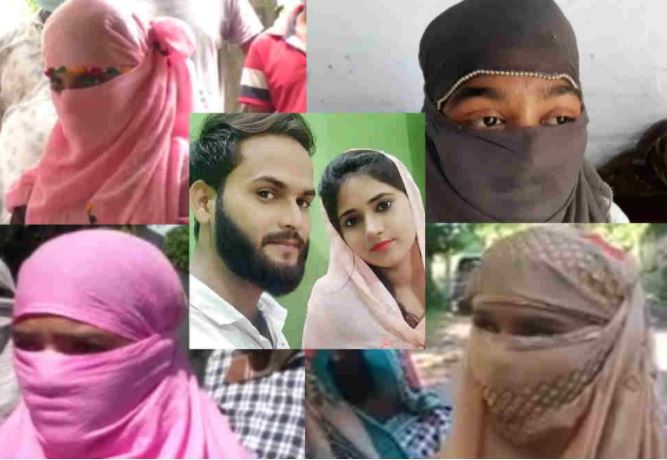
In a major breakthrough, the special investigating team (SIT) which has been working relentlessly under the directions of Uttar Pradesh CM Yogi Adityanath, to probe the allegations of ‘Love Jihad’ and forced conversion in the state, has managed to establish links between all the five cases which were reported from Kanpur’s Juhi colony last month. According to a Jagran report, the Uttar Pradesh police, after scrutinising the call record details (CDR) of the five Muslim youths accused of implicating Shalini Yadav and four other Hindu girls in Juhi colony, ascertained that they were not only in touch with each other but also working in unison.
It is pertinent to note here that these five girls, belonging to different families, hailing from different areas, had almost at the same time ended up abandoning their families, converting to Islam and marrying these boys.
Interestingly, the call records of Faisal accused in Shalini Yadav’s case, the two Shahrukhs accused of implicating two sisters from the Kalyanpur on July 2 and Mohd Moseen and Aamir, accused in the Panki case, showed that all these five boys interacted daily with each other. SIT’s in charge CO Govindnagar Vikas Pandey also said that evidence points out that these youths were in regular touch and often met each other.
Though the UP police have still not managed to identify the alleged mastermind of the racket, it said that the disclosure definitely authenticates the claims that an entire “Love Jihad” syndicate has been working in various parts of Uttar Pradesh, especially the western fringe of the state.
OpIndia extensive reportage on this ‘organised crime’
While extensively reporting about these cases of Love Jihad in Kanpur’s Juhi colony, OpIndia had turned the spotlight on the forces which are active across the country, targeting susceptible and vulnerable Hindu women, luring, brainwashing and forcefully converting them into Islam. OpIndia spoke to the Bajrang Dal activists, who explained how these cartels operate with financial support from various Islamic organisations.
In fact, owing to this case, Juhi colony’s Shalini Yadav’s case and several such cases reported from different parts of the state, the Uttar Pradesh police have constituted a special investigating team (SIT) to probe allegations of ‘Love Jihad’ and forced conversion.
Possibility of banned radical organisations like PFI and SIMI being behind the funding of the ongoing ‘Love Jihad racket’ in Kanpur
The SIT, which has come across at least 9 such cases of recent past, has decided to broaden the scope of its investigation and probe the alleged role of the banned radical organisations like Popular Front of India (PFI) and SIMI behind the funding of the ongoing ‘Love Jihad’ racket in Kanpur.
Pertinently, the banned radical Islamic organisations like PFI and SIMI are notoriously known for funding various anti-national activities. Last year in December, during the anti-CAA protests that had literally engulfed the entire country, an Intelligence report shared with the Ministry of Home Affairs had pointed to some ‘political parties’ and banned radical Islamist outfits like SIMI and PFI for being behind the violent protests in several places across the country.
According to a Zee report, Pakistan funding might also be involved in the Love Jihad conspiracies that have been rearing its ugly head across the country, especially in Uttar Pradesh.
Meanwhile, according to Inspector General (IG) Kanpur, Mohit Agarwal, who set up a Special Investigation Team (SIT), led by Superintendent of Police south Deepak Bhuker, to probe the matter, there is a large possibility that these Islamic outfit is trying to spread ‘jihad’ across the length and breadth of the state by providing financial assistance to a handful of organizations that are involved in such anti-national acts.
He has instructed the team to collect information about such organizations and such people from the mobile numbers of the accused.
On July 25, Bharatiya Kisan Union and several other organisations had called for a nationwide strike, a Bharat Bandh, protesting against the three bills relating to the agriculture sector passed in the just concluded Parliament session. The call for Bandh was supported by the Congress party. Most of the protests were seen in Punjab, where the ruling Congress government is joining the protests Although the bills bring much-needed changes to the farm laws that are extremely beneficial for the farmers, which were proposed by the Congress party also when they were in power, now they are opposing the bills for political purposes.
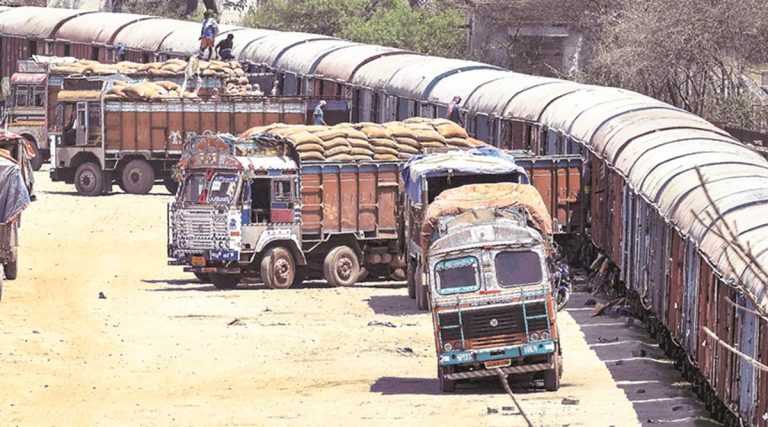
As part of the protests, the protesting organisations also announced ‘rail roko’ protests. But it seems there was no impact on the movement of trains, as there no drop in the amount of freight carried by Indian Railways yesterday.
According to data provided by the Railways, total freight loading by the railways on 24th September was 3.42 MT (Million Tonnes), which was 26% more than the same date last year. The Indian Railways earned ₹326.42 crore yesterday from freight operations, an increase 19% compared to last ₹273.37 crore in the last year same day.
In fact, Railways saw an increase in freight volume during the Bharat Bandh compared to the previous day. On September 24, the loading volume was 3.4 MT. The same for Friday in the last week was 3.19 MT. This shows that there has been a steady increase in the freight carried by the Railways, the farmers strike had no impact on its movements.
The Railways have moved 83.74 million tonnes of cargo in the month of September till 25th, earning a revenue of ₹8,071.20 crore. The volume in the same period last war was 273.37 MT and the revenue earned was ₹7230.63 crore. This shows that the freight volume has grown by 19%, while the revenue increased by 12%.
This year has seen a significant increase in the speed of goods trains. The average speed of the trains for the month stands at almost 47 kmph, almost double from the last year’s average of 24 kmph. Absent of most passenger trains due to the lockdown, and improvements made to the tracks taking the opportunity of less train movements, are the main two main reasons for this increase in average speed of freight trains. This has ensured that different places in the country get essential commodities and other items get much sooner than earlier.
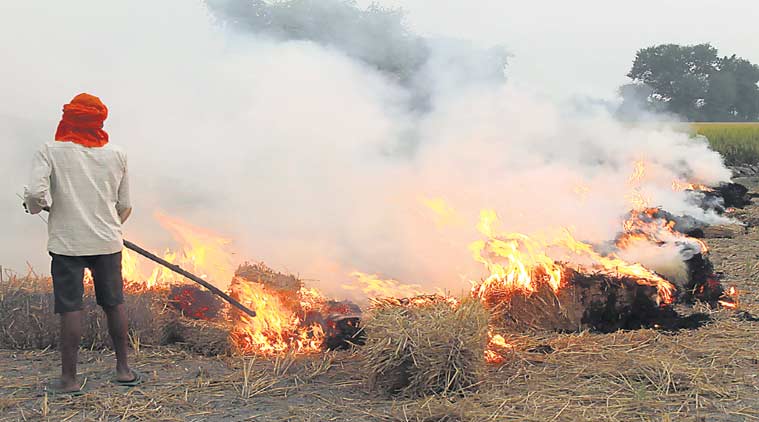
The menace of stubble burning in Northern India is not a new phenomenon. As winter approaches, major parts of north India are covered in a smoky haze, primarily caused by the stubble burning in Punjab and Haryana, and to a lesser extent in states of Uttar Pradesh and Rajasthan.
This year too, stubble burning in some states of north India have already started. According to satellite images released by the National Aeronautics and Space Administration (NASA), plumes of smoke are seen over Delhi, and other parts of north India, raising concerns over deteriorating air quality that usually accompanies the smog caused by stubble burning.
Stubble burning could aggravate COVID-19 situation in north India
Every year, Delhi and the surrounding places witness a steady deterioration of air quality during the months of winter because of a host of reasons such as unfavourable weather, stubble burning and local sources of pollution. However, this time around, the situation is more serious, considering the country is in the throes of an unprecedented coronavirus crisis, a pandemic known for causing serious respiratory complications.
Doctors and environmental experts believe that stubble burning and the subsequent deterioration of air quality could aggravate the COVID-19 situation in north India and pose a major challenge for the government to cope with the effects of worsening pollution on the coronavirus crisis. Coronavirus and the exacerbating air pollution could prove to be a double whammy for COVID-19 patients, who already face breathing issues due to the contagion.
According to doctors, alarming levels of air pollution causes an increase in the cases of asthma and with the hospitals already battling COVID-19, a respiratory illness, it will be difficult for them to distinguish whether a patient is suffering from asthma flare-up or coronavirus. Doctors also believe that people who are prone to dust allergies or are asthma patients are more susceptible to contracting the coronavirus and high exposure to air pollution is likely to increase their vulnerability to the contagion.
Punjab Government busy protesting as crisis looms
As per the data provided by Goddard Earth Sciences Technology and Research (GESTAR), stubble burning in Punjab is on the rise and several towns and cities of the state such as Amritsar, Tarn Taran, Kapurthala, Jalandhar, Gurdaspur, Pathankot and parts of Firozpur are already spotted in satellite images with plumes of smoke over them.
According to reports, 297 stubble burning incidents have been already reported between 21st & 25th September this year from Punjab. Last year, there had been 197 such incidents in the same period. The Supreme Court had last year made critical observations on stubble burning incidents and slammed the Punjab and Haryana governments for not doing enough to address the farmer woes.
Despite the rising number of stubble burning incidents and the Supreme Court rap, the Punjab government has turned a blind eye to the real reforms that could eliminate the chronic problems bedevilling farmers in the state and compelling them to burn the stubble. Instead, the Punjab government is busy mobilising resources to organise and support the protests against the recently passed farm bills.
Instead of addressing the pressing concern of farmers regarding stubble, Punjab’s finance minister Manpreet Singh Badal on Friday threatened the central government of approaching the Supreme Court against the recently passed farm bills.
Amritsar: Jeet Singh, a farmer says, “Farmers don’t wish to burn stubble, but we are compelled to do it as govt is not providing us with a solution. We asked District administration to take it & dump it, but they didn’t take any action. So, finally after 10 days, we burnt it.” https://t.co/I5SB3dIEV2pic.twitter.com/kaeOKdRpaj
The apathy of the Punjab government towards the problems faced by farmers was encapsulated by a farmer in an interview with ANI. Speaking on the issue of stubble burning, a farmer, Jeet Singh, said that the farmers don’t wish to burn the stubble and vitiate the environment but they are compelled to do it because the government has failed to provide any solution to them.
“We asked District administration to take it & dump it, but they didn’t take any action. So, finally, after 10 days, we burnt it,” he said.
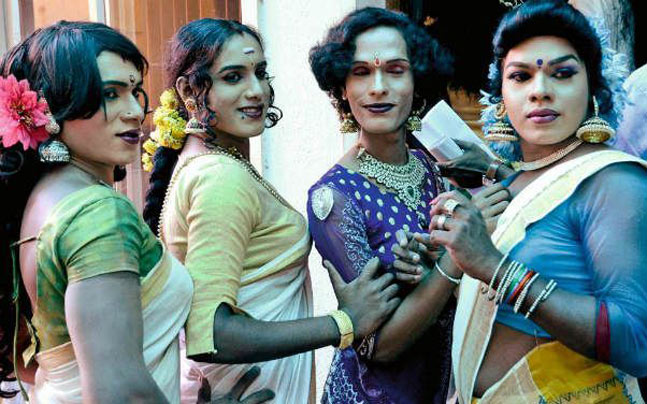
A petition has been filed in the Supreme Court seeking protection for the transgender community under laws against sex crimes. As reported by Live Law, the plea states that provisions available under the Indian Penal Code (IPC) do not provide protection to transgender persons from sexual crimes by males, females or even from another transgender person.
The petition, filed by Advocate Reepak Kansal, challenges clauses (i), (ii) and (iv) of sub-section (1) of Section 354A of the IPC as being ultra vires the Articles 14, 15 and 21 of the constitution contending that the above mentioned clauses exclude transgender persons from being considered victims of sexual harassment.
How the Law Excludes Transgender Persons
Advocate Kansal has stated in the plea that Indian laws against sexual crimes are for men and woman and the transgender persons, being neither men nor women, fail to get justice under the available laws. He has requested the court to make appropriate modification or interpretation of the relevant sections of the IPC so as to include transsexuals or eunuchs under them.
He said that Articles 14 and 15 do not limit the term person to just male and female and therefore the state cannot discriminate on the ground of gender. He relied on Article 21 which provides every person the right to life and personal liberty which includes life with dignity and said that due to sexual and hate crimes, transgender persons cannot lead their lives with dignity.
The Decision in NALSA v Union of India
Advocate Kansal referred to the Supreme Court decision in the 2014 case of National Legal Services Authority v Union of India in which the court had recognised transgender people as ‘persons’ under Article 14. He said despite the fact that transgender persons have been declared as Third Gender by the court, there is no provision under the IPC which extends protection to transgender persons against sex crimes.
The petition also cites some statistics indicating high levels of sexual abuse of transgender persons. The statistics referred show that one in every two transgender persons is subjected to sexual abuse or assault at some point in their lives. Some of them are also subjected to sexual abuse and assault in jail or police custody. The pleas states that 15% of transgender persons report being sexually assaulted while in police custody or jail. No separate jails, wards or security are there for transgender people.
Filing of Sexual Assault Cases Against Transgender under 354A
The petition states that the Delhi Police has submitted before the Delhi High Court that all the cases of sexual harassment against transgenders will be registered under section 354A of the IPC. However, the statement of the Delhi Police does not have a legal backing and it has not binding force in other states. The petition highlighted that India is a signatory to the Universal Declaration of Human Rights (UDHR) and therefore, the rights relating to life, liberty, equality and dignity available under the Constitution as well as the International Covenants are enforceable by the courts.
The plea, in addition to appropriate writ, order or direction, has sought directions from the court for:
Setting up of gender-neutral sexual harassment mechanism,
Enactment of an Anti-Discrimination Bill that penalises discrimination and harassment on the basis of gender,
Adoption and implementation of the UDHR, and
Framing of guidelines for the protection of the Fundamental Rights of transgenders till legislation to that effect is passed.
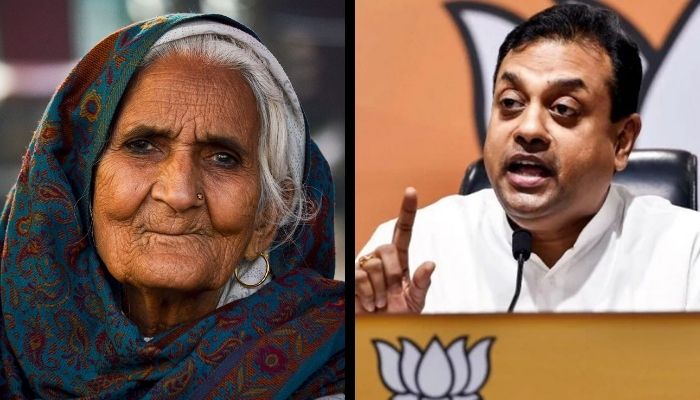
During the ‘Taal Thok Ke’ show on Zee News that was aired on Wednesday, BJP leader and spokesperson Sambit Patra took a dig at the opposition parties at the expense of Shaheen Bagh ‘Sherni’, Bilkis Bano. Bilkis, one of the ‘dadis’ of anti-CAA protest site Shaheen Bagh, has been named by the Time Magazine in its list of ‘100 Most Influential People of 2020’.
In response to a bizarre comment by Tanveer Ahmed about respecting the post of Prime Minister but not Narendra Modi, Sambit Patra stated, “I would like to congratulate you first. As you said, you respect the position of the designation of Prime Minister but not Narendra Modi. I would like to congratulate you and co-panelist Safoora Jahan.”
He emphasised, “Aap logo ko dadi hui hai. Aap log rakho na.Aap pradhan mantri ke khilaf khada bhi kar do dadi ko. Kisne mana kiya hai. (Congratulations on the emergence of a new dadi [referring to Bilkis Bano]. Keep her with you. I will suggest you to nominate her against PM Modi. Who has stopped you from doing so?)”
Sambit Patra hits out at Sonia Gandhi and Owaisi
While taking potshots at the Congress party with references of party supremo Sonia Gandhi as the ‘mummy’, Sambit Patra stated, “Mein toh keh raha hu mummy ko hata ke dadi ko lao. Aur Congress party sune. Mummy ko hatao dadi lao. Owaisi bhi hatey dadi laye. Dadi hui ke congratulations. (I am telling you to remove ‘mummy’ Sonia Gandhi and bring in Bilkis dadi. The Congress party must listen to it carefully. Owaisi too must get hold of dadi. Congratulations on the rise of Bilkis.)”
While taking a dig at the Shaheen Bagh ‘sherni’, the BJP leader asked, “She is superbly talented. She has featured in the list of top 100 people in the world. Do you think this is a small feat? A proposal must be placed by evening that only Bilkis dadi can compete with PM Narendra Modi. This is because she also does like the Prime Minister. Safoora Jahan is also sitting here. Ask her about the proposal.”
Shaheen Bagh Anti-CAA protests
The anti-CAA protests, especially at Shaheen Bagh, which began as a peaceful protest crossed all the boundaries as it turned out to be another typical left-wing managed anti-India event. Eventually, the Shaheen Bagh protest site had provided fodder and a shield for violent rioters who had, in February, targeted Hindus and gone on a rampage burning the capital, timing the bloodbath with US President Trump’s visit to Delhi.
Following the failure of violent protests perpetrated by the Muslim mobs on the streets of Delhi and Jamia Millia Islamia University, few women belonging to Muslim community sat on a protest at Shaheen Bagh, blocked a bus stop and a highway causing severe problems to the public of Delhi.
Shaheen Bagh protests, which were initially passed off as an organic protest in a bid to ‘save the constitution’ began to turn into a blatantly communal event. It was earlier reported that the Muslim mobs had shouted pro-Pakistan and Hinduphobic slogans like “Jinnah Wali Azadi”, demanding another partition of the country.
Not too long ago, India provided refuge to twenty-one Hindu and Sikh families from Ghazni in Afghanistan. The constant threat to their lives and the hardships they have to endure is not something that is secret. Islamic terrorism and extremism has made the lives of ethnic and religious minorities in the war torn country a living hell.
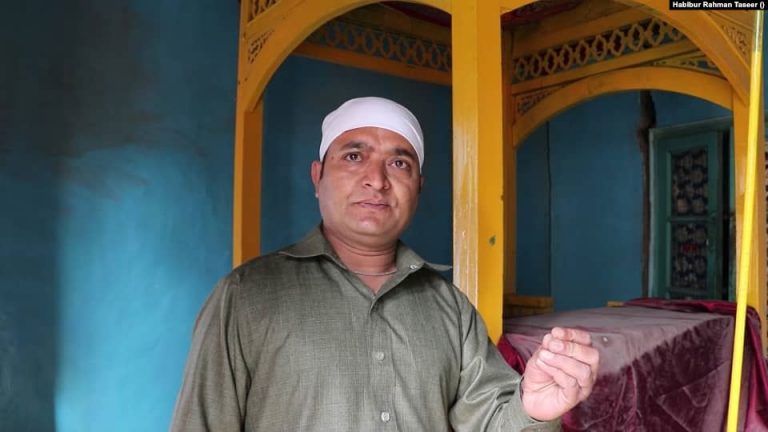
While the Hindu and Sikh families came over to India, one man remained. He had to stay behind in order to take care of the Hindu Temple that still exists. His name is Raja Ram. He may have never set his feet in India but his name bears the unmistakable mark of the intimate relationship he shares with out country.
Raja Ram told Radio Free Afghanistan, “We all love our homeland, but they had to flee after the attacks.” “To everyone, their homeland is Kashmir,” he added. He further said, “Members of our community have left with broken hearts because of their worsening circumstances here.” His wife and four children have come to India, in the hope of a better future, but he chose to remain to take care of the Temple. He is paid nearly $100 by the Afghan government a month to take care of it.
The last Hindu of Ghazni still hopes that there will come a day when his wife and children will be able to return to the place they call home and live in peace. But perhaps, he knows in his heart that these are mere fantasies and it does not do well for people to dwell too much in them. “I hope that everyone will return to Afghanistan once there is peace here. The Hindus and Sikhs are sons of this soil — they are Afghans, too,” he said.
Hindus and Sikhs were once an 80,000 strong minority in Afghanistan but they are now vanishing. Most of them have come over to India while some, with the means for it, chose to leave for the West. In India, the beleaguered minorities have found a home and an opportunity to build a future for their children.
While they still miss their homeland, sometimes, as is human nature, they are grateful for the opportunity India has provided them with. And it is in their hopes that India finds the true meaning for its existence. It is the sacred duty of our country to provide shelter to Hindus, Sikhs, Jains and Buddhists whose lives are in jeopardy in our neighbouring Islamic states.
The passage of the Citizenship Amendment Act, 2019, was the first step towards recognising this sacred duty that India bears towards these unfortunate victims of Islamic extremism. It was opposed tooth and nail by many but the misery that such refugees have to endure illustrates perfectly the necessity of it. In neighbouring Pakistan, we are daily witness to the savagery that the Hindu and Sikh minorities are subjected to.
The story of the last Hindu of Ghazni, Raja Ram, also demonstrates the sacrifices that Hindus have made through the ages to ensure the continued worship of our Gods and Goddesses. All alone in a hostile environment, with his children and wife away in a distant land, he chose to remain to ensure that a candle is still lit in the Temple that has been placed in his care. It is through these monumental sacrifices that our civilisation is sustained and the flag of our ancestors continues to fly high.