The carelessness of Mumbai Metro authorities took the life of a motorcyclist and seriously injured his pillion rider. A 28-year-old biker was reportedly killed after a metro rail barricading fell on him. The biker and his pillion rider came under the wheels of a truck coming at speed from behind.
In the un-dated 20-second video that was captured on a CCTV, it was clearly visible that there was dense traffic at the spot and the majority of the vehicles were moving at speed. The accident took place in Kandivali at Western Express Highway. One of the riders died on the spot while the other rider was seriously injured.
Nutella USA, while responding to a question on Twitter clarified that their product is not halal. Halal means ‘permissible’ or ‘lawful’ in Arabic while ‘haram’ means forbidden. Halal is usually associated with dietary laws as per Islam and meat needs to be processed as well as prepared as per those requirements.
Muslim fans were clearly not amused. However, instead of taking out their anger on the hazelnut chocolate spread brand, they decided to convince the brand and themselves that while it is not ‘halal certified’, it is still halal by default.
It’s just not certified halal but it is halal by definition as long as there are no animal by products (aside from dairy) or any alcohol in it
When a heartbroken fan asked for proof that Nutella is not halal, another fan explained how there are no animal products (except dairy) or alcohol in it, it is halal by default, not just ‘halal certified’.
Yes they are. Paying a Rabbi/Imam/Priest to sign a piece of paper doesn’t make things halal or not halal. All of your ingredients are halal, your product couldn’t be “not halal” even if you wanted them to be.
Some even suggested how Nutella USA should learn social media from other brands which know how to communicate about labelling.
This is a typical example of a company's social media account answering a question they don't have proper knowledge about. They could have said Nutella are not halal certified. I think companies in the UK are much more educated about halal labelling than the US. https://t.co/elpAG7ftT1
In reality, the halal certification depends on the country one lives in. US and Canada laws do not require certain products to be halal certified while the same products with same ingredients are halal certified in other countries they are sold. You could read more on halal and non-halal products here.
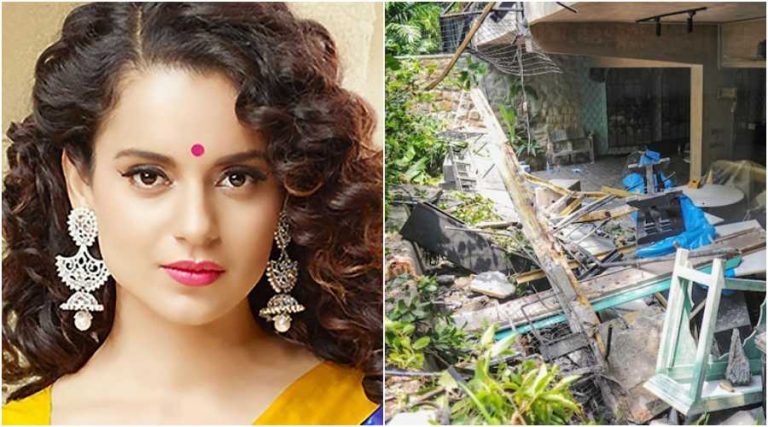
Days after the highly publicised war of words between the Shiv Sena and actress Kangana Ranaut, the party bulldozed the office of the actress. Meanwhile, Shiv Sena workers, also known as Shiv Sainiks, thrashed a retired navy officer Madan Sharma for sharing a Whatsapp forward criticising Uddhav Thackeray.
During a panel discussion on Aaj Tak on the issue of hooliganism of the Shiv Sainiks and the high-handedness of the Maharashtra government, actor Nassar Abdulla came in support of the party. Abdulla, who featured in movies such as ‘Gandhi’, ‘Main Hoon Na’, and Page 3, not only acted as an ‘unofficial spokesperson’ but also attempted to whitewash the actions of Shiv Sena by suggesting that the party respects women.
Shiv Sena has a culture of violence, concedes Nassar Abdullah
“It is a well-known thing about Shiv Sena’s history. Whenever someone spoke against them or mocked them or even made cartoons on them, they have always reacted violently. Breaking offices, assaulting people is not a new phenomenon. I am seeing this for the past 20-25 years. We know what happened to Nikhil Wagle,” conceded the actor.
The above mentioned part can be seen in the video from 32.00 minutes onwards in the video.
(Video Courtesy: Aaj Tak)
Nassar Abdullah resorts to victim blaming
While lending credence to the actions of the Maharashtra government, Abdullah had a word of caution for the Shiv Sena. He said, “”This is proving costly for Shiv Sena. Whatever they did with Kangana as a reactionary measure was wrong to a large extent…” Later, he resorted to victim-blaming to shift the onus from the party’s collective action to one individual. Abdullah stated, “They need to now think about how they are going to approach the situation… Kangana has misused her freedom of speech. It was a highly irresponsible statement.”
Shiv Sena did not assault Kangana because they respect women, Abdullah makes bizarre claims
Nassar Abdullah claimed, “I am watching Shiv Sainiks engaging in vandalism since the time of Balasaheb Thackeray. However, I want to point it out to you that Shiv Sainiks respect women. Only because Kangana Ranuat is a woman, they did not engage in violence. They just used a bulldozer instead (to demolish her office).” Drawing parallels with the attack on the former navy officer, he said, “Shiv Sainiks aurat ki itni toh izzat karta hai ki hatha pai nahin karta (Shiv Sainiks respect women to the extent that they don’t beat her.)” Abdullah seemed to operate on the belief that party workers were doing a favour on Kangana Ranaut by not thrashing her and just demolishing her property.
India Today anchor trashes bizarre claims of Abdullah
His bizarre attempt at whitewashing the culture of ‘violence’ and ‘vandalism’ imbibed within the Shiv Sena found no takers on the debate. Host Anjana Kashyap rebuked, “I have never heard anything more absurd and ridiculous than this. What are you even saying? Shiv Sena respects women just because they don’t beat and instead send bulldozers to destroy her office. The way you are supporting the Shiv Sena is unique. They respect women so they only beat the retired navy officer.”
Maharashtra government at loggerheads with Kangana Ranaut
The Kangana vs Shiv Sena standoff escalated after Shiv Sena leaders, as well as NCP leaders, threatened Kangana Ranaut for referring to Mumbai as Pakistan-occupied-Kashmir after Azadi slogans were spotted on graffiti. Later, the Mumbai Commissioner of Police also ‘liked’ a tweet abusing her. Shiv Sena MP and chief spokesperson Sanjay Raut even referred to her as ‘haramkhor ladki’. After the misogynist and sexist tirade against her, Raut claimed ‘haramkhor’ means ‘naughty. Sena MLA Pratap Sarnaik had stated that Shiv Sena workers will ‘break Kangana’s mouth’ if she sets foot in Mumbai.
The persecution of Shia Muslims in Sunni-majority Pakistan is not a new phenomenon. Shias who constitute 20% of the Muslims in Pakistan and are often targeted during Muharram processions. While there has been a general decline in violence against Shiites since 2013, sectarian attacks continue unabated in several pockets of the country.
Though both Shia and Sunni Muslims had supported the partition of India to create a Muslim country for themselves known as Pakistan, there has been a lot of enmity between these two sects of Islam, not just in Pakistan, but in many Islamic countries.
Recently, a Shia shopkeeper was murdered in Pakistan’s Karachi, allegedly by Deobandi radical elements.
In light of recent anti-Shia demonstrations in the Islamic republic, the Shia Muslims took to Twitter to narrate their harrowing experiences.
A Twitter user (@Zahara Kazmi) recounted, “I was 6 years old, and this happened at school right after the anti-shia riots that ended in burning my house and the houses of a dozen other shias in KPK, they wrote the same thing “shia kafir” on the burnt and demolished walls of my beloved home.”
I was 6 years old, and this happened at school right after the anti-shia riots that ended in burning my house and the houses of a dozen other shias in KPK, they wrote the same thing “shia kafir” on the burnt and demolished walls of my beloved home.
In another tweet, a Pakistani national wrote that she was just 8 when her classmates informed her that killing a Shia would guarantee a house in ‘paradise.’ She stated that according to Sunni beliefs, the number of such houses equal to the number of Shias being killed by Sunni Muslims.
I was 8 when classmates told me you get a house in Paradise for each Shia you kill. https://t.co/hFUcTVrrFZ
Another user, Saim Rizvi, experienced the sectarianism when he lived in Germany with his Pakistani friends. He wrote, “I never had experienced this until I moved in a student hostel in Germany, where a bunch of Pakistani students mutually decided to avoid eating with me. Avoid praying together, avoid the food I cooked and they ask others to do so. Later I was alone and they preserve their Islam.”
I never had experience this until I moved in a student hostel in Germany, where bunch of Pakistani students mutually decided to avoid eating with me. Avoid praying together, avoid the food I cooked and they ask others to do so. Later I was alone and they preserve their Islam.
Journalist Sarah B Haider reminiscenced how she was labelled as a Kafir (derogatory term for non-Muslims) and ‘gande log‘ (dirty people) by fellow Sunni Muslims. “I was 12 when a bunch of girls in our class started calling me and another Shia classmate “kafir,” “ganday log,” and other things. I never mentioned anything about my faith, my name said it all. Told our teacher, she said: “You all should treat ‘non-Muslims’ kindly,” she tweeted.
I was 12 when a bunch of girls in our class started calling me and another Shia classmate “kafir,” “ganday log,” and other things. I never mentioned anything about my faith, my name said it all. Told our teacher, she said: “You all should treat ‘non-Muslims’ kindly.
Another Pakistani user stated that he was in 6th grade when he learnt about the anti-Shia sentiment in Pakistan. He therefore chose to hid his identity as Shias were ‘often humiliated’. He further added, “I had to sit quietly and watch my fellows get the same treatment. A never ending cycle of pain.”
It started in 6th grade. So as time went by I just hid the fact I was one but those who openly expressed that they were shia were often humiliated and I had to sit quietly and watch my fellows get the same treatment. A never ending cycle of pain.
Recounting the public humiliation, one Wajahat Zaidi wrote, “Class 6. Can’t remember the age. Whole class(excluding girls) loudly chanted Shia Kafir while pointing towards me.”
Class 6. Can’t remember the age. Whole class(excluding girls) loudly chanted Shia Kafir while pointing towards me.
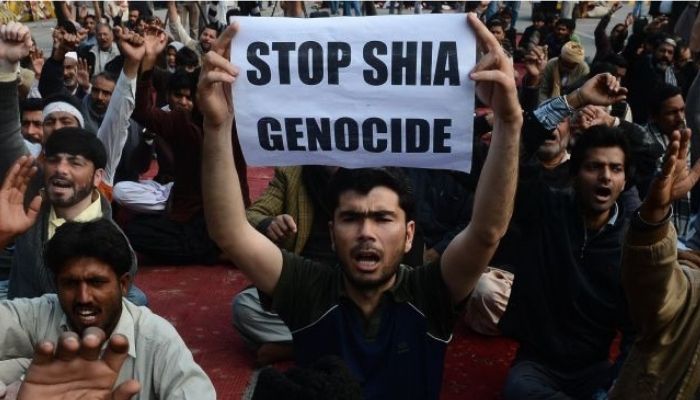
On Friday, thousands of Sunni extremists hit the streets of Karachi to lead anti-Shia protests, thereby escalating tensions between the two Islamic sects and sparking fears of a series of violent events. The rally took place near the Jinnah Mausoleum, also known as Mazar-e-Quaid. The Sunni extremists were affiliated with anti-Shia groups such as Sipah-e-Sahaba and Tehreek Labbaik Pakistan.
Several videos of the said protests have come to light. In one such video, Sunni extremists atop buses can be seen waving flags and shouting Anti-Shia slogans. “Kafir, Kafir Shia Kafir (Infidels, infidels, Shia infidels)”, the demonstrators were heard as saying. In another video, Sunni extremists associated with Sipah Sahaba can be seen pelting stones at an Imambargah (congregation halls for Shia Muslims during ceremonies) during their demonstrations in Karachi.
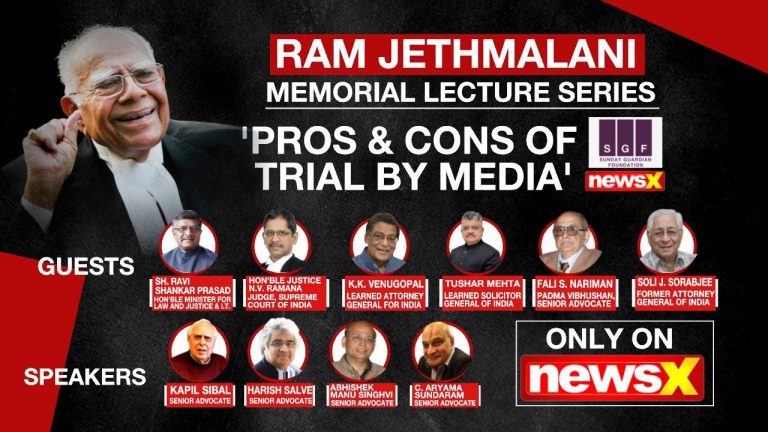
2 days ahead of ace lawyer Ram Jethmalani’s birthday on 14th September, the iTV network hosted the first edition of Ram Jethmalani Memorial Lecture Series on 12th September, which was broadcast on the group’s TV channel NewsX. The topic for the discussion was trial by media. India’s finest minds in the legal fraternity participated in the event conducted through video conferencing, which was hosted by Kartikeya Sharma, founder and managing director of iTV.
Union law minister Ravi Shankar Prasad, Ram Jethmalani’s son and senior lawyer Mahesh Jethmalani, Supreme Court judge Justice NV Ramada, KK Venugopal, Tushar Mehta, Fali S Nariman, Shri Soli J. Sorabjee, Kapil Sibal, Harish Salve, Abhishek Singhvi and Aryamana Sundaram spoke in the event.
Mahesh Jethmalani
Inaugurating the event and welcoming the speakers, Mahesh Jethmalani said that the objective of the lecture series is to promote excellence in bar, as well as to foster a passion among lawyers and common people about the constitution and the laws of the country. He presented the topic of the discussion, which is the most burning issue related to law and justice in recent times, ‘the pros and cons of trial by media‘. He said that a vital aspect of justice in criminal cases is a fair investigation and a fair trial.
Giving the example of the ongoing Sushant Singh Rajput’s death case and the high-profile media coverage of the same, Mahesh Jethmalani said that sometimes media houses seem to have obtained evidences which have not been gathered by even the investigating agencies. He wondered if such parallel investigation by the media in full public glare is in the interests of the justice or not. Jethmalani said that a line should be drawn between a laudable investigative journalism and a media witch-hunt. “Does the media believe in justice or in simply taking a position and depicting it as just?” he asked, saying that the panel members will share their views on the issue.
Ravi Shankar Prasad
Union Law and IT minister Ravi Shankar Prasad delivered the first speech in the event, where he recalled his nostalgic memory of Ram Jethmalani, when he was a student activist during the JP movement in Bihar, and had protested against the Emergency. He said that Jethmalani had left his practice in India, went to the USA and started campaigning against the emergency there.
Ravi Shankar mostly talked about his memories with Ram Jethmalani. He narrated how once Ram Jethmalani had told him that he had come to India from Pakistan during partition with just Rs 10 in pocket but with an ambition and a vision. The minister talked briefly about the topic, saying that it also the expectation of people that investigation should be fair. Along with that, there is also a stake of the people of India in a fair investigation. “How to balance the two is a difficult question but the balance has to be achieved,” the minister added.
KK Venugopal
Attorney General of India K.K. Venugopal described Ram Jethmalani as brave and fearless, and a warrior in the legal field. Recalling Kerala bar association meeting in 1975, where Jethmalani was invited as the chief guest, Venugopal narrated how he had delivered a fiery speech attacking the Gandhi family and tearing Sanjay Gandhi apart. At that time people were afraid to even listen to such a diatribe against the Gandhi family, and a larger number of lawyers and reporters left the venue as Jethmalani was speaking, but he still finished his speech, Venugopal said.
Tushar Mehta
Solicitor General Tushar Mehta described Ram Jethmalani as a legend, a phenomena, and said that it is a befitting tribute by his son as the topic of the lecture series, media trial, was very dear to his heart. Nobody could have blasted media the way Ram did, at the same time he was a darling of the media, Mehta said. Calling Jethmalani a bundle of contradictions, the solicitor general reminded how he fought institutional corruption with full commitment and also appeared to defend people accused of corruption with equal amount of commitment.
Harish Salve
Senior advocate Harish Salve slammed the media for running media trial in criminal cases. He criticised the media for turning big criminal story coverage into a “circus”, but he also slammed investigating agencies for selective leaks to the media. He said that by evening on almost all media channels 5-6 ‘expert jurors’ promptly come to a conclusion of guilt and convict the accused.
Harish Salve said that media was invading the privacy of people in the name of transparency, and this system has to be changed if India is to be taken as a serious democracy.
He also said that investigating agencies clamour for arrest when they are given cases to probe. He claimed that the probe agencies tend to frame the person against whom media has made allegations. “Investigation agency feels it is their moral duty to see that the person against whom media has made its allegation is the culprit,’’ he said.
Although he criticised the role of media in reporting crime cases, he acknowledged that government control is not the solution. “The only way to fix this is not through the government because anything worse than reckless media is a government tamed media,” Salve added. He said that the media should be controlled by the courts, and courts have to lay down the Laxman Rekha which the media should not cross.
Salve said that he has been suggesting successive law ministers and I&B ministers to set up a tribunal, which will try cases of defamation and deliver judgement in 6 months. He said the trouble today is that media can slander people easily, and if defamation cases are file they go on forever, he said. Salve added that if defamation cases are settled within six months, it will help in taming the media. He said that a solution has to be found to protect private reputations from trial by media.
Harish Salve added that media must unearth cases where the system has failed the victims, but they should not run a parallel investigation and trial when the cases are actively pursued by the system.
Kapil Sibal
Congress leader and senior advocate Kapil Sibal also criticised the recent trend of trial by media, saying that it is nothing but breach of law, and it should be considered as contempt of the court. “Of late, the media acts as the court, passes judgement even before the court, pronounces its verdict,” he said. Sibal said that media has power as the 4th pillar of democracy, but to misuse this power is criminal.
The Congress leader who had a TV channel said that technology plays a very great role in terms of its reach and its influence, and the influence of mainstream media is both constructive and destructive. He added that social media is a jungle of words and images, where it is difficult to tell what is true and what is fake. “These platforms provide choices, but in that terrain, it is difficult to make a choice”, he said. Kapil Sibal said that all mediums and technology can be misused, and there should be always a Laxman Rekha to be drawn in respect of all human activity.
He also acknowledged the role of media in exposing crimes, saying that media in any form is an indispensable tool to detect crime, expose protection of criminals by the rich and the powerful, unearth facts and bring them in the public domain, build pressure that investigation is commenced, and further expose attempts by agencies to protect the accused. Sibal added that the role of media should be limited to discovery of facts during the investigation of a case. He mentioned some cases where media ensured that the guilty were punished, like the cases of Ruchika Girhotra, Jessica Lal, Priyadarshini Mattoo, Nirbhaya etc.
But now the problem is that media has taking such discoveries of facts as way of earning TRPs, resulting in not bothering about the credibility of the source, Sibal added. “They instead try to sensationalise the event, even if it takes distortion of facts. And the fact of the matter is that the media can make a hero turn into a villain in no time at all because of its enormous power,” he said.
Kapil Sibal said that sometimes media verdicts overshadow the court verdict, and the appearance of social media has deteriorated the situation further. “Today, the media has reincarnated itself into a public court. The new media presumes guilt, and the victim must prove his or her innocence,” he added.
The former union minister gave the example of 2G case to illustrate damage caused by trial by media. He said that the trial has acquitted all the accused, but in the entire process so much damage was done to the telecom industry that “a sector which was then live and kicking, which was earning profits, which was providing efficient service- is today under the debt of almost 5,000 crore.” He stressed that media should not be allowed to deliver verdicts at the stage of investigation, because it can influence the processes of the law.
Abhishek Manu Singhvi
Another Congress leader and lawyer Abhishek Manu Singhvi also participated in the event and talked about trial by media. He said that if the media claims the ‘exalted status’ of the 4th pillar of democracy, they also must be open to criticism just like the other three pillars. He said that while media has done a fantastic job on news gathering, investigation etc, the Indian news has plummeted in the wrong direction of the equation between sense and sensationalism, between news and noise, between civility and chaos, and between balance and extremism. He described the actions of India media as verbal terrorism, visual extremism, and content fundamentalism. He attributed the TRP race, revenue, politics, ambitious anchors, public baying for blood as the reason for the degradation of media.
Abhishek Singhvi pointed towards techniques used by TV channels, which included non-level playing fields in debates, verbal blood sport, the conscious invitation to biased and malicious panellists, strategic cutting of mics, one-sided themes etc. He said that serious news items are presented as crime thrillers, extremist and fundamentalist viewpoints are easily spoken by anchors and participants without bothering about their threats to democracy.
As a remedy for the situation, Singhvi said that time has come to name and shame. He said that the NBSA (News Broadcasting Standards Authority) must be more proactive, it must issue advisories more often, and those should be “followed not merely by snarling but by biting and fighting hard”. Only if few violators are made examples by the NBSA, a lot of it will stop.
Singhvi added that the NBSA guidelines should be recognised by the I&B ministry, and they should be notified under the Cable TV act and regulations. Because without that, it does not bind non-members, he added. Here it is interesting to note that NBSA was formed by News Broadcasters Association (NBA), an organisation of some news channels, not all. There is a rival organisation, News Broadcasters Federation (NBF), formed by Republic TV, TV9 Bharatvarsh, and around 50 regional channels.
He said that NBSA is failing because channels leave their membership. Therefore, Abhishek Manu Singhvi indirectly suggested that NBF members should be forced to follow the guidelines of their rival organisation, a clear attempt at controlling Republic TV headed by Arnab Goswami.
Singhvi said that there is an urgent need of an independent ratings agency. He said the 44000 TRP meters installed in the country to measure viewership is too less. He also called for creating a Chinese wall to eliminate conflict wall in the media. He remined that the Broadcasting Bill is languishing in the parliament for almost 25 years since 1997, and stressed that this bill should be passed.
Aryamana Sundaram
Advocate Aryamana Sundaram said more than ‘media trial’, the issue is of ‘pros and cons of increased influence of media in ongoing investigations and trial’. He said that it is not right to blame only media, as media is driven by public opinion. He said that public listens to the fourth pillar because other three pillars have failed.
He that today media has become a creator of public opinion. While earlier it was said that let the guilty get away in nine cases out of ten just to save one innocent, today media wants to say let nine innocent men be hanged but dont let one guilty get away. He said that the media has become the voice of the public.
Sundaram said that if the other three estates were functioning properly, the fourth estate, the media, would not have become like this. He said the institutional failure is responsible for the current situation of trial by media, as public has lack of faith on the system. “There is public perception that corruption has entered the judiciary, there is no doubt that there are extreme delays in justice, there are no doubt that people who will be brought to book will take about 29 years to be completed”.
Due to this low public perception about police and courts, media comes forward and tells that they are interested in getting the justice. “There is a complete loss of faith in the absolute fairness and integrity of all institutions, including judiciary because of delays and corruption”.
Sundaram concluded by said that it is a fact that media has become a public court, and media has started portraying itself as a court of public opinion. Media is also determining what the public opinion should be. Media is doing that because public has lost faith in looking anywhere else. He said that it is wonderful that media is a watchdog of public opinion and public interest, but let the media not become a guard of brain treating the public as blind and trying to leave them alone around. He also called for improving other institutions so that media does not have to take on their roles.
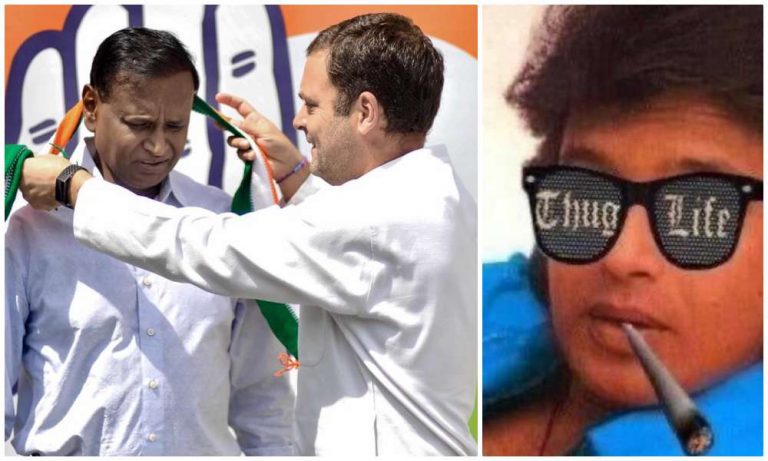
In conversation with Outlook, Congress leader Dr Udit Raj, with a massive fan base online, said that the ‘BJP IT cell’ is trying to create a rift between him and Congress leadership by pitching him as the party president. He accused the ‘BJP IT cell’ of running Twitter hashtags demanding him to take over the responsibilities from Sonia Gandhi. Speaking to OpIndia’s Nirwa Mehta, @Being_Humor, whom Raj has accused of being ‘BJP IT cell’, the digital activist reveals why he has extended his relentless support for the tall leader.
#UditRajForCongressPresident has been trending in social media after the reshuffle in Congress. What do you make of it?
It has not happened after the reshuffle. The hashtag has been trending for over 2 weeks now, the reshuffle has only intensified it. It’s a genuine demand by Udit Raj Ji’s fans. Shri Udit Raj Ji has been vocal about people’s issues with real and justified substance in his demands, which isn’t seen in Rahul Gandhi’s statements.
In his interview to Outlook magazine, Udit Raj has said that he’s a mass leader that’s why he’s being targeted. Do you think he’s a mass leader?
Over one lakh tweets with #UditRajForCongressPresident and #JusticeForUditRaj are testimonies of his huge fanbase, however, I wish to draw your attention to even a bigger picture, his fans come from all age groups, cutting across caste line. He is being humble for calling himself just a mass leader and not Tsunami (or Aandhi). Check out some of the images that prove his mass appeal.
Do you think his interview with Outlook was a pressure tactic to get noticed by the ‘high command’ at Congress?
Absolutely, In more than one of his answers, he not only tried to get noticed but also attacked Congress’ high command. He also said that he has informed Rahul Gandhi but he has not responded yet, smartly indicating Congress doesn’t listen to Dalit leaders. Upon asking that veteran Dalit leader Mallikarjun Kharge also dropped from Gen. Secy. position of AICC, Udit Raj said Kharge is still a Rajya Sabha member. Read between the lines and you know the former MP’s demand.
Do you think Congress even acknowledges his existence?
Doesn’t matter. Congress is an opportunist party. They denied the existence of Lord Shri Ram, but when PM Modi on 5th August did Ram Janmabhoomi Pujan they started taking credit of Ram mandir. When Congress will realize the power of Udit Raj Ji they’ll start worshipping him.
Why are you trending this?
I alone can’t do anything, I along with Shri @Amit_Gujju Ji, just raised our voices and million, and million of fans of Udit Raj Ji’s fans joined me and it became a mass movement. As if they all were just waiting for someone to start. Perhaps because so many people have seen Congress talking about Dalits and attacking BJP for not giving enough representation to Dalits, and they now want Congress to live by example. You must have noticed that Udit Raj ji has also said in his recent interview with Outlook that Congress needs to do more in terms of Dalit representation.
Did BJP IT Cell ask you? Or did anyone else ask you to?
No, I am not even remotely connected to BJP IT Cell. However, if paid good I’ll consider being a part of it. I am getting messages (DM) in million from the Udit Raj Warriors (popularly known as Uditians). Uditians are ready to be deployed at the service of great leader and visionary.
You clearly appear anti-Congress, so why should people believe that you genuinely support a Congress leader of tall stature like Udit Raj?
I may appear against Congress and its ideology but I am always in a favour of a strong nationalist and competent opposition, which Congress has failed to provide. Now coming to Dr. Udit Raj Ji, for him the country has always been above politics and that can be established by the fact that he along with his party (Indian Justice Party, having 4 crores active members) chose to leave the party and switched to BJP. In 2019 again, amidst the strong pro-Modi wave, he realised that the Congress under Rahul Gandhi isn’t strong enough to take on Modi on its own. He took the burden upon himself to reinvent the sinking ship. Hence, after empowering BJP he switched to the Congress. I see Dr. Udit Raj Ji has the potential and charisma to not only be Congress president but also world president and eventually take over the galaxy.
The last time a Dalit was Congress president, Sitaram Kesari, he was mistreated. Do you secretly hate Udit Raj and want him mistreated?
You have not understood Dr. Udit Raj Ji well. He’s like Daya of CID, can break door whenever he wishes. It’s his power that when the #UditRajForCongressPresident was trending, Sonia Gandhi and Rahul Gandhi had to leave the country to divert the attention.
Till when do you plan to run the campaign?
We are not stopping anytime soon. In fact you’ll see more support on the ground after the COVID situation is over. We are also planning to buy Jantar Mantar spot for the next four years (Kejriwal should look for another place). We will ensure that the support and campaign intensifies with time and Congress is forced to make Dr. Udit Raj Ji not only the Congress President but also the PM Candidate of Congress for 2024 elections.
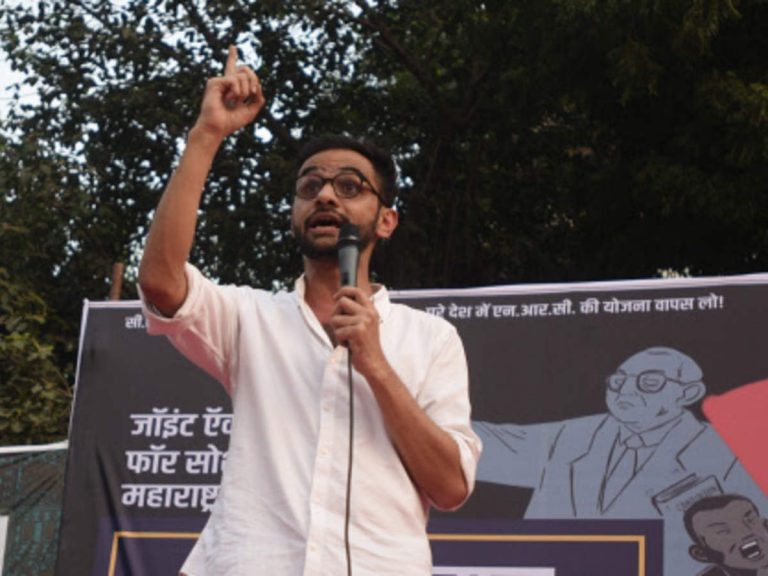
On Sunday, a Special Cell of the Delhi police has reportedly arrested erstwhile JNU ‘scholar’ Umar Khalid in connection to the Delhi Anti-Hindu riots. He was booked under the newly amended Unlawful Activities Prevention Act (UAPA) and will be produced before the Court today.
As per reports, Khalid was earlier summoned at the Special Cell office in Lodhi Colony on Saturday. He was questioned on Sunday by the cops till 1 pm. The JNU ‘scholar’ was eventually arrested in the evening. The Delhi police informed that a chargesheet will be filed against him in the upcoming days.
Umar Khalid has been booked under the Unlawful Activities Prevention Act (UAPA). https://t.co/EaA7fKLd6g
Umar, along with several other rabble-rousers such as Jamia media coordinator Safoora Zargar, RJD’s youth wing president Meeran Haider, Pinjra Tod activist Natasha Narwal and several others have been booked under the stringent Unlawful Activities (Prevention) Act (UAPA) for allegedly instigating the violence that swept over large swathes of the northeast Delhi in February earlier this year.
the Delhi Police Crime Branch in its FIR dated 6th March 2020 stated that the anti-Hindu riots that took place in North East Delhi between 24-26 February during the visit of US President Donald Trump were preplanned. The FIR copy stated that the anti-Hindu riots conspiracy was hatched by ex-JNU student Umar Khalid and his associates who are linked with two groups. As part of the conspiracy, Umar Khalid gave provocative speeches at two different locations and appealed to people to take to streets during the visit of US President Donald Trump so that the propaganda that minorities are oppressed in India can be internationalized.
Umar Khalid dismisses allegations against him
In his defence, advocate Trideep Pais, representing Umar Khalid in courts, claimed on Saturday that the accusations of conspiracy are ‘fabricated’, ‘false’ and obtained under duress. On September 4, Umar Khalid addressed a press conference wherein he alleged that supporters of the ruling BJP were differently treated by the law than common people. He alleged that evidence was being manufactured against those who criticise the government. You can read in detail what he is accused of here.
A petition has been filed in the Delhi High Court seeking the recognition of same sex marriages under the Hindu Marriage Act. The petition has been filed by Abhijit Iyer Mitra, Gopi Shankar M, Giti Thadani and G Oorvasi and the matter will be heard by Chief Justice DN Patel and Justice Prateek Jalan.
The petitioners claim that Hindu Marriage Act permits any two Hindus to solemnise their marriage and therefore, homosexuals should also have the right to marry and have their marriages recognised.
Petitioners are Abhitjit Iyer Mitra, Gopi Shankar M, Giti Thadani and G Oorvasi .
The petition states that as per HMA, a marriage can be solemnised
between 'any two Hindus' and therefore, the right to get married should not be confined to
heterosexual couples.@Iyervval
“That it is further submitted that despite the fact that there is absolutely no statutory bar under the Hindu Marriage Act of 1955 and the Special Marriage Act of 1956 against gay marriage, the same are not being registered throughout the country and also in Delhi,” the plea claims. “As a result of the same, there are many benefits that would otherwise be available to heterosexual married couples that are not available to them,” it stated.
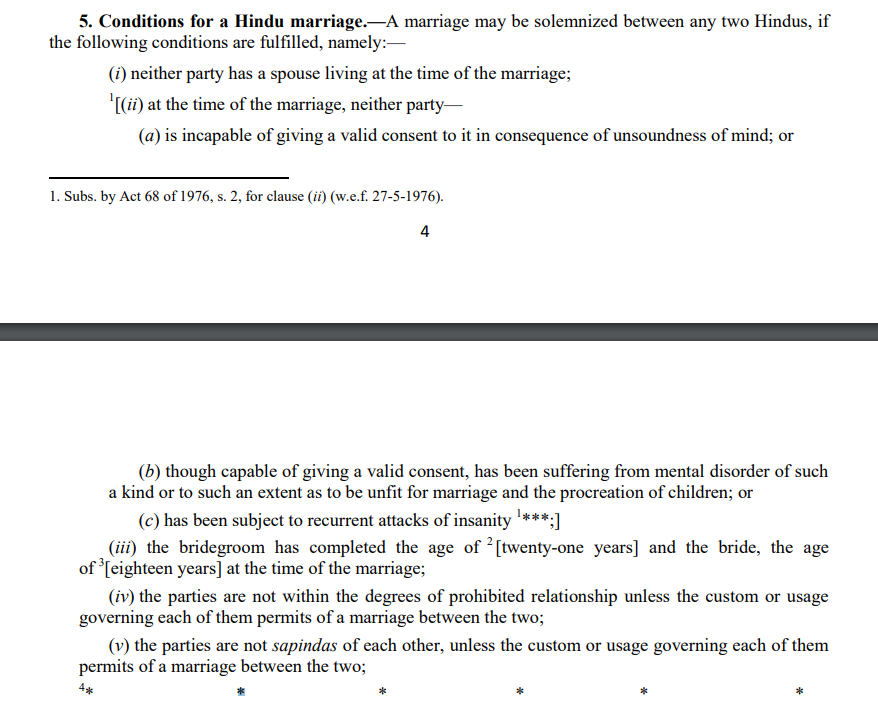
The claim that Act does not mandate that a marriage is between a man and a woman appears to be unfounded. Section 5(iii) clearly mentions that a marriage between two Hindus can be solemnised if the groom is 21 years old and the bride is 18 years old at the minimum. It is a clear indication that the Act recognises marriage only between a man and a woman.
Section 5 of the Hindu Marriage Act
The petition filed by advocates Mukesh Sharma and Raghav Awasthi states, “…the non-recognition of the rights of gay couples, especially when their sexuality has been recognised as such as valid by the Hon’ble Supreme Court of India is violative of various provisions of the Constitution of India as well as various conventions that India as a sovereign State is signatory to.”
“That Right to Marry is also stated under Human Rights Charter within the meaning of the right to start a family. The Right to Marry is a universal right and it is available to everyone irrespective of their sexual orientation and gender identity,” it added. The petition also argued that denial of the Right to Marry is in violation of the Right to Equality and Right to Life as guaranteed by the Indian Constitution.
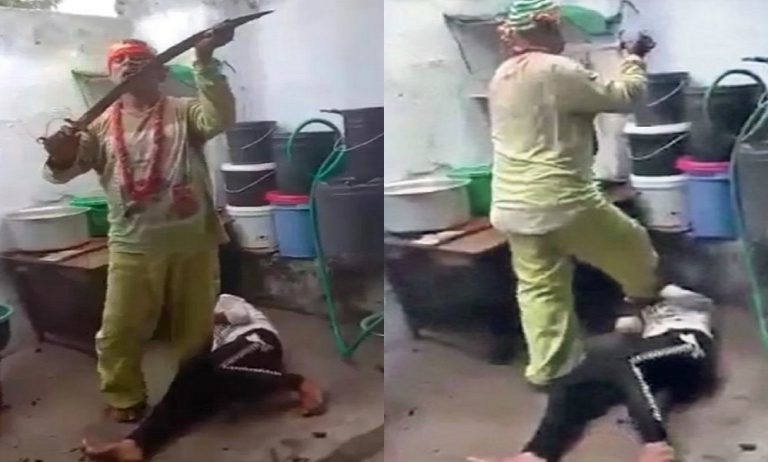
A horrific incident of child abuse has come to light in Bhilwara district of Rajasthan in which a Muslim ‘Tantrik’ was caught abusing and beating up a minor girl in the name of exorcism. The accused has been identified as Mehboob Qureshi.
A video had gone viral recently in which the accused was seen brandishing his sword as he beat up a 16-year-old girl. Reportedly, the cleric used to step on the neck of these minor children and beat them up on the pretext of removing ghosts from their body.
“महबूब कुरेशी उर्फ़ तलवार बाबा, भूत भगाने के बहाने लड़कियों को पैर से कुचलता था और बाल पकड़ के घसीटता था” pic.twitter.com/cWm0d0AT9S
In the above video, it can be seen that a minor girl was dragged by her hair and kicked by the Muslim cleric. The minor girl can also be heard shouting and screaming as Qureshi abused her in the name of exorcism.
According to investigation by the police, it has been revealed that the incident took place about a month ago in Kanwakhera Kachchi village near Bhilwara, Rajasthan. The police have begun their search to nab the accused, who has now absconded. The accused Mehboob Qureshi belongs to Jahazpur.
The police said that Qureshi had rented a house along with the parents of the kid. The accused had carried out the act on the minor kid in the presence of her parents, said Rajasthan police. As the video of the horrific incident went viral on social media, the locals informed the police regarding his presence that led to an investigation.
In the past, the Police has also investigated allegations of prostitution against Qureshi. The accused had begun prostitution at a place in Jahazpur. Following complaints by local, the police had put an end to it. An image has also gone viral on the internet where he can be seen in the colours and symbols of the Congress party. That image is from an election campaign in December, 2018.
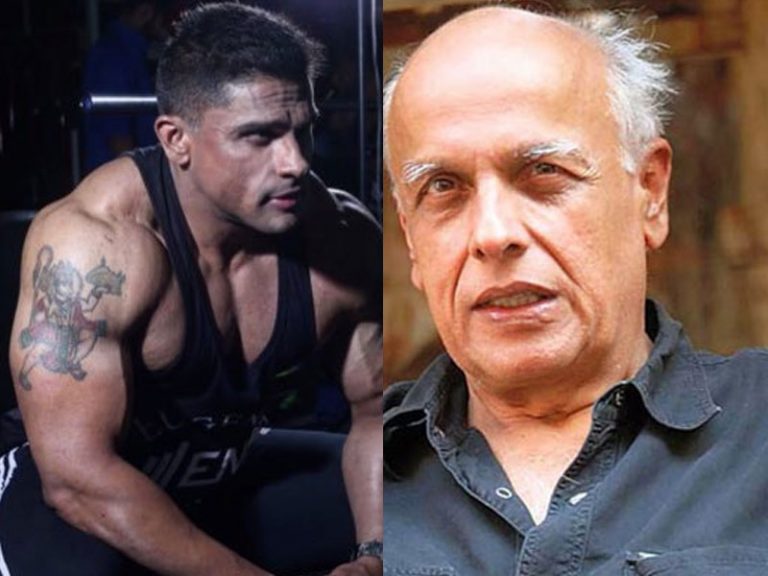
Mahesh Bhatt has a long history of controversies attached to him. Several old skeletons have come out in the last few days since his name appeared in the Sushant Singh Rajput case. One such controversial subject was of his son Rahul who was also named by 26/11 conspirator David Headley during interrogation. Headley wanted to recruit Rahul to ISI. As per media reports, Headley asked Rahul not to go to South Mumbai on the day of the 26/11 terror attack in Mumbai that left 166 people dead and hundreds of other injured.
The 2012 interview
In 2012, Times of India interviewed Rahul Bhatt in which he made some explosive statements about his father, Mahesh Bhatt. In his interview, he claimed that Mahesh never considered him like his son and wanted to name him ‘Mohammad.’ Many people did not believe him when he says so, but according to him, it was true. It was his neighbours who requested her anglo-Indian mother not to let Mahesh name him Mohammad as Mahesh will have several chances to show his secularism.
If Rahul was named Mohammad, he would have never seen the outside world after 26/11
Rahul claimed that if he would have named Mohammad, no one would even know who his father was. He believed when his name appeared in the 26/11 case, if he had named Mohammad, he would have been thrown in Tihar with no scope of coming out. He blamed his father for not considering or treating him as his son. Rahul said it was his behaviour that allowed to him come in contact with Headley. If he had been a better father, the situation would have been a lot different. Those times and circumstances were challenging for him. He had no one to show the right path. He said though he knows he should not say, but Mahesh treated him like an illegitimate child.
The experiences made him stronger
Rahul said that he used to feel like Andy Garcia of Godfather 3. It was scary for him to miss those experiences, but the truth is it made him stronger. He always felt insecure, and there were resentment and despair in his attitude. At the time of the interview, he claimed that he moved out of every emotionally painful situation and was in a much better position in life. Rahul had said, “I don’t want to play any Victim Card. But the truth is that Mahesh Bhatt never did anything for me. I am not a bitter person, but a better person, and the reason is only my father.” Mahesh Bhatt has four children. Alia and Shaheen Bhatt from his wife Soni Razdan and Rahul and Pooja Bhatt from his wife, Kiran Bhatt. Most of us have heard about Alia, Pooja and Shaheen, but Rahul Bhatt is sort of an unknown name to the world.