Home Blog Page 5114

Casteism and Government Schools: Behind the veils of the Dravidian Delusion

In an earlier part in the series, we looked at EV Ramasamy’s subversion and destruction of the nationalist Cheranmadevi Gurukulam. We will now look at yet another sordid episode in their history. This one is from the 1950s. Whenever the Dravidian movement, especially the DMK is challenged on account of corruption or their support for divisive Breaking India Forces or their Hinduphobia, an immediate shield they use is that of their position as defenders of lower castes against caste-based occupation and discrimination in education.

One of the historical episodes they quote is that of Rajaji’s ‘Kula Kalvi Thittam’ – a policy of making children learn hereditary trades and thereby perpetuate caste-based discrimination and how the DMK leaders thwarted it.

Let us lift another veil of the Dravidian delusion and study what really happened. Apart from other references, Dravida Mayai part 1 and 2 by Subbu have been relied upon for the information.

Literacy rates and educational attainment

In 1931, the literacy rate among women in the Madras Presidency was only 2.5%. By 1951 it had improved to 10%. The overall literacy rate was 11% in 1931 and had risen to 20% by 1951.

In 1939, considering the poor capacity of the Government school system and the need to somehow get children into school, Rajaji, then Chief Minister of Madras Presidency, introduced a scheme by which girl students of classes III to V would have to only spend three days per week in school instead of five. Girls from Depressed Classes – today’s Scheduled Castes – would have this dispensation for as long as they were able to attend school, since the literacy rates among women from these sections was practically nil. This was hoped to reduce drop out rates and reduce the strain on the school system. Experiments had also been made in introducing shifts in school.

In 1952, when a Congress Government led by Rajaji took charge of Madras Presidency, the enrolment rate was increasing and was at 47% in 1951. However, the Government school system was overwhelmed, since there were only 38,000 schools for a population of roughly 30 million, with close to 10 million children. Of these, 4,000 schools had only one teacher. 15,000 or more elementary schools had only four teachers or less.

Drop-out rates were at unacceptable levels. Of 1.22 million students that had enrolled in Class I in 1946, only 37% had reached Class V in 1951.

The modified education scheme

The Government in 1953 proposed a modified education scheme. The salient features of this proposal were

  • Take the 5-hour school day and modify it to two shifts of 3 hours each
  • Students would need to attend school in only one of two shifts, effectively making school attendance limited to 3 hours in a day.
  • Teachers would have to teach an additional hour, for which they would be given an additional allowance of Rs 10.
  • Boys would have to spend the remaining hours of the day learning any craft or trade. They could apprentice themselves with any tradesman, including their own fathers. If they had no one to apprentice with, they could help in fields or in construction sites.
  • If they did not wish to apprentice themselves, it was also left to their parents’ discretion.
  • Girls could utilize this time in helping with household chores or in the fields.

The intent behind this was:

  • Reduce the strain on the school system
  • Improve dropout rates. Since children were dropping out to help in trade, the fields or the household, a reduced academic load would enable them to continue with their formal studies.
  • Help children learn a useful trade and become self-reliant.

Criticism

The Opposition DMK held that this was a flawed plan on these grounds:

  • This would place an additional burden on the teachers
  • The hours out of school would be frittered away without teacher supervision
  • The introduction of vocational training would perpetuate caste stereotypes and tie children to professions held by their parents.

While the first objection was fatuous, what really carried the argument was the accusation of caste bias. That Rajaji was a Brahmin helped in bolstering the argument and raising fears of a Brahmin bogeyman.

The leaders of the DMK were jailed for communal disharmony. In the meantime, the Tamizharasu Kazhagam, led by Ma Po SIvagnanam, a leader of MBC in North Tamil Nadu, announced support for this new policy. One of his meetings in Mayavaram was set upon by DMK’s cadre and a bleeding Ma Po Si had to be hospitalized.

These disturbances were a catalyst for Kamaraj, Rajaji’s rival in the Madras Presidency Congress to raise a banner of revolt. 49 Congress legislators, led by Dr Varadarajulu Naidu, a close confidant of EV Ramasamy, who was then in the Congress, sent a memorandum to Nehru objecting to this proposal. Rajaji offered to resign, on condition that the scheme not be withdrawn. 

This compromise was not accepted and he had to resign anyway. Kamaraj became the Chief Minister and Rajaji never held any post thereafter.

In one sense, this was a case of things coming full circle. Rajaji had revolted against Satyamurti, the Madras Presidency Congress Committee leader from 1936-1939 and Mayor of Madras for a term, on charges of casteism in the 1930s. Kamaraj, Satyamurti’s protégé, removed Rajaji as CM using the same charge of casteism.

Parulekar Committee

The proposal was referred to a Committee of educational experts led by Parulekar, Director IIT Bombay. After studying the proposal, the Committee reported that the charges of casteism were unfounded and there would be the possibility of improving primary educational attainment at lower marginal costs.

It also found the proposal in keeping with educational goals in other developing countries, which would help students attain basic proficiency in the three Rs and also learn skills for earning a living. 

The Committee also expressed that the scheme would improve the relationship between the village school and the local community.

Kamaraj Proposal

However, Kamaraj was in no mood to accept this finding. Instead, the Government of Madras Presidency set goals of opening one school for each hamlet of 300 people and abolished school fees.

12000 new schools were either opened or brought under Government aid.

To make this possible, one of the techniques was to fund teacher salaries as aid to private schools. The cost of teacher salaries having been met, private schools would charge very low sums of money, in some cases, providing education for the first 3 classes for free. The costs of maintaining the schools may be met by charging nominal fees from senior students and renovations could be met through philanthropic donations.

This scheme worked well for the first decade. Literacy levels rose from 20% in 1951 to 36% in 1961, especially that of girls doubled from 10 to 20%. However, the economic stagnation and strife of the 60s and 70s did not allow investment at the same pace. Literacy levels rose to 45% in 1971 and 54% in 1981. Literacy rate for girls rose to 30% in 1971 and 40% in 1981.

One wonders if Rajaji’s proposal would have made literacy and basic education levels decoupled from economic growth and ensured a higher literacy rate in 1981. A literacy rate of 70% for girls in 1981 would have seen the demographic transition happen earlier in Tamil Nadu as well as helped the State industrialize at a faster pace during the stagnant 90s.

Another unintended effect of Kamaraj’s solution was the rise and dominance of Christian schools in Tamil Nadu.

A clear trend emerges – the Dravidian leaders did not let the control of education slip out of colonial hands. We saw how they stymied the rise of the nationalist Cheranmadevi Gurukulam.

When the Government became an Indian nationalist one, control of education was given to Christian missionaries. Many schools in the Madras Presidency had been established by Christian denominations on land grants provided by the colonial British Government. Their commercial properties could defray the expense of maintenance of schools, while teacher salaries would be met from Government funds. This gave the Christian schools a clear competitive advantage compared to other schools that were run as individual institutions. Even until the mid-sixties, the Christian schools were administered by European missionaries, who were placed in the senior management positions of schools run by various denominations and dioceses.

How did the Dravidian movement work to isolate the Tamil people from the rest of the country through linguistic divisions? We will see that in the next part of this series, where we analyse the anti-Hindi agitations.
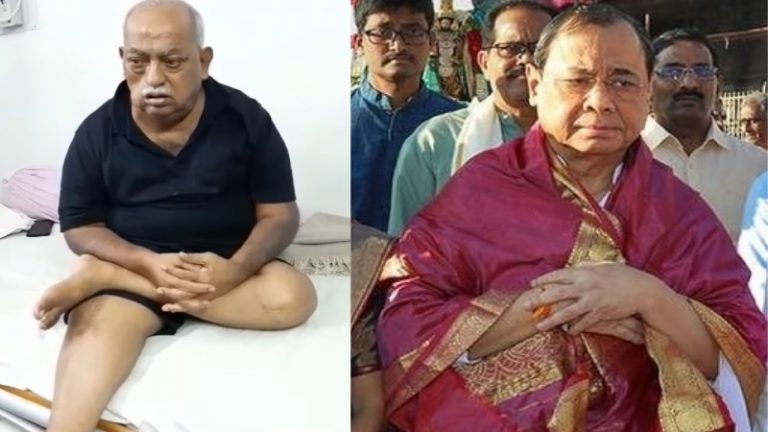
“Even a prostitute in India charges more for selling herself than Ranjan Gogoi did”: Munawwar Rana spews venom over Ram Janmabhoomi verdict

Urdu poet Munawwar Rana, who recently hogged the spotlight for his blatantly Hinduphobic remarks, is once again in news for his extremely diabolical remark against ex-CJI Ranjan Gogoi.

Though it has almost been a year since the Supreme Court bench, headed by the then CJI Ranjan Gogoi, gave its unanimous verdict on the Ram Janmabhoomi, the Urdu poet, Munawwar Rana, seems to be still upset with the decision. In an interview with News Nation, the controversial poet was seen making some extremely repugnant remarks against the Chief Justice of India.

He said in Hindi: “भारत के पूर्व CJI रंजन गोगोई जितने कम दाम में बिके, उतने में हिंदुस्तान की एक ₹#डी भी नहीं बिकती है”, roughly traslated as, “Even a prostitute in India charges more for selling herself than Ranjan Gogoi did”.

The poet said that a court only gives a judgement, it does not deliver justice, especially when it the matter of faith. Such as in the case of Ram Janmabhoomi. “The decisions related to faith cannot be made in the court as these are the decisions of the hearts, but the apex court decided on the Ram temple and those who took the decision were now made Rajya Sabha MPs”, lamented the Urdu Poet. Notably, the historic decision of the Ayodhya dispute was given by a bench headed by Ranjan Gogoi.

Munawwar Rana continued to spew venom, not only raising apprehensions on the historic Ram Jamnabhoomi verdict but also ex-CJI Ranjan Gogoi’s appointment in the Rajya Sabha immediately after his retirement as the chief justice of India. “What was worse, that CJI Ranjan Gogoi, immediately after retiring as the CJI, accepted his appointment in the Rajya Sabha. Gogoi’s decision to accept Rajya Sabha membership was a disgrace on the judicial system of the country”, said the poet. Here, Rana audaciously commented that Ranjan Gogoi sold himself at a price in which even the prostitutes of India would refuse to sell themselves.

He furthers that Ranjan Gogoi sold himself to the Rajya Sabha seat which is otherwise “traded for Rs 1 crore…Rs 50 lakhs…Rs 2 crores…Rs 5 crores.”

Munawwar Rana refuses to apologise for his statements

Munawwar Rana alluded to the Ramayana, saying that even Lord Rama had abdicated his throne to adhere to the pledge but Ranjan Gogoi did not even “honour his position”.

The controversial poet refused to apologize for his statements, saying that he had not said anything wrong. He said that if he apologises he would feel that he too has sold himself.

BJP leader Shalabh Mani Tripathi condemned Rana’s statements

Meanwhile, Uttar Pradesh BJP leader Shalabh Mani Tripathi condemned the Urdu poet’s statements saying that Rana is a jackal disguised in poet’s skin. Expressing disenchant, over Rana’s observations on women and the highest constitutional court in India, Tripathi said that it is an irony that the poet who has been encashing a poem on ‘Maa’, has such abject opinions for women. “He is a nothing less than a traitor”, opined the BJP leader.

It is pertinent to note here that earlier too Munawwar Rana’s remark had stirred a massive outrage on the social media where netizens not only condemned Rana’s appalling Hinduphobic remark, wherein he had relegated 100 crores Hindus in India to ‘animals’ who come in handy only during the election but also criticised Rana’s work and raised aspersions on the originality of his poem “Mere Hisse Main Maa Aai”. It was alleged that the lines of his poem was stolen from a couplet by poet Alok Srivastav.

Visva Bharati University shuts down, seeks central forces for security after clashes over construction of boundary wall on ‘Poush Mela ground’

The Visva Bharati administration has reportedly decided to shut down the varsity in light of the recent protests and vandalism that took place in the wake of the construction of a boundary wall on the ‘Poush Mela’ ground.

The decision to wall ‘Poush mela’ ground

Reportedly, the Shantiniketan Trust has sanctioned an amount of ₹70 lacs as a part of the initiative of the Vishva Bharati university to build a boundary wall near the eastern side of the old ‘Poush Mela ground’. According to the varsity, it was within its rights to build a wall to prevent the ‘misuse’ of the playground. An order issued by the university read, “Visva-Bharati will demarcate the Mela ground and barricade the same so that the Mela ground will be a separate self-contained unit from the university and locality.” The undertaking further stated that the National Green Tribunal had to be reported by Wednesday whether the construction work had begun.

The University had earlier sought to cancel three-day ‘Poush Mela ‘celebrations held in the last week of December for over 125 years. The annual festival is a part of Shantineketan’s culture, as envisioned by Nobel laureate Rabindranath Tagore. According to the Vice-Chancellor of the varsity, the institution is ‘ill-equipped’ to conduct such festivals. Reportedly, the decision was taken without consulting the Shantiniketan trust which is responsible for conducting ‘Poush Mela.’

The controversy over the fencing

The decision of the university to fence the ‘Poush Mela’ ground received vehement opposition from students, traders, artisans, and even the Chief Minister of West Bengal Mamata Banerjee. The agitators have dubbed the move as ‘contrary to the Tagore school of thought.’ According to the State CM, the barricade would hamper the natural beauty of Shantinektan.

“The purpose of Rabindranath Tagore in setting up Visva-Bharati was to conduct academic activities, besides programmes like Basanta Utsav and Poush Mela, in the lap of nature, in the open air, under the trees, amid chirping birds…. He set up Santiniketan as an abode of peace, it wasn’t just about construction,” she was quoted as saying on Sunday.

Violence and Vandalism at Visva Bharati university

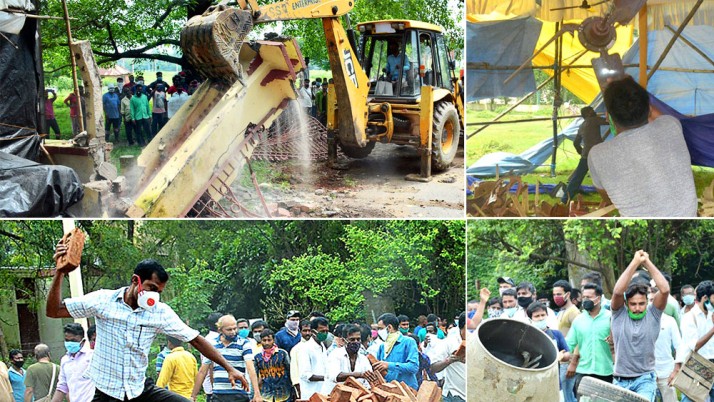
On Monday morning, around 5000 people stormed into the Poush Mela ground, demolished the iron gate, damaged the construction materials, and vandalised a pandal. The unruly mob also destroyed the temporary Visha Bharati office that was built near the ground. In viral videos, locals and traders can be seen destroying property as a ‘mark’ of protest. The miscreants also took control of a JCB machine to destroy existing constructed structures.

Earlier on Saturday, the varsity officials had informed that a clash broke out between the ‘protestors’ and the contractors, resulting in the latter being brutally thrashed by traders from Bolpur. Reportedly, the administration of the University used staff, teachers, and several ‘BJP workers’ as ‘human shields’ to ward off violent protestors from causing damage to the construction site. This led to a political slugfest between the BJP and the ruling Trinamool Congress (TMC).

Meanwhile, an advocate by the name of Sailen Mishra had filed a complaint against the Vice Chancellor of the varsity Bidyut Chakrabarty for ‘violating’ Coronavirus guidelines through planned ‘mass gathering’.

Varsity shuts down, requests intervention of law enforcement authorities

In the wake of vandalism and violent protests, the Visva Bharati administration announced that the university will remain shut until the situation improved. The varsity has written a letter to the District Magistrate seeking imposition of IPC Section 144 in the campus to prevent ‘unlawful assembly.’ Moreover, the administration has also written to the Centre asking for deployment of central security forces to contain the law and order situation within the campus.

Meanwhile, Mamata Banerjee has urged the District magistrate to hold a meeting between the Vice-Chancellor and the students to resolve the issue ‘peacefully.’ While the BJP leaders in Birbhum have claimed that the TMC had supported the vandalism in a bid to defame the varsity, the ruling dispensation has accused the BJP of trying to ‘saffronise’ the renowned university.

Liberals want to save only Prashant Bhushan, not everyone’s free speech rights

Since the 2014 election, the liberal teacup has raged with so many storms that you might have forgotten most of them already. One of the earliest and most instructive was one that raged in Jan 2015 over the post of Chair of the CBFC, popularly known as the censor board.

At the time, the sitting Chairperson Leela Samson had resigned. And as with almost anyone appointed by Modi government, liberals had a problem with her successor. Their objection: that the new Censor Board Chief was suppressing freedom of expression.

The irony is thick on that one. He is the chief of the censor board. Of course he would suppress freedom of expression. Isn’t that his job? So what’s the objection about?

Liberals never objected to the censor board as a concept. They merely objected to who was wielding the power to carry out the censorship. Once you go there, you lose all moral high ground. You are no longer arguing for freedom of expression. You just want your friends to control what can be said.

In the last few days, India’s liberals have picked up a new cause. This time they are upset that lawyer Prashant Bhushan has been found guilty of contempt of court. Now, this is a Supreme Court judgement and Modi government has literally no control over it. But liberal outrage stopped making sense a long time ago. I am sure they will feed this Supreme Court judgement into the same fact-free narrative of “intolerance” since 2014.

There is an obvious parallel here with the liberal outrage in the CBFC case from 2015. They are not objecting to contempt of court as a concept. They have no interest in free speech. I see them signing petitions, filling out open letters and crying online about Prashant Bhushan. They are crying about their privileged friend, not free speech rights for all.

Have you seen any liberals demanding that contempt of court provisions should be abolished in the interest of free speech for all?

No.

Instead, what we have seen is XYZ number of eminent persons signing petitions that Prashant Bhushan should not be punished.

The first one is a principled stand. The second one is pure hypocrisy. It is a bunch of self appointed ’eminent’ people demanding special treatment for their ’eminent’ friend. Because he is ’eminent.’

Free speech is an issue of rights. The moment you say that so and so person deserves free speech because of their supposed ’eminence,’ it’s all over. You are trying to make free speech a privilege for a chosen few. And that’s the most undemocratic you can get.

In fact, I have a message even for the handful of liberals who have come out and requested the court to reconsider the laws on contempt. For the ones who have taken the principled stand. I would say they should stay out of this particular case. For same sort of reason as they say justice must not only be done, it must be seen to be done.

If you are taking a principled stand, you must demonstrate that by taking it up when a common citizen of India is in the dock. Right now it looks like your conscience has woken up because someone from the high and mighty of this country is in trouble.

You should not just have a conscience. You must be seen to have a conscience.

So stop worrying and crying for someone who can so well take care of himself. Take up the cause of someone who does not have 5000 sympathizers among the Indian elite.

The Indian elite is also on trial here, accused of contempt for ordinary people. So far, as a common citizen of India, I find them guilty as charged.

Uttar Pradesh Police arrests ‘journalist’ Prashant Kanojia: This is the post through which he spread fake news

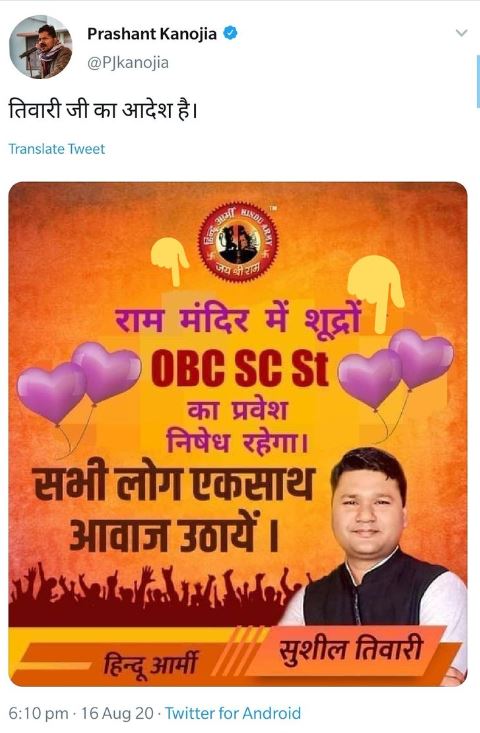
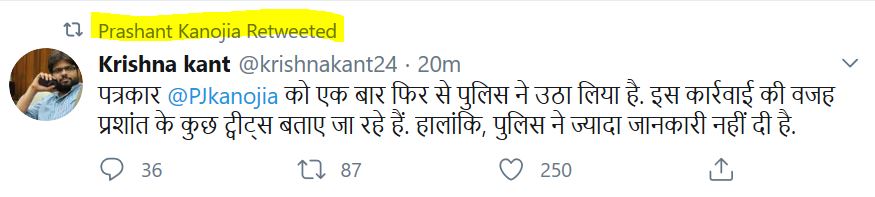
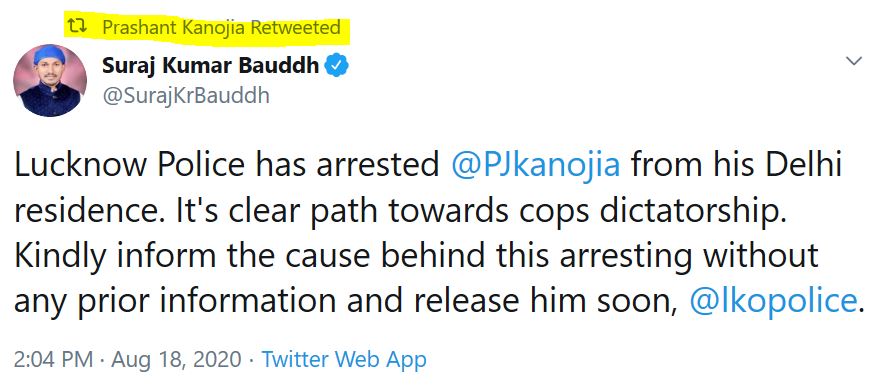
The Hazratganj police have arrested habitual fake news peddler Prashant Kanojia from his residence on Tuesday, for morphing an image in his social media post in an attempt to spread fake news and incite hatred. The FIR has been filed by the Hazratganj police on the basis of a complaint lodged by one Dinesh Kumar Shukla on August 17, 2020, for the spurious post that was posted by Prashant Kanojia on Twitter on August 16.

The freelance journalist has been booked under Section-154 of the CrPC, 1973 and IPC sections 153-A (Promoting enmity between different groups on grounds of religion, race, place of birth, residence, language, etc., and doing acts prejudicial to maintenance of harmony), 153-B (wantonly giving provocation with intent to cause riot), 420 (cheating), 465 (Punishment for forgery), 468 (Forgery for purpose of cheating), 500 (Punishment for defamation), 505(1)(b) (likely to cause, fear or alarm to the public), 505(2) (offence commited in any place of worship or in an assembly engaged in the performance of religious worship) and 66 (imposed for non-payment of fine).

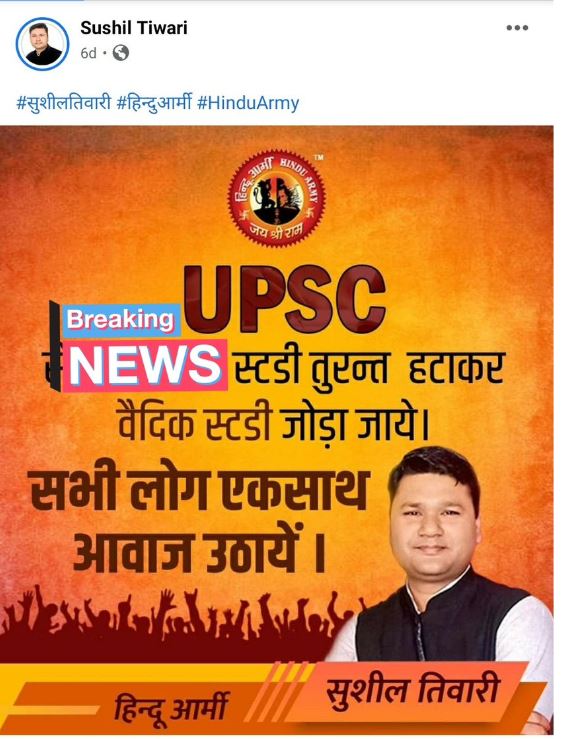
The controversial journalist had in his Twitter post morphed a poster to insinuate that the ST/SC and backward class people will not allowed in the Ram Mandir. Prashant Kanojia had morphed a poster of Hindu Army chief Sushil Tiwari. The Netizens were quick to identify and point out the treachery on the microblogging site.

Retaining the Hindu Army chief’s picture on the poster, the controversial jounalists replaced the content. He then shared the morphed poster on his Twitter handle with a comment that Sushil Tiwari had ordered that the ST/SC and OBC will not be allowed in Ayodhya’s Ram Mandir. He appealed to people to raise their voice against the same.

Original post
Morphed image shared by Kanojia, courtesy: @Lala_The_Don via Twitter

Surprisingly, even after the news of he being arrested by the Lucknow police, the controversial journalist has been re-tweeting the news of his own arrest from his official Twitter handle. This made people wonder that either he still hasn’t been handed over to UP police or someone else has access to his social media account.

This is however not the first time the controversial journalist has been arrested. Last year, the freelance journalist was arrested by the Uttar Pradesh government for posting derogatory tweets about Gods, Goddesses and fake allegations on UP CM Yogi Adityanath.

The accused Prashant Kanoja known in social media for habitually spreading fake news, rabid anti-Hindu hate especially against Dalits by making atrocious statements. Prashant Kanoja has a history of making vile comments against Dalits and Hindu saints. He had even referred to Dalits as ‘animals with no brains’ in the past.

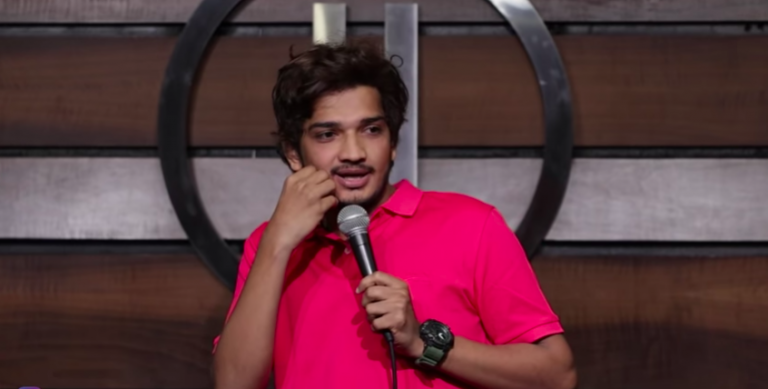
Police complaint filed against ‘comedian’ Munawar Faruqui for making crass remarks against Lord Ram and Sita maa, mocking Godhra victims

Months after ‘comedian’ Munawar Faruqui mocked Godhra riots, insulted Hindu gods and was seen blaming RSS for the Godhra massacre of Hindus, a Hindu rights activist Shivam Rawat had filed a complaint against him with the Station House Officer (SHO) of the Kishangarh police station.

Earlier too, there were several complaints filed against Faruqui for hurting Hindu sentiments and mocking religious beliefs of Hindus via his stand up shows.

Activist files complaint seeking action against Faruqui

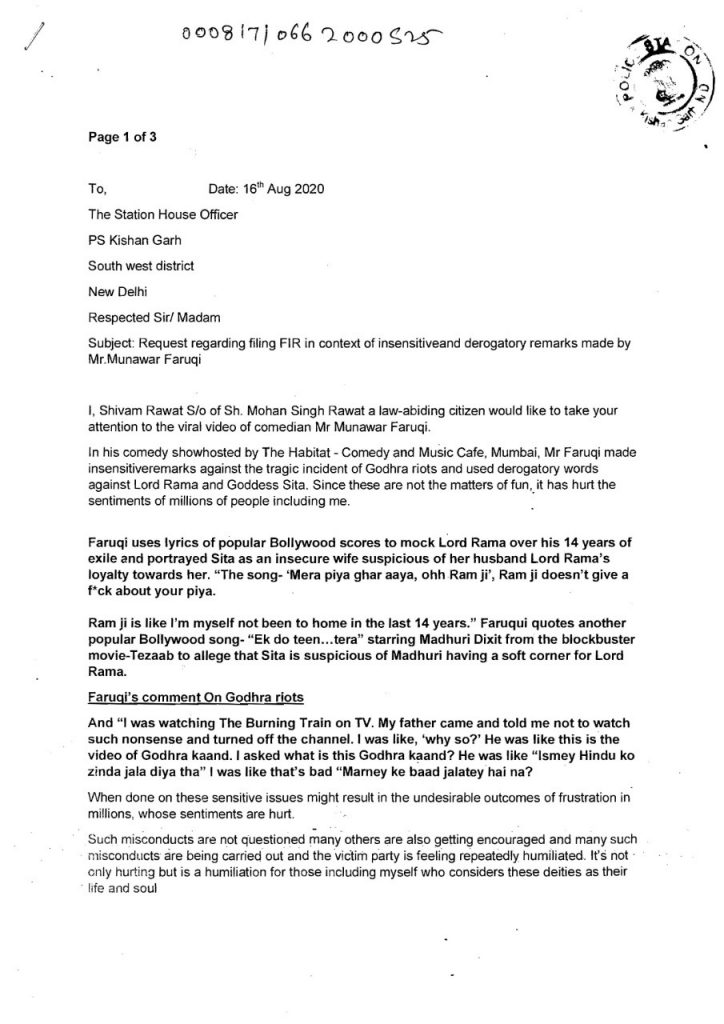
Shivam Rawat, the founder of Pen of Dharma, had filed a complaint with the SHO of the Kishangarh police station in Delhi. In his complaint, Rawat emphasised how the comments made by Faruqui hurt the sentiments of millions of Hindus including him. In his complaint, Rawat has stated how Faruqui had used Bollywood songs to make crass, disrespectful remarks on Hindu gods and belief system.

Copy of the police complaint by Shivam Rawat (Page 1)

Quoting comments made by Faruqui, Rawat implied that the so-called ‘comedian’ has deliberately hurt Hindus and their faith. Rawat also pointed out how he mocked the brutal massacre of Hindus in the Godhra carnage by claiming, “Marney ke baad jaltay hai na? (Hindus get burnt anyway after death).” He further emphasised that inaction against such miscreants has led to the repeated humiliation for the Hindu faith.

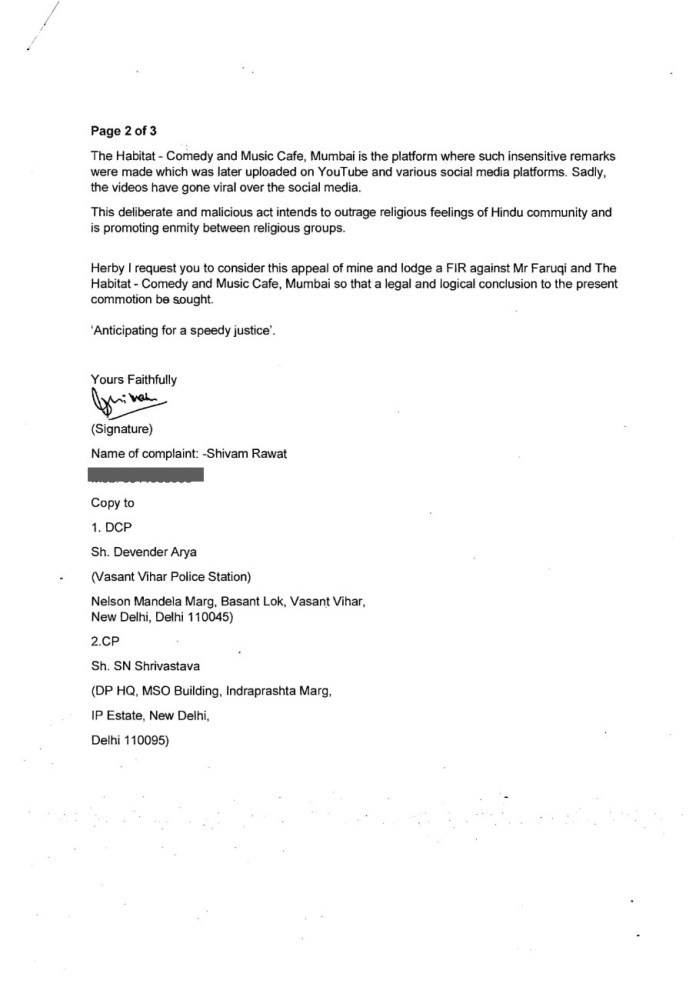
Copy of the police complaint by Shivam Rawat (Page 2)

Shivam Rawat had made a detailed video on his Youtube channel, ‘Pen of Dharma’ about how Munawar’s actions had hurt the sentiments on Hindus.

Shivam Rawat speaks to Opindia

When OpIndia spoke to the Shivam Rawat about his decision to take the legal route against the ‘comedian’, he informed, “earlier, I used to debunk claims on social media or write articles exposing Hinduphobia. However, now, we have received the support of a few eminent lawyers. We have therefore chosen to take legal action against them. I do not believe in violence or taking law into my own hands.”

On being asked why he filed complaint against Munawar Faruqi now, the founder of ‘Pen of Dharma’ replied, “I was agitated after I watched the rap song made by Faruqi. Instead of apologising, he seems to challenge us that we cannot do anything about him or stop him from making derogatory comments about our Gods. As a practicing Hindu and a devotee of Lord Ram, I have come to realise that if such behaviour is left unchecked, it will only encourage others to display more of such Hindu hatred.”

Muslim mobs burn police stations, MLAs house over a Facebook post that allegedly insulted Mohammad

Comedians and so-called entertainers have long been habitually offending Hindus and the Hindu faith by making crass comments, insulting remarks and often even blatantly derogatory depictions in the name of ‘freedom of expression’. However, the same people never even dare to do the same against other faiths because the repercussions are heavy, even brutal.

Recently, a violent Muslim mob in Bengaluru had attacked the DJ Halli and KG Halli police stations and burned them down. The mob had also attacked the residence of a sitting MLA because a young relative of the MLA had shared a Facebook post that was allegedly derogatory to Prophet Mohammad.

Last year, former Hindu Mahasabha activist Kamlesh Tiwari was murdered in his own house by two Islamist fanatics because of a remark he had made against Mohammad in 2015.

Pakistan: The extra-judicial killing of Hayat Baloch at the hands of Frontier Corps. Read details

On Thursday, a 25-year-old resident of Turbat in Pakistan, Hayat Baloch, was reportedly shot dead by the paramilitary Frontier Corps in broad daylight. He was a final-year student of BSC (Physiology) at the Karachi University.

On the fateful morning of August 13, Baloch was harvesting dates on a farm with his father Ma’azar Mohammed. Reportedly, a convoy of Pakistani security forces was passing by the Aapsar area, just before noon, when it was attacked with an IED explosion. Since the farm was located adjacent to the road where the blast took place, troops of paramilitary Frontier Corps entered the farm. As per reports, they began harassing Hayat Baloch and accused him of engineering the IED explosion.

The Murder of Hayat Baloch

Frontier Corps tied him up and carried him to the other side of the farm, despite his father pleading to the security forces that Hayat had not left the farm since morning. Mohammed’s plea fell on deaf ears as the FC Corps personnel dumped him on the ground while one of the officers fired 8-10 shots at him. Reportedly, the security personnel then abandoned his dead body while the parents of Baloch wept by the side of his dead body. Hayat Baloch was dead even before they could manage to take him to a hospital.

Accused FC personnel handed over to Turbat police

The family of the victim then lodged a First Information Report (FIR) with the Turbat police. The parents of Hayat Baloch have informed the cops that they can identify the murderer of their son. According to SSP (Turbat), an internal investigation by the Frontier Corps found that the accused personnel ‘reacted in haste’ and handed him over to the police for further probe into the extra-judicial killing of the 25-year-old student.

Eye witness accounts reveal details about the military excess

Dismissing claims that Hayat Baloch was killed in crossfire between militants and Pakistani security forces, an eye witness anonymously revealed, “I saw five or six FC men beating him. Whenever he raised his head, I think to explain something, they kicked him more. He must have been shot dead later when we left. He was not caught in the crossfire.” The spokesperson for the Human Rights Council of Balochistan (HRCB) said, “The security forces took him to the road. He was not caught in the crossfire as being claimed.”

According to another witness, he had not heard anything that ‘sounded like gunfire.’ The witness informed that Hayat Baloch was made to bend on his knees while the security personnel kicked him. He left in his car believing that the FC Corps will let the victim go. Another witness stated that she believed that the security forces will either question the victim or atmost abduct him. “I did not know they would kill him. I feel so hurt now knowing they killed this young man,” she was quoted as saying.

Protests against the extra-judicial killing of Hayat Baloch

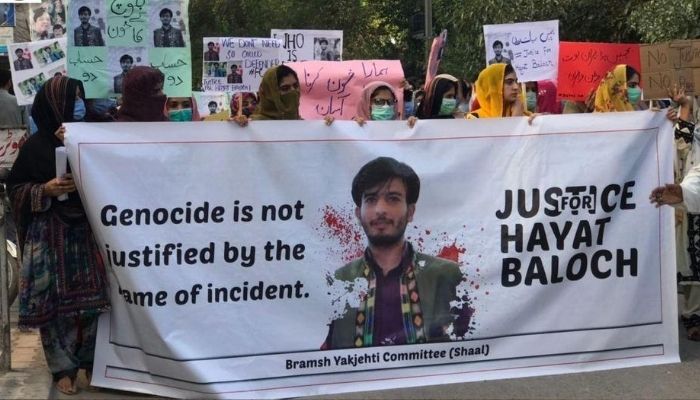
Following the extra-judicial killing of the 25-year-old resident of Turbat, campaign groups reportedly organised protests in Karachi and Quetta. Hundreds of people took part in the demonstrations, demanding justice for Hayat Baloch. The protestors were seen carrying posters, placards, and portraits of the victim.

As per reports, the agitation in Quetta was held at Quetta Press Club and was attended by Baloch and Pashtun students and families of victims of forced disappearances. The speakers urged the youth to be the voice of resistance against the hegemony of the Pakistani State and armed forces, besides reiterating that they have lost faith in the government.

Similarly, demonstrations in Karachi were held at Karachi Press Club and labelled the killing of Hayat Baloch as ‘the abject violation of human rights.’ The Baloch Republican Party also condemned the killing of the 25-year-old student and said that it was a part of the mission of the Pakistani security forces to eliminated educated youth in Balochistan.

1984 Sikh massacre: When former Indian cricketer and UP cabinet minister Chetan Chauhan rescued Sikh teammates from an irate mob

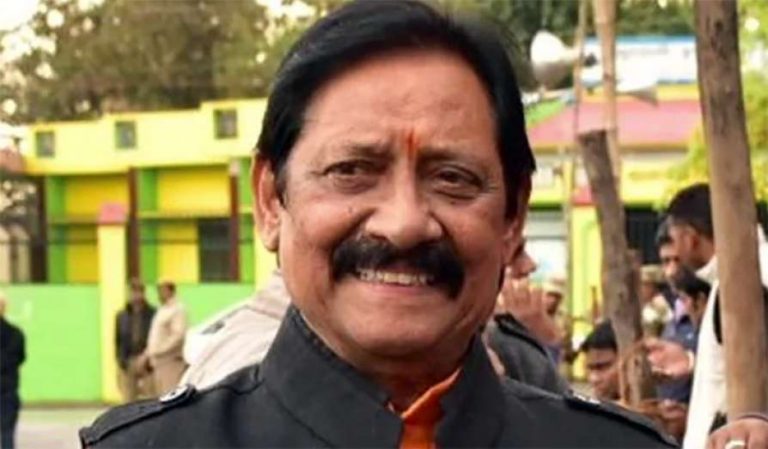
Chetan Chauhan, a former Indian cricket opener and known for his umpteen memorable partnership with another cricketing legend Sunil Gavaskar, left for heavenly abode on August 16 due to COVID-19 related complications.

While he was known for his gutsy and gritty character on the ground, especially after he scored three consecutive centuries with a broken jaw, his off-the-ground personality had not been any different. In the wake of his tragic death, former North Zone cricketers recollected the fearless attitude the former opener embodied in the face of adversity.

North Zone team was return to Delhi from Punjab on the day Indira Gandhi was assassinated

In the aftermath of the assassination of the former Prime Minister Indira Gandhi, Sikhs across the country, particularly in Delhi, were targeted by the Congress party led mobs to exact the revenge of Ms Gandhi’s killing.

During the turmoil, the former North Zone cricketers remember, Chauhan staked his life to rescue embattled Navjot Singh Sidhu and Rajinder Ghai, who were on their way back on ‘Jhelum Express’ from Pune after playing their Duleep Trophy semi-final.

Reminiscing about the incident, former Haryana off-spinner Sarkar Talwar detailed the ordeal the team had to go through while their return to the national capital amidst the Sikh riots triggered by Ms Gandhi’s assassination.

In an interview with the Times of India, Talwar said, “Our match concluded on October 30 and the next morning we were supposed to fly Delhi. However, the news came that PM had been assassinated. So our team manager got us first-class tickets on Jhelum Express. The arduous journey took us 4 days to reach Delhi.”

Chetan Chauhan confronted the mob baying for Sikh blood

Talwar continued that at one of the stations, an angry mob baying for the blood of Sikhs entered the compartment. Navjot Singh Sidhu, Rajinder Ghai and Yograj Singh were the three Sikh players in the team. Salwar claims that it was Chetan Chauhan and Yashpal Sharma, who entered into a heated quarrel with the hoodlums and once they were convinced that they were Indian players, the mob relented.

Salwar asserts that players were so terrified by the violent mob that they hid Navjot Singh Sidhu and Ghai beneath the lower berth. Former Indian all-rounder Yograj Singh even advised Sidhu to trim his hair.

Were it not for Chauhan, we would not have survived: North Zone cricketers

The fear that shot through him and other players amidst the cacophony is still fresh in the memories of Yograj Singh, former Indian player and father of Yuvraj Singh. “I remember one of the people from the mob shouted at Chetan paaji and said, ‘We are here to kill the sardars, nothing will happen to you.’ Chetan paaji replied back, ‘They are my brothers and you can’t touch them.’ The way Chetan Chauhan dealt with the situation was quite commendable,” he said.

Another player, Gurucharan Singh, who was in another coach, recollects that had it not been for Chetan Chauhan, they would not have made it unscathed through the rampaging mob. “I and Rajinder Hans were in a different bogey. When we came to know about the incident, it sent a chill down our spine. However, Chetan Chauhan came and reassured us that we would be safe and the mob won’t harm us,” Singh said.

Sanjay Raut insults medical professionals, says ‘compounders know better than doctors’, IMA seeks his resignation

Shiv Sena leader Sanjay Raut has been receiving criticism for insulting medical professionals. In an interview with ABP’s Marathi channel on 15th August, Raut said that doctors do not know anything. He added that compounders are better and he always takes medicines from the compounders (assistants), not the doctors. “WHO is a useless organization. Because of WHO, the Covid-19 pandemic happened,” he claimed.

IMA seeks Raut’s resignation

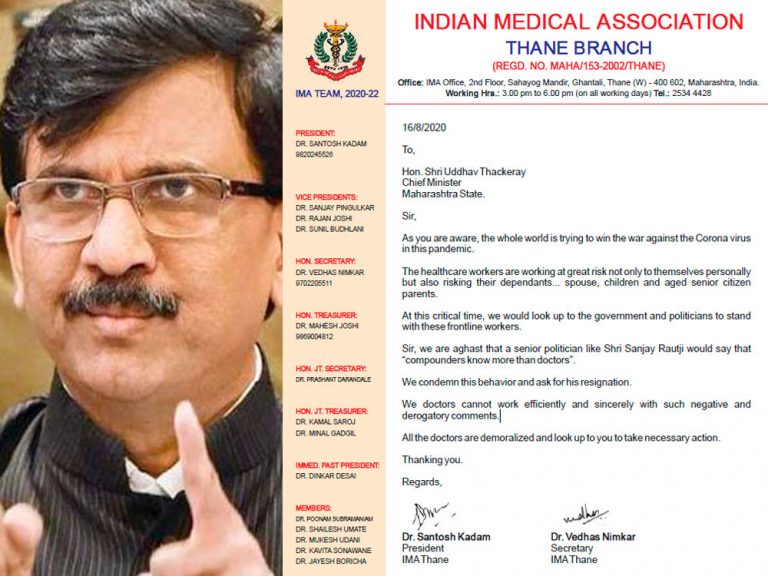
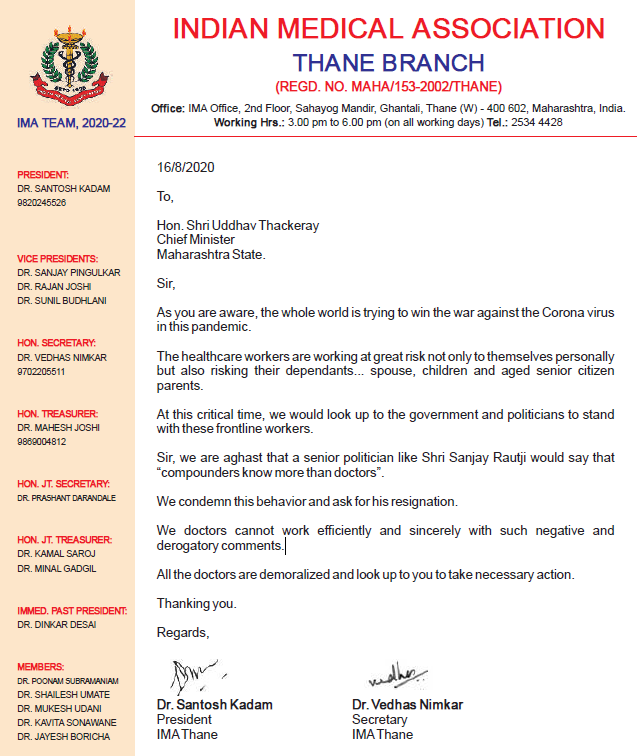
In a letter to Maharashtra Chief Minister Uddhav Thackeray, Indian Medical Association condemned Raut’s statement and asked for his resignation. They said, “the healthcare workers are working at great risk not only to themselves personally but also risking their dependents… spouses, children and aged senior citizen patients.” IMA said that at this critical time, they expect government and politicians to stand with them. They condemned the statement made by Raut that doctors know nothing and compounders know more. “We condemn this behaviour and ask for his resignation,” they added.

IMA’s letter to CM Thackeray seeking Raut’s resignation

Doctors stage protest

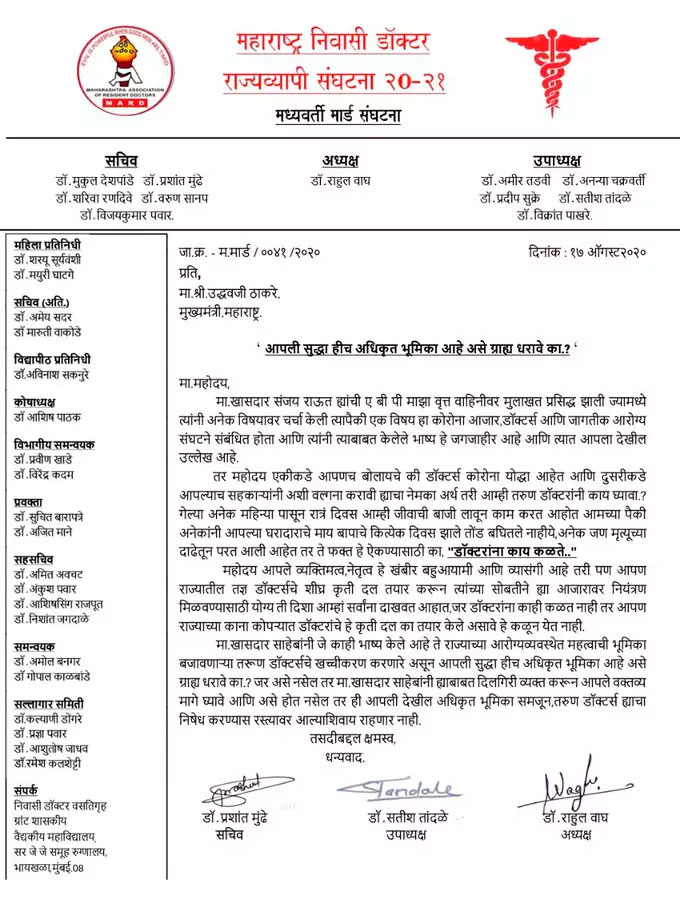
The Maharashtra Association of Resident Doctors (MARD) wrote to CM Thackeray and demanded an apology from Raut. They said, “Raut’s statement is embarrassing to young doctors.” The association asked CM if he believes in what Raut said. If he does not Sanjay Raut should apologize. “Otherwise, the doctors will take to the streets assuming that the role they have played is their official role,” they added.

MARD’s letter to CM Thackeray seeking apology from Raut

Dr Avinash Bhondwe, IMA-M President, said in a statement that over 300,000 doctors are working in the state to fight the pandemic. He said that around 50 doctors have already lost their lives to Covid-19 in the state. “Such disparaging, disrespectful, and dishonoring comments by a respectable leader, a journalist, and a Rajya Sabha member has hurt the feelings of doctors in Maharashtra. These lighting and uncomplimentary remark have damaged the morale of the doctors who are fighting Covid-19 for more than four-and-a-half months now,” he added.

“My comment was about WHO,” claims Raut

Sanjay Raut refused to apologize and denied the allegations that he had hurt the medical professionals in any way. He said that there is a difference between an “insult” and a “joke”. He said, “They [doctors] are seeking an apology, but they should first understand that I have not insulted them and had no intention to do so. Whatever I said was in reply to a question on WHO. There is a difference between an insult and a joke. I have always had respect for doctors and the medical community. The politics over the statement should stop.”

Raut draws flak

Former CM of Maharashtra Devendra Fadnavis said that while he does not know in what context Raut made the statement, he feels that giving such statement is not proper amidst the COVID scenario. “Our doctors are working really hard. They are putting their lives into danger and working day and night for us. This statement has hurt their feelings,” he added.

Asian Age quoted Maharashtra BJP chief media coordinator Vishwas Pathak saying, “Visualisation goes with the capacity and competence of every human being. First Sanjay Raut said that Uddhav Thackeray is fit to be the WHO advisor.” He added that he ridiculed the WHO team to the level of a compounder to match his boss’s capabilities.

Supreme Court dismisses plea to transfer money collected under the PM CARES Fund set up for COVID-19 relief to the NDRF

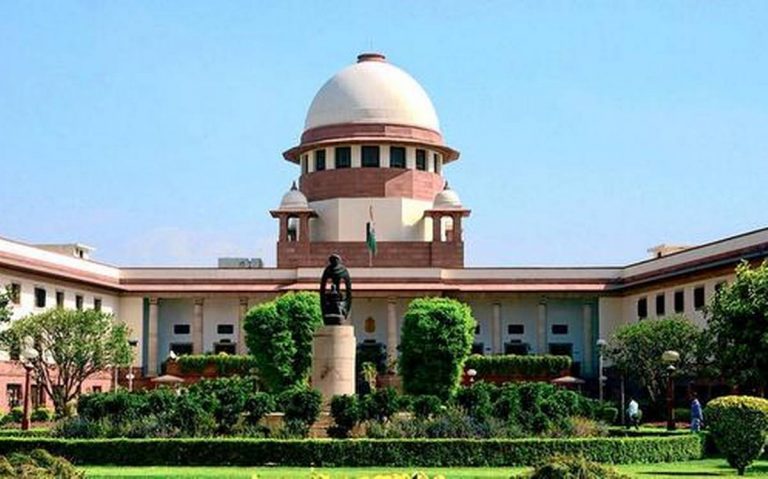
The Supreme Court on Tuesday dismissed a plea seeking transfer of money collected under the Prime Minister’s Citizen Assistance and Relief in Emergency Situations Fund (PM CARES Fund) set up for Coronavirus relief to the National Disaster Relief Fund (NDRF).

As reported by Bar and Bench, the three-judge bench of justices Ashok Bhushan, R Subhash Reddy, and MR Shah also held that contributions to the PM CARES Fund are voluntary and that there was no statutory prohibition on contributions made to the NDRF, hence the funds need not be transferred to NDRF.

While disposing of the petition, Supreme Court said, that there was no need for fresh national disaster relief plan.

Clarifying that the funds collected under the PM CARES Fund are entirely different from the NDRF, as these are funds belonging to a charitable trust the apex court held that plan prepared by the Centre is sufficient to cater to the pandemic. It rejected petitioner’s request to set up a National Plan for COVID-19.

The bench said that the minimum standard of relief issued by the government prior to COVID-19 to continue and that no fresh issuance is required

The writ petition filed by CPIL

The SC was hearing a writ petition filed by an NGO- Centre for Public Interest Litigation (CPIL) which had claimed that PM CARES Fund was set up in violation of the legal mandate under the Disaster Management Act. It claimed that under the DM Act any grant made by any person or institution for the purpose of disaster management should be compulsorily credited to NDRF.

Senior Counsel Dushyant Dave, representing the NGO (the petitioner in this case) had also questioned the audit mechanism of the PM’s Citizen Assistance and Relief in Emergency Situations Fund. Dave argued that the NDRF has to be audited by the Comptroller and Auditor General (CAG) while PM CARES is audited by some private auditor.

Senior Advocate Kapil Sibal, who was appearing in a connected matter related to drawing up a National Disaster Management Plan, argued that since contributions to PM CARES are eligible for Corporate Social Responsibility (CSR) benefits, corporates and others would not have the incentive to donate to the NDRF.

Meanwhile, the Centre, in its affidavit filed in the matter, had defended the creation of the PM CARES Fund and opposed the transfer of these funds to the NDRF. 

However, the apex court today dismissed all arguments seeking the transfer of money collected under the PM CARES Fund to the National Disaster Response Fund (NDRF).

PM CARES Fund collected Rs 6500 crores within a few days of its launch

The PM CARES Fund was set up by the central government on March 28 as a public charitable trust with the primary objective of dealing with any kind of emergency or distress situation such as that posed by the Covid-19 pandemic. Notably, with open-hearted donations from the public, corporates and celebrities, it collected over Rs 6500 crores within a few days of its launch.

Sonia Gandhi demanded contributions should be transfered to PMNRF

It is pertinent to note that the oppositions parties, including the left and the Congress Party had also lamented over the government’s decision to create PM CARES Fund. The Congress had written to PM Narendra Modi demanding that all money under the PM-CARES fund be transferred to the Prime Minister’s National Relief Fund (PMNRF). According to Congress President Sonia Gandhi, this was to be done for ‘better transparency, accountability and efficiency’.

In this regard, it is pertinent to note that the PMNRF had a management committee that oversaw how the funds are employed. While the Prime Minister has discretion, the committee, when it was set up by Jawaharlal Nehru included the President of the Congress party.

The Modi government had however, ignored the demads made by the Congress President.