Home Blog Page 517

No survivors found yet after American Airlines plane and Black Hawk helicopter collide near Reagan Airport in Washington DC

0

A large-scale search operation is underway after a tragic mid-air collision between a American Airlines plane and a US Army Black Hawk helicopter near Reagan National Airport outside Washington, DC On Wednesday night, the collision resulted in both aircraft crashing into the Potomac River, CNN reported.

Authorities confirmed fatalities, and as of early Thursday morning (local time), no survivors had been recovered from the river, according to law enforcement sources.

The aircraft involved in the collision included American Airlines Flight 5342, a regional jet with 60 passengers and four crew members on board. The flight had departed from Wichita, Kansas, and was approaching the airport when it collided with a Black Hawk helicopter on a training mission. The three soldiers aboard the helicopter were also confirmed dead. As of the latest reports, the wreckage from both the plane and the helicopter was found submerged in the icy waters of the Potomac River. “The plane is in pieces in the water and the helicopter is in the water nearby,” said one law enforcement source.

The collision occurred at a time when the airport was busy, with 858 flights scheduled to take off and land at Reagan National Airport on Wednesday, according to aviation analytics firm Cirium. In the wake of the incident, approximately 19 aircraft that were in the air at the time were diverted to nearby Dulles International Airport, about 20 miles away from Reagan National. The airport was closed, and all flights were grounded for the night, a decision expected to remain in effect until at least 11 am ET Thursday, airport officials confirmed.

The crash sent shockwaves through the local community and beyond, with President Donald Trump offering condolences to the families of the victims, reported CNN.

“This is a bad situation that looks like it should have been prevented,” Trump posted on Truth Social. Meanwhile, DC Mayor Muriel Bowser confirmed early Thursday that the focus of search efforts remains on recovering the victims, with all personnel concentrating on the water search.

She added that the National Transportation Safety Board would lead the investigation into the cause of the crash, but the details remain scarce at this time.

DC’s Fire and EMS Chief John A Donnelly Sr described the conditions as “dangerous” for rescue teams. “The water is about 8 feet deep, with ice and murky visibility, making it very difficult to conduct rescue operations,” Donnelly said.

He also warned that recovery efforts could take several days due to the challenging environment. “The river is a large black spot at night with no lights, except for a few buoy lights,” Donnelly explained, emphasising the difficulty of navigating the cold, dark waters.

Meanwhile, the FBI’s Washington Field Office dive team, part of the Underwater Search and Evidence Response Team (USERT), has been assisting in efforts to locate the victims. This team is specially trained in recovering submerged evidence and is providing critical support in the ongoing recovery operations, CNN reported.

A citywide prayer vigil is planned for Thursday in Wichita, Kansas, where the American Airlines flight originated. The Kansas Aviation Museum announced the event to support the victims and their families, with prayers for the 64 people on the plane and the three soldiers aboard the helicopter. The vigil will be held at the Wichita City Council Chambers at noon local time. “Our thoughts and prayers are with all affected by this tragedy as well as the aviation community,” the museum said in a Facebook post.

The crash and subsequent search efforts have deeply affected the Washington, DC community, with officials and emergency responders working tirelessly under difficult conditions. As the search continues, the investigation will hopefully provide answers to what led to this devastating collision.


(This news report is published from a syndicated feed. Except for the headline, the content has not been written or edited by OpIndia staff)

Trump halts US foreign aid, sends shockwaves to NGOs and ‘media’ organizations who were working on fuelling conflicts

On Wednesday, 29th January, the US government led by President Donald Trump decided to hold on to the ‘America first’ policy and freeze foreign funding assistance to Pakistan, Bangladesh and other countries affecting several USAID projects, including Ambassadors Funds for Cultural Preservations (AFCP). As per the reports, the AFCP is a flagship program in Pakistan that supports the country’s cultural heritage.

“It helps protect the historical buildings, archaeological sites, museum collections, and traditional cultural expressions like Indigenous arts and crafts and languages around the world,” the US embassy in Pakistan said. The authorities stated that the aid had been stopped at the executive orders of President Donald Trump for revaluation.

As a result of this, five major energy projects in Pakistan include the Power Sector Improvement Activity, Pakistan Private Sector Energy Activity, Energy Sector Advisory Services Projects, Clean Energy Loan Portfolio Guarantee Program, and Pakistan Climate Financing Activity.

Apart from this, the US has also stopped aid to other countries including Israel, Egypt, Thailand, and Ukraine which have raised alarming concerns due to the shortage of funds. Secretary of State Marco Rubio confirmed the development and stated that only emergency food and military aid to Israel and Egypt would be exempted. He stated that Trump has issued executive orders to halt US aid to worldwide countries for 90 days. During this period, the state would have time to review which of the thousands of humanitarian, development, and security programs would keep getting money from the US.

It is crucial to note that US funding is the largest foreign assistance worldwide providing 4 out of 10 dollars for humanitarian aid. The US government has placed more than 50 officials who work for the US Agency for International Development on leave. It is alleged that these officials were helping the organizations deal with the freeze and defying the orders issued by Trump.

The country earlier believed that assisting foreign countries aided in strengthening national security and improving international relations. It helped several organizations like the OCCRP which targeted India and the Adani Group several times in the past. However, the current administration led by Trump believes that much of such aid money should be used for development at home. The state will now re-evaluate the humanitarian aid in 90 days and make decisions to corner funds accordingly.

While the country of Pakistan which has already been facing dire economic conditions for the past few months, has expressed dissatisfaction over the US decision, the Ukraine said its military assistance remains unaffected. Ukrainian President Volodymyr Zelenskyy commented on the matter and said that the current US freeze of funds doesn’t affect its vital support in fighting Russia.

“Neither of the Defense Department programs is directly affected by the freeze. But civilian programs vital to Ukraine’s war effort do come from the State Department. There’s no word of exemptions for them. That includes salary support that the US provides to keep Ukraine’s government running despite the war’s damage to the economy,” Zelenskyy said.

However, notably, the US has issued a stop-work notice to wartime civilian programs including an NGO named Veteran Hub that helps war veterans overcome social and psychological instability. The NGO now says that it could lose more than 30 staff members as a result of the US action. It also adds that no notice of the funds’ stoppage was issued by the country.

The US funds stoppage has meanwhile affected several NGOs in Zimbabwe and West Africa. As per the reports, the USAID helped West Africa recover from years of vicious wars. The money helped schools run, supported girls’ education, facilitated health systems, and helped small flowers.

Also, the temporary stoppage of funds has affected several medical and refugee camps in Thailand that provide shelter to more than lacs from Myanmar. Refugee camps sheltering Rohingyas in Bangladesh are also affected. The NGO working for these people stated that a waiver for food and emergency medical aid has been approved but fixing homes for refugees won’t be possible if the funds are stopped permanently. India has in the past few years faced the problem of illegal immigration of Rohingyas and Bangladeshis.

The newly-inaugurated Trump administration’s stringent approach towards deporting illegal immigrants from the United States and meticulous efforts to enhance border security, expedite the removal of illegals, and enforce border laws have intrigued the world.

From conducting raids to identify illegal immigrants to ensuring that illegals are accepted back by their native countries, the US administration has made Indians particularly question why India does not deport illegal Rohingya and Bangladeshi immigrants as aggressively and effectively as the US.

Notably, Rohingya refugee camps have been strongly suspected of being breeding grounds for radicalization and terror activities. Rohingyas have been arrested in the past for involvement in human trafficking. They have been arrested for involvement in dacoities. Rohingyas are known to have committed massacres of Hindus. It is undeniable that the illegal Rohingya infiltrators are a security threat to India contrary to the Islamo-leftist cabal’s constant efforts at whitewashing the involvement of the members of this community in criminal activities. A detailed account of Rohingyas and Bangladeshi immigrants’ illegal activities can be read here.

While the process of identification and deportation of illegal immigrants in India is not stagnant, the country grapples with multi-faceted challenges in deporting illegals. Amid this, the US is taking faster steps to re-evaluate its decision to provide funds to NGOs that work to fix illegal immigrants’ lives, waiving basic aid like food and medicines.

Atul Gawande, former head of global health at USAID who left the organization recently meanwhile said that the decision taken by the state to stop USAID is catastrophic and that the cut of funds will affect 6.5 million orphans and vulnerable children with HIV in 23 countries.

USAID supported a media project that targeted India and the Adani Group

It is crucial to note that the USAID also supported media organizations and projects like the Organised Crime and Corruption Reporting Project (OCCRP) which had previously targeted India and the Adani Group. It was reported how USAID assisted the Organised Crime and Corruption Reporting Project with $1.7 million of aid.

OCCRP brands itself as an independent organization but receives a huge share of funding from the US Department of State and the US Agency for International Development (USAID). Since its inception, OCCRP, which published a hit piece on Adani has received at least $47 million from the US government, $14 million from European countries (Britain, Sweden, Denmark, Switzerland, Slovakia, and France), and 1.1 million from the European Union.

OpIndia had also previously reported how USAID, which funds OCCRP, had been at the helm of a ‘regime change’ operation in India’s neighboring country of Bangladesh. The controversial United States Agency for International Development (USAID) signed an agreement to provide $202 million (~2414 crore Taka) to the interim government in Bangladesh, led by ‘American asset‘ Muhammad Yunus. The objective ‘on paper’ behind the financial aid is supposedly to empower youth, strengthen democracy and governance, and bring about development in Bangladesh.

Controversial track record of USAID in Nicaragua and Venezuela

According to a research report published by the Council of Hemispheric Affairs, USAID interference led to the 2018 uprising in Nicaragua. An extraordinary leaked document revealed the US government’s plan to interfere with the internal affairs in Nicaragua before and after the 2021 presidential election.

The 14-page extract of a much longer document outlined a contract of USAID to create “the environment for Nicaragua’s transition to democracy.” William Grigsby from Radio La Primerisima revealed the plan in the document that described how USAID worked with various NGOs, think tanks, media organizations, and human rights bodies to support opposition to the Ortega government.

To support and justify the interference by the US body, the document misrepresented historical events such as claims that the Sandinista party manipulated the elections even though the Organization of American States (OAS) acknowledged there were only minor irregularities. Furthermore, it also rewrote the 2018 uprising narrative ignoring the fact that the opposition indulged in violence and economic disruption.

The US has a long history of interventions in Nicaragua dating back to 1856. The existence of such documents that revealed the plan of the US’s intervention was not surprising. USAID also has a long history of meddling with Venezuela’s internal affairs. According to a 2019 report in People’s World, USAID aligned closely with the National Endowment of Democracy in “Transition Initiatives” to promote the foreign policy goals of the US. The organization has been an integral part of US efforts to organize humanitarian aid convoys to Venezuela which aligned with the political agenda of the US administration and then-interim president Guaido. As reported, USAID and NED funded opposition groups extensively and the former’s operations often blended humanitarian aid with political motives. 

The State Department said on Sunday, opens a new tab that the US government must refocus on American national interests in its role as steward of taxpayer dollars. “President Trump stated clearly that the United States is no longer going to blindly dole out money with no return for the American people. Reviewing and realigning foreign assistance on behalf of hardworking taxpayers is not just the right thing to do, it is a moral imperative,” the State Department said.

Meta to pay Donald Trump $25 million to settle lawsuit over suspension of his Facebook and Instagram accounts

Social media giant Meta will be paying around $25 million to settle a lawsuit filed by US President Donald Trump for suspending his Facebook and Instagram accounts in 2021. Several social media platforms had blocked Trump’s accounts following the January 6 incident on Capitol Hills after the presidential elections were lost by Trump.

After the suspension of his Meta accounts, Donald Trump sued Meta alleging a violation of the First Amendment which guarantees free speech, along with some other charges. Trump had alleged that by suspending his accounts, Meta and its CEO Mark Zuckerberg indulged in “impermissible censorship”.

A Meta spokesperson confirmed the development, saying that $22 million of the settlement amount will go toward a fund for Trump’s presidential library. The rest will be paid towards legal fees and other relevant costs. As part of the settlement, Meta won’t admit to any wrongdoing.

According to the Wall Street Journal, Donald Trump signed the settlement in the Oval Office on Wednesday. As per reports, Zuckerberg wrote a letter to a judge in Northern California that “parties have reached an agreement” in the case, saying that both sides will soon ask for the suit to be dismissed.

The settlement comes amid the attempts by the company and Mark Zuckerberg to improve the relationship with the president after the bitter episode of suspending the account of the then-former president. Mark Zuckerberg met Trump several times since 2023, and reportedly Trump had said that the lawsuit had to be dealt with before Zuckerberg could be “brought into the tent”.

Meta has made a U-turn on censorship policy since then and has announced the end of its third-party fact-checking system. Zuckerberg had acknowledged that the fact-checkers were too biased. Mark Zuckerberg also shared how the Biden administration in the US weaponised political censorship to curtail free speech on platforms such as Facebook and Instagram.

While Trump’s Facebook and Instagram accounts were suspended indefinitely, later as it became clear that he would return to the White House, the company reinstated the accounts in 2023.

Apart from Meta, Trump had also sued YouTube and Twitter (now ?) for suspending his accounts. The case against Twitter was dismissed by a court, while the suit against YouTube owner Google was closed in 2023. Twitter has now been acquired and renamed X by Elon Musk, who is now part of the Trump administration. Both the ? and YouTube accounts of Trump have been restored.

Trump’s social media accounts were suspended by far-left executives of the platforms accusing him of spreading misinformation regarding the 2020 election results.

Echoing US Vice President JD Vance, British MP Suella Braverman says UK could become an ‘Islamist nation with nuclear weapons’

0

Speaking at the Heritage Foundation in Washington DC, USA, on Tuesday, the UK former Home Secretary Suella Braverman said that ‘Britain could fall into the hands of Muslim fundamentalism’ and become like Iran. Agreeing, with the statement of the US Vice President JD Vance made last year, Braverman said that the UK could become an Islamist nation with nuclear weapons.

“VP J D Vance said at the National Conservative Conference, at which I also spoke in the summer here in DC, that the UK was going to be the first Islamist nation with nuclear weapons. I don’t think he was entirely joking,” Braverman said. “What happens if the UK falls into the hands of Islamic fundamentalism, our legal system gets substituted by Sharia law and our nuclear capability vests in a regime not dissimilar to that of Iran today?” She added.

Mass migration is a threat to Western civilisation: Braverman

Braverman, who was criticised for openly speaking against the grooming gangs of British Pakistani Muslim men that targeted British girls for sex crimes, termed mass migration as an existential threat to Western civilisation. “Mass migration is an existential threat to the way of life in our country and to Western civilisation”, she said.

She pointed out the possibility of the changing demography of the UK becoming a threat to the US as well. “Is it a possibility that 20 years from now, it will be the UK, not China or Russia that will emerge as the greatest strategic threat to the USA born out of a broken relationship and weak leadership?” she said.

Hailing the victory of Donald Trump in the US Presidential elections as the victory of freedom, the British MP expressed hope for a revival of freedom in the Western world. “But now thankfully the tide is beginning to turn towards freedom. If the freedom revival fails in the USA, we all lose and the loss will be irrevocable”, Braverman said. “If the USA wins, we will all have freedom. But the USA needs its allies”, she added.

Progressive thinking is losing says Braverman

Braverman termed the idea of multiculturalism promoted by the far-left ideologies as a mere ‘benefit’. She said that the ‘progressive’ thinking of the left ideologies has been rejected by the people. “The prevailing consensus of how multiculturalism was nothing but a benefit is unravelling at pace along with many far-left ideologies. Progressive thinking is losing. It is losing with the young. It is losing with the old. It is losing with the blue and white-collared workers alike,” she said.

What the US Vice President JD Vance said about the UK

In the run-up to the US Presidential election, the US Vice President JD Vance, who was then Trump’s Vice President nominee, had made the controversial remark about the UK becoming the first Islamist nation with nuclear power. Vance speaking at the National Conservatism conference said, ” I was talking with a friend recently and we were talking about, you know one of the big dangers of the world, of course, is nuclear proliferation, though, the Biden administration, of course, doesn’t care about it. And I was talking about, you know, what is the first truly Islamist country that will get a nuclear weapon, and we were like maybe it’s Iran, you know, maybe Pakistan already kind of counts, and then we sort of finally decided maybe it’s actually the UK since Labour just took over”.

West Bengal: College professor faces inquiry for performing marriage rituals with a student, calls the wedding ‘part of a project’

A video of a college professor marrying a college student in West Bengal has been doing rounds on social media. As per reports, the incident is from the Psychology Department of Haringhata Technology College affiliated with Maulana Abul Kalam Azad University of Technology (MAKAUT) in Haringhata, West Bengal. The video shows a professor, dressed as a bride, exchanging garlands with the student, and the latter applying sindoor (vermilion) to her forehead.

After the video went viral on social media, the university acted swiftly and formed an inquiry panel to investigate the matter. The professor who is reportedly a faculty member in the Applied Psychology Department has been sent on leave by college authorities. The student involved has also been asked not to attend the classes. The acting Vice-Chancellor of the Haringhata College, Tapash Chakrabortty said, “We spoke with the professor and she said it was a part of their practice class. We’re not satisfied with her explanation. We started a probe…professor has been sent on leave”.

The professor claimed the act was part of a ‘classroom project’

In her defence, the professor reportedly said that the marriage ritual was part of a psych-drama demonstration for her class. She clarified that there was no misconduct or immoral intent behind the act. She claimed that the video recording was meant for internal documentation but was leaked to damage the reputation of the department.

“It was interpreted wrongly. This was part of a project, a drama we had planned for the fresher’s party. It was made viral intentionally as part of a conspiracy against me. I will file a police complaint against those who tried to defame me”, the professor clarified. “They requested me to play the main character and I agreed. Other faculty members knew about it and agreed to the programme; no one objected then. Students printed the card and planned the whole thing. My first-year students and I acted following the script. This was nothing serious. I agreed only because the students requested me,” she added.

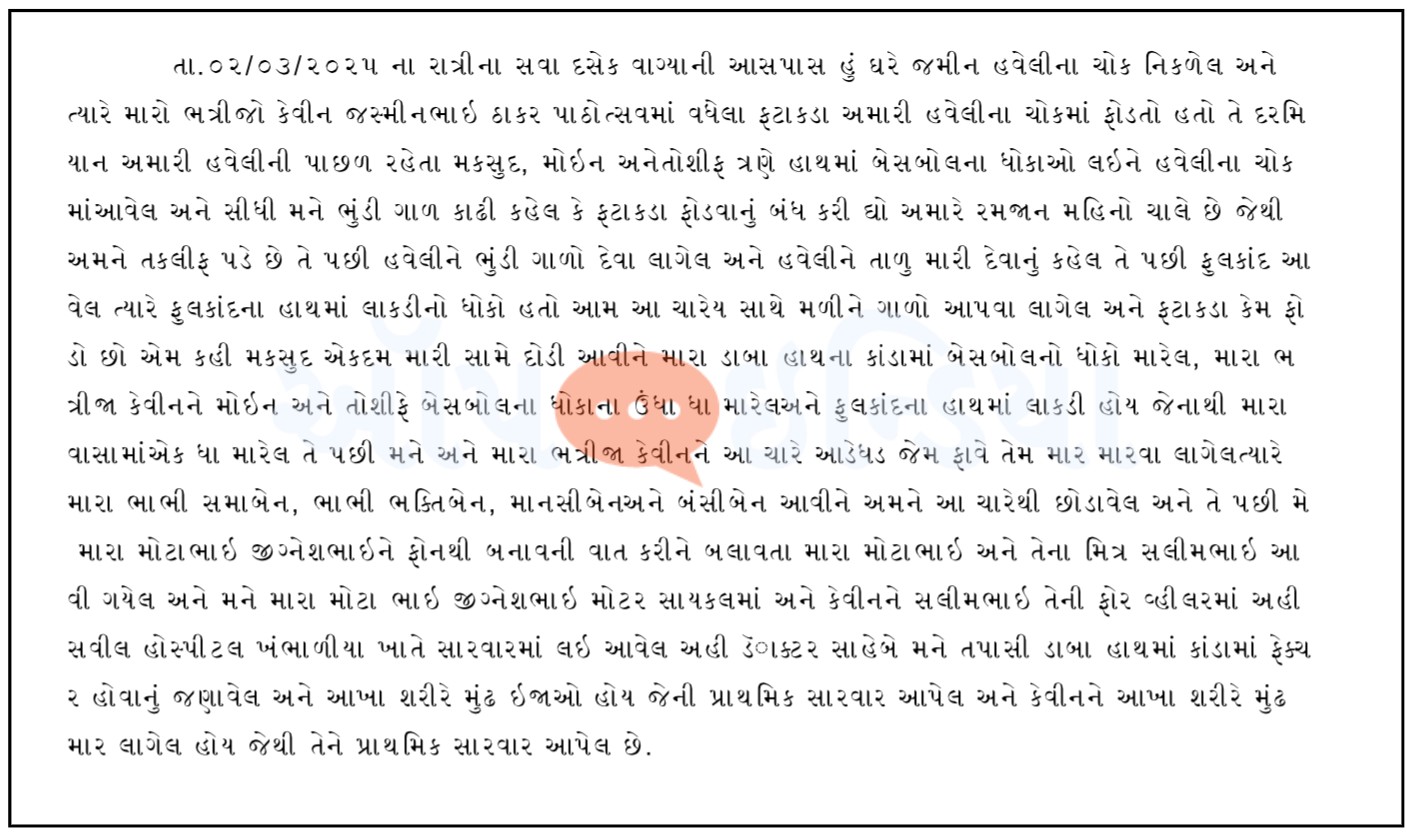
A letter written by the professor and the student surfaces online

As per reports, a letter purported to be written by the professor, the student and three other student witnesses has emerged online.

The letter (India Today)

An investigation is being conducted by the inquiry panel in the matter.

The Portuguese onslaught Part 1: How Vasco da Gama’s ‘discovery’ of India brought years of bloodshed, murders and violence to our shores

The earth is imbued with the marks and memories of countless conflicts, encompassing both victories and losses, which have led to massive changes in power dynamics, authority, demographics and the social landscape of countless lands. The impact of battles, whether waged on land or at sea, has indelibly influenced global history, with different degrees of significance. Indian subcontinent too has been profoundly affected by the decisive battles of Panipat, Tarain, Haldighati, Plassey, and Buxar, among others.

Likewise, naval battles including the Battle of Midway during World War II, the Battle of Trafalgar in the Napoleonic Wars and the Battle of Salamis, which took place between Greece and the Persian forces in 480 BC also played an equally important role in altering the world history. Since much of the world is oceans, battles of the seas have deeply influenced the trajectory of nations.

Unknown to most of use, conspicuously absent from the popular stories of our history and our school textbooks is a crucial phase of our history that came from the sea, spread along the coast and encompassed some fierce, pivotal naval battles that shaped India’s history.

It is known as the “Battle of Diu” also referred as the “Second Battle of Chaul” fought on the 3rd February of 1509 in which the Portuguese succeeded and effectively established their control over the Indian Ocean for the subsequent century until other European powers began to intrude upon their alleged territory what was referred to as the “Portuguese Lake.”

The chain of events that triggered the fateful confrontation including personal vengence, selfish greed along with an unprecedented religious fanaticism not only serve as a fascinating lesson but also expose the exploitation of vulnerabilities at the hands of imperial forces throughout history, especially in relation to India.

1498: Vasco da Gama’s arrival in Calicut (1st Portuguese Armada on Indian coast)

Two years after leaving Portugal’s Lisbon, Vasco da Gama landed in Calicut (now Kozhikode) of Kerala on the western coast of India on 20th May 1498. This was the first time a European convoy had traveled by sea, rounded the Cape, to reach India. He is hence credited for ‘discovering’ the sea passage to India, a country known for its spices and other treasures since ancient times which had been sought after by countless western traders and sailors. In 1492, Christopher Columbus accidentally found America when his real objective was to reach the Indian coast. Eventually, Vasco da Gama was successful for the better (for the benefit of his European bosses) and worse (for India) but it’s reasonable to conclude that his voyage did change the world.

Europe had a high demand for goods from the Orient and India. Spices in particular were highly prized because they could be employed as preservatives to help people survive Europe’s severe winters. The majority of trade with India was conducted by road or through Arab traders who brought valuable items from India’s coast to the Venetians, who then sold the spices and other goods to the rest of Europe. The conquest of Constantinople by Ottomans in 1453 significantly lowered trade between Venice and Genoa, and the land voyage was costly. A direct commercial route to India would improve access to local commodities and increase revenues.

Vasco da Gama, 16th-century painting in the Maritime Museum, Lisbon. (Source: Gianni Dagli Orti/Shutterstock.com)

Additionally, it would grant the nation a monopoly on the profitable spice trade. The trip to India was approved by King Manuel I of Portugal, who also named da Gama the Armada’s captain and expedition leader. There were 170 soldiers and 4 ships on the trip. da Gama was the captain of a ship named Sao Gabriel. The fleet set sail on 8th July 1497 from Lisbon. The intent was to circumnavigate Africa and then travel from there to India. According to some accounts, Abdul Majid who was a Gujarati naval pilot in Malindi, guided Vasco da Gama to Calicut in (1497-1498). 

On 7th November, the expedition arrived near the southern tip of Africa, and halted at St. Helena Bay to replenish and make repairs. However, a violent encounter with locals ensued in which da Gama was wounded but they rounded the Cape of Good Hope on 22nd November and stopped at Mossel Bay to reorganize the fleet. Many of the crew members had scurvy throughout the challenging journey following which they anchored in Malindi, East Africa after passing through Mozambique.

An Indian from Kenya reportedly gave da Gama information about the monsoons and helped him find his way to the subcontinent. When the latter arrived in Kappad, close to Kozhikode, on 20th May 1498, it was a part of the Kingdom of the Zamorin (Samuthiri Raja, or Samudrin) of Calicut, one of the richest men in the whole world.

The Zamorin was not impressed by da Gama’s presents, which included some clothing, caps, corals, sugar, oil, and other items. Interestingly, the foreigners were greeted with hospitality that included a spectacular procession. The Indians also questioned why there was neither silver nor gold.

A Renaissance Tapestry made in Tournai depicting Vasco da Gama’s arrival at Calicut. It now hangs in the Caixa Geral de Depositos Museum. This image was used in the reverse of the 5000 Escudos banknotes. (Source: Wikimedia Commons)

His inconsiderate gifts and impolite demeanor turned off the Hindu monarch Zamorin of Calicut, which at the time was the most prominent trading hub in southern India. Local interpreters and Arabic speakers helped with communication, although misunderstandings took place. Naturally, the presence of a possible rival in the local trade irritated Calicut’s Muslim merchants. He was unable to reach a treaty, in part due to the animosity of Muslim traders and in part because the cheap trade items and trumpery gifts he had brought were barely in demand in India, although being appropriate for the West African commerce.

The Hindus were incorrectly thought to be Christians by the Portuguese who made a good fortune from the sale of spices they brought from India. Early on, da Gama’s refusal to pay the standard customs fees also caused tension in the relationship between the Zamorin and him. When hostilities rose, he departed at the end of August 1498, bringing five or six Hindus with him so King Manuel might become familiar with their traditions. Due to his ignorance and disregard for local knowledge, he had to sail against the monsoon as he had chosen the worst time of year to leave. Half of the soldiers had perished on this return trip, leaving the crew in poor condition.

Only two ships returned to Europe and arrived in Lisbon on 10th July 1499. The monarch welcomed da Gama as a hero and even accorded him the title “Dom.” The cargo that the voyage brought in was worth over 60 times its total cost. Many more Portuguese armadas would visit India, manipulating the subcontinent in a variety of ways. Portugal began as a commercial partner before colonizing some areas of India. Goa, their largest Indian colony, would be ruled by the Portuguese for more than 450 years, beginning in 1505 and ending only in 1961 when the Indian army freed the province.

Vasco da Gama’s return to Portugal with spices like cinnamon and pepper proved the sea route was feasible, opening the door for other expeditions and fundamentally changing the scope of international trade. It is frequently considered the most significant finding in what is known as the “Age of Discovery,” despite the fact that other European countries suppressed the Portuguese on the subcontinent (where the British ultimately prevailed).

It is ironic that in India, schoolchildren are taught to admire Vasco da Gama, as if he did a favour on us by ‘discovering’ an alternate route to India to serve the European interests. Little is discussed in the mainstream narrative about how Vasco da Gama brought us years of war, and centuries of colonisation for some of our key regions on the Western coast.

1500: Pedro Alvares Cabral’s fleet reaches India (2nd Portuguese Armada to India) 

The Portuguese sailor, adventurer and aristocrat Pedro Alvares Cabral is known for his discovery of Brazil. Manuel I, the king of Portugal, assigned him the task of traveling to India. Three years after da Gama’s historic journey, the king gave him command of the second significant expedition, stating “the great confidence we have in Pedralvares de Gouveia, nobleman of our household.” He directed Cabral to strengthen trade relations and spread Catholicism. On 9th March 1500, he was appointed admiral in supreme command of 13 ships, which sailed from Lisbon. He intended to continue the campaign that Vasco da Gama commenced, fortify trade relations and pursue the same course as his predecessor.

Pedro Alvares Cabral’s journey to Brazil and India. (Source: Wikipedia)

Arab and Turkish traders dominated the lucrative spice trade till that time. Cabral was to sail southwest in order to avoid the turbulent waters of the “Gulf of Guinea,” as per da Gama’s instructions based on his experiences during the first journey. The Portuguese had the added benefit of being able to reconnoitre along the west coast of the lands along this track, which was dubbed as the “circle around Brazil.” However, Cabral had no prior sailing experience and hence renowned explorer Bartolomeu Dias traveled alongside him to aid in his quest.

One of Cabral’s ships went missing shortly after they left and was feared to have sunk. He was to travel around Africa to India in the same manner as Vasco da Gama. However, he unintentionally ventured into the Atlantic Ocean too far to the southwest. This mishap led him to a new country that the Europeans were unaware of, the coast of South America. Cabral understood that it was not India. He made landfall in Porto Seguro, on the coast of what is now the state of Bahia, with his fleet. He claimed the territory in the name of Portugal as they installed a big wooden cross on the shore. He believed that they had arrived on an island which is today known as Brazil.

Pedro Alvares Cabral taking possession of Brazil in the name of Portugal, 22nd April 1500. (Source: ©Getty – Apic)

Cabral informed the ruler of his news by sending a ship back to Portugal and spent roughly ten days in Terra de Vera Cruz (the first name given by the Portuguese navigators to the northeast coast) with the remainder of his fleet. He interacted with the natives and preached his religion before setting sail for India, a journey marred by a string of unfortunate events. He also left two of his men behind for more investigation. They made stops at a number of African ports, including Kilwa, Mozambique and Sofala but ran against hostile locals and had little success trading.

Four ships with all crews on board were lost on 29th May, when the crew rounded the Cape of Good Hope. On 13th September the surviving ships anchored in Calicut where Cabral was greeted by the Zamorin of Calicut. He brought diplomatic letters and expensive presents from the Portuguese king himself to Calicut. He negotiated a commercial agreement that allowed the Portuguese to engage in trade and also set a factory there. However, disagreements with Muslim traders soon erupted.

The facility had been operating for two months before roughly 500 men attacked it. Arabs, who were trading rivals of the Portuguese, spearheaded this surprise onslaught. Moreover, the Portuguese and Arabs had a long-standing religious conflict. The majority of the Portuguese defenders were murdered before the Portuguese fleet, which was moored in the harbor, could send reinforcements. This incident claimed the lives of about 50 Portuguese. Indians reportedly helped the Arabs in this attack as well. When Cabral did not receive an answer from the Zamorin regarding this incident, he attacked 10 Arab commercial ships. The vessels were burned and the crew slaughtered, in retaliation. Calicut was under siege for a full day.

Cabral then headed south to the Indian port of Cochin (now Kochi), where he was warmly greeted and allowed to exchange valuable spices for his six surviving ships. He completed his cargo in Carangolos and Cananor (Cannanore, now Kannur) on the same coast. He carried on selling and trading products and spices in other Indian cities. After forming business partnerships, he brought back a plethora of spices to Portugal. On 16th January 1501, he set out again for Portugal. However, two of his ships went down en route, and on 23rd June, he arrived at the entrance of the Tagus River in Portugal with just four ships.

The project had been plagued with disasters, but King Manuel was delighted with the outcome. He is reported to have initially supported appointing Cabral as the leader of a fresh, more potent expedition, but in the end, Vasco da Gama was chosen to command it. The Portuguese were always outnumbered by Indians, thus they sought to establish their military and artillery superiority and open the way for future traders from their nation. The tone for ‘gunboat diplomacy,’ which other European countries would adopt in their colonial endeavors in the subcontinent, was established by the Portuguese.

Belmonte, Portugal: Pedro Álvares Cabral monument. (Source: Encyclopædia Britannica)

Gunboat diplomacy is the pursuit of foreign policy objectives with the aid of conspicuous displays of naval power, implying or constituting a direct threat of warfare should terms not be agreeable to the superior force.

1501: Joao da Nova lands in India (3rd Portuguese India Armada)

King Manuel I of Portugal in 1501 ordered Joao da Nova who was a Galician-born explorer in the service of Portugal to lead a relatively smaller mission to India whose primary aim was commercial in nature. They had four ships, two owned by the crown and two privately while a fifth supply ship could have existed. The journey consisted of 350 to 400 men, only 80 of which were armed. Their goal was to travel to India, stock the spices and then head back home. They did, however, participate in the first major Portuguese naval conflict in the Indian Ocean.

Joao da Nova (Source: Wikipedia)

Additionally, the uninhabited islands of Ascension and Saint Helena in the South Atlantic Ocean were originally discovered by Nova. It also might have been the first Portuguese fleet to arrive in Ceylon (Sri Lanka), according to some speculations. It was hoped that Cabral had been successful in its ambassadorial assignment to negotiate a treaty with Calicut and establish a factory there. Unbeknownst to Nova, the expedition had not only failed in its purpose but had also sparked a conflict between Calicut and Portugal. Nova and his soldiers were sailing into an unanticipated and unprepared war. Furthermore, it appeared that they had a prearranged stopover in Sofala, where Cabral had been advised to establish a factory. However, there was no such Portuguese factory in Sofala as he was again unsuccessful.

The fleet docked in India in August 1501 in the Santa Maria Islands off the Malabar coast, named for the feast of the “Assumption of Mary” (15 August). He started heading along the Indian coast towards Kerala promptly, according to some accounts, while others claimed that he stopped at Batecala (Bhatkhal), the main trade port of the Vijayanagara Empire at the time and stayed there, trading with various merchants in the harbors and hunting down pirates in Onor (Honnavar). He then begun to move towards the Indian coast in the direction of Kerala, taking two merchant ships along the way that were supposedly from Calicut, close to Mount d’Eli.

Fleet of Joao da Nova from the Memória das Armadas. (Source: Wikipedia)

After trading and possibly engaging in some piracy, they appeared to have just stayed in the region between Batecala and Mount d’Eli before moving south to Cannanore. It has been speculated, however, that during this lull, Nova might have begun some explorations in the region, specifically a broad swoop far south, beneath Cape Comorin, in an effort to find the famous island of ‘Taprobana’ (Ceylon), the world’s primary cinnamon supplier.

The Kolathiri Raja (King) of Cannanore welcomed him when he reached there in the fall of 1501, and he asked Nova to pack his ships with spices from the city’s marketplaces. Nova politely declined the offer, pointing out that he needs to first pick up the goods that the Portuguese factory in Cochin has already purchased. However, before departing, Nova leaves a few agents behind, instructing them to make plans to buy spices (mostly cinnamon and ginger) in the Cannanore markets to be collected up later.The Portuguese factory in Cannanore is supposed to have been founded by Nova at this period.

However, he left behind Paio Rodrigues, who was not a worker at the Casa da India (the crown trading company) but rather a private agent of D. Alvaro of Braganza and the Marchionni consortium. At the mouth of Calicut harbor, Nova attacked three merchant ships one of which was owned by the Zamorin himself, en route to Cochin. He took their cargo and set the ships on fire in full view of the city. Loot from these ships included some expensive silver Indian navigational charts and nautical instruments.

Meanwhile, he learned that Portuguese merchandise was unsold in both Cochin and Cannanore as the spice traders wanted payment in silver. A boycott of Portuguese products in Indian markets had reportedly been orchestrated by the Arab Merchants Guild as well. Raja Trimumpara of Cochin was also angry with the Portuguese because Cabral and his fleet left abruptly (without amity and taking two noble Cochinese hostages with them), even though he was an ally and had protected the factory. The Kolathiri Raja of Cannanore stepped in as collateral for the sale of spices to the Portuguese on credit just as the mission was about to fail. As a result, the impasse was broken and the Portuguese were able to finally stock up on spices.

First battle of Cannanore

Nova planned to depart India in late December 1501, laden with the spices he could obtain on credit in Cannanore (as well as any cargoes he was able to take through pirate attacks on Malabari ships). As the crew was preparaing to begin their journey from Cannanore on 31st December, they were surrounded in the harbor by a fleet sent by the Zamorin of Calicut comprising of roughly 180 small paraus and zambuks, as well as over forty large ships, totaling an estimated 7,000-man armed Malabari army.

Nova was urged by the King of Cannanore to remain under his protection and refrain from fighting. He, however, decided to try a break-out after spotting the favorable landside breeze. Nova directed his four ships into a column formation and charged through the Calicut line, gun exploding on either side of the little opening created by a few rounds of cannon.

Nova kept shooting at his assailants with his cannon while the Portuguese column advanced to the sea. Less seaworthy, the Calicut fleet started to disintegrate and fall behind. The fight was reduced to a ranged artillery duel as Nova pulled away, eliminating the possibility of a grapple. The Malabari ships soon discovered that their Indian cannon was unable to match the Portuguese cannon’s range and reloading speed. They then began to turn away and were followed by Nova for some time. However, the encounter concluded on 2nd January 1502.

Battle of Cannanore, drawing by Alfredo Roque Gameiro in the book Historia de Portugal, Popular e Ilustrada. (Source: Wikipedia)

What favoured the Portuguese? Better ships with better guns

Overall, the Portugueses had destroyed presumably a dozen oar-driven boats and five huge ships after two days of combat. They suffered minor damage but caused severe harm to the remaining Malabari vessels. The two-day naval combat off Cannanore was possibly the first major Portuguese naval action in the Indian Ocean, despite Nova’s lack of preparation.

Portuguese and Indian ships had previously clashed during the first two Armadas as well. The significant difference in ship construction and cannon technology between Europeans and Indians was made evident during the Battle of Cannanore. The Portuguese would later frequently take advantage of this discrepancy.

The Zamorin would have to stay on land or turn to the Arabs, Turks and Venetians in order to negate the Portuguese naval superiority. The conflict is particularly noteworthy in history because it was one of the first documented intentional uses of a naval column, which was later referred to as the line of battle. It was also decided only by the utilization of artillery. As fleets changed and started to view ships more as floating guns than as carriages of armed troops, these strategies would become more and more common. This has been referred to as the first ‘modern’ naval engagement in that regard (at least for one side).

Nova took a Calicut commercial ship off Mount d’Eli in early 1502, and after looting it, they burned and sank it before ultimately making their return journey. Their expedition had not been a complete success. They returned with fewer spices than expected (letters suggest that cargo holds returned largely empty), and they had failed to trade for gold in Africa. They stopped twice in East Africa, once in Malindi, where he dropped some letters which were recieved by Thome Lopes later that year and the second at Mozambique Island.

1502-1503: Vasco da Gama’s second voyage to India (4th Portuguese Armada to India)

Manuel I ordered another expedition to take advantage of the achievements of their previous missions and a third fleet was shortly outfitted in Lisbon. Vasco da Gama who was made an admiral in January 1502, was assigned command of this fleet. On 12th February 1502 he set out once more with a fleet of 20 warships to uphold Portuguese interests. Ten ships were backed by two flotillas of five ships each which was led by his relatives, based on some reports. They made a stop at the Cape Verdes, and arrived in the East African town of Sofala on 14th June. The Portuguese expedition made a brief halt in Mozambique before continuing on to Kilwa, which is today in Tanzania.

Key port cities on the Eastern African coast, Sofala, Mombasa, Kilwa and Malindi, where Arab and Indian merchants frequented, image via Saylor Academy

Cabral had not been friendly with the Amir Ibrahim, the ruler of Kilwa and da Gama threatened to burn Kilwa unless he swore allegiance to King Manuel and submitted to the Portuguese, which he did. After making a stop at Goa, which would later become the center of Portuguese dominance in India, da Gama continued his journey along the southern Arabian coast to Cannanore, where he waited for Arab ships which appeared with 200 to 400 people, including women and children as well as merchandise after few days.

Vasco da Gama’s second visit to India. (Source: Weebly)

How Vasco da Gama attacked a ship returning with pilgrims from Mecca, burned hundreds of men, women and children

Interestingly, Vasco da Gama brought gold and silk to demonstrate that he had visited India earlier. He was now ready to face the Muslim traders owing to his experience from the first mission. He had twenty vessels in his fleet. He killed many Muslims and Arabs in an attempt to take revenge from the former for the 1498 upest and to further Portugal’s interests in the east. He once awaited the return of a ship from Mecca, took all the cargo, locked the passengers in the hold, and set the ship on fire. All of the men, women and children perished when the ship sank after four days. The ship sank in four days, killing all of the men, women and children on board.

The fleet sailed to Calicut after da Gama forged an agreement with the Zamorin’s adversary, the ruler of Cannanore, to destroy its trade and get revenge on the Zamorin for his favors toward Muslim traders. After bombarding the port, he captured and killed 38 prisoners. Afterwards, the Portuguese headed south to the port of Cochin, where they forged an alliance with its king, a Zamorin foe. The Portuguese engaged Arab ships in a brief battle off Calicut but forced them to take full flight after the Zamorin’s invitation to da Gama turned out to be a bid to trap him.

He played privateer among Arab commercial ships before destroying a fleet of twenty-nine Calicut ships and successfully taking over that port city. He gained great favor with the Portuguese crown by negotiating favorable commercial arrangements as he secured a substantial quantity of booty in return for peace. He threatened to exile all Muslims in order to show his authority. He severed the hands, feet, and heads of 38 fisherman and hung them to show off his power. The mutilated bodies then drifted onto the beach. Later, they managed to enter the trading system and bombarded the city with firearms. Other Portuguese conquests in the East Indies were made possible afterwards. He then went back home following his conquest.

As a result, Portuguese trading practices were linked to terror, and da Gama was rightly demonized. On the first leg of their return journey, the fleet sailed from Cannanore to Mozambique on 20th February 1503, arriving at the Tagus on 11th October. He was appointed Count of Vidigueira from territory that had once belonged to the Braganca royal line, in Portugal. He was also granted feudal rights and control over Vila dos Frades and Vidigueira.

Unfortunately yet unsurprisingly, the avaricious desire for power unleashed more bloodshed and conflicts for the Indian subcontinent, which will be discussed in the upcoming articles and ultimately, this led to the pivotal “Battle of Diu”and cemented the roots of Portuguese in India for many generations to come.

The Portuguese in the late 15th century may or many not have been aware that their brutality, grit and savage bravery to travel to new shores is changing the world, and laying the foundation for pivotal points in human history, from the beginning of European colonisation of Asia to gathering the money and resources that eventually funded the industrial revolution in Europe. But they did know one thing, that they needed stronger ships fitted with better guns. It was those ships that helped them defeat the Ottomans.

This is Part 1 of a series that will discuss the Battle of Diu, a crucial point in the history of the world that changed the destiny of not just India, but the entire Western Asia, South Asia and the Indian Ocean Region. The seas that only knew the severity of the Monsoon winds, were about to witness something far more violent, European colonisers.

Chhattisgarh: 29 Naxals, including seven women surrender before Narayanpur SP

0

 In a significant turnaround, as many as 29 naxals of the Kutul area Committee in Chhattisgarh surrendered before Narayanpur SP Prabhat Kumar on Wednesday, officials said.

As per the officials, 22 men and 7 women were among the surrendered Naxals. Narayanpur SP, Prabhat Kumar, said that the administration is conducting a movement against Naxalism.

He further stated that a social change can be witnessed as an impact of this development work.

“We are conducting a movement against Naxalism… Effective operations have been conducted under this and development works have also been done… In the Kutul area, we are witnessing a social change as an impact of this development work. People who were involved in naxal activities are surrendering…29 people who were actively involved in naxal activities have surrendered today. They are affected by the development work,” Prabhat Kumar told ANI.

Earlier, security forces took control of a Maoist training camp in the core area of PLGA Battalion No. 01 in the dense forests of Bhattiguda, Bijapur district. The camp was left abandoned by the Maoists, who fled during the army’s search operation.

The joint operation was carried out by CoBRA units 201, 204, and 210. Security personnel on Tuesday, where security forces stormed their camps and demolished the Naxal martyr memorial. The Naxal’s training camp had tall trees prepared for training purposes, trenches, and various other resources. It also housed permanent barracks and huts used by the Maoists.

Officials have called the operation a major blow to Maoist activities in the region and a step towards dismantling their infrastructure. Security forces have reaffirmed their commitment to ensuring peace and stability in the region.

Meanwhile, a recent encounter in Chhattisgarh’s Gariaband took place where bodies of 16 Naxals were recovered following an encounter with the security forces. The Chhattisgarh Chief Minister highlighted the achievements of the security forces and their success in dealing with the Maoist threat, emphasising the government’s commitment to eliminating Naxalism in the state.

The operation, which was started on Sunday, also saw senior cadres of Maoists dead and a large quantity of weapons, including automatic weapons like SLR rifles, recovered.


(This news report is published from a syndicated feed. Except for the headline, the content has not been written or edited by OpIndia staff)

Cabinet Committee on Security clears ₹10,000-crore Pinaka rocket project for Army, Solar Industries & Munitions India to manufacture

In a mega success for indigenous weapon systems, the Cabinet Committee on Security has cleared the project to buy over Rs 10,000 crore worth of ammunition for the Indian Army’s Pinaka multi-barrel rocket launcher systems.

The Indian Army project to buy the Rs 10,000 crore plus ammunition including the Area Denial Munitions and Pinaka Enhanced Range rockets was cleared by the Cabinet Committee on Security in a meeting held on Wednesday, defence sources told ANI.

The project would be divided between the rocket manufacturer Solar Industries of Nagpur and the former Ordnance Factory Board company Munitions India Limited (MIL), they said.

Army Chief Gen Upendra Dwivedi in his annual press conference on January 13 had stated that the contract for Pinaka weapon systems munitions including the Rs 5,700 crore for high-explosive ammunition and Rs 4,500 crore area denial munitions were expected to be cleared soon by the government.

The DRDO is already in the advanced stages of making a 120 km strike version of the Pinaka rockets and is expected to carry out its first test in the next financial year.

The rockets cleared today by the CCS have a range of around 45 Kms and can be very effective at both the Pakistan and China border.

One of the biggest success stories among the Indigenous weapon systems, the Army is fully backing it as Chief of Army Staff Gen Dwivedi has already made it clear that as soon as longer-range versions of the Pinaka are ready, the force might drop plans for other alternate weapons.

The Pinaka has already been a major success story in the export sector as it has been bought by Armenia while many European countries including France are showing interest in it.


(This news report is published from a syndicated feed. Except for the headline, the content has not been written or edited by OpIndia staff)

Arvind Kejriwal spreads fake news to reiterate his ‘Poisoned Yamuna’ allegation, posts doctored video of Haryana CM drinking Yamuna water

Former Delhi CM and AAP chief has received notices from the Election Commission and a court in Haryana over his claim that BJP is mixing poison in Yamuna water to cause a mass massacre in Delhi. While he had claimed that the Delhi Jal Board engineered detected the poison and stopped the water from reaching Delhi, the DJB that comes under the Delhi govt has denied the allegations.

But Kejriwal is not retreating from his baseless allegations, and today he proceeded to post a doctored video to target Haryana CM Nayab Singh Saini. Posting an edited video of Saini taking a sip from Yamuna, Kejriwal claimed that the Haryana CM did drama and he actually didn’t drink the water.

Kejriwal claimed that Saini pretended to drink water, and then spat the wated back into Yamuna. He added, “When I said that Yamuna water could be dangerous for the lives of Delhiites due to ammonia contamination, they threatened to file an FIR against me. They want to make the people of Delhi drink the same poisonous water which they themselves cannot drink. I will never let this happen.”

However, what Kejriwal did was post a clip of a longer video, and the Haryana CM did drink the water of the Yamuna River. As seen in the following video posted by ANI, it can be seen that Nayab Singh Saini first took a sip of water from the river, and then spat it out, perhaps he was rinsing his mouth. However, immediately after that, he took another sip, and this time he gulped a fistful of water.

As per reports, Saini visited the river at Delhi’s Palla Village, where he drank from the river to disprove Kejriwal’s claim of poisoning.

Notably, while Kejriwal said that BJP has threatened to file an FIR against him, a complaint has already been registered against him at the Chief Judicial Magistrate Court of Sonipat in Haryana. The BJP govt in Haryana lodged the complaint demanding action against him. Accordingly, the court issued a summon to Kejriwal and asked him to appear in the court on 17 February.

The Election Commission of India also has asked Arvind Kejriwal to furnish evidence on his claim that the BJP-led Haryana government poisoned the Yamuna water supply to Delhi, after BJP lodged a complaint against him.

Notably, the Delhi Jal Board has already busted Kejriwal’s claims over Ammonia level in the river explaining that it is a natural phenomenon.  DBJ called his claims “factually incorrect, without any basis and misleading.” The board added that the Ammonia level increases in the Yamuna water every year between October and February due to a decrease in water level.

India’s big immigration problem: From Rohingyas to Bangladeshis, the challenges entailing the deportation of lakhs of illegal immigrants

The newly-inaugurated Trump administration’s stringent approach towards deporting illegal immigrants from the United States and meticulous efforts to enhance border security, expedite the removal of illegals, and enforce border laws has intrigued the world. From conducting raids to identify illegal immigrants to ensuring that illegals are accepted back by their native countries, the US administration has made Indians particularly question why India does not deport illegal Rohingya and Bangladeshi immigrants as aggressively and effectively as the US.

How many Rohingyas and Bangladeshi illegal immigrants are staying in India?

As per the latest data as of 31 December by UNHCR, around 95,600 Rohingyas are living in India who fled after facing persecution in Myanmar. This includes 22,500 refugees and asylum seekers considered stateless by the United Nations High Commissioner for Refugees. The majority of Rohingya Muslims, over 10 lakh, who fled Myanmar reside in Bangladesh, and they are supported by international aid agencies.

Back in 2016, then Union Minister of State for Home Affairs Kiren Rijiju had told the Rajya Sabha that there are over 2 crore illegal Bangladeshi immigrants residing in India which is nearly the entire population of Australia. This marked a 67% increase in the presence of illegal Bangladeshi immigrants since Sriprakash Jaiswal who was Union Minister of State for Home Affairs in 2004 UPA government told Rajya Sabha that as of 31st December 2001, around 12 million illegal Bangladeshis were staying in India. Caving into the pressure of upsetting the Muslim vote bank and reluctance to heed BJP’s demand for deporting the illegals, Minister Jaiswal later dismissed his own statement as one based on “hearsay”.

It, however, must be noted that since the infiltration of illegal Bangladeshi immigrants into India is clandestine, accurate data collection has been a herculean task for the authorities. The actual figures of both these illegal immigrants could by way higher than the estimated numbers.

Notably, Rohingya refugee camps have been strongly suspected to be breeding grounds for radicalization and terror activities. Rohingyas have been arrested in the past for involvement in human trafficking. They have been arrested for involvement in dacoities. There has also been the suspicion that there is a deliberate attempt to Islamicize Hindu-majority Jammu by settling Rohingyas. Rohingyas are known to have committed massacres of Hindus. It is undeniable that the illegal Rohingya infiltrators are a security threat to India contrary to Islamo-leftist cabal’s constant efforts at whitewashing the involvement of the members of this community in criminal activities.

While the process of identification and deportation of illegal immigrants in India is not stagnant, the country grapples with multi-faceted challenges in deporting the illegals.

Rohingyas are stateless

A 1982 Citizenship law passed in Myanmar derecognised Rohingyas as citizens. This law created a three-category hierarchy of citizenship based on national races —citizens, associated citizens and naturalised citizens. The Burmese government decided that national races were those who settled in Myanmar before the first occupation of the country by the British in 1824. The authorities did not consider Rohingyas as one among the indigenous races thus their citizenship was revoked making them stateless.

Fast largest to 2017, the exodus of the Rohingyas from Myanmar after violence broke out in Rakhine state compelled the community to flee the country. These people over the years have illegally entered Bangladesh, India and Malaysia. Earlier this month, Malaysia turned away two boats carrying around 300 Rohingyas trying to enter the country illegally. The Muslim-majority country had earlier accepted Rohingya Muslims in large numbers. However, it shifted the policy and began to limit their intake apprehending their mass influx.

This statelessness implies that the Rohingyas who fled to Bangladesh, India and other countries to escape persecution do not have a country where they can be deported since Myanmar does not recognise them as nationals. The situation becomes further exacerbated due to international non-refoulement laws which restrict the deportation of refugees back to countries where they might suffer persecution. While India is not a signatory to the 1951 UN Refugee Convention or its 1967 protocol which means that India is not essentially obliged to adhere to non-refoulement laws, since Myanmar refuses to accept Rohingyas as its citizens, a precarious situation arises.

Also, even though India is not a signatory to the 1951 UN Refugee Convention or its 1967 protocol, it has signed the International Convention on the Elimination of All Forms of Racial Discrimination, the International Covenant on Civil and Political Rights (ICCPR), the International Covenant on Economic and Social Rights (ICESCR) which do lay a direct or indirect emphasis on non-refoulement.

Despite the humanitarian dilemma, international scrutiny and the pressure from Muslim appeasing politicians and their ideological allies in the media and ‘civil society’, the Modi government has taken measures to detect, detain and deport illegal immigrants. These illegals mainly infiltrate into India through porous borders the country shares with Bangladesh, Myanmar, the Indian-Bangladesh-Myanmar tri-junction and several pathways leading into northeast India.

The menace of Bangladeshi illegal immigrants and the underlying challenges in deporting them

Bangladesh, the erstwhile East Pakistan shares 4096 kilometres of border with the Indian states of Assam, Meghalaya, Tripura, Mizoram and West Bengal. Over many decades after the creation of Bangladesh, refugee crises were a major concern. However, the influx of illegal Bangladeshi immigrants into the bordering states of India has been a threat to the country’s national security and demography. The Bangladeshi illegals overwhelming the locals and fraudulently obtaining voter cards caused tensions in states like Assam. Between 1979-85, a movement was undertaken to demand mass deportation of these illegal immigrants.

A major step towards ousting the illegal Bangladeshi immigrants in Assam was the signing of the Assam Accord in 1985 which said that those foreigners who Assam on or after 25th March 1971 would be identified, their names removed from electoral rolls and they be deported. While steps have been taken to deport illegals since then, the illegal infiltration of Bangladeshis in India has continued. These illegal immigrants pick up menial jobs, erect illegal shanties by encroaching on land including government-owned land and also indulge in unlawful activities.

One of the biggest obstacles in identifying and deporting Bangladeshi illegal immigrants is proving their nationality. This is because the illegal immigrants who have been staying in India for many years and decades have obtained bogus Aadhar Cards and other documents. These illegal immigrants have integrated into local communities and even received support from Muslim-appeasing political parties. When these people are caught by Indian authorities, Bangladeshi authorities often refuse to take them back without clear proof of Bangladeshi citizenship which is difficult to establish given in many cases they have obtained fake Aadhar, voter IDs. Even if the Bangladeshi authorities do take these illegals back, there is high likelihood of them re-entering India, illegally of course. In fact, Bangladesh does not even acknowledge the large presence of Bangladeshi illegals in India nor does it undertake any effective measures to prevent its citizens from infiltrating Indian borders.

In the cases of both Rohingyas and Bangladeshi illegal immigrants, the reluctance of their respective home countries to accept their nationals back complicates the situation further. It must be recalled how now ousted Bangladeshi Prime Minister Sheikh Hasina’s advisor Gowher Rizvi had asserted that illegal immigrants would be accepted back in Bangladesh only if India proved their Bangladeshi nationality. He even dismissed the issue of illegal immigration of Bangladeshi nationals into India as the country’s ‘internal issue’.

State governments not giving land for fencing to prevent infiltration to local groups opposing fencing on borders

Besides the reluctance of the home countries of illegal immigrants to take them back, some state governments in India have also either lacked cooperation or shown resistance in providing land for border fencing even as it is crucial in deterring illegal entries. This resistance often stems from state governments adopting a lethargic attitude in land acquisition to avoid displeasing the Muslim community since the majority of the illegal immigrants are Muslims.

Recently, West Bengal BJP leader Suvendu Adhikari raised the issue of the ruling CM Mamata Banerjee-led TMC government’s reluctance to provide land for fencing 600 kilometres of area which allowed several illegal immigrants to enter India. Adhikari said this while highlighting the case of 3 Rohingya women who were arrested at Sealdah railway station in Kolkata.

In December 2024, Adhikari accused the West Bengal government of not cooperating with the Border Security Force (BSF) in curbing infiltration. “Of about 2,216.7 kilometres long border with Bangladesh in West Bengal, 1,647.446 kilometres have been fenced. Among the remaining 569.254 kilometres, 456.474 kilometres are land borders. However, land acquisition issues for 284.56 kilometres are still tied up in legal proceedings,” he said.

Even when the state government approves the land acquisition for border fencing, the district officials are found to be causing delays in the disbursal of funds. Amidst BJP’s attacks over the alleged delays in land acquisition, the West Bengal government approved BSF’s decision to acquire land for fencing the India-Bangladesh border at Karimpur in the Nadia district. Securing borders is paramount to national security especially when Bangladesh a major source of illegal immigrants entering India has descended into chaos and is led by a bunch of people who have historically been hostile to India. However, the land acquisition process and local communal-political dynamics come up as major hurdles in expediting border fencing efforts thus making it difficult for BSF to prevent illegal immigrants from making their way into India, which often involves paying money to some agents.

Similarly, fencing projects sometimes face opposition from particular outfits for specific reasons. A recent opposition to fencing projects along the Indo-Myanmar border came from a Manipur-based United Naga Council. In Mizoram as well, a student organisation Mizo Zirlai Pawl (MZP) submitted a memorandum to Union Home Minister Amit Shah urging him to reconsider the decision to revoke the Free Movement Regime (FMR) and fence the Myanmar border.

The FMR allows people living in both Myanmar and India to enter each other’s territory without a visa for up to 15 kilometres. Those opposed to border fencing in Mizoram include organisations of  Kuki-Zo and Naga Christian communities who demanded that the Centre allow the continuation of FMR and discard its border fencing project. On the contrary, the local Meitei Hindus in Manipur support the Centre’s decision to fence the border saying that the root cause of ongoing ethnic conflict is cross-border narco-terrorism from Myanmar.

OpIndia reported earlier how Kuki Chin militant groups both in India and Myanmar earn money through the cultivation of opium and trafficking drugs, including synthetic drugs, from Myanmar and Manipur through Mizoram and Bangladesh. They use the money earned from these illegal activities to fund Kuki victimhood propaganda while villainising Meities and purchasing weapons to destabilise the region.

In addition to this, Bangladesh also opposes India’s efforts to put up barbed wire fences along the border citing the 1975 Joint India-Bangladesh Guidelines. This agreement restricts the construction of defence structures within 150 yards of the international boundary (zero line).

Notably, while Bangladesh contends that barbed wire fences are “defence structures”, India maintains that barbed wire fencing, border lighting, installation of technical devices and cattle fences “are measures for securing the border” to address the challenges of cross-border criminal activities, smuggling, movement of criminals and trafficking. India rightfully asserts that such installations do not violate any protocol.

Earlier this month, the Border Guard Bangladesh (BGB) engaged in a verbal altercation with India’s Border Security Force (BSF) officials over the latter’s ongoing fencing work in Sukdevpur. While the two countries are engaged in dialogue to resolve the issue, recently, the BGB Joypurhat’s Panchbibi upazila (bordering West Bengal’s Dakshin Dinajpur district).

In addition to the BGB, Bangladeshi villagers in the border areas resort to hurling crude bombs when the BSF tries to install fencing along the border. The Bangladeshi nationals oppose BSF’s attempts to fence the border stems from the fact that unfenced borders allow them to smuggle people, cattle and goods into India.

These issues indicate that not only deporting illegal immigrants but also preventing further illegal entries and their unlawful activities is also a mammoth challenge.

Opposition to nationwide NRC, violence by Muslims and politicisation of the illegal immigrants issue

The fearmongering around the National Register of Citizens (NRC) by the ‘Kaagaz nahi dikhayenge’ gang and the Muslim appeasing political outfits like Congress, AIMIM among others and opposition to NRC’s implementation further adds to the difficulties in identifying and deporting illegal immigrants. Relying on the Goebbelsian propaganda, the Islamo-leftist ecosystem in India since 2019 began inciting Indian Muslims by claiming that their citizenship will be revoked and they be dumped into detention centres randomly due to their religious identity.

OpIndia reported earlier about politicians like Mamata Banerjee holding constitutional posts, the ‘elite’ members of the infamous Khan Market gang to ‘human rights’ bodies like Amnesty peddling falsehoods like if a nationwide NRC is prepared, people will lose citizenship.  Not to forget how West Bengal CM Mamata Banerjee who on numerous occasions labelled her political adversaries like BJP as “Kafirs” (infidels) to bolster her Muslim-supporting credentials, declared in March 2024 that she would not let NRC be implemented in the state.

Besides, the now-outlawed Islamist organisation Popular Front of India (PFI) had planned to incite a “civil war” in India over the Centre’s plans to bring the Citizenship Amendment Act (CAA) and NRC. In 2020, ‘journalist’ Faye Dsouza came up with a ‘cheat sheet’ for answering the WhatsApp uncles on CAA and NRC.

All this propaganda, fearmongering, and ‘Qudrati Biryani’ special anti-CAA/NRC/NPR protests culminated in the anti-Hindu Riots in Delhi in 2020 wherein Islamist mobs resorted to violence against authorities and local Hindus in the national capital. On one hand, the Islamists opposed CAA implementation which was to give citizenship to Hindus, Buddhists, Sikhs and other non-Muslims persecuted people from Pakistan, Bangladesh and Afghanistan all Muslim-majority nations who came to India before 2014, on the other hand, they opposed Centre’s plans to bring NRC to identify illegal immigrants. Basically, they wanted India not to give citizenship to persecuted Hindus on one hand and not to detect and deport illegal Rohingya and Bangladeshi Muslim immigrants on the other.

The violence, stone pelting and anarchy unleashed by Islamists coupled with opposition from their political and media allies makes it difficult to systematically detect and deport illegal immigrants. In Assam, the NRC list was published in August 2019. 19.06 lakh people out of 3.3 crore applicants were left out of the list. In December 2024, the BJP government in Assam announced that it would be mandatory for new Aadhaar Card applicants to submit their National Register of Citizens (NRC) application receipt number (ARN). The move is aimed at curbing illegal infiltrators from acquiring Aadhar Cards and misusing the same for identification and other benefits an Indian citizen enjoys.

While the government takes various measures to restrict illegal immigration and identify illegals, such measures including the NRC implementation in Assam have not been without opposition from Islamists and political parties sympathising with them. In a recent demonstration of unwarranted sympathy for illegal immigrants, Congress leader Sam Pitroda extended support to illegal Bangladeshi immigrants residing in India and villainised the Modi government for its efforts to oust the illegals. “We are not thinking about our planet. We are not concerned about global warming…Because we are busy hounding immigrants who are poor and hungry. They do so much work to come here…Of course illegally. I understand it is not right but we are busy targeting illegal Bangladeshis and minorities,” he said.

The 2020 anti-Hindu Delhi Riots and violence in other parts of the country including Uttar Pradesh and West Bengal over CAA/NRC/NPR shows that the government’s efforts to accommodate genuine refugees, distinguish illegal immigrants from Indian citizens and deport them are faced with violence and anarchy within the country. It thus becomes imperative for the government to be cautious while handling the issue of identifying and deporting illegals.

Besides, the politicisation of this national security issue under the garb of humanitarian concerns and the attempts to guilt-trap the Centre for taking a strict position on the deportation of illegal immigrants further exacerbates the issue. On one hand, the Centre intends to identify and deport illegals while also stopping fresh infiltrations, the Muslim appeasing governments and political parties go out of their way to facilitate illegal Rohingya Muslims to continue staying in India to woo their Indian co-religionists. Evidently, political expediency takes precedence over national security for the ‘secular’ parties.

A prime example of this was seen in the national capital New Delhi wherein the Aam Aadmi Party government decided to shift the Rohingya illegal migrants was that of the Delhi government. However, the Central government intervened and said that none of the illegal immigrants would be given EWS flats and that having a UNHCR refugee card does not give any legal status for illegals in India as the UNHCR card is not recognised by Indian law. In addition, it was reported how the AAP government and its MLA Amanatullah Khan allegedly facilitated the illegal settlement of 300 Rohingya Muslims in Delhi’s Madanpur Khadar area. 

While the AAP government worked towards settling the illegals, AIMIM leader Asaduddin Owaisi once expressed his displeasure of Defence Minister Rajnath Singh called illegal Rohingya infiltrators as “illegal immigrants”. He called Minister Singh’s remarks. “disingenuous”.

This comes even as it is known that the Rohingyas are largely circumventing a safe haven in Bangladesh to reach India in search of material benefits, they are economic refugees in India, who have entered illegally. Thus, it is apparent that when they reach India, they are economic migrants rather than persecuted/oppressed minorities.

Judicial interventions complicate the already complicated deportation process

Back in 2021, the Supreme Court of India allowed the deportation of illegal Rohingya immigrants from Jammu to Myanmar noting that the fundamental right to settle in India is only for Indian citizens. In June 2024, Jharkhand High Court ordered the state government to identify the Bangladeshis who have entered India illegally and prepare an action plan to take action against them and send them back. While courts have on some occasions allowed the deportation of illegals emphasising that due process be followed, those sympathising with the illegal Muslim immigrants often knock on the doors of courts to prevent the removal of illegal immigrants. The petitions and cases challenging the constitutional validity of NRC and related laws contribute to further delay in action.

Indians need to escape the “If the US can do it why not India” spiral

While the Trump administration’s crackdown against illegal immigrants be it those from Colombia or Mexico or even from India, is commendable, however, the question that “if Trump can do it within days of coming to power why not the Modi government doing the same?” is a juvenile rant. The situation in India and the US is way different. In the US, there is a well-established legal framework for immigration and deportation. They have agencies like Immigration and Customs Enforcement (ICE) among others to execute swift deportation of illegals who mostly come in search of better economic opportunities and a decent life than escaping persecution in their homeland or are stateless.

In India, the process is far less streamlined and is obstructed by multi-dimensional challenges. In the case of the United States, all that was needed was political will and stringent implementation of laws to oust the illegal immigrants as the US can leverage its position to ensure that the illegals are accepted back by their native countries as seen in the recent case of the Colombian government’s U-turn.

Besides, India shares a porous border with Bangladesh and Myanmar with only 30 km of the total, 1,624-kilometre-long Indo-Myanmar border fenced and even fencing does not come without regional and political challenges. In addition, unlike India where the country’s federal structure empowers both the Centre and the state governments, in the US, there is a more centralised federal structure which is conducive to the implementation of policies to deport illegals despite resistance from the states. Thus, comparing the scenarios in India and the US in this context misses the nuanced realities of policy implementation and governance in the two diverse democracies.

This “If the US can do it why not India” question was also raised when President Donald Trump signed the executive order of the US’s withdrawal from the World Health Organisation over Covid mishandling and surging Chinese influence. OpIndia, however, explained why imitating the US in this regard is not a good idea for India.

Despite the challenges, deportation of illegal Rohingya and Bangladeshi immigrants continues

The process of identifying, detaining and deporting illegal immigrants is undeniably tough, however, despite the challenges the Central government has continued with deportation efforts. India has also been engaging in diplomatic engagement with Bangladesh to resolve the issue of illegal immigrants. While Bangladesh has always been lackadaisical towards accepting back its nationals illegally entering India, a slow but noticeable progress has been reported.  

In December 2024, India deported 14 Bangladeshi illegal immigrants staying in Central Delhi back to Bangladesh as a part of a special drive to identify and deport the illegals. Similarly, in December 2024, the South-West Delhi Police deported 8 Bangladeshi illegals.

In 2021, India deported several Rohingyas from Jammu. This came after 170 Rohingya illegals were detained from a camp in Jammu for document verification and later sent to Hiranagar Jail. Many of them were deported eventually outlining India’s deportation efforts despite challenges, international scrutiny and propaganda.

In December 2024, the electricity and water connections of over 400 households were cut, and eviction orders were issued for land that was unlawfully occupied by illegal immigrants. Four Rohingyas were also arrested by the police during the operation.

In Delhi, the police busted a major illegal immigration racket in December 2024 and arrested 11 individuals, including document forgers, Aadhaar operators, and tech experts involved in creating fake websites.  

On 9th December, the Home Minister of Chhattisgarh, Vijay Sharma, said that the authorities have deported around 850 illegal Bangladeshi infiltrators from the state. Sharma was speaking at a public meeting in Bhilai where he assured that all infiltrators would be identified and deported. Notably, he pointed out that around 500 illegal Bangladeshis have already been deported from Bastar and 350 have been removed from Kawardha.

Last year, the police in various states arrested Bangladeshi illegal immigrants. In some cases, the illegals were involved in criminal activities as well. In August 2024, it was reported that the Delhi Police said in a chargesheet that Bangladeshi illegals were running an illegal organ transplant racket.

On 25th January 2025, Delhi Police apprehended seven Bangladeshi nationals Mohammad Bellal, Mohammad Yeasin, Emon Hossein, Mohammad Ghiyas Uddin, Mohammad Rubel Hossain, Nasruddin, and Tanvir Hasan in a hotel in Delhi for overstaying their visa. The Bangladeshi nationals have been deported to Bangladesh.

In May 2024, Manipur CM Biren Singh informed that 5457 illegal immigrants were detected in the state’s Kamjong district and that the process to deport them all was underway. Of these, 359 have voluntarily returned to Myanmar. Before this, 38 illegal immigrants were deported to Myanmar from Manipur, bringing the total number of illegal Myanmarese migrants deported to 77 since 8th March 2024.  

In June 2024, OpIndia reported about the Manipur government and security agencies waging a war against fake Aadhaar and Voter ID gangs helping illegal immigrants from Myanmar. The police arrested two illegal infiltrators from Myanmar residing in the Churachandpur district and recovered fake identity cards from them. Similar cases were reported in the following months.

Back in 2018, 10 people were arrested for involvement in two fake Aadhaar card rackets operating from the bordering towns of Jirbhim and Moreh. Of the 10 arrested, 9 were illegal Muslim immigrants from Myanmar. One Indian woman Paritha Begum from Tamil Nadu was also arrested. The police raided the house one Mohammad Tomba at Moreh and seized two laptops, four Aadhaar Cards, one printer machine, one laminating film machine, plastic sheets, DVDs and photo paper.

Similarly, in May 2018, around 98 illegal immigrants with fake Aadhaar cards were arrested from Imphal City.

In October 2021, Assam Rifles troops arrested  24 Burmese illegal immigrants who were travelling with counterfeit Aadhaar cards along the Indo-Myanmar border in Manipur’s Tengnoupal district. This came about a week after 11 Myanmar nationals were arrested at Imphal Airport while attempting to board a Delhi-bound flight using forged Aadhaar cards.

In January 2025, three Rohingya Muslims including two women were arrested from Kolkata’s Sealdah railway station.

On 28th January 2025, Jaipur Police in Rajasthan detained 500 people, including 394 Rohingyas and Bangladeshi nationals in a massive crackdown on illegal immigrants. Jaipur Police Commissioner Biju George Joseph said that the campaign has been launched to address criminal activities and to identify illegal immigrants.

While India faces numerous hurdles and challenges in deporting illegal immigrants the process has never been stagnant. The government and security agencies have also ramped up measures including bolstered border security, fencing including smart fencing and installation of CCTV cameras, and diplomatic dialogues among other steps to prevent illegal immigrants from entering India and reinforce the country’s borders. Recently, the Delhi Police has started reviving its “Bangladesh Cells” also called “Foreigners Detection Cells” comprising Bangla-speaking cops to mingle with residents in localities, slums, unauthorised colonies and labour camps across the national capital where the presence of illegal Bangladeshi immigrants is suspected. These police officials are being tasked with obtaining information about the illegals to identify, detain and deport them.

Way forward

Indian authorities are tackling all the legal, logistical and geographical challenges, political opposition from all quarters and other complexities involved, in deporting illegal immigrants. From the efforts by the Central government, security agencies and police initiatives,  a multi-level approach has been adopted to handle the issue of illegal immigration. Undoubtedly, the menace of illegal Rohingyas and Bangladeshi immigrants staying in India and often indulging in illegal activities is far from over. However, India needs to expedite the deportation process caring a little less about the international scrutiny and internal opposition.

India should bolster its border security surveillance by enhancing technology and manpower along the Indo-Myanmar and Indo-Bangladesh borders. The country should also integrate a comprehensive database for identity verification, it is high time the Modi government to consider a cautious but effective implementation of NRC. While Bangladesh may have turned hostile towards India especially after the Islamists took control of the country in August 2024, India should continue to negotiate repatriation agreements with the country and exert diplomatic pressure as and when required. Similar negotiation bids should be made with Myanmar. Besides fast-tracking court cases pertaining to the illegals can also help in quicker legal proceedings and subsequent deportation. Cross-checking documents, scrutinising the origins of suspected illegals, and tracking unauthorised settlements are some of the measures the authorities are focusing more on to nab the illegals and deport them.

It is only through a perfect blend of stringent law enforcement, political will, effective cooperation among security agencies, international collaborations as well as implementation of much-needed NRC, NPR can India tackle this intricate issue of illegal immigration and deportation effectively. India is navigating its way towards a reduced if not entirely illegal immigrants-free nation, with each step taken bringing the country closer to a resolution. There, however, is still much ground to cover.