Amidst the border standoff and escalating tensions between India and China, Nepal has reportedly erected barriers which is creating a hindrance in carrying out flood prevention work ahead of monsoon. Bihar shares 700 km-long border with Nepal. The provocative move by the landlocked country has forced the repair work, undertaken by the Bihar government to prevent floods, to cease on the river embankments. As such, the state can be severely affected by floods during the monsoon season and lead to the destruction of entire villages.
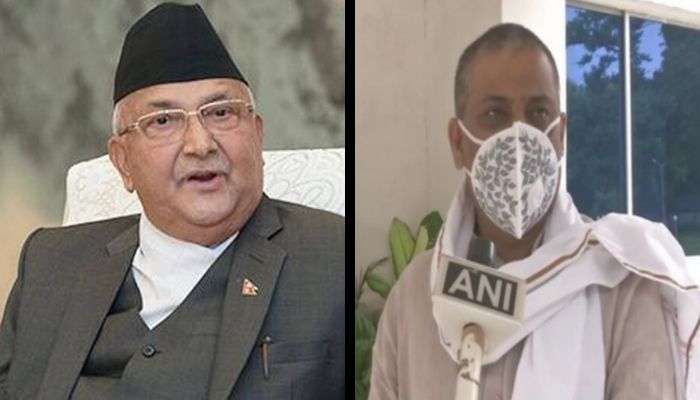
State Water Resources Minister, Sanjay Kumar Jha, told news agency ANI on Monday that the Bihar government will take up the issue with the Ministry of External Affairs (MEA). Jha informed that 18 out of 36 gates of the Gandak barrage in Valmiki Nagar are on the Nepalese side and the presence of barriers posed an impending threat to the State. He emphasised, “Yesterday also over 1.5 lakh cusecs water was released from the barrage. If the flood-fighting materials and our officers cannot go there, then, in that case, there will be a grave danger”
Nepal obstructs repair work for the first time
Reportedly, repair work has also been obstructed on the embankment of the Lalbakeya river in the Champaran (east) district of Bihar. While flood prevention work is carried out every year, it is for the first time that Nepal sought to create hindrances. The Minister has been taken aback by the behaviour of the Nepal authorities is restricting the repair work done alongside the border. “This time they are not letting it happen. In Madhubani’s Jaynagar upstream on Kamala river too they are not letting us conduct repairs,” he highlighted.
Jha also informed that the engineers and the district magistrates are in talks with the Nepal administration to resolve the issue. He stressed on the difficulties faced by the State in sending materials and officers, even though the repair work on the Nepal’s side is also done by the India Government. Jha reiterated that he will write a letter to the MEA informing them about the issue and its immediate aftermath.
Nepal initiates radio warfare against India
Nepal has started radio warfare in bordering villages of Uttarakhand. The residents of these villages can catch Nepali Radio stations that are now playing anti-India songs from the last few months. These songs mainly state that areas like Kalapani, Lipulekh, and Limpiyadhura in Uttarakhand are part of Nepal and India should return them. Nepal has recently included these areas in its new map. These songs are played several times between shows, including news bulletins. Along with anti-India sentiment, these songs also taunt Nepalese politicians for “not doing enough” to take control of the land that “belongs” to Nepal.
The annals of the Indian Army are replete with stories of bravery and uncommon valor. And then there are stories of courage so overwhelming that it is almost impossible for the human soul to even comprehend that such men walked the face of this very earth.
On a freezing and unforgiving November night, 123 Indian soldiers – frostbitten, weary, hungry and heavily outnumbered – defied the might of the rampaging Chinese Army. On 18 November 1962, Major Shaitan Singh and men of Charlie Company, 13 Kumaon Regiment, forever passed into the mists of legend.
This is a story of unimaginable sacrifice. This is a story of men pitted against impossible odds. This is the story of Indian soldiers who looked death in the eye and did not flinch. This is the story of the Battle of Rezang La.
Ladakh, 1962
In their initial assault on Indian positions in October, the Chinese had overrun border posts from Daulat Beg Oldie to Damchok, along the Karakoram Range. The defence of Chushul was the responsibility of 114 Brigade, which had a battalion less. An Infantry Brigade has 3 battalions. 114 Brigade had just 1/8 Gurkha Rifles and 5 Jat Regiment. When the danger to Chushul was realized, 13 Kumaon was rushed from Baramulla to augment 114 Brigade.
Other companies of 13 Kumaon occupied heights like Gun Hill, Gurung Hill and Mugger Hill. Charlie Company was given Rezang La, a pass 19 km away on the southeastern approach to Chushul. Rezang La was all rock, bitterly cold with bone chilling winds and the troops were not acclimatized to such extreme temperatures. The company was deployed at a height of 16,404 feet above sea level, and the main company position was defended by the 7th, 8th& 9th platoons. The surrounding mountains isolated it from the rest of the battalion.
No suitable winter clothing, underarmed and unprotected
The biting cold and the howling winds were accompanied by snowfall. Lack of protective winter clothing made the vigil more treacherous. And to add to the already impossible situation, Charlie Company was “crested to artillery”. This meant that there was an intervening feature, which did not allow Charlie Company the cover and protection of Indian Army’s artillery.
Charlie Company was without cover, without support and on its own.
In the very early hours of 18 November, the Chinese Army attacked the 7thand 8th platoon.
At 0500 hrs, Charlie Company opened up with rifles, machine guns and mortars. The retaliation was so ferocious that hundreds of Chinese lay dead. The first wave of the Chinese Army was repulsed.
At 0540 hrs, Charlie Company came under intense artillery and mortar shelling, and under the cover of this fire, about 350 Chinese attacked 9thplatoon. The platoon, true to their training, held their fire till the last moment. When the Chinese were a mere 90 meters away, the 9th platoon opened up with all their weapons. Their fire was devastating and hundreds of Chinese dead bodies littered the “nullahs”. The second wave of the Chinese Army was repulsed.
Impossible odds
Major Shaitan Singh moved from platoon to platoon, firing at the enemy and encouraging his men. He ignored the grave danger to his life and kept fighting. They say that he fought like a man possessed, completely oblivious to his own safety.
For the Chinese, this horrific rate of casualties was not sustainable. They changed tactics. 9th platoon was brought under withering MMG fire and under the cover of this fire, 400 Chinese attacked 8th platoon from the rear. This attack was stopped at the platoon barbed wire fence. Simultaneously, a heavily armed assault group of 120 Chinese attacked 7th platoon from the rear. The 7th platoon responded with mortars and rifle fire. There were heavy casualties on both the sides.
By now, the strength of 7th and 8th platoon was severely depleted.
When the Chinese again assaulted the 7th platoon, our soldiers rushed out of their post and engaged the Chinese in hand-to-hand combat. The Chinese brought reinforcements.
Out of ammunitions, they fought with their bare hands
The entire 7th and 8th platoon of Charlie Company was martyred. There were no survivors. 9th platoon was very severely depleted and out of ammunition. So, the survivors fought the heavily armed Chinese with their bare hands. Naik Ram Singh, a wrestler, killed many Chinese soldiers with his bare hands before he was shot in the head.
Major Shaitan Singh was constantly fighting, moving from platoon to platoon, encouraging his men and leading from the front. During the course of the battle, he was critically injured by MMG fire. While being evacuated, the Chinese started firing at him and the two soldiers who were accompanying him. Not wanting his soldiers to be killed in such a manner, he ordered them to leave him with his weapon and rejoin the fighting.
They repulsed seven attacks by the Chinese
Charlie Company, 13 Kumaon, repulsed seven attacks by the Chinese before the entire company was martyred in combat.
On 21 November 1962, a unilateral ceasefire was declared between China and India.
When the Indian Army visited the Charlie Company location after the war, Major Shaitan Singh was found holding his weapon. He had died fighting. The nursing assistant was found dead with bandages and a syringe in his hand. The mortar section commander was found dead, holding a mortar round. He kept firing till his position was overrun and he was killed. Out of the thousand mortar rounds that Charlie Company had, all but 7 had been fired.
Out of the 123 soldiers of Charlie Company, 114 were martyred and 6 were captured by the Chinese Army and kept as PoWs. They later miraculously escaped.
Param Veer Chakra
For conspicuous bravery and heroism beyond the call of duty, Major Shaitan Singh Bhati was posthumously awarded a grateful nation’s highest gallantry award, the Param Veer Chakra. The company was also awarded 8 Veer Chakras and 4 Sena Medals for exceptional bravery. Charlie Company was later re-designated as “Rezang La Company”.
I am from the Kumaon Regiment and I have studied the battle of Rezang La in detail. After all these years I still wonder what motivated Major Shaitan Singh and the entire Charlie Company to so willingly embrace martyrdom. It is unheard of, in the annals of modern warfare.
I don’t know if Rezang La was strategically important or not, but in those dark days of the winter of 1962, for an army facing reverse after reverse, Rezang La somehow became a matter of national honor. This was where the Indian Army dug in and said “thus far, and no further”. Rezang La was not just about “izzat”. Somewhere along the way, it became “zidd”.
Naam, Namak, Nishan
122 Ahirs from Haryana, led by Major Shaitan Singh Bhati of Jodhpur, fought for “Naam, Namak, Nishan” at -30 degrees centigrade. In freezing, inhuman cold, clothed in thin sweaters and jackets, wet canvas shoes, badly equipped and armed with Second World War vintage .303 rifles, they fought against an enemy who was far better equipped and armed.
When they were out of ammunition, they fought with their bayonets. When their bayonets broke, they fought with their bare hands. These young men from Haryana had probably never seen mountains so high. Most saw snow for the first time. But it is also true that the mountains of Ladakh had never seen such grit.
These brave 122 fought against 3000 attacking Chinese and counted over 1300 enemy dead before embracing martyrdom.
The Rezang La memorial in Ladakh
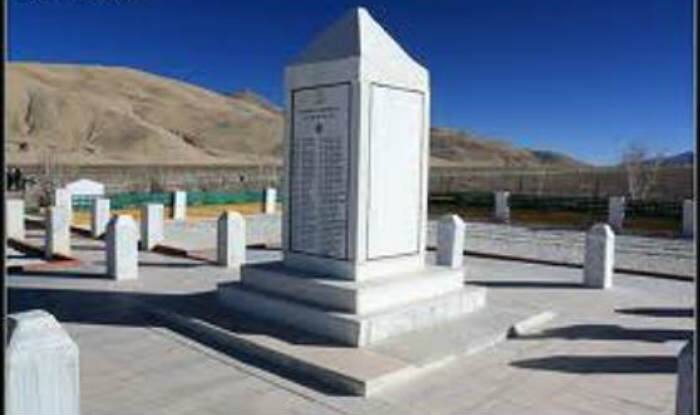
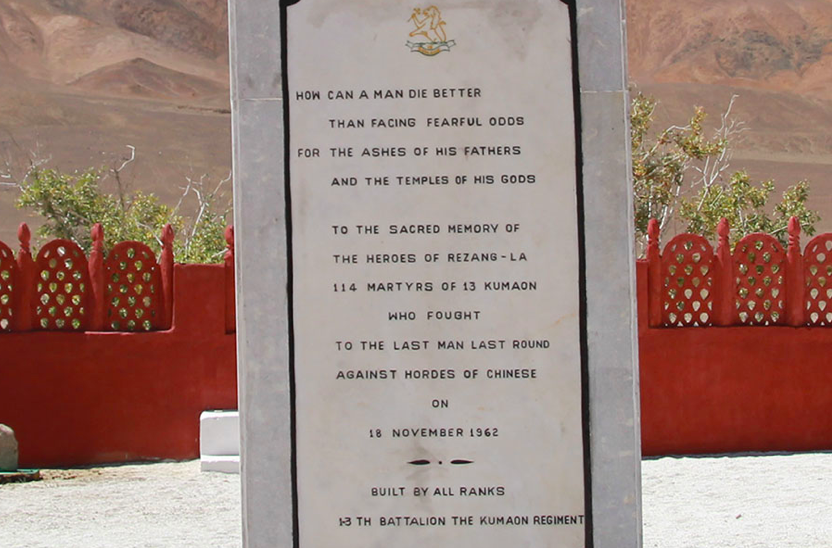
Today, a memorial stands at Rezang La, honoring the memory of those heroes. It reads:
“How can a man die better
Than facing fearful odds
For the ashes of his fathers
And the temples of his Gods.”
To the sacred memory of the Heroes of Rezang La, 114 Martyrs of 13 Kumaon who fought to the Last Man, Last Round, Against Hordes of Chinese on 18 November 1962.
– Built by All Ranks 13th Battalion, The Kumaon Regiment.
Disclaimer: 13 Kumaon and 11 Kumaon are both pure Ahir Battalions. There are other battalions in the Kumaon Regiment that have a mix of Kumaonis, Ahirs and a few other ethnicities. Some other battalions are pure Kumaoni, where the soldiers are from the Kumaon Region. My battalion (17 Kumaon) is a pure Kumaoni Unit with 100% troops from the Kumaon Region. However, in case of all infantry regiments of the Indian Army (including Kumaon), the officers are from all over the country.
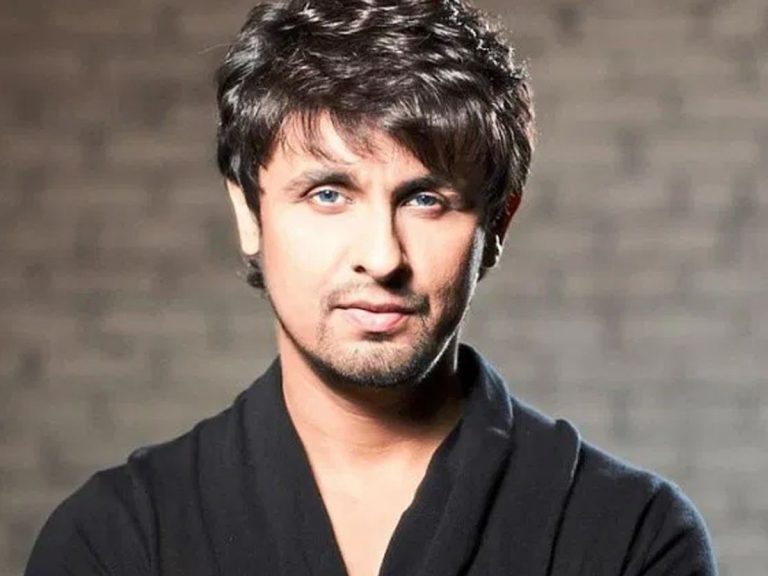
Singer Sonu Nigam on Monday took to Instagram to further expose the ‘Music Mafia’ of the film industry and the media nexus within. He also took on T-Series supremo Bhushan Kumar and asked him not to mess with him.
Taking on the T-Series chief Bhushan Kumar, Nigam said that he has messed with the wrong person. Nigam said, “Now I have to take your name Bhushan. You are not alone. You have messed with the wrong person.” He alleged that Bhushan used to come to his house for help. He begged him to Deewana album with T-series. Sonu Nigam alleged that he also helped Bhushan to meet Smita Thackeray and Bal Thackeray.
In the video, Sonu Nigam made explosive allegations that Bhushan sought his help to save himself from gangster Abu Salem. “Remember Marina Kunwar? And the allegations she made? Why did she say this and why did she back out? Media knows. I have her video. If you mess with me, I will upload her video on my YouTube channel. Don’t mess with me,” he said.
#MeToo allegations on Bhushan Kumar by Marina Kunwar
In 2018, Marina Kunwar came out publicly during an interview with Aaj Tak, where she accused Bhushan Kumar and Sajid Khan of sexually harassing her. At that time, it was alleged that the media did not cover the case and Marina’s story was thrown under the carpet.
In her #MeToo allegations, Kunwar had alleged that she was meeting Kumar for a video of singer Honey Singh’s song. She says that even though Kumar was getting late, he called her to his office to meet him. “Maybe it was his trick to show that he’s a nice person and not a bad guy,” she alleges. She further accused that he met her in a white Swift car with blackened windows and took her to an office-cum-home. “He didn’t even take a second or try to convince me and tried to molest me. I feel bad saying on media like how Sajid showed me his private part and Bhushan Kumar also didn’t wait a second and just undressed himself. Is a woman created just for this? To be used. And no one believes us,” she alleged.
“I would’ve rather become a porn star, which is more respectable,” she said in her interview with Aaj Tak.
In the past few days, Sonu Nigam has posted series of vlogs revolving around problems faced by actors, singers, and other artists in the film industry, especially those who do not have any godfather or family support.
The controversy revolving around Sonu Nigam and Bhushan Kumar
A few days ago, he released a video in which he claimed that there is a “music mafia” in the music industry that is bigger than the movie mafia. He accused two big “music giants” of running the “music mafia.” Many users had then commented on that video that he might be talking about Bhushan Kumar.
Sonu Nigam was upset over a report Time of India has published alleging it a press release on his last video where he exposed nepotism in the music industry. Sonu said that no one approached him to include his views in the said report. He added that he knows how press releases work and TOI has just copy-pasted a press release sent by T-Series claiming Nigam’s views on nepotism in the music industry stand null and void.
The uncalled aggression shown by China at the Indian border near eastern Ladakh at the time of Covid-19 pandemic has created widespread anguish among the concerned citizens of our country. To express the resentment towards China, many celebrities and also renowned education reformist Sonam Wangchuk called for a boycott of Chinese products. This appeal resonated with the opinion of our citizens and motivated a Jaipur based start-up to make an app named “Remove Chinese app” which detects and deletes the Chinese app from a smartphone.
This app crossed 1 million download mark within few days of its launch. But very soon this app is delisted from Google play store and made Indian citizens, who are protesting against China in their own way of boycott, feel powerless. When AMUL which is the most shining example of the success of Indian cooperative societies, posted an advertisement to support new policy of “Aatmanirbhar Bharat” in its typical pun-filled style, its Twitter account was blocked briefly. We have such crippling dependency on foreign companies in every sphere including social media that even we are unable to express our solidarity towards National cause and in case if we try, we are arm twisted and rendered option less. In such situations, we wish to have our own Indian companies to fall back upon.
Also in 2017 during Doklam face-off between Indian and Chinese troops, there were incidences of boycotting Chinese products by Indian citizens. But such a phenomenon of calls for a boycott is short-lived and easily fades away because of two reasons. First, it is based on pessimistic and reactionary sentiments of our citizens towards a hostile country like China in the current situation and not on the foundation of a structured plan to promote Indian products and companies. Second, in many cases, Indian companies do not offer a comparable option like in the case of Mobiles, Internet Search Engine, and Social Media Platforms. For example, the Indian mobile phone market is totally dominated by Chinese companies to the extent that messages of boycotting Chinese products are shared on Chinese mobiles.
Our efforts should be established on the constructive sense and long term plan of promoting Swadeshi products and Swadeshi companies, may it be anything, salt or software, printing paper or planes, tissue paper or tractor, household appliances or mobile apps. The need to support Swadeshi is imperative not only for an economic reason but also for National security and stability as foreign companies keep sensitive data in servers located abroad which may be compromised on the request of their respective govt. Turning towards Swadeshi will be the only and correct way in the direction of Aatmanirbhar Bharat and Vocal for Local.
For most of the youngsters, the first picture which comes to mind after hearing the word Swadeshi is Gandhi, Charka and Khadi. These three symbols, in today’s times, do not fully represent the spirit of Swadeshi.
Firstly, Though Mahatma Gandhi led the second phase of Swadeshi movement, the first phase of Swadeshi mass movement which boycotted British goods as a sign of protest was started in 1905 when Lord Curzon announced the partition of Bengal. Second, the symbol of Charka now no longer does full justice to the representation of gamut of Indian Industries, small or big, cottage or corporation, which need to be promoted. During the struggle of independence, Charka as a tool of manufacturing represented the need for self-sufficiency instead of depending on imported clothes manufactured in the mills of Britain.
But now in the 21st-century imports which undermine our economic self-reliance and decimate local industries includes Mobiles, Networking devices, medical equipment, Computer/Mobile processor Chips, toys etc. Thirdly, at that time Khadi was an iconic product which was selected to ameliorate the plight of weavers who were losing their livelihood because of imports. Khadi was a representative product of the Swadeshi movement and definitely not the only product of the movement. Swadeshi Movement played an important role in the National struggle of freedom but after independence, it was reduced to spiritless perfunctory govt. the scheme which limited itself to merely selling of Khadi Clothes by govt. owned stores where few citizen shops on 15th Aug and 26th Jan. Today we need to rejuvenate the Swadeshi movement in its truest spirit.
In the current challenging time of COVID–19, there is pressing need of creating Aatmanirbhar Bharat and of being Vocal for Local as appropriately appealed by PM Modi. Promoting Swadeshi products and Swadeshi companies will pave the way to achieve it.
To impart a fitting identity, iconic status and distinguished reputation to Swadeshi products and companies, we need a unique official symbol for Swadeshi to which all Indians can connect and feel proud about and most importantly through which we can promote and patronize Swadeshi. The way Food Safety and Standards (Packaging and Labeling) Regulations, 2011 mandatorily labels the vegetarian food with a green dot inside a green square and help the customer to easily select vegetarian food; similarly, Swadeshi symbol/mark will allow easy distinction and selection of Swadeshi products.
The symbol of International Day of Yoga launched in 2015 helped in popularizing Yoga across the world. The manner in which unique graphic symbol of Rupee introduced in the year 2010 highlighted the growing importance and clout of Indian economy at global level, the same way, a symbol for Swadeshi will enhance the brand value and influence of Indian products not only in the domestic market but also for exports. The benefits of Swadeshi symbol will be double-pronged, one – it will provide an identity point behind which Indians can rally to support the national cause and second – buying product bearing Swadeshi symbol will instil the feeling of belongingness among Indian Diaspora.
It would not be unnatural to ask that when we have a symbol for “Make in India” then why there is a requirement of a symbol for Swadeshi. The answer lies in the fact “Make in India” is to promote manufacturing in India irrespective of it by Indian or foreign company for the purpose of employment generation and reducing costly imports whereas promoting Swadeshi is one level ahead and more holistic which develops the Indian companies and eliminate the dependency on foreign enterprises. “Make in India” scheme is open to all foreign companies including China-based which pump back lion’s share of profit to their countries and oblige to their respective govt. in various matters.
The selection of official Swadeshi symbol can be done by the means of open competition inviting entries from the citizens of India. Once symbol finalized, Department of Promotion of Industry and Internal Trade can be made nodal agency giving permission for using Swadeshi symbol. All MSMEs owned by Indian citizens may be allowed to use the Swadeshi symbol by default; it will support the revival plan of MSME. For large corporations, permission to use Swadeshi symbol may be granted by SEBI in cases where promoters and the majority of shareholders are Indian citizens or Institutions. Creating separate incentivized category on GeM portal for Swadeshi mark bearing items can be deliberated upon. Access to subsidized loan can be provided to Swadeshi mark bearing companies. Tax benefits can be extended to NRIs investing in Swadeshi companies.
Each Indian heart which takes pride in seeing the Indian Flag furling high will definitely feel proud in owning a good quality product bearing Swadeshi symbol, may it be car or mobile. And it will be a proud moment for the whole nation when we will see rockets made by ISRO and IAF fighter planes made by HAL soaring high in the sky with shining Swadeshi symbol on it.
In order to get quick fame, delinquent teenagers are nowadays going overboard, making offensive and violent videos on the Chinese social media app, TikTok. In one such incident, four youths in Bazarkhala area of Lucknow, Uttar Pradesh allegedly burnt the Indian national flag and raised anti-national slogans to make a TikTok video go viral.
Police have arrested one of the accused, who is a minor, and are in the lookout for the other three, who fled when locals tried to intervene and catch them.
Arrested minor admitted of burning the India flag and raising anti-national slogans to make TikTok video go viral
An FIR, under stringent IPC sections 124 (A), 153 (A), 504, 505 (1) (B) (2), 352, 325, 506 and Rashtriya Gaurav Insult Prevention Act 2, has been registered in Bazarkhala police station, against the accused. During interrogation, the minor admitted of burning the India flag and raising anti-national slogans. He said that they were doing so to make the video go viral on the popular Chinese social media app.
Officer-in-charge Brijendra Singh said that on Sunday evening a man named Ravikant Singh, a resident of Rajajipuram, was cycling near Tikait Rai Talab in Bazarkhala, Lucknow when he saw four youths burning the national flag and raise anti-national slogans. When Ravikant Singh confronted the four youths, they attacked him. Seeing the commotion, another man named Rupesh Gupta intervened. Ravikant and Rupesh managed to catch the minor boy while the other three fled. A crowd also gathered there shortly and took the minor to Bazarkhala police station, where the police took him into custody and lodged a complaint against all the four youths based on Ravikant Singh’s complaint.
Media reports say arrested minor was a former local SP leader’s nephew, police denies the claim
Many media reports have quoted Bazarkhala officer-in-charge, Vijayendra Singh as saying that the arrested minor in the nephew of a former Samajwadi party leader. However, when OpIndia got in touch with the Bazarkhala police station, police denied the claim. Police confirmed that one minor youth has been arrested in connection to the case, while the search is on for the other three absconding persons.
According to reports, many people from a particular community gathered outside the Bazarkhala police station and demanded that the minor, who they claimed was the relative of a former Samajwadi Party leader, be released immediately. Seeing the crowd swell, the police called for additional force as they feared that the arrest might lead to communal tensions, however, police refused to give in to the demand of the crowd and sent the arrested minor to a juvenile home.
According to the News 18 report, Inspector Brijendra Singh said that police have received information about the three absconding accused and their search has been expedited.
Downgrading of Chinese app – TikTok
The Chinese social media app has been recently receiving severe backlash over its misuse by anti-social elements for inciting violence and crimes.
A social media user named Faizal Siddiqui had also shockingly recreated a disturbing scene of an acid attack, leaving social media users angry. A complaint was also registered against the ‘TikTok influencer’ for promoting acid attack as a means to avenge lost love by jilted lovers.
Last month, a Bench of Justice S.K. Panigrahi of the Odisha High Court had reportedly slammed TikTok for promoting disturbing content and pornography.
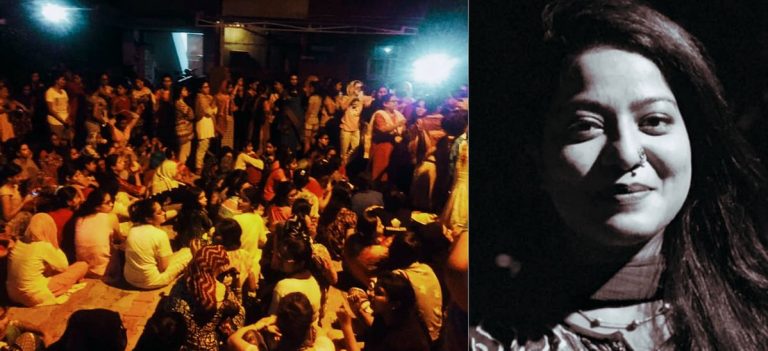
The Delhi Police in its status report submitted to the Delhi High Court has asserted that Safoora Zargar was responsible for the violence that broke out at the national capital. The status report was filed in response to a bail plea filed by the Jamia Milia Islamia University student. She was booked under the Unlawful Activities (Prevention) Act.
The Delhi Police has also maintained that pregnancy cannot be grounds to award Safoora Zargar a bail. “It is respectfully submitted that till date 39 deliveries have taken place in Delhi prison in last 10 years,” the Police said adding that the Jamia student was not entitled to any kind of special treatment.
It was also claimed that the Jamia student imperilled national security. “The applicant/ accused was not only disposed towards creating turmoil to severely undermine public order and imperil national security but erode and frustrate the civil compact which holds our polity together,” the status report said.
The status report stated, “The applicant/ accused combined with the other accused weaved a web of actions animated by an unlawful object of creating terror and disaffection. And notwithstanding her maintaining stealth and secrecy about her real designs the available circumstantial evidence clearly demonstrates that a protestation of innocence is phony, her actions are neither licit nor legitimate and she is clearly culpable of criminal wrongs or grave magnitude deserving no indulgence from this court.”
The Delhi Police also informed the Court that the case against Safoora Zargar was made out from the statements that have been recorded thus far, which are corroborated by the admissions she has made herself and extensive documentary evidence.
“It is also extremely crucial to note here that direct evidence is not always available of a conspiratorial design and mere absence of a contemporaneous record does not even remotely suggest the absence of a case against the applicant/ accused because she stands clearly implicated by the evidence which stands unearthed by the investigation which is continuing even now and further trails of criminality is being unearthed,” it added.
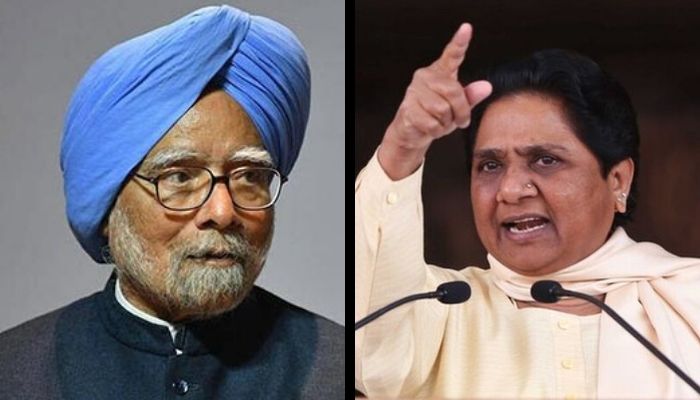
On Monday, Bahujan Samaj Party (BSP) leader Mayawati tweeted in memory of the soldiers martyred during the violent clash between India and China in the Galwan Valley, Ladakh, and emphasised that the course of action required to safeguard our borders must be left at the discretion of the government. She wrote, “The country is aggrieved, worried and agitated by the death of 20 soldiers, including a Colonel in the recent scuffle with Chinese forces on June 15. The government and the opposition must stay united and work towards finding a feasible solution.”
Mayawati added, “Amidst the challenging times, the opinion of the people and the experts may differ in terms of the future course of action that the government must undertake (to resolve the issue). However, it is best if we leave it to the government to decide the course of action regarding the nation’s security because it is the responsibility of the government to safeguard our borders.”
Mayawati’s tweet came at the backdrop of the ‘advice’ given by former Prime Minister Manmohan Singh to the incumbent Prime Minister Narendra Modi. In his press release, Singh had said, “We remind the Government that disinformation is no substitute for diplomacy or decisive leadership. The truth cannot be suppressed by having pliant allies sprout comforting but false statements. “
2. ऐसे कठिन व चुनौती भरे समय में भारत सरकार की अगली कार्रवाई के सम्बंध में लोगों व विशषज्ञों की राय अलग-अलग हो सकती है, लेकिन मूल रूप से यह सरकार पर छोड़ देना बेहतर है कि वह देशहित व सीमा की रक्षा हर हाल में करे, जो कि हर सरकार का दायित्व भी है। 2/2
Earlier, the BSP supremo had said that the country had pinned its hopes on the government and that it will safeguard the pride, honour and territorial integrity of the country at all costs. “It’s a good thing that the country is united and has forgotten the shortcomings of the government (at this crucial juncture). The government must now stand up to the expectations of people,” she tweeted.
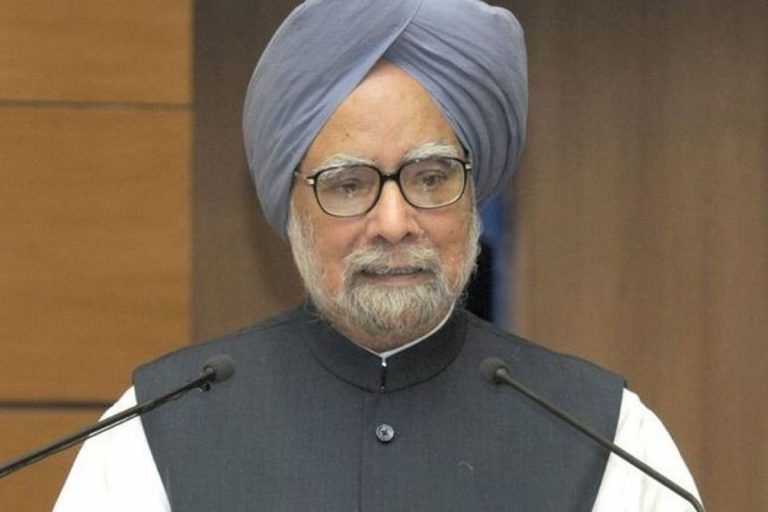
Former Prime Minister Dr Manmohan Singh in a statement today said that this is the time to stay together as a nation. The statement was released by Indian National Congress in wake of the recent face-off between Indian and Chinese troops in Galwan valley. Singh said in the statement that the sacrifice of the 20 brave soldiers who lost their lives on 15th and 16th June 2020 should not go in vain.
This is a moment where we must stand together as a nation and be united in our response to this brazen threat: Press Statement by Former PM Dr. Manmohan Singh pic.twitter.com/qP3hN3Od9D
Dr Singh in his statement said the decision of the government will decide how the future generation perceives us. The Prime Minister must be mindful of the implications of his words and declarations on the Nation’s security along with strategic and territorials interests. He added that China is illegally seeking claim on parts of Indian territories such as Galwan Valley and the Pangong Tsy Lake. “The Prime Minister cannot allow them to use his words as a vindication of their position and must ensure that organs of the government organs work together to tackle this crisis and prevent it from escalating further. This is a moment where we must stand together as a nation and be united in our response to this brazen threat,” he said.
Congress’s attempts to spread lies and misinformation
While ex-PM is calling everyone to come together against China’s mischievous plans, his own party has been spreading lies and misinformation since the incident came to light. Rahul Gandhi and other Congress Party leaders have tried to undermine the government over border issues with China. Congress leader Husain Dalwai said in a statement that no one from China’s side died and tried to promote China’s agenda.
Congress leader Zakir Hussain’s ‘private talk’ got leaked in which he mentioned that China should take half of Leh. He glorified the Chinese army and said Ladakh would break into 1000 pieces. Congress ecosystem tried its level best to propagate fake claims by China that they had zero causality. They also stated that China ‘saved’ ten Indian troops who were injured. In fact, despite multiple clarifications by the central government, Rahul Gandhi and Congress have maintained that China has successfully managed to take over the Indian territory and that the government is lying.
PM has surrendered Indian territory to Chinese aggression.
If the land was Chinese: 1. Why were our soldiers killed? 2. Where were they killed? pic.twitter.com/vZFVqtu3fD
In fact, it has been Congress leader, especially Rahul Gandhi, who has been regularly casting aspersions on the government and feeding the Chinese propaganda instead of standing united as a nation.
Although it is natural that the general public will not know the details of the India-China border issue, it is a surprise that Rahul Gandhi is surprised about soldiers not carrying arms at the LAC. Because it is agreements signed by governments led and supported by his party that prevents the soldiers from using firearms on the border with China. Rahul Gandhi headed the party that ruled India for half a decade, he keeps meeting Chinese officials behind the curtains often, and therefore, he should know why Indian soldiers were unarmed.
Further, Rahul Gandhi and Congress would rather indulge in petty politics than ‘stand united’ as suggested by Dr Singh.
If it was so painful:
1. Why insult Indian Army by not naming China in your tweet? 2. Why take 2 days to condole? 3. Why address rallies as soldiers were being martyred? 4. Why hide and get the Army blamed by the crony media? 5. Why make paid-media blame Army instead of GOI? https://t.co/mpLpMRxwS7
And ironically, it was Rahul Gandhi who also shared the message of Dr Singh which called for unity at such testing time.
पूर्व प्रधानमंत्री डॉ. मनमोहन सिंह जी की महत्वपूर्ण सलाह। भारत की भलाई के लिए, मैं आशा करता हूँ कि PM उनकी बात को विनम्रता से मानेंगे। pic.twitter.com/0QTewzmcyD
Facebook has taken cognisance of an OpIndia report that spoke about an employee of the social media giant who used to work with political strategist Prashant Kishor. Responding to OpIndia, Facebook has said that they treat these matters seriously. However, Facebook has refused to confirm the nature of action that will be initiated against the abusive employee, if any.
The OpIndia report and what it said about the Facebook employee Siddharth Mazumdar
On the 18th of June, OpIndia had published a report about an abusive employee of Facebook who used to work with the political strategist Prashant Kishor. The Facebook employee, who now abuses ideological opponents through an anonymous account called NyaySahay. The article traced his Twitter account back to his old handle, sid_mazumdar. Through that handle, we accessed several articles written by Siddharth Mazumdar that revealed that he was the co-founder of Citizens for Accountable Governance and used to work with political strategist Prashant Kishor. Digging further, we found his LinkedIn account which revealed that he is an employee of Facebook and works as their public policy manager.
The present avatar of the Facebook employee, Siddharth Mazumdar, NyaySahay often abuses Indians, the Modi government, Hindus, and anyone who refuses to agree with his worldview. Even during the India-China stand-off, this handle has questioned the integrity of India and gone as far as to abuse the Prime Minister and anyone who supported India’s actions against China.
Facebook’s statement about abusive employee Siddharth Mazumdar
OpIndia reached out to Facebook via email seeking a response on the report that detailed how their public policy manager was abusing the integrity of India during the India-China stand-off and was also being abusive towards anybody who doesn’t agree with his worldview.
In this regard, OpIndia asked Facebook 5 pointed questions:
1. Is Facebook aware of this situation?
2. Does the abusive tweets, from the past as well as from era when Siddharth joined Facebook, a cause of concern for Facebook? Is Facebook planning any action against him in the wake of the widespread complaint?
3. Does Facebook think that a politically active and aligned person like Siddharth Mazumdar can be fair and non-partisan while discharging his duties as public policy manager?
4. There have been calls on Twitter insisting that Facebook take action against partisan, abusive and biased employees such as Siddhart Mazumdar – is Facebook contemplating any action?
5. Does Facebook have any specific policy for social media use that is applicable to its employees? If yes, what is the policy and does the conduct of Siddharth Mazumdar breach that policy?
However, Facebook failed to respond to the questioned posed. Instead, Facebook issued a short statement that read as follows:
“The matter has been brought to our notice. We expect all our employees to follow an ethical code of conduct and Facebook treats these matters seriously.” – Facebook Spokesperson
If Facebook ‘treats these matters seriously’, will it launch an internal inquiry? The follow up and Facebook’s response
Following the statement by Facebook, OpIndia reached out to the spokesperson yet again to confirm whether any internal inquiry will be launched and action be initiated against the Facebook employee in question. For the first follow-ups, OpIndia did not receive a response. However, later, the spokesperson got in touch with OpIndia to assert that Facebook does not ‘disclose what actions might be taken publicly’. In essence, the Facebook spokesperson refused to confirm whether any action will be taken against their public policy manager Siddharth Mazumdar and whether an internal inquiry will be launched.
Through the conversation, the spokesperson reiterated that Facebook does take this issue seriously and that Siddharth Mazumdar is indeed the public policy manager of Facebook, however, what action will be taken is something that Facebook cannot confirm currently.
What is Siddharth Mazumdar tweeting even after Facebook has been made aware of its employee’s conduct
Even after Facebook spokesperson confirmed that they are aware of the situation and ‘treat these matters seriously’, Siddharth Mazumdar has continued to spew venom on Twitter, often undermining the position of India during the ongoing India-China conflict.
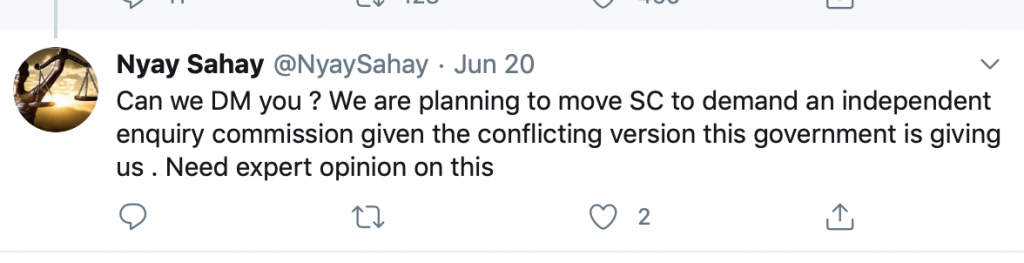
Currently, Siddharth Mazumdar who is an employee of Facebook is planning to approach the Supreme Court to demand an “independent enquiry commission” since he thinks the Modi govt is giving conflicting versions regarding what is happening with China. Essentially, Mazumdar is apparently planning to approach the SC to ensure that the government of India compromises national security and gives a blow by blow account of what transpired at the LAC.
Recent Tweet by Siddharth Mazumdar
The ideological bias in several social media platforms, specifically Facebook and Twitter have been a subject of discussion worldwide for quite some time. The bias against conservative voices worldwide has led to a heated debate about political parties and ideologically motivated elements making inroads in the management of these platforms. The Cambridge Analytica fiasco blew the lid off how the Left was exploiting Facebook to silence political opponents. In fact, the role of Congress and how it had worked closely with Cambridge Analytica to skew elections was also revealed.
With the ideological bias being admitted by Facebook rather openly, several times we have seen employees of these social media giants displaying their hatred towards conservative voices. In India, the hate has been directed at PM Narendra Modi and any individual who is seen as supporting the Prime Minister.
With Facebook acknowledging that Siddharth Mazumdar is indeed a Facebook employee, it remains to be seen whether any action is initiated against him.
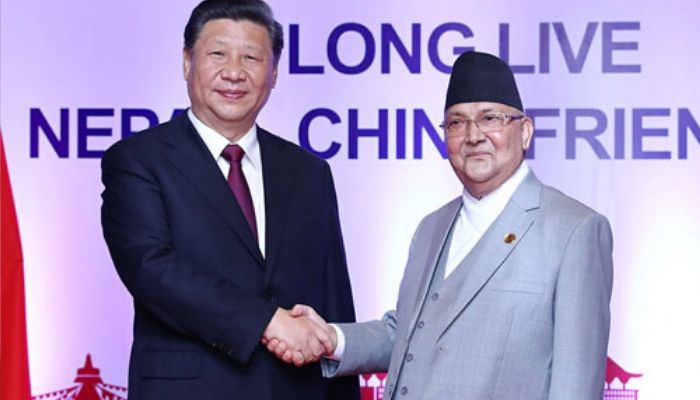
While the landlocked country of Nepal has been at loggerheads with India over the supposed encroachment of regions such as Kalapani, Lipulekh, and Limpiyadhura, China has reportedly occupied the Rui village in Gorkha district of Nepal. As such, the village has now been annexed to Tibet, an autonomous region of China. As reported by Nepal-based newspaper, Khabarhub, the aggressive stance of Nepal’s Prime Minister KP Sharma Oli towards India has been an eyewash to suppress the events in its own territory.
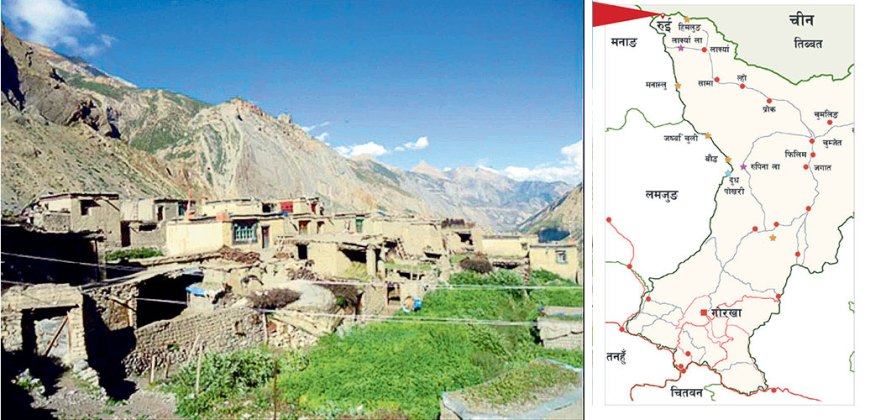
Even though Rui is still included in the map of Nepal, China has removed the boundary pillars to legitimise its occupation, the report says. The village which consists of about 72 houses, has reportedly been under siege, owing to the negligence and apathy of the Nepalese government and its officials. According to the Land Revenue Office (Gorkha), it has a record of revenue collected from the residents of the village of Rui. Khabarhub reported that the records are still secured in file number one in the Land Revenue Office.
As per historian Ramesh Dhungal, both the villages of Rui and Teigha which are located in the northern part of Gorkha district have been lost due to the negligence of the Nepalese authorities in fixing the boundary pillars. He added that Rui was neither lost by Nepal in war nor was it the subject of any special agreement with Tibet. He said, “India’s border is accessible. People walk around it. Therefore, border issues with India are visible to all, but the situation of Nepal at the northern border with Tibet is extremely bad.”
Map of Gorkha district of Nepal and adjoining Tibet (Photo Credits: News 24)
Rui villagers still pay land revenue to Nepal
The President of Chumubari Rural Municipality ward number 1, Bir Bahadur Lama, conceded that even though the people of Rui had deposited their share of land revenue to the Nepal government, yet they had become Tibetans following the encroachment by China. Khabarhub reported that pillar number 35 was demarcated as the border between Samdo and Rui village. However, during the restoration work of the pillar no. 35, owing to negligence, the village came under Chinese occupation, Dhungal was quoted by News 24.
Agitated residents fled to adjoining villages
While the language, culture, and places of worship of the people of Sama, Samdo, and Rui villages are the similar, ward President Lama informed that his elders had told him that the agitated residents of Rui returned back to their farms in Samdo and established a new settlement there. “Several people did not want to join Tibet and instead fled to Samdo. They had come historical and cultural documents that were 1000-1200 years old. They built their places of worship here. The sacred site still has historical evidence of Aditya Malla and Punya Malla, the two historical deities of the Malla kings.”
Nepal initiates radio warfare against India
Nepal has started radio warfare in bordering villages of Uttarakhand. The residents of these villages can catch Nepali Radio stations that are now playing anti-India songs from the last few months. These songs mainly state that areas like Kalapani, Lipulekh, and Limpiyadhura in Uttarakhand are part of Nepal and India should return them. Nepal has recently included these areas in its new map. These songs are played several times between shows, including news bulletins. Along with anti-India sentiment, these songs also taunt Nepalese politicians for “not doing enough” to take control of the land that “belongs” to Nepal.