Home Blog Page 5852

India vs Bangladesh historic pink ball test: Brief history, records and India’s chances

0

India will be playing its first day-night test on Friday against Bangladesh in Kolkata. India and Bangladesh are the last two test teams to play a day-night Test. India has been the most reluctant team to try for new things when it comes to cricket. They were the last test team to play an ODI in 1974 (3 years after the ODIs were introduced). They were also the last Test team to play a T20I in 2006. Even India wasn’t ready to participate in the inaugural World T20 in South Africa, which they played and won eventually. Today they host the cricket’s biggest T20 tournament every year famously known as IPL.

History

The first day-night first-class match was played in India in 1997, the Ranji Trophy final between Delhi and Mumbai with the white ball. The first pink ball first class in India was played in 2016 at Eden Gardens. The first-ever day-night first-class match with the pink ball was played in West Indies in the late 2000s between Guyana and Trinidad and Tobago. While the first day-night test was played between Australia and New Zealand in 2015.

Why Pink Ball?

A white ball loses its shine and colour after a few overs while a red ball is not easy to sight under the lights, whereas the pink ball not only lasts long but is also sightable under the lights.

Timings

The match will start at 1.00 PM IST and end at 8.00 PM. The first interval will be at 3:00 PM IST, and the second session will resume at 3:40 PM IST. Tea will be taken at 5.40 PM with a 20-minute break, and the final session is scheduled to start at 6:00 PM IST.

India’s chances

India’s chances in its first day-night test look very promising. The biggest reason is team India’s form. They are winning everything in Tests this year. Also the home advantage, they hardly lost a game at home in the last few years. The match will get over by 8:00 PM so the dew factor would be minimum for both the teams. Very few Indian players have the experience of playing with the pink ball and the same goes for the Bangladeshi players. So as far as the experience is a concern, both the teams are at an equal level, but when it comes to batting line up and pace attack, India is far more superior to Bangladesh.

Eden Gardens is a happy hunting ground for Rohit Sharma. He has scored highest ODI score here in 2014, scored a maiden hundred in his debut test in 2013, his lone IPL hundred was scored in Eden Gardens, and as a captain, he won 2 IPL titles here. Can he score a triple hundred here?

Rohit’s opening partner Mayank Agarwal has played five innings in pink-ball cricket, and he never scored under 50 in any of the innings – his scores were 92, 161, 58, 57, 52. Pujara has a double hundred in pink-ball cricket – 256, which is also the highest score in pink-ball cricket in India. Vihari, too has a hundred on his name in pink-ball cricket.

Shami and Jadeja have the experience of taking a five-wicket haul in pink-ball cricket while Umesh and Ashwin never played a pink ball first-class game, just like Virat Kohli and Ajinkya Rahane.

Records

Interestingly, all day-night tests produced results. Australia played the maximum day-night tests (5), and they have won all 5 of them, whereas West Indies lost all the three day-night tests they have played so far.

Pakistan’s Azhar Ali has the highest number of runs (456) in day-night tests, and he also holds the record of the highest score (302*) in a day-night Test.

In bowling, Starc has maximum wickets (26), while Cummins has the best bowling figure in a Test (10-62). Trent Boult of New Zealand has an astonishing strike rate of 26.5.

Starc and Lyon have played the maximum number of day-night tests (5) so far.

Madhya Pradesh: Lawyer files PIL seeking ‘immediate restoration’ of SPG cover for Gandhis, gets fined Rs 25,000

On Wednesday, the Gwalior bench of the Madhya Pradesh High Court not only rejected a PIL which had sought ‘immediate restoration’ of SPG protection to the Gandhi family but also fined the lawyer Rs 25,000 for trying to gain ‘cheap popularity’.

According to reports, Advocate Umesh Bohre had filed public interest litigation (PIL) in the Gwalior bench of the Madhya Pradesh High Court against the decision of the Union government to withdraw special protection group (SPG) protection of Gandhi family claiming that the two members of the family, who had served as former prime ministers (Indira Gandhi and Rajiv Gandhi), were assassinated.

The Madhya Pradesh HC while rejecting the PIL also fined the petitioner Rs 25,000, saying he was trying to gain ‘cheap publicity’. Bohre’s petition had named the prime minister’s office, the home ministry, the defence ministry, the director of SPG and two others as respondents.

“The Gandhi family is a renowned family nationally and internationally and their lives are in constant danger especially in the present circumstances where the country is a tense following abrogation of article 370 in Kashmir and Ayodhya verdict. I have prayed for immediate restoration of cover to the three Gandhi family members as they are in dire need of the protection in the light of the fact that two former prime ministers belonging to the family were killed,” advocate Bohre was quoted by The Week.

The Narendra Modi-led NDA government had recently withdrawn SPG cover for Congress interim president Sonia Gandhi, former party president Rahul Gandhi and general secretary Priyanka Gandhi Vadra.

Reportedly, the non-cooperation of the Gandhi family with the SPG over the years and preventing the smooth functioning of SPG was also one of the reasons for the government to downgrade their security from SPG to a Z-plus category.

The intelligence agencies had concluded while evaluating the danger posed to the Gandhis, that their safety would be ensured by replacing the SPG with ‘Z-plus’. The ‘Z plus’ security means the Gandhis will be guarded by around 100 CRPF personnel.

Following the SPG cover removal of the Gandhi family, senior Congress leaders have launched a searing attack against the BJP, accusing it of “political vendetta”. Protesting against the Centre’s move to withdraw SPG security cover of Gandhi family and former Prime Minister Manmohan Singh, the Congress had raised the issue in the Rajya Sabha urging the government to restore special protection.

Congress leaders have also been organising protests over the removal of SPG issue.

Rahul Kanwal of India Today bullies a BHU student during debate, refuses to let him speak

0

The Banaras Hindu University (BHU) students have been protesting against the employment of a Muslim professor at the Dharma Vigyan department of the university. The students have faced severe vilification at the hands of the media since the media has constantly misrepresented the situation to insinuate that the students merely don’t want a Muslim professor teaching them Sanskrit as a linguistic effort, when in fact, the students don’t want the professor employed in the ‘Dharma Vigyan’ department and have no problem if he is employed as a Sanskrit teacher at the Arts department. When the media is lying and vilifying based on a lie, Rahul Kanwal of India Today cannot be too far behind.


The debate was meant to be between a BHU student called Chakrapani Ojha and one Professor Mahesh Ahirwar. However, the debate became Rahul Kanwal’s rude, arrogant, shameless tirade against the student.

In an arrogant tone, Rahul Kanwal first tells the students that we want people from all over the world to learn Sanskrit, but BHU students, by blocking the appointment of a professor who is a Sanskrit gyaani from India, have defamed BHU not only in India but the entire World.

Read: How the BHU students were demonised and the ones who refused to be ‘secularised’ unfairly called ‘bigots’

Rahul Kanwal then goes on to open his eyes wide with an excessively scary, and creepy expression and tells the student that according to his professor, the students are a ‘kalank’ (black mark). Then, he tells the student to be ashamed.

Then, after the student in an extremely respectful tone poses questions to the professor, Rahul in between starts in his annoying little voice again. He says, “Arre kaise sawal pooch rahe ho, anyway let the professor respond. Aap chhatra ho, abhi abhi janme ho, professor se pooch rahe ho ki uska pata hai kya, professor jawab denge ab” (What sort of questions are you asking? Anyway let the professor respond. You are a student who has just been born and you are asking the professor if he knows or not?)

Read: We perform Purohit Karm, we do not want Sanatan Dharma studies get influenced by Islam or Christianity: Protesting students at BHU

After saying this in an extremely arrogant, rude tone, Rahul Kanwal starts gesticulating in derision for the student. Then, when the student tries to respond to Kanwal, he shuts him up and asks him not to “talk nonstop”.

After an extremely civil discussion between the student and the professor, where the student said ‘Ji boliye Guruji’ and the Professor spoke about the rules of BHU, the student tried to respond to the points raised by the professor. But Rahul Kanwal interrupted the BHU student and launched a tirade. He said he was hurting the image of BHU and when the student tried to respond, Rahul Kanwal rudely told the student to keep quiet and put him on mute while ranting himself.

The facts of the case have been twisted beyond measure. One needs to understand at the very onset of this discussion that the students of Dharma Vigyan don’t learn Sanskrit as a linguistic endeavour. The media and elements like Rahul Kanwal are essentially set on demonising the students without even giving them a chance to explain their position.

Read: The BHU controversy: Demanding that ‘Hindu Dharma Vigyan’ be taught by a Hindu and not a Muslim is not bigotry

The first fact to understand is that BHU has a separate Arts department that teaches Sanskrit as a linguistic endeavour. Just as one would perhaps learn French or English or even Hindi. The Sanskrit being taught at the Dharma Vigyan department has deep religious significance.

It is not wrong for BHU students to want to learn their own faith from someone who is a practitioner of the faith. In fact, the BHU students have categorically stated that they have no problem with Dr Khan and that he should be shifted to the Arts faculty to teach Sanskrit as a linguistic endeavor.

Pakistan Army’s propaganda to malign ‘Endia’ exposed as they could not spell ‘Delhi’ correctly

The terror state of Pakistan, which corroborates false theories and propaganda to save itself from humiliation and global isolation, has been yet again caught for spreading fake news on social media.

As per a Republic TV report, the lies of Pakistani propaganda machinery has now been caught after they had circulated an image of a death certificate of a suspected Pakistani national by claiming that he was killed by Indian security establishment during his interrogation. However, a spelling mistake committed by the propaganda machinery of the terrorist state of Pakistan has exposed their lies once again.

In 2017, the Pakistan fake news establishment had planted news in its media and social media that a person named Lt Colonel Mohammad Habib (retd) of the Pakistani army had gone missing from the Lumbini area of Nepal, who according to Pakistan was there to meet someone in connection with a post-retirement job.

Furthering their lies, the propaganda arm of Pakistan army, the ISPR, initially spread the fake message in the Pakistani WhatsApp groups blaming India for his abduction, which was soon picked up by the Pakistani media outlets. The Pakistani machinery had accused Indian intelligence agencies of “kidnapping” the Lt Col Habib (retd). This fake news of Habib’s kidnapping coincided with the Pakistani military court sentencing Indian businessman and former Naval officer Kulbushan Jadhav who was kidnapped from Iran and sold to the Pakistani army.

Read: Pakistani singer Rabi Pirzada’s sex videos leaked a day after she criticised their army spokesperson Ghafoora on Twitter

Recently, an image of a fake death certificate allegedly issued by the Municipal Corporation of Delhi was being circulated in the social media claiming to be that of the same Lt Col Habib. Pakistani social media groups were found using it widely to spread the narrative that Kulbhushan Jadhav should ‘meet the same fate’.

However, the so-called death certificate had basic discrepancies such as spelling mistakes and other errors. The low-IQ Pakistanis had spelt Delhi as “Dehli”.

Image Source: Republic TV

Another glaring error was that while the death certificate says that the place of death is NIA Headquarters Dehli (DCP Special Cell), however, Pakistani establishment seems to be not aware of the fact that DCP Special Cell and NIA headquarters are two different things.

According to the sources in the security establishment, who spoke to Republic TV stated that the fake news phenomenon is part of a psy-operation that has been launched by the Pakistani intelligence agency, as the Lt Col in question was living in Pakistan.

Read: Frustrated Pakistani Army now wants Shah Rukh Khan to pay attention to them

“Pakistan deliberately is spreading the fake news about the death of the so-called officer, just to build a case for Kulbushan Jadav. They want to bargain on Kulbushan Jadav, but India has no information about this so-called officer of the Pakistani army” a security officer told Republic.

Watch: Congress workers shout ‘Modi Media Murdabad’ after journalist exposes clueless youngsters at protest

Congress is a party that continues to give. Jokes, that is. Yesterday Congress workers took to streets to protest against withdrawal of SPG cover for the Gandhis. They burnt effigies of PM Modi and HM Amit Shah. The government of India decided to withdraw the SPG cover granted to Gandhi family on November 8, 2019 and accorded then with Z+ security. The move came weeks after SPG protection was removed from another eminent Congress leader and former Prime Minister Manmohan Singh.

However, for a lot of these ‘protestors’, it was just a picnic as they had no idea what they were protesting against.


A video of TV9 Bharatvarsh has gone viral on social media where the journalist is asking some Congress workers at the protest site what they are protesting against. The Congress workers are as clueless as Rahul Gandhi was about implications of NYAY scheme.

“Why are you breaking the barricades? Why are you here?” the journalist asked a Congress worker. The Congress worker high on adrenaline screams that he is here because ‘tanashahi’ (dictatorship) will no longer be tolerated. The journalist asks who is enforcing dictatorship. The Congress supporter then says “everyone is doing dictatorship.” In middle of sentence he turns around and goes back to sloganeering.

The persistent journalist then reaches out to him again and asks again who is doing dictatorship. “What is this protest about?” he asks the Congress worker. “We are supposed to stay with our team, we do not know anything,” he says before going back to sloganeering against dictatorship. When probed whether he knows what he is protesting against, since he has come to a protest, he said he does not know what he is protesting against. “We are brought to the rally and we are doing out work,” he says. When asked what does he even know, the Congress worker look around, having forgotten he was to shout slogans.

The journalist then asks another Congress worker who was standing there reportedly breaking barricades what was he there for. Like a deer caught in headlights, he looks around before finally saying he is here for Congress party. He again had no answer on what the protests were for. Soon, other curious Congress workers, fascinated by presence of camera, came forward for their 15 seconds of fame. They also had no clue what the protests were about.

Read: Priyanka Gandhi Vadra continues to stay in govt accommodation despite the removal of SPG cover

One Congress worker, who was actually protesting over withdrawal of SPG cover for the Gandhis, said how their demands of job creation was not fulfilled and hence they were protesting. Improvising on the spot, he young boy said he is protesting for getting a government job. When the journalist said how he had heard the protests were for security, the protestor instantly agreed yes, security too.

“Whose security?” the journalist asked. “Our security,” came the reply. Again improvising, the clueless protestors said they are protesting for the security of the nation.

In another video that has gone viral, the girls are at least aware that they want the SPG back, but don’t know what SPG means.


“We want Rahul Gandhi gets his SPG back,” a young girl tells TV9 Bharatvarsh reporter. When asked what the full-form of SPG is, the clueless supporter looks at the placard she is holding for any hint before shrugging her shoulders. Other girls, too, do not know what SPG stands for. The young girl’s definition of dictatorship is ‘harassing the Gandhi family’.

Another girl says she is protesting because Rahul Gandhi’s ‘CPG’ cover is removed. Later she corrects herself that it is SPG. When the journalist asked her the full-form of SPG, a bunch of very excited Congress supporters burst into the frame shouting “Modi media murdabad”.

Youth Congress tries to target BJP over JNU protests, scores a self goal by using pictures of police action during Sonia regime

The youth wing of the Indian National Congress is up to its usual tricks again. Amidst the JNU protests and the decision to revoke the SPG cover of the Gandhi family, the Youth Congress decided to use the two issues together in order to corner the BJP government.


In its efforts to target the BJP government, the Youth Congress made quite a few errors of judgment. For one, the two issues are completely unrelated, it makes no sense to draw a false sense of equivalence between the two. The only similarity between the two is that in both these cases, the youth wing of the Congress party is supporting the wrong party.

Furthermore, as has been pointed out by Twitter user @Gujju_Er, the photo of the man Youth Congress has used to peddle its agenda is not a student of the JNU. According to his profile on Facebook, he is a researcher at the Kiran Nadar Museum of Art and a former Assistant Professor at the Amity University. The cover picture of his profile also reveals his political inclinations quite clearly.

Source: @Gujju_Er/Twitter

Furthermore, the image they have used where a girl can be seen being beaten by the Police is actually from the Nirbhaya protests which occurred during the UPA regime. Thus, the Youth Congress is using an instance where a girl was thrashed by the Police which was under the control of the Congress-led UPA government in order to target the NDA government at the Center.

Source: @Gujju_Er/Twitter

The Youth Congress has decided to side with the students of JNU on an issue which cannot be justified in any manner. The quality and the quantity of output produced by the JNU does not justify the exorbitant subsidies it receives from the government. The administration, meanwhile, has approached the Delhi High Court seeking contempt action against its “students” and the Delhi Police for violating a court order against holding a protest within 100 metres of the varsity’s administrative block.

Like its former president Rahul Gandhi who landed in JNU to defend the indefensible when anti-national slogans were raised in the campus, the Youth Congress has decided to tread a similar path. Earlier, the Youth Congress had protested the removal of SPG cover of the Gandhi family by burning effigies of Prime Minister Narendra Modi and Home Minister Amit Shah.

Do not try to paint BHU as another bigoted institution because of its name

Students of Banaras Hindu University (BHU) have been protesting over the appointment of a Muslim professor, Dr Firoz Khan, at the Sanskrit Vidya Dharma Vigyan. The students have been called Adharmik bigots, giving it a colour of communal bigotry.

The controversy surrounding this appointment and the protest is worth exploring, trying to understand each side’s point of view, without labelling them, bigots. Nevertheless, it seems those who are opposing the BHU students have only argument available – label all believers as bigots. No reasoning, no logic, no discussion, just call them Hindutvawadis.

I am a graduate from BHU. I prefer people indulging in this debate to first understand BHU, about its conceptualization, about its principal objective, and also about the people behind this sacred institution that blends ancient Indian traditions with modern education.

Bharat Ratna Pandit Madan Mohan Malaviya, who became president of the Indian National Congress as many as four times and also founded the Hindu Mahasabha, stands as a colossal figure in the history of the nation. He observed that while students of other sects knew much about their religion, the Hindus knew very little about their rich cultural legacy. He was grieved to learn that the number of Indian youths, who went abroad for higher studies, returned home with distorted attitudes towards their own country and culture. The only solution to his mind was to lay in creating a university in which a correct approach towards Indian cultural values.

Read: How the BHU students were demonised and the ones who refused to be ‘secularised’ unfairly called ‘bigots’

Same time, as part of the Aligarh movement, in 1875, the Muhammadan Anglo-Oriental College was set up by Sir Syed Ahmad Khan to help Muslims in India overcome their educational backwardness and prepare themselves for government services. MOA provided western education, but the focus remained on Islamic theology. In 1920, it was granted university status and called the Aligarh Muslim University.

In the year 1904, Mahamana formally moved the resolution for establishing a Hindu University. The Hindu University was not established merely to grant degrees and diplomas to young men of India. Its primary purpose was to enable the students to feel grateful to be true Hindus and patriots.

The resolution for the establishment of a HINDU UNIVERSITY was announced on 1 January 1906. The resolution was reiterated at an assembly of Hindu religious leaders and scholars held at Prayag during Kumbh under the President-ship of Jagadguru Swami Shankaracharyaji.

The resolution reads as follows:

The resolution

Notice the first laid out objective of the university and the first institution of learning that was resolved to be created. It was a Vedic Vidyalaya that later turned out to be Sanskrit Vidya Dharma Vigyan Sansthan.

Since Malviya Ji hailed from Prayag, many influential citizens pressed him to shift the venue of the University to Prayag, but Malaviyaji did not budge an inch. He chose Kashi as the site because of the centuries-old tradition of learning, wisdom, and spirituality inherent to the place.

Read: We perform Purohit Karm, we do not want Sanatan Dharma studies get influenced by Islam or Christianity: Protesting students at BHU

After initial hiccups, Malviya Ji got the clue of how to persuade people to donate. He propagated it as a noble Hindu cause. With the overwhelming support of the Hindus, the foundation-stone of the BHU was laid by Lord Hardinge, the then Viceroy, on the Vasant Panchami day in 1916.

It was a unique experiment where the study of Dharma Shastras was promoted by the most potent functionary of the colonial government in Gandhi Ji’s presence. It established that the genuine pursuit of Hindu Dharma Shastras is not a gateway to some chauvinism, the way today’s liberals make us believe.

The vision of this Hindu University, in the beginning, was to study Dharma Shastras and other such literature. However, Malviya Ji was a true sage who represented a unique amalgamation of the ancient and the modern.

BHU has the word ‘Hindu’ in it and a grand Viswanath temple inside the campus that echoes Hinduism in its institutional thinking. However, the word ‘Hindu’ in BHU does not carry any communal and sectarian connotation. In a speech delivered at the time when BHU Bill was introduced in the Legislative Assembly, Malaviyaji explained its real purport.

His words:

Malaviyaji explained its real purport

BHU is essentially a national and cultural University whose character is an extension of the sacred geography of Banaras. Please do not try to paint it as another bigoted institution because of its name. There are plenty of obvious ones. BHU teaches us how to be culture-specific and yet cosmopolitan. Its excellence does come from not moving away from its Hindu character, but because of it.

The BHU Act of 1915 clearly states that the university will be open to people cutting across gender, race, caste, creed, and class, something which makes it truly inclusive. The ONLY EXCEPTION being the Sanskrit Vidya Dharma Vigyan Sansthan that follows a specific rule as per BHU’s constitution.

The establishment of the SVDV stream is dedicated to establishing scientific value to the Hindu beliefs, unearthing the minefield of Indian texts. The other objective is also to reverse the colonial thrust of contemporary knowledge about India, that mocks and demeans Hindu traditions and faith. It is the responsibility of this faculty to clarify and put forth the scientific basis for each matter of tradition and faith.

Read: A Tale of Two Protests: ‘Students’ at JNU receive a free pass while the students at BHU are demonized for a fair demand

BHU has 14 faculties, more than 120 departments dealing with ould an array of subjects across all branches of the humanities, social sciences, sciences, engineering, and medicine. It boasts of more than 20,000 students from more than 34 nations and nearly 2,000 faculty members who come from all castes and religions.

With that background, now look at the roots for this controversy over the protest.

  1. The students allege serious corruption in the recruitment process. The allegation is also that the recruitment of Dr Khan is done through OBC quota. It could be true or false, and there is no arm investigating the matter.
  1. The appointment is against the established rules of the department. The BHU rule clearly says that a non-Hindu can neither study nor teach in SVDV stream. The appointment of a Muslim as an assistant professor could be a part of a conspiracy.

First and foremost, this protest is NOT about a Muslim scholar teaching Sanskrit. The students are NOT seeking exclusive claim over Sanskrit. Sanskrit is just another Indian language, and any person following any religion can teach it. BHU has a Department of Sanskrit in the Faculty of Arts.

But the usual suspects in media are running the story as if the students are opposing the appointment of Muslim professors in BHU. That would have been ugly bigotry if that was the case.

There are two aspects to this debate — first, the rules, then the logic.

The rules as per BHU’s constitution are loud and clear, and it does not allow a non-Hindu to study and teach ONLY in this department. Debate on it. Present solid arguments and get the rules changed. Until that is achieved, the rules must adhere.

Now, let us talk about logic. For once, give a try to understand and respect a believer’s perspective. It is not a “Sanskrit course.” It is Dharma Vigyan. There is a vast difference.

This one department out of 120 other departments teaches Hindu Theology – Vedic and Dharmic Studies. The protesting students are followers of Sanatan Hindu traditions. Their objection is not – how can someone who does not practice, who does not have faith in the literature, teach Hindu Dharma? Their objection is – how can they have the trust and faith in what that person is teaching? It is not about his ability or eligibility; it is about the believer’s faith.

For believers who are pursuing a career in Dharma Vigyan, the expectation from their Guru to embody respect for the sacredness of the literature he is going to teach is obvious. How is it considered misplaced by any measure? What is the debate?

Those who are opposing the believers have deeply internalized the idea that since Hindus are a majority in India, they must cease to own any exclusivity. How can they ask to build a Rama Temple in India at his birthplace? How can they have an exclusionary rule in a tiny department of a large University that was conceptualized primarily for the studies of Hindu Dharma Shastra?

Prof Khan chose Sanskrit as his career, which is excellent. There is no taking away from the professor’s scholarship. These students have also not chosen a lucrative career either. The opted Vedas, Vedang, Karmakand, Jyotish in which they have full faith and have dedicated their lives to them.

Faith matters when the topic taught is about faith. In Dharma Vigyan, the literature has to be decoupled from the point of view of Dharma. It requires embodying specific values, practices, and rituals. Obfuscating from this and focusing on the language only, is misleading.

While laying the foundation-stone of BHU, Lord Hardinge who echoed these Indian sentiments:

Quote:

The whole Indian idea of education is wrapped up in the conception of a group of pupils surroundings their Guru in loving reverence and not only imbibing the words of wisdom that fall from his lips but also looking up to him for guidance in religion and moulding their character in accordance with their precept and example.”

Unquote.

One may still disagree with the student’s point of view, but calling it bigotry as the only presentable argument, going in every tangent to abuse the believers, is ugly bigotry.

Assam government plans to spend Rs 800 crore on Arundhati scheme to discourage child marriages in the state

In order to reduce the number of child marriages happening in Assam, state Minister for P.W.D, Health and Finance, Himanta Biswa Sarma, has announced that the Assam government in the state will spend Rs 800 crores per year under Arundhati scheme. Through this scheme, the brides belonging to Economically Weaker Section (EWS) will be given 1 tola(10gms) of gold free, provided they register their marriage.


Assam Arundhati Gold Scheme was announced by the state Finance Minister Himanta Biswa Sarma on February 6, 2019, while presenting State Budget 2019. Under the Assam Arundhati Gold Scheme state government will provide One Tola (10 Gm) Gold worth Rs 38000 to new marriages brides of economic weaker section (EWS), whose parents’ annual income from all sources is up to 5 lakh Rupees.

With the stated aim of discouraging cold marriages, the Assam government approved the Arundhati scheme that incentivises marriage registration. Child marriage is prescribed under the Prohibition of Child Marriage Act which states that a girl in India cant get married before the age of 18, and a boy cant get married before 21 years of age.  Brides belonging to EVS can avail the scheme by formal registration of the marriage under the Special  Marriage (Assam) Rules, 1954 at the time of marriage.

The claimant of Arundhati scheme will have to apply one month in advance from the date of marriage. However, if the claimant applies post-marriage, then the benefits can only be availed when he/she applies within one year from the date of their wedding. Those applying after one year of their marriage would not be granted benefits of the scheme.

Besides reducing child marriage, the scheme also aims to economically empower newly married couples and provide them with a prospect of bettering their future.

Watch: “You think I can’t buy an AK-47?” JNU ‘student’ threatens to take up arms while protesting against hostel fee hike

In a shocking video, one of the protesting students of the Jawaharlal Nehru University (JNU), who have taken to violence while protesting against the ‘unaffordable’ hostel fee hike, was seen threatening a media person that he had all the means to purchase an AK-47 rifle to shoot the police and journalists if he wants to.

On November 19, the Republic TV’s Legal Editor, Rhythm Bharadwaj, was interviewing a JNU student on the University campus when he, in his attempt, to justify the violence being resorted to, by the JNU students, in their ensuing battle against the administration was heard threatening the media person.

[youtube https://www.youtube.com/watch?v=69MdzJdQHwE]

The students had reportedly blocked ambulances, stalled traffic on the arterial roads of Delhi yesterday, after the protests that have been going on for about 3 weeks spiralled out of the University onto the roads of Delhi after the JNUSU called for a protest-march from college to Parliament to demand the rollback of the increased fees, along with multiple other restrictions imposed.

In the video, the student is heard threatening the journalist, as he justifies picking up lathis and guns in retaliation to the alleged police action. “Lathi aur bandook humein bhi uthana aata hain, kal humlog ki baari thi, aaj police aur media ki bhi baari aa sakti hain..”, (roughly translated as, even we know how to pick up sticks and guns. Yesterday it was us, today it might be the police or the media’s turn) said the student.

When the reporter cross-questioned the student on his warning of picking up lathis against the authorities by asking “aap ab lathi-charge karenge?” (You will now resort to lathi-charge?), the student said, “Bilkul karenge, kyun nahi karenge…hum kisi se darte nahi hain (why not, of course, we will lathi-charge, we are not scared of anyone)”.

When the media person questioned him on the unlawful protest, the JNU student remarked, “Mein physically handicapped hoon, mujhe janwaro ki tarah maara gaya, kya mein nahi khareed sakta AK-47, meri itni aukaat nahi hain kya? (I was beaten yesterday. A physically handicapped person was beaten yesterday. I am saying that can’t I purchase an AK-47? Don’t I have the status to buy an AK-47? We will open fire using guns. We will kill the journalists one by one.)”

Read: Hindu Mahasabha suggests ‘discount’ on fees to JNU students if they chant ‘Jai Shri Ram’ slogan

Yesterday, Republic TV had claimed that the JNUSU avoided answering questions asked by their crew and their crew were heckled by the students gathered there.

The JNU students have been protesting for the last few weeks about the new hostel manual which advocated a hike in hostel fees, dress code regulations, and curfew timings. Yesterday the JNUSU called for a protest-march from college to Parliament to demand the rollback of the increased fees, along with multiple other restrictions imposed. A few days back, a soon-to-be inaugurated Swami Vivekananda’s bust in the campus was vandalised by the JNU hoodlums opposing the new fees hike and other restrictions.

Here is why we need a global publicity strategy for Citizenship Amendment Bill

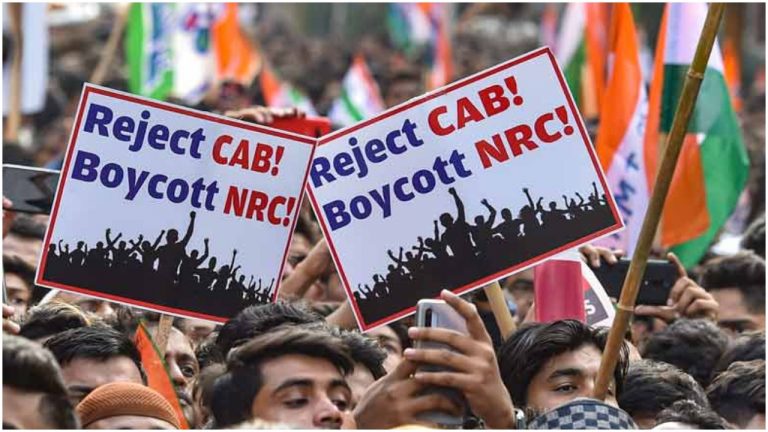
Home Minister Amit Shah has formally announced in Rajya Sabha today that the National Register of Citizens (NRC) will be implemented all across the country. The Citizenship Amendment Bill (CAB) is also slated to be taken up by Parliament in this session. Last time, the bill lapsed because it was not passed by the Rajya Sabha.

It goes without saying that the CAB is the most crucial safety measure required to ensure that the NRC is a success. Without the CAB, genuine Hindu (and Sikh, etc) refugees in the country would feel harassed by the NRC process, causing additional misery to an already marginalized and vulnerable people.

At the same time, we also need to understand that the global anti-Hindu ecosystem is waiting to pounce upon the CAB and use it to misrepresent and demonize India and its elected government. We cannot underestimate the power of this ecosystem. Following the abrogation of Article 370, there was systematic vilification of India on the roads, in universities, in newspapers, in diplomatic circles and in legislatures of foreign countries. We have to do all we can to nip this in the bud.

Read: India: A land with Hindu consciousness, which will forever be a natural home for Hindus

There are two practicalities to be acknowledged here. First, we may bristle at foreign countries getting involved in purely internal matters of India, such as NRC, CAB or Kashmir. But the fact remains that as a $3 trillion economy, we cannot avoid global attention in our domestic affairs. We simply have to adapt to this. Think about how everyone everywhere has something to say about the US Presidential race.

Second, a good deal of this vilification campaign is due to reasons that are beyond our control. The global liberal subservience to Islamism, for instance. If the New York Times refuses to blame radical jihadis for the 9/11 attacks and blames the airplanes instead, we cannot expect them to understand our pain in Kashmir. Again, we cannot stop British MPs who must answer to huge Pakistani populations in their constituencies. Not much we can do there. But where we can pull strings, we have to do our best.

Therefore, we have to adapt, be proactive and make sure that India is not demonized over the Citizenship Amendment Bill.

The accusations are already flying thick and fast, with India being accused of trying to deprive Muslims of citizenship.

How might we counter this? We have to explain that the proposed CAB is not something that is exclusionary in nature. Rather it is a measure that protects a vulnerable group of refugees by giving them citizenship.

Read: India has a civilisational responsibility to provide citizenship only to persecuted followers of Indic religions: Here is why

How can India deport a Hindu refugee to Pakistan or Bangladesh to face religious persecution, perhaps even death?

This is not discrimination against anybody. Civilized countries all over the world have policies that prevent people from being deported to places where they would be persecuted for their identity.

Let me quote to you the UN Convention of 1951 which defines a refugee as:

someone who is unable or unwilling to return to their country of origin owing to a well-founded fear of being persecuted for reasons of race, religion, nationality, membership of a particular social group, or political opinion

This definition has been incorporated into the laws of many countries, including the 1980 Refugee Act in the United States. This act amended the Immigration and Nationality Law in the US and established a clear distinction between “immigrants” and “refugees.”

India is merely doing the same here. We are establishing a legal distinction between immigrants and refugees.

Most Western countries, for instance, would not deport a gay person to Iran, where they would face the death penalty. Is this discrimination against straight people?

It is similarly dishonest to say that India protecting Hindus from getting deported to Pakistan is somehow against secular principles. The Indian government is not discriminating here; the Indian government is merely acknowledging the fact that other countries in our neighbourhood discriminate against Hindus.

Read: 34 Pakistani migrant Hindus from 3 districts of Rajasthan granted Indian citizenship

As the Citizenship Amendment Bill makes its way through Parliament, we need an aggressive strategy to tell the world that we are merely enforcing a globally accepted principle of justice.

One concrete suggestion that I would make in this regard is to change the bureaucratic sounding name of the Bill. The Bill amends Citizenship law in India and therefore it’s been called the ‘Citizenship Amendment Bill.’ As such, the name of the bill doesn’t immediately tell us what its purpose is. Whose citizenship? What amendment? This means that any mention of the bill must come with an additional explanation. And global liberals speaking to foreign audiences get a chance to twist their explanation to fit their propaganda.

We can short circuit this propaganda rather easily by changing the name of the bill. Why not rename it to something like “Protection of vulnerable religious minorities bill”? Let’s put it upfront that the bill is supposed to protect a group of particularly vulnerable people and not to exclude anyone. Make the job of our enemies that much harder. Leave them to explain why they are against protection for vulnerable religious minorities.

We saw the power of names quite recently. Even though OCI is not more than a visa, global liberals pounced upon the C-word in OCI to claim that India had stripped someone of citizenship! As opposed to just denying a visa. This was a small instance, but it shows why we need to be careful in choosing names.

As a nation primarily made up of Hindus, the deck is already stacked against us in foreign capitals. We don’t enjoy the benefit of the doubt like a Western country would. As a prominent world power, we cannot expect our domestic affairs to fly under the global radar. We have to aggressively engage with the world and explain our side. Because nobody else will.