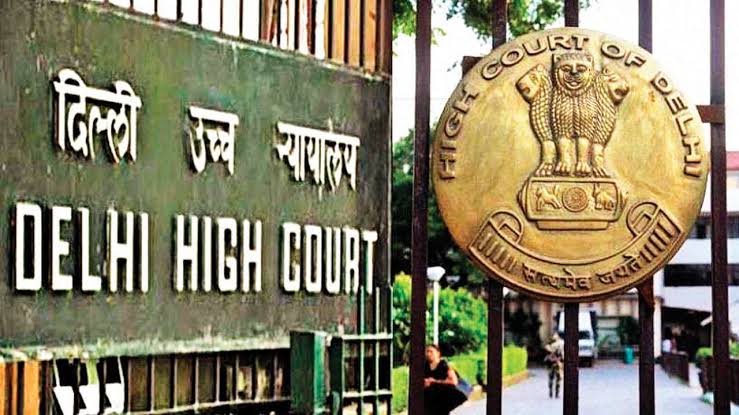
The Delhi High Court has issued a clarification stating there was no “cut and paste” job in its order pronounced in the bail plea of the former Union Minister P Chidamabaram in the INX Media case as alleged by news reports published in ‘The Hindu’ and the ‘Indian Express’.
Taking suo moto cognisance of the reports published in ‘The Hindu’ and the ‘Indian Express’ alleging that there was a cut-paste job in the Delhi HC order, the single judge bench of Justice Suresh Kumar Kait, who pronounced the order last week, asked the Chief Editors of the two news organisations to clarify and publish that there was no copy-paste job.
In order to cope with the contentions regarding the 2013 Amendment to the Prevention of Money Laundering Act while deciding on P Chidambaram’s bail, the courts had cited the High Court’s order in Rohit Tandon vs Enforcement Directorate. However, in the later paragraphs of no. 35 & 36, it accidentally went on to reproduce the facts of the Rohit Tandon case as recorded in paragraph 16 & 18 of the order passed in the case in May 2017.
The Delhi HC‘s issued an explicit clarification saying that the paragraphs quoted only record the observations made in the Rohit Tandon case and they are not made in the P Chidambaram’s INX Media case. Reportedly the ‘confusion‘ arose as the paragraph of Rohit Tandon vs ED was not in quotes and The Hindu and Indian Express called it ‘cut-paste’ job.
“It is mentioned nowhere in the order that the observation made in para 35 is of the present case (in the case of P Chidambaram). Thus there is no cut and paste as alleged and I hereby make it clear that that the observations made in para 35 shall be read as and are confined to the case of Rohit Tandon vs Enforcement Directorate,” Justice Kait said.
Besides, the investigation agency Enforcement Directorate (ED) too has moved the Delhi High Court seeking rectification of the “accidental factual errors” and “inadvertent slips” in the judgment given by the High Court while deciding on the bail plea applied by P Chidambaram in the INX Media case. The court may take up the matter tomorrow.
Chidambaram is currently lodged in Tihar jail and is facing investigation over his alleged role in granting FIPB approvals to the INX Media company while he was holding the position of Union Minister in the UPA regime.
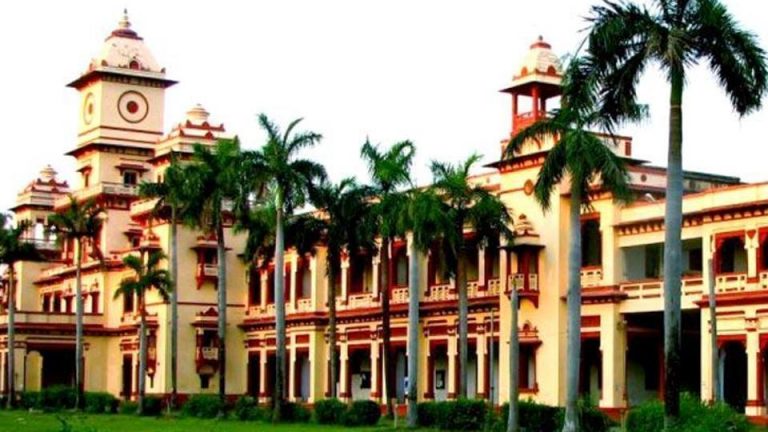
The students at the Banaras Hindu University are protesting over the appointment of a Muslim professor for teaching at the Sanskrit Vidya Dharma Vigyan (SVDV) faculty at the institution. The students are being accused of bigotry over their stance, however, as we have said earlier, it is perfectly rational to demand that Hindu Theology be taught by someone who has faith in it.
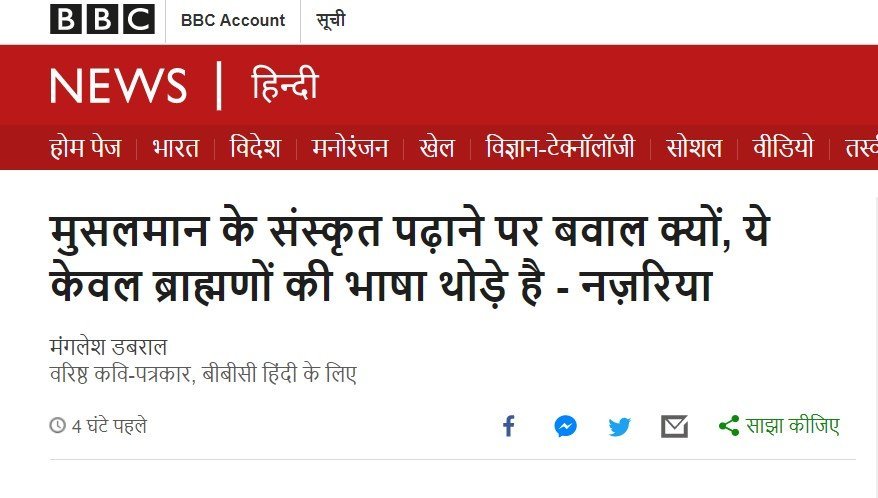
However, the mainstream media continues to slander them. The BBC, for instance, turned the entire matter into a caste issue and used the protests to further peddle its own morbid hatred against the Brahmin community. The BBC’s agenda is particularly malicious considering the fact that OpIndia.com was told specifically by the protesting students that they do not care about the caste or religion, for that matter, of the professor. They had specified the professor could teach Sanskrit language in any other department of the BHU except the theology or Dharma Vigyan one.
BBC Hindi bringing in castesim
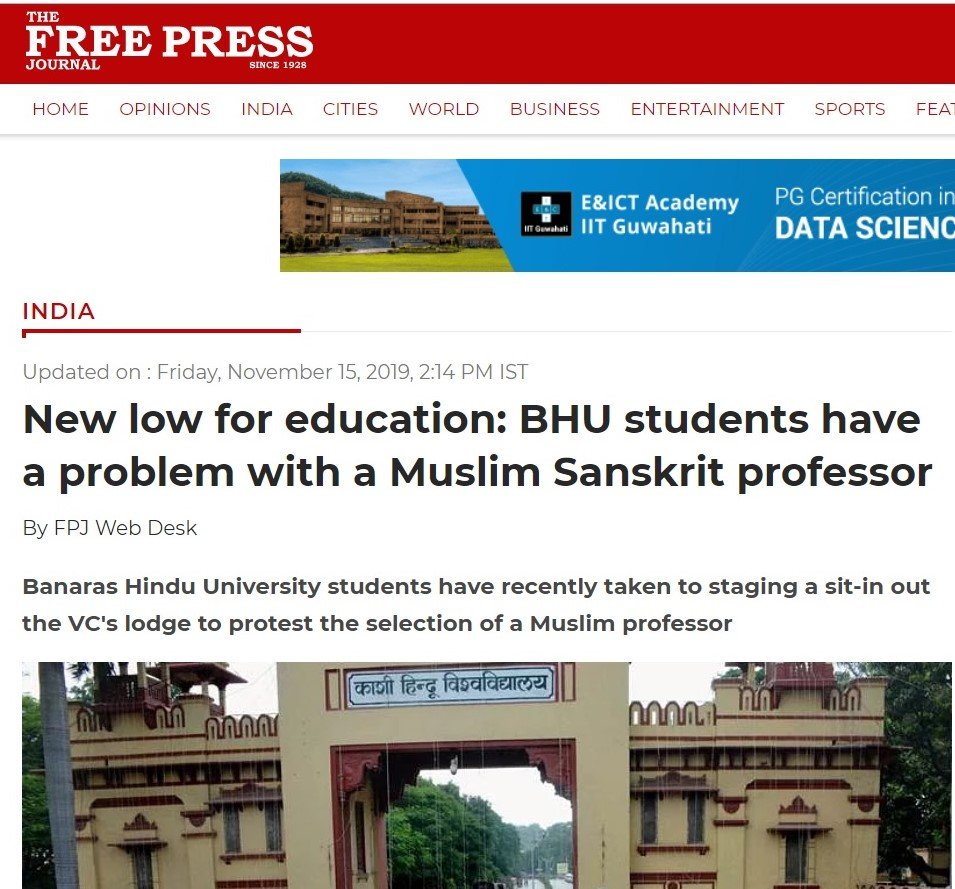
Other media organizations were not too far behind. The Free Press Journal called the protests a ‘new low for education’.
Cleverly skipping the part that Muslim Professor teaching in Dharma Vigyan faculty.
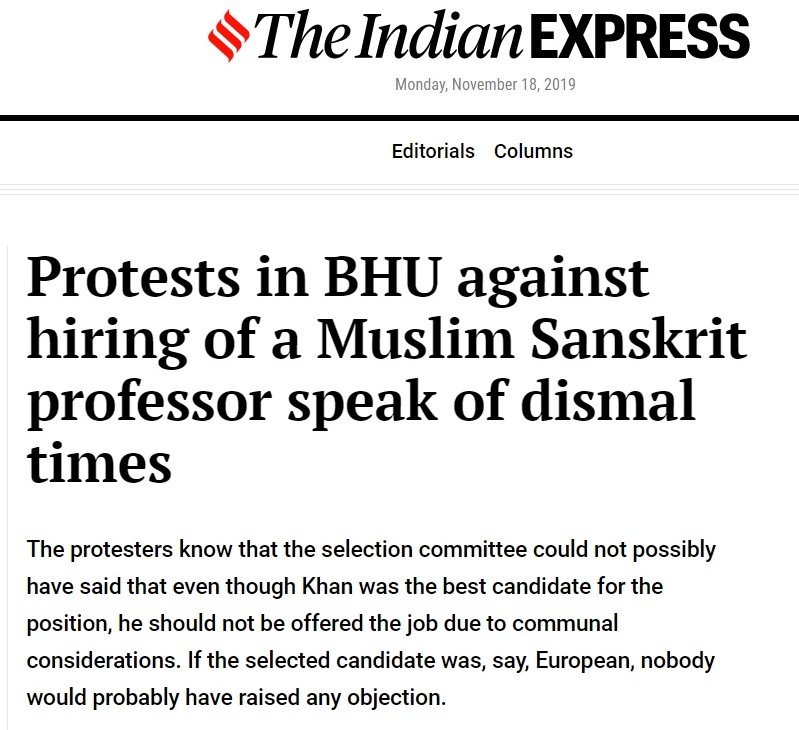
The Indian Express claimed that the protests speak of ‘dismal times’. It said, “It is a measure of the hatefulness and narrow-mindedness that has come to permeate the national atmosphere that the appointment of a young Muslim Sanskrit scholar, Firoz Khan, as an assistant professor in the literature department of the Sanskrit Vidya Dharma Vijnan at Banaras Hindu University has brought forth protests from his to-be colleagues as well as the faculty’s PhD students, demanding a cancellation of the appointment.”
Indian Express called it ‘dismal times’ and assumed there wouldn’t be any protests had the professor been ‘European’.
Indian Express also says how there probably wouldn’t have been any objection had the candidate been ‘European’, comparing religious beliefs to nationality.
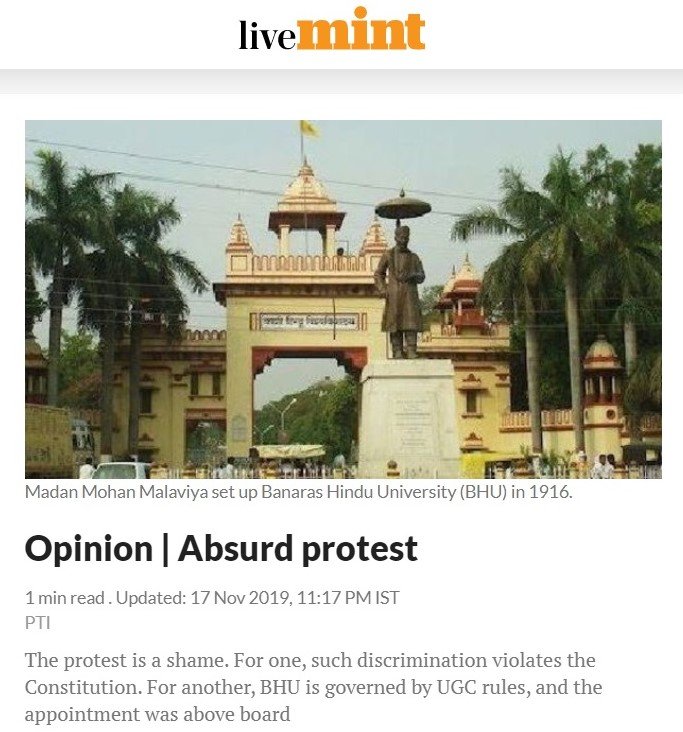
LiveMint, meanwhile, was muted in comparison to others and only reproduced an article by PTI that called the protests ‘absurd’ and a ‘shame’. It said, “The protest is a shame. For one, such discrimination violates the Constitution. For another, BHU is governed by University Grants Commission rules, and the appointment was above board. The professor holds a PhD in Sanskrit literature. It’s a classical language that’s open to anybody who wants to study or teach it. Any “Aryan” association is entirely irrelevant. These protesters should look up the Rigveda. “Let noble thoughts come to us from every side,” it says.”
LiveMint on BHU protests
In their efforts to malign the protesters at BHU, the media has again engaged in completely misrepresenting the point of view of the students of the University. First of all, the faculty is not for merely teaching Sanskrit. A separate department exists for that within the BHU. The faculty in question exists to teach students Hindu Theology. There’s a huge difference between the two.
Secondly, due to its own biases, the media has completely ignored the allegations of corruption against the institution. For purpose of fairness, the media would normally be expected to evaluate the allegations on their merits but on this particular occasion, they have dismissed it entirely.
Thirdly, instead of asking the question whether the concerned professor is eligible to teach Hindu Theology and whether it would be preferable to have someone who has actual faith in Hinduism to teach the subject, they have ignored it entirely and brushed it under the carpet. They appear to have deliberately misrepresented the students’ arguments to suit their own benefits.
One student had told OpIndia, “If we do not protest now, then 15 years hence this faculty will have one Muslim professor, faculty head and even dean. They will appoint more Muslims and a time will come when the ones who will be in charge of ‘Hindu Dharma Vigyan’ stream will be non-Hindus. Those who do not have any connection to Hindu Sanatan traditions, Yagnas and Jyotish.”
Another student said, “We do not have teachers, we have gurus. Everyone here keeps a ‘choti’, touches feet of the elders and conduct havans and yagnas. The professor who has been appointed identifies his religion as ‘Muslim’. If he is appointed, will it not be discrimination against the students who follow the Vedic Sanatan traditions?”
Under these circumstances, how is it bigotry for the students to demand that they be taught by someone who is suited to the task? It is unfair to the Muslim professor himself to expect him to be a faithful practitioner of Yagnas and Jyotish. And it is grossly unfair to the students themselves that they be forced to abandon the traditional manner in which Theology is taught.
The sole responsibility for this mess lies with the administration and administration alone. However, the administration has been given a free pass by the media while the students have been demonized for making a very rational demand. The conduct of the mainstream media in response to the protests at BHU stands in stark contrast to their conduct when ‘students’ at JNU indulge in political protests.
Here we have students protesting over an issue that is fundamental to their education and the media has abandoned them completely. But when ‘students’ at JNU indulge in vandalism, senseless political sloganeering, harassing their professors, not allowing ambulances to pass, the very same media jumps to defend the students and demonizes the administration.
Why is the media treating the two groups of students differently? One group is protesting about an issue that affects their education significantly while the other is indulging in toxic politics. And yet, it’s the first group that is demonized by ’eminent intellectuals’ while the latter is defended on the basis of ‘freedom of expression’. Why these double-standards? Unfortunately, all of us know why.
The ‘students’ of JNU were not demonized so blatantly even when they chanted slogans such as ‘Bharat tere tukde hongey inshallah inshallah’. Their Jihadist chants were defended under the garb of ‘Freedom of Expression’ by ’eminent intellectuals’. And here we have the media completely misrepresenting the position of the BHU students entirely. Perhaps, it’s because protests in JNU are ‘secular’ while those in BHU is ‘saffron’.
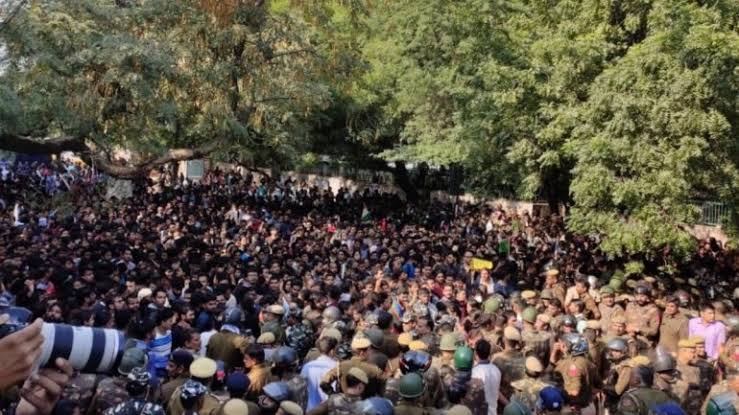
The perpetual protest dawdlers of the Jawaharlal Nehru University today launched a march towards the Indian parliament in opposition to JNU administration’s proposed fees hike and other proposals. Thousands of students hit the streets demanding a complete rollback of the fees hike amid massive police deployment.
Prohibitory orders issued under Section 144 in and around the university were imposed as the march crossed three layers of police barricading, a kilometre away from the JNU Gate. The students who were holding priests for more than 3 weeks in the university campus over the fees hike and other restrictions organised a protest march carrying placards and chanting slogans, seeking to get the attention of the HRD about their demand. The HRD ministry had instituted a three-member panel to hold a dialogue with the protesting students.
#WATCH Delhi: Clash between Jawaharlal Nehru University (JNU) students and police, earlier today. Delhi Police PRO has said that they will inquire into lathi charge allegations made by JNU students. pic.twitter.com/5yOhuDBvdi
Hundreds of students were stopped near Safdarjung tomb square following which the Delhi police allegedly rained lathis against the protestors. The Delhi Police PRO asserted that will inquire into the allegations of lathi-charge made by the JNU students.
Groups of students protested near the Safdarjung Tomb, raising ‘azadi’ slogans.
#WATCH: Jawaharlal Nehru University (JNU) students protest near Safdarjung Tomb after their march to Parliament was stopped by Police. They are demanding complete fee roll back along with other demands. pic.twitter.com/qstFa3G5SN
Some protestors are detained by the Delhi Police. The entry and exit to Udyog Bhawan, Patel Chowk and Central Secretariat metro stations have been closed in view of the JNU students’ protests. The trains are not stopping at Udyog Bhawan, Lok Kalyan Marg and Patel Chowk.
The students have demanded that the detainees which included JNUSU President be released by the police. They have also demanded the MHRD to declare the withdrawal of both the draft Hostel manual and the Executive Council decisions about its adoption. Their other demands include JNUSU, which is the elected representatives of the students, and the JNUTA must be treated as stakeholders.
Recently, some ‘activists’ of JNU had vandalised a soon-to-be inaugurated statue of Swami Vivekananda on campus while protesting about the new fees structure and added restrictions.
Sait is an MLA of Narasimharaj constituency and was attending a function when one Pasha attacked him with a knife. He underwent a surgery in a hospital in Mysuru where his condition is critical. Pasha is currently being interrogated.
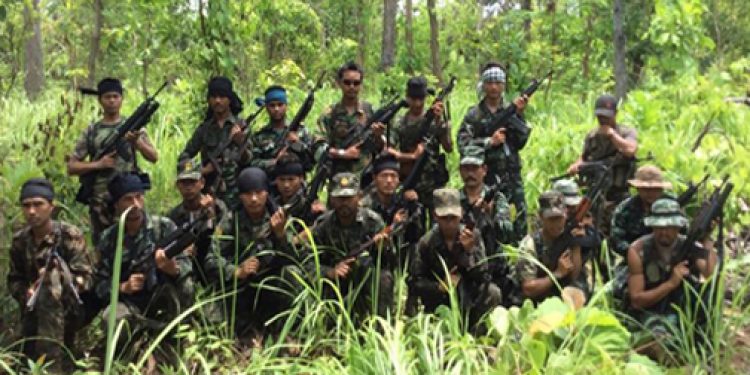
The central government has decided to ban the Meghalaya-based terrorist group Hynniewtrep National Liberation Council (HNLC) under the Unlawful Activities Prevention Act (UAPA).
In a notification, the Ministry of Home Affairs (MHA) today said that the HNLC along with all its factions, wings and frontal organisations have been openly declaring the secession of the state’s areas, which are largely inhabited by Khasi and Jaintia tribals, from the Indian Union as one of its key objectives.
Home Ministry bans Meghalaya-based insurgent group HNLC
“It continues to intimidate and bully civilians to extort funds, maintains links with other insurgent groups of the Northeast to carry out acts of extortion and intimidation, and maintains camps in Bangladesh to give sanctuary and training to its cadre”, said the ministry also opinioning that HNLC’s activities are detrimental to the sovereignty and integrity of India.
Listing the innumerable incidents of violence carried out by the HNLC in recent past that include several instances of murder, kidnap and illegal weapons, the MHA said: “If these are not immediately curbed and controlled, the HNLC will regroup and rearm itself, expand its cadre base, procure sophisticated weapons, cause loss of lives of civilians and security forces, and accelerate its anti-national activities”.
#Exclusive#Breaking | Meghalaya based insurgent group HNLC banned under UAPA. TIMES NOW accesses the MHA notification.
“Now, therefore, in exercise of the powers conferred by sub-section (1) of section 3 of the Unlawful Activities (Prevention) Act, 1967 (37 of 1967), (hereinafter referred to as the said Act), the central government hereby declares the HNLC, along with all its factions, wings and front organisations as unlawful association,” the notification read.
The Hynniewtrep National Liberation Council (HNLC) is a terrorist organization operating in Meghalaya. It claims to be fighting for a sovereign homeland for the tribal Khasi-Jaintia population of Meghalaya and aims to free the state from the alleged domination of the Garo tribe (an indigenous Tibeto-Burman ethnic group) and the outsiders from the Indian mainland.
HNLC was first banned on November 16, 2000, but the ban was lifted later.
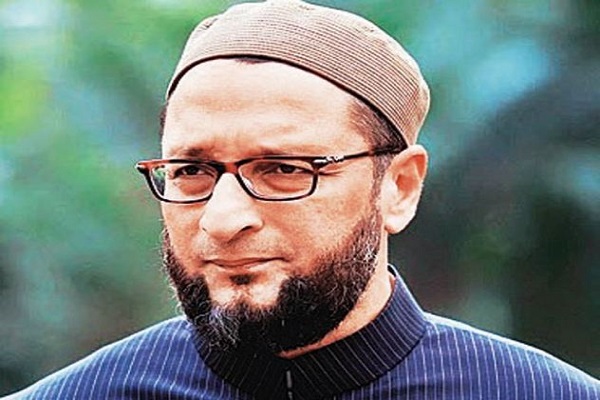
AIMIM chief Asaduddin Owaisi has been continuing his tirade against the Ram Janmabhoomi verdict ever since the SC in a landmark decision on November 9 pronounced that the disputed Ram Janmabhoomi-Babri masjid land is to be provided to the Hindu parties, making way for Hindu devotees to have a grand Ram Mandir at the birthplace of Lord Ram.
The National Muslim Forum has today criticised this antagonism and disdain shown by the AIMIM chief towards the SC verdict and said that the Owaisi is trying to create tension and confusion in the country over the Ayodhya issue.
Taking to Twitter, the National spokesperson of Rashtriya Muslim Manch (RMM), Yaser Jilani called Owaisi the real ‘Babur’ who is trying to create communal discord with his negativism.
Condemning the AIMIM chief’s statements, Jilani furthered that Owiasi should clarify as to who is he asking the mosque for and which Muslim community stands by his statement. He hinted that what Owaisi has actually been saying for all these days was not what the Muslims’ of the country felt rather he was accentuating his personal agenda which is to divide the Nation and fan communal discord within the country.
Jilani also criticised AIMPLB’ decision to file a review petition in the Supreme Court of India against the Ram Janmabhoomi case verdict.
He was also quoted by ANI as saying: “The Muslim Personal Law Board’s people are trying to create confusion and intoxication in the country. They are trying to incite the Muslim brethren, who have displayed their peacefulness and brotherhood after the verdict. The Muslims have rejected them when they are themselves stating that their petition will be rejected then why to file it at all?”
“I want to request the Indian agencies to keep an eye on them. They are trying to create drama through the review petition,” he said.
AIMPLB trying to create confusion, tension in country over Ayodhya verdict, says Yaser Jilani https://t.co/o5j71jjlck
Yesterday, there were reports that the AIMPLB after holding a crucial meeting on Sunday decided to challenge the Supreme Court order by filing a review petition on the Ram Janmabhoomi judgement that was delivered by the top court on November 9.
Notably, Iqbal Ansari, one of the petitioners in Ram Janmbhoomi-Babri Masjid land dispute, on Sunday distanced himself from the decision of All India Muslim Personal Law Board (AIMPLB) to seek review of the Supreme Court order in the matter.
“We respect the apex court’s ruling. We are Muslims of India and respect the law of the land. We would not go further on this issue,” Ansari told ANI here. “Since there are so many litigants in the case, I cannot take guarantee of everyone.”
Reacting to the SC verdict, Owaisi had ‘rejected’ the 5 acres of land offered by the apex court saying, “We were fighting for our right, we don’t need 5 acres of land as a donation, we should reject this offer”.
Owaisi went on, “Supreme Court is Supreme but not infallible. Those who were responsible for razing down the Babri mosque in 1992 have been given the responsibility of forming a trust and building a temple there. I am dissatisfied with the judgment.”
Shortly, Yoga Guru Baba Ramdev had also slammed Owaisi calling him a traitor in his appearance at Republic TV. “If Owaisi has his way, he would create another ‘fasaad‘ in the country like the Nizam’s time but he doesn’t have the aukaat (capability) to partition Hindustan,” he added referring to the Hyderabad Nizam’s attempt to create a Muslim-ruled sovereign nation inside Indian territory after Independence.
While most Indian citizens have accepted the Supreme Court judgment on Ram Janmabhoomi title suit, few Muslims, who love to identify themselves as “liberals”, have started a tirade against the judgment on social media. Since they can’t legally challenge the verdict (because of not being the petitioners to the original case) they have started running social media campaigns and writing open letters. These are their usual tricks to brainwash and mislead the common man, and malign any organisation and body that opposes their fundamentalism under the garb of liberalism.
One such Muslim ‘liberal’ Irena Akbar, a former journalist with Indian Express, who is visibly angry just like Arfa Khanum Sherwani, Saba Naqvi, and Assaudin Owaisi on the judgment, started a trend on Twitter #MosquesofIndia, appealing people to share photographs of various mosques in India.
I propose trending #MosquesofIndia hashtag. Pls share pics of mosques in cities/towns/villages in India. They may be large/historical or small/simple. Every masjid is a place of worship. This is Teele Waali Masjid in Lucknow, built by Aurangzeb. Stands on a hill or ‘teela’. pic.twitter.com/7fdlKtVxOV
In a separate tweet, she also gave her reasons for starting the trend, and evidently it was linked to Babri Masjid.
So why are we trending #MosquesofIndia ?
Because Babri Masjid may have been demolished, but you can never wish away Indo-Islamic heritage that is spread across India, in its beautiful, serene mosques. We love our architecture, our heritage and we celebrate it. Alhamdulillah!
Soon the trend became number one in India, at outfits like Shekhar Gupta’s The Print, did a story on it. BBC Urdu too joined in, not wanting to left behind. While they were happy, that it occupied numero uno spot for a brief time in Twitter trends, Irena also expressed her dismay at the trend vanishing from top 20 on Twitter soon after.
How is it that #MosquesofIndia which was trending at no.1 a few hours ago has completely vanished from the list of top 20 trends? I understand it would go down the list, but disappear completely from top 20? Just after it had reached the top? Strange.
However, trending this hashtag had one unintended consequence though. It exposed few more mosques, which were essentially temples earlier, evident from their Indic architectural style and design, a far cry from usual dome and minaret structures. See some tweets below.
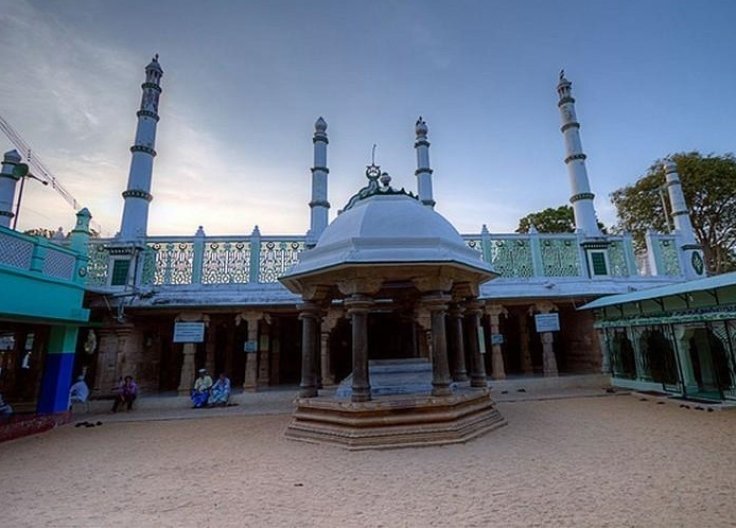
This is a mosque in Ramnathpuram. As evident from photographs, you can see a sanctum sanctorum, shut with a door and a covered courtyard immediately outside it, is an essential temple style. A study of Islamic monuments invariably shows that mosques across the world generally have an open courtyard. While apologists can claim that Islam adopted local architectural style and it was a mosque from beginning, the second photograph shows additions in form of minarets, painted in white and green, again a typical feature of contemporary mosques. It is an established fact that Muslim invaders had plundered over 40,000 temples to build mosques over them. Even Babri Masjid of Ayodhya had material used from an erstwhile destroyed temple. There is a famous book written by Sita Ram Goel and Arun Shourie, in decade of early 1990, by the name Hindu Temples; What Happened to Them?
Coming back to mosque in Ramnathpuram, the name of the town itself has evidence of something related to Ram. Holy site of Rameshwaram is situated in Ramnathpuram district. In the above-mentioned book this mosque is documented. A PDF version of this book is available here. Go on the link, use control F, type Ramanathapuram District and you will find five sites listed as erstwhile Hindu temples by Sitaram Goel. The above mosque is Jami Masjid, Kilakari. I would however like to urge every Hindu to purchase this book.
This is Shah-I-Hamdan mosque in Srinagar. This is also referred to, the book. In the PDF version, on page 79, you will find it as “Dargãh and Masjid of Shãh-i-Hamadãnî in Kalashpura. On the site of the Kãlî Temple.”
These are just couple of examples from the tweets posted under #MosquesofIndia. Sitaram Goel and Arun Shourie have done a fantastic work by compiling over 40,000 temple sites converted into mosques. It’s the duty of every self-respecting Hindu, to read this book.
While Gyanvapi Masjid and Idgah of Mathura are situated on erstwhile Kashi Vishwanath Temple and Krishna Janmabhoomi temple are even visible to naked eyes and there is no need of archeological evidence to prove it as it was needed in Ram Janmabhoomi case.
Few other notable mosques made by vandalizing old temples are Rudra Mahalaya – Jami Masjid, Patan in Gujarat and Bhadrakali Temple – Jama Masjid in Ahmedabad. A ruined temple complex of Rudra Mahalaya is located at Siddhpur in Patan district of Gujarat. The magnificient Rudra Mahalaya temple was built in the 12th century AD by a ruler of Gujarat, Siddhraj Jaisinh. The temple was dismantled by Allauddin Khilji during 1410-1444 and later Ahmed Shah I, who converted some part of it into the conjoing mosque. While Jama Masjid, which was built during 1424 AD in Ahmedabad (originally known as Karnavati) made by Ahmed Shah I on a Hindu temple of Goddess Bhadrakali.
Many Hindu motifs such as lotus flowers and creepers, mandalas, elephants, coiled serpants representing the Kundalini, celestial dancers and bells are found carved on the 100 odd surviving pillars that line the temple complex, showing that it was built over destruction of a Hindu temple.
A day will come, when Hindus, if not in our lifetime, sometime in future, would reclaim all of these holy sites.
In a bizarre editorial, Times of India has asserted that the Indian government must violate its own laws in order to prove that India remains true to its democratic ideals. TOI says that revoking Aatish Taseer’s OCI card could lead to India being isolated at the international forum.
The editorial said, “Aatish’s OCI status must be restored to send out a signal to both the diaspora and international community that India remains true to its democratic ideals. If New Delhi cannot achieve the latter, then instead of isolating Pakistan it will itself stand isolated and lose control of the international narrative.”
The editorial notes that “certain actions by his own government undermine the PM’s energetic efforts, such as the move to revoke diasporic writer Aatish Taseer’s OCI status soon after he wrote an article critical of Modi in an international newsmagazine. In a significant move 260 prominent authors, journalists, activists and artistes – including Nobel prize winners – have signed a letter urging the PM to review the drastic decision.”
It appears that TOI is vastly overestimating the importance of these ’eminent intellectuals’. Not even the ordinary American takes them seriously. In fact, Donald Trump was elected in large parts because he was hated by these very individuals and during his presidential campaign. Trump went out of his way to pour scorn on them.
Furthermore, the ’eminent intellectuals’ did not provide any significant reason as to why Aatish Taseer’s OCI card should be revoked. ‘Liberals’ had claimed that the OCI status was revoked because he had written an article critical of Narendra Modi. TOI followed the same path and made the same argument despite the fact that it’s obviously not true.
Aatish Taseer’s OCI card was revoked because he failed to disclose the fact that his father is a Pakistani. Furthermore, that fact alone makes him ineligible to hold the OCI card. The only controversy is how did he manage to acquire it in the first place. Therefore, to claim that India must violate its own laws in order to prove its democratic credentials is utterly ridiculous and the heights of entitlement.
Like the ’eminent intellectuals’, TOI, too, has decided to vouch for Aatish Taseer only because he belongs to the same club. This set of individuals are so accustomed to ‘liberal privilege’ that they live under the delusion that ordinary laws do not apply to them. The manner in which these set of individuals are demanding that the Indian government make an exception for one of their own only reveals the extent of their entitlement.
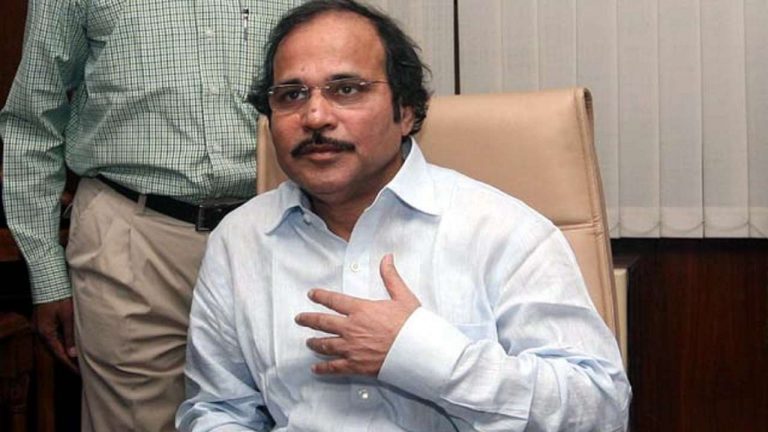
Leader of Opposition in Lok Sabha, senior Congress leader Adhir Ranjan Chowdhury today used derogatory remarks against the European parliament members who had recently visited Jammu and Kashmir to review the situation after the abrogation of Article 370. Chowdhury said that the European delegation that visited Kashmir were all “kiraye ke tattu (hired hacks)”.
Leader of Opposition in Lok Sabha Adhir Ranjan Chowdhary calls European delegation that recently visited J&K as “kiraye ke tatoo”
The derogatory remarks used by Ranjan was opposed by some members of parliament. Lok Sabha speaker Om Birla said he would examine if the remarks needed to be expunged from the proceedings.
Speaking in the Lower house of the parliament, Chowdhury slammed the government for barring Indian members of parliament from visiting Jammu and Kashmir while facilitating the visit of European delegation. “Our leaders were not allowed to go there. Rahul Gandhi was stopped. Several other MPs were prevented from visiting Kashmir. Labourers are dying there. Army men are dying,” he said.
Chowdhury was speaking in the Zero Hour during which he termed it an “atrocity” to not allow former Jammu and Kashmir chief minister Farooq Abdullah to attend the Lok Sabha proceedings.
A 28-member delegation of European parliamentarians had recently visited Jammu and Kashmir and interacted with the Jammu and Kashmir administration including the governor, and members of the civil society following the abrogation of Article 370 and subsequent bifurcation of the state into union territories of Jammu and Kashmir and Ladakh.
However, the visit was also criticised by other politicians including firebrand politician Asaduddin Owaisi. The AIMIM chief rattled by their visit had claimed that the European members were ‘Nazi lovers’. This was strongly opposed by the members with one them saying “We are not Nazi lovers. If we were, we would have not been elected. We are very angry at being called Nazi lovers.”
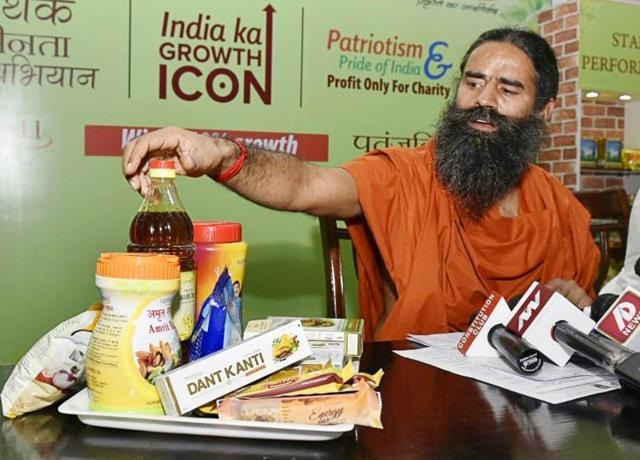
On November 11, in an interaction with The Economic Times, Patanjali chief executive Acharya Balkrishna, said that the company is ‘not averse to working with multinationals as long as it doesn’t clash’ with its values. He said that there are several MNC’s that has approached Patanjali. He furthered that they are not being refused merely because these business deals are being offered by multinationals.
The regular gossipers were quick to pick up this statement made by Acharya Balkrishna and without verifying the facts, misconstrued and represented it, to falsely malign Yoga guru Baba Ramdev, questioning his ideologies. Balkrishna’s statement was interpreted as if he said that Patanjali is in the process to sign agreements with various multinational companies.
The All India Mahila Congress took to Twitter to say that Baba Ramdev-led Patanjali Ayurved, which has always positioned itself as a swadeshi brand, is leaving behind ‘Swadeshi’ and collaborating with MNCs. Calling this stance hypocritical, the Congress chattels said that guru Baba Ramdev who made fortunes riding on ‘Swadeshi’ & nationalism has now displayed his hypocrisy by collaborating with multinationals.
Patanjali group reaches hypocrisy level of @BJP4India
Patanjali by yoga guru Baba Ramdev made fortunes riding on ‘Swadeshi’ & nationalism.
Now with falling revenues owing to poor quality, they are leaving behind ‘Swadeshi’ and collaborating with MNCs.https://t.co/AUjod5zTHK
Advocate Nazma Fatima Khan, describing Baba Ramdev as ‘paltu’ said the companies with whom Ramdev claims to be in a war with, will now enter into an agreement with him. Sharing a report by India Times, which yet again had a misleading headline, Khan tweeted with hashtag ‘shut down Patanjali’.
However, Baba Ramdev took to Twitter to give out an explanation of what Balkrishna’s statement actually meant. Clarifying that Patanjali has never accepted foreign investments till date and will never do so ever in future, Ramdev said that what Balkrishna meant was that these companies would be used only for distribution of Patanjali products abroad.
This meant that in order to increase its outreach within countries where Patanjali does not have any direct distribution facility the company might tie-up with these companies.
पतंजलि ने कभी भी विदेशी निवेश ना कभी लिया है,ना कभी लेंगे.@Ach_Balkrishna जी ने @EconomicTimes के इंटरव्यू में केवल यह कहा है”विदेशों में डिस्ट्रिब्यूशन्स के लिए विदेशी कंपनियों का इस्तेमाल करेंगे” विदेशों में भारत का बना सामान बेचना स्वदेशी को ताकत देना है.
In his tweet, Ramdev assured that Patanjali will not collaborate with any foreign company but if the goods manufactured in India could be sold in foreign countries it would only strengthen the ‘swadesi’ campaign.