The autopsy report of Mukesh Chandrakar has revealed chilling details about the torture inflicted on the body of the 28-year-old journalist, who was murdered for exposing the corruption of Congress leader Suresh Chandrakar.
According to the report, the deceased journalist had sustained 15 fractures to his head. His neck was broken and his heart was ripped out.
As per doctors who carried out the post-mortem of Mukesh Chandrakar, they also found 5 broken ribs and 4 pieces of liver. The doctors conceded that they had not seen such brutality in their 12-year careers.
They informed that more than 2 people must have been involved in the gruesome murder. Mukesh’s body was recovered from a septic tank, which was located on the premises of Suresh Chandrakar.
Mukesh had exposed irregularities and corruption by the Congress leader in a ₹120-crore road construction project in Bastar. This prompted the BJP-led-government in the State to act against the contractor.
The Chhattisgarh police arrested the primary accused Suresh Chandrakar from Hyderabad city of Telangana on Sunday (5th January). He had been on the run since Friday (3rd January).
Suresh’s brothers Dinesh Chandrakar and Ritesh Chandrakar were also apprehended by the police. The deceased journalist Mukesh Chandrakar had been missing since 1st of January.
A missing complaint was filed by his elder brother Yukesh after his phone was found switched off. Mukesh had last gone to meet Suresh’s brother Ritesh at one of the contractor’s properties.
After the murder, the Bijapur administration took swift action and razed some illegal constructions owned by Suresh Chandrakar.
3 of his bank accounts were also seized. Govt land illegally seized by the politically influential contractor was also sealed and taken back by the administration.
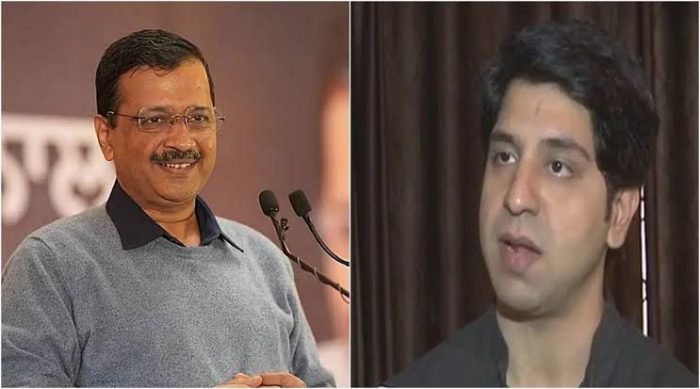
BJP leader Shehzad Poonawalla on Monday, launched a sharp attack on the Aam Aadmi Party (AAP) national convenor Arvind Kejriwal over ‘Sheesh Mahal’ expenses saying, that during COVID when people in Delhi waited for oxygen and food, Kejriwal was busy building his palace.
Speaking to ANI, Poonawalla said, “This is a very good suggestion given by our promising candidate Pravesh Verma, “open Sheeshmahal to the public. When Covid was prevalent and the people of Delhi were waiting for oxygen and food, Arvind Kejriwal was busy building his palace. Now the CAG report has also come out.”
Poonawala said that under the leadership of Atishi and Kejriwal, Delhi would face a revenue deficit for the first time in 31 years and opening the ‘Sheesh Mahal’ to the public would help generate income for the city.
“With Atishi ji and Kejriwal in power, the Delhi government is going to have a revenue deficit for the first time in 31 years, so if ‘Sheesh Mahal’ is open for public viewing, Delhi will also get some income from this,” he said.
He targeted Kejriwal further saying, “Why not make this ‘Sheesh Mahal’ of Arvind Kejriwal public and open it for public viewing, so that the truth comes out? People can see how Arvind Kejriwal, who gave an affidavit in 2013 saying that he would live in a small house is using a commode worth Rs. 4.5-5 lakhs. Atishi Sheesh ji should accept this suggestion.”
Poonawalla’s remarks follow an audit report from the Comptroller and Auditor General, Girish Chandra Murmu, which revealed that the total cost of renovating the Delhi Chief Minister’s residence, referred to as the ‘Sheesh Mahal,’ was Rs 33.66 crore.
Earlier, BJP National Spokesperson CR Kesavan also attacked Kejriwal, accusing him of betraying Delhi’s people, bankrupting the government, and enabling scams and scandals over the past decade.
“Arvind Kejriwal has muffled the truth and has now degenerated into a discredited and dishonest ‘Sheesh Mahal’ man. He can never cover up the frauds of the AAP. The CAG audit trail has been explosive and has exposed the AAP. The AAP government. has spent Rs 33.6 crores of taxpayers’ money in the ‘Sheesh Mahal’. That too during COVID when people were struggling for survival. The AAP and Kejriwal have betrayed the people of Delhi they have bankrupted the Delhi government and benefited by unleashing scams, scandals in a decade of disaster,” Kesavan said.
He also expressed confidence in the party’s victory in the upcoming assembly election, saying that the people of Delhi will sweep AAP into the dustbin of history and bless the BJP to form a government.
“The central schemes of the Prime Minister have not been able to reach the people of Delhi because it has been blocked by this dubious, devious AAP government. The people of Delhi have realised that the AAP has derailed in Delhi, and they have decided to put a full stop to this government of Delhi run by AAP. We are very sure that in the coming election, the people of Delhi will sweep AAP into the dustbin of history and bless the BJP to form a government so that Delhi takes its rightful place in our nation’s growth story as we march towards becoming a Vikshit Bharat,” Kesavan said.
The ‘Sheesh Mahal’ controversy centres around allegations that Arvind Kejriwal spent crores of rupees renovating his official residence during the Covid-19 pandemic, a period when many public development projects were stalled.
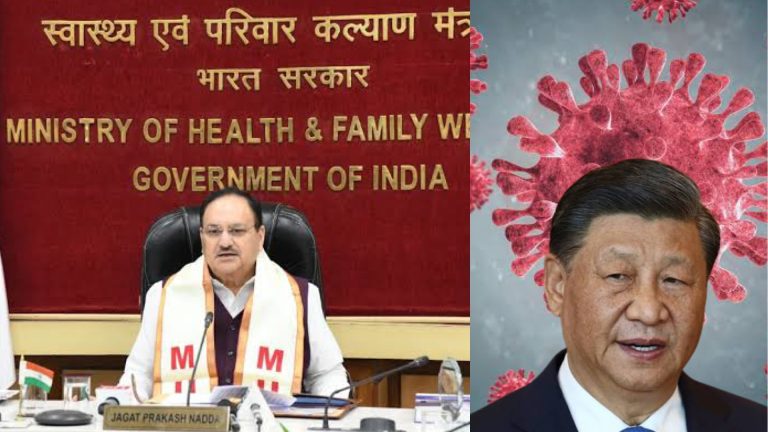
The Indian government has issued a press note following media reports of some Human Metapneumovirus (HMPV) cases detected in Karnataka. Amid concerns over the HMPV outbreak in China, the Indian Council of Medical Research (ICMR) has reassured the public that there is no cause for alarm.
The official X account of the Ministry of Health has issued an update in the wake of HMPV cases detected in India. The Ministry of Health has quoted Dr Atul Goel, Director-General of Health Services, who has said there is no need to panic and advised people to follow basic hygiene practices and take general precautions to stay safe during the winter season.
A press release by the Ministry of Health and Family Welfare said that the HMPV is already prevalent worldwide, including in India, with cases of respiratory illnesses linked to the virus reported in several countries. Additionally, according to the latest data from ICMR and the Integrated Disease Surveillance Programme (IDSP), there has been no significant increase in Influenza-Like Illness (ILI) or Severe Acute Respiratory Illness (SARI) cases across the country.
Two cases of HMPV were detected both of which involved infants treated for bronchopneumonia at Baptist Hospital, Bengaluru, with one discharged and the other recovering. Neither had an international travel history, the press release stated.
The Union Health Ministry is closely observing the situation using all available surveillance systems, while ICMR will maintain year-round monitoring of HMPV circulation trends. The World Health Organization (WHO) is providing regular updates on the situation in China to support ongoing response efforts. A recent nationwide preparedness drill demonstrated that India is well-prepared to manage any potential rise in respiratory illnesses, with public health measures ready for swift deployment if required.
What is Human Metapneumovirus (HMPV) and what are its symptoms?
HMPV is an RNA virus from the Metapneumovirus genus, first identified in 2001. Research suggests it has been circulating for over 60 years and is now recognized as a common respiratory pathogen globally. It spreads via respiratory droplets, close contact with infected individuals, or contaminated surfaces.
The Chinese CDC reports an infection period of 3–5 days. While it can occur year-round, the virus is most prevalent in winter and spring. Notably, HMPV does not generate a robust immune response, allowing for reinfection.
HMPV symptoms are similar to those of the common cold and coronavirus, including cough, fever, and cold-like signs. Officials advise wearing masks and frequent handwashing to curb the spread.
Among those most vulnerable to the virus are children and the elderly. Officials recommend wearing masks, avoiding crowded spaces, and maintaining hygiene to reduce infection risks.
Also, it is worth noting that though it is quite prevalent, there is no vaccine for HMPV, and its symptoms are often mistaken for those of a common cold.
A Muslim youth from the Mauganj district has been charged with the kidnapping of a 16-year-old Hindu girl and her forced conversion, according to a report in NDTV Madhya Pradesh Chhattisgarh. The incident transpired on 2nd January. The man has been identified as Iman Ali Ansari and was accused of love jihad by the minor’s family who also criticised the police and administration for their negligence in the case.
The case pertained to Sitapur village of Mauganj district in Madhya Pradesh. The victim’s father Vishwanath Gupta unveiled that the culprit who is a resident abducted his underage daughter and pushed her into embracing Islam. He even raised serious concerns regarding the Laur police station’s inaction and the district administration’s handling of this matter. The family members asserted that the occurrence was part of a larger conspiracy, but despite notifying the authorities, they did not initiate any action to arrest the offender.
The teenager’s father disclosed that despite his efforts to report the instance, the Laur police station ignored his requests. Instead of registering the complaint, the station in-charge humiliated him and drove him out of the police station, the father alleged. He said the police dismissed his concerns and appeared to be dragging their feet on the issue. Furthermore, it has been reported that Iman Ali Ansari and his family members threatened to murder the complainant and his family capitalizing on the police’s indifference.
Meanwhile, the police appeared to be passive observers. Vishwanath Gupta, expressed his distress, stating that he searched tirelessly from one door to another for several days in pursuit of his daughter, yet received no aid from the authorities. The helpless family then arrived at the office of the Inspector General of Police to lodge their complaint. The victim’s father conveyed that he hopes to get justice from there.
A Hindu woman named Sumitra Prasad, originally from Bangladesh has been granted Indian citizenship in the Bhojpur district of Bihar. The Hindu woman was trying to get Indian citizenship for the last 40 years. Sumitra, who was living on a visa till now, got to apply for Indian citizenship through the Citizenship Amendment Act (CAA) and on Friday (3rd January) she became an Indian citizen. This is the first case of granting Indian citizenship to a foreigner under CAA in Bihar. Sumitra admitted that Hindus are tortured by Islamic extremists in Bangladesh.
Reports say that at age 5, Sumitra Prasad alias Rani Shaha went to her aunt’s house in Bangladesh due to her father’s poor financial condition. Her father, Madan Gopal, was not able to bear the expenses of his wife, 2 daughters, and 2 sons. Sumitra’s aunt lived in the Rajshahi district of Bangladesh. Pakistan was divided in 1971, and chaos ensued. Meanwhile, Sumitra stayed there and passed high school from her aunt’s house.
Sumitra said that Hindus are not looked upon favourably in Bangladesh. Sumitra returned to India in 1985 due to the daily harassment by Islamic extremists. After this Sumitra never returned to Bangladesh. Sumitra was 20 years old when she came to India. After returning to India she went to Katihar to her father. In 1985 Sumitra got married to Parameshwar of Ara (Bhojpur) district. Sumitra’s husband runs a home appliance shop. The couple has 3 daughters.
In 2010, Sumitra’s husband died of illness. Since arriving in India, Sumitra had been trying to get Indian citizenship. She used to visit visa offices every year. Sumitra says that many people in her neighbourhood in Bihar often advised her to go back to Bangladesh. Due to the delay in visa, the police also gave her the same advice in 2023. Some people also scared Sumitra by talking about getting into court cases and going to jail etc.
Eventually, her daughter Aishwarya came to know about CAA (Citizenship Amendment Act). Aishwarya applied for her mother under this law. Within just 3 months of application, Sumitra got Indian citizenship. Now Sumitra’s family is very happy after becoming Indian citizens. Aishwarya says that till now her mother’s Indian identity card could not be made, due to which her family was deprived of basic facilities like gas connection.
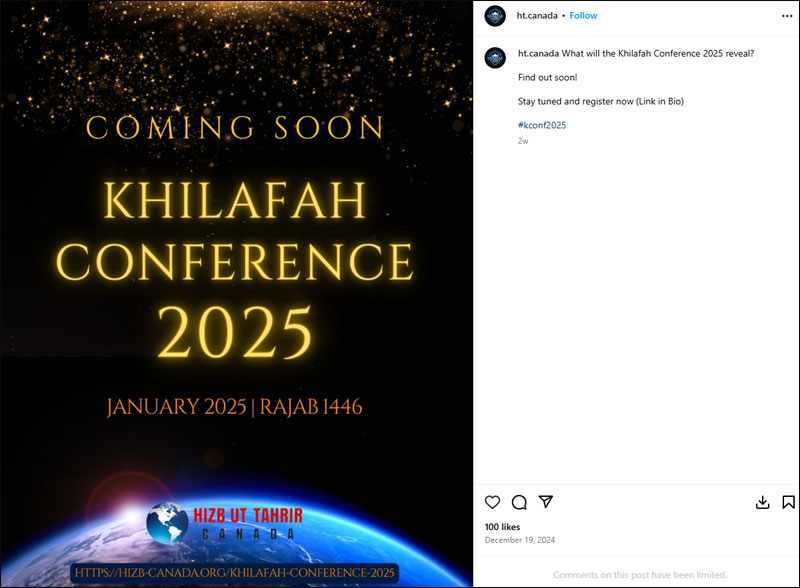
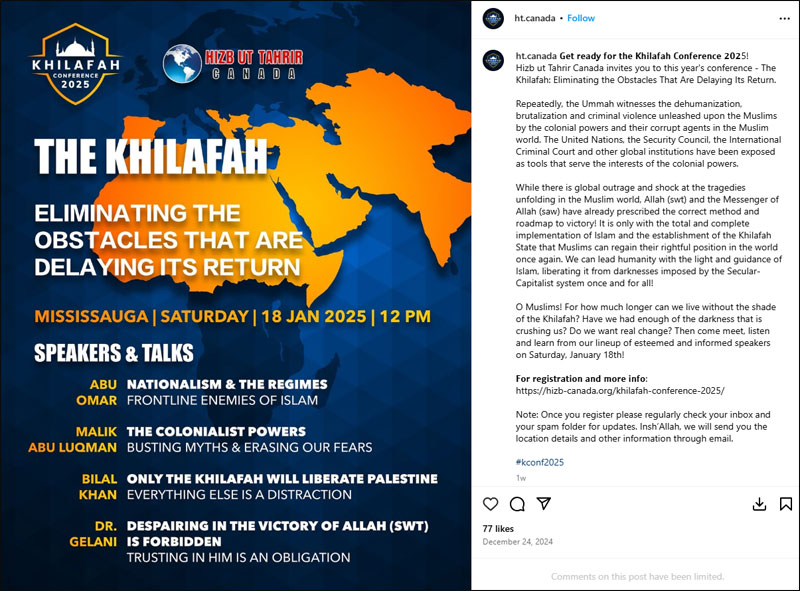
On 3rd January, the international pan-Islamist terrorist organisation Hizb ut-Tahrir (HuT) announced that it will host the ‘Khilafah Conference 2025’ in Mississauga, Canada. The mayor of Mississauga, Carolyn Parrish, has, however, vowed to oppose the conference. Interestingly, HuT has not mentioned the exact location of the so-called conference and stated on the event page that it will be sent via email to those who register for the event.
According to social media posts on HuT’s Canada chapter’s Instagram account, the conference was first announced on 19th December 2024.
Source: Instagram/ht.canada
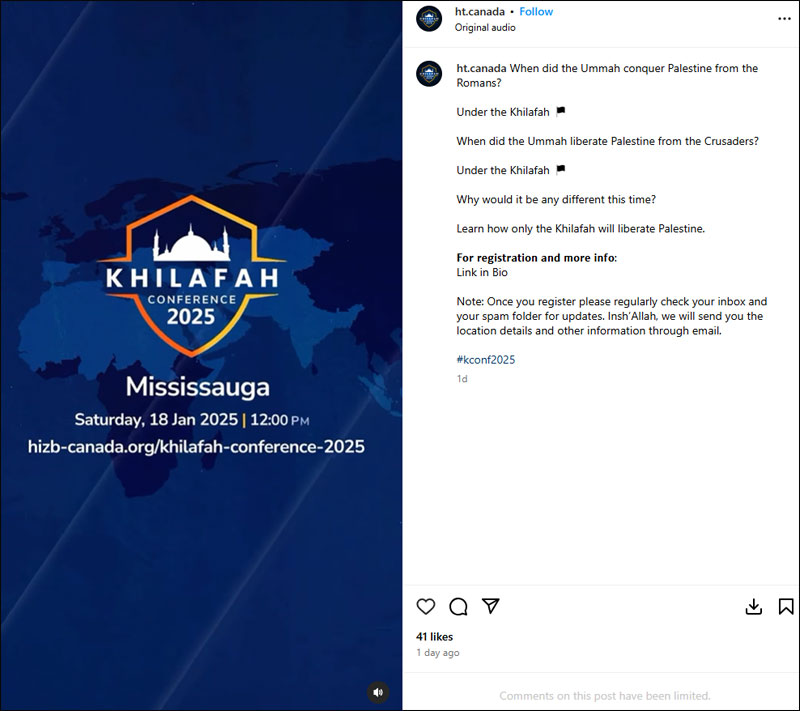
A week later, the group announced the details of the event, excluding information about the location. According to a 24th December post, the event will take place in Mississauga on 18th January 2025 at 12 PM. Abu Omar, Malik Abu Luqman, Bilal Khan, and Dr Gelani have been listed as the speakers of the conference.
Source: Instagram/ht.canada
According to the post, the conference is called “The Khilafah: Eliminating the Obstacles That Are Delaying Its Return”. The event seeks to rally support for the restoration of an Islamic Caliphate. The aim is to act against global institutions like the United Nations and the International Criminal Court, which, according to HuT, are being used as tools of colonial powers. The organisers of the conference claimed that the Khilafah is essential for addressing challenges faced by Muslims. The event page on Event Brite mentions that the conference will run for 5 hours and 30 minutes.
HuT’s posts suggest that the topics of the conference include speakers Abu Omar discussing ‘Nationalism & the regimes: Frontline enemies of Islam’, Malik Abu Luqman addressing ‘The colonialist powers: Busting myths & erasing our fears’, Bilal Khan speaking on ‘Only the Khilafah will liberate Palestine: Everything else is a distraction’ and Dr Gelani concluding the event with ‘Despairing in the victory of Allah (SWT) is forbidden: Trusting in Him is an obligation, inspiring faith in divine victory’.
In a post from a day ago, the group also mentioned the Indian state of Kashmir and claimed that the “so-called” Islamic powers have not done anything for Muslims suffering worldwide, including in Palestine, Kashmir, and other places. In the video attached to the post, the group noted, “Since losing the Khilafah, which was our shield, the Ummah has witnessed nothing short of bloodshed, foreign occupation, invasions, and oppression over these last 100 years. Despite this, the colonialist powers are still afraid of the Ummah’s latent strength.”
Mississauga mayor vowed action against the group
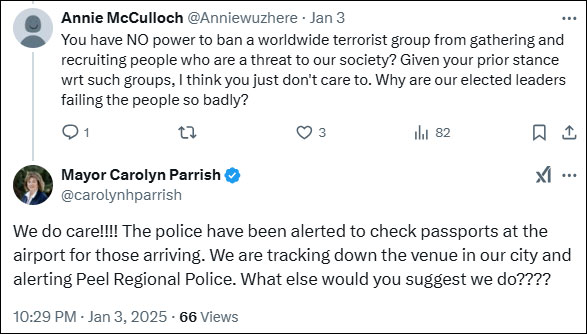
On 3rd January, Mississauga Mayor Carolyn Parrish responded to a user on the social media platform X, stating that the city was aware of the event and noting that the group had been banned from using city facilities a decade ago. However, she clarified that the city has no control over who private facilities, such as hotels or banquet halls, choose to rent to. Speaking to Toronto Sun, she said, “our staff is attempting to track down which private facility is hosting the conference so we can share what we know about the Hizb ut-Tahrir with the management” and “we have also alerted Pearson Airport authorities to carefully monitor passports to deny entry to those on Canada’s banned lists.”
Source: X
Amid mounting pressure, the mayor said in another post that the police had been alerted to check the passports of those arriving for the event. Furthermore, she mentioned that the police were tracking the venue within the city, and Peel Regional Police had been notified.
Source: X
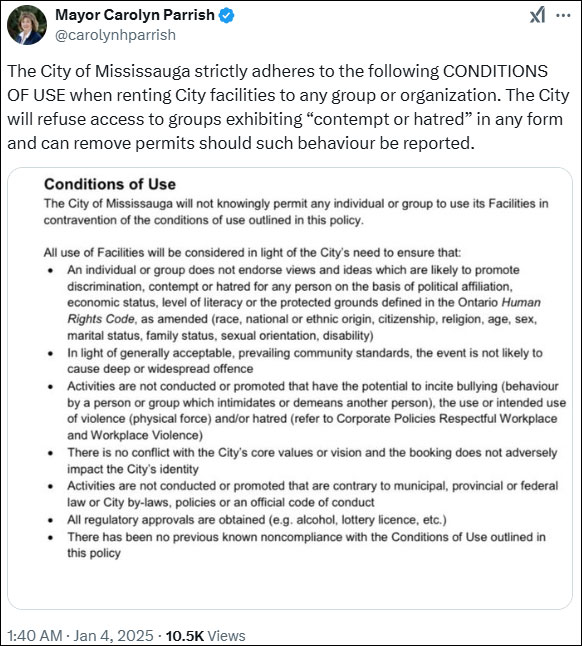
In a post on 4th January, Mayor Parrish listed the conditions required to rent city facilities, noting, “The city will refuse access to groups exhibiting ‘contempt or hatred’ in any form and can revoke permits should such behaviour be reported.”
Source: X
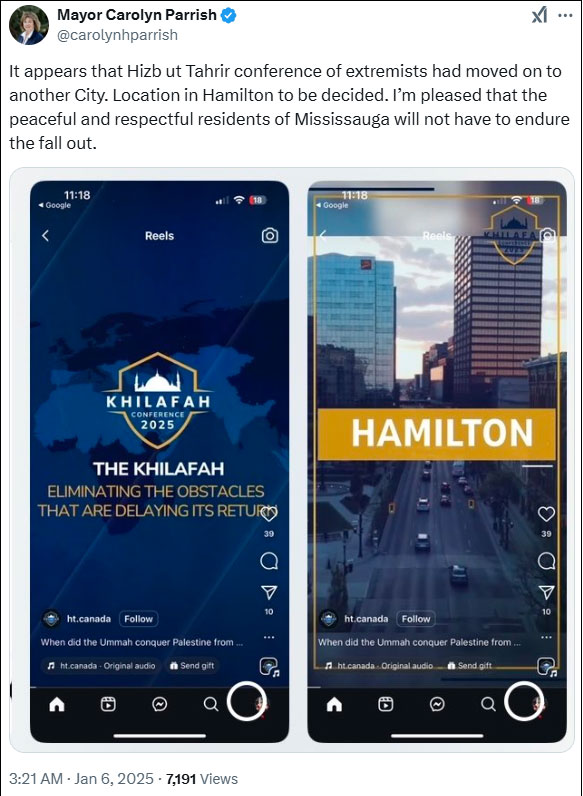
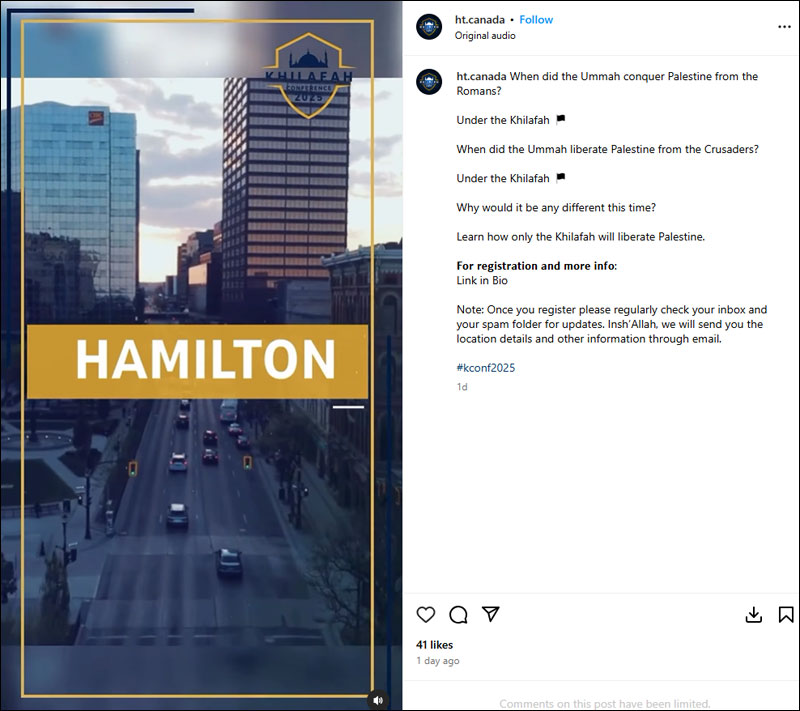
Interestingly, on 6th January, she claimed in another post that the conference had been moved to Hamilton, citing screenshots from a recent video published by the group.
Source: X
However, when OpIndia checked to confirm, it found that the group might have used an old video, as all the conference details still pointed to Mississauga. The following screenshots have been taken from the same video mentioning both Hamilton and Mississauga.
Source: Instagram
Source: Instagram
A similar video was earlier published for Mississauga but was deleted. It is still unclear if the group has moved the venue or not. The deleted video has been shared on X by Western Standard journalist Jarryd Jager.
It appears as though Hizb ut-Tahrir Canada has hidden or deleted this video from its Facebook page.
Notably, the group had planned a conference in Mississauga in 2024 as well but it was cancelled a day after United Kingdom listed it as a designated terrorist organisation. At that time, the website, that was active since 2012, YouTube channel, Facebook, Instagram and X accounts of the group were deleted or deactivated.
Elon Musk has also raised concern over the conference and tagged community noted to verify it.
Hizb ut-Tahrir has been banned in several countries including Bangladesh, China, Russia, Pakistan, Germany, Turkey, Indonesia, and others. Among Arab countries, it is banned in all except Lebanon, Yemen and the UAE. In recent times, HuT has started expanding its feet in India as well. It was declared a terrorist outfit by the Indian government in October 2024. “Pursuing PM Narendra Modi Ji’s policy of zero tolerance towards terrorism, the MHA today declared ‘Hizb-Ut-Tahrir’ as a Terrorist Organisation,’ MHA Amit Shah said. “The outfit is involved in various acts of terror, including radicalizing the gullible youths to join terrorist organizations and raise funds for terror activities, posing a serious threat to the national security and sovereignty of India. The Modi government is committed to securing Bharat by dealing with the forces of terror with an iron fist,” the minister added.
Hizb-ut-Tahrir, established in Jerusalem in 1953 by Taqiuddin al-Nabhan is a global pan-Islamic terrorist organization. Over the decades, the terrorist organization evolved from its initial non-violent methods that were chosen to gain influence within Muslim communities, to a more complex approach that involves gathering support from military factions and influential leaders that have the capacity to stage coups. The group is headquartered in Lebanon and operates in at least 30 countries, including the United Kingdom, the United States, Canada, and Australia.
It advocates for the formation of a universal Islamic caliphate under Sharia rule. The HuT has a history of encouraging and glorifying attacks on Israel and Jews more broadly. Notably, HuT has been banned in several countries including Bangladesh, China, Russia, Pakistan, Germany, Turkey, Indonesia, and others. Among Arab countries, it is banned in all except Lebanon, Yemen, and the UAE. In recent times, HuT had started expanding its feet in India as well.
Presence of HuT in different countries
In Great Britain, HuT has actively organised political campaigns and protests. In 2015, it called for Muslims to not participate in the parliamentary elections. Furthermore, they organised a protest against the killings of civilians in Aleppo outside the Syrian embassy in London.
In March 2019 in Denmark, they organised significant prayer and rallies outside the Danish Parliament in Copenhagen in response to a shooting at a mosque in New Zealand. Several hundred Muslims participated in the rally making it evident that HuT has the potential to mobilise people.
In the US, HuT has used the Syrian conflict to hold protests against the government. Two significant events were organised by HuT that were focused on the siege of Aleppo by Syrian regime forces and pro-Iranian militias.
In Australia, their activity has increased over the past decade. In March 2015, a video of Islamic Australian leader Ismail Alwahwah emerged calling for jihad against Jews during a rally in New South Wales. Later, in November 2015, HuT organised a conference to oppose forced assimilation. In 2017, they released a video supporting domestic violence against “disobedient wives”. The video faced a lot of criticism. Furthermore, HuT publicly blamed the West for a terror attack in Melbourne in June 2017.
In Russia, HuT was banned by the Supreme Court for its terrorist activities. However, the HuT members continued their operations leading to their arrests. In August 2012, HuT members were arrested in Muslim-dominating areas for their involvement in terror activities. In 2017, the Russian FSB detained six Crimean locals on accusations of being members of HuT. Later, in June 2019, a Russian court sentenced five Crimean Tatars to hard labour for their membership in the group.
In Belgium, they openly demonstrated against the visit of Islam Karimov to the European Union and NATO in 2011 outside the Uzbek embassy in Brussels.
In Kyrgyzstan, authorities closed down hundreds of HuT websites for promoting terrorism including its regional web pages. In December 2017, Kyrgyz authorities arrested eleven alleged HuT members, including a local leader of the organisation, indicating the government’s ongoing efforts to curb the group’s influence.
In Tunisia after the Arab Spring revolutions, HuT tried to capitalise on the renewed quest for religious identity in the region. In March 2012, HuT organised a much-publicised female conference in Tunisia. However, in September 2016, the Tunisian government asked a military court to outlaw the group. In 2017, it was banned for one month for inciting hatred. Though the ban was lifted, its activities remained under close watch.
In Jordan, it faced action by the government on several occasions. In April 2013, HuT organised a press conference in Amman that attracted hundreds of women including journalists etc and discussed the establishment of a caliphate. In 2016, the Jordanian government arrested 15 senior members of HuT for campaigning against changes to the school curriculum.
In Turkey, the government banned its annual conference after the authorities conflated the group with the Gülen movement. 58 of its members were imprisoned.
In Indonesia, it protested against Jakarta’s former Christian governor, Basuki “Ahok” Tjahaja Purnama, accusing him of blasphemy and facing setbacks. The Indonesian government subsequently banned HuT for opposing the state’s secular ideology and “causing friction in society.” The group’s organised campaign against Ahok played a role in the former governor being sentenced to two years in prison on blasphemy charges. In response to the ban, HuT allegedly rebranded itself as the Islamic Royatul Community (KARIM) and continued its activities.
Hizb ut-Tahrir’s plans to expand Islamic and anti-India ideology in India
On June 30th, OpIndia reported that the National Investigating Agency conducted multiple searches at various places in relation to the terrorist organization. Two of its members, Abdul Rehman and Mujibur Rehman, were arrested by the NIA for indoctrinating young people.
The trainees were tasked with transforming India from Darul Kufr (Land of Non-believers) to Darul Islam (House/abode of Islam). The agency seized digital devices (cell phones, computers, SIM cards, memory cards) as well as many incriminating materials, including printouts and books containing the philosophies of Hizb-ut-Tahrir, Khilafa, Islamic State, and the proposed Khilafa administration and financial systems.
On Monday (6th January), media reports claimed that India had recorded its first case of the Human Metapneumovirus (HMPV). The ‘patient zero’ is said to be an 8-month-old from Bengaluru.
Another 3-month-old child had also tested positive for HMPV. The development comes amid a surge of Human Metapneumovirus in China, which was where Covid-19 originated.
While the 8-month-old child is still undergoing treatment, the 3-month-old toddler has been discharged.
The cases were confirmed by the Indian Council of Medical Research (ICMR). However, it is not confirmed whether the strain of HMPV is the same as found in China.
The “latest virus from China” HMPV has already been in India since decades and is a well known pathogen causing respiratory illness especially in children. This study done at AIIMS almost two decades ago showed its prevalence at about 3% to 33% of childhood respiratory illnesses. pic.twitter.com/H4nLOdcgXI
On Saturday (4th January), noted surgeon Amit Thadhani attempted to pacify the public, worried about the ‘new virus’ from China. He informed that HMPV has been in India for decades.
“The “latest virus from China” HMPV has already been in India since decades and is a well known pathogen causing respiratory illness especially in children,” he tweeted.
Amit Thadhani shared the screenshot of a study on Human Metapneumovirus and stated, “This study done at AIIMS almost two decades ago showed its prevalence at about 3% to 33% of childhood respiratory illnesses.”
IMHO it doesn’t matter much, mostly there will be cross immunity. SARS virus was seen in animals and birds but not in humans, whereas this virus has already been found commonly in humans.
A netizen asked the surgeon about the possibility of the Chinese HMPV having a different strain than what was reported before. Dr Amit Thadhani clarified that there would be cross-immunity even if the strain is new or different.
He pointed out that, unlike Severe Acute Respiratory Syndrome (SARS) virus which was reported only in animals and birds, HMPV is commonly found in humans.
In the meantime, China has downplayed concerns over the surge in HMPV cases as an ‘annual seasonal reoccurrence.’
A group of Palestinians, who were staying at the Wisma Transit in Kuala Lumpur, carried out vandalism at the facility on Saturday (4th January) evening.
About 127 Palestinians, including 41 injured, had arrived in Malaysia for medical treatment in August last year. Malaysian authorities welcomed them with open arms on ‘humanitarian grounds.’
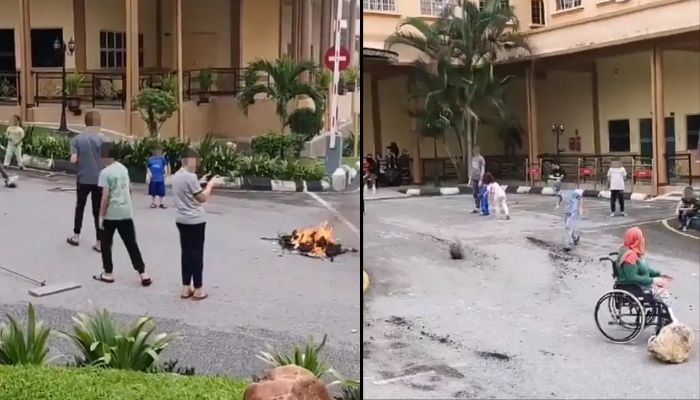
On Saturday, the group of Palestinians damaged the property of the facility and set bedsheets on fire. They reportedly wanted their visa processing to be sped up for return to Gaza.
WARGA PALESTIN DI PUSAT TRANSIT KL BUAT RUSUHAN. BANYAK BARANG DI ROSAKAN DAN DI BAKAR pic.twitter.com/G4fJqfGFb3
Reportedly, the Palestinians have been frustrated since October 2024 after Malaysian authorities placed them in the transit centre and restricted their movement.
On Sunday (5th January), the Malaysian Armed Forces (MAF) said in a statement, “Armed Forces officers and personnel on duty there held discussions with the Palestinians involved. The matter was then resolved without any argument and injuries.”
In visuals that have surfaced on social media, a large broken vase could be seen outside the Wisma Transit building. Palestinians had also set bedsheets on fire.
Following the incident, the Palestinian Ambassador to Malaysia Walid Abu Ali apologised to the Malaysian authorities.
41 Palestinians were being treated at the Tuanku Mizan Armed Forces Hospital while 86 others were housed at the Wisma Transit.
Goa Shipyard Limited (GSL) on Sunday concurrently launched two indigenously designed and constructed Fast Patrol Vessels (FPVs) for the Indian Coast Guard.
The launch marks a historic chapter in GSL’s ambitious journey towards technological and operational excellence.
Speaking at the launch, Brajesh Kumar Upadhyay, CMD, GSL, highlighted the Shipyard’s impressive growth trajectory, which has seen a remarkable 100 per cent increase in Gross Revenue, crossing the Rs 2,000 Crore threshold.
“GSL has consistently outperformed its past achievements, embracing cutting-edge technologies and transformative policies to become one of India’s foremost shipbuilders with indigenous capabilities,” CMD Upadhyay stated.
He attributed GSL’s success to its steadfast commitment to innovation, modernization, and the dynamic partnership with the Indian Coast Guard, which has continually strengthened operational readiness for national security.
According to a release, the two vessels, Amulya and Akshay, were launched ceremoniously by Vandana Agrawal in the presence of Sanjeev Kumar, IAS, Secretary (Defence Production) amidst the resonant chants of the ‘Atharva Veda’. The distinguished gathering included IG HK Sharma, TM, DDG (M&M), as well as key stakeholders from the defence and maritime communities.
GSL also launched two vessels of the same series in October 2024 as GSL is constructing a fleet of eight FPVs for the Indian Coast Guard, underscoring the shipyard’s pivotal role in realising the vision of ‘Atmanirbhar Bharat’ in defence production.
Secretary (DP) lauded the enduring collaboration between the Indian Coast Guard and GSL, which has faced and overcome challenges ranging from the COVID-19 pandemic to geopolitical disruptions.
“This launch epitomizes the resilience and ingenuity of GSL, achieved in close collaboration with Indian industry. The indigenous content of these vessels is a proud reflection of the Atmanirbhar Bharat initiative,” said Secretary (DP).
These state-of-the-art FPVs are designed in-house by GSL to meet the Indian Coast Guard’s specific operational needs. With a length of 52 meters, a breadth of 8 metres, and a displacement of 320 tonnes, these vessels are optimized for protecting offshore assets, island territories, and conducting surveillance operations. For the first time in GSL’s history, two vessels were launched simultaneously using the Shipyard’s State-of-the-Art Ship-Lift System, a transformative feat that underscores GSL’s modernization efforts.
The Chief Guest praised GSL’s team for ensuring the Coast Guard’s shipbuilding needs are met through indigenous efforts, and he commended the shipyard’s workforce for achieving this milestone despite the challenges. The Chief Guest further urged all to continue the journey towards self-reliance in defence production with undeterred focus and commitment.
(This news report is published from a syndicated feed. Except for the headline, the content has not been written or edited by OpIndia staff)
An incident of encroachment on temple land has come to light from Umran village in Thathia police station area of Kannauj, Uttar Pradesh. As per a report of Dainik Bhaskar, clashes broke out between Muslims and Hindus in the village after a Mazar was found erected on the land belonging to the village temple.
According to the report, about a week ago when people from the Hindu community reached on the spot to register protests against the encroachment on the temple land, the Muslims started pelting stones on them. They even targeted the Hindu women passing from there.
A video of the stone pelting recently surfaced on social media.
कन्नौज के ठठिया थाना क्षेत्र के उमरन गांव में जमीनी विवाद को लेकर दो पक्षों में पथराव हुआ। गाली-गलौज के बाद पथराव हुआ, जिसका वीडियो सोशल मीडिया पर वायरल हो गया। पुलिस ने मामले की जांच शुरू कर दी है और स्थिति पर नजर रखी जा रही है।#Kannauj@kannaujpolice@Uppolicepic.twitter.com/fGHHbvzDQd
The matter reportedly relates to an elevated piece of land spread across 70 Bighas densely covered by Acacia trees. Out these 70 Bighas, about 7 Bighas belong to the village temple and the rest of the land belongs to Gram Sabha. According to the villagers, the entire piece of land has been lying vacant due to dense Acacia trees. However, recently a Mazar was found erected on the temple land which led to violence between the two communities.
The villagers alleged that the local Muslims have been keeping an eye on the land. The villagers also accused the local police and the Electricity Department of being hand in glove with the Muslims who have been trying to grab the temple land. They said that the police helped the Muslims level the elevated ground and start illegal mining there. It is further alleged that the Muslims were even able to set up a tubewell on the land with the help of Electricity Department and started cultivation on it.
According to the report, when one Mahipal, a Dalit man from the village, confronted the Muslim men about the Mazar and the stone pelting incident, they physically attacked him and used caste slurs on him.
The villagers accused the police of not cooperating and refusing to file a case in this regard until the matter was raised by leaders from Hindu organisations like Bajrang Dal and Vishva Hindu Parishad raised the matter with higher authorities.
An FIR has been lodged against Noor Hasan, Ibl-e-Hasan and Qamil for physically attacking Mahipal and using caste slurs under relevant legal provisions.
Police rejects mazar angle, says it is land dispute between 2 parties
The Kannauj police, however, have denied the Mazar angle in the incident, saying that it is only a land dispute between 2 parties.
धार्मिक स्थल तोड़कर बनाई गई मजार का कोई प्रकरण न आज व बीते दिनों में नहीं हुआ है। तथ्यात्मक आधार नहीं है और यह पूरी तरह भ्रामक एवं असत्य है । कन्नौज पुलिस इसका खण्डन करती है। थाना ठठिया क्षेत्रांतर्गत एक गांव में जमीन के स्वामित्व को लेकर दो पक्षों में विवाद है जो मा0 न्यायालय…
Taking to X, Kannauj Police posted, “No incident of mazar built by demolishing a religious structure has been reported in recent days. The specific incident mentioned is a land dispute between 2 parties and the matter is sub judice in court. Kannauj police have registered a complaint of dispute between the two said parties. The reports of mazar building are false and misleading.”
Note: The report has been updated with the police statement.