Home Blog Page 649

Congress, which claims to champion Dalit causes, fails to honour prominent Dalit leader Babu Jagjivan Ram’s contribution to the 1971 Bangladesh liberation war

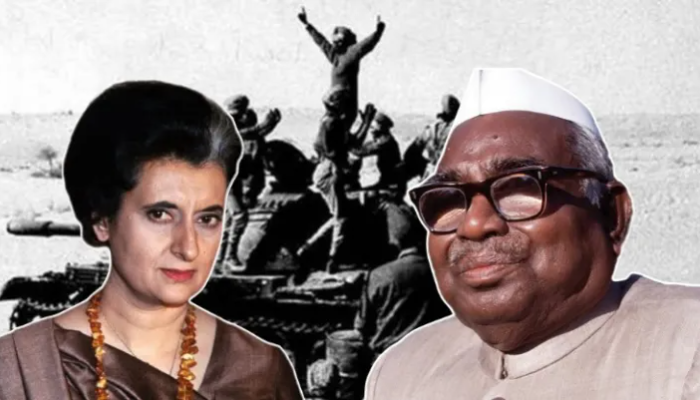
The India-Pakistan War of 1971 is the best example of the bravery, indomitable spirit and success of the Indian Army. On 16th December, Vijay Diwas, the Indian army liberated Bangladesh from Pakistan’s atrocities and brought about both historical and geographical transformations. Bangladesh was subsequently created. Former deputy prime minister Late Babu Jagjivan Ram, a prominent Dalit face of the Congress Party, is regarded as one of the war’s heroes, and yet he had received little honour by the party in its efforts to aggrandise and adulate the Gandhi family.

India was also impacted in 1971 when the authoritarianism and tyranny of General Yahya Khan, the leader of Pakistan, caused Bangladesh previously known as East Pakistan to fall apart. Approximately one crore refugees arrived in India from Bangladesh. India decided to help the then part of Pakistan as the crisis escalated wherein the three branches of the country’s army, led by the Department of Defense and the Minister of Defense, showed unwavering courage.

Babu Jagjivan Ram’s role in the 1971 war

Bangladesh considered Congress leader and then Defense Minister Babu Jagjivan Ram as the hero of this war. Importantly, not only did the Indian army have a strong sense of patriotism, but the war was fought for a different land rather than India itself. At that time, Babu Jagjivanram played an important role in boosting the morale of the army soldiers and instilling faith in them. The danger of war between India and Pakistan had been growing ever since he was appointed Defense Minister in 1970.

During this period, West Pakistan (present-day Pakistan) was also committing greater crimes against Bangladesh, its former part. Mrs. Meira Kumari, a former speaker of the Lok Sabha and the daughter of Babu Jagjivan Ram, attended a presentation called “1971 Indo-Pakistani War: Bangladesh Ki Mukti,” which was arranged in collaboration with the Indian War Veterans Association, Indian Foundation, and the Nehru Memorial Museum and Library. The preparations made under his command were mentioned during the memorial speech on 16th December 2016.

Common people were prepared for the war after visiting different parts of the country

She stated that Babu Jagjivan Ram met the army and travelled throughout India after assuming charge. “Starting wars on the front is not in our history, tradition or roots. However, the conflict will not take place in India if it is forced upon us. We’ll drive the enemy out and seize their territory.” She unveiled that Babu Jagjivan Ram used to give briefings in Parliament every two to three days on the state of affairs and war preparations.

He would speak in public every two or three days, updating the public on national events and our war plans. “There’s nothing to fear” he would tell everyone in India, whether they lived in an urban or rural area and declared, “We will make this a historic war.” He created the atmosphere that was needed in the country.

Committed to honouring army personnel

Meira Kumar highlighted in her speech that Babu Jagjivan Ram used to say that one may or may not respect another person but whenever you see a soldier you must respect him because it is not common to give your life for something intangible. The army crossing the border to safeguard India is not the only aspect of the country’s defence. In addition to preparing the populace and armed forces for war, the defence of India entails that every person should defend the nation and its honour through their actions. On the other hand, he also had faith in Mukti Bahini of Bangladesh.

Additionally, to minimize any inconvenience to people, he directed the Indian Army to stay away from crowded locations whenever they entered enemy territory. According to Meira Kumar, the Indian Army had not yet been the target of any such complaints, even though the brutality and inhumanity committed by the Pakistan Army are documented in history. She referred to this war as an honourable one. This war was critical for several reasons, but it is particularly significant because it not only founded Bangladesh but also altered history and geography.

93,000 Pakistani soldiers surrendered

For the first time, the Indian Navy had to take part in any conflict. Both the Army and the Air Force had served in previous wars. Operation Trident, the Indian Navy’s first and most successful operation, was initiated during this period. The Indian Navy damaged Karachi, Pakistan’s backbone, during this operation, which caused the country’s morale to crash. This was the same battle in which Lieutenant General Amir Abdullah Khan Niazi surrendered to India along with 93,000 of his soldiers.

The nepotism of Congress is the sole explanation for the nation’s unawareness of these vital details. Notably, the party has, up to this point, only attributed historical events to members of the Nehru-Gandhi family. The same transpired in this matter. The name of the Dalit leader Babu Jagjivan, who ensured India’s victory and prepared the entire nation for this conflict, has vanished from the war’s records. Even the Congress, which consistently refers to itself as the “Messiah of Dalits,” did not consider it important to draw attention to the accomplishment of their Dalit leader. This reality would never have been revealed if Bangladesh hadn’t established Babu Jagjivan Ram as the war’s hero.

Bangladesh highlighted Babu Jagjivan Ram’s contribution

Babu Jagjivan Ram’s contribution might never have been known if Bangladesh had not acknowledged him by bringing notice to this issue. Sheikh Hasina was the prime minister of Bangladesh when his role was revealed in 2012, 41 years after the country gained its freedom. Babu Jagjivan Ram, the defence minister at the time, was deemed “important” by Bangladesh in the 1971 conflict with Pakistan. Bangladesh wrote a letter of appreciation for Babu Jagjivan Ram, expressing gratitude.

“He played an important role in forming a ‘joint command’ of Bangladesh and Indian forces for the final attack, which resulted in victory,” the citation pointed out. “He strengthened and coordinated the war strategy with great efforts by providing training, arms and supplies to the Bangladeshi freedom fighters. However, the history of politics will remember him more for his landmark parliamentary speech on 16th December 1971 announcing the emergence of independent Bangladesh,” it added.

A memorable speech in Parliament after victory

Babu Jagjivan Ram’s speech in Parliament is also mentioned in the testimonial letter. According to which Babu Jagjivan Ram declared, “I have to make an announcement. The West Pakistan Army has unconditionally surrendered to Bangladesh. Dhaka (present-day Dhaka) is an independent country or an independent capital.” Significantly, Babu Jagjivan Ram gave a speech in Parliament a few minutes after the surrender of Pakistan to the joint forces of India-Bangladesh.

Babu Jagjivan Ram’s grandson and Meira Kumar’s son Anshul Kumar was also present when Bangladesh conferred this honor on him. He was felicitated by President Mohammed Zillur Rahman and Prime Minister Sheikh Hasina at the Bangabandhu International Conference Hall on 20th October 2012. “The remarkable thing is that he (Babu Jagjivan Ram) never wanted war and only desired justice because Pakistani soldiers had committed genocide in Bangladesh and attacked India as well,” he stated on the occasion. Security experts have also appreciated the leadership of Babu Jagjivan Ram.
Sukhbir Badal assassination attempt: Court sends Narain Singh Chaura to 14-day judicial custody

0

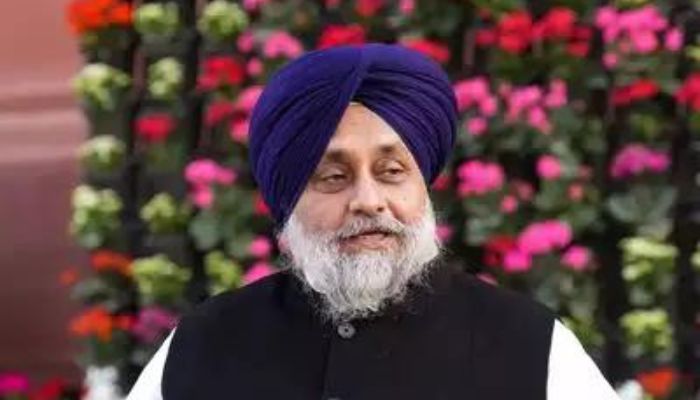
The Punjab Police on Monday presented Narain Singh Chaura, the accused in the alleged assassination attempt on Shiromani Akali Dal (SAD) leader Sukhbir Singh Badal, before the Amritsar Court.

Chaura has been remanded to 14 days of judicial custody.

Amritsar Additional Commissioner of Police (ACP) Jaspal Singh told ANI that Chaura will remain in custody until December 30.

“Narain Singh Chaura was produced before the court today. He has been sent to judicial custody until December 30,” Singh stated.

Advocate Jagdeep Singh Randhawa mentioned that the police had sought a three-day remand for Chaura, but the court instead granted a 14-day judicial custody.

“They requested a three-day remand, but he has been sent to 14 days of judicial custody,” Randhawa said. Previously, on Saturday, the Amritsar Court had extended Chaura’s police remand by two days.

On December 4, an assassination attempt was made on Sukhbir Singh Badal at the Golden Temple premises. Despite the attack, Badal resumed his religious duties under heavy security and performed ‘seva’ at Takhat Sri Kesgarh Sahib in Anandpur Sahib.

SAD leaders have sharply criticised the Punjab government, demanding swift action against the accused involved in the attack on their party chief.

SAD leader Bikram Singh Majithia condemned the incident, stating, “This attack occurred at the most sacred site of our religion. Why has the accused not been arrested sooner?”

Daljit Singh Cheema accused the investigation of being biased, saying, “The investigative officers are seen roaming around with a history-sheeter. Those who should be investigated are leading the inquiry. There is absolutely no law and order in Punjab.”

(This news report is published from a syndicated feed. Except for the headline, the content has not been written or edited by OpIndia staff)

Bangladesh and the Islamist treachery: 53 years on, India, Bangladesh’s liberator, is seen as an enemy, while genocidal Pakistan a ‘friend’

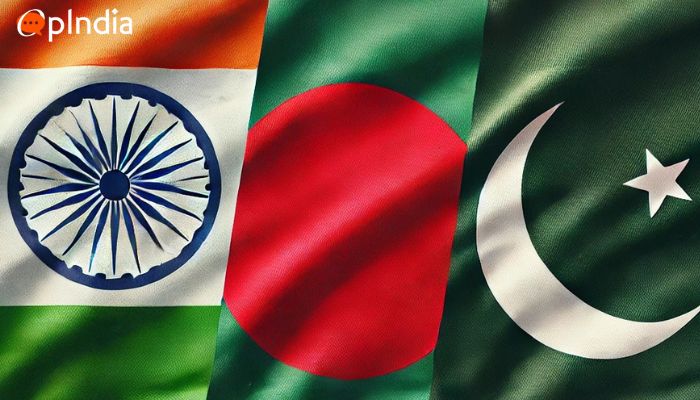
On the 16th of December 1971, the struggle of the Bengali people and the unforgettable valour of the Indian Army broke the shackles of Pakistani Islamist suppression and East Pakistan’s transformation into Bangladesh became inevitable. On this historic day, Pakistan ultimately called for a unilateral ceasefire and surrendered its entire four-tier military to the triumphant Indian Army.  

A nation born of a genocidal campaign waged against its Bengali citizens by Pakistan’s Islamist army. India was at the vanguard of this liberation, intervening militarily, sheltering and feeding millions of refugees, and coming to the rescue in a crisis that claimed up to three million lives and a slew of atrocities. It was a victory not just a military triumph for India but a victory for the Bengali people who fought for their freedom, culture and dignity.

Operation Searchlight and Pakistan’s bloodlust

In 1970, Sheikh Mujibur Rahman of the Awami League won 167 seats in East Pakistan’s provincial legislature, demanding greater regional autonomy due to Islamic interference. Despite being united by a common faith, resentment between West and East Pakistan grew. Zulfikar Ali Bhutto of the Pakistan People’s Party (PPP) opposed Rahman’s demands, leading to a civil disobedience movement in 1971. President Yahya Khan declared martial law and arrested Rahman and other leaders.

On the 25th of March, 1971, the Pakistan Army launched Operation Searchlight, a brutal crackdown on East Pakistan’s nationalist movement. The genocide and rape of the Bengali people of the then East Pakistan was spearheaded by former Army chief General Yahya Khan. Even as per the conservative estimates, over 200,000 Bengalis were killed and in a deliberate campaign of genocidal rape, Pakistani military personnel and the Razakars raped between 200,000 and 400,000 Bengali women and girls. 

The people of East Pakistan had faced discrimination, be it in the political representation, governmental and other institutions due to these being concentrated in West Pakistan and dominated by West Pakistanis, budgetary discrimination despite East Pakistan forming 55% of the population,  with most drastic being discrimination based on linguistic and cultural lines. While the partition of India on Islamic lines makes it clear that Islamists hated Hindus and other non-Muslim communities, the crux of the blatant disdain of the West Pakistani Islamist government and the army towards the Bengali Muslims was deeply embedded in their hatred for Hindus and their culture. In addition to seeing Bengalis as ‘non-martial’ [read cowardly] people, the Pakistani Islamists opined that the Islam of Bengali Muslims was not ‘pure’ enough due to their connections with the Bengali Hindus, their culture and traditions etc. You see, the Islamists not only hate Hindus but anyone in the Islamic fold they deem not ‘Muslim enough’.

Bangladesh’s journey from resisting the atrocities of its genocidaire Pakistan to romanticising the same

Fast forward to 53 years later, and the political landscape of Bangladesh has turned ironic, if not tragic. The country whose independence India had conferred through military intervention now harbours increasing hostility towards India while cuddling up to Pakistan, the very state responsible for unspeakable violence against its own population. One question the ‘apolitical’ people, especially Indians ask is why despite helping Bangladesh in attaining freedom and lending continued support, the Bangladeshi Muslims hate Hindu-majority India. While an average Bangladeshi Islamist will give a vague response like India asserting its supposed ‘control’ over Bangladesh, economic disparities, ‘border disputes’, water-sharing issues and whatnot, the factual answer to this lies in the fight against the very ideology. Bangladesh is a culmination of. While the Bengali people with the help of India could get rid of Pakistani Islamists in 1971, Islamic extremism in Bangladesh could never really be eradicated. The Urdu-speaking Islamists were replaced with Bengali-speaking Islamists. It can be understood from the fact that since Bangladesh’s liberation, the governments there have ‘legally’ confiscated the lands of Hindus by arbitrarily declaring them “enemies”.

The Islamist political outfits like the Bangladesh Nationalist Party (BNP) and the Jamaat-e-Islami (JeI) have historically antagonised India, its contemporary demonstration was seen in the ‘India Out’ campaign and its threats of ‘conquering’ Kolkata in 4 days. The Jamaat and its student wing Chhatra Shibir were also directly involved in targeted attacks on Hindus and their temples since the undemocratic ouster of Sheikh Hasina on the 5th of August 2024.  One of the first few decisions of the Muhammad Yunus-led interim government was to lift the ban on this Islamist outfit.

Pakistan’s founding ideology, which was premised on an autonomous Muslim identity separate from Hindu-majority India, has evolved into a broader narrative in which antagonism towards India is a fundamental aspect. Pakistani political leaders and “Ghazwa-e-Hind” enthusiasts frequently use this animosity to gain public support, divert attention away from internal issues, and justify the military’s enormous control over civilian affairs. Now the Bangladeshi Islamists have taken a page from the playbook of Pakistani Islamists to instigate an already in “jihad” mode Islamist populace into not only persecuting Hindu minorities in Bangladesh but also justifying its hatred for the Hindu-majority India while turning completely oblivious to Pakistan’s unspeakable atrocities against Bangladeshis even as Pakistan has in five decades never apologised for the horrors it unleashed.

As noted Bangladeshi author Taslima Nasreen pointed out, India went all out to support Bengali freedom fighters, from providing weapons and training to food and shelter, however, Bangladesh which now has clearly slipped into the hands of Islamists is harbouring hatred against India and limerence for Pakistan.

Earlier this month, the Bangladeshi Ministry of Foreign Affairs (MOFA) in Dhaka directed all its missions abroad to facilitate visas for Pakistani citizens and those of Pakistani origin. Meanwhile, the Yunus administration said that it would stop visa services from one of its missions in India’s Tripura’s Agartala. On one hand, Bangladesh is strengthening ties with its erstwhile oppressor Pakistan and on the other, it is straining ties with its liberator India.

Ironically, Jamaat-e-Islami, which was opposed to the creation of Bangladesh has now become so mainstream and powerful in the country that its Chhatra Shibir ‘activists’ who participated in the violent anti-Hasina protests appeared on the Victory Day posters published by the Yunus government. It is a matter of national shame that JeI ‘activists’ are now being made the face of the Bengali freedom struggle even as the Jamaat itself assisted the genocidal Pakistani army in killing and raping millions of their fellow countrymen. But there is no scope for Bangladesh to even realise its fall and collective shame given its conscience died the day, the Islamist mobs began destroying the legacy of Mujibur Rahman on one hand and attacking Hindu minorities on the other. If the geography allowed, the Islamists in Bangladesh would have merged the country with Pakistan by now.

Islamic groups like Jamat-e-Islami in Bangladesh have long advocated a pan-Islamic identity, one that is sharply in contrast with the secular and nationalist ideals on which Bangladesh’s foundation should have been laid given its people were liberated from horrors of Islamic extremism and barbarism. However, the Pakistan-sympathising Jamat and BNP, who now are more powerful than ever, want its people to see its liberator India as an enemy and its genocider Pakistan as a close ally and natural friend due to the ‘shared’ Islamic identity. Why would Pakistan ever apologise for the brutalities it inflicted on the people of erstwhile East Pakistan when the Bangladeshi people are themselves cuddling up to their genocidaire?

While the Sheikh Hasina government sought to hold accountable those like Jamat-e-Islami who collaborated with Pakistan armed forces during the 1971 genocide, the recent drift and mainstreaming of Jamaat and other Pakistan sympathising entities in Bangladesh, forget accountability for past war crimes, now Pakistan and Bangladeshi Islamists will shamelessly forge deeper ties, villainise India as a Hindu oppressor while persecuting Hindu minorities just as Islamists in Pakistan do without a smidgen of shame.

For India, the outcome of the rise of Islamists is disappointing and a matter of serious concern. India’s sacrifices for the oppressed Bengali people during the 1971 Liberation War are eclipsed by the current weft and warp of the anti-India narrative peddled by the interim Islamist regime in Bangladesh. India is Bangladesh’s major trading partner and ally, however, the growing hostility driven by Islamists is a disconcerting trend. The case of Bangladesh stands as a cautionary tale for India how Islamic supremacist ideology trumps humanitarian alliances and how a country governed by Islamists can turn apathetic to the sufferings and pain of its own people. It is a cruel irony that a founded on the imperative to end Islamist tyranny is now grappling with similar elements of fanaticism and violence.

With Bangladesh falling into the hands of Islamists, with its leader downplaying Islamist violence and mollycoddling the genocidaire of its own people while antagonising its liberator, Bangladesh’s future is bleak and it is becoming everything it fought against. From destroying the legacy of Mujibur Rahman, straining ties with India to abandoning Joy Bangla, a slogan that symbolised the Bangladeshi freedom struggle, Bangladesh is becoming East Pakistan all over again all because even as it got liberation from Pakistan it could liberate itself from Islamist ideology which was the very root cause of the Bengali genocide.

“Priyanka Gandhi carrying Palestine bag is nothing but Muslim League agenda”: BJP’s Anirban Ganguly

0

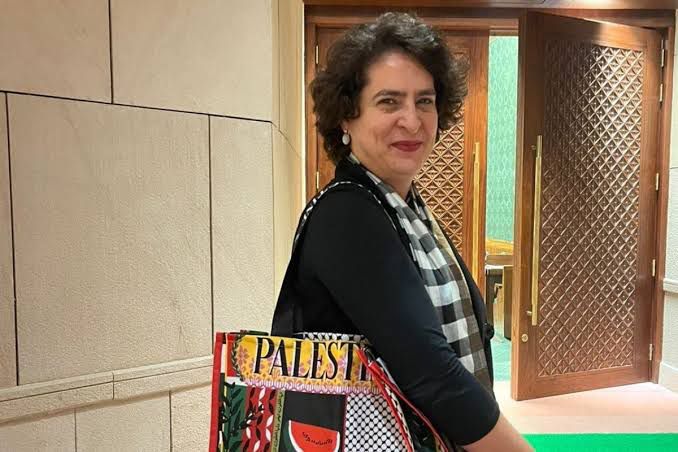
BJP leader Anirban Ganguly on Monday accused Congress MP Priyanka Gandhi Vadra of promoting the Muslim League agenda — divisive politics by carrying a bag with “Palestine” written on it to Parliament.

Slamming Congress MP Vadra, Ganguly said that Priyanka Gandhi is unaware of the geopolitical landscape and termed the Congress party as the “new Muslim League.” Notably, the Muslim League, founded in 1906, was a political organisation that represented the interests of the Muslim community in British India. Its significance lies in its role in fostering Muslim nationalism and ultimately leading to the creation of Pakistan in 1947.

“Congress is the new Muslim League. Priyanka Gandhi is neither well-informed nor is she educated. She is absolutely unaware of the geopolitical landscape… Right from Pt Nehru to Priyanka Gandhi, they have always shown their anti-Hindu mindset. They never said anything for the persecuted minorities in Bangladesh. Her carrying the Palestine bag to the Parliament is nothing but the Muslim League agenda…” Ganguly told ANI.

Ganguly also attacked her for opposing the Citizenship Amendment Act, adding that she first needs to agree that minorities in Bangladesh are in trouble.

He said, “Whenever Priyanka Gandhi says something, shows that she is unaware of the ground reality. CAA was opposed by Priyanka Gandhi and her party and now she demands that minorities be brought to India… They first need to agree that minorities in Bangladesh are in trouble… They are speaking on Palestine and showing their support but not speaking anything about Bangladesh Hindus…”

Congress MP Priyanka Gandhi Vadra slammed BJP remarks on her carrying a bag with “Palestine” written on it, terming them “useless things.”

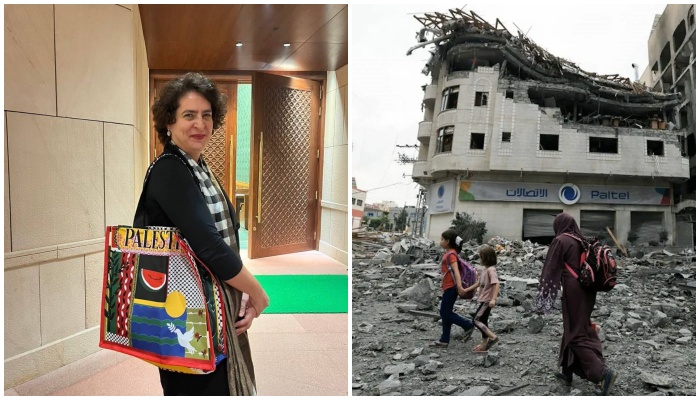
The row erupted when Priyanka Gandhi was seen carrying the bag during a Parliament session. It had “Palestine” written on it and several emblems embedded in it, including a watermelon, a symbol which is often associated with Palestinian solidarity.

Reacting to the BJP’s accusation of appeasement, Priyanka Gandhi Vadra said that instead of talking about this “rubbish,” the government should take some steps regarding the atrocities happening in Bangladesh, against minorities and Hindus.

She asserted that the Central government should talk to Bangladesh about this issue.

” The atrocities happening in Bangladesh, against minorities and Hindus…something should be done regarding this. Talks should be held with Bangladesh govt regarding this…and they should not say such useless things” Vadra told reporters in the Parliament premises.

The BJP seized on the opportunity to criticize her, alleging that the bag’s inscription indicated her support for Palestine over India’s interests. BJP MP Manoj Tiwari accused her of “appeasement” and said the Congress party uses different agendas to get votes by entangling them.

Manoj Tiwari said, “Congress does appeasement. They don’t do anything good to the Muslim community. They use different agendas to get votes by entangling them. You may have heard PM Modi has said about Congress’ one gimmick – ‘Garibi Hatao’, which was used by Nehru Ji, Indira Ji, Rajiv Ji and currently it is being used by both Rahul and Priyanka Ji. They love and support the people of the country by dividing them. Now, the people of the country knows this trick.”

Union MoS SP Singh Bhagel noted that Vadra carrying a bag with Palestine written on it was not just a mere coincidence, rather it was an attempt to give a message.

He stated that through this move, she is trying to appease, satisfy and polarise the Muslim votes.

Baghel told ANI, “This is not just a coincidence, rather, it is being tried to give a message. If only she carried an Indian bag, which is unique for every district and is being made in several cities, including Agra, Kanpur, Chennai, etc. If she could use ‘Swadeshi’ product, as it could give huge boost to that industry…By carrying a bag written Palestine on it, she is trying to appease, satisfy and polarise the Muslim votes.”

Notably, on December 11, Palestine Embassy Charge de Affairs Abed Elrazeg Abu Jazer met Congress MP Priyanka Gandhi Vadra at her residence to congratulate her on her victory in the Wayanad Lok Sabha seat.

Since October 2023, Israel-Palestine has been engaged in an ongoing conflict after Hamas attacked Israel and captured its citizens.
According to a statement from the Ministry of External Affairs, India has strongly condemned the terror attacks on Israel on October 7, 2023 and the loss of civilian lives in the ongoing Israel-Hamas conflict.

India’s policy towards Palestine has been long-standing and consistent. We have supported a negotiated two-state solution, towards the establishment of a sovereign, independent and viable State of Palestine within secure and recognized borders, living side by side in peace with Israel, as per MEA. 

(This news report is published from a syndicated feed. Except for the headline, the content has not been written or edited by OpIndia staff)

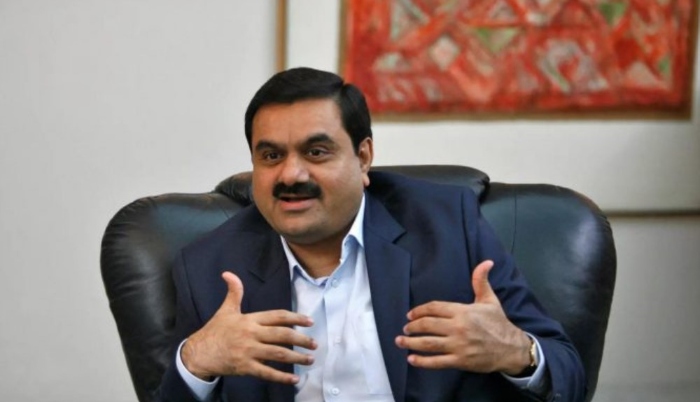
Bombay High Court dismisses frivolous petition against power contract to Adani Group, imposes 50,000 Rs fine on petitioner

On Monday, December 16, the Bombay High Court dismissed a petition against a power contract awarded by the Maharashtra government to Adani Group for supply of renewable and thermal power electricity. The plea stated that the award was “unsubstantiated and reckless”. The honourable Court, while dismissing the plea, also imposed a fine of Rs 50,000 on the petitioner.

A division bench of Chief Justice D K Upadhyaya and Justice Amit Borkar heard the case and dismissed the frivolous petition.

The plea also leveled allegations against former state chief minister Eknath Shinde, who is currently the deputy CM, of having been involved in corrupt practices while awarding the contract to Adani Group. However, the petitioner’s allegations were totally unsubstantiated.

The petitioner also alleged that the contract awarded to the Adani Group for the supply of 6,600 megawatts of renewable and thermal power in Maharashtra was a violation of the petitioner’s fundamental right to have access to fair electricity supply at a reasonable rate.

However, the Bench noted, “In our opinion, filing of such petitions containing unsubstantiated and reckless averments run the risk of sometimes even good causes being lost.”

As per the Bench, the petition made “vague and unsubstantiated” assertions that the contract awarded was a scam involving government authorities.

The High Court said the petition did not contain any supporting materials to show the former chief minister Eknath Shinde was involved in any corrupt practices.

The petitioner was not a participant in the tender process of the contract, the court added.

“The petition is bereft of any substantiating and supporting material and contains absolutely bald and vague allegations,” the HC said dismissing the plea.

The court directed the Rs 50,000 cost to be deposited by the petitioner to the Maharashtra State Legal Services Authority.

Banwari Lal, who regarded Muslims as his brothers, had his limbs chopped, throat slit: Recalling horrors of Sambhal riots where 24 Hindus were burnt alive in 1978

Sambhal has a long history of riots. Over time, these riots became a means for the Muslim population to drive Hindus out of the Sambhal municipal area. In 1947, when India gained independence, Hindus made up 45% of the area’s population, while Muslims accounted for 55%. However, over time, the Hindu population in the region has dropped to 15-20%, and Muslims now account for 80-85%.

Khaggusarai, a neighbourhood in Sambhal, once had a temple that disappeared after the 1978 riots which has recently been discovered. According to an internal report accessed by OpIndia, the 1978 riots recorded the highest casualties in Sambhal’s history. Following the violence, around 100 Hindu families left Khaggusarai permanently.

A Hindu teacher’s daughter was raped, and his wife was abducted

Media reports suggest that the riots began after Holi celebrations on 29th March 1978 and claimed 184 lives. This led to a month-long curfew in the area. At that time, Banwari Lal Goyal, a prominent businessman in Sambhal, was brutally murdered during the riots. In the same riots, the daughter and wife of a Hindu teacher were abducted and brutally raped by Manzar Shafi, who played a key role in inciting violence against Hindus. The teacher’s wife was later rescued by Hindus. The families of Banwari Lal Goyal and the Hindu teacher left Sambhal after the riots.

24 Hindus burnt alive using tyres and sugarcane husk

When the riots broke out, Banwari Lal urged several Hindu shopkeepers to hide at his brother-in-law Murari Lal’s house. However, Muslim traders tipped off the rioters. A mob of Islamist rioters then broke the gates of Murari Lal’s house using a tractor and brutally killed 24 Hindus. They piled sugarcane husks and tyres around the dead bodies and set them on fire. The situation was so grim that many Hindus had to perform symbolic cremations of their loved ones using effigies at Brijghat.

Dainik Bhaskar quoted 58-year-old historian Sanjay Shankhdhar, who is familiar with Sambhal’s history, in a report. He noted that the riots caused a significant exodus of Hindus from the area. Before the 1978 riots, Hindus constituted 35% of the population. However, this dropped to 20% in the aftermath of the riots. Shankhdhar described the 1978 riots a pivotal moment in Sambhal’s history, precipitating an exodus to an extent never seen before. He detailed how Muslim rioters killed 26 people, including 24 Hindu shopkeepers who had taken shelter at Murari Lal’s house.

Banwari Lal begged to be shot but was hacked to death

According to the internal report accessed by OpIndia, Banwari Lal went to the riot-affected area despite warnings from his wife and son. He told them, “All Muslims are like my friends and brothers. Everyone works with me. Nothing will happen to me,” and went to the area. When he reached the area, Muslim rioters captured him. The rioters then cut off his legs. Then taunted him, claiming he had come to collect money using his hands and then cut off his arms, and finally slit his throat.

During this torture, Banwari Lal begged the rioters to shoot him instead. However, his pleas were ignored. The horrific incident was witnessed by Hardwari Lal Sharma and Subhash Chandra Rastogi, who managed to save themselves by hiding inside a drum. During the massacre, Hardwari Lal’s brother, a high school student, was also killed by the rioters.

Witnesses under immense pressure

Witnesses like Sharma and Rastogi identified the accused, including Irfan, Wajid, Zahid, Manzar, Shahid, Kamil, and Acchan. However, by 2010, the case was closed due to the absence of witnesses. The judge, while closing the case, remarked that it was unthinkable that the accused were not being sentenced to death.

The pressure on witnesses can be seen from the fact that Wasim, one of the accused, shot and killed the brother of Pradeep Agarwal, a business partner of Banwari Lal’s son, Vineet Goyal. Wasim threatened to kill anyone who filed an FIR against him, ensuring no case was ever registered against him.

In 1995, Banwari Lal Goyal’s family permanently left Sambhal. According to the internal report, Banwari Lal’s family was pressured by former Samajwadi Party MP from Sambhal, Dr Shafiqur Rahman Barq. His son, Zia-ur Rahman Barq, is currently an MP from Sambhal. Notably, he has been named in a case related to the violence in Sambhal that broke out on 24th November 2024 during the Jama Masjid survey.

AAP attacks BJP over Rohingya migrants in Delhi after building slums and schools for them, demanding flats and more: The politics of settling illegals

Aam Aadmi Party (AAP) has made a name for itself due to various reasons. It promised to reject VIP culture and embrace honesty, transparency and good governance but delivered scams, massive U-turns on policy decisions, a dysfunctional administrative system that is constantly in a tussle with the center or LG (lieutenant governor) and an opulent lifestyle for its leaders, especially Chief Minister Arvind Kejriwal.

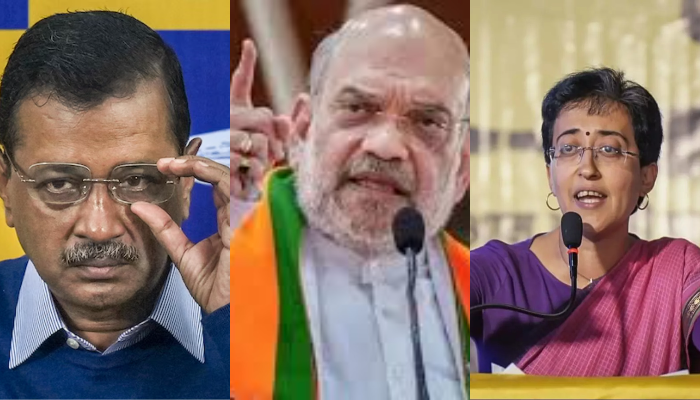
The AAP even partnered with other political parties, like Congress and the Rashtriya Janata Dal (RJD) which it has earlier repeatedly accused of corruption and looting the country. Furthermore, the party has also perfected the Nazi propaganda efforts helmed by Joseph Goebbels by blaming others for what it has been doing. Now, the latest edition is over the settlement of illegal Rohingya immigrants in the national capital. The Delhi Chief Minister Atishi Marlena expressed her alleged concerns over the matter in a written letter to Union Home Minister Amit Shah on 15th December.

She referred to a social media post from 2022 in which Union Minister Hardeep Singh Puri declared that Rohingya intruders would be relocated to EWS (Economically Weaker Section) apartments in the Bakkarwala neighborhood of the city. “From the tweet of Shri Hardeep Puri, it seems they were settled into EWS flats of Bakkarwala. These flats were meant for the poor people of Delhi. It appears that the rights and facilities meant for the people of Delhi are being given away to migrants. People of Delhi will not tolerate this,” she claimed.

Notably, shortly after the tweet caused a significant controversy, the Modi administration confirmed that no such apartments will be provided to Rohingyas. Her letter came after Amit Shah was slammed by former chief minister and national convenor of her party, Arvind Kejriwal who is currently on bail in an excise policy corruption case and was forced to resign after the Supreme Court barred him from going to the Chief Minister’s Office.

Amit Shah had asserted that state governments were in charge of protecting India’s 4% unfenced borders during an interview. He added that their job was to raise awareness among the local populace and stop infiltration from turning into a community crime. Afterward, Arvind Kejriwal retaliated that the center had abandoned its constitutional duty to protect the border.

A long-running dispute over the Rohingya immigrants’ presence in Delhi has been reignited by the recent developments. The AAP has frequently claimed that the Bharatiya Janata Party ignored the demands of Delhi’s citizens by bringing Rohingyas in the city. On the other hand, the saffron party has charged that the former is using the Rohingyas as a vote bank to facilitate illegal settlements in order to obtain an electoral edge. Notably, the political activity is heating up as Delhi assembly elections are around the corner.

Truth behind AAP’s allegations

AAP is openly exploiting the Rohingya issue as a political instrument to gain an advantage in the electoral contest as both political parties prepare for the polls. The past statements of the AAP’s leaders and the policies implemented by its administration to support the inflators and even rave about it effectively refute the anti-Rohingya front that the party has recently forged for the camera to deceive the voters.

“I am Amanatullah Khan Okhla MLA and chariman of Delhi Waqf Board. We have distributed one month ration and Rs 10,000 to each Rohingya family living here,” an old video of the AAP stalwart has been making the rounds on social media in a stark demonstration of how his party embraced the intruders. Interestingly, Khan is also charged with financial irregularities and alleged illegal recruitment of staff within the Delhi Waqf Board. He was also described as a history-sheeter in 2022.

According to a 2020 report, more than 300 Rohingya Muslims had unlawfully settled in Delhi’s Madanpur Khadar neighborhood and are growing their base. It disclosed that they were unlawfully residing in the Madanpur Khadar area of the national capital, directly across from the cremation site. Additionally, they had established themselves on 5.2 acres of property owned by the Uttar Pradesh government’s irrigation department.

The illegal Rohingyas and Bangladeshis had seized the Khasra number 612 land, which is worth crores of rupees. They were also receiving all government benefits, per the article. The Delhi government and Amanatullah Khan had been distributing rations to them during the lockdown. Madanpur Khadar is a part of Khan’s Okhla constituency.

More importantly, the impoverished in New Delhi’s Sarita Vihar area were forced to fend for themselves during the coronavirus lockdown in the same year after being turned away for failing to vote for AAP MLA Amanatullah Khan. “We said we come from Khadar. So they said that they will not give us ration as we do not vote for them. I said, even all Muslims don’t vote for you, but you are still giving them ration. I told him that someday you give them daal, rice, potatoes, give some to us also but then he drove us away,” a woman complained.

AAP supporters acknowledged that the Arvind Kejriwal government in Delhi has worked very hard to uplift Muslims in Delhi, including “sharanarthi” (refugees or rather, illegal infiltrators), in a 2022 video that went viral from an Ahmedabad gathering organized by the “Muslim Fighters Club,” a community of Muslims based in Juhapura. The club’s manager, Imranbhai, declared that Arvind Kejriwal is the only one who truly cares about Muslims and that the community has always been the target of bigotry.

“I have spoken to our Muslim brothers in Delhi and they have said their situation has improved. Arvind Kejriwal takes care of Muslims from every part of the world. He even takes care of Muslim refugees,” he boasted. However, he invited the Muslims in the crowd to make reasonable assumptions rather than directly naming the “refugees.”

School for Rohingya children, appeals to settle them and contempt for Hindu refugees

The intention to construct a Rohingya residential school on the grounds of the Secondary School in Nanakheri village in 2022 spurred a protest by the villagers against Delhi Chief Minister Arvind Kejriwal. The villagers had started an agitation after Delhi Deputy Chief Minister Manish Sisodia and Chief Minister Arvind Kejriwal established a school for the children of Rohingya Muslims.

They voiced reservations that if the Rohingyas moved in, there could be an increase in criminal activity in the vicinity and mentioned that even though the demonstrations have been ongoing for over a week, the Delhi government has not altered its decision. “We have been sitting here for the last eight days, but till now her MLA Gulab Singh has not even visited to inquire about our demands and our condition,” an angry local had highlighted. “Rohingyas are a threat to our country and Arvind Kejriwal is keeping national security at bay with this move. Rohingyas must leave India,” BJP leader Gaurav Bhatia had responded to the issue.

According to the BJP in 2022, the Kejriwal administration’s officials wrote numerous letters asking for the “infiltrators” to be given EWS apartments. Delhi BJP president Adesh Gupta pointed out that AAP’s Delhi administration guaranteed Rohingyas ample food, housing and all other amenities, but it has not even given a basic electricity connection to Pakistani Hindu refugees living in a camp there.

“There were numerous communications from the home department of Delhi government and its district magistrate (south east) to FRRO, NDMC and the DCP concerned for providing EWS flats to Rohingyas. Kejriwal government has a duty to identify illegal infiltrators living in the city instead it is busy protecting them. Chief Minister Kejriwal is concerned about infiltrators not refugees” he had charged.

“The audacity of these Pakistanis? First, they infiltrated our country illegally and broke the laws of our country. He should have been in jail. Have they got so much courage that they are protesting and creating ruckus in our country? After CAA (Citizenship Amendment Act), Pakistanis and Bangladeshis will spread across the country and harass people. In the selfish interest of making them their vote bank, BJP is pushing the entire country into trouble,” Arvind Kejriwal had posted on social media in March of this year after Hindu and Sikh refugees demonstrated against his blatant fear mongering and petty politics over the sensitive issue of CAA.

Visibly ignoring the plight of the Hindu communities in the neighboring Islamic countries he questioned why the Indian government planned to announce regulations so close to the 2024 Lok Sabha Elections, in a 7-minute video. He alleged that the BJP would have presented its accomplishments rather than announcing the CAA guidelines if it had done more work over the previous ten years. He added that the center was talking about CAA rather than addressing issues like unemployment and skyrocketing costs.

Arvind Kejriwal argued that the BJP-led administration intended to admit a large number of “minorities” from the three nations and provide them with citizenship, jobs, housing and other benefits. He then charged that immigrants would receive services that are legally the property of the Indian people. He also regularly labeled the persecuted minorities from nearby Islamic countries, particularly the oppressed Hindus, as “ghuspathiyas” (illegal immigrants) throughout his address.

Why Rohingya Muslims are a national threat

The liberal, commie, Islamist brigade in India holds the Rohingyas in high regard as innocent and helpless, but they are in reality another gang of veiled jihadis who would kill any non-Muslim who stood in their way if given the chance. The 2017 killing of innocent Hindus in Myanmar is the perfect real-world illustration of the spiteful temperament of the community. According to a 2018 Amnesty International report, in August 2017, the Arakan Rohingya Salvation Army (ARSA), the terrorist wing of Rohingyas, massacred up to 99 Hindu women, men and children in addition to carrying out other illegal killings and kidnappings of Hindu villagers.

The group disclosed how Arakan Rohingya Salvation Army (ARSA) fighters incited fear among Hindus and other ethnic communities with these heinous attacks, based on dozens of interviews conducted there and across the border in Bangladesh, as well as photographic evidence examined by forensic pathologists. Moreover, Rohingyas are associated with international terrorist groups. Osama Bin Laden, the founder of Al Qaeda, had also mentioned Burma, which had a sizable jihadi militia, in an interview with the Karachi-based journal Ummat.

Therefore, it is not shocking that Kashmiri terrorists support the Rohingyas. In a 10-minute audio message posted on the YouTube channel Ansar Ghazwa, late Zakir Musa, the self-described leader of Ansar Ghazwat-Ul-Hind, an Al Qaeda offshoot, cautioned the government against expelling the Rohingya Muslims from Jammu. Later, he was expelled from the world by Indian security forces in 2019.

Moreover, Rohingyas are associated with international terrorist groups. Osama Bin Laden, the founder of Al Qaeda, had also mentioned Burma, which had a sizable jihadi militia, in an interview with the Karachi-based journal Ummat. Therefore, it is not shocking that Kashmiri terrorists support the Rohingyas. In a 10-minute audio message posted on the YouTube channel Ansar Ghazwa, Zakir Musa, the self-described leader of Ansar Ghazwat-Ul-Hind, an Al Qaeda offshoot, cautioned the government against expelling the Rohingya Muslims from Jammu. Later, he was expelled from the world by Indian security forces in 2019.

It should be noted that Rohingyas are also associated with the Bangladesh Islami Chhatrashibir (ICS), a terrorist branch of the Bangladesh Jamaat-e-Islami with headquarters in the country. They are in charge of organizing violent protests and attacking security personnel, secular political opponents and secular people.

Conclusion

The AAP’s policies to aid the Rohingyas make it obvious that they have no regard for the security of the country or the rightful share of the Indian population. The current outage is merely a smokescreen to mislead unsuspecting citizens and improve the party’s reputation ahead of the upcoming election. As mentioned earlier, AAP is obviously following in the footsteps of the Nazi propaganda minister by accusing the BJP of the actions taken by their own party to unfairly favor the Rohingya community in spite of regular concerns and protests.

Likewise, their open hate for any attempt to protect the lives of innocent Hindus in Bangladesh, Afghanistan and Pakistan who are massacring their minorities, as well as their evident sympathy for Rohingyas, also speaks volumes about the party’s ideology and its vote bank politics.

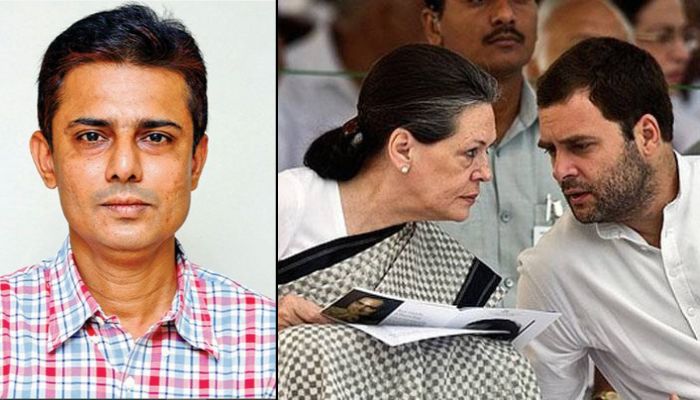
OpIndia speaks to Rizwan Kadri, historian who wants Sonia Gandhi to return Nehru’s letters with Edwina Mountbatten to PM Museum

Rizwan Kadri has made headlines for seeking the release of private letters of Jawaharlal Nehru with Edwina Mountbatten.

OpIndia reported how 51 cartons containing correspondence of the former Prime Minister with different individuals were removed from the Nehru Memorial Museum and Library (now known as Prime Minister’s Museum & Library) in 2008.

It was done at the behest of Sonia Gandhi. OpIndia spoke to Rizwan Kadri about the recent development and his letters to the Gandhi family.

Question: Why do you want the release of the Nehru papers?

Rizwan Kadri: When I became a member of the Prime Minister’s Museum & Library (PMML) in 2019, I wanted to read those letters. I kept on talking about it since then.

The public now has access to a lot of information but not the Nehru papers. This is especially true for the letters exchanged between Jawaharlal Nehru with JP Narayan and Edwina Mountbatten.

We had taken this issue up for discussion during the Annual General Meeting (AGM) in February this year. All members have demanded that the collection of private papers be returned to PMML.

In the minutes of the meeting, it was mentioned that the entire collection of Nehru papers was removed in 2008 at the behest of Sonia Gandhi. It was taken away in 51 cartons.

The huge collection encompasses hidden facets of Indian history, which we have yet to explore. I had requested Sonia Gandhi in September to return the Nehru papers to PMML or allow us access either in digital or physical form.

Our objective is to study and encourage research on this subject.

Question: How and why did you reach out to the Gandhi family?

Rizwan Kadri: I sent a letter to Sonia Gandhi via speed post in September this year. An email was also sent. When I did not get any response, I sent a letter and email to Rahul Gandhi as well.

I told him that it is also his responsibility as Leader of the Opposition to ensure cultural preservation and future research by making the collection of Nehru papers available.

The history contained in those letters must come to the public domain. Right now, there is some element of speculation about what exactly is contained in those letters.

There must be some underlying reason for withdrawing the private collection of letters.

Question: Did historians ever access Nehru papers since Independence?

Rizwan Kadri: If we had to look at the Nehru collection earlier, then, we needed the permission of Smt Sonia Gandhi. And it was still not being shown to us for years.

A few years ago, about 21 collections were de-classified and made open to the public. It baffles me how access to historical materials can be closed or denied.

The more accessible you make resources for researchers, the higher the authenticity of the historical material which is read by the public.

Question: What message do you want to send to the Gandhi scions through our platform?

The Nehru papers constitute source material for researchers. We do not mind if the Gandhi family wants to retain the original copies of the letters. But, researchers must have digital access to them.

It is difficult for researchers from all over the country to come to Delhi, stay here and continue with their research. So for the sake of India’s history, we must provide access to the large collection of Nehru papers.

The Prime Minister’s Museum & Library is also exploring legal options.

Rizwan Kadri is an Ahmedabad-based historian. He is known for his exemplary work on Sardar Vallabhbhai Patel, Mahatma Gandhi and Lokmanya Tilak. He currently works as an Associate Professor at the Shree Swaminarayan Arts College in Ahmedabad and serves as a member of the Prime Minister’s Museum & Library.

Uttar Pradesh: Kasganj police arrest 2 suspects in advocate Mohini Tomar murder case; contract for the killing was given by Mustafa Kamil

0

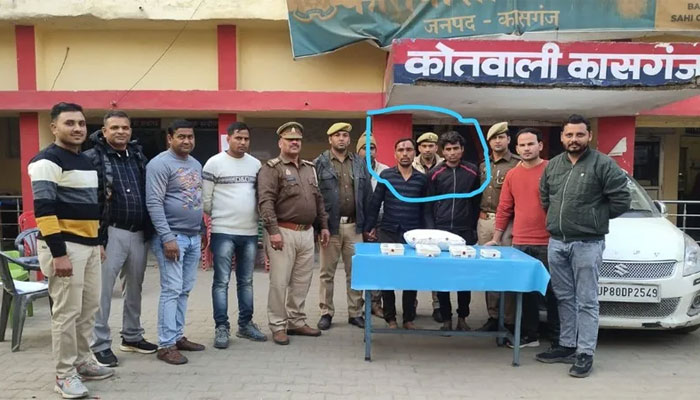
On 15th December, Kasganj police arrested two suspects in connection with the advocate Mohini Tomar murder case. The suspects have been identified as Sunil Fauji and Rajat Solanki. They were apprehended by the police near the Hazara canal, the same spot where Mohini’s body was found.

Notably, Mohini was murdered on 3rd September 2024. Her body was recovered from the Hazara canal. Following the murder, an FIR was lodged based on her husband’s complaint against Mustafa Kamil, Asad Mustafa, Haider Mustafa, Salman, Munazir Rafi, and Keshav Mishra.

Both Sunil and Rajat have reportedly confessed to accepting a ₹30 lakh contract to kill Mohini. The contract was allegedly given by advocate Mustafa Kamil and his sons. Both Sunil and Rajat had bounties of ₹1 lakh each for their arrests. Police recovered a car used in the murder, a country-made pistol, another firearm, Mohini’s mobile phone, and a stamp bearing Mohini’s name from their possession.

During interrogation, they admitted to being involved in the murder. They told the police that on 3rd September, they traveled to Kasganj Court in a car. They posed as clients wanting to arrange a marriage and lured Mohini into their car. Later, they strangled her to death and dumped her body in the canal. Earlier, two other conspirators, Bobby and Renu, were also arrested by the police for their alleged role in the crime.

Speaking to the media, Kasganj Additional Superintendent of Police (ASP) Rajesh Bharti said that Sunil Fauji confessed to receiving ₹30 lakh from advocate Mustafa Kamil and his sons Haider and Asad Mustafa, along with Salman, Munazir Rafi, and Keshav Mishra, to kill Mohini. Sunil recruited Rajat, Bobby, and Renu to execute the plan to murder Mohini. They called Mohini out of the court under the pretext of seeking help for a court marriage. Renu and Bobby posed as the couple to make it more believable.

Notably, on 30th July 2024, Haider and Salman Mustafa brutally assaulted a man named Shivshankar in the Kasganj court premises and even tore off his shikha. As Mustafa Kamil was an influential person in the court premises, no lawyer was willing to take Shivshankar’s case. Mohini Tomar, however, stepped forward and represented him. Her efforts caused a delay in Kamil’s sons getting bail from the court, which angered him.

They reportedly threatened Mohini Tomar with dire consequences for opposing the bail plea of Kamil’s sons. She had previously expressed her fear to her husband that she could face physical harm. Ultimately, Kamil hired contract killers to murder Mohini. Further legal proceedings in the case are underway.

How to mix irony with stupidity? Carry a ‘Palestine’ bag to show off fake activism, then cry ‘patriarchy’ when called out

Priyanka Gandhi Vadra has declared that she stands strongly against patriarchy and she won’t let anyone tell her what kind of bag she should carry (or not carry). The statement here can sound bizarre to somebody uninitiated on the whole issue. Why would someone even notice Priyanka’s handbag if she wasn’t the one flaunting it in the first place?

The newly elected MP from Wayanad made a huge blunder in the first Lok Sabha speech last week. She started ranting against the state government in Himachal Pradesh, where her own party is in power. She got trolled and criticised for it, not because she is a woman and criticising a woman MP is ‘patriarchy’, she got criticised because she made a stupid blunder, in her first Lok Sabha address.

Today on December 16, Priyanka thought to make headlines again. So she carried a huge handbag with ‘PALESTINE’ written on it in bold capital letters. Nobody knows what was she trying to prove by that. Celebrities flaunt their clothes and accessories with a specific brand name when they are paid for it, or entrepreneurial celebrities like Virat Kohli, Anushka Sharma and Deepika Padukone flaunt their own brands because they want people to buy them. Priyanka’s activism would have seemed a similar fashion endorsement if it wasn’t for the hollow entitlement that is more visible than the big bag here.

Priyanka even stopped and posed for photographs with that bag, beaming and grinning.

Regarding Priyanka’s choice of handbag though, the message she is trying to send is rather confusing.

The irony in ‘flaunting’ a Palestine bag is multi-layered. First, there are Palestinian civilians being used as human shields by Hamas in Gaza. Priyanka’s version of ‘supporting’ the Palestinian cause is to highlight Israel’s war against Hamas and call to stop it. She has been peddling Hamas talking points for months. Priyanka hasn’t yet questioned Hamas why it isn’t allowing Palestinian civilians to flee, why were they running terrorist shelters, and weapons silos under civilian structures.

Second, the war in Gaza started because Hamas terrorists attacked women, children and the elderly in Israel. The October 7 attack was targeted at women, children, families and the elderly living quiet lives, enjoying family time in their homes. Hamas misused the employment and earning opportunities provided by Israel to Palestinian civilians to earn a decent livelihood by working in their territory by launching the attack and taking hundreds of civilians hostage, after killing hundreds of women and children brutally.

Priyanka’s feminism and activism are perhaps only for one specific group of victims, depending on their religion.

There are people starving in Gaza, and children living in fear. There are bombs being dropped relentlessly for over a year and much of it has been turned into rubble. Here, a privileged fourth-generation ultra-rich political heir of one of the most powerful families in India is flaunting her alleged sympathy for those people, by carrying a colourful bag and smiling at the cameras. How very touching.

When asked by a journalist what she has to say to the people criticising her flashy, vibrant, (and possibly very expensive) handbag, Priyanka instantly played the patriarchy card. She said it is a patriarchal mindset to dictate what a woman should and should not wear and she doesn’t subscribe to such mindset. Bravo queen. What a statement. The starving women and children, huddled under a bunker in Gaza must feel elated that their champion has successfully carried a Palestine bag to her office and flaunted it before cameras.

In reality, Priyanka’s feminism here is as hollow as her fake activism for Palestine. She has done what every dumb Insta influencer does these days. Just as clueless millennials feel good about themselves by trending hashtags, the Wayanad MP is trying to do what woke teenagers are doing in US colleges nowadays, become stupid instruments for stupid activism, play victim and hog headlines, without ever doing anything meaningful. Even then, those teenagers are at least taking some risk, Priyanka is easily one of the most privileged, most protected women in India. Nobody is going to expel her from a college campus, and no recruiter is going to say she cannot be hired. She is only mocking the voters in Wayanad who would have thought their MP was going to address their issues.