Home Blog Page 682

Decks cleared for Xi-Modi meet at the BRICS Summit? China confirms agreement with India on LAC patrol, says ‘will work to implement solution’

0

Decks appear to be cleared for a potential meeting between the leaders of China and India, as Beijing confirmed on Tuesday that they have reached an agreement with India to resolve the Ladakh border standoff and have agreed on border patrols in the region.

The confirmation came from the Chinese foreign ministry spokesperson Lin Jian, almost 24 hours after foreign secretary Vikram Misri stated that the two sides had reached an agreement on patrolling arrangements along the disputed border, a key milestone to end the yearslong border conflict between the two nations.

“China and India have maintained close communication through diplomatic and military channels regarding border-related issues. Currently, the two sides have reached a solution on the relevant matters, which China views positively,” the Chinese foreign ministry spokesperson was quoted as saying by the Chinese state media.

Lin further added that in the next phase, China will closely work with India to implement the solution.

The Chinese confirmation is widely viewed as a key development ahead of the expected meeting between PM Modi and Chinese Premier Xi Jinping during the sidelines of the ongoing BRICS Summit underway at Kazan, Russia.

PM Modi embarked on a two-day visit to Kazan, Russia today (October 22, 2024), to attend the 16th BRICS (Brazil-Russia-India-China-South Africa) summit. Hosted by Russia, the summit is viewed as an effort by non-Western powers to showcase their influence amid the ongoing Ukraine conflict.

This is the first BRICS summit following the group’s expansion at last year’s meeting in Johannesburg, which saw the inclusion of Egypt, Ethiopia, Iran, and the United Arab Emirates as new members.

However, the agreement between Beijing and New Delhi adds a new dimension to the Summit that is likely to expand the membership to new members, including Egypt, Ethiopia, Iran, Saudi Arabia, and the United Arab Emirates (UAE). Even as growth is slowing, Beijing is actively courting countries across the world to challenge Western hegemony.

The de-escalation of tensions with India and the resulting agreement indicates that Beijing has approached the situation with a fresh mindset and is now willing to reduce its traditional stubbornness in pursuit of its geopolitical ambitions.

From India’s perspective, the breakthrough with China is crucial in the sense that it offers New Delhi a larger wriggle room to negotiate with its Western partners, most notably with the United States, in the wake of an escalating diplomatic fallout with Canada over the killing of Khalistani terrorist Hardeep Singh Nijjar, which the Canadian intel agencies attributed to Indian diplomats, Lawrence Bishnoi gang, all the way up to the Home Minister Amit Shah.

India, on the other hand, had expelled Canadian diplomats and warned of repercussions for levelling baseless allegations against the country without providing a shred of proof that implicates its role in the Nijjar killing.

In this context, the prospect of a likely meeting between PM Modi and Xi Jinping is all set to make the Western nations anxious as they try to corner China over a host of issues, including possible military action against Taiwan, technology theft, and transnational repression, among other things.

India-China disengagement in LAC announced just before PM Modi arrives for BRICS Summit: A message to USA and Canada?

There is a major geopolitical chess match going on wherein India, Russia, China and the US and Canada are making their moves with one sole aim—self-interest. On the 21st of October, Indian External Affairs Minister Dr. S. Jaishankar said that India and China’s disengagement process along the Line of Actual Control (LAC) has now been completed. Minister Jaishankar said that the situation along the Line of Actual Control (LAC) has returned to what it was before May 2020, when tensions arose between the two neighbours in Galwan Valley, which resulted in casualties on both sides.

This massive development came ahead of the BRICS summit hinting at the strategic undertones that transcend the scope of mere resolution of bilateral disputes. It appears that India is sending out a message to the United States, Canada, and other Western powers that India and the BRICS nations are capable of resolving their disputes on their own without the interference of Western nations, particularly the Five Eyes and that India will not compromise its strategic autonomy to preserve ties with the West.

PM Modi to meet President Putin and President Jinping at BRICS summit: Global South challenging the status quo in the West-led global order?

While BRICS leaders like Russian President Vladimir Putin and Indian Prime Minister Narendra Modi have maintained that BRICS is not an anti-West grouping or a geopolitical ‘rival’ of the West, its non-West influence remains a concern for the US, the only remaining major superpower. Prime Minister Modi is on a two-day visit to Russia’s Kazan city to attend the 16th BRICS Summit.  He is anticipated to hold a bilateral meeting with President Putin and discuss various issues including the Ukraine-Russia war, and about the future course of action to strengthen cooperation between Russia and India. Moreover, reports say that PM Modi is also likely to meet Chinese President Xi Jinping in the wake of the disengagement agreement.

In a statement before embarking on his Russia visit, PM Modi said: “I am departing today on a two-day visit to Kazan at the invitation of Vladimir Putin, President of the Russian Federation, to attend the 16th BRICS Summit. India values the close cooperation within BRICS which has emerged as an important platform for dialogue and discussion on issues concerning the global developmental agenda, reformed multilateralism, climate change, economic cooperation, building resilient supply chains, and promoting cultural and people-to-people connections, among others.”

With countries like India and China resolving their disputes without leaving any scope for the West to interfere and India asserting its strategic autonomy to bolster ties with West’s bête noire Russia, the US will certainly closely monitor the BRICS Summit even as it may claim not to see the grouping as “geopolitical rivals”.

India, China, and Russia are major actors in BRICS, a group that is rapidly positioning itself as an alternative to Western-dominated institutions such as the G7. By disengaging at the border and coordinating high-level meetings, India and China appear to emphasise the necessity of preserving functional ties notwithstanding their disagreements. The move might send a signal to the United States that the BRICS countries can resolve issues without the need for Western intermediaries, demonstrating the strength of non-Western partnerships.

Harbouring Khalistani terrorists at home, Canada slandered India, after killing terrorists like Osama Bin Laden on foreign soil, US cries hoarse over alleged Indian attempt to kill Pannun: The epitome of hypocrisy

The BRICS summit comes at a time when the diplomatic ties between India and Canada have hit rock bottom owing to Canadian Prime Minister Justin Trudeau’s unfounded and preposterous allegations against the Indian diplomats. Trudeau’s government launched a fresh wave of attacks on the Indian government and diplomats accusing them of involvement in criminal activities against Khalistani terrorists in Canada without a shred of evidence. Right after destroying ties with India, Trudeau admitted that Canada had no evidence before accusing the Indian government of involvement in the killing of Khalistani extremist Hardeep Singh Nijjar. In an interview, Trudeau said that they had no proof to pinpoint the killing of Nijjar to India when they had first accused New Delhi of orchestrating the assassination on Canadian soil.

This was the second time that Canada accused the Modi government and Indian diplomats of involvement in the Khalistani terrorist’s killing, of course, without any evidence. Back in September 2023, PM Trudeau had launched his first attack against India accusing the Modi government of involvement in Nijjar’s killing. A year has passed, however, the Trudeau government could not furnish any evidence to back its claim. All it has done is make baseless allegations, demanding proof from the Indian government after accusing the same of foul play and lecturing India on the ‘rule of law’.

Canada under Justin Trudeau has turned into a safe haven for Khalistani terrorists who directly challenge the territorial integrity of India and want to separate Punjab from India. Not a day goes by when Khalistani separatists do not raise anti-India protests, burn Indian flags, and slander the Indian Prime Minister and Indian diplomats with impunity since the Canadian Prime Minister shields the anti-India elements in the garb of protecting their freedom of expression and right to protest while actual interest in defending Khalistani terrorists is garnering their votes.

Similarly, despite being a crucial ally,  the US takes delight in behaving like the ‘Big boss’ and sermonising India over religious freedom, press freedom, right protest and whatnot while crushing all of it at home as seen in the case of University students doing ant-Israel encampment protests in the US.

Be it issuing biased reports on India and the country’s internal matters based on dubious sources, or providing safe haven to anti-India and anti-Hindu terrorists like Gurpatwant Singh Pannun as well as pro-Khalistan outfits, the US has outdone itself in being a top-order hypocrite. Moreover, the US has been attempting to interfere in Indian democracy.

As OpIndia reported earlier, US diplomats met National Conference leaders in Jammu and Kashmir ahead of the scheduled Assembly Elections, they also reportedly met farmer leaders and leaders of the opposition parties. The US has also been taking measures to influence public opinion in India and promoting the anti-government ‘influencers’ under the garb of making Indians ‘aware’ and ‘active’ citizens. Other than this, US lawmakers had also raised their ‘concerns’ during the 2019 ant-CAA protests and even called the humanitarian law ‘discriminatory’. Also, when the Modi government abrogated Article 370 in Jammu and Kashmir in 2019, the US House of Representatives held a hearing on human rights in Kashmir.

Alongside interfering in India’s internal matters,  the US has also been threatening India.  The US Ambassador to India, Eric Garcetti launched a veiled attack on Prime Minister Narendra Modi and went so far as to threaten ties with Western powers over his Russia visit. Even when India signed the historic Chabahar Port deal with Iran,  the US issued a ‘sanctions’ threat to India. Probably, the US expects other countries to seek its ‘permission’ before taking steps to serve their own national interests and pursue partnerships with respective neighbours.

Amidst the India-Canada row over Nijjar’s killing, the United States recently claimed that a certain Indian national was allegedly involved in conspiring to assassinate a person designated as a terrorist by the Indian security agencies. The same US however, had no qualms in carrying out arbitrary bombings in Pakistan, Afghanistan, and the Middle East, including the operation authorised by the then PM Barack Obama, to take down Al Qaeda terrorist Osama Bin Laden, who was hiding in a safe house in Abbottabad, Pakistan. The US operations destroyed nations like Iraq but no one opposed the US, the same Canada granting a safe haven to Khalistani terrorists had backed the US when Laden was hunted down in Pakistan. While Canada offers its land and resources to the Khalistani terrorist to carry out their anti-India activities and the US delays the extradition of Mumbai 26/11 attacks conspirators like Tahawwur Rana and David Headley, the two countries expect India to silently accept this and cry hoarse when it allegedly goes the US way to eliminate terrorists on foreign land.

It is amusing that the US backs Israel in its war against the Islamic terror group Hamas, its invasion of Palestine and Lebanon to eliminate Hamas and Hezbollah terrorists like Yahya Sinwar, Ismail Haniyeh and Nasrallah among others. However, it has strong objections with India allegedly attempting to eliminate its designated terrorists on foreign soil. Why do the US and Canada support Israel in its war against terrorists but not India in the same way? Is it because, unlike Israel, India shares good ties with Russia?

Notably, the very fact that India under the Modi government has maintained its policy of strategic autonomy, where it refuses to be a part of any bloc that compromises or challenges its independent decision-making and refuses to be anyone’s puppet has rattled the Western powers. Despite the differences, the US and India share strong ties, however, India solving disputes with China and increasing cooperation with Russia, especially in the oil and defence sector, the US would not be very pleased with India’s balancing act between multiple global powers in pursuit of its national interests. India’s efforts to maintain balanced relations with US adversaries like Russia, China or Iran as well as the West send a subtle message to the US and the Five Eyes that India remains a sovereign player in global relations and it is capable of sustaining diverse alliances instead of aligning fully with one side or surrender its autonomy.

While the US has backed Canada in its attacks on India over the Khalistani terrorist’s killing in an apparent attempt to build up pressure on India, however, with its efforts to solve disputes with China and increase cooperation with non-West allies like the BRICS nations, India has sent out a message to the US and the West that it cannot be diplomatically isolated and any sinister attempt to tarnish the image of India cannot diminish India’s global influence and its position as an emerging major world power. Being a non-West group of nations, the BRICS platform allows India to consolidate its position as a representative of the Global South while also implicitly challenging the West-led narrative in world trade and economic policies especially when the advocacy for de-dollarisation has increased with President Puttin suggesting that the BRICS nations should adopt SWIFT-like cross border payments systems to counter US dollar dominance.

As the Indian External Affairs Minister S Jaishankar highlighted, there has been a shift in the power balance from overtly Western domination to the rise of regional powers around different pockets of the world. And these regional powers are in no mood to let the West dictate terms for their foreign policy or how they pursue their national interests.

Illegal mosque in Shimla: Demolition of three unauthorized floors of Sanjauli mosque in Himachal Pradesh underway

0

On October 5 this year, a Shimla Court had ordered the demolition of top three illegal floors of the Sanjauli Mosque. The Municipal Commissioner Court in Shimla ordered the demolition of illegally built three floors of the Sanjauli Mosque. The Court gave two months to the Masjid committee and Waqf Board to complete the demolition process.

Now, within a month, the demolition process has started. The demolition process started on Monday, October 21, after getting a nod from Waqf Board. The Court had ordered that mosque committee and Waqf Board will bear the cost of the demolition of the illegal portion.

Notably, Hindus took to the streets, launched massive demonstrations and observed shutdowns against this illegal construction of a moque and demanded its demolition.

Afterwards, the Sanjauli mosque committee approached the Municipal Corporation office and asked them to remove the illegal portion of the building which they claimed was constructed by outsiders who came there. The Muslims assured that they had no objection to the action and alleged that they wanted to do this in the name of brotherhood and harmony.

On 5th October, the Municipal Corporation approved the submission and decided to take action. Shimla’s Municipal Corporation Commissioner also issued directives in this regard and approved the mosque’s three storeys to be dismantled. 

Notably, this mosque was built before 1947, at that time it was a two-storey building. After this, 3 more illegal floors were built. Hindus protested against the construction of these illegal floors.

In 2010, residents of Sanjauli had moved a complaint against the illegal construction of further floors in the mosque. Finally after 14 years, their appeal reached fruition and the illegally constructed floors are getting demolished.

‘If you campaign in Rolls-Royces, you can afford the clean up’: Delhi HC slams DUSU candidates for defacing university campus

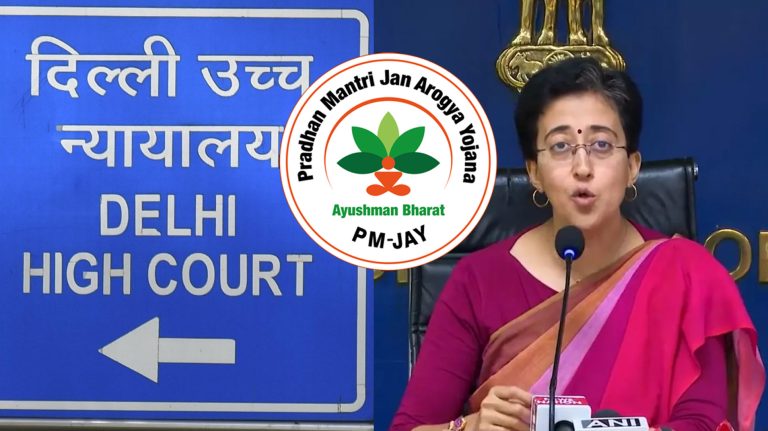
On 21st October, the Delhi High Court asked the vice-chancellor of Delhi University to be “proactive” and issued notices to several student candidates for damaging public property during the student union elections on 27th September. The high court summoned 15 candidates to appear before it on 28th October, explain their conduct, and declare the parties to the case. The bench led by Chief Justice Manmohan also comprising Justice Tushar Rao Gedela instructed Delhi University to notify the implicated candidates regarding the matter. “Those candidates who have majorly defaced the public property have to be brought here,” the court directed.

A Public Interest Litigation (PIL) was filed to take action against the student organizations and potential DUSU candidates who were responsible for destroying, defacing, damaging, and contaminating public walls. The court decided that Delhi University Students Union  (DUSU) election results would not be declared until the cleanup had concluded, emphasizing how crucial it is to address the defacement issues before moving forward with vote counting which was originally scheduled for 28th September.

The court noted that the posters, banners, and graffiti had not been taken down and refused to lift the stay on vote counting until the vandalism was rectified. The court sought the university’s stand on MCD’s (Municipal Corporation of Delhi) assertion that it hired private contractors to clean up this vandalism, costing Rs 1 crore. The MCD’s attorney asked DU for a deposit of the same amount to cover the cleaning expenses for 12 zones.

The court ruled that candidates could “also spend money to clean up public premises” while they were running for office if they could afford Rolls-Royces and other high-end vehicles and tractors. The hearing was posted for 28th October and the court instructed police, MCD, and DU to provide new status reports.

“There are cars without number plates in the DU area, (people) campaign in Rolls-Royce and other luxury cars, but the police and the university are doing nothing. Do you even have a vice-chancellor? We are saying it mildly that he needs to be proactive, or else we will pass orders. It is very surprising. You have to do something. These candidates study in your colleges, and you have full power,” the bench pronounced.

The Delhi Police and the university were questioned by the court for failing to take appropriate action against the perpetrators of hooliganism and defacement. The court ordered that Delhi University’s attorney inform the vice-chancellor that an administrative error had caused this uncomfortable circumstance and that he should take corrective action. The court observed that, in contrast to the university and college elections, such situations were not even seen during the municipal elections. It warned, “How can you permit students to do hooliganism on highways? You put it to the vice-chancellor or else we will pass some speaking orders.”

The court rejected DU’s argument that 90% of its campuses, colleges, and institutes were free of defacement. Pushkar Sood, a standing counsel for DMRC (Delhi Metro Rail Corporation), and Sanjeev Sabharwal, a standing counsel for MCD, both contested this, as did the petitioner, Advocate Prashant Manchanda. According to DU’s status report, it has “issued a notice/advisory to the prospective/contesting candidates to advise them to remove the defacement made to public and private properties.”

Meanwhile, Manchanda brought the magnitude of the defacement to the attention of the bench in a memo. It read, “Campaign materials, including posters and graffiti, were plastered across entire city roads/walls, college campus, protected green spaces, and even reached the offices of the director general of Home Guard, office of assistant commissioner of police, police stations as well as the walls in front of embassies of the Republic of Iraq and Chad.” After seeing the note, photos, and videos that also showed candidates blocking national highways, the Chief Justice questioned, “What is Delhi Police doing? There are all these unnumbered cars plying. Take some action.”

The court slammed, “How can you permit students to do hooliganism on highways? It is not a very happy situation. It is an administrative failure by DU that led to such an unpleasant situation. Remedial steps should be taken.” It further pointed out that police should take action against these vehicles on the road and described it as a severe problem. The court added, “That expenditure can go into drains. We don’t intend to stop the counting. You clean the place and the next day, counting will be allowed. These candidates have to spend money to clean the defaced university area. When they can afford big luxury cars for campaigning, they can surely bring a tractor and JCB for cleaning it up also.”

26 candidates “shall have to bear the liability to compensate the loss to the civic authorities/government department and DMRC according to the Lyngdoh Committee recommendations,” according to a 30th September notice from the office of the chief election officer for the DUSU elections.

A subcommittee has been formed by Delhi University, and the court is urging them to take responsibility. The court made it clear that it is not lifting the stay on vote counting until the defacement is fully addressed and is requiring candidates to begin cleanup efforts. The bench earlier stated that elections should celebrate democracy, not serve as a vehicle for “money laundering.” The Chief Justice highlighted the pressing civic issues in the city, including rising cases of dengue and malaria, attributing them to persistent littering.

Delhi High Court observations came following applications from two candidates contesting college elections at different Delhi University colleges, who sought a declaration of election results. The candidates assured the court that they would mobilize students to clean and repaint their college premises in collaboration with the university. The application is part of a larger pending petition aimed at holding DUSU candidates and student organizations accountable for damaging and defacing public property. The court had previously suspended the counting process due to concerns over these violations.

(With inputs from ANI)

What happens when Karwa Chauth fast falls during Ramzan, will that fast be healthy or unhealthy: Can Indian Express explain

Indian women, on Sunday, 20th October, celebrated the festival of Karwa Chauth, holding rigorous fasts for their husbands, showcasing love, and worshiping the full moon. The women fast on this day and abstain from food and water praying for the long life, health, and well-being of their husbands.

However, the leftist-liberals continue to attack the Hindu celebrations in one or the other way. While they generally criticize Hindu celebrations like Ganeshotsav, Durga Puja, Diwali, etc for idol worship or for causing alleged pollution, the festival of Karwa Chauth is being targeted for the ritual of fasting.

An article by the Indian Express on 20th October claimed that fasting on Karwa Chauth by women could have drastic impacts on their health leading to hormonal imbalances and other related problems. The Indian Express report also added that women could experience stress, and feel malnutrition and this eventually could result in delayed or missed periods, known as amenorrhea, as well as irregular cycles.

Notably, during Ramzan, Indian Express published an article claiming that fasting could boost insulin sensitivity, better glycemic control, and reduce inflammation.

So, as per Indian Express, fasting for 1 day for Karwa Chauth hurts your health, but fasting for a month during Ramzan boosts your health.

Notably, Ramzan month changes every year, since it is based on Hijri calendar. Very soon, Ramzan will fall during the same month as Karwa Chauth. So now the question to Indian Express is, when that happens, will fasting on that one day hurt health because it is Karwa Chauth, or will it boost health since it is Ramzan?

As an average reader of Indian Express, their reports have left me totally confused, will fasting for Karwa Chauth cause health problems, or will fasting for Ramzan on the same day improve your health? Since those two things will happen on the same day, it is mighty confusing for every human, not just me, maybe Indian Express will guide us.

Does human body know which fast hurts human body and which fast helps human body? As per Indian Express reports, human body apparently does. If you say you are fasting for Karwa Chauth, your body gives up, if you say you are fasting for Ramzan, your body gets a kick.

Indian media outlets are known to attack Hindu festivals, but this kind of blatant dislike of Hindu festivals while promoting Islamic festivals is something new, and kudos to Indian Express for taking the lead.

Maybe Indian Express can explicitly say that they are against Hindu religion’s fasts and promote Muslim religion’s fasts, at least there will be honesty there. Till they don’t issue such statements, we will continue to wonder.

BR Ambedkar and the ‘Idea of India’: Why was he against ‘socialist and secular’ being inserted in the preamble of the Indian Constitution?

Deep discussions and debates about the nation’s identity and future direction were the foundation stones of framing the Constitution of India. The monumental task, which took several years after India’s independence, was marked by some of the most notable key debates. One such debate was over the inclusion of the terms ‘secular’ and ‘socialist’ in the preamble.

On 15 November 1948, Professor KT Shah proposed an amendment to the draft of the Indian Constitution, seeking to label India as a “Secular, Federal, Socialist Union of States.” However, Dr BR Ambedkar, the Chairman of the Drafting Committee, firmly rejected the proposal.

Ambedkar had two objections to the proposal laid down by Shah at the time, which formed the bedrock of the understanding of his vision of India. His vision placed democracy and the will of the people of the country above fixed ideological positions.

Ambedkar’s first objection: The Constitution should not impose an ideology

Ambedkar’s central argument was rooted in his commitment to democracy. He firmly believed that the Constitution was a mechanism to regulate the functioning of the state. Ambedkar categorically pointed out that the Constitution could not be seen as a document that imposes a particular social or economic ideology on future generations of the country.

Responding to Shah’s proposal, Ambedkar said, “What should be the policy of the state, how society should be organised in its social and economic side, are matters which must be decided by the people themselves according to time and circumstances.”

According to Ambedkar, there was a fundamental contradiction in codifying an ideology like socialism within the Constitution of India. He argued that if socialism were added to the preamble, it would restrict the liberty of future generations to choose their own path. He said, “It cannot be laid down in the Constitution itself because that is destroying democracy altogether.”

It was evident that he foresaw that different periods in history might present new challenges and opportunities. He was not willing to bind the future generations of the country to any specified system of social and economic organisation. Socialism was popular at one point in history, and at the time the Constitution was formulated, it was still evolving, making it relevant for Ambedkar to refuse to add it to the Constitution itself. With time, new social and economic systems would emerge and evolve, which could be better than socialism, and Ambedkar understood that.

Ambedkar’s second objection: The Constitution already contained socialist principles

In his second point, while rejecting the proposal, Ambedkar argued that the drafted Constitution already had provisions that could be seen as socialist principles through the Directive Principles of State Policy. He pointed to Article 31 of the draft and emphasised that it outlined measures such as preventing the concentration of wealth and providing equal pay for equal work, which, in fact, are socialist provisions.

Rhetorically, he asked, “If these directive principles… are not socialistic in their direction and in their content, I fail to understand what more socialism can be.” He further argued that socialist ideals were already embedded in the Directive Principles, making it constitutionally possible to guide India towards a more equitable society.

According to Ambedkar, explicitly adding ‘socialist’ to the preamble would be redundant, given that the principles of social and economic justice were already part of the drafted text. Furthermore, he believed that the socialist ideals in the Directive Principles would allow the government to run the country with more flexibility. It would enable the government to adapt to changing economic and social conditions over time. Contrary to this idea, if ‘socialist’ was added to the preamble, it would bind future generations of the country to a more rigid ideological framework, which would create hurdles.

Though he did not present any specific reason(s) against adding the word ‘secular’, Ambedkar opposed the proposed amendment as a whole.

The secularism debate: A nuanced approach

Dr BR Ambedkar was a strong advocate for keeping religion out of politics. Not only him, but the first Prime Minister of India, Pandit Jawaharlal Nehru, also believed the same. However, they both argued that the term ‘secular’ did not need to be explicitly mentioned in the preamble. Ambedkar argued that the Constitution had already made it clear that India would be a state that did not recognise any religion. His ideas were implemented in various articles that dealt with religious freedom and the non-alignment of the state with any particular religion, such as Article 19 and Article 16. These articles prohibit discrimination against any person based on religion.

On the other hand, Nehru believed that secularism in India was different from its Western counterparts. In the West, secularism primarily addressed the historical conflict between the Church and the State of Europe. Contrary to that, according to Nehru, the religious landscape of India was more intertwined with politics, and thus secularism had to be understood as a more flexible and functional concept.

Indira Gandhi’s 42nd Amendment and the insertion of ‘socialist’ and ‘secular’

During the Emergency in 1976, then-Prime Minister of India, Indira Gandhi, eventually introduced the terms ‘socialist’ and ‘secular’ to the preamble of India through the 42nd Amendment. The decision of Gandhi, at the time of Emergency, to make such a drastic change in the preamble has been repeatedly criticised and seen as a politically motivated move aimed at consolidating Gandhi’s power. If we look at the changes made from Ambedkar’s perspective, they are antithetical to the spirit of democracy and liberty that he wanted to protect.

Ambedkar believed that decisions about socialism and secularism should reflect the will of the people. These should not become the ideological preferences of a ruling government. Recently, it was argued to be a reflection of an insecure government rather than a reflection of Indian values. In September 2024, Tamil Nadu Governor RN Ravi noted that secularism is a European concept and not Bharatiya. He added that it came into being to end conflicts between the Church and the King of Europe. Calling ‘secularism’ unnecessary in India, he pointed out that the original framers had not included it in the document. Referring to Indira Gandhi, he called her “one secure prime minister” who got the word ‘secular’ added to the Constitution.

Ambedkar’s long-term vision: Democracy over ideology

Ambedkar’s views and reluctance regarding the inclusion of ‘secular’ and ‘socialist’ in the preamble reflect his commitment to democratic values. He believed that if these ideals were imposed through the Constitution, it would be antithetical to the freedom and agency of the people. He argued that the Constitution should be a flexible document, capable of adapting to the changing needs of society.

According to him, a democratic state should provide its citizens with the freedom to choose their social and economic systems based on the circumstances the country is facing. Secularism and socialism are rigid ideals, which limit the freedom of the people. Ambedkar’s deep commitment to democracy, individual liberty, and the adaptability of the state drove him to oppose these amendments so strongly.

Conclusion

Just because Ambedkar was against adding the terms ‘socialist’ and ‘secular’ to the preamble does not mean he rejected the values themselves. It was more of a defence of democracy and the liberty of future generations to determine the direction of the country. The Constitution should be a living document. As time passes, the Constitution must evolve according to the people’s needs. It should not lock the people of the country into a particular ideology. Ambedkar’s vision of India was one where democracy thrived through flexibility, allowing the people to shape their social, political, and economic systems as they saw fit.

However, the 42nd Amendment did not align with the original version of the framers of the Constitution. Ambedkar’s opposition to adding the terms ‘secular’ and ‘socialist’ to the preamble should serve as a reminder that it is the responsibility of the leaders of the country to safeguard the Constitution and not contaminate it for the sake of their own insecurities.

SC stays NCPCR’s recommendation of halting madrasa funding, no action to be taken against madrassas not adhering to RTE Act: Details

0

On Monday, 21st October, the Supreme Court held back the Union Government and the States from serving on the National Commission for Protection of Child Rights (NCPCR) communications to revoke the recognition of Madrassas that do not comply with the Right to Education Act 2009 and to inspect all Madrassas.

A bench consisting of Chief Justice of India DY Chandrahcud, Justice JB Pardiwala, and Manoj Misra issued the interim decision after hearing a writ case brought by the Jamiat Ulema-l-Hind, an organization of Islamic clerics, challenging the NCPCR’s actions.

NCPCR has been long making efforts to get the Madarsa students into the formal education system. On June 7th, 2024, the NCPCR addressed the Chief Secretary of the State of Uttar Pradesh, requesting that the recognition of Madrassas that do not conform with the RTE Act be withdrawn. Later, on June 25th, 2024, the NCPR appealed to the Secretary, Department of Education & Literacy, Ministry of Education, Government of India, directing all States and UTs to conduct assessments of existent Madrasas per the UDISE code (Unified District Information System for Education).

The acknowledgment and UDISE Code of Madrassas that do not conform with the norms under the RTE Act of 2009 were requested to be removed with immediate effect. The NCPCR further asked the Union not to expand the UDISE system to madrasas. The NCPCR advised that the Union create a separate category of UDIE to record information about all Madrasas, whether recognized, unrecognized, or unmapped.

Following that, on June 26th, 2024, the Uttar Pradesh Chief Secretary directed all District Collectors to conduct a detailed investigation of all government-recognized madrassas in the state that admit non-Muslim children and to ensure immediate admission of all children enrolled in madrasas into schools.

The Government of Tripura had released a similar instruction on August 28, 2024.

On July 10th, 2024, the Union Government directed all states and union territories to follow the NCPCR’s instructions. The petitioner contacted the Supreme Court, claiming that these rulings violated religious minorities’ right to education under Article 30 of the Constitution.

While issuing notice, the Court directed that pending further orders, the communications dated June 7th and June 25th of NCPCR, as well as the consequential communications dated June 26th of the Chief Secretary of Uttar Pradesh, communication dated July 10th issued by the Secretary, Department of Education & Literacy, Ministry of Education, Government of India, and communication dated August 28th issued by the Government of Tripura, shall not be acted upon.

Senior advocate Indira Jaising, representing Jamiat Ulama-e-Hind, made an oral request during the proceedings to include all states and union territories as parties to the petition, which the Supreme Court granted. The writ petition was filed by advocate Fuzail Ahmed Ayyubi. In the case, the Supreme Court ruled that no action would be taken against madrassas based on the NCPCR’s directives or those issued by various states for the time being.

The Right to Education Act (RTE) 2009 mandates free and compulsory education for all children aged 6 to 14 years, requiring both private and government schools to meet prescribed standards. The NCPCR’s directive applies to madrassas that are either recognized under the RTE Act or connected to the UDISE (Unified District Information System for Education) code.

The petitioner argued that the NCPCR’s and government’s directives infringe upon the rights of religious minority educational institutions, asserting that these orders violate both the rights of religious minorities and the fundamental principles of the Indian Constitution, which guarantees religious freedom and the right to education to all citizens.

After hearing the arguments, the Supreme Court issued an interim order preventing any state or central government from acting on the NCPCR’s directives until the next hearing. As a result, no action will be taken against madrassas not adhering to the RTE Act at this stage.

Bulandshahr, UP: Blast inside a house kills Riyazuddin, Rukhsana and 4 others, many injured

0

Six people lost their lives and three others were wounded in an explosion involving an oxygen cylinder which also led to a partial collapse of a house in the Sikandrabad area of Bulandshahr district, Uttar Pradesh. According to Bulandshahr District Magistrate Chandra Prakash Singh, the incident happened on October 21st in the evening at Riyazuddin’s home, inhabited by about 19 individuals, including women and children. Five people were killed at first, then in the early hours of 22nd October, that number rose to six.

They were transported to the district hospital, according to city magistrate Chandra Prakash Priyadarshi. There were three male and three female victims. The deceased has been identified as Riyazuddin alias Raju (50), his wife Rukhsana (45), Salman (16), Tamanna (24), Hivja (3) and Aas Mohammed (26). One of the injured is in a critical state.

“A total of six bodies have been brought here in the district hospital for post-mortem, three male bodies and three female bodies. These are the victims of the Sikandrabad tragedy. I can’t exactly say the total number of casualties. I have my duty in the district hospital and six bodies were brought here,” Chandra Prakash Paryadarshi stated. “A cylinder blast occurred at a house in Ashapuri colony between 8:30-9 pm. There were 18-19 people in the house, eight people were rescued from here whose condition were very critical. The Chief Medical Officer has confirmed the death of five people, three people are still injured, out of which one is in serious condition but his treatment is underway,” he had informed earlier.

Senior Superintendent of Police of Bulandshahr Shlok Kumar revealed that after being hospitalized for treatment, Riyazuddin’s wife was recently taken home by the family, who had brought an oxygen cylinder and its accessories to aid with post-hospitalization care. He stated “This oxygen cylinder exploded. The cylinder, its nozzle, etc have been recovered from the debris. The bodies have been sent for post-mortem and further legal proceedings in the matter are underway.”

Rescue and relief efforts were started as soon as information of the casualties was received, according to Dhruva Kant Thakur, Additional Director General of Police, Meerut Zone. He mentioned that the rescue effort encompassed members of the local government, police, fire department, NDRF, and medical personnel. “Chief Minister (Yogi Adityanath) took immediate cognisance of the incident. We were sent to the spot and directions were issued that good-quality treatment should be given to the injured persons,” Chandra Prakash Singh conveyed. Regarding the rescue effort, he added that gas cutters had to be used to pry open the house’s iron roof beams. An excavator was dispatched to clean the rubble at the same time.

S Jaishankar speaks on India-Canada diplomatic row over Khalistan appeasement by Trudeau, exposes hypocrisy of the West: What he said

On Monday (21st October), External Affairs Minister S Jaishankar spoke on the ongoing diplomatic tension between India and Canada and pointed out that the issue needed to be analysed both from a Western and Canada-specific perspective.

During the NDTV World Summit, he pointed out that there has been a shift in the power balance from overtly Western domination to the rise of regional powers around different pockets of the world (something which has made Western countries in particular uncomfortable).

“In the last 20-25 years, there has been what you can call a rebalancing or multipolarity. Many non-western countries have a bigger share, bigger contribution, and a bigger role (in geopolitics). And a bigger influence which will naturally come. So, the equations in a way between the west and the non-west I think are changing,” S Jaishankar emphasised.

He pointed out, “There was a time when in the conversation you were looking up and I was looking down. Now, the conversation is no longer like that. It takes a little bit of getting used to.”

“Today, when the natural diversity of the world has started to express itself when many more countries and particularly many more large countries like India or China have points of view and positions to take, there will be contestations, frictions and arguments. So, it won’t be so smooth,” the EAM added.

S Jaishankar then highlighted the Canada-specific issue, which has been the bone of contention between the two countries. He referred to the bombing of Air India Flight 182 by Khalistani terrorists, adding that the problem goes beyond recent geopolitics.

Hypocrisy and double standards of Western nations like Canada

“It was a reflection of something which was going on there. But at a time when many people felt that, it was all behind us, I think developments in (domestic) politics went in a different direction. And we are seeing, to some degree, the consequences of that” the EAM stated.

The career diplomat-turned-politician noted, “They seem to have a problem if Indian diplomats are even trying to make efforts to find out what is happening in Canada on matters which directly pertain to their welfare and security. But look what happens in India. Canadian diplomats have no problem going around collecting information on our military, on our police, profiling people, and targeting people to be stopped in Canada.”

“We tell them, look, you have people openly threatening leaders of India, diplomats of India. Sometimes the threat is not just verbal, it’s physical. So their answer is freedom of speech…But if an Indian journalist says the Canadian High commissioner walked out of South Block looking very grumpy, it is apparently foreign interference,” he further exposed Canada’s hypocrisy

IDF destroys Hezbollah’s money network, bombs Al Qard Al Hassan branches all over Lebanon, reveals bunker location where all gold was stashed

On Monday (21st October), Israel announced that it had declassified evidence that claimed the location of a hidden Hezbollah finance base underneath a Beirut hospital. It has been revealed that this Hezbollah bunker at the hospital was storing over $500 million in gold and cash.

In a press release, the Israel Defence Forces (IDF) said Hassan Nasrallah’s bunker had hundreds of millions of dollars in cash and gold, which was allegedly used to fund the Islamic terror outfit’s activities.

“Tonight, I am going to declassify intelligence on a site that we did not strike—where Hezbollah has millions of dollars in gold and cash—in Hassan Nasrallah’s bunker. Where is the bunker located? Directly under Al-Sahel Hospital in the heart of Beirut,” IDF Spokesperson Rear Admiral Daniel Hagari said.

The IDF spokesperson, however, stated that the site has not yet been struck, in spite of the purported presence of huge amounts of gold and cash. “The bunker was deliberately placed under a hospital. According to estimates, there is at least half a billion dollars in dollar bills and gold stored in this bunker. That money could have been used to rehabilitate Lebanon, but it went to rehabilitate Hezbollah. This money could and still can be used to rebuild the state of Lebanon. The [Israeli] Air Force aircraft are watching the site and will continue to track it,” Hagari said.

He added that the money that should have been used to revive the economy of Lebanon, was instead being used to fund Hezbollah. Hagari also added that Hezbollah operated factories and other resources in Syria too, to generate money for their terrorist activities, including the “suitcases full of gold and cash” it kept receiving from the government of Iran.

Notably, on Monday, Israeli forces struck numerous branches of Hezbollah-linked financial group Al-Qard Al-Hassan in the southern neighbourhoods of Beirut, across southern Lebanon and in the eastern Bekaa Valley, the Hezbollah stronghold. The strikes caused no casualties as civilians were warned before to move away. IDF’s Arabic language spokesperson said that the Israeli strikes targeted several locations including those linked to Al Qard Al Hassan, which was allegedly used to purchase arms and pay money to Hezbollah terrorists. The IDF spokesperson added that Hezbollah maintains hundreds of millions of cash in the 30 branches and that the strikes were intended to prevent the terrorist organisation from rearming.