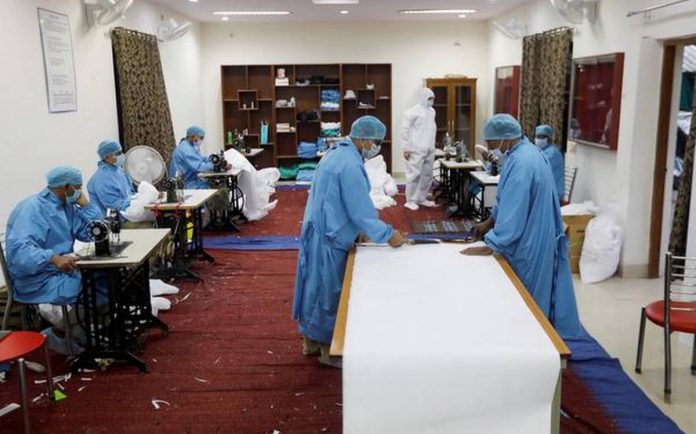
The Central Reserved Police Force (CRPF) has a new frontier to conquer. This time, it is the fight against the novel coronavirus that threatens to ravage the country which has so far affected 7000+ people in the country with several fatalities. As India grapples with the scourge of Wuhan coronavirus, the Central Reserve Police Force(CRPF) has stepped up to ensure that there is no dearth of Personal Protective Equipment(PPE) and masks in her fight against the COVID-19.
Recognised for their preparedness and battle-readiness against Naxalites and other enemies of India, the jawans of CRPF are prepping to bolster the nation’s crusade against the coronavirus. PPE kits, which are the most important gear to be donned by healthcare workers while treating positive COVID-19 patients, are being prepared by CRPF jawans and delivered to hospitals and police personnel, who are at the vanguard of the country’s campaign against coronavirus.
CRPF and ITBP have deployed specialised machines and manpower at their bases in and around the national capital for helping in the production of PPEs and masks. The country’s largest paramilitary force, CRPF, with a strength of 3.25 lakh personnel, has brought in a large automated machine in a Delhi-based camp that produces about 1 lakh three-plier masks a day which can be scaled up to 2 lakh units based on the demand on availability of raw material.
As per a senior CRPF official, the three-plier mask made by the machine deployed by the CRPF will cost only ₹5 per piece compared to ₹15 in the market. He also added that the northern sector office of the force has also put together a team of its tailors and other professionals who will prepare 500-1,000 hand-made cloth masks in a day and 400-500 PPEs per day.
CRPF is also producing PPEs which will provide healthcare workers or other frontline persons operating in the virus-infected environment complete safety with a special lamination cover and all accessories. The cost of the PPE kit is worth Rs 450 per set.
On the other hand, the Indo-Tibetan Border Police (ITBP) is involved in a similar initiative at its supply and support battalion in Saboli near Sonipat (Haryana). An ITBP official claimed that they are preparing PPEs that will cost just about Rs 100 and a three-layer mask which will be available at Rs 5.
Thousands of PPEs and 2000 face masks have already been manufactured by the ITBP. It has the capacity to produce 200 PPEs and 500 masks per day.