

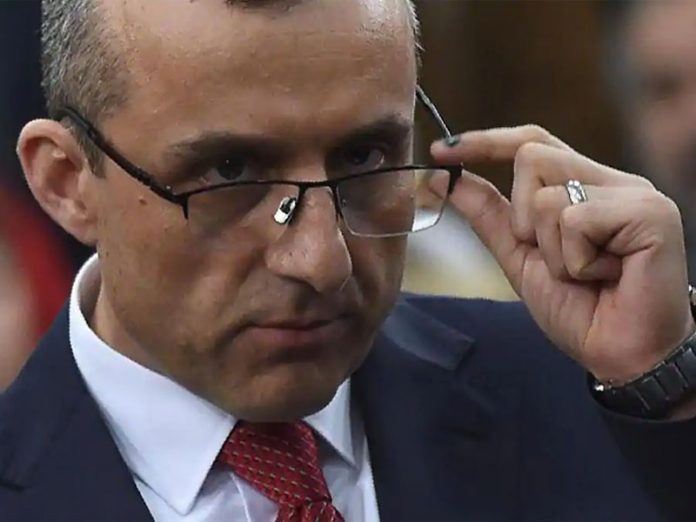
During an interview with Tolo News on 7th September, Amrullah Saleh, the Vice President Afghanistan, raised the Durand Line issue with Pakistan. He said that no Afghan politician of national stature could overlook the issue of the Durand Line. It will condemn him or her forever. He added, “It is an issue which needs discussions & resolution. Expecting us to gift it for free is un-realistic. Peshawar used to be the winter capital of Afghanistan.”
No Afghan politician of national stature can overlook the issue of Durand Line. It will condemn him or her in life & after life. It is an issue which needs discussions & resolution. Expecting us to gift it for free is un-realistic. Peshawar used to be the winter capital of Afg
— Amrullah Saleh (@AmrullahSaleh2) September 6, 2020
Saleh further added that Pakistan has come out of denial. It is openly saying that they are harbouring the Taliban. “This clarity despite being bitter is a development which can be utilized in benefit of peace process. I had candid discussions with Gen. Bajwa & ISI director when they visited Afghanistan. Keep Pakistan engaged 4 peace,” he said.
Pak has come out of denial & is openly saying they are harboring the Taliban. This clarity despite being bitter is a development which can be utilized in benefit of peace prcss. I had a candid discussions with Gen. Bajwa & ISI drctr when they visited Afg. Keep Pak engaged 4 peace
— Amrullah Saleh (@AmrullahSaleh2) September 6, 2020
The issue between Pakistan and Afghanistan over the Durand line
In 1893, the Durand Line was drawn between then British-ruled India and Afghanistan’s Amir Abdur Rahman Khan as an attempt to improve relations and exchange between the two countries. Though the British controlled several issues related to Afghanistan, it was considered a free state. The 2,600 KM long line was in a way imposed upon Afghanistan by the British and after Pakistan’s formation, the same line was treated as the international border between Pakistan and Afghanistan.
Since the departure of the British from the Area, Afghanistan has been trying to reassess the border with Pakistan, but the two nations have failed to come to any conclusion. Though Pakistan claims that Durand Line is a well established international border, Afghanistan has never accepted it. Afghanistan claims a significant portion of Khyber Pakhtunkhwa and Balochistan provinces in Pakistan based on the fact that though they were claimed by Pakistan at the time of its formation, however, they used to be a part of Afghanistan and the ethnic groups of Balochs and Pashtuns have been partitioned.
Afghanistan had also demanded in 1947 that the Pashtuns should be given the right of self-determination. The demand was ignored by both the British and Pakistan at that time.
One claim that Afghanistan often uses to assert its position over the Durand Line is that the border drawn by the British was valid for 100 years, and its validity has expired. Another claim that Afghanistan makes is that the legitimacy of the border ended with Pakistan’s formation as the agreement was between India and Afghanistan and not with Pakistan.
In recent years, the tension between Afghanistan and Pakistan has increased due to Pakistan’s continued support of the Taliban.


