

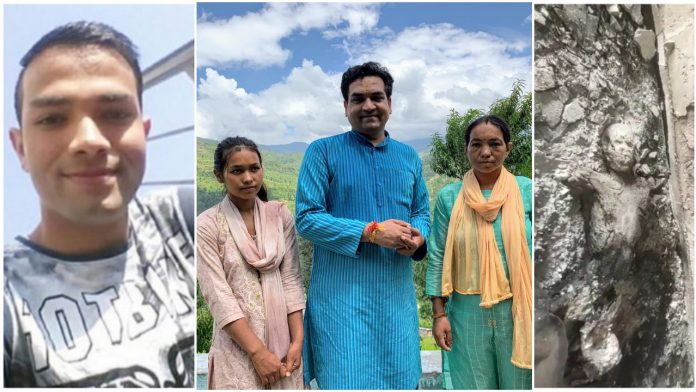
In a moving incident, BJP leader Kapil Mishra on Sunday visited the family of Anti-Hindu Delhi riots victim Dilbar Negi in Uttarakhand and spent time with the family on the occasion of Rakshabandhan.
BJP leader Kapil Mishra visited Dilbar Negi’s family and shared pictures where Negi’s sisters tied Rakhi on his wrist.
My Rakhi with sisters of Dilbar Negi Ji pic.twitter.com/wBnIwt08xw
— Kapil Mishra (@KapilMishra_IND) August 22, 2021
Earlier, Kapil Mishra had announced on Twitter that he would spend time with Dilbar Negi’s family on this year’s Rakshabandhan in Uttarakhand. He had remembered how the Islamist mob had brutally killed the 20-year-old Dilbar Negi during the Anti-Hindu Delhi riots in Delhi.
राखी के दिन उत्तराखंड के बेटे दिलबर नेगी जी की बहनों के साथ रहूंगा
— Kapil Mishra (@KapilMishra_IND) August 20, 2021
दिलबर नेगी जी को दिल्ली दंगो के दौरान बड़ी बेरहमी से मार दिया गया था
कल कोटद्वार, सतपुली और राखी के दिन दिलबर नेगी जी के घर पर pic.twitter.com/ntHd2ATs9N
The personal visit by Kapil Mishra to Dilbar Negi’s residence to meet his parents moved social media users, who praised him for his empathy towards those families who lost their loved ones during the Anti-Hindu riots in Delhi unleashed by the Islamic mob in February 2020.
Dil jit liye Bhai ??
— Bibhu Ranjan Dash । ବିଭୁ ରଞ୍ଜନ ଦାଶ?? (@bibhu4443) August 22, 2021
FYI, Dilbar Negi is one of Victims of Delhi Riot and his body was found charred after 2 days. In charge sheet of Delhi Police it is clearly mentioned that Muslim mob targetted shops and he was BURNT ALIVE ?
Source – TOI https://t.co/PpboZ0oyKM
This touched my heart ❤️- thank you @KapilMishra_IND ? #Uttarakhand https://t.co/hz5znemWae
— अद्वैता काला Advaita Kala ? (@AdvaitaKala) August 22, 2021
Never forget our brother Dilbar Negi and his family. Never Forgive Arvind Kejriwal. Thank you @KapilMishra_IND ji for taking care of Dilbar Negi’s family. You were the first person to start crowd funding for his family.♥️?? https://t.co/FdDmXqMFD8
— अभिषेक कुमार सिंह ?? (@Abhishek834028) August 21, 2021
So thoughtful of you, @KapilMishra_IND ji. Deep respects. Hope the family is coping with the loss https://t.co/vArAclBvyk
— Swati Goel Sharma (@swati_gs) August 22, 2021
Islamist rioters burned Dilbar Singh Negi after they brutally chopped off his limbs with a sword. The rest of his body was tossed into the fire like a piece of meat by the blood-thirsty mob.
The brutal murder of Dilbar Negi:
The 20-year-old Dilbar Negi, who had dreamt of joining the Indian Army, was working at a restaurant in Delhi to make a living. On the evening of 23 February, 2020 when violence erupted in Delhi, he had fallen victim to the brutality of these riots after he was burnt by a mob of rioters in the burning house after being cut off with a sword.
The gruesome videos of anti-Hindu riots in Delhi had emerged, which showed how rioters, after cutting Dilbar Singh Negi’s hands and feet, threw the rest of his body into the burning fire. The incident was first reported by OpIndia when the relatives of Dilbar Negi, the deceased, contacted us and reported the horrific accident.
Dilbar Singh Negi was from Thalisain block in the Pauri district of Uttarakhand. He used to work at a sweet shop located in Shiv Vihar. His close aide Shyam Singh told OpIndia that some rioters entered the Shahdara area on the evening of 23 February. The rioters made Negi their first target. First, they cut off his arms and legs. Then, they burnt his body in a nearby shop. He was accompanied by his two other companions in the building, who managed to escape from there.
On February 26, when the shop owner Anil Pal reached the spot to know the condition of his shop with the police, he found the body of the deceased Negi near the stairway on the second floor. We can assume that he was trying to jump from the building after seeing the rioters. Negi had visited the godown of the shop for having food and taking rest, the charge-sheet said.
According to the charge sheet, the main accused in the murder of Dilbar Negi is one Shahnawaz, as he was the one who led the mob that day. Along with Shahnawaz, the other accused have been charged with murder, criminal conspiracy, rioting and promoting enmity between groups. Currently, he is in judicial custody.
Moreover, the Delhi Police had named Dr MA Anwar, the owner of Al-Hind hospital in the riot-hit Mustafabad area, as one of the organisers of the protest. The controversial doctor has been named in the charge sheet filed by Delhi Police in the murder of 20-year-old Hindu youth Dilbar Negi.
A key eyewitness in the case had said that there were clear instructions for the mob to attack Hindu homes and shops. The eyewitness said that the mob was abusing Hindus in a vile manner and were speaking freely of finishing off Hindus. Furthermore, it was alleged that the mob was speaking of setting Hindu homes on fire and were calling them ‘Kaafir’.
Three accused men in the murder of Dilbar Singh Negi have confessed to firing indiscriminately at Hindus in Shiv Vihar during the communal riots at North-East Delhi. Shahnawaz, Salman and Sonu Saifi admitted to procuring a pistol, while Salman confessed of “firing at Hindus”.
As was the case of Dilbar Negi, many Hindus including IB sleuth Ankit Sharma and police constable Ratan Lal, were also brutally murdered by the Muslim mob who had come from the Brijpuri Pulia side in northeast Delhi and unleashed violence, targeting properties of Hindus. The unfortunate families of these Hindus have still not come to terms with the fact that they will never see their loved ones again. Even as with time, things tend to be forgotten, this deadly riot, which was the fall out of religious hatred stoked by radical fundamentalists, will not be erased from the memories of the aggrieved families.


