

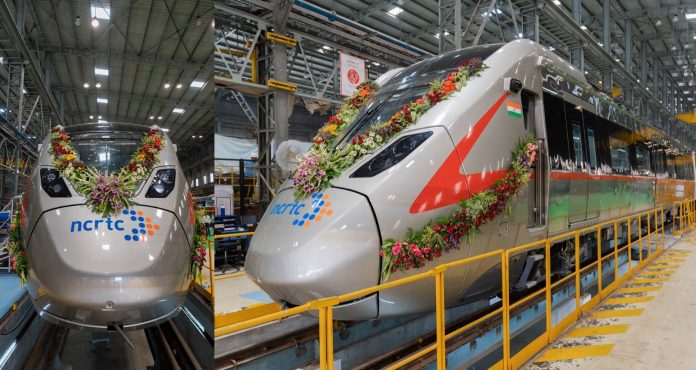
The first trainset for the India’s first Regional Rapid Transit System (RRTS) project was handed over to the National Capital Region Transport Corporation (NCRTC) by Alstom at its plant in Savli in Gujarat. The made-in-India trainset will be transported to Ghaziabad and will be deployed at the upcoming Delhi–Meerut Regional Rapid Transit System.
The NCRTC is establishing India’s first rail-based, high-speed, high-frequency regional commuter transit system connecting Delhi NCR with the neighbouring cities. At present three corridors are being developed in the project, Delhi – Ghaziabad – Meerut, Delhi – Panipat and Delhi-Gurugram-SNB-Alwar.
The Delhi Meerut corridor is coming up first, and the first trainset was delivered to the NCRTC in Savli in presence of Manoj Joshi, Secretary, Ministry of Housing & Urban Affairs (MoHUA) and Chairman of NCRTC. Vinay Kumar Singh, managing director of NCRTC, and other senior officials of the corporation and Alstom were present at the occasion.
Hardeep Singh Puri, Union Minister of Petroleum & Natural Gas and Housing & Urban Affairs, sent a video message for this occasion. He said, “It is a proud moment for all of us as this project is a true manifestation of the Hon’ble Prime Minister’s vision of an Atmanirbhar Bharat.”
“This is just the beginning of India’s journey of Regional Rails with two more RRTS corridors planned in the 1st phase itself. Work on them will also be taken up shortly and once completed it will create a network of networks connecting all the major hubs of NCR,” Puri added.
NCRTC MD Vinay Kumar Singh said that along with the bundled contract for supply and comprehensive maintenance of trainsets awarded to Alstom, they have finalised the selection process of a private O&M Partner for a long-term operation and maintenance contract of the Delhi–Meerut RRTS corridor.
Alstom India MD Alain SPOHR said that the RRTS project is one of the most ambitious ventures in India’s mobility sector and will prove to be a game-changer in India’s regional rail segment.
Alstom has been awarded the contract to manufacture trainsets for the Regional Rapid Transit System, under which the company will 40 trainsets. This includes 10 three-coach trainsets for Meerut Metro. It is notable that Meerut metro will use the RRTS infrastructure, with the addition of some metro-only stations.
The Delhi – Meerut RRTS will mostly consist of elevated tracks and tunnels, will total 82 kms, which will be covered in less than one hour. The trains will run at the speed of 160 km/hour, with the maximum capacity of 180 km/hour. The RRTS will start operations by March 2023. Initially the trains will run on a 17-km long priority section, between Sahibabad and Duhai.
The RRTS trains will have ergonomically designed 2×2 transverse cushioned seating, wide standing space, luggage racks, CCTV cameras, laptop/mobile charging facility, dynamic route maps, auto control ambient lighting system, Heating Ventilation and Air Conditioning System (HVAC), and other amenities.
The lightweight coaches are equipped with a regenerative braking system and are compatible with Automatic Train Protection (ATP), Automatic Train Control (ATC), and Automatic Train Operations (ATO). The AC trains will have standard and premium coaches.
The RRTS is a first-of-its-kind train system where semi-high-speed inter-city train will travel with high frequency.


