

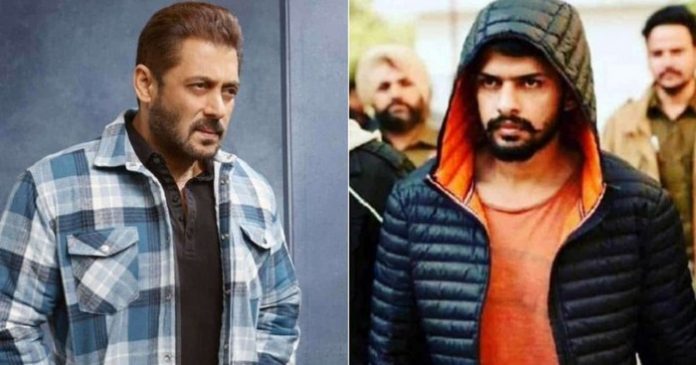
On Tuesday, gangster Lawrence Bishnoi revealed to the Police that he had planned to kill Bollywood actor Salman Khan in the year 2018. Bishnoi, who is being questioned in connection with the assassination of popular singer Sidhu Moosewala also said that he had bought a special rifle worth Rs 4 lakhs to murder Khan.
According to the reports, Bishnoi told the cops that he wanted to kill Salman Khan because of the 1998 Chinkara poaching case in Rajasthan’s Jodhpur, which occurred during the filming of the movie named Hum Saath Saath Hain. During interrogation, Bishnoi reportedly stated that Chinkara, or blackbucks, are sacred to the Bishnoi community in Haryana, Rajasthan, and Punjab.
Khan was convicted to five years in prison by a Jodhpur court in April 2018 for murdering two blackbucks in October 1998. The actor has appealed his conviction. Khan was first detained in the Jodhpur jail in connection with the case but was subsequently transferred to the Bharatpur jail.
During his questioning, Bishnoi reportedly admitted to having sent texts to his colleague Sampat Nehra, who was from Rajgarh, requesting that Salman Khan be killed. Nehra was absconding in other instances at the time. Lawrence Bishnoi also informed the police that Sampat Nehra was sent to Mumbai to assassinate Salman Khan and undertook a reconnaissance of the actor’s home. According to Bishnoi, Nehra only possessed a pistol and no long-distance fire weapon, thus he could attack Khan from a distance.
The mobster then ordered an RK Spring rifle from a guy named Dinesh Dagar, according to sources, who added that the gun cost Rs 4 lakh. According to reports, the money was paid to Anil Pandey, a Dagar colleague. This rifle was later recovered in 2018 from Dagar’s possession.
On July 6, Hasti Mal Saraswat, a lawyer defending Salman Khan in the blackbuck poaching case, said that the Lawrence Bishnoi gang had threatened him with murder. In his lawsuit, Saraswat stated that a threat letter was discovered on July 3 on a door knob of the High Court’s Jubilee Chamber, which houses attorneys’ offices. According to the lawsuit, the letter had the initials of Lawrence Bishnoi and his aide Goldy Brar. It stated that the lawyer will face the same death as Sidhu Moosewala, adding that an ‘enemy’s friend is their first enemy’.
Last month, three members of the Lawrence Bishnoi gang were claimed to have delivered a letter threatening Salman Khan and his father Salim Khan. The letter allegedly threatened Salman Khan and his father with the same fate as Moosewala, who was assassinated in broad daylight on May 29 in Punjab’s Mansa.


