

On 12th January (Saturday), the National Statistical Office (NSO), Ministry of Statistics and Programme Implementation (MoSPI) released the latest economic data (pdf). As per the NSO data, Core inflation has eased to a sub-4 percent level which has happened for the first time in the post-pandemic period. It has declined to 3.89 percent in December from 4.1 percent in November. With this, the core inflation has declined to a 48-month low in December 2023.
As per reports, reducing core inflation has been a key objective of the Reserve Bank of India’s Monetary Policy Committee. It has brought it down from 6.1 percent at the start of 2023 to the 48-month low in December 2023. Notably, core inflation is the inflation excluding food and fuel items.
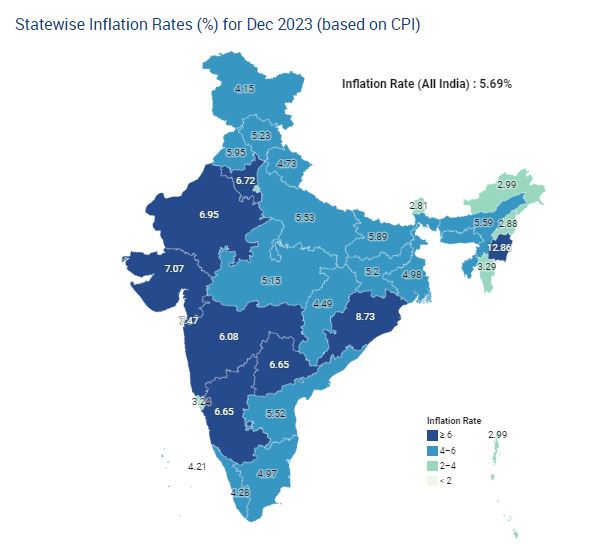
Moreover, miscellaneous inflation, a broad indicator of price changes for services, decreased from 4.38 percent in November to 4.07 percent in December. However, the Consumer Price Index (CPI) inflation has increased to a four-month high of 5.69 percent in December but it continues to remain within the RBI’s tolerance range of 2-6%. The CPI was 5.72% in December 2022, so there has not been much change on a year-on-year basis.
Food inflation remained high, which was 9.53% in December 2023, up from 4.19% in the same month previous year.
As per the statewide inflation rate, North Eastern states have achieved greater success in controlling inflation. The following map depicts the state-wide inflation rate for December month –
Nonetheless, nations across the globe have been facing the brunt of turbulent events including the Russia-Ukraine, Israel-Hamas wars, and attacks on the busy shipping lanes in the Red Sea which have resulted in higher costs of living across the globe. Consequently, India’s payments outgo for oil, gold, and other commodities have increased leading to a rise in the cost of raw materials and commodities.
A day after NSO released the economic data, Rajya Sabha MP and Uddhav Sena leader Priyanka Chaturvedi on 13th January (Saturday), targeted the Modi government.
यहाँ ज़िंदगी सस्ती है
— Priyanka Chaturvedi?? (@priyankac19) January 13, 2024
ज़िंदगी जीना महंगा है।
महंगाई डायन! pic.twitter.com/Q8xA5ZoAef
In her post, she shared screengrabs of a media article taking a ‘Mehngai Dyan’ jibe at the Union government. However, netizens called her out for selectively sharing screenshots of a media report and omitting the part where the media portal had highlighted that core inflation has declined further in the country.
The Same article mentions that "Core inflation" for the 1st time post pandemic, eased further to 3.9% in December from 4.1% in November.
— Emergency Undeclared (@emergency_und) January 13, 2024
Selective SS posting won't help in any way, except for the X payout. https://t.co/ifULNalLFw pic.twitter.com/GgizxlytmF
This is the original Data. But you choose to spread fake news. ? pic.twitter.com/TqXu73X9bI
— Knight Rider (@iKnightRider19) January 13, 2024
Sharing a screenshot of the same article which the Rajya Sabha MP omitted, an X user wrote, “The Same article mentions that ‘Core inflation’ for the 1st time post-pandemic, eased further to 3.9% in December from 4.1% in November. Selective SS posting won’t help in any way, except for the X payout.”
Earlier, the government estimate showed that the Indian economy is expected to expand by 7.3 percent in the fiscal year 2023-24, surpassing the predictions of most economists.


