

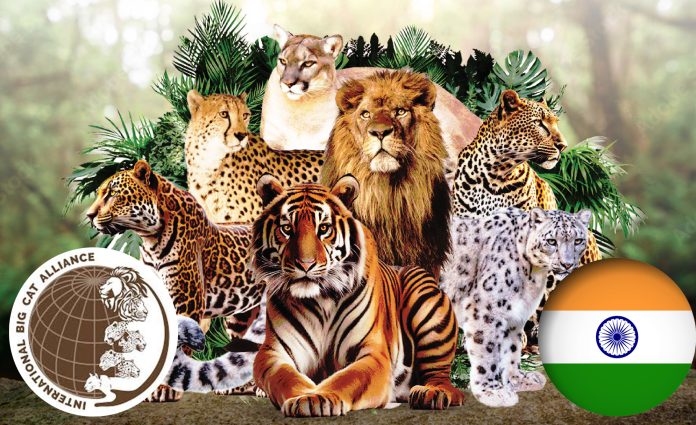
The Union Government has extended privileges and immunities under the United Nations (Privileges and Immunities) Act, 1947 to the International Big Cat Alliance, its representatives, and officials. The International Big Cat Alliance (IBCA) with headquarters in India has been established with PM Modi’s initiative with a goal to protect seven big cats- Tiger, Lion, Leopard, Snow Leopard, Puma, Jaguar and the Cheetah.
Environment, Forest & Climate Change minister Bhupendra Yadav announced the extension of the privileges on X on Friday. He said “The significant step reaffirms India’s steadfast commitment to strengthening international cooperation for big cat conservation.” Yadav said that the conservation of big cats is also instrumental in preserving and protecting their ecosystems and hence the well-being of our Planet.
The minister added, “With these privileges and immunities, IBCA gets the necessary empowerment to function effectively as a global platform to foster collaboration, knowledge exchange, and capacity building for the conservation of our big cats worldwide.”
Minister Bhupendra Yadav shared the gazette notification dated 8th August extending the privileges and immunities as per the Host Country Agreement signed by India earlier this year.
It states, ‘Article X of the Host Country Agreement provides for privileges and immunities of the International Big Cat Alliance, its representatives and officials. The Central Government considers it expedient to extend the necessary privileges and immunities provided under the United Nations (Privileges and Immunities) Act, 1947 (46 of 1947) to the International Big Cat Alliance, its representatives and officials in accordance with Article X of the above mentioned Host Country Agreement.’
Glad to share that the Government of India has issued the Gazette Notification extending privileges and immunities to the International Big Cat Alliance, its representatives, and officials under the United Nations (Privileges and Immunities) Act, 1947.
— Bhupender Yadav (@byadavbjp) August 22, 2025
The significant step… pic.twitter.com/KJnmcQu1tA
The gazette notification states, “Now, therefore, in exercise of the powers conferred by section 3 of the United Nations (Privileges and Immunities) Act, 1947 (46 of 1947), the Central Government hereby declares that the provisions of section 1 of Article I, provisions under Article II, section 9 of Article III, sections 18 and 20 of Article V and sections 22 and 23 of Article VI of the Schedule to the said Act shall apply, mutatis mutandis, to the International Big Cat Alliance, its representatives and officials.”
International Big Cat Alliance
Acknowledging India’s leading role in conserving tigers, other big cats and many of its endangered species, the Prime Minister of India during his speech on the occasion of Global Tiger Day, 2019 called for an Alliance of Global Leaders to curb poaching in Asia. He reiterated this on the occasion of Commemorating 50 years of India’s Project Tiger on April 9, 2023 and formally announced launch of an International Big Cat Alliance aiming at securing the future of big cats and landscapes they thrive. The pioneering and long standing tiger and other big cat conservation good practices evolved in India may-be replicated in many other range countries.
Out of the seven big cats, five are found in India – Tiger, Lion, Leopard, Snow Leopard and Cheetah. The other two are Puma and Jaguar.
The International Big Cat Alliance has been conceived as a multi-country, multi-agency coalition of 96 big cat range countries, non-range countries interested in big cat conservation, conservation partners and scientific organizations working in the field of big cat conservation besides business groups and corporates willing to contribute to the cause of big cats, to establish networks and develop synergies in a focused manner so as to bring to a common platform a centralized repository of successful practices and personnel, backed by financial support which can be leveraged to strengthen the conservation agenda in the field to arrest decline in big cat population and reverse the trend. This will be a demonstrative step in leadership position on big cat agenda, to bring range countries and others on a common platform.


