

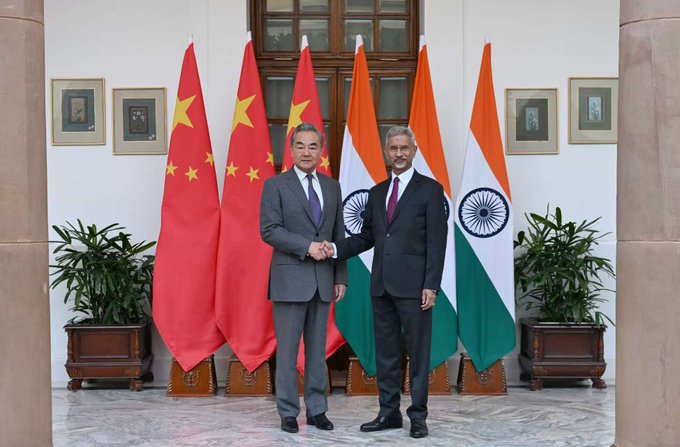
Chinese Foreign Minister Wang Yi’s two-day visit to India, capped by an audience with Prime Minister Narendra Modi, has set off ripples in global diplomatic circles. Rarely does a foreign minister receive such treatment from India’s leadership, and rarely is such a meeting publicly highlighted by New Delhi with such deliberation.
This was not a routine protocol call but a carefully crafted signal. As the world order drifts deeper into disorder, the meeting reflects both pragmatism and symbolism: a calculated reset between the world’s second-largest and soon-to-be third-largest economies, with India reopening channels where interests overlap, but without dropping its guard.
Welcomed Politburo member and Foreign Minister Wang Yi in Delhi this evening.
— Dr. S. Jaishankar (@DrSJaishankar) August 18, 2025
Highlighted that our relations are best guided by the three mutuals – mutual respect, mutual sensitivity and mutual interest. As we seek to move ahead from a difficult period in our ties, it needs a… pic.twitter.com/xRMYm4Nqpv
It is engagement, yes, but stripped of illusions.
What makes Wang Yi’s visit significant is not merely that he held the 24th round of Special Representatives talks on the boundary issue with NSA Ajit Doval or that he sat down with External Affairs Minister S. Jaishankar. The defining moment will be his meeting with Prime Minister Modi, a privilege usually reserved for heads of state.
That gesture is India’s way of saying it will engage China as an equal, not as a subordinate, and that Washington should take note. The message to the Americans is clear: their reckless, transactional foreign policy risks driving friends like India closer to their adversaries.
#WATCH | Delhi: During meeting with NSA Ajit Doval, Chinese Foreign Minister Wang Yi says, "The Chinese side attaches great importance to the Prime Minister's visit to China to attend the SCO summit at our invitation. We believe that Indian side will also make contribution to a… pic.twitter.com/Go1mNAly89
— ANI (@ANI) August 19, 2025
Beijing came bearing tangible assurances that go beyond diplomatic niceties. For months, Chinese restrictions on exports of key equipment and raw materials had threatened India’s infrastructure and industrial plans. Now, after Wang’s visit, Beijing has promised to resume supplies of tunnel boring machines critical for metro and highway projects, lift curbs on rare earth magnets indispensable for electric vehicles and renewable energy, and restart exports of speciality fertilisers essential for Indian agriculture.
These are not empty words but strategic concessions, designed to rebuild a modicum of economic trust. They address three of India’s most pressing vulnerabilities: construction, green technology, and food security. China knows exactly where to press and where to relax, and India has extracted these assurances with care.
The thaw is not limited to supply chains. Talks also touched upon resuming direct flights, restoring border trade, and easing visa restrictions, all suspended since the Galwan clashes of 2020. Yet nobody is under any illusion that mistrust has evaporated. Tens of thousands of troops still stand deployed along the Line of Actual Control.
Neither India nor China want a war, but Eastern Ladakh still remains an issue, India won’t compromise on sovereignty
Roughly 50,000-60,000 soldiers from each side remain in high alert positions in eastern Ladakh. Neither India nor China wants a shooting war, but neither will yield on sovereignty. The military reality underscores the fragile nature of this reset. Although trade and flights may resume, the mistrust along the Himalayas remains unwavering.
India also knows that Beijing’s embrace is never singular. Wang Yi’s next stops are Pakistan and Afghanistan. There, he will pitch for expanding the China-Pakistan Economic Corridor into Afghan territory, strengthen Beijing’s hold over Islamabad, and court the Taliban regime with promises of counterterrorism cooperation and economic connectivity. For India, this is the clearest reminder that China’s reset is transactional, not transformational.
Beijing will simultaneously talk peace in Delhi and plot encirclement through Islamabad and Kabul. That is why India continues to invest in “Neighbourhood First,” deepen ties in Africa, and strengthen its strategic presence across the Indian Ocean counterweights to China’s ambitions.
Timing is the key
The timing of Wang’s visit is no coincidence. It comes precisely when Washington is applying its version of coercion on India. President Donald Trump’s administration has slapped punitive tariffs on Indian exports, ranging from 25 percent to 50 percent, with additional penalties designed to punish India’s continued purchase of Russian oil.
In Delhi, this is viewed as nothing less than “tariff terror.” It is not partnership but pressure, not cooperation but coercion. Until recently, India-U.S. ties were at their peak, with defense pacts, Quad cooperation, and a shared Indo-Pacific vision. Today, America’s crude attempt to arm-twist India on energy security is pushing Delhi to diversify its options.
Wang Yi’s reception in Delhi, therefore, was also a subtle message to Washington: if America tries to box India in, New Delhi will chart its path, even if that means opening guarded doors to Beijing.
Not softening, it is strategic diplomacy
Critics may ask if India is now softening toward China. The answer lies in the details. India is not surrendering its core interests. Sensitive sectors such as defense and telecommunications remain closed to Chinese investments. The Quad partnership remains intact.
Military exercises with Japan, Australia, and the U.S. continue. What India is doing is managing risks intelligently, accepting economic concessions where they help, but refusing to compromise on sovereignty or strategic autonomy. By carefully publicising Wang Yi’s meeting with Modi, India projected confidence and equality, not submission.
This diplomacy is choreographed for a larger stage. Modi’s upcoming trip to China for the SCO summit, possible bilateral meetings with Xi Jinping, and onward travels to Japan will showcase India’s multipolar engagement. If the much-rumored Modi-Xi-Putin trilateral at the SCO summit takes place, the symbolism will be unmistakable: India will not be dragged into America’s camp, nor will it be absorbed into China’s orbit.
It will remain an independent, sovereign pole in a multipolar world. That is civilizational sovereignty in practice, the hallmark of Modi’s foreign policy.
Wang Yi’s visit is less about friendship and more about realpolitik. China is offering economic carrots to test India’s responses; India is accepting what helps but refusing to lower its guard. America is resorting to tariff sticks that only harden Indian resolve. In this triangular power game, Delhi is pursuing its script flexibility without illusions, engagement without surrender, and independence without apology.
The world may see Wang Yi’s visit as a thaw in India-China relations, but it is better understood as an assertion of India’s autonomy. The boundary remains contested, the mistrust remains deep, and China’s ties with Pakistan remain toxic.
Yet India is willing to talk, extract concessions, and buy itself breathing space, all while preparing for the long strategic competition ahead. In this balancing act, Modi’s government has made one thing clear: India will not be dictated to by Washington, manipulated by Beijing, or confined by either power. The message is simple but unmistakable: India is nobody’s pawn.


