

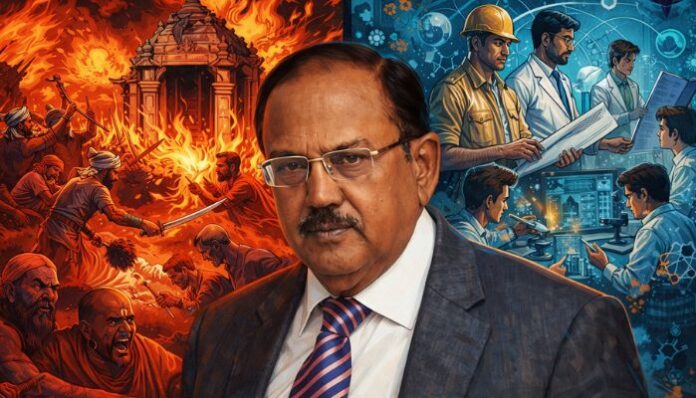
On 10th January, National Security Adviser (NSA) Ajit Doval addressed young Indians at the Viksit Bharat Young Leaders Dialogue. His speech was rooted in civilisational decline, historical memory and national rebuilding. However, it was quickly stripped of context and projected as a communal provocation by a section of political leaders and self styled liberal commentators.
It is deeply unfortunate that a high ranking officer like Mr Doval, whose duty is to guard the nation against internal and external nefarious designs, has chosen to join a communal ideology of hate and normalise violence against Muslims. Calling for REVENGE in the 21st century… https://t.co/cKRvuXdavu
— Mehbooba Mufti (@MehboobaMufti) January 11, 2026
At the centre of the manufactured outrage was Doval’s use of the word “revenge”. He qualified and contextualised the term himself during the speech. What followed was not a reasoned disagreement but a predictable escalation. History itself was put on trial, and any discussion of India’s past humiliation was branded as hatred.
The speech of our National Security Adviser left me puzzled. He spoke of the need for revenge against those who came to India and trashed our civilisation. So who do we attack first: Afghanistan? Uzbekistan? Türkiye?
— Tavleen Singh (@tavleen_singh) January 11, 2026
The likes of former Chief Minister of Jammu and Kashmir Mehbooba Mufti, The Wire’s propagandist masquerading as journalist Arfa Khanum Sherwani, Tavleen Singh and Suhasini Haider did not take much time to frame the speech as “insecure”, “Islamophobic” and “dangerous”.
"Revenge is not a good word, but it can be a huge force. We have to avenge our history…" says NSA Ajit Doval.
— Suhasini Haidar (@suhasinih) January 11, 2026
Is the NSA suggesting India will take "revenge" for India's colonisation ? From the UK? Or Uzbekistan where the colonisers came from? https://t.co/WZWyMwgNEY
Yet none of these reactions engaged with what Doval actually said during his speech. They relied on insinuation, assumption and a deliberate narrowing of a civilisational argument into a communal box.
Imagine someone this insecure holding the title National Security Adviser. pic.twitter.com/Xz3SrFoVWk
— Arfa Khanum Sherwani (@khanumarfa) January 11, 2026
What the NSA actually spoke about
During his address, Doval did not say anything that could be marked as impulsive or rhetorical. It was a structured reflection on how India’s freedom came at the cost of centuries of humiliation, executions, destroyed villages, looted cultural sites and economic collapse. Doval spoke of how generations lived without agency, forced to watch their civilisation weaken without the capacity to respond.
Importantly, he emphasised not grievance but responsibility. He asked the young generation to understand history not as a source of perpetual sorrow but as a reservoir of strength. The word “revenge” that he used, and which the so called critics seized upon, was immediately explained by him as rebuilding India into a strong, self confident nation rooted in its own values, institutions and capabilities.
VIDEO | Delhi: NSA Ajit Doval at the Viksit Bharat Young Leaders Dialogue says, “You will all witness the India we are imagining. But this will not be the first time this has happened with India. When Japan was rising, the West began discussing whether an Asian country could move… pic.twitter.com/XoKcF1neRJ
— Press Trust of India (@PTI_News) January 10, 2026
Doval did not call for violence. There was no naming of a religious community. There was no incitement. The speech remained focused on historical lessons and national capacity.
Colonialism and decline, not a Muslim exclusive narrative
One of the most misleading claims made while criticising him was that he targeted Muslims or framed history through a Muslim invader lens. This assertion collapses when the speech’s content is examined.
Doval clearly spoke about foreign rule, civilisational decline and colonial exploitation. His speech included references to economic devastation, and he cited academic work that documents how India and China together once accounted for over half of the world economy before centuries of decline. He did not attribute the decline to a single community but to repeated external domination and internal vulnerability.
To reduce such a wide historical argument to a Muslim exclusive narrative is not analysis. It is projection. Those who criticised him inserted a communal reading where none existed.
Civilisational memory is not hatred
A deeper discomfort is hidden in plain sight behind the outrage. The idea that India should remember history without judgement, without naming loss and without acknowledging trauma is what the “critics” want. This demand is neither realistic nor intellectually honest.
The memories of civilisations are built on records, archaeology, economic data and historical documentation. Remembering destroyed villages, looted temples or cultural erosion is not an act of hatred. It is an acknowledgement of facts. No civilisation erases its past to appear polite in the present.
Countries across the world openly discuss slavery, genocide, colonial exploitation and war crimes. No one accuses them of hatred against contemporary communities. However, in India, the so called intellectual setup is such that the act of remembering history invites accusations of bigotry.
The misuse of islamophobia as a shutdown tool
Another troubling pattern in the backlash was the casual expansion of the islamophobia label. Any uncomfortable discussion of historical facts was quickly reframed as violence normalisation or dog whistles. This approach is adopted not to protect minorities but to undermine serious discourse.
In literal terms, Islamophobia should be used when Muslims are targeted, discriminated against or harmed for their faith. In this case, or in similar cases where atrocities of the past are discussed, Muslims in the present are not harmed at all. Merely remembering the humiliation, cultural decline, genocides and looting India faced does not make it fall under the category of “Islamophobia”, even if Muslims were among those who carried out the atrocities.
The revealing contradiction in the outrage
There is also a contradiction that remains largely unaddressed. Many Indian Islamists consistently claim that Muslim rule in India was peaceful, tolerant and benevolent. However, the same voices erupt in outrage when even a general mention of historical atrocities is made.
If history was uniformly peaceful, why does discussion provoke such hostility? The discomfort suggests an anxiety about narratives that are no longer fully controlled.
Acknowledging that periods of rule involved violence, destruction and decline does not delegitimise any modern community. It only recognises that power, across history and geography, has rarely been benign.
Reading Doval in strategic continuity
Doval’s address cannot be read as a standalone moment. It fits into a larger shift in how India now views itself and its place in the world. The present leadership functions through an interconnected strategic outlook rather than isolated voices.
The Prime Minister defines the framework, placing India’s interests first, asserting independence in decision making, and ending the habit of seeking external approval. The External Affairs Minister translates this approach into action overseas by pushing back against unsolicited mediation, moral lectures and double standards.
Doval reflects the same mindset domestically, asking Indians to move beyond viewing history as a catalogue of grievances and instead treat it as a source of strength for rebuilding national capacity. This posture is not hostility. It is self assurance. Those who label it insecurity often find it difficult to accept an India that no longer feels the need to explain or apologise for itself.
Memory versus grievance
The self styled critics of India’s current leadership often collapse memory into grievance. For them, remembering historical loss automatically implies resentment and hostility. This confusion lies at the heart of the panic over Doval’s remarks.
In his speech, Doval did not argue for eternal victimhood. He argued for learning from failure, recognising vulnerability and ensuring it is never repeated. There is a significant difference. Nations that forget their past do not become enlightened. They become careless.
Power built quietly, not theatrically
India’s growing stature today is not the result of loud slogans but structural decisions. Foreign policy credibility, economic resilience and strategic autonomy were built by refusing to apologise for existence.
The next challenge, as Doval implicitly underlined, lies at home. Capacity building in manufacturing, judicial efficiency, urban infrastructure, education and governance. This is where power compounds. This is the revenge Doval spoke of, slow, institutional and irreversible.
Conclusion
Ajit Doval’s speech was not a call to hatred. It was a call to responsibility. The outrage surrounding it reveals less about the speech and more about the discomfort of those who fear a nation that remembers, reflects and rebuilds without seeking validation.
Nation building is not revenge against people. It is revenge against decline.


