

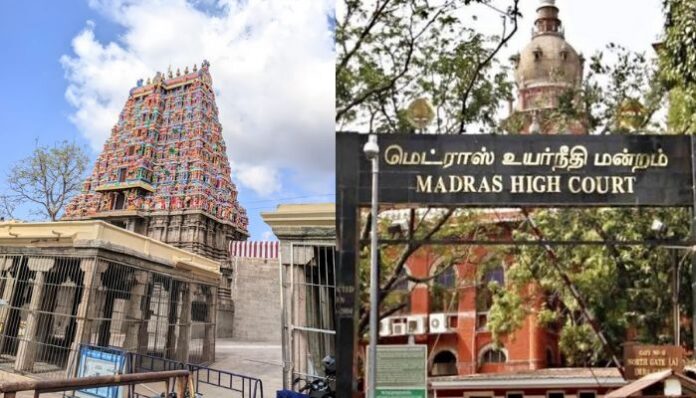
The Madras High Court (Madurai Bench) has struck down a Tamil Nadu government order that allowed commercial activities to be carried out using surplus funds of the historic Kallazhagar Temple in Madurai district.
The court made it clear on 23rd January that temples cannot be treated like development projects and that any activity carried out in the name of ‘development’ must strictly align with the religious ethos of the institution and the law governing temple administration.
A division bench of Justice Anita Sumanth and Justice C. Kumarappan quashed the government order issued on 8th March, 2024, which had permitted the construction of restaurants, shopping complexes, cottages and other commercial facilities using temple funds. The bench held that the order was legally unsustainable and violated multiple provisions of the Tamil Nadu Hindu Religious and Charitable Endowments (HR&CE) Act.
🚩 HUGE VICTORY for Hindu Devotees!
— trramesh (@trramesh) January 27, 2026
A historic judgment by the Hon'ble Division Bench Madras High Court paves the way to restore the sanctity of Temple Administration!
The Madurai Bench of Madras HC of Hon. Justice Dr. Anita Sumanth and Hon. Justice Shri C. Kumarappan
(Order… pic.twitter.com/P2OhD0NB0K
The court observed that the move reflected a worrying trend where the State was attempting to treat temple resources as its own, without following the statutory framework meant to protect religious institutions.
Court says temple development must align with its ethos
While delivering the judgment, the High Court underlined that temples are not commercial spaces and cannot be reimagined as infrastructure projects. The judges strongly criticised the approach adopted by the HR&CE Department, stating that its primary role is to preserve and protect temples, not convert them into revenue-generating ventures.
“Sections 35, 36, 66, 67 and 86 of the HR & CE Act, as well as the ‘Maintenance of Incorporated Devaswoms out of Devaswoms Fund Rules’, ‘Utilisation of Surplus Funds Rules’ and other Rules, stipulate that the incurrence of expenditure for temple upkeep should be only out of current receipts and not accumulated surpluses. The reserves of the temple have been depleted by the State in an irresponsible and illegal manner, and constitute a violation of the Act and Rules,” the court observed.
The court noted that the department had wrongly viewed the Kallazhagar Temple as a “project” requiring modern development and upgradation. “Instead, the department has envisioned the temple as a ‘project’ requiring development and upgradation, concepts that are alien to a temple,” the judges remarked.
According to the bench, providing basic facilities for devotees is necessary, but such activities must never compromise the spiritual character of the institution or bypass legal safeguards.
Illegal use of temple funds without budget approval
One of the strongest reasons for quashing the government order was the complete failure to follow the mandatory budgeting and approval process under the HR&CE Act. The court pointed out that large-scale expenditure had been planned without preparing a proper budget or obtaining approval from the temple’s Board of Trustees.
Under Section 86 of the HR&CE Act, a detailed procedure exists for budget approval, including scrutiny by the HR&CE Commissioner, exchange of views, clarifications and exclusion of unauthorised expenses. The court found that none of these steps had been followed.
“There is no material to show that the trustees applied their mind to the necessity or legality of the expenditure,” the bench observed.
The court further held that funds belonging to a religious institution cannot be diverted for commercial purposes without proper sanction and oversight, especially when such decisions involve crores of rupees.
Sharp decline in temple surplus raises red flags
The judges expressed serious concern over the rapid depletion of the temple’s accumulated surplus. Based on audited accounts produced before the court, the bench noted that the surplus had reduced drastically over a short period.
The temple’s accumulated surplus stood at ₹96.6 crore in March 2021, rose to ₹107.60 crore by March 2023, but dropped sharply to ₹62.37 crore by March 2024.
“This reduction represents expenditure incurred without budgeting for the same and is without the sanction or authority of law. It is a crime against the deity and a clear illustration of the fence eating the crops,” the court said in a strong observation.
According to the judges, such unauthorised spending was not just illegal but a betrayal of the trust placed in authorities managing temple finances.
Absence of Board of Trustees weakens legality
The court also took note of the fact that the term of the temple’s Board of Trustees had expired, and no new board had been constituted as required under law. Despite the statutory mandate under Section 46 of the HR&CE Act, there was no evidence to show that steps had been taken to form a new board.
The judges made it clear that a “Fit Person” or Executive Officer cannot permanently replace trustees. “Such temples must be administered by a Board of Trustees, not by officials,” the bench held.
The absence of a valid board, the court said, further weakened the legality of decisions taken regarding the temple’s finances and development.
Temple is not government property, court reminds state
In one of the most important observations, the High Court reminded the Tamil Nadu government that temples are not extensions of the State.
“The State cannot treat temple properties as its own or use temple funds for projects conceived by the government,” the bench said.
The judges criticised the State’s “Iconic Temple Development Scheme,” stating that development must arise from the needs of the temple and devotees, not from political announcements or one-size-fits-all models.
“Temples are places of faith, not development projects for administrative experimentation,” the court observed.
Background: How the dispute began
The dispute arose from a Government Order issued on 8th March, 2024, followed by a work order dated 11th October, 2024. The orders approved civil works worth nearly ₹40 crore at the Kallazhagar Temple as part of the State’s Iconic Temple Development Scheme.
The proposed project included the construction of guest houses, dormitories, shops, dining halls, parking facilities, a sewage treatment plant, archakas’ quarters and renovation of temple structures.
Several petitions were filed challenging the move, arguing that temple funds were being diverted without legal authority, no approval was taken from the Board of Trustees, and the HR&CE Act was being violated. Petitioners also alleged that the government was treating temple property as if it were government land.
After hearing the batch of petitions, the High Court quashed both the government order and the work order, while also issuing directions for proper maintenance of the temple, including preservation of the famous mural paintings in the Vasantha Mandapam.
Earlier similar case: Arulmighu Nandeeswarar Shivan Temple
This is not the first time the Madras High Court has stepped in to stop the commercial use of temple funds. Earlier in January 2025, the court struck down a similar plan involving the Arulmighu Nandeeswarar Shivan Temple.
A two-judge bench of Chief Justice K.R. Shriram and Justice Senthilkumar Ramamoorthy ruled that surplus funds of revenue-rich temples cannot be used to construct shopping complexes.
The court noted that constructing a shopping complex does not propagate the religious tenets of a temple, as required under Section 66 of the HR&CE Act. “Constructing the shopping complex using the funds of the temple certainly does not indicate any propagation of the religious tenets of the institution,” the judges held.
The bench also criticised the HR&CE Department for not conducting a proper project study. They observed that even investing the money in a fixed deposit would yield predictable returns, whereas commercial construction could lead to litigation, tenant disputes and encroachments.
In that case, too, the court quashed the government’s plan and suggested alternative uses such as planting native trees, conducting marriages for poor Hindus and feeding the needy, all of which align with the temple’s religious purpose.


