

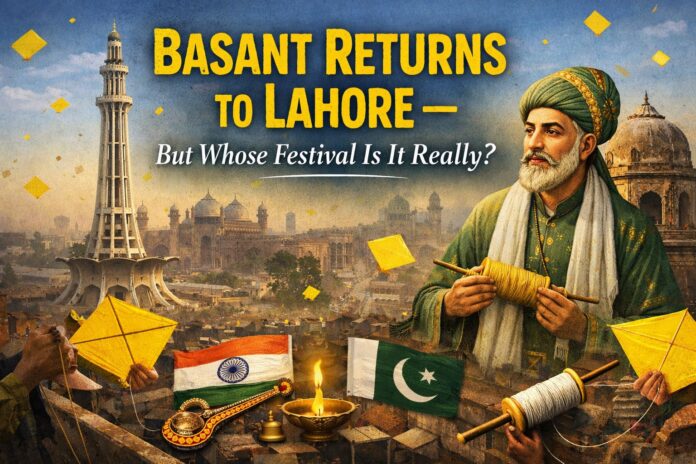
After over two decades of prohibition, Punjab in Pakistan has formally reinstated Basant. Lahore’s skyline is once again streaked with kites. The state has gone all in to oversee what it now refers to as a “Punjabi cultural festival,” deploying surveillance drones, enforcing QR-coded kite lines, registering rooftops, and applying stiff penalties. But as Basant returned to the skies, an old justification campaign resurfaced online, with several users on X insisting that the Basant celebrated in Pakistan is entirely different from India’s Basant Panchami, and claiming that it was started in Lahore by Amir Khusro as a Muslim, kite-flying spring ritual, supposedly unconnected to Hindu tradition or Indian civilisational history.
Framed as historical nuance, this claim is anything but. It reduces centuries of civilisational continuity to a single Sufi anecdote, deliberately blurs the line between cultural participation and cultural origin, and functions as a textbook case of cultural chori, retaining the festival, its symbols, and its economic value, while quietly stripping it of its Indian roots to make it ideologically palatable.
A quarter century on, Basant proved Lahore’s spirit was only paused, never broken.This wasn’t the end of Basant; it was the return of Lahore 🩷 pic.twitter.com/y0wBO49XD5
— Maryam Nawaz Sharif (@MaryamNSharif) February 8, 2026
Before Islam, before Khusro: Basant’s civilisational lineage
Basant is not an abstract “seasonal celebration” that evolved naturally in medieval Punjab. It is a vernacular continuation of Vasant (spring) observances that date back to Indic culture, predating Islam’s arrival in the subcontinent. Classical Sanskrit literature, temple calendars, and regional folk traditions all celebrate spring as a time of agricultural renewal. Basant marks the preparation for the arrival of spring. The colour yellow, central to Basant, is not a decorative coincidence; it reflects ripening mustard fields, the changing agrarian cycle, and springtime fertility across North India.
These symbols existed independently and coherently centuries before any Sufi engagement with local culture. By the time Muslim rule entered Punjab and Delhi, Basant was already a social fact, not a ritual in search of meaning, but a lived seasonal rhythm. What followed was not invention but adaptation. This distinction is crucial. When Muslim invaders, elites or common people participated in Basant, they were entering an already-established cultural space. Participation did not retroactively convert the festival’s origin, just as celebrating a harvest does not rewrite the origin of agriculture.
What Amir Khusro actually did and what is being falsely attributed to him
Amir Khusro’s relationship with Basant is real, but what is deceptive is the scale and significance that are now being retroactively built around it. The historical record places Khusro’s Basant observance squarely within the precincts of Delhi’s Nizamuddin dargah, not Lahore, and ties it to a specific, symbolic episode rather than the creation of a new festival. Following the death of his young nephew, Hazrat Nizamuddin Auliya is said to have withdrawn into grief. Among them was Amir Khusro, whose poetry blended Persian court culture with local vernaculars.
According to dargah tradition, Khusro encountered a group of Hindu women dressed in yellow, carrying flowers, on their way to the Kalkaji Mandir to celebrate Basant. Khusro adopted the colour yellow and brought the symbolism back to the dargah, where it briefly lifted his mentor’s sorrow. It is in memory of this act that Basant continues to be ritually observed at the Nizamuddin shrine.
This is not just a ‘Heeramandi’ song. Watch till the end to discover the rich history behind Khusrau’s ‘Sakal Ban’.
— Peek TV (@PeekTV_in) January 23, 2026
Centuries ago, on Basant Panchami, when grief silenced a Hazrat Nizamuddin, his disciple chose the colours, rhythms, and beauty of a Hindu festival to heal him. pic.twitter.com/BvNCONRibF
This episode explains why Basant is commemorated at one specific Sufi shrine in Delhi. It does not explain the origins of Basant itself, nor does it support the claim that Khusro “started” Basant as a Muslim festival, introduced it to Muslims at large, or founded a kite-flying tradition in Lahore. There is no contemporaneous Persian chronicle, tazkira, or historical account that makes such a claim. What is being projected today is not history, but retrospective myth-making.
Why this rewriting is convenient for Pakistan
Pakistan’s relationship with its pre-Islamic past has always been uneasy. Hindu temples are neglected, Indian history is marginalised in textbooks, and ancient cultural continuities are treated as ideological liabilities. Yet Basant poses a problem: it is too deeply embedded in Punjabi social life to be discarded altogether. The solution has been to retain the festival while rewriting its provenance. By framing Basant as a “Punjabi” festival rather than an Indian one, a Muslim cultural practice rather than a Hindu seasonal observance, and a Khusro-origin tradition rather than a pre-Islamic continuity. Pakistan gets to enjoy the celebration without confronting the civilisational inheritance it comes from.
That is the essence of cultural theft, keeping the practice, erasing the source.
Conclusion: You can celebrate, but you cannot erase
There is nothing illegitimate about Punjabis in Pakistan celebrating Basant. After all, Culture survives borders and outlives states. But there is something deeply dishonest about celebrating a festival while denying its origins. Basant does not need Islamic validation. Amir Khusro does not need to be turned into a civilisational founder. And Punjabi culture does not need historical amnesia to survive.
You can fly the kites. You can paint the city yellow. But you cannot cut the string that ties Basant to its Indian, Hindu, civilisational roots, no matter how many times the story is rewritten.


