

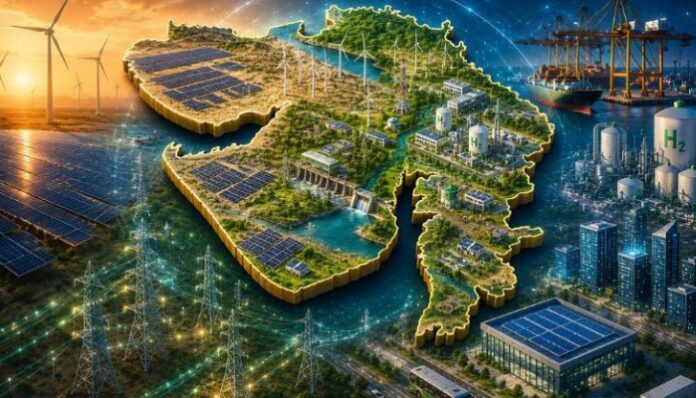
Renewable energy is now becoming one of the biggest drivers of economic and industrial change across the world. Countries that once depended heavily on oil and gas are rapidly moving towards clean energy because of rising fuel costs, climate concerns, geopolitical tensions and the need for energy security. India is also moving in the same direction, and among all states, Gujarat has emerged as one of the strongest players in this transition.
Today, Gujarat has become the leading state in India in renewable energy capacity. The state currently has around 47,178 MW of renewable energy capacity. This includes nearly 29,303 MW of solar power, 15,642 MW of wind energy, 2,103 MW of hydro power and 130 MW of bio energy. Gujarat is also leading the country in rooftop solar installations, with more than 6,881 MW capacity already installed.
ગુજરાત અક્ષય ઊર્જા ક્ષેત્રે દેશમાં પ્રથમ
— CMO Gujarat (@CMOGuj) May 6, 2026
માનનીય વડાપ્રધાન શ્રી નરેન્દ્રભાઈ મોદીના નેતૃત્વમાં દેશ આજે રિન્યુએબલ એનર્જીના ક્ષેત્રે ગ્લોબલ હબ તરીકે ઉભરી રહ્યો છે ત્યારે મુખ્યમંત્રી શ્રી ભૂપેન્દ્રભાઈ પટેલના દિશાદર્શનમાં રાજ્ય સરકારની અક્ષય ઊર્જા ક્ષેત્રે હાથ ધરવામાં આવેલ વિવિધ… pic.twitter.com/BjZyDgQtaC
But Gujarat’s renewable energy push is not just about generating electricity. The state is now building an entire green energy ecosystem where power generation, manufacturing, exports, hydrogen, battery storage, semiconductors and future industries are being connected together. This is why the phrase “from Khavda to Dholera” is now being seen as a symbol of India’s new green energy corridor.
Gujarat saw renewable energy as an economic opportunity early
For many years, India’s energy sector has mainly focused on coal and thermal power plants. Renewable energy was treated as an additional source rather than the main driver of growth. Gujarat, however, was among the first states to view solar and wind energy not only as an environmental need but also as a major economic opportunity.
The state already had several natural advantages. Gujarat has a long coastline, strong wind flow in regions like Kutch and Saurashtra, vast empty land, and high solar radiation for most of the year. At the same time, Gujarat already had a strong industrial base and major ports. Instead of limiting renewable energy to electricity production, the state started linking it with industries, exports and future manufacturing.
That thinking slowly shaped a larger model where solar parks, wind corridors, hybrid renewable projects, transmission networks, green hydrogen plans and industrial cities became part of one connected system.
Khavda: India’s biggest green energy hub rising in the desert
One of the biggest examples of Gujarat’s renewable energy strategy can be seen in the Khavda region of Kutch near the Pakistan border. This area was once mainly known for desert land and a sparse population. Today, it is turning into one of the world’s largest renewable energy hubs.
The Khavda hybrid renewable energy park combines both solar and wind power on a massive scale. The geography of the region has become its biggest strength. Large stretches of unused land, strong sunlight throughout the year and powerful wind currents make the region ideal for renewable energy generation.
Although the project is still expanding, a major part of it has already become operational, and thousands of megawatts of electricity are being generated. Its capacity is expected to rise even further in the coming years. Many reports already describe it as one of the largest renewable energy parks in the world.
The importance of Khavda goes beyond just producing electricity. The region is also becoming a testing ground for India’s future energy strategy. Along with energy generation, a large transmission network is being developed so that electricity from Kutch can reach industrial regions and other states efficiently.
This is where the idea of a “green energy corridor” becomes important. Gujarat is not only producing clean energy, but also building the entire chain from generation to industrial use.
Dholera: Building the industrial economy of the future
If Khavda represents energy production, Dholera represents the future industrial economy powered by that energy.
The Dholera Special Investment Region is being developed as one of India’s most ambitious smart industrial city projects. But it is not just about roads, buildings and urban development. The city is being designed around future industries such as semiconductor manufacturing, electric vehicles, battery storage, green hydrogen and advanced manufacturing.
This is where Gujarat’s approach looks very different from the traditional renewable energy model. The state is not satisfied with only producing green electricity. It wants industries of the future to run on that electricity.
The idea is simple: renewable energy generated in regions like Khavda can eventually power industrial hubs like Dholera. On one side, there are giant solar and wind projects, and on the other side, there are semiconductor plants, EV ecosystems, battery manufacturing units and export-focused industries.
This turns renewable energy into an industrial transformation rather than just an energy transformation.
Government policies played a major role
Natural advantages alone did not make Gujarat a renewable energy leader. Long-term policy planning also played a major role.
The state government focused on making large areas of land available for renewable projects, especially in Kutch. Land acquisition is often one of the biggest challenges for solar and wind projects, but Gujarat managed to use its vast open spaces effectively.
The government also invested heavily in transmission infrastructure so the electricity produced could be connected smoothly to the grid. Gujarat additionally pushed for hybrid renewable projects where both solar and wind power are developed together to improve efficiency and stability.
The state also succeeded in attracting major private investment. Large companies like Adani Group, Tata Group and Reliance Industries are investing heavily in Gujarat’s green energy sector.
Rooftop solar is another area where Gujarat moved quickly. Due to policy support and faster implementation, rooftop solar adoption expanded across the state on a large scale.
Ports and exports add another advantage
Gujarat’s ports and industrial corridors have strengthened its renewable energy plans even further. Because of its strong port network, the state is also positioning itself as a future export hub for green hydrogen, ammonia and other clean energy products.
This gives Gujarat an advantage not only in electricity generation but also in global clean energy trade.
As countries across the world shift towards low-carbon economies, industries running on clean energy are becoming more attractive for global supply chains. Gujarat is trying to place itself at the centre of that future market.
Renewable energy is also about energy security
The renewable energy push is not just about climate goals. It is also closely linked to India’s energy security.
India still imports a large share of its oil and gas requirements. Whenever tensions rise in regions like the Middle East, fuel prices increase and directly impact the Indian economy.
This is why large renewable energy ecosystems like the one being developed in Gujarat are strategically important. If India expands solar, wind and green hydrogen capacity significantly, dependence on imported fuel can gradually reduce over time.
At the same time, global industries are increasingly looking for manufacturing supply chains powered by clean energy. In the coming years, industries may not only compete on cost, but also on how green their energy source is.
More than electricity: Jobs, investment and manufacturing
Renewable energy is often seen only as an environmental issue, but Gujarat’s model shows that it can also become a major source of industrial growth, jobs and investment.
Large-scale solar and wind projects create demand for transmission systems, logistics, manufacturing units, maintenance networks and skilled workers. When those projects are connected with sectors like semiconductors, electric vehicles and battery manufacturing, the economic impact becomes much larger.
This is one of the reasons why Dholera is being seen as a major future industrial zone. If green energy-based manufacturing grows successfully there, Gujarat could further strengthen its position on India’s industrial map.
Is Gujarat becoming India’s first green industrial state?
The developments taking place across Gujarat are now raising an important question: Is the state becoming India’s first major green industrial economy?
The answer appears to be yes. Gujarat is trying to connect renewable energy generation, storage, transmission, industry, exports and urban infrastructure into one integrated system.
Massive renewable projects in Khavda, wind corridors across Kutch and Saurashtra, rooftop solar expansion, green hydrogen plans, smart industrial cities like Dholera, and export infrastructure linked to ports together create a much larger picture.
The state is no longer positioning itself only as an electricity producer. Gujarat is trying to become the centre of India’s future green economy.
Gujarat’s changing role in India’s economy
Over the last two decades, Gujarat has repeatedly aligned itself with India’s changing economic priorities. The state was once mainly known for ports, petrochemicals and manufacturing. Later, it became a major automobile and industrial corridor hub.
Now, Gujarat is moving into another phase, becoming a centre for the future energy economy.
The transformation is visible on the ground. Solar panels spread across the deserts of Kutch, wind turbines along the coastline, expanding transmission networks, green hydrogen projects and smart industrial zones together show how the state is reshaping its economic structure.
The most important part of Gujarat’s strategy is that renewable energy is not being treated as a separate sector. Instead, it is being linked with manufacturing, exports, urban development and future technologies.
The bigger picture ahead
The world is currently going through a major energy transition, and Gujarat is trying to prepare itself for that future much earlier than many others.
Clean energy production in Khavda, industrial expansion in Dholera, green hydrogen projects, EV ecosystems, semiconductor plans and export-focused infrastructure together form a larger vision. It is a vision where energy and industrial growth move side by side.
Gujarat’s current model suggests that if geography, policy support, industrial infrastructure and long-term planning work together, a state can go beyond simply producing electricity and become the centre of a wider economic transformation.
As India’s energy and industrial landscape changes in the coming years, Gujarat appears determined to stay at the front of that shift.


