

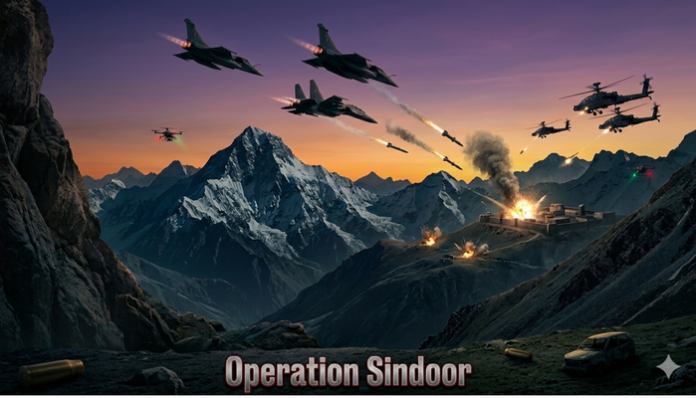
Today, May 7, 2026, marks the first anniversary of Operation Sindoor, India’s unprecedented military response to Pakistan-sponsored terrorism. The operation was India’s highly measured and precise military action against Pakistan-backed terrorism in the wake of the barbaric Pahalgam terror attack. During the operation, the Indian armed forces carried out a coordinated attack on multiple terror sites located inside Pakistan and the Pakistan-occupied Kashmir (PoK).
Symbol of national resolve #OpSindoor
— HQ IDS (@HQ_IDS_India) May 6, 2026
JAI HIND#OpSindoor #indianarmedforces #NationalSecurity @narendramodi @DefenceMinIndia @SethSanjayMP @SpokespersonMoD @MIB_India pic.twitter.com/y67xwYHZCP
Remembering Operation Sindoor, Prime Minister Modi hailed the valour and the commitment of the Indian armed forces and asserted India’s resolve to defeat terrorism and destroy its enabling ecosystem. “A year ago, our armed forces displayed unparalleled courage, precision and resolve during #OperationSindoor. They gave a fitting response to those who dared to attack innocent Indians at Pahalgam. The entire nation salutes our forces for their valour. Operation Sindoor reflected India’s firm response against terrorism and an unwavering commitment to safeguarding national security,” PM Modi wrote on X.
“It also highlighted the professionalism, preparedness and coordinated strength of our armed forces. At the same time, it showcased the growing jointness among our forces and underlined the strength that India’s quest for self-reliance in the defence sector has brought to our national security. Today, a year later, we remain as steadfast as ever in our resolve to defeat terrorism and destroy its enabling ecosystem,” he added.
A year ago, our armed forces displayed unparalleled courage, precision and resolve during #OperationSindoor. They gave a fitting response to those who dared to attack innocent Indians at Pahalgam. The entire nation salutes our forces for their valour.
— Narendra Modi (@narendramodi) May 7, 2026
Operation Sindoor reflected…
Defence Minister Rajnath Singh hailed Operation Sindoor as a symbol of national resolve and a testament to India’s steady advance towards achieving the goal of Atmanirbharta (self-reliance). “On the anniversary of Operation Sindoor, we salute the valour and sacrifices of our armed forces, whose courage and dedication continue to safeguard the nation. Their actions during the operation reflected unmatched precision, seamless jointness and deep synergy across services, setting a benchmark for modern military operations. Operation Sindoor stands as a powerful symbol of national resolve and preparedness, showing that our armed forces are always ready to act decisively when it matters most. It also stands as a testament to India’s steady advance towards achieving #Atmanirbharta, enhancing capability while reinforcing resilience,” Singh posted on X.
On the anniversary of Operation Sindoor, we salute the valour and sacrifices of our armed forces, whose courage and dedication continue to safeguard the nation. Their actions during the operation reflected unmatched precision, seamless jointness and deep synergy across services,… pic.twitter.com/r8pVDnEoYV
— Rajnath Singh (@rajnathsingh) May 7, 2026
Praising Operation Sindoor, Union Home Minister Amit Shah said that it will always remind our enemies of the infallible striking power of our armed force, meticulous intelligence of our agencies, and resolute political will. He saluted the Indian armed forces for their “unparalleled valour”.
“#OperationSindoor stands as an epochal mission of India that will always remind our enemies of the infallible striking power of our armed forces. History will remember it as the day of the precise striking power of our armed forces, meticulous intelligence of our agencies, and resolute political will rising together as one to destroy each and every address of terror across the border that dared to cast an evil shadow on our citizens at Pahalgam. This day will continue to bring the dreadful message to our enemies that no matter where they hide, they cannot escape. They are always within our sight and the fierce wrath of our firepower. On this day, I salute the unparalleled valour of our forces,” Shah wrote on X.
#OperationSindoor stands as an epochal mission of India that will always remind our enemies of the infallible striking power of our armed forces.
— Amit Shah (@AmitShah) May 7, 2026
History will remember it as the day of the precise striking power of our armed forces, meticulous intelligence of our agencies, and…
What triggered India’s Operation Sindoor
Operation Sindoor was India’s much-needed and long-overdue military action against Pakistan-sponsored terrorism, which has been a constant and evolving threat to India’s security. India has long suffered from terrorist attacks carried out by Pakistan-based terror groups over decades, but the April 2022 terrorist attack in the Baisaran valley of Pahalgham, J&K, last year came as a tipping point.
In the ghastly terrorist attack, Pakistani terrorists killed 25 Hindu male tourists in Pahalgam after verifying their religious identity. The terrorists asked male tourists in Pahalgam to recite the Kalma (an Islamic prayer) and removed their pants to verify if they were Muslims. After identifying Hindu males among the tourists, the terrorists brutally massacred them in front of their families. The animosity behind the attack can be ascertained from the fact that the terrorists left the women and children as witnesses of the bloodshed and asked them to “go tell Modi” about Markaz Subhan Allah of Jaish-e-Mohammad, Bahawalpur, Pakistan, what happened.
The terrorist attack triggered a massive military action by the Indian armed forces, which brought the Pakistani government to its knees and beg for a ceasefire. Operation Sindoor was not just India’s military response to terrorism; it marked a strategic shift in India’s counter-terrorism doctrine.
Operation Sindoor: India’s policy shift with respect to terrorism
Triggered by the Pahalgam terror attack, the Indian armed forces launched a massive military operation against terror launch pads in Pakistan and the Pakistan-occupied Kashmir. The Indian military action started in the early hours of May 7, 2025 and lasted less than half an hour. Within a span of about 25 minutes, India uprooted the entire terror infrastructure in Pakistan and the PoK. The Indian armed forces destroyed 9 terror sites through precision strikes carried out using missiles, glide bombs, Loitering munitions and other state-of-the-art weapons.
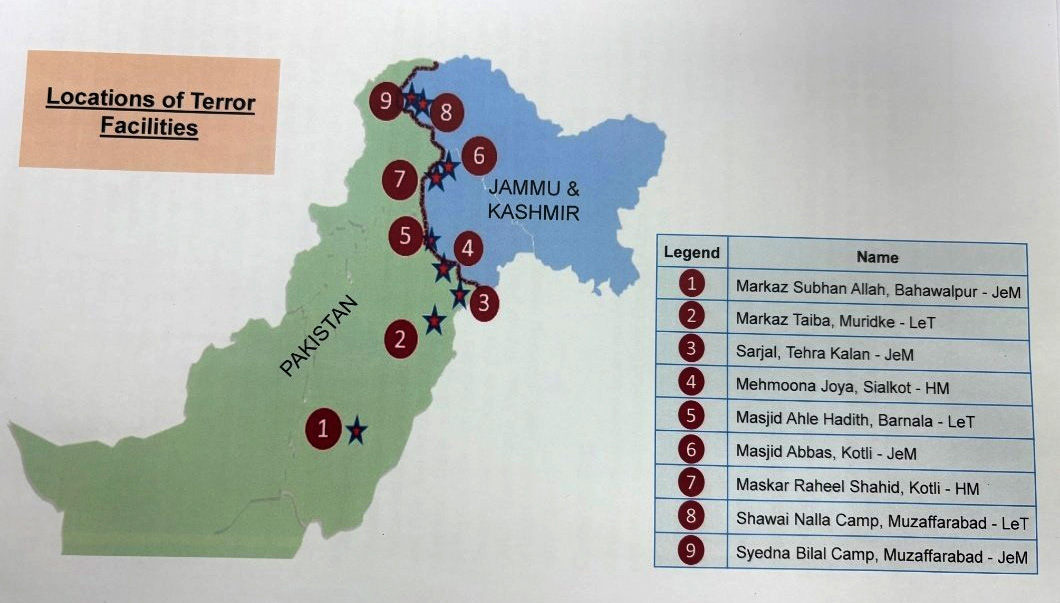
Here is a list of the 9 terror sites destroyed by the Indian armed forces in Operation Sindoor:
Markaz Subhan Allah of Jaish-e-Mohammad, Bahawalpur, Pakistan: It is the main centre of Jaish-e-Mohammad (JeM) for training and indoctrination of youth. It is located at NH-5 (Karachi- Torkham Highway) on the outskirts of Bahawalpur at Karachi Mor, and is spread over a 15-acre area, around 100 km away from the international border.
Markaz Taiba of Lashkar-e-Taiba, Muridke, Pakistan: Markaz Taiba is the ‘alma mater’ and the most important training centre of Lashkar-e-Taiba (LeT), located in Nangal Sahdan, Muridke, Sheikhupura, Punjab, Pakistan. Established in 2000, the centre is spread across 82 acres, and comprises a madrassa, market, residential area for terror entities, sports facility, a fish farm and agricultural tracts.
Sarjal / Tehra Kalan facility of Jaish-e-Mohammad, Sarjal, Pakistan: It is the main launching site of JeM for infiltration of terrorists into J&K. It is located in the Shakargarh Tehsil of Narowal District in Punjab, Pakistan. This facility is located inside the premises of a Primary Health Centre in Tehra Kalan Village of Sarjal area, so as to conceal its real purpose.
Mehmoona Joya Facility of Hizbul Mujahideen (HM), Sialkot, Pakistan: It is a Hizbul Mujahideen (HM) facility located near Kotli Bhutta Govt. Hospital in Head Marala area of Sialkot District of Punjab, Pakistan. This is one among several such terror camps running from government buildings in Pakistan with ISI’s assistance.
Markaz Ahle Hadith of Lashkar-e-Taiba in Barnala, PoK: It is one of the important Markaz of LeT in Pakistan-occupied Jammu and Kashmir and is used for infiltration of LeT terrorists and arms/ammunition into the Poonch – Rajauri – Reasi sector. It is situated at the outskirts of Barnala town on Kote Jamel road and is at a distance of 500 metres from Barnala town and 200 metres from Kote Jamel road.
Markaz Abbas of Jaish-e-Mohammad in Kotli, PoK: Markaz Saidna Hazrat Abbas Bin Abdul Mutalib (Markaz Abbas) of JeM is located in Mohalla Roli Dhara Bypass Road, Kotli, Pakistan-occupied Jammu and Kashmir. This Markaz is located approx. 02 km south-east of Kotli Military Camp.
Maskar Raheel Shahid of Hizbul-Mujahideen in Kotli, PoK: It is one of the oldest facilities of Hizbul Mujahideen (HM), located at approx. 2.5 kms from Mahuli Puli (a bridge on Mahuli Nalla on Mirpur-Kotli road) in Kotli District, PoK. Hizbul Mujahideen Head Syed Salahuddin used to welcome newly recruited terrorist cadres at this facility and supervise training activities being held here.
Shawai Nallah Camp of Lashkar-e-Taiba, Muzaffarabad, PoK: Shawai Nallah Camp is one of the most important camps of LeT and is used for recruitment, registration and training of LeT cadres. This camp has been functional since the early 2000s. LeT head Hafiz Saeed used to welcome new inductees to this camp on their arrival.
Syedna Bilal Markaz of Jaish-e-Mohammad, Muzaffarabad, PoK: This is the main centre of JeM in PoK, located opposite the Red Fort, Muzaffarabad. This facility is spread over 08-10 Kanals, and has family quarters, office building and office of Al-Rehmat Trust, charity wing of JeM.
Perpetrators of the Pahalgam terror attack hunted down
After a manhunt of 96 days, the Indian security forces located and neutralised the terrorists who carried out the Pahalgam terror attack. The terrorists were identified as Hashim Musa alias Abu Suleman, Hamza Afghani, alias Afghan, and Zibran. They were classified as ‘A’ category terrorists linked to Lashkar-e-Taiba. Suleman, who was the mastermind of the Pahalgam attack, was also involved in several terrorist activities, including the Gagangir incident. Afgan and Zibran were also directly linked to the murders of civilians in the Baisaran Valley during the Pahalgam attack.
Pakistan’s drone attacks thwarted by India’s Iron Dome’
Triggered by India’s legitimate action on terror launch pads, the Pakistan Armed Forces launched multiple attacks using drones and other munitions along the entire Western Border as an act of revenge against Indian strikes on terror camps under Operation Sindoor. While Indian strikes targeted terror camps in Pakistan and PoK, the Pakistani Army resorted to ceasefire violations along the Line of Control in Jammu and Kashmir and targeted civilian areas.
Pakistan launched a coordinated drone strike on around 15 locations across northern and western India, including Srinagar, Jammu, Amritsar, Bathinda, and Chandigarh. These areas are strategically significant given their proximity to crucial defence infrastructure. However, Pakistan’s attack was thwarted by the Indian Armed Forces through India’s indigenous ‘Iron Dome’ Akashteer Air Defence System (ADS) along with S-400 Sudarshan Chakra ADS to foil Pakistani plans of targeting Indian civilians.
Indian strikes Pakistan’s military establishments
During Operation Sindoor, India caught Pakistan off guard and unleashed its military might against not just its terror hubs but also against its military establishments. During the wee hours of May 10, 2025, the Indian Air Force (IAF) targeted important and strategic Pakistan Air Force (PAF) bases with BrahMos-A cruise missiles. India carried out precision strikes on 11 airbases in Pakistan, including three critical Pakistani airbases: Jacobabad, Chaklala (Rawalpindi), and Sargodha.
Notably, the three airbases play a critical role in the operation, maintenance, and deployment of F-16 jets that have been supplied to Pakistan by the United States. These locations also house essential infrastructure, including training facilities and ammunition stockpiles.
Pakistan’s plea for a ceasefire
Pakistan, which was not expecting such a scale of Indian military response, panicked and rushed to the United States, seeking intervention. The Indian attack on Pakistani military establishments was described as the largest Indian military strike since 1971. Pakistan Army Chief General Asim Munir spoke to US Secretary of State Marco Rubio, requesting American intervention to de-escalate the spiralling tensions with India.
The US offered to mediate and help reduce further conflict between India and Pakistan. Finally, a ceasefire understanding was reached bilaterally between the two countries. However, hours after a ceasefire was agreed, Pakistan violated it and initiated another round of attacks on several cities across the Line of Control (LoC), which were effectively dealt with by the Indian armed forces.
Following the ceasefire understanding, the Indian Armed Forces and Defence Minister Rajnath Singh clarified that the arrangement should not be seen as a ceasefire, but as an understanding. India will continue to assess how Pakistan behaves in the coming days and will act accordingly. In April this year, a few days after the anniversary of the Pahalgam terror attack, the Indian Army posted a message on social media reiterating that Operation Sindoor was still on.


