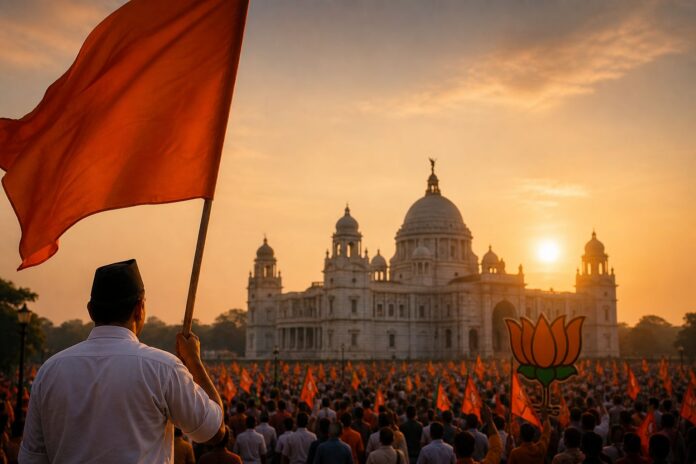
The 2026 West Bengal Assembly election will be remembered not merely as a political upset but as a structural shift in the state’s political consciousness. To reduce the Bharatiya Janata Party’s (BJP) victory to campaign optics, charismatic speeches, or anti-incumbency would be analytically shallow. What unfolded in Bengal was something far deeper, a carefully engineered, long-duration socio-political transformation in which the Rashtriya Swayamsevak Sangh (RSS) played a decisive, if understated, role.
At the surface, the headlines celebrated leaders like PM Modi and Amit Shah. Strategists like Sunil Bansal were credited with electoral precision and booth-level execution. But beneath this visible layer lay an invisible architecture, the Sangh’s disciplined, decentralised network, which quietly did what conventional politics often fails to achieve: reshape the very instincts of an electorate.
For decades, West Bengal operated under a unique political grammar in which ideology trumped identity. The legacy of Left politics ensured that class consciousness overshadowed religious mobilisation, and even when identity politics gained prominence in other parts of India, Bengal remained relatively resistant to overt religious consolidation.
The RSS recognised this anomaly early. Bengal was not just another state; it was the land of Syama Prasad Mookerjee, the ideological fountainhead of the Bharatiya Jana Sangh, the BJP’s precursor. The inability of the BJP to dominate this terrain was therefore not merely an electoral gap but an ideological incompleteness.
What the RSS embarked upon was not an election campaign but a civilisational project. It sought to replace Bengal’s fragmented Hindu identity, divided by caste, class, and sub-regional loyalties, with a cohesive political consciousness. It did so not through spectacle but through persistence. Lakhs of micro-level engagements, ranging from voter awareness meetings to Lokmat Parishkar sessions, were conducted across constituencies. These were not rallies designed for television optics; they were conversations designed to recalibrate perception and embed a new framework of political thinking.
The most significant achievement of this effort lies in what Bengal had historically resisted: Hindu consolidation beyond caste lines. Unlike states where caste arithmetic dictates electoral outcomes, Bengal’s Hindu society had never voted as a unified bloc. The Sangh’s intervention gradually altered this equation.
Through sustained outreach that blended religious, cultural, and social messaging, it normalised the idea of collective identity without making it appear abrupt or externally imposed. Festivals like Ram Navami evolved into platforms for reinforcing shared identity, while grassroots outreach ensured that these signals penetrated rural, tribal, and semi-urban regions. The process was incremental, almost imperceptible, but cumulatively transformative.
What made this strategy particularly potent was its framing. It was not presented as political mobilisation in the conventional sense but as cultural awakening. That distinction is crucial because when identity is internalised rather than instructed, it becomes far more resilient. The RSS’s work operated at precisely this psychological level, embedding a sense of shared belonging that eventually translated into political alignment.
Modern elections are typically dominated by spectacle, mass rallies, aggressive media campaigns, and high-decibel rhetoric. The RSS inverted this paradigm in Bengal by relying on what can best be described as a “silent campaign.” Its strategy centred on hyper-local engagement, where volunteers and swayamsevaks held small meetings in homes, temples, tea stalls, and community spaces. The objective was simple yet effective: build trust through familiarity and maintain continuous contact with voters. This approach bypassed media scrutiny, avoided counter-narratives, and allowed for highly customised messaging tailored to local concerns.
Winning elections, however, requires more than shaping opinion; it demands converting that opinion into actual votes. Here again, the RSS played a pivotal role by ensuring high voter mobilisation. Campaigns emphasising participation were not merely symbolic slogans but operational frameworks. Volunteers tracked voter engagement, followed up through local networks and digital communication, and ensured that turnout among sympathetic demographics remained high. At the same time, efforts were made to minimise vote leakage by discouraging NOTA voting and strengthening booth-level coordination. This is where the synergy between the RSS and the BJP became particularly evident: the Sangh built social capital, and the BJP converted it into electoral outcomes.
The organisational backbone of this effort was the RSS’s expansive network of shakhas and affiliated bodies. Over the past decade, this network has grown significantly in Bengal, allowing it to penetrate regions that were once beyond the BJP’s reach. From tribal belts and border districts to tea garden communities and urban peripheries, the Sangh ecosystem created multiple points of engagement across social strata. This multi-layered presence enabled it to operate not as a single campaign entity but as a coordinated system of interventions, each tailored to specific demographics and local realities.
Equally important was the role of narrative construction. The RSS’s outreach consistently contextualised local electoral choices within broader civilisational concerns. Discussions around the condition of Hindus in neighbouring Bangladesh, particularly amid political instability, were used to frame the election as more than just a contest over governance. By linking voting behaviour to questions of identity and security, the stakes of participation were elevated. Voting was no longer perceived as a routine democratic act but as a decision with deeper cultural implications.
Beyond voter outreach, the RSS also played a crucial role in managing the BJP’s internal dynamics in Bengal. The party had long struggled with factionalism, particularly between established cadres and newer entrants. The Sangh, with its institutional authority and perceived neutrality, acted as a mediator. Coordination meetings helped align competing interests, resolve disputes, and maintain organisational cohesion during a high-stakes election. This internal stability proved essential, as even the most sophisticated electoral strategies can falter in the face of internal discord.
While the RSS built the socio-cultural foundation, leaders like Sunil Bansal provided the strategic architecture necessary to translate groundwork into votes. Bansal’s emphasis on data-driven micromanagement, booth-level strengthening, and candidate selection complemented the Sangh’s grassroots efforts. His coordination with the RSS ensured alignment between ideological mobilisation and electoral execution. This convergence of structure and strategy was instrumental in delivering the BJP’s breakthrough.
Bengal’s transformation is particularly significant because of the challenges it historically posed. The state’s strong regional identity, intellectual traditions, and legacy of Left politics made it resistant to the Sangh’s ideological framework. That this resistance was gradually overcome suggests that long-term, decentralised mobilisation can succeed even in environments that appear structurally hostile. It also signals a broader shift in Bengal’s political axis, from ideology-driven politics to identity-centric mobilisation.
To characterise the RSS’s role as merely supportive would therefore be misleading. In Bengal, it functioned as the foundational force that enabled the BJP’s electoral success. What became visible in the election results was the culmination of years of groundwork, an intricate web of relationships, narratives, and organisational structures that shaped voter behaviour long before polling day.
The implications of this model extend far beyond Bengal. It demonstrates that electoral success in complex political landscapes requires sustained social investment, culturally rooted narratives, and decentralised organisational strength. For the BJP, Bengal represents a replicable template. For its opponents, it represents a far more complex challenge because they are no longer confronting just a political party, but a transformed social consciousness.
Ultimately, the BJP’s victory in Bengal was not an isolated event but the culmination of a long-term process. At the centre of this process stood the RSS, whose quiet, methodical, and deeply embedded mobilisation redefined the contours of the state’s politics. By reshaping identity, strengthening organisation, and ensuring participation, the Sangh did what high-voltage campaigns alone cannot achieve: it altered how an electorate thinks, and therefore how it votes.