

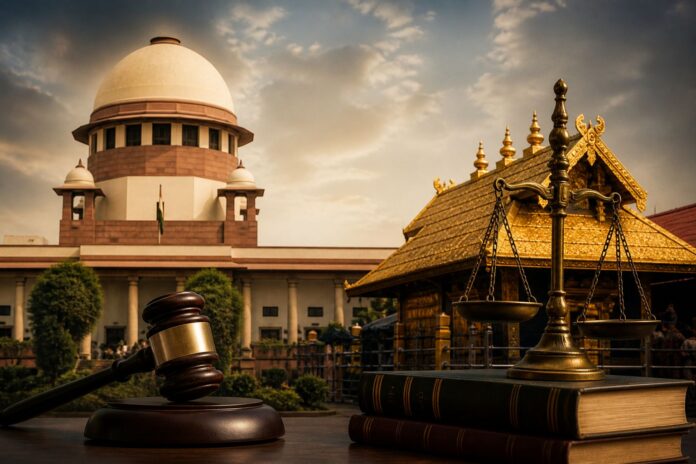
There have been times in India’s judicial history when the Supreme Court has delivered a moral verdict on individuals who have abused its hallowed grounds rather than simply adjudicating a legal case. May 5, 2026, was one such day.
The India Young Lawyers Association (IYLA), the petitioner organisation whose initial 2018 writ petition sparked a ten-year storm over Lord Ayyappa’s sacred temple at Sabarimala, suffered a humiliation from which it will be difficult to recover with any professional dignity on the eleventh day of arguments before the nine-judge Constitution Bench hearing the Sabarimala reference.
The bench, which was led by Chief Justice of India Surya Kant and included Justices BV Nagarathna, MM Sundresh, Ahsanuddin Amanullah, Aravind Kumar, Augustine George Masih, Prasanna B. Varale, R. Mahadevan, and Joymalya Bagchi, revealed what many legal observers had long suspected: that the IYLA’s involvement in these proceedings is a planned, driven, and legally futile exercise that has wasted the apex court’s valuable time.
The bench asked the IYLA’s counsel, who was representing a group whose president is Naushad Ali, a series of scathing questions that made it clear how seriously the court took the organisation’s standing, objectives, and conduct during these proceedings.
A PIL built on newspaper clippings
Perhaps the most startling moment of the day’s proceedings occurred when the IYLA’s counsel revealed to the court the intellectual foundations of the original public interest litigation that dared to challenge Lord Ayyappa’s centuries-old tradition of celibate worship. Those foundations were four newspaper stories published in June 2006. This is neither theological research nor constitutional research. Four newspaper stories, including ‘The Sex Slump Felt Sabarimala’ and ‘Touching Feet and Attracting Touches.’
Chief Justice Surya Kant’s answer was scathing, clinical, and precise. The CJI’s statement, ‘Okay, so it was based on press reports,’ sums up the intellectual gravity of the petition that disrupted millions of people’s devotional lives in just four words.
This is something worth contemplating. The Indian Young Lawyers Association filed a writ suit with the Supreme Court of India, aiming to overturn an old, unbroken, theologically founded religious tradition observed by tens of millions of Lord Ayyappa devotees, based on sensationalist tabloid journalism. The petition lacked a genuine comprehension of the rights of believers, the philosophical relevance of Naishtika Brahmacharya (celibate devotion), or the Ayyappa tradition. It was based on news stories intended to incite anger rather than reveal the truth. Every IYLA member who linked their name to this exercise should be deeply ashamed of this one disclosure.
An abuse of the process of law: The court’s own words
What followed was much more awful. ‘This is nothing but an abuse of the process of law, that too before a nine-judge Constitution Bench,’ declared Justice MM Sundresh from the bench in response to the IYLA’s counsel’s attempt to raise procedural arguments contesting the maintainability of the nine-judge bench reference, claiming that the original speaking order had referred the matter to a seven-judge bench rather than nine. Go through issues and get them done. We don’t want to humiliate you any further.
A sitting Supreme Court judge does not use these words lightly. An ‘abuse of the process of law’ is one of the most serious charges that a court can bring against a party before it. It signifies that the court has determined that the actions are being undertaken not for a valid legal purpose, but rather to harass, delay, or meddle. The Supreme Court of India’s nine-judge Constitution Bench has finally come to define the IYLA. This is not a small criticism; it is a court statement.
Nevertheless, the counsel continued. There were mentions of dubious procedural details. An attempt was made to use newspaper stories as proof. CJI Kant intervened directly after a comparison to the Khajuraho temple was made. If you do not know about a temple, please do not refer to all of them. Don’t waste our time, please. Simply continue and complete.
Throughout the morning’s proceedings, the same pattern emerged: a bench that was clearly irritated by the calibre of arguments being made, the irrelevant content being quoted, and the counsel’s seeming ignorance of the seriousness of the constitutional issues at hand.
Who is Naushad Ali, and why does it matter?
‘Who is your president?’ was the crucial question posed by Justice Aravind Kumar. Naushad Ali was IYLA’s counsel’s response.
Judge BV Nagarathna then brought out what is arguably the most significant and little-discussed issue about the entire Sabarimala PIL, ‘This is for an individual, how can a legal body such as yours have a belief? You lack morality.’ Then, sharply, ‘How is he a believer?’ Justify your explanation of the legal position.
The legitimacy of the PIL that sparked this debate is at issue when it comes to locus standi, or who has the moral and legal right to contest a religious practice. The president of a group that filed a writ petition to enter a Hindu temple worshipping a celibate deity, a temple whose customs have been upheld for generations by devout followers of that tradition, is Naushad Ali. Therefore, Justice Nagarathna’s inquiry was more than just procedural. What authority does this organisation and this person claim to advocate for, on behalf of, or against the devotional rights of Lord Ayyappa’s devotees? This was a fundamental challenge.
The answer appears to be none whatsoever. The organisation’s membership did not vote on a resolution approving the PIL’s file. Justice Aravind Kumar enquired directly, ‘Has your organisation passed a resolution to file a PIL? Has your President signed it?’ There was no such resolution; the counsel’s response was revelatory in its insufficiency. The PIL was submitted without the petitioner organisation’s own internal democratic approval.
A pattern of targeting the Hindu religion alone
Selective targeting is the underlying question raised by today’s proceedings and by millions of Hindu devotees since 2018. There is no arbitrary gender discrimination in the Sabarimala ritual. Because Lord Ayyappa is Naishtika Brahmachari, an immortal celibate, the tradition of celibacy linked with his form at Sabarimala is a sacred mandate. It is a differentiation based on the particular and distinctive nature of worship at that temple rather than the unworthiness of women. Devotees are aware of this. Practitioners are aware of this. The guardians of the tradition are aware of this.
During today’s proceedings, Justice BV Nagarathna made an observation that echoed this issue strongly. The court stated unequivocally: ‘Those who have faith in the deity will perform all that is required.’ However, this court cannot support anyone who claims to be willing to break all Niyam (rules). We are not superstitious. You are suggesting that people who do not have faith or belief in that deity are welcome to enter. You are not a true believer.
It is difficult to express the essential conflict more accurately. An organisation that had no believers among its petitioners attempted to overturn millions of believers’ deeply held convictions. Non-devotees marched into the Supreme Court, headed by a president who has no claim to be an Ayyappa devotee, to impose their will on a centuries-old religious tradition. They dressed it up in the rhetoric of constitutional rights, which they claimed out of ideology rather than actual faith.
Conclusion
Today was a quiet moment of vindication for the millions of devotees of Lord Ayyappa who walk barefoot through the Western Ghats forests, observe 41-day fasts, wear the Mala (rudraksha garland), and dedicate every part of their lives to their devotion during the pilgrimage season. The Supreme Court of India’s nine-judge panel stated unequivocally that the IYLA had squandered the court’s time, abused the legal process, and failed to present any genuine standing or argument for its case.
The Sabarimala case is far from over, and the nine-judge court will issue a decision with constitutional implications for religion, gender, and institutional autonomy. But what happened on Day 11 was a reckoning, a time when the court looked at the petitioners who sparked the debate and found them inadequate in every way, standing, sincerity, scholarship, and respect for the legal process. There are eighteen holy steps on the way to Sabarimala. The IYLA was a complete failure from the start.


