

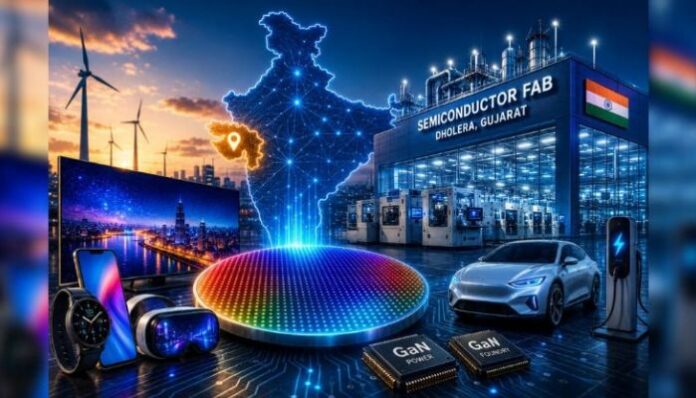
As the global race for advanced technology accelerates, India has been trying to strengthen its position on the global map of advanced technology, not just as a manufacturing hub, for the last few years. From semiconductors to artificial intelligence (AI) and electronics manufacturing, India is now also moving ahead rapidly in the technological competition going on around the world, and Gujarat is now emerging as an important centre in this journey. In a major development, India’s first mini/micro LED display fabrication unit will now be set up in Dholera, Ahmedabad, after receiving approval from the Central government under the India Semiconductor Mission.
The project will be developed by Crystal Matrix Limited with an investment of nearly ₹3,068 crore. The Company will set up a Gallium Nitride (GaN) based mini/micro-LED display fabrication facility in Dholera. Until now, India has not manufactured such advanced display technologies domestically and has mostly depended on imports from countries like China, South Korea and Taiwan. Now, for the first time, India is moving towards developing such technology domestically.
What is mini-micro LED technology?
Display technology has become extremely important in today’s world of smartphones, smartwatches, premium televisions, EVs and AR/VR devices. The brighter, more energy-efficient and thinner the screen, the better the user experience is considered. Mini and Micro LED technology is seen as the next generation of display technology.
Currently, most devices around the world use LCD or OLED screens, but mini/micro LED displays offer higher brightness, greater contrast, lower power consumption, and longer life-cycle. Micro-LED technology in particular is considered extremely important for future devices, as it is ideal for foldable displays, automotive dashboards, augmented reality glasses, and ultra-premium televisions.
In simple terms, till now, India has been a country that mostly buys such screens. Now, this facility to be set up in Dholera can become a major link that takes India from a ‘consumer’ to a ‘producer’.
What is gallium nitride (GaN) and why is it becoming increasingly important?
A key part of this entire project is gallium nitride (GaN) technology. While silicon-based technology is typically used in semiconductor manufacturing, GaN is seen as a next-generation high-performance semiconductor material.
GaN allows faster power transfer, generates less heat and is far more energy-efficient than traditional silicon-based systems. Because of these advantages, its use is rapidly increasing not only in display technology but also in electric vehicles, defence electronics, 5G infrastructure and advanced communication systems.
This means the Dholera project is not just about manufacturing screens. It is also being viewed as India’s entry into the larger compound semiconductor ecosystem, which is expected to play a major role in future global technologies.
According to PIB, the facility will not only manufacture mini and micro LED display modules but will also provide GaN foundry services. Advanced processes like epitaxy on 6-inch wafers will also be carried out at the plant.
A major step towards reducing dependence on China-Taiwan
The world has seen the importance of the semiconductor supply chain closely over the past few years. The Covid-19 pandemic, the US-China trade tensions and rising geopolitical concerns surrounding Taiwan exposed the risks of depending too heavily on a few countries for semiconductors and advanced electronics.
For India, this became an important strategic issue. From smartphones and automobiles to defence systems and communication networks, semiconductors are now essential for almost every major industry.
The mini/micro LED fab unit to be set up in Dholera is being considered as part of the same larger strategy. It simply means that India no longer wants to be just an electronics assembly country, but is also moving towards manufacturing the basic components of future technologies within the country.
What does it have to do with the life of a common man?
Terms like semiconductor or display fabrication often sound highly technical to the average reader, but in reality, this technology is directly related to everyday life. The advanced displays that will be seen in smartphones, smart TVs, electric vehicles, wearable devices and AR/VR products in the coming times are now being prepared to be made in India.
According to the details released by the government, this facility in Dholera will be able to produce 72,000 square meters of mini/micro LED display panels and 24,000 sets of RGB wafers per year. So this is not just a factory, but an industrial capacity that can give India a stronger position in the consumer electronics economy of the next decade. Along with this, thousands of high-tech jobs will be created, and local youth will get new opportunities in the manufacturing sector.
Acceleration for ‘Self-reliant India’
In recent years, slogans like “Make in India” and “Atmanirbhar Bharat” have been repeatedly promoted by the government. But this project in Dholera shows that this vision is now visible on the ground too. Because self-reliance does not come from just assembling imported products, it comes when a country builds its own manufacturing capacity in core technologies.
The Mini/Micro LED Fab Unit at Dholera is an important step in the same direction. This project can give India a new identity in the field of future display technology, compound semiconductors and advanced electronics manufacturing.
For a long time, such advanced technologies were largely associated with countries like the United States, Taiwan, South Korea and China. India is now trying to enter that same global race, and the Dholera project may become one of the clearest symbols of that technological shift.
(This article is a translation of the original article published at OpIndia Gujarati.)


