

On 25th August (Tuesday), the United Nations Committee on the Elimination of Racial Discrimination (UNCERD) has accused India of alleged “large-scale violations” by authorities against the members of the SC-ST community, the tribal people and “non-citizens,” in its latest release.
The UN body somehow made Rohingya Muslims the bigger victims of the April 2022 Pahalgam attack wherein Hindus were singled out and shot dead by Islamic terrorists for being Hindus, as the Central government launched a crackdown against illegal immigrants.
It read, “The Committee was gravely concerned about reports of large-scale violations perpetrated by law enforcement officials against ethnic and ethno-religious groups, Indigenous and Tribal Peoples, including Scheduled Tribes, Scheduled Castes, particularly Dalits, and non-citizens. These included racially motivated violence, excessive use of force, extrajudicial killings, arbitrary and prolonged detention without due process, torture, ill-treatment and sexual violence.”
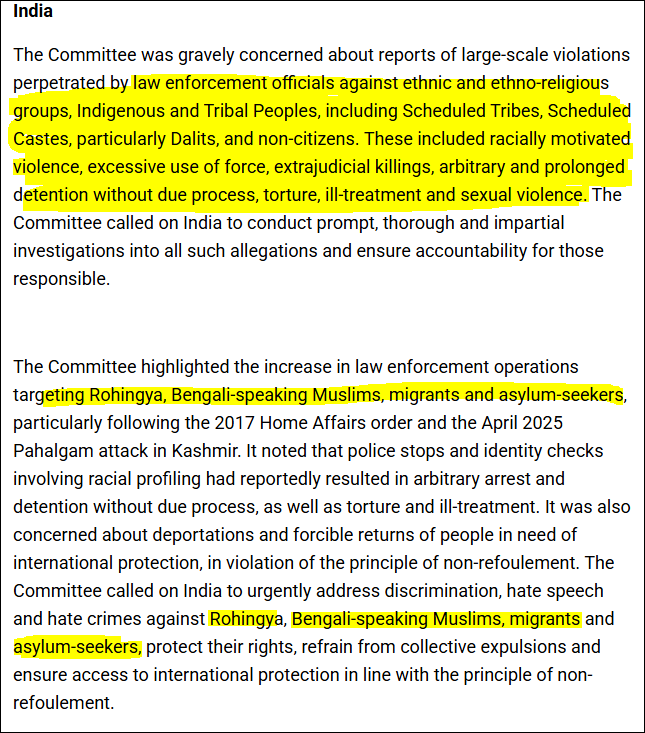
“The Committee called on India to conduct prompt, thorough and impartial investigations into all such allegations and ensure accountability for those responsible,” the UNCERD report added.
There is nothing new about a foreign body making such sweeping and unsubstantiated allegations against India, completely blurring the line between fact, anti-India rhetoric and unverified claims. It also conveniently ignores the fact that the country has a fully functioning Constitution, courts, statutory bodies and investigative agencies that provide avenues for scrutiny and redress. Hence, the calls for inquiry are just as much a farce as the investigations that do not align with their expected results or outcomes are never accepted.
The reality remains that these claims appear less rooted in genuine concern or ground realities and more in an attempt to attack India and damage its global reputation. Their alleged concerns have effectively become a licence to make judgments about an entire country with the apparent purpose of denigrating it.
UNCERD further charged, “The Committee highlighted the increase in law enforcement operations targeting Rohingya, Bengali-speaking Muslims, migrants and asylum-seekers, particularly following the 2017 Home Affairs order and the April 2025 Pahalgam attack in Kashmir. It noted that police stops and identity checks involving racial profiling had reportedly resulted in arbitrary arrest and detention without due process, as well as torture and ill-treatment.
“It was also concerned about deportations and forcible returns of people in need of international protection, in violation of the principle of non-refoulement. The Committee called on India to urgently address discrimination, hate speech and hate crimes against Rohingya, Bengali-speaking Muslims, migrants and asylum-seekers, protect their rights, refrain from collective expulsions and ensure access to international protection in line with the principle of non-refoulement,” it continued.
A country that has repeatedly been targeted by terrorist attacks from across the border has been lectured against taking measures to protect the lives of its citizens. The body appears to want India to put national security on the back burner and turn a blind eye to illegal immigration and its potential risks, even as countries ranging from the United States to Bangladesh seek to curb such inflows.
Likewise, the brutal massacre of 25 Hindu men in Pahalgam seemed to generate greater concern for those detained by the authorities than for the victims themselves. The familiar rhetoric of discrimination and human rights followed, with India once again being lectured on its responsibilities. The contrast is difficult to overlook: a country facing real security threats is expected to remain vulnerable, while the rights of those entering it illegally appear to command greater attention.
The claims concerning Indian communities such as Scheduled Castes and Scheduled Tribes further serve not only to deepen the fault lines but also as a tool to portray India as mistreating its own people, yet without providing even an iota of evidence to substantiate these allegations except dubious or already refuted reports. The concern is neither rooted in reality nor genuine concern for these communities but driven by an agenda to denigrate India at every opportunity.
Of course, attempts by United Nations bodies to weigh in on India’s internal affairs and attack the country are neither new nor novel. United Nations Special Rapporteurs appointed by the UN Human Rights Council had similarly raised allegations of “human rights violations” during India’s counter-terrorism operations following the Pahalgam attack.
Nevertheless, the body was more focused on Islamophobia than on the incidents that resulted in the loss of lives and the devastation of families. It is important to highlight that these organisations consistently overlook the serious incidents that occur prior to any action taken by the authorities, and any expressions of condolences are merely feeble attempts to seem neutral while concealing the true objective.
The USCIRF has been leading the charge in promoting this anti-India narrative. The body repeatedly seeks to classify India as a country of particular concern. It even advocates for sanctions against the Rashtriya Swayamsevak Sangh (RSS) and India’s Research and Analysis Wing (RAW). Furthermore, it has been openly campaigning against the US visit of RSS chief Mohan Bhagwat.
“We are all aware that the organisation—or entity—you are referring to is biased; for years, it has been making disparaging and inflammatory remarks about India. I would say we should steer clear of such organisations, as they operate with their own agendas and lack any credibility or trustworthiness. That is my response to that point,” External Affairs Ministry spokesperson Randhir Jaiswal countered the outrageous submissions of the commission.
These groups are permeated with a foulness of bigotry, Hinduphobia and antagonism against India, and they essentially operate as a pressure arm of the global Islamo-leftist alliance. The use of anti-India rhetoric, including invoking purported hate speech directed at specific groups or accusations of discrimination and violations of “human rights,” has become a convenient refuge for such organisations to advance their agenda of demonising India. And the recent UNCERD report is yet another case in point.


