

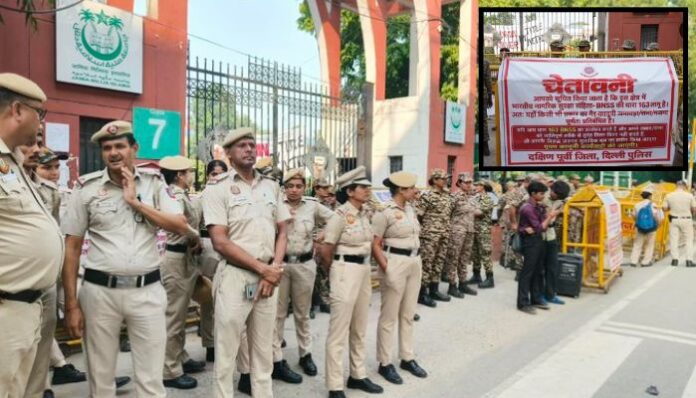
The campus of Jamia Millia Islamia remains on high alert following days of intense agitation. On Tuesday, 27th October, police officials have enforced Section 163 of the Bharatiya Nagarik Suraksha Sanhita (BNSS) outside the university campus to prohibit unlawful gatherings and assemblies. The move came after a fresh call for agitation at the university gates by the All India Students’ Association (AISA), a left-wing group affiliated with the Communist Party of India (Marxist–Leninist) Liberation.
Heavy police deployement, detention buses, tear gas van, has been deployed outside the Jamia Millia Islamia campus. Announcements are being made about Section 163 BNSS being in place and legal action can be taken against those who assemble in the area. "We are suspecting a large gathering of students here. No one is allowed to gather here due to Section 163 BNSS in place," said Additional DCP Utkarsha. ~@Shrimansi12 reports 📷 @Shrimansi12
— The Hindu (@the_hindu) October 27, 2026
Even after 20 hours of continuous demonstration, the administration’s appeals and the student signatures on agreement papers failed to break the deadlock. Central police forces, including the CRPF, CISF, and ITBP, have been heavily deployed outside the gates, where barricades now display notices warning about Section 163 restrictions. This fresh wave of security deployment was triggered when protesting students outrightly rejected the terms of an agreement offered by the university on Monday, 26th October.
Jamia administration accepts key demands, but students refuse to call off protest
Despite the standoff, the university administration has accepted several key demands raised by the students. On Monday, 26th October, Jamia Millia Islamia announced its decision to restore student union elections after nearly 20 years, responding to persistent student demonstrations demanding an elected representative body.
Jamia Registrar Mahtab Alam Rizvi arrived at the protest spot around 4:30 AM on Monday to hold talks with the demonstrators, presenting the official order and asking them to end the agitation since their primary concerns had been addressed. However, the protesters refused to back down, arguing that the notice fails to provide a concrete, time-bound deadline for approving the union constitution or holding the elections, nor does it address their demand for the Proctor’s resignation.
Jamia Millia Islamia announces resumption of student union elections after two decades. In an order issued on Monday, the university administration said the elections would be held within 15 days of the approval of the students’ union constitution. “The Jamia Millia Islamia Students’ Union Election will be held after 15 days, from the date of approval of the constitution of the Students’ Union of Jamia Millia Islamia,” the order stated. The announcement comes after days of protests by students, who have been demanding the restoration of the elected students’ union, which was dissolved by the university administration in 2006.
— ANI (@ANI) October 26, 2026
As per the official notification issued by the Competent Authority of Jamia Millia Islamia on 26th October, the university outlined three major directives:
- The Jamia Millia Islamia Students’ Union Election will be held 15 days from the date of approval of the constitution of the Students’ Union of Jamia Millia Islamia.
- Suspension and Show-Cause Notices issued to students during the period of protest are hereby revoked.
- A Committee shall be constituted to enquire into the actions of security staff during the period of protest.
Furthermore, the official notice stated that the protesting students agreed to issue a public apology for any defamatory statements or social media posts made against the university administration during the course of the protest, and promised that all such posts would be taken down immediately. While the administration maintained that the protest was formally called off with this order and that compliance would be closely monitored, student groups maintained their stance, insisting on a fixed timeline.
Chaos on campus and the shift to online classes
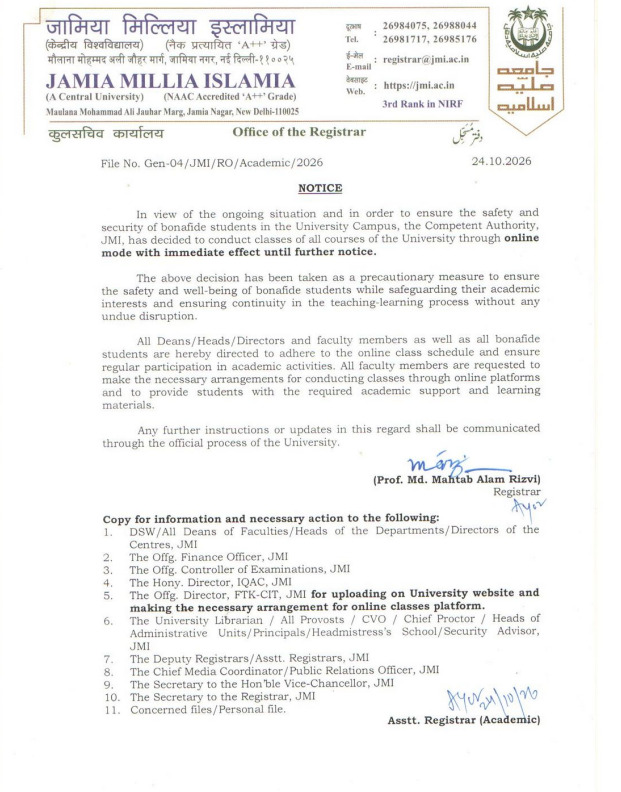
The continuous disruption forced the university to shift all classes online after protesters created chaos on the campus. On Saturday, 24th October, the university shifted classes to online mode amid security concerns and escalating tensions on campus. The decision was described by the administration as a precautionary measure intended to protect students and allow teaching to continue without further disruption.
The situation inside Jamia had deteriorated over the weekend as the student agitation entered its 14th day on Sunday, 25th October. The campus saw over 100 security personnel on duty, while several protesters tried to enter the premises by climbing over walls fitted with barbed wire and metal spikes. Scuffles broke out between protesters and security personnel, accompanied by loud rallies and sloganeering. Demonstrators on a hunger strike locked themselves inside the Department of Political Science to prevent authorities from breaking their fast.
Even after classes were moved online, tension remained high, with over 500 students assembling to support the stir on Sunday. Key campus hubs, including the area near Gulistan-e-Ghalib, the central library, and the university canteen, were completely cordoned off from outside access, with regular students barred from entry.
Security personnel from the Delhi Police, CRPF, CISF, and ITBP guarded points both inside and outside the varsity. A senior police officer told The Indian Express, “About 150 to 200 security personnel were deployed outside the campus. Three people, who were not students, were detained from outside.”
FIR against Congress MPs for inciting unrest
In response to the disruption, the Delhi Police filed a formal First Information Report (FIR) following a complaint by the university administration. The FIR explicitly named Congress Lok Sabha MP Imran Masood and Rajya Sabha MP Imran Pratapgarhi, accusing them of trespassing on the campus premises and inciting unrest among the student body.
The university administration publicly stated that political leaders visited the campus to exploit the situation, turning student grievances into fodder for a political narrative. Registrar Mahtab Alam Rizvi stated that the two Congress MPs disrupted the peace on campus by sneaking in over a boundary wall. He pointed out that MP Imran Masood visited the campus on Friday, 23rd October, under the guise of supporting the student stir, but went on to publicly demand “justice” for Islamist Sharjeel Imam, who faces charges in the larger conspiracy case tied to the February 2020 anti-Hindu Delhi riots.
Meanwhile, student groups like AISA counter-alleged that university security had assaulted students during negotiations.
Controversial slogans surface on Campus walls
While the demonstration originally began under the banner of student representation and union elections, the movement quickly took a controversial turn as familiar radical narratives emerged. In line with a recurring pattern seen in left-led campus agitations, the core administrative issues were soon overshadowed by provocative, divisive, and anti-Hindu graffiti scrawled across university property.
What was framed as a fight for democratic rights transformed into a display of ideological hostility, with campus walls defaced with inflammatory slogans such as “Free Kashmir,” “Free Sharjeel Imam,” “Death to RSS,” and “Death to ABVP”. Rather than fostering constructive dialogue, the organisers allowed the agitation to degenerate into open provocation, echoing radical rhetoric and targeting specific organisations to incite ideological friction on campus.
Delhi: A controversy has erupted after slogans such as ‘Free Kashmir’ and ‘Free Sharjeel Imam’ were found written on the walls of Jamia Millia Islamia University. Slogans targeting the RSS, ABVP and the university’s Vice-Chancellor were also found on the walls. The ABVP has objected to the incident and demanded action
— IANS (@ians_india) October 23, 2026
The university administration moved quickly to remove these slogans using chemical agents and noted that CCTV wiring had been tampered with or cut in the specific areas where the graffitied slogans appeared.
The slogan referring to Sharjeel Imam came at a time when anti-India Islamist Sharjeel Imam is back in the news for a recent interview with the Islamo-leftist propaganda portal ‘The Quint’ published on 29th September, 2026.
While the core demands of the student movement focused on restoring the Jamia Millia Islamia Students’ Union (JMISU), establishing a time-bound election schedule, revoking disciplinary actions, and probing security excesses, the appearance of these political slogans added a volatile layer to the protest.
Jamia’s history of violent protests
Jamia Millia Islamia has a history of violent protests. Most notably, the centrally-funded institute was the epicentre of anti-CAA protests in 2019, which claimed the lives of more than 50 people and resulted in around 100 injuries, with students threatening the administration during the unrest. As the protests started on campus, the college administration shut down the canteen and the library and suspended classes. However, this move enraged the protesting students, who accused the administration of suppressing their right to express and organise protests.
AISA issued a statement regarding this and targeted the administration for imposing alleged restrictions: “On December 15, 2019, Delhi Police injured our friends, vandalised our campus, and treated us like terrorists. Today, they are preventing us from even remembering that horrific day.” Several videos of the protests circulated on social media in which protesting students could be seen raising slogans against the Delhi Police deployed outside the campus, claiming the campus was put under lockdown and entry and exit were restricted, with chants like “Delhi Police Go Back” and “Hum kya chahte? Azadi”.
Although students claimed the facilities were shut down to stifle dissent, the administration clarified that maintenance and ongoing construction were the primary reasons for restricted movement.
The 2019 anti-CAA protests at Jamia began on 12th December and turned violent by 13th December. Enraged protesters at Jamia and AMU, including several Muslim groups, attacked public transport systems to show resentment against the Centre. By 14th December, the situation worsened as students at Jamia Millia Islamia became violent amidst chants of Allahu Akbar and Naara-e-Taqbeer, leaving 12 police personnel injured.
Why the elections were suspended
The fundamental issue driving the current unrest is the two-decade ban on student union elections. Jamia Millia Islamia dissolved its central students’ union on 31st March, 2006, shutting down elected student representation due to frequent physical clashes, administrative impasses, and severe academic disruptions. The union had only briefly been restored in December 2005 under former Vice-Chancellor Professor Mushirul Hasan after an earlier hiatus lasting from 1996.
The 2006 decision was driven by chronic indiscipline and constant overreach by union leaders into non-academic administrative functions, including admission procedures, hostel room allocations, and student disciplinary inquiries. The university administration maintained that union representatives regularly exceeded their authority, attempted to dictate institutional policies, and intimidated faculty and administrative staff.
These power struggles routinely escalated into physical violence. In 2006, clashes broke out involving student factions and the proctorial board, leading to an assault on then Proctor Rocket Ibrahim. Following severe violence in July 2006 that forced an indefinite closure of the university, the administration barred outgoing union president Shams Pervez and several other student leaders from entering campus. In an official response submitted to the Rajya Sabha in 2012, the university formally recorded that the union was dismantled after repeated violent events, culminating in physical threats and an attack directed at the Vice-Chancellor.
Administrative figures argued that campus-wide political elections introduced muscle power, factionalism, and external party politics into an academic environment. Successive Vice-Chancellors, including Najeeb Jung (2009–2013), consistently refused to revive the central student union, choosing instead to implement decentralised “subject associations.” Under this system, students elected departmental representatives by secret ballot strictly to manage academic seminars, guest lectures, and cultural events without engaging in central university politics.
Left-wing groups calling for further unrest
As the current agitation enters its 16th day on Tuesday, the campus remains locked in uncertainty. By leveraging the ongoing agitation as political currency, left-wing student groups, including AISA, SFI, and NSUI, have effectively driven Jamia Millia Islamia into an operational gridlock, prioritising aggressive ideological posturing over institutional peace and academic stability.
Even after the university’s conditional offer to hold elections within 15 days of approving a new constitution, these radical student factions rejected the agreement, choosing instead to escalate tensions and prolong campus unrest. Their persistent disruption forced the administration to shift online classes until 8th November, holding regular academic progress and upcoming examinations hostage to fuel their political agenda.


