

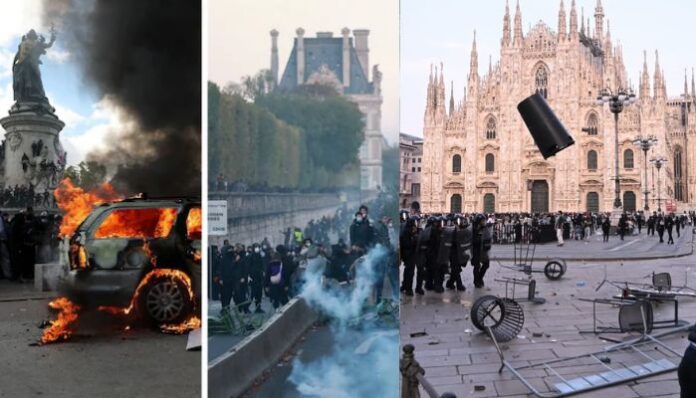
The initially portrayed student protests in France have now escalated into widespread violence, with shops looted, public buildings attacked, and a historic town hall set ablaze. Similar scenes unfolded in Italy, where demonstrators clashed with police in central Milan, forcing shops to close and tourists to flee.
On Saturday, 17th October, violent clashes broke out across France, spreading through Paris and several other major cities. Masked rioters attacked shops and public buildings, set fires and confronted riot police, while security forces used tear gas and water cannons to disperse crowds.
Massive protests in France against the high cost of living and the deterioration of public services. https://t.co/H3FUK6kcvC
— Globe Eye News (@GlobeEyeNews) October 18, 2026
In Paris, tens of thousands marched through the city’s eastern and northern sectors, chanting slogans like “Everyone hates the police” and “Macron, resign”. Riot police deployed tear gas and water cannons at major gathering points like Place de la République and Place de la Nation to break up violent crowds. Several central Metro stations were shut down, and strict security cordons were set up around the Champs-Élysées, government centres, and the presidential Élysée Palace to prevent protesters from storming official premises.
Des milliers de projectiles ont été lancés contre les forces de l’ordre Place de la République à Paris. #17octobre #Paris https://t.co/OxIN36C3vJ
— Luc Auffret (@LucAuffret) October 17, 2026
In Lyon, anarchists set the city’s tourism centre on fire, prompting riot police to use tear gas and water cannons. In Marseille, demonstrators entered the municipal headquarters, overturned a bust of Marianne, a national symbol of France, and smashed furniture and television sets, and spray-painted anarchist symbols before police cleared them out. In Lille, protesters broke into the mayor’s office and vandalised the premises.
Alors, Emmanuel Macron, les policiers manquent toujours d’empathie ? À Marseille, des criminels veulent à tout prix tuer un flic 🇫🇷 ! Regardez les images : les voyous tentent d’ouvrir les véhicules de police pour s’y introduire. À force d’accuser, d’insulter et de désarmer la police, voilà le résultat ⤵️
— Matthieu Valet (@mvalet_officiel) October 17, 2026
Looters also targeted high-end retail outlets like Apple, Louis Vuitton, and Hermès in Bordeaux and Paris, setting fire to parked vehicles and erecting burning street barricades.
Des véhicules de police sont prises pour cible par la foule dans le secteur République à Paris. #Paris #17octobre https://t.co/yMReav1Tie
— Luc Auffret (@LucAuffret) October 17, 2026
The most tragic symbol of this destruction occurred in the city of Limoges, where the 143-year-old historic town hall (Hôtel de Ville) was set ablaze by rioters. Built in 1883, the landmark’s decorative clock tower collapsed late Saturday night as crowds watched and cheered.
This is the moment a town hall collapsed as protests sweep across France. The 140-year-old town hall in the French city of Limoges caught fire during protests in the city Read the latest on the Sky News website and app: https://t.co/oaLTf7aDbP https://t.co/3OC3eU3Hf7
— Sky News (@SkyNews) October 17, 2026
French Interior Minister Laurent Nuñez confirmed over 1,200 arrests nationwide, including around 110 in Paris, attributing much of the targeted vandalism to far-left militants operating on the fringes of peaceful demonstrations.
Prime Minister Sébastien Lecornu condemned the destruction, saying, “Peaceful protests have their full place in our Republic. Looting and attacks have none.”
President Emmanuel Macron echoed this stance on social media, writing: “There is no place for violence in the Republic. Those who broke, attacked and looted will be brought to justice and punished.”
Aucune place pour la violence dans notre République. Ceux qui ont cassé, attaqué les préfectures comme les commerces, pillé jusqu’à nos mairies, seront poursuivis et punis. Aux forces de l’ordre, garantes du droit à manifester, je dis le soutien de la Nation. Nous ferons tous bloc face aux semeurs de chaos, qui ne cherchent qu’à abattre nos institutions et empêchent ceux qui expriment pacifiquement leurs revendications de le faire.
— Emmanuel Macron (@EmmanuelMacron) October 17, 2026
Italy: Clashes empty Milan’s central shopping district
The wave of street agitation quickly crossed the border into Italy, where similar scenes of chaos unfolded in central Milan. Demonstrations that were ostensibly organised against wars and the rising cost of living rapidly escalated into violent riots outside the iconic Milan Cathedral (Piazza del Duomo).
The ‘student protests’ have spread to Italy, where Muslim rioters are rampaging outside Milan Cathedral (the Duomo) and trying to set it on fire. This is a religious war of conquest against Europe, Christianity, and Western civilization as a whole. https://t.co/qx1JLnQyqc
— Dr. Maalouf (@realMaalouf) October 17, 2026
Masked rioters threw paving stones, rocks, and improvised missiles at riot police, erecting barricades out of outdoor cafe tables and setting them on fire. A Carabinieri police vehicle was severely damaged during the melee. Security forces responded with tear gas and water cannons to clear the crowded square and protect the landmark shopping arcades.
BREAKING: Massive riots have now also broken out in Milan, Italy. An alliance of migrant gangs and Antifa extremists is attacking police officers and setting fires in front of the Milan Cathedral (Duomo) https://t.co/yh8sbPWmsS
— Visegrád 24 (@visegrad24) October 17, 2026
The violence resulted in injuries to at least two police officers and the detention of around 50 agitators. Expressing strong disapproval of the disorder, Italian Prime Minister Giorgia Meloni posted on social media: “Demonstrating is a right. Setting our cities ablaze is not,” condemning the “hooligans who exploit demonstrations to sow chaos, attack those responsible for ensuring security and hold entire cities hostage.”
Ho grande rispetto per le migliaia di persone che oggi hanno manifestato pacificamente, anche partecipando alla mobilitazione indetta dalla CGIL che ha visto anche la partecipazione dei leader della sinistra. Qualunque siano le idee per le quali si manifesta, la partecipazione è alla base di qualunque sana democrazia. Dall’altro lato, però, non possiamo ignorare quanto accaduto in altre piazze italiane. A Milano, come mostrano queste immagini, lanci di pietre contro le Forze dell’Ordine, agenti feriti, danneggiamenti e violenze che hanno costretto a interrompere il corteo. A Torino sono state fermate persone con sanpietrini e martelletti frangivetro. A Bologna i disordini hanno portato alla chiusura precauzionale della stazione ferroviaria. Teppisti che sfruttano le manifestazioni per seminare il caos, aggredire chi garantisce la sicurezza e tenere in ostaggio intere città. Manifestare è un diritto. Mettere a ferro e fuoco le nostre città non lo è. Rinnovo la mia richiesta alle opposizioni: non siano ambigue su questo. Condannino senza ambiguità queste violenze e lancino un appello chiaro affinché ogni mobilitazione sia pacifica. Di fronte a scene del genere, il rifiuto deve essere unanime. Ogni reticenza diventa giustificazione. Il silenzio non è accettabile.
— Giorgia Meloni (@GiorgiaMeloni) October 17, 2026
Milan Mayor Giuseppe Sala noted that while “the reasons for the protests were understandable,” the “violence against law enforcement and serious damage to the city are not justifiable.”
The Indian parallel: CJP’s attempted anarchy and the July protests
While European cities are grappling with rampant street violence, similar tactics were attempted in India by the Cockroach Janta Party (CJP). Operating under the guise of student protests over allegations surrounding the NEET paper leak and demands for the resignation of the Union Education Minister, the group attempted to incite widespread public unrest first in New Delhi and subsequently across the nation.
During protests at Jantar Mantar and near Parliament, CJP organisers pushed demonstrators into violent confrontations with law enforcement. On 20th July, supporters of the party turned a march toward Parliament into a violent clash near Kerala Bhawan. Despite the Delhi Police explicitly denying permission for the march, protesters charged at security barricades, attempted to breach the security perimeter, and pelted stones and bottles at police personnel. The Rapid Action Force (RAF) was forced to execute lathi-charges to restore public order and maintain the safety of the capital’s central administrative zones.
#WATCH | Delhi | Protesters gathered for CJP’s protest march clash with RPF personnel at Jantar Mantar; RPF personnel & police use lathis for crowd control https://t.co/gijaCjJksW
— ANI (@ANI) July 20, 2026
In response to the growing threat of street violence, the central government granted preventive detention powers under the National Security Act (NSA) to Delhi Police Commissioner Anurag Kumar. A notification in the Delhi Gazette gave the police chief authority under Section 3(2) of the Act to issue preventive detention orders from 19th July to 18th October against individuals posing a threat to public security and national order. The Delhi Police subsequently clarified that such NSA delegations are routine administrative renewals, but the preventive powers allowed law enforcement to keep a strict check on professional agitators.
The matter eventually reached the Supreme Court, which on 1st September quashed blanket FIRs registered against the general pool of protesters to distinguish casual participants from habitual offenders. However, the apex court added a critical condition: the Delhi Police remained fully authorised to investigate and take strict legal action against 2,873 agitators identified via facial recognition technology who possessed serious prior criminal antecedents and were involved in acts of violence or property damage during the demonstrations.
Preventative action: Foiling European-style chaos in New Delhi
Having observed how student-led demonstrations were manipulated into violent uprisings in European cities as well as regime-change disruptions in neighbouring countries like Bangladesh and Nepal, the central government and the Delhi Police took firm preventive steps to ensure New Delhi did not suffer a similar fate.
On 10th October, CJP founder Abhijit Dipke and co-conveners Saurav Das and Ashutosh Ranka were detained by Delhi Police immediately upon landing at Indira Gandhi International Airport. The party had planned an unpermitted mass demonstration at Jantar Mantar targeting Chief Election Commissioner Gyanesh Kumar over electoral roll revisions (Special Intensive Revision).
Following his detention, Dipke held a press conference where he criticised the security arrangements, claiming that police presence and traffic restrictions had disrupted life in the national capital. He further alleged that several opposition leaders who supported the demonstrations, including Rahul Gandhi, Mamata Banerjee, Arvind Kejriwal, and Pinarayi Vijayan, had been detained, and questioned the security provided to the Chief Election Commissioner.
Inflammatory rhetoric: Leftists’ calls for bloodshed and regime change
While the Central government is putting all its efforts to prevent chaos in the country, leftists like Prashant Bhushan and Neha Bora are openly calling for violence, bloodshed and regime change.
During an X Spaces audio discussion on 11th October, Supreme Court advocate and former AAP leader Prashant Bhushan openly discussed street uprisings, stating: “The only way to get back power is revolution.” He went on to remark in Hindi, “Problem ye hai na ki dekho, aur hamare paas options kya hain? Options toh yehi hain ki bhai hum revolution ke through kuch kara lein. Ab us revolution mein toh bahut khoon kharaba hoega” (The problem is, what other options do we have? The only option is to bring about something through a revolution. Now, in that revolution, there will be a lot of bloodshed).
Prashant Bhushan, Supreme Court advocate who is marching with Rahul Gandhi & part of Congress ecosystem says-" What option we have except Street Revolution. Bloodshed can also happen" Congress ecosystem is a big threat to Indian Democracy! People of India are fighting these out of power Anarchist! Congress ecosystem is exploring violence for regime change!
— Pradeep Bhandari(प्रदीप भंडारी)🇮🇳 (@pradip103) October 12, 2026
Days later, on 15th October, Bhushan reiterated his stance to reporters, openly stating that the agitations were aimed at regime change: “There will definitely be a regime change. We all want a regime change. Is there anything wrong with that?”
Delhi: Advocate Prashant Bhushan says, "There will definitely be a regime change. We all want a regime change. Is there anything wrong with that?…" https://t.co/vUDowEBAI8
— IANS (@ians_india) October 15, 2026
Similarly, far-left anarchist and National President of the All India Students Association (AISA), Neha Bora, publicly cited the August 2024 “Gen-Z movement” in Bangladesh as an inspiration for Indian demonstrations.
Bora expressed a desire to replicate similar events in India after receiving support from anti-India Bangladeshi figures like Nahid Islam. Further highlighting her apparent admiration for such destructive turmoil, she was recently seen wearing a red T-shirt emblazoned with the Jolly Roger symbol of the Straw Hat Pirates from the popular “One Piece” manga, which has been prominently linked to deadly uprisings across Asia and the world, including Nepal, Indonesia and the Philippines.
The leftist ecosystem in India has been obsessed with the fantasy of somehow imposing a similar model to Bangladesh and Nepal in India to oust the democratically elected Modi government. Starting unrest under the guise of student protests, then damaging property and creating chaos in the country, and then calling for bloodshed and regime change.
Modi government prevents European-style riot scenes
The sequence of events highlights a recurring strategy utilised by radical elements: invoking student issues to gather initial crowds, escalating the situation through property damage and police confrontations, and ultimately using the resulting chaos to demand non-constitutional regime change. While self-proclaimed defenders of democratic institutions cite constitutional values when convenient, their willingness to endorse destructive street tactics risks plunging urban centres into anarchy.
Through timely intelligence, strict enforcement of law and order, and proactive preventive detentions from June through October, the Modi administration and the Delhi Police prevented arson, looting, and widespread damage to public property. By holding bad actors accountable and keeping street agitation from spiralling out of control, Indian law enforcement successfully prevented New Delhi from mirroring the destructive scenes seen in Paris and Milan.


