

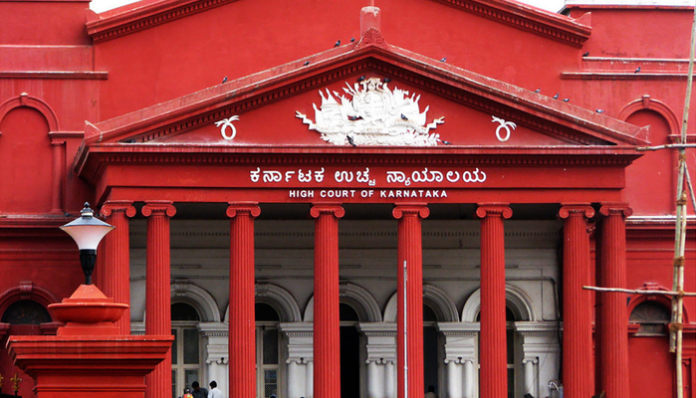
The Karnataka High Court on Tuesday (November 17, 2026) stayed the investigation into 3 FIRs filed against 10 individuals over allegations that they attempted to get the names of some voters, including Muslim voters, removed using Form 7 applications during the Special Intensive Revision (SIR) of voter rolls in the State.
Staying the investigation in the FIRs, a Single Bench of Justice Anant Ramanath Hegde said the Election Commission should first examine the validity of the Form 7 applications under the Registration of Electors Rules, 1960 before the police investigation proceeds.
The order was passed on three petitions filed by 10 individuals, including Harish Kumar C, Deepak Singh R, and G S Vasantha Lakshmi, seeking quashing of FIRs filed against them. Earlier, on October 9, 2026, the High Court had granted interim protection to petitioners Deepak Singh R and G S Vasantha Lakshmi(Deepak Singh R v. State of Karnataka and G S Vasantha Lakshmi v. State of Karnataka) by staying the criminal proceedings. The court had allowed the state to seek modifications in the stay order. In the fresh development, the court extended the stay in the two petitions and granted a fresh stay in Harish Kumar C and Others v. State of Karnataka.
What were the FIRs about?
The FIRs were filed based on complaints of alleged misuse of Form 7 applications seeking deletion of names of several voters, particularly Muslim voters, in Malleshwaram, Jayanagar, Yeshwanthpur, Kodagu and Mysuru constituencies. The complainants alleged that the Form 7 applications were filed with malicious intentions, particularly targeting Muslim voters in the constituencies.
The petitioners rejected the allegations and challenged the validity of the FIRs, arguing that the Form 7 objections were raised in line with the law. They contended that the criminal investigation was not warranted as it should be preceded by an examination of the objections by the electoral authorities. The Court examined rules under the Registration of Electors Rules, 1960 relating to scrutiny of claims and objections, inquiry, hearing of the persons concerned and a decision by the Registration Officer. Here is what the court observed in each petition:
Harish Kumar C and Others v. State of Karnataka
The petitioners sought quashing of an FIR registered on October 1, 2026, at Narasimharaja Police Station, Mysuru under Sections 192, 196, 3(5), 318(4), 336(3), 336(4), 353 and 61(2) of the BNS. The FIR was lodged over complaints containing allegations that the petitioners, including Dr Anil Thomas, President of the BJP Minority Wing, had filed Form 7 applications seeking to target Muslim voters.
The complainants alleged that the petitioners filed Form 7 applications based on incorrect information. They further alleged that the Form 7 applications were aimed at deleting the names of eligible voters belonging to a particular religious community who are loyal voters of a political party.
The petitioners sought quashing of the FIR, arguing that Booth Level Agents are authorised to submit Form 7 objections. They added that the Electoral authorities must first examine the applications and that criminal investigation before the statutory inquiry is premature.
The High Court examined Rules 5 to 23 of the Registration of Electors Rules, 1960, and explained the statutory procedure for revising electoral rolls. The Court distinguished between Form 6 and Form 7 applications. It observed that while Form 6 applications, which are meant for seeking inclusion of a name, must be signed by the person seeking inclusion, Form 7 applications are made for raising an objection to the inclusion of another person’s name and can be filed by anyone whose name is already on the electoral roll.
The High Court further observed that the statutory scheme requires the Registration Officer to conduct a scrutiny of claims and objections, and grant an opportunity of hearing to the persons concerned, before making a decision on a Form 7 objection. The court said that the principal allegation was that incorrect information had been furnished in Form 7 applications. The court said that the Registration Officer is required to examine the correctness of information enclosed in the Form 7 applications.
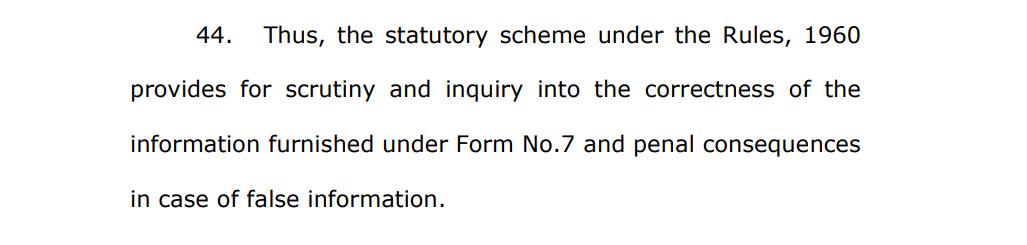
The court said that if the Registration Officer finds that the information in Form 7 applications is false, it will attract action under Section 31 of the Representation of the People Act, 1950, which punishes knowingly making a false written declaration in connection with the preparation, revision or correction of electoral rolls.
The High Court held that there was no justification for a criminal investigation to precede an examination of Form 7 applications by the electoral authorities. Directing the criminal investigation to be stayed, the High Court said that further decision on quashing the FIR or allowing the investigation to continue would be made based on the findings of the Registration Officer.
Deepak Singh R v. State of Karnataka
This petition challenged an FIR registered on October 5, 2026, at Yeshwanthpura Police Sub-Division under Sections 319(2), 336(2), 340(2), 61(2) and 217(b) of the BNS. The FIR was lodged based on a complaint alleging that the petitioners filed around 136 Form 7 applications, targeting a particular community, with the intention to manipulate the electoral rolls and disenfranchise eligible voters.
It further alleged that though all the applications were made by the same person, the signatures on several forms did not match, which indicated that they were forged. The complainant also questioned the information contained in the applications, alleging that it was false and attracted action under Section 217 of the BNS. The complainant sought an investigation into whether the Forms were filed by impersonating and creating false records and by furnishing false information relating to the voters whose names are sought to be deleted.
The petitioner challenged the FIR, arguing that the applications were filed by Booth Level Agents on behalf of political parties and that any alleged discrepancy, error or false information should first be examined by the Registration Officer. The petition also pointed out that none of the persons regarding whose names the objections were made filed a complaint against the petitioner.
Notably, the High Court had already granted interim protection to the petitioner from criminal proceedings on October 9, 2026. It has allowed the state to seek modification of the interim order.
After examining the material on record, the High Court distinguished between forgery and impersonation. It observed that the signatures alleged to have been forged are neither those of the complainant nor those of the voters whose names are sought to be deleted. The court noted that the petitioner has not disowned his own signatures on the Forms and therefore a case of forgery was not made out at this stage. “That being the position, in the facts of the present case, the allegation of forgery cannot be accepted at this stage,” the court stated.
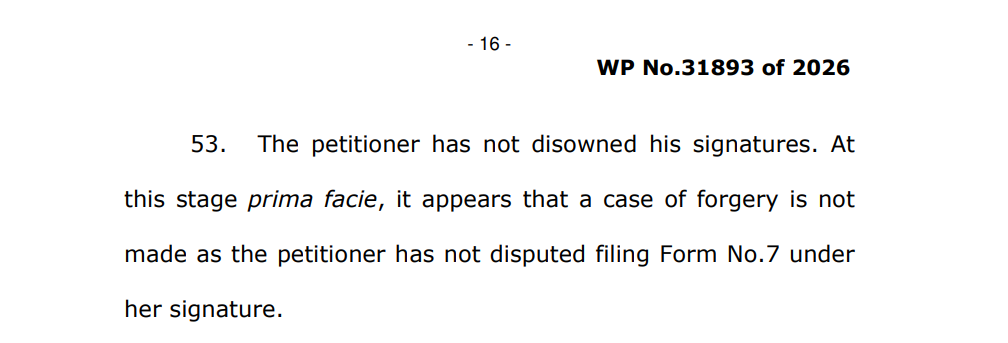
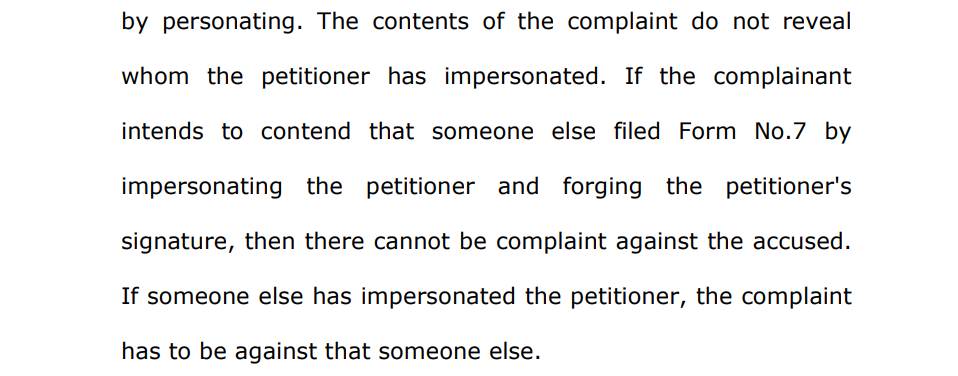
The High Court clarified that if the complainant claims that the applications were made by impersonation, then the complaint should be made against the impersonator and not the petitioner, who had admitted to having made the applications and having signed them. The petitioner’s admission defeats the claim of impersonation as well.
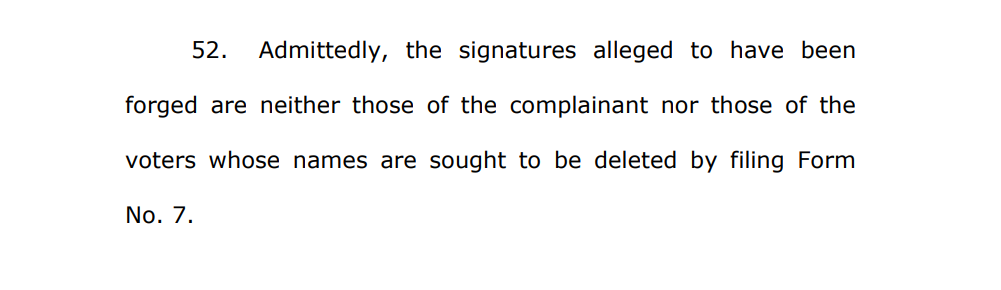
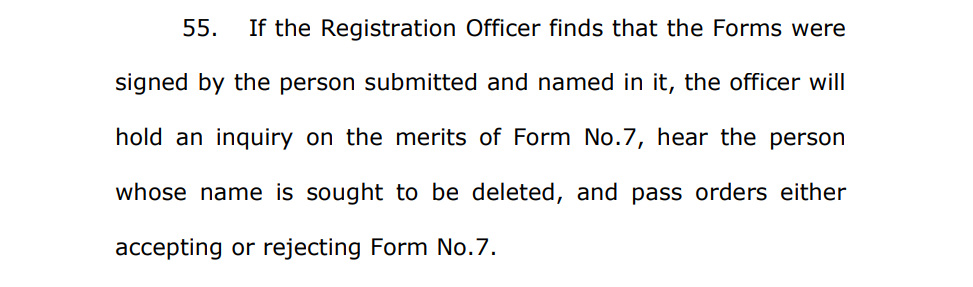
The High Court directed the Registration Officer to first ascertain whether the person who made the applications had actually signed all the forms. It further said that if, during the Registration Officer’s inquiry, the petitioner disowns his signatures, in that case an investigation into claims of impersonation can be initiated, but not at the present stage.
Regarding the allegation of furnishing incorrect or false information in the applications, the High Court said that the Registration Officer first needs to determine that the information is incorrect. The finding will determine the future course of action on the allegations.
The High Court maintained its stay on the criminal investigation pending an inquiry by the Registration Officer and deferred the state’s request seeking vacation of its earlier stay order.
G S Vasantha Lakshmi v. State of Karnataka
In this petition also, the petitioner was granted interim protection by the High Court pending the hearing of the petition. The petition sought quashing of an FIR registered on October 2, 2026, at Vyalikaval Police Station, Bengaluru under Sections 61, 217, 319, 335, 336 and 340 of BNS. The FIR was filed based on the complaint alleging that the mass Form 7 applications were filed as part of a “systematic attempt”, targeting voters from the minority community to interfere with the electoral roll and delete the names of genuine and eligible voters.
This complaint also made similar allegations of forgery as made in the case of Deepak Singh R. It alleged that the signatures of G S Vasantha Lakshmi, the BJP Booth Level Agent who filed the applications, differed across the 778 Form 7 applications. Advocate General K Shashi Kiran Shetty and State Public Prosecutor B N Jagadeesha, appearing for the state, argued that the Election Commission was not empowered to investigate allegations of forgery and creation of fake documents. They added that the disclosed cognizable offences and police investigation were necessary.
In the petition, the High Court’s reasoning was substantially similar to its reasoning in Deepak Singh’s case. The High Court reasoned that if somebody else, as alleged, had filed the applications by impersonating Vasantha Lakshmi, the complaint should be directed against that person. But the court noted that the petitioner has not disputed the presence of her signatures on the applications and therefore the offence of forgery was not made out at this stage.
The High Court reiterated that the Registration Officer must ascertain whether the person named in the applications actually signed them.
The High Court said that if the petitioner acknowledges signing the applications but the signatures differ, the Registration Officer should seek an explanation. If the explanation is unsatisfactory, the applications may be rejected. But if the applications are found to have been signed by the petitioner, the officer must examine the merits of the objections and hear the affected voters.
After examining all the submissions, the High Court maintained the stay on investigation against the petition and deferred the state’s application for vacating the stay order. In all three petitions, the High Court directed the Election Commission to place the materials relating to the decisions taken on Form No.7 filed by the petitioners.
The Election Commission of India (ECI) rolled out the nationwide Special Intensive Revision (SIR) of electoral rolls across 32 States and Union Territories (covering 26 states and 6 UTs) in three phases starting in mid-2025. The SIR is a routine and necessary revision of electoral rolls undertaken by the Election Commission to update the country’s voter list by removing the names of deceased, invalid, ineligible and bogus voters, including illegal immigrants who have been living in the country using forged documents. The exercise is important as it ensures that rightful citizens get to choose who rules the country.
However, since the beginning, the SIR has been a target of the Opposition parties, which have been trying to obstruct the process by raising suspicions about the Election Commission. The Opposition has unsuccessfully tried to manufacture a popular resentment against the SIR, which was approved and upheld by the top court of the country. Over the past few months, the Opposition has tried to execute a vicious regime change operation against the Modi government in the name of demanding accountability from it and the Election Commission for alleged discrepancies in the SIR.


