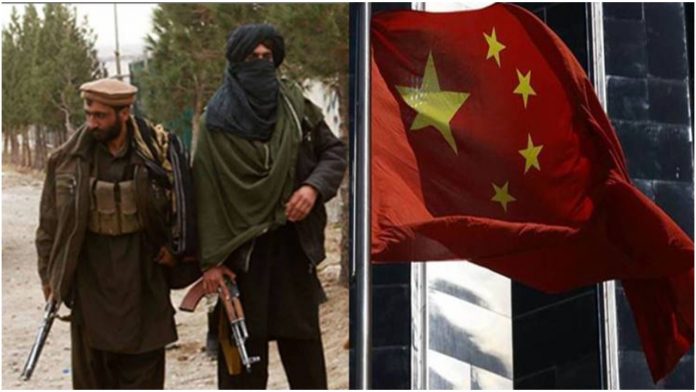
Amidst the withdrawal of US forces from war-torn Afghanistan, the Taliban has said that it sees China as a “friend” to Afghanistan and hoped that China invests in the reconstruction of the war-torn country.
Speaking to South China Morning Post, Taliban spokesperson Suhail Shaheen said the radical Islamic group now controls 85 per cent of Afghan territory and would guarantee the safety of Chinese investors and workers. The comments came at a time when the Taliban has been making huge territorial gains in the war-torn country amidst US forces’ withdrawal, threatening the progress the country made in the last two decades.
During the interview, Shaheen said that the Taliban has assured China that it would not host Uyghur militants from the Xinjiang province, some of whom had previously entered Afghanistan to escape from Chinese persecution. The Taliban would also prevent al-Qaeda or any other terrorist group from operating there, he said.
Reportedly, China is concerned that Afghanistan, under Taliban rule, may become a hub for the East Turkistan Islamic Movement (ETIM), a separatist outfit aligned to Al-Qaeda, which is leading an insurgency in Xinjiang autonomous area. The northwest Xinjian region, which is home to Uyghur Muslims, shares about an 8- km-long border with Afghanistan.
“We have been to China many times and we have good relations with them,” Suhail said while speaking to Hong Kong-based South China Morning Post, as he recalled his frequent trips to China as part of Taliban delegations.
Taliban views China as a friendly country and we welcome it for reconstruction and developing Afghanistan, said Suhail Shaheen, adding that “If (the Chinese) have investments, of course, we will ensure their safety”.
China looking to make investments in Afghanistan
China is looking to make big-ticket investments in Afghanistan as it is home to one of the world’s largest unexploited reserves of copper, coal, iron, gas, cobalt, mercury, gold, lithium and thorium, valued at more than US$ one trillion. China has already invested in oil exploration and mining in Afghanistan. In 2011, the China National Petroleum Corporation (CNPC) won a US$400 million contract to drill three oil fields for 25 years, containing about 87 million barrels of oil.
In addition, some Chinese firms have also gained rights to mine copper at Mes Aynak in Logar province. However, observers believe that China will remain very cautious and concerned about the Taliban delivering on its promises. Experts believe that China’s biggest concern in its dealings with the Taliban will always be the Taliban’s indirect support for was sheltering Uyghur Muslims.
The ongoing persecution against Uyghurs in Xinjiang has angered the native Uyghur Muslims in Xinjiang, who are crossing the border towards Afghanistan. The US, the EU and several international human rights organisations have accused Beijing of committing genocide in the province, however, China is keen to keep its Muslim population in check for security reasons.
Meanwhile, China has reacted strongly against the US decision to pull out its troops without achieving any substantial peace process in Afghanistan. Earlier this week, China had asked its close ally Pakistan to step up cooperation in Afghanistan to contain the possible security risks in Afghanistan after US forces withdraw.
“(China and Pakistan) need to defend regional peace together. Problems in Afghanistan are practical challenges that China and Pakistan both face,” Chinese Foreign Minister Wang Yi said on Tuesday, addressing a meeting of the 70th anniversary of diplomatic relations with Pakistan.
It is expected that the withdrawal of American troops and resurgence of the Taliban will strategically benefit China as the Taliban shares close ties with Pakistan, one of the patrons of the radical Islamic terror group, which now hold power in the warn-torn country.
Taliban takes control of Afghanistan after US forces pull out, India evacuates its citizens
As the US forces prepare to exit Afghanistan after 20 years since the 9/11 attacks, the Taliban takes control of at least 85 per cent of the war-torn country. According to local officials, Taliban fighters, stirred by the withdrawal, have already captured vital districts across the country.
Thousands of Afghan security personnel and refugees have continued to flee from Afghanistan across the border to neighbouring countries of Iran and Tajikistan, inviting large scale humanitarian concerns. The crisis has fuelled a concern across the world about the imminent takeover of the country by the radical Islamic group, whose members could infiltrate Central and South Asian countries.
In the view of the Taliban fighters rapidly seizing control of the region, triggering security concerns, the Indian government is taking necessary precautionary measures and have evacuated around 50 diplomats, and other staff members working at the Kandahar consulate in Afghanistan.
In the wake of a security threat, the Indian government has also temporarily closed the Kandahar consulate. The personnel were flown out on an Air Force plane. Earlier, the Ministry of External Affairs said India was carefully monitoring the deteriorating security situation in Afghanistan and its implications on the safety and security of Indian nationals.
A large number of Taliban terrorists, joined by Pakistan-based Lashkar-e-Taiba, have been present in the southern provinces of Kandahar and Helmand. This has resulted in the Indian government’s decision to pull out the diplomats and security personnel from the city. According to a recent estimate, more than 7,000 Lashkar fighters are fighting alongside the Taliban in southern Afghanistan.