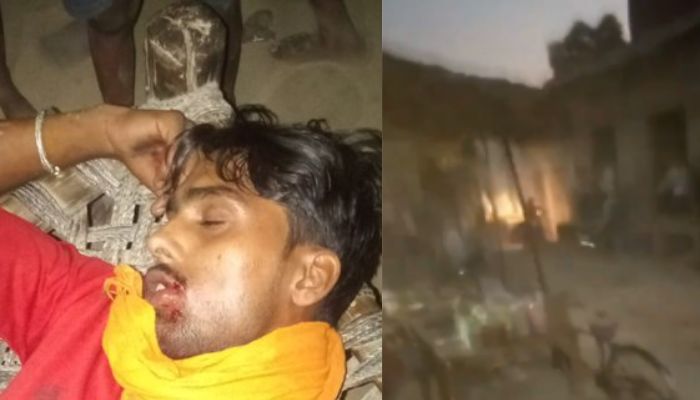
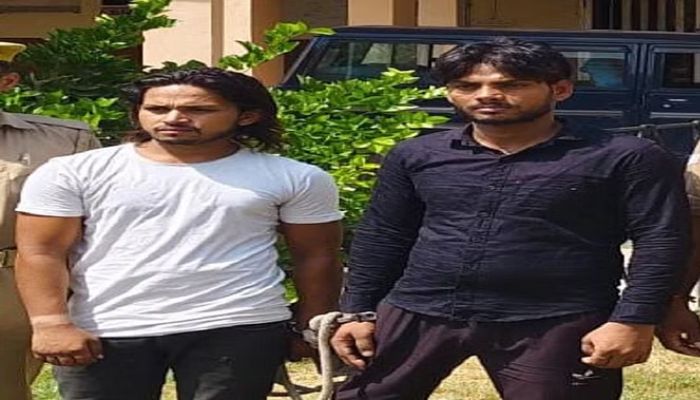
On the 17th of June, a Hindu man named Jaipal was brutally attacked by several Muslim youths in Uttar Pradesh’s Moradabad over an allegation that the victim’s brother Mahendra Singh who runs a tent house shop in Udmawala village in Bhagatpur Police Station precinct, had given them a defected burner gas stove’s pipe deliberately. The police have arrested 12 including Ilyas, Bhura, Irfan, Arman, Mohammad Evdesham, Fakira, Mahfooz, Muslim, Rashid, Munajir, Anas, Nadeem, Basim in this matter.
OpIndia has accessed the FIR copy of the case. The FIR states that the incident unfolded at around 7:30 pm on Monday when the accused Muslim youths arrived at complainant Mahendra Singh’s shop along with the gas pipe they bought from his shop and sticks. Mahendra alleged that the accused persons started abusing him and said, “You have deliberately given us the leaking pipe for the burner gas stove to burn us alive.”
The complainant tried to explain to the accused persons that he had checked the pipe before giving it to them. Soon after, Mahendra’s cousins Jaipal and Rajveer also arrived at the spot. Mahendra alleged that despite his efforts to convince the accused persons, they attacked him and his cousins with the iron pipe and sticks. The FIR says that accused Ilyas hit Jaipal with the iron pipe on his head and mouth with the intention to kill him. After this, victim Jaipal fell unconscious.
BREAKING: Islamists suddenly attacked, pelted stones, and allegedly looted the shop of Jaipal.
Jaipal has been seriously injured in the incident.
“When my aunt Kalavati heard the noise, she came to help him and the other people. They started kicking, punching and beating her with sticks leaving her injured”, complainant Mahendra said. One of the accused attempted to allegedly kill Mahendra by grabbing his neck. “As I tried to flee from the spot, the attackers hurled bricks and stones. We were rescued by locals. Jaipal was then taken to Bhojpur Hospital after dialling 108. These people were shouting in the streets that they would not leave us alive today,” Mahendra said in his complaint to the police and demanded stringent action against the accused persons.
प्रकरण के संबंध में थाना भगतपुर पर सुसंगत धाराओ मे अभियोग पंजीकृत कर,12 आरोपियों की गिरफ्तारी की गई है,अन्य वैधानिक कार्यवाही प्रचलित है।
According to the FIR copy obtained by OpIndia, the accused persons, 13 named and 5-6 unnamed, have been booked under IPC sections 147, 149, 323, 504, 506, 307, and 306. After registering the case, Moradabad Police has arrested police have arrested including Ilyas, Bhura, Irfan, Arman, Mohammad Evdesham, Fakira, Mahfooz, Muslim, Rashid, Munajir, Anas, Nadeem, and Basim.
After the police took swift action in the matter, complainant Mahendra thanked the police and said that he was satisfied with the action taken against the accused so far. “The Muslim people hurled stones at us leaving my brothers injured. After this, I informed the police, who then arrived at the spot and took necessary action. I am completely satisfied with the police action in the matter,” Mahendra said in a video message.
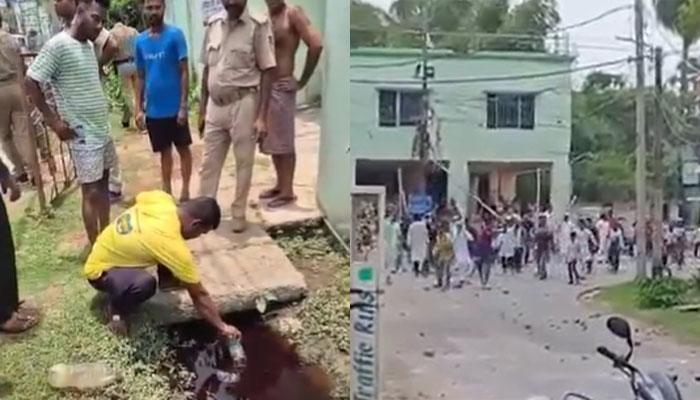
On 17th June, the Balasore district administration imposed Section 144 in the region from Pir Bazar to Patrapada (later extended to the entire Balasore municipality) after Islamists pelted stones at Hindus and a clash occurred between 2 communities in the district in Northern Odisha.
The incident occurred after people spotted red blood colour substance flowing in the drain near the Pir Bazar. It was alleged that cows were slaughtered in the area during Id-ul-Adha or Bakrid celebrations. The news spread quickly in the area and several Hindus came onto the road protesting against cow slaughter at Pir Bazar. They also blocked the Chandipur-Balasore main road.
Locals in Balasore, Sunhat area reported to police that their drains were filled with blood. SP of Balasore @sagarika_nath has controlled the situation but it is alarming to see that in a peaceful state of Odisha such events are occurring. Additionally VHP had filed a… pic.twitter.com/TkgZbCbeFZ
— Gayatri ????(BharatKiBeti) (@changu311) June 17, 2024
Following the protest, the Islamists started pelting stones at the protestors leading to a clash between the two groups. The stone pelting continued for around 15 minutes according to a report in Odisha TV.
The police were informed about the clash and rushed to the spot to control the law and order situation. Around five people including police personnel sustained injuries. Over 15 vehicles were damaged during the clash. Police officials held peace talks with the seniors of both sides to ensure the situation did not escalate. The police did not arrest anyone in the matter.
Section 144 was imposed by the administration to control the situation. Balasore collector Asish Thakare said, “The situation is under control. Action will be taken against culprits who are responsible for vitiating harmony between two communities.” Furthermore, a school holiday was declared keeping the tension in mind. Thakare added that the administration was keeping a close eye on the situation. Additional police personnel were deployed in the areas where clashes happened.
Newly elected Odisha Chief Minister Mohan Majhi took cognisance of the matter. He said that Odisha is a peace-loving state and appealed to everyone to maintain peace and harmony. He took stalk of the situation from the district collector and the Superintendent of Police directing them to ensure the law and order was under control.
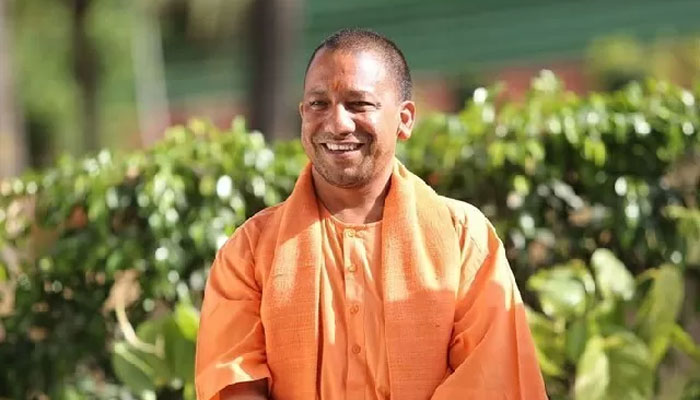
After Uttar Pradesh Chief Minister Yogi Adityanath’s appeal, the state set an example again with Eid prayers that were offered in designated areas and not on the roads without obstructing traffic flow across the state on the occasion of Eid-ul-Azha on Monday.
Muslim religious leaders backed the Chief Minister’s appeal, leading to Eid prayers held exclusively at designated Eidgahs and other traditional locations. In areas where mosques and Eidgahs had limited space, prayers were conducted in different shifts.
Tight security measures were implemented across the state, including drone surveillance in sensitive areas. Additionally, a heavy police force conducted a flag march the day before to reassure the public about their safety.
Earlier during Eid-ul-Fitr, a similar response was witnessed to the Chief Minister’s appeal when prayers were offered in mosques and not on roads.
CM Yogi had already instructed officials from all districts and senior state-level officers regarding Eid preparations. He emphasized the importance of maintaining dialogue with religious leaders and other prominent community members to ensure a positive message is conveyed to the public.
He advised senior officers at the police station, circle, district, range, zone, and division levels to hold peace committee meetings and involve the media to maintain an atmosphere of peace and harmony. Additionally, he directed that designated areas for sacrifices be marked in advance and stressed that the sacrifice of banned animals should be strictly prohibited. A systematic plan for waste disposal after the sacrifices should also be implemented in every district.
According to estimates, this year, namaz was performed at more than 30,000 places across the state, with about 3,000 designated sites where strong security arrangements were made.
Previously, in many cities across the state, millions of people would offer namaz on roads and other places, causing traffic problems. However, as a result of Chief Minister Yogi Adityanath’s call, a new message is being sent across the country, with namaz being peacefully performed in mosques and Eidgahs in every district of the state.
Additionally, with Ganga Dussehra on Sunday, Eid-ul-Azha on Monday, and Bada Mangal of the Jyeshtha month on Tuesday, the state police department remained on high alert. This proactive approach helped dispel fears of potential disputes, leading to joyful and enthusiastic celebrations reported from all 75 districts.
(This news report is published from a syndicated feed. Except for the headline, the content has not been written or edited by OpIndia staff)
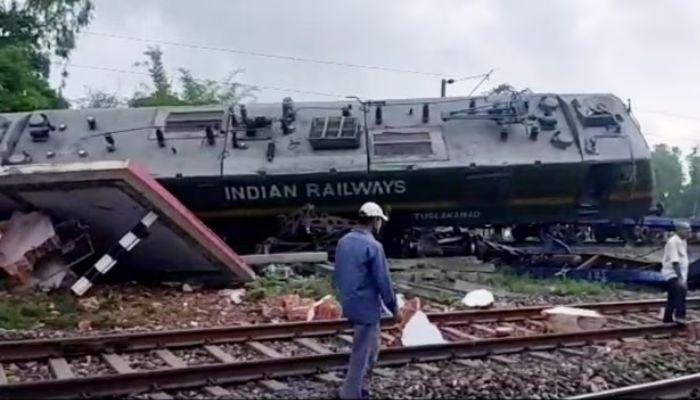
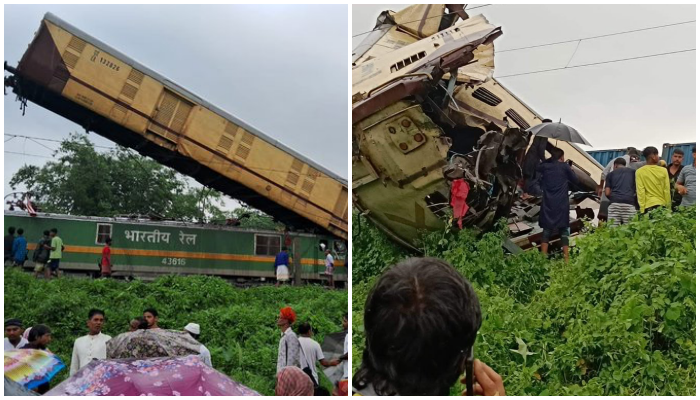
In a tragic train accident on Monday (17th June 2024), at least 8 passengers lost their lives and over 25 people sustained injuries after a goods train rammed into the Kanchenjunga Express train in West Bengal’s Darjeeling district. Visuals from the site showed a wagon of Kanchenjunga Express train suspended in the air. Sources in the Railways said that the goods container train overshot the signal and hit the rear parcel coach of the Kanchanjunga Express.
Officials are reviewing the situation, the Railway officials said. The accident took place at the Rangapani area in the Katihar Railway Division ahead of New Jalpaiguri Junction at around 8:45 am today.
The tragic incident has once again brought the safety of passengers into the limelight and added to the harrowing list of train disasters in the last two years.
2 coaches of Suheldev Superfast Express derailed in October 2023, thankfully no casualties were reported
On 31st October 2023, Train number 22433, Suheldev Superfast Express which was heading towards Anand Vihar via Ghazipur derailed minutes after exiting Prayagraj Junction. As per reports, four wheels of the train’s generator-cum-SLR (seating cum luggage rake) coach derailed in the incident.
Uttar Pradesh | Suheldev Superfast Express going from Ghazipur City to Anand Vihar derailed at the Prayagraj outer area. As per Railway officials, there are no casualties. Restoration work is underway: Amit Malviya, Public Relation Officer, NCR pic.twitter.com/KJuO1vBQ5F
The incident unfolded at around 8:53 PM when the train was still in the Prayagraj Outer area and was travelling at a very low speed. Due to this, no injuries were reported despite the derailment. As per Railway officials, the train later proceeded on its journey. However, a four-member probe committee was constituted to submit a report regarding the derailment.
Collision near Vizianagaram district in Andra Pradesh claims the lives of more than 9 people, four coaches derailed
On 29th October 2023, at least nine people lost their lives and several others were injured after two passenger trains collided near Alamanda-Kankatapalli in Vizianagaram district, Andhra Pradesh. As a result, four coaches derailed after the passenger train travelling from Vizianagaram to Raigad hit a passenger train bound for Palasa from Vishakapatnam, which was travelling on the same route.
#AndhraPradesh: One person was killed and several others injured on Sunday when a passenger train collided with another passenger train near Alamanda- Kankatapalli in #Vizianagaram district. pic.twitter.com/KG6Q2dnS1i
As per reports, a preliminary railway probe into the train accident in Andhra Pradesh held the driver and the assistant driver of the Rayagada Passenger train responsible for the collision, as it passed two defective auto signals in violation of norms. Both crew members were killed in the accident.
6 coaches of Delhi-Kamakhya NE Express derailed near Bihar’s Buxar, 4 passengers died, and over 40 injured
On 11th October 2023, six coaches of Train Number 12506, the Delhi-Kamakhya North East Express, derailed near the Raghunathpur station in Bihar’s Buxar district. The accident claimed the lives of four passengers and left over 40 passengers with serious injuries. The tragic incident occurred at around 9:53 pm.
Latest visuals from the site where the Delhi-Kamakhya North East Express derailed in Buxar, Bihar. pic.twitter.com/vCV5vh7t1Z
EMU Train climbs platform at Mathura Junction, 1 injured as passengers had already de-boarded the train
On 26th September 2023, an electric multiple unit (EMU) train climbed onto a platform at Mathura Junction, injuring one person. The train was coming from Delhi, and the passengers had already de-boarded before the incident occurred. However, when another railway staff member proceeded to park the train, it picked up speed, broke the stopper, and climbed onto the platform.
EMU train derails, climbs on platform at Mathura, video surfaces An Electric Multiple Unit (EMU) train derailed and climbed onto a platform at UP's Mathura railway station on Tuesday night. However, there were no casualties reported in the incident. The train coming from Shakur… pic.twitter.com/zCNjyNAu4h
13 wagons of two freight trains derailed near Bankura, West Bengal, no injuries reported
On 25th June 2023, around 13 wagons of two goods trains derailed after two locomotives collided near West Bengal’s Bankura at around 4 am. As per reports, one of the goods trains hit the other from behind, causing several wagons to derail. The incident took place at Onda station. Railways officials said that no one was injured in the incident.
At least 12 wagons of two goods trains were derailed on Sunday morning after the locomotives collided near West Bengal’s #Bankura
Divisional Railway Manager (DRM) of South Eastern Railway’s Adra Division, Manish Kumar said, “This accident happened due to the mistake of the driver (of the moving goods train). It seems that he fell asleep and didn’t see the red signal to stop.” He added that a probe will be held to pinpoint the cause of the incident.
One coach of an EMU train derailed near Basin Bridge railway station in Chennai, no injuries were reported
On 11th June 2023, the last coach of an EMU train derailed near Basin Bridge station, however, no injuries or casualties were reported. The Chennai suburban local train was heading towards Tiruvallur when it derailed near Basin Bridge railway station, 10 minutes after it left Dr. MGR Chennai Central station. Although several passengers were gripped by panic, railway officials confirmed that no one was injured since only two wheels of one coach had gone off the tracks.
A suburban #train operating between Chennai-#Tiruvallur derailed near Basin bridge #railway station on Sunday. Only 2 days ago, an empty coach of #JanShatabdi#train derailed near Basin Bridge junction in #Chennai when it was being taken to yard for cleaning.
It was the second derailment within the span of just one week.
Two wheels of the Jan Shatabdi Express derailed, no injuries were reported
Two wheels of the Jan Shatabdi Express derailed near the Basin Bridge workshop in Chennai on 9th June 2023. Officials said that no injuries or casualties were reported in the incident. The Jan Shatabdi Express, arriving from Vijayawada, had already disembarked passengers at Puratchi Thalaivar Dr MGR Chennai Central station. As it was proceeding towards the Basin Bridge yard, two front wheels of one coach derailed. The incident occurred around midnight when the train cars were unoccupied. Railway police are currently investigating the incident alongside the locomotive pilot and other railway personnel.
2 coaches derail near Tamil Nadu’s Coonoor, no injuries were reported in ‘minor’ incident
On 8th June 2023, two coaches of a train heading to Mettupalayam from Ooty derailed near Coonoor in Tamil Nadu. Fortunately, there were no reports of any passengers getting injured in the incident, which officials had termed as minor.
The infamous triple train accident in Odisha’s Balasore district claimed the lives of over 293 people, injuring another 1,200 passengers
The Balasore triple train accident took place, on 2nd June 2023, when the Chennai-bound Coromandel Express entered the loop line at the station instead of going straight on the main line. Subsequently, it rammed into a stationary goods train at full speed. Its derailed coaches hit the Yesvantpur Superfast Express which was just passing the station. It was evident that the signalling was wrongly set for the train at the station. This triple train accident at Bahanaga Bazar station near Balasore in Odisha claimed over 293 lives and injured over 1,200 passengers.
#WATCH | Latest visuals from the site of the deadly train accident in Odisha's Balasore. Rescue operations underway
Coach of Chennai-Bengaluru double-decker train derails near Kolar, no passengers were reported injured
A coach of the double-decker train from Chennai to Bengaluru derailed at Bisanattam on the Karnataka-Andhra Pradesh border, near Bangarpet in Kolar district on 15th May 2023.
Mumbai-Jodhpur Suryanagari Express Train derails In Rajasthan, 11 coaches impacted, no injuries were reported
On 2nd January 2023, eleven coaches of the Bandra Terminus-Jodhpur Suryanagari Express were affected by a derailment near Pali, Rajasthan. 10 passengers were reportedly injured in the incident which occurred at 3:27 am between the Rajkiawas-Bomadra section of the Jodhpur division. Officials later stated that a ‘rail fracture’ was the cause of the Suryanagari Express derailment.
11 coaches of Pawan Express derailed near Nashik, two passengers were injured
On 3rd April 2022, eleven coaches of Train Number 11061, LTT-Jaynagar Express derailed between Lahavit and Devlali (near Nashik) on the Dn line. The incident occurred at 3:10 pm on Sunday.
Few coaches of 11061 LTT-Jaynagar Express have been derailed between Lahavit and Devlali (near Nashik) on Dn line at around 15.10 hrs today, April 3. Accident relief train and medical van rushed to the spot. Details awaited: Central railway CPRO
In a statement, the CPRO, said, “2 minor injuries in train derailment in Nashik. Both are given primary treatment, not required to be hospitalized. No one else is reported to be injured, no deaths either. One body found near tracks is not of a passenger, & is believed to be there before the derailment.”
Apart from collision and derailment, the Indian Railways has suffered multiple incidents of tragic fire accidents due to technical reasons, causing another area of concern regarding passenger safety. Here is a list of several fire accidents (excluding ones where passengers were found to be responsible for the mishap) that took place in the last two years.
Twin fire accidents were reported in passenger trains in less than 12 hours in November 2023, injuring over 29 passengers
Two horrifying fire incidents were reported within less than 12 hours in November 2023, resulting in 29 passengers suffering serious injuries. On 16th November last year, a fire erupted in the S-6 coach of the Delhi-Saharsa Vaishali Superfast Express (12554) in Uttar Pradesh’s Etawah, injuring at least 21 passengers. The cause of the fire was under investigation. The incident occurred around 2:40 am while the train was traveling from New Delhi to Saharsa, Bihar, passing through an area near the Friends Colony police station.
It is pertinent to note that this was the second incident within 12 hours. A day earlier, at around 5:30 pm, a fire broke out in the New Delhi-Darbhanga Special Express train, damaging three coaches and injuring eight passengers.
Fire erupts in Shri Ganganagar Express train, likely due to short circuit, no injuries were reported
On 23rd September 2023, a fire broke out in the generator coach and an adjacent passenger car of the Shri Ganganagar Humsafar Express shortly after it departed from Valsad railway station in Gujarat. The train was halted and all the passengers were deboarded. As a result, no one was reported injured in the fire incident. The fire originated in the power coach, possibly due to a short circuit, and spread to the adjoining B1 coach. Superintendent of Police Karanraj Vaghela had confirmed that the fire was contained.
7 boogies of Falaknuma Express caught fire near Yadadri district in Telangana, no injuries were reported
Reportedly, 7 coaches of Falaknuma Express caught fire while the train was crossing the Yadadri district of Telangana on 7th July 2023. The train was coming from Howrah and heading towards Secunderabad. The fire was reportedly caused by a short circuit. DGP said, “Police, Fire Dept, and Railways are working in coordination. So far, no fatalities have been reported. Out of 18 coaches, 11 are detached and taken away safely. 7 bogies caught fire, out of which fire is extinguished in 3 bogies as of now”.
PHOTO | Howrah-Secunderabad Falaknuma Express catches fire. More details are awaited. pic.twitter.com/P1AfEAoEoV
A fire broke out on the Lokmanya Tilak Express train due to friction in a high-voltage power line, no injuries were reported
On 22nd Jun 2023, a coach of Lokmanya Tilak Express from Chennai to Mumbai caught fire near Vyasarpadi station due to friction in a high-voltage power line. No injuries or casualties were reported.
Reasons for the mishap and possible safety measures that can mitigate risk to a greater extent
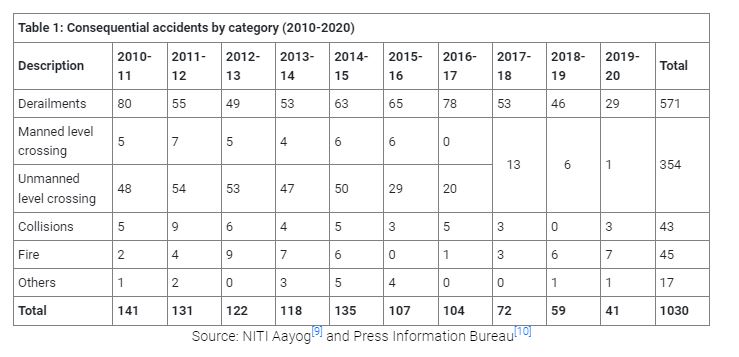
Most of the train mishaps in India take place because of human error or outdated equipment. As per official data, derailments have been the biggest cause of rail accidents. According to The Quint, level-crossing incidents ranked second, with fires and collisions following closely in third and fourth positions respectively.
(Consequential accidents have declined over the years, a lot more has to be done, Image Source – ORF)
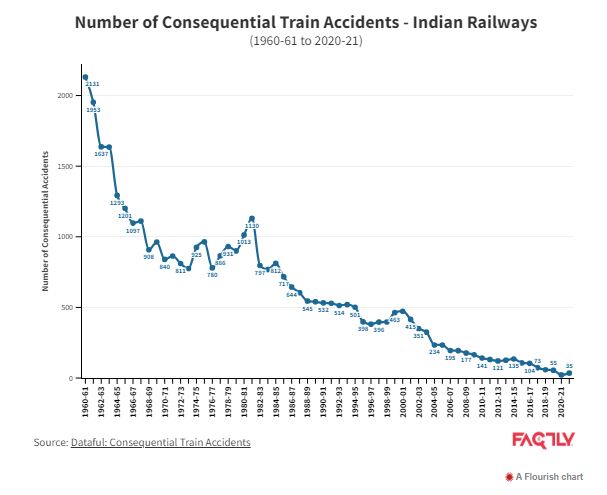
Fortunately, official data also points out that derailments and consequential accidents have been on a decline in recent years. Consequential accidents are incidents caused by operational lapses, such as derailments, collisions, and fires.
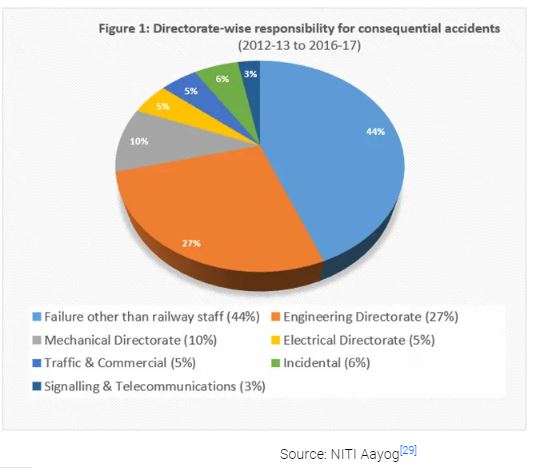
(Department-wise responsibility breakup for consequential accidents and areas of concerns to mitigate deaths, Image Source – ORF)
As per the News18 report, the Commission of Railway Safety data showed that 292 accidents between 2017-18 and 2022-2023 were derailment (75%). The data pointed out that 55% of the train accidents between the period between 2017-18 and 2021-22 were caused by “railway staff error”. As per IndiaSpend, a 2022 CAG report noted that “7 in 10” railway accidents between 2018 and 2021 came due to derailments.
(Image Source – Factly)
As per a government railway safety report for 2019-20, derailments accounted for 70% of railway accidents. After analysing 40 derailments, the report attributes 17 derailments to track defects, which could include track fractures and subsidence. Additionally, nine derailments were caused by defects in trains such as engines, coaches, or wagons.
The CAG report identified several factors contributing to derailments, such as track defects, maintenance deficiencies, outdated signaling equipment, and human errors. It highlighted that 26% of accidents resulted from insufficient funding or underutilization of available funds for track restoration.
Incidentally, Official data assert that Human error was behind most rail accidents in the last three decades. Examples of human errors include overspeeding, passing signals despite danger, carrying out maintenance without getting a proper block of stretches, poor maintenance of equipment, etc.
NITI Aayog found human failure, including the fault of railway staff, to have caused 87% of the 586 consequential accidents recorded between 2012-13 and 2016-17. The share of fault of railway staff in accidents has only grown incrementally on a year-on-year basis.
temperature changes. These measures include tightening components and replacing sleepers. Track inspections, including by specialised cars, are necessary for assessing track geometrical and structural conditions, as noted in a federal audit report on derailments from April 2017 to March 2021.
However, the report highlighted deficiencies in track-recording car inspections, ranging from 30% to 100%. Analysis of 1,129 derailment investigation reports identified around two dozen contributing factors, with track maintenance issues (171 cases) being predominant, followed by deviations from permissible track parameters. Mechanical issues accounted for over 180 derailments, with a significant portion attributed to defects in coaches and wagons. Additionally, poor driving practices and excessive speeds were significant factors contributing to derailments.
As the Railway tracks are made of metal, they require regular maintenance because of routine wear and tear. The focus of the administration should be on not only optimising the human resources to avoid mishaps but also undertaking periodic surveys of tracks and bridges to ensure accidents are averted.
The 2022 CAG report highlighted a significant rise in signal density across Indian Railways, noting that loco-pilots encounter signals nearly every kilometre and minute of their journey. However, the report emphasized a lack of technological aids for loco-pilots, necessitating their reliance on vigilant signal monitoring, thereby increasing the risk of accidents.
The railways’ safety directorate noted that even under “optimum field conditions and with the best of intentions, a human being is likely to commit a mistake from time to time”. However, it also stressed that human technical safeguards and backups can’t replace human efforts, as in many cases, complacency based on technical support has resulted in mistakes.
Several reports on Railway safety state that the railway authorities asking their senior manager to “critically analyse long working hours of the crew, especially in East Coast Railway and South East Central Railway, and take corrective action urgently”.
Measures taken so far that need to be ramped up further
Official documents detail measures to “eliminate human failure” in train operations, including a computer-based electronic interlocking system and a European technology-based signalling system to prevent accidents caused by human error or speeding. Additionally, the Kavach anti-collision system, designed to prevent overspeeding and signal violations, has been introduced but is currently active on only 2% of India’s rail network.
Passenger safety measures include the rollout of superior Linke Hofmann Busch (LHB) coaches, which experts say helped reduce casualties in the Balasore accident. Many conventional coaches have been replaced with LHB coaches, known for their enhanced safety, stability, and speed.
Experts emphasize the need for India’s railway system to prioritize safe tracks and collision protection. Key improvements include upgrading traffic facilities, rolling stock, tracks, signal and telecommunication networks, and building road over/under bridges at level crossings. Additionally, addressing lapses by railway staff through skills enhancement is crucial, with over 300,000 non-gazetted officers having undergone refresher training.
Furthermore, the Railways, which has been investing in anti-collision systems, centralized traffic control, train management systems, signalling, bridge inspection and management, increased nighttime footplate inspections, and public engagement through safety awareness campaigns, must accelerate its efforts to achieve the ambitious goal of ‘Towards Zero Deaths.’
A shocking case of sexual exploitation of girls on the pretext of promising them jobs has come to light in Muzaffarpur, Bihar. It is alleged that around 180 girls were held hostage in the Ahiyapur area under the guise of recruitment. The victims were sexually exploited and physically assaulted with belts. Notably, a victim from Chapra has made shocking revelations. She has filed a case regarding the incident that took place in Muzaffarpur.
As per reports, the accused gang weaponised Bihar’s unemployment and migration issues and opened a fake marketing racket (company) named DVR, and posted job offers on social media. The post offered lucrative jobs, however, it was only for girls.
According to the victim, a company called DVR had posted a job offer for girls on Facebook, and she applied for it. After being selected, she was asked to pay Rs 20,000 for training. After depositing the money, many girls were housed near Bakhri in the Ahiyapur police station area. However, even after 3 months, their salaries were not paid. Subsequently, these girls approached the company’s CMD, Tilak Singh. The victim was then instructed to recruit 50 more girls for the company with the promise that her salary would increase to Rs 50,000 after this.
According to the victim, when she told the accused that she was unable to add 50 more people, she was forced to contact her acquaintances and people on her contact list.
Meanwhile, she stated that till then she was not aware of the reality of the company and in the greed of money she started connecting her acquaintances with the company. Strikingly, police had once raided the alleged office and hostel of the company located in Ahiyapur. They also rescued many girls from there. But after getting information about the raid, CMD Tilak Singh along with many girls shifted to Hajipur where Tilak Singh forcefully married the victim.
The victim alleged that even when they were staying in Muzaffarpur, the accused forcibly had sexual relations with her and also forced her to undergo an abortion. Meanwhile, after marriage whenever she insisted on visiting her family, the accused brutally assaulted her and stopped her.
In the Bauriya area, she was given some money and was told that now she was free. The victim stated that the girls are taken hostage and goons are deployed to prevent them from escaping. The girls are then made to call other girls known to them and they are also offered jobs and sexually exploited. According to reports, the girls were threatened that their family members would be killed if they shared their ordeal. Reportedly, several videos of girls being assaulted with a belt have also surfaced.
Nonetheless, the Police have registered an FIR in this case and further investigation is underway. The victim further alleged that after she filed a complaint against the fake recruitment company, Tilak Singh arranged for her kidnapping and attempted to prevent her from going to court. Threats were also made to murder her brother by summoning him to Patna to create terror.
Pertinent to note that it is the same area that had earned infamy for the ‘Muzaffarpur Shelter Home case’ where allegations of sexual exploitation of 34 girls had come to light. The Bollywood film, ‘Bhakshak’ was based on this horrifying case. The accused Brajesh Thakur also ran a local newspaper.
PM Modi earlier this month defied a vicious political campaign by the opposition INDI alliance that entailed battling a barrage of fake news and disinformation and returned to power with BJP winning 240 seats on its own, a notable achievement for a party and a leader after being in office for 10 years.
However, his reelection to the highest office of the land ruffled quite a few feathers, both domestically and internationally, especially for dubious foreign groups who perhaps believed an amenable and docile INDI alliance leader would have been easier to manipulate and control than a leader known for placing national interests above everything else.
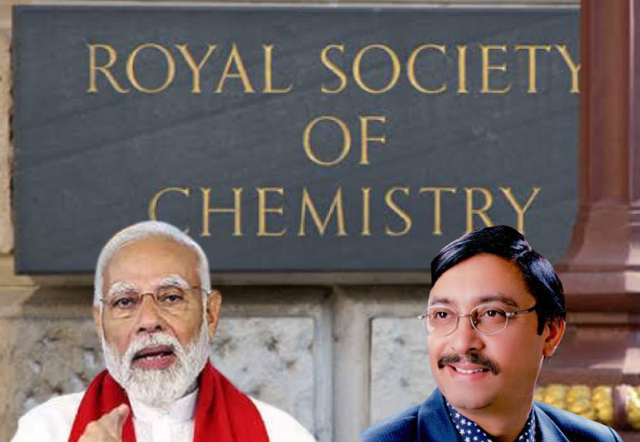
Therefore, when the UK-based Royal Society of Chemistry’s ‘Chemistry World’, a monthly chemistry news magazine, published an article targeting PM Modi after his reelection to office, it wasn’t entirely surprising that a foreign-based Chemistry society has attacked the Prime Minister of India by publishing a prejudiced piece based on a shoddy premise and ludicrous comparisons.
And even more unsurprising was the commissioning of an Indian brown sahib to trash on PM Modi. Titled ‘Modi’s return as India’s leader has scientists worried about persistent problems’, the article was authored by one Sanjay Kumar, who according to the official website claims to be a “science journalist who has reported extensively on science, technology, health and environment for over two decades from the Indian subcontinent for leading international publications.”
Source: Chemistryworld.com
“The election result has many scientists worried that creeping authoritarianism under Modi will mean long-standing problems in research, such as meagre and delayed funding, political interference in appointments and corruption, will not be addressed,” Kumar contends in the article, of course, without providing any evidence or quoting ‘scientists’ claiming there is an environment that discourages scientific scholarship.
It conveniently compares India with countries like China, South Korea, and the United States, all of which have allocated a substantially higher chunk of their GDP for scientific research than India. The R&D investment in India as a percentage of the GDP stands at 0.64 per cent, abysmally low, but comparing it with nations like China is dishonesty, given that China has an autocratic form of government, unlike the democratic form in India and China’s economy is much larger than that of India, which offers Beijing enough legroom to allocate funds for a plethora of areas, including in scientific research.
Similarly, the United States spends 3.46 per cent of its GDP on scientific research, but its economy is roughly nine times bigger than India. In addition to this crucial fact, the per capita GDP of the US is several times higher than that of India, which provides the American government with enough cushion to invest in areas such as scientific research against the Indian government, which is often hard-pressed in dealing with issues such as chronic poverty, availability of potable water, uninterrupted power supply, and toilets. In fact, it was only after Modi came to power in 2014 that emphasis was placed on building toilets and connecting the remotest part of the country to electrical grids.
Despite what Kumar would have us believe, India had a stellar achievement in the field of science since 2019. In August 2023, India became the first country to touch down near the lunar south pole, an unparalleled feat for the Indian Space Research Organisation. Before that, during the height of the coronavirus crisis, Indian companies Serum Institute of India and Bharat Biotech were at the vanguard of manufacturing COVID-19 vaccines to head off a pandemic that caused unprecedented fatalities around the globe.
While India certainly has to do much more than what it is doing in terms of investing in scientific research, it is worth noting that the Modi government has not cut back on the investment in the field as the numbers suggest India’s investment in R&D had remained around 0.6 to 0.7 per cent in the 10 years of Manmohan Singh government as well.
However, rationality was never the concern for foreign publications bent on attacking the Modi government. As is their wont, shady indices are relied upon to accuse the Modi government of the ‘creeping authoritarianism’ that is given to us to believe the cause for low investment in R&D.
“Modi’s domineering style of governance over the past decade has also affected almost all aspects of life in India, including higher education and research. Consequently, the Sweden-based V-Dem Institute dubbed India an ‘electoral autocracy since 2018’,” the article reads.
If a country’s democratic ratings had a bearing on its investment in scientific research, why does the author then cite China, an authoritarian country by all accounts, as an example for India to emulate in terms of spending in R&D? These jarring inconsistencies further demonstrate that the pursuit of the piece is not to express caution over India’s reduced spending on R&D but an attempt to weaponise science to attack the Modi government.
And as it turns out, this is not the first time that Kumar has used science to indulge in peddling alarmist tropes against the Modi government. Funnily, in May 2019, after Modi stormed back to power with a thumping majority, Kumar had penned a similar sounding article, using ‘anxiety’ of scientists to camouflage his anti-Modi bias. The article published then was titled ‘Another five years of a Modi government leaves Indian scientists worried’ even though India saw a remarkable scientific growth during 2014 to 2019 period, witnessing nation’s first mission to Mars, the launch of 104 satellites in a single mission and becoming the fifth most prolific publisher of scientific research.
Weaponising science to undermine current regime
Notably, weaponising science to undermine the current regime has long been a pet project of the restive Indian leftwing ecosystem, a part of multi-pronged strategy to show the Modi government as opposed to scientific growth, and thereby rallying progressives against it. In the midst of this year’s Lok Sabha elections, a website called ‘nature.com‘ published an article titled ‘Why doing science is difficult in India.’ The article was authored by none other than the daughter of controversial Congress leader Mani Shankar Aiyar.
The article relied on rankings published by the Sweden-based institute, Varieties of Democracy (V- Dem), which put India in the bottom 20% of the list in academic freedom among 179 countries.
For the unversed, V-Dem is funded by the likes of George Soros’ Open Society Foundations (OSF) and has been involved in anti-India propaganda for several years. OpIndia has previously reported that Soros has been eyeing a colour revolution in India.
“India’s academic freedom has been in steady decline for a decade. This is well documented…Historically, academic freedoms were certainly not perfect in India. Yet even a cursory glance at the evidence reveals that the scale of restrictions and the misuse of laws to curb academic freedom has increased,” Yamini Aiyar claimed in her article.
The day was 14th October 2022. The semi-decomposed body of a 23-year-old boy, identified as Faizan Ahmed, was found in his hostel room at the prestigious Indian Institute of Technology (Kharagpur).
Ahmed was a native of Tinsukia district of Assam and was a 3rd-year student at the Mechanical Engineering Department of IIT Kharagpur. It was initially suspected by the local police that he died of suicide.
According to IIT Kharagpur Registrar Tamal Nath, Ahmed’s room in the Lala Lajpat Rai (LLR) hostel was forcibly opened after receiving no communication from him. He was last seen 3 days earlier on 11th October 2022.
Deeply pained by the unfortunate death of Faizan Ahmed, a bright young student from Tinsukia studying at the prestigious IIT Kharagpur.
When Ahmed’s parents were informed of his untimely death, they refused to believe the ‘suicide angle.’ They demanded a full-fledged police inquiry and alleged that the 23-year-old IITian was murdered.
“Our son who was so jovial during the family event, cannot kill himself. He was murdered. We demand that a proper inquiry be held into the events leading to his death and how he died,” Faizan Ahmed’s mother was quoted as saying.
In the meantime, the students of the prestigious institution carried out protests, demanding justice for the deceased student. On 20th October 2022, the Deputy Director of IIT Kharagpur Amit Patra met the students and acknowledged lapses on the part of the institution.
Director's Address to students on October 21st, 2022
After a long series of events and a protest concerning the loss of a fellow student, Faizan Ahmed, the Director Prof. VK Tewari has agreed to address the General Body on Today 8:30 pm onwards at the Tagore Open Theatre. pic.twitter.com/PuyTWiP66e
Parents of Faizan Ahmed approach Calcutta High Court
Around that time, it came to light that Ahmed suffered ragging at the Rajendra Prasad Hall of Residence during an ‘assimilation programme’ held between February and March 2022. The victim was reportedly humiliated in front of his batchmates, which forced him to change his hostel.
The parents of Faizan Ahmed were dismayed by the investigation carried out by Kharagpur police. They accused the IIT-Kharagpur authorities of trying to pass their son’s untimely death as a ‘case of suicide.’
Forced by circumstances, they moved the Calcutta High Court on 1st November 2022 demanding a probe by the Crime Investigation Department (CID), Central Bureau of Investigation (CBI) or a Special Investigation Team (SIT).
The court directed the Kharagpur police to determine whether IIT-Kharagpur adhered to the anti-ragging guidelines [pdf] laid down by the Supreme Court of India in Faizan Ahmed’s case.
“From the bare look of the body, it seems to be a clear case of ragging and student enmity taking horrendous proportions,” it said in its verdict on 4th November 2022. The breakthrough in the case, however, came 6 months later in April 2023.
A single-judge bench of the Calcutta High Court ordered the officials to exhume the body of the deceased IIT student and conduct a second post-mortem.
Key findings missing in first autopsy report
In his verdict, Justice Rajasekhar Mantha,”The body of the victim has been buried as per Muslim rites at Assam. Let the body of the victim Faizan Ahmed is ordered to be exhumed. The investigating officer in the matter shall coordinate with the Assam Police and ensure that the body and/or remains are exhumed, brought to Kolkata by the State Police and a fresh post-mortem is conducted.”
It must be mentioned that the first post-mortem, conducted at the Midnapore Medical College and Hospital, was inconclusive in nature. Dr Ajay Kumar Gupta told the court that three key findings were missing in the report. These included:
Two visible injury marks on the back of the head.
No examination was done of the skull’s base
Cut marks on Faizan Ahmed’s arms were inflicted after death
He had recommended the court to exhume the body of Faizan Ahmed at the earliest and conduct a second autopsy.
The second autopsy of Faizan Ahmed
Following the order of the Calcutta High Court, the body of Faizan Ahmed was taken to Kolkata from Assam by the West Bengal police. A second autopsy was done on 27th April 2023 by Dr Ajay Kumar Gupta appointed by the court.
In June of that year, the Calcutta High Court observed that the cause of death of the IITian was ‘homicidal’. It also directed the police to include Indian Penal Code (IPC) Section 302 (murder) in the case. A Special Investigation Team (SIT) was constituted to probe Ahmed’s untimely death.
The observations were upheld by a Division Bench comprising of Justices TS Sivagnanam and Hiranmai Bhattacharyya in August 2023.
In February this year, the Calcutta High Court directed the SIT, probing the death of Faizan Ahmed, to speed up the investigation.
“The investigation has to be concluded at the earliest. The SIT has to file its report on March 18. The investigating agency will not submit its report without the permission of the court. The court will go through the documents of the probe,” Justice Jay Sengupta ordered.
In May 2024, the expert who conducted the second autopsy, Dr Ajay Kumar Gupta submitted in court that Faizan Ahmed was murdered. The deceased IIT-Kharagpur student had sustained stab and gunshot injuries to his neck.
Mother's fight for justice: Autopsy says her son was stabbed and shot at IIT Kharagpur
After two years of legal battle, the family of Faizan Ahmed continues to seek justice amidst troubling revelations surrounding his untimely death at IIT Kharagpur.
Dr Gupta further added that human blood was found in the hair strands, spine, mandible, nail cuttings and muscles of the deceased. It also came to light that the temporal bone of Faizan Ahmed’s skull was missing.
However, the truth in the matter would not have been uncovered without the relentless pursuit of the case by his mother Rehana Ahmed. She toldThe Telegraph, “The IIT is involved in my son’s death…From where do students get guns, swords and knives inside the campus of a premier institute like the IIT?”
“There was so much blood on his body and around him…When I asked why there was so much blood, a police officer convinced me that bleeding is natural. Faizan was not even kept inside a coffin. For three days [after his body was found] we were not informed. I asked him to show the photographs of where the body was found, but was told the photographs have been destroyed. Is that how an investigation is conducted?” she further added.
In the Aligarh district of Uttar Pradesh, two young men named Rajuddin and Salman have been accused of pressuring two Hindu sisters to marry them. According to reports, the accused threatened the sisters with a gun while they were on their way to and from school. When the girls refused, they were brutally assaulted, and their clothes were torn.
When the victims’ father went to the accused to confront them, he was also physically assaulted. Based on the complaint, three accused have been named in the FIR. The accused are said to be relatives. On Sunday (16th June 2024), the police arrested Rajuddin and Salman. The search for the third accused, Premuddin Alvi, is ongoing.
The case pertains to the Iglas police station area of Aligarh district. On Sunday (9th June), the victims’ father filed a complaint with the police. In the complaint, he stated that his two daughters study at a nearby government inter-college. Rajuddin, who works as a welder, has a shop on the route to the school. His aunt’s son, Salman, also works at this shop.
It is alleged that Rajuddin and Salman attempted to ensnare both sisters in love jihad. However, when the victims refused to comply with their demands, the accused threatened to kill the victims’ brother and father.
As per reports, Rajuddin and Salman also have some pictures of the victims. Both accused frightened the girls and threatened them that they would post these pictures on social media if they refused to marry them. The accused sent a threatening video to the victims’ brother. It is alleged that in the threatening video, the accused were brandishing guns in their hands. On account of these threats, both sisters were forced to discontinue their studies. Neither of them even appeared for exams this year.
The complainant further stated that on Friday (7th June), at around 7 pm, both the sisters had gone to the market for shopping. At that time, Rajuddin and Salman also reached there. After a while, Rajuddin and Salman forcibly grabbed the sisters inside the shop. They attempted to commit obscene acts with both sisters and hurled abuses at them. During this time, the clothes of both sisters were torn. After a while, Rajuddin and Salman left the place after threatening to kill the sisters. On the way back, both of them gave a mobile phone to the girls and asked them to stay in touch.
The frightened and trembling sisters returned home and narrated their ordeal to their family members. Subsequently, their father went with his son to confront Rajuddin at his shop, where they encountered Rajuddin’s brother, Premuddin. Instead of acknowledging his brother’s mistake, Premuddin threatened the victims’ family members. He then started abusing and assaulting them. When bystanders gathered around, the accused stopped. Later, Premuddin grabbed an iron rod, threatened the father-son duo, and drove them away from his shop.
Finally, the victims’ father lodged a complaint with the police. In the complaint, he named Rajuddin, Salman, and Premuddin and demanded strict action against them. The police have filed a case under sections 354 (D), 342, 504, and 506 of the Indian Penal Code, as well as Section 67A of the IT Act. OpIndia has a copy of the FIR. The police arrested Rajuddin and Salman on Sunday. Investigation and other necessary actions are underway in the case.
A case of Love Jihad has come to the fore from the Gwalior district of Madhya Pradesh where an individual identified as Mohammed Shabbir befriended a Hindu girl and established sexual relations with her. The accused posed as Raju and claimed that he belonged to the Hindu religion.
As per the reports, the Hindu woman was already married and was staying separated from her husband. Meanwhile, she met Shabbir who made her believe that he was a Hindu and is interested in her.
Gwalior, MP: Mohd Shabbir, posing as Raju Kumar, befriended a Hindu girl and they got married in a Hindu temple.
After marriage, she was shocked to learn he was Muslim. He then allegedly pressured her to convert to Islam.
The woman filed a police complaint after she discovered that the man who had forcefully established sexual relations with her was actually a Muslim. She said that the accused lied to her saying that his name was Raju. On confrontation, however, he accepted that he was a Muslim.
The woman in the complaint stated that the accused forced her to convert her religion to Islam and also abused, and assaulted her for refusing to agree to him. She also stated that the accused tried to kill her. This kept on happening for the last 4-5 years.
The police took cognizance of the event and arrested the accused for raping and torturing a Hindu woman. “He raped her and also forced her to convert her religion to Islam. The woman complained to the police station based on which the complaint under section 376 of the Indian Penal Code has been filed. Also, relevant sections of the State Conversion Act have been imposed upon the accused,” the Police said.
Union Railways Minister Ashwini Vaishnaw on Monday inspected the Kanchenjunga Express train accident site in Darjeeling district and said that the rescue operation has been completed.
“Right now our focus is on restoration. This is the main line. The rescue operation has been completed. This is not the time for politics. I will also meet the injured,” Vaishnaw told reporters.
The Railways Minister also visited the North Bengal Medical College in Siliguri and met the injured.
At least eight people have died and about 25 to 30 are injured as a goods train collided with the Sealdah-bound Kanchanjungha Express on Monday morning near New Jalpaiguri, a senior North Frontier Railway (NFR) official said.
The accident took place at Ruidhasa near Rangapani station in the Katihar Railway Division ahead of New Jalpaiguri Junction at around 8:45 am today. The area falls in the Siliguri subdivision of Darjeeling district.
Kanchanjungha Express which runs between Silchar in Assam to Sealdah in Kolkata was on its way from Agartala in Tripura to Sealdah when the goods train hit it from behind, according to Sabyasachi De, Chief Public Relations Officer – Northeast Frontier Railway (NFR).
A wagon of the Kanchenjunga Express train was suspended in the air after a goods train rammed into it at Ruidhasa near Rangapani station under the Siliguri subdivision in the Darjeeling district.
Meanwhile, rescue efforts to extricate trapped passengers are ongoing. Teams of the National Disaster Response Force (NDRF) and police are present at the Kanchenjunga Express train accident site in Ruidhasa in the Darjeeling district of West Bengal.
(This news report is published from a syndicated feed. Except for the headline, the content has not been written or edited by OpIndia staff)