Saudi Arabia has finally ended its much-criticised “Kafala” sponsorship system. The decision, announced in June 2025, brings to a close a 50-year-old system that left foreign workers with complete control in the hands of employers.
This is a big thing for the about 13 million migrant labourers in the kingdom, who are from countries such as India, Bangladesh, Nepal, and the Philippines. Their lives were shaped by this one system for decades. Now, as part of a grand modernisation initiative called Vision 2030, they are promised greater freedom and dignity.
What was the Kafala system
“Kafala” is the Arabic word that means “sponsorship.” The system was established in the 1950s when oil-rich Gulf countries needed a lot of low-cost labour to construct their cities and oil industries.
This is how it functioned: each and every foreign worker was required to be legally bound to a local sponsor, called “Kafeel.” This Kafeel was not just a boss; they determined the legal status of the worker. The Kafeel had complete authority over the workers’ immigration status, their work visa, residency card, and even the right to be in the country.
While it was supposed to manage foreign labour, it actually created a huge power imbalance. Workers were completely dependent on their sponsor’s (Kafeel’s) goodwill, so having a good boss was pure luck, while a bad one could make life hell.
Why did people call it ‘Modern-Day Slavery’
The Kafala system came under intense criticism for decades by human rights groups and the International Labour Organisation (ILO). They blamed it for facilitating forced labour and human trafficking by comparing it to “modern-day slavery” because the system took away worker’s most fundamental rights.
In the Kafala system, the foreign workers were completely trapped. Even if their boss treated them poorly, underpaid them, or forced them to work 18-hour days, they couldn’t just quit and find another job. They had to get their Kafeel’s (sponsor’s) permission to change employers. If any worker left without this permission, they were considered an “illegal resident” and could be arrested.
Workers couldn’t even leave the country, not even for a family emergency at home. They needed their employer to approve and get them an “exit visa,” but bosses would often refuse, essentially holding their employees hostage. To make the workers prisoners, it was a common practice for employers to take away the workers’ passports. With no ID and no way to travel, they were trapped.
And if workers weren’t paid their wages or were abused, they had almost no way to get help. They couldn’t report it to the authorities without their sponsor’s approval. Most were too afraid to speak up, fearing their own boss would have them jailed or deported.
Why Saudi Arabia made this significant change now
This massive reform is occurring for two primary reasons. First, it’s a central element of Crown Prince Mohammed bin Salman’s Vision 2030. That’s a huge plan to transform Saudi Arabia, get its economy of oil so that it doesn’t rely on it, and show the world a more modern face. A slave labour system appears very bad to international investors and talented professionals, but the kingdom is eager to recruit.
Second, there has been increasing global pressure. Human rights organisations, foreign governments, and international organisations have called for the abolition of Kafala for years. Other Gulf states, such as Qatar, also amended their labour laws similarly after being subjected to severe criticism before hosting the 2022 FIFA World Cup.
How will this change life for millions of workers
The end of Kafala is Saudi Arabia transitioning to a regular, contract-based system of work, as in most other nations. It is aimed at providing employees with independence and autonomy over their own lives. Employees will be allowed to switch employment without prior permission from the current employer.
Workers will be free to leave the country whenever they want just by booking a ticket, with no one’s permission needed. It will also be easier for them to get legal help. This means they can report abuse and seek justice more safely.
Human rights groups say this is a big step in the right direction, but they also warn that this is just the beginning. The real test will be making sure these new rules are actually put into practice. Everyone needs to see if all employers will follow them, especially to protect the most vulnerable workers, like domestic helpers.
The leaders of Young Republicans group have come under fire in the US after their racist chat over Telegram got leaked. Recently, POLITICO exposed the racist and homophobic messages spanning 2000 pages, exchanged by Young Republican group members in a Telegram group chat, “RESTOREYR WAR ROOM” – referring to an organisation called Restore YR, a young Republicans movement.
The chat group was created by Peter Giunta, the former chair of the New York State Young Republicans (NYSR). Giunta claimed that the group chat was created to rally support for his campaign to become the chair of NYSR.
The offensive messages were sent between early January and mid-August this year. Following the exposé, many Republican leaders have lost their positions as an outrage erupted in the political circles of the US.
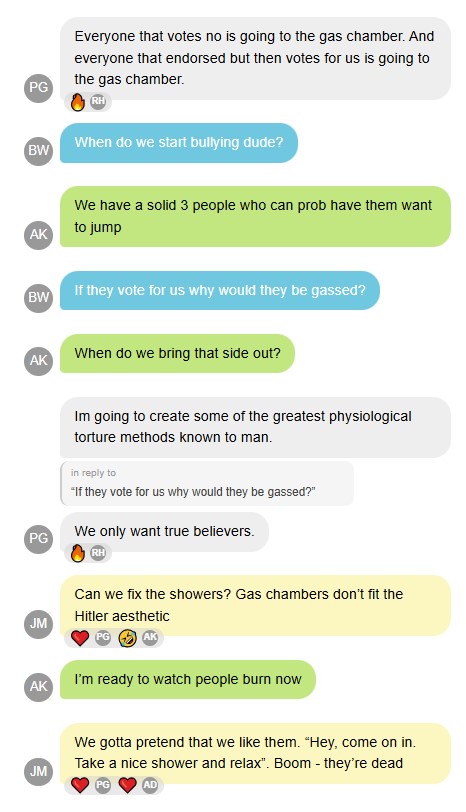
The Republican leaders referred to Black people as monkeys and “the watermelon people”. They also discussed putting their political opponents in gas chambers. They talked about raping their enemies and driving them to suicide and lauded Republicans who they believed support slavery, POLITICO reported.
The vice chair of the Kansas Young Republicans, William Hendrix, wrote the racist slurs “n–ga” and “n–guh” more than a dozen times during the conversation. At the time, Bobby Walker, the vice head of the New York State Young Republicans, called rape “epic.” In a June message, Peter Giunta, who was then the chair of the same group, stated that “everyone that votes no is going to the gas chamber.”
“Im going to create some of the greatest physiological torture methods known to man. We only want true believers,” Giunta in one of the messages.
In response, Joe Maligno, who previously identified himself as the general counsel for the New York State Young Republicans, wrote, “Can we fix the showers? Gas chambers don’t fit the Hitler aesthetic.”
“I’m ready to watch people burn now,” Annie Kaykaty, New York’s national committee member also responded.
Source: POLITICO
In one of the messages, Bobby Wlaker wrote, “If we ever had a leak of this chat we would be cooked”.
Members of the group chat openly discussed the president Donald Trump’s purported efforts to censor data pertaining to billionaire financier Jeffrey Epstein’s child sex offences, the love of Nazis within their party’s right wing, and the pressure to bow to Trump to avoid being labelled a RINO.
In one such case, Alex Dwyer, the chair of the Kansas Young Republicans, wrote, “Trumps too busy burning the Epstein files.”
Racist talks in America are now incomplete without mocking Indians. This Republican group chat was no exception.
Another group member Bobby Walker discussed about how a mutual friend of some in the chat “dated this very obese Indian woman for a period of time.” Doubling down on the hygiene stereotype, Giunta responded that the woman “was not Indian.”
Replying to Giunta, Samuel Douglass, a state senator from northern Vermont and the head of the state’s Young Republicans wrote, “She just didn’t bathe often.”
Walker was set to manage Republican Peter Oberacker’s campaign for Congress in upstate New York, however, a spokesperson for the campaign said Walker will not be brought onboard due to his outrageous commentary in the said Telegram group.
Paul Ingrassia, the newly-nominated lead for the Office of the Special Counsel in the Trump administration also expressed his pro-Nazi thoughts in the group chat. However, Ingrassia withdrew the nomination on Tuesday after the chats leaked. His nomination was pending for a congressional approval, and was scheduled to testify before the Senate Homeland Security and Governmental Affairs Committee (HSGAC) on Thursday.
“I will be withdrawing myself from Thursday’s HSGAC hearing to lead the Office of Special Counsel because unfortunately I do not have enough Republican votes at this time,” Ingrassia posted on X.
I will be withdrawing myself from Thursday’s HSGAC hearing to lead the Office of Special Counsel because unfortunately I do not have enough Republican votes at this time.
I appreciate the overwhelming support that I have received throughout this process and will continue to…
He said that the Martin Luther King Jr holiday should be abolished and that he has “a Nazi streak.” Ingrassia wrote, “MLK Jr/s was the 1960s George Floyd and his holiday should be tossed into the seventh circle of hell where it belongs”.
In one of the messages sent in May 2024, a participant wrote, “Paul belongs in the Hitler Youth with Ubergruppenfuhrer Steve Bannon.” Ubergruppenfuhrer was a paramilitary rank in Nazi Germany.
Responding to this, Ingrassia wrote, “I do have a Nazi streak in me from time to time, I will admit it.” Ingrassia also made racist remark about Indian-American Republican leader Vivek Ramaswamy. “Never trust a Chinaman or Indian. NEVER,” he allegedly wrote.
While Paul Ingrassia withdrew from nonimation for the Office of the Special Counsel, he continues to serve as White House liaison to the Department of Homeland Security.
The GOP leaders also talked about Nazism with one of them writing, “an we get them to start releasing Nazi edits with her… Like pro Nazi and faciam [sic] propaganda.”
“Omg I love this plan,” Rachel Hope, the Arizona Young Republicans events chair, responded.
In another conversation, a member staying in a hotel asks its members to “GUESS WHAT ROOM WE’RE IN.”
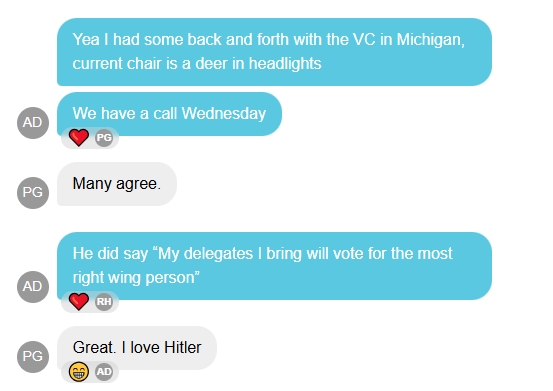
Responding to this, Republican leader Dwyer wrote, “1488”. Here 14 is the number of words in the white supremacist slogan “We must secure the existence of our people and a future for white children.” Meanwhile, 88 used as a shorthand for “Heil Hitler.” In another message, Giunta wrote, “Great. I love Hitler.”
In a separate conversation, Mosiman tells the group that, “The Spanish came to America and had sex with every single woman.” “Sex is gay,” Dwyer writes.“Sex? It was rape,” Mosiman replies. “Epic,” Walker says.
Other anti-Asian barbs targeted Chinese Americans with slurs like “Ch—ks”. “Keep the ch—ks, though”.
The GOP leaders also expressed their antisemitic thoughts in the group. In one of the messages, Giunta slandered for the Young Republicans in states that were supporting or leaning toward Hayden Padgett’s faction and wrote, “Minnesota – f—-ts. Arkansas – inbred cow fuckers Nebraska – revolt in our favor; blocked their bind and have a majority of their delegates Maryland – fat stinky Jew … Rhode Island – traitorous c—s who I will eradicate from the face of this planet.”
Additionally, Giunta and other group chat members frequently used homophobic epithets to describe Padgett. Arizona Young Republicans Chair Luke Mosiman wrote, “RAPE HAYDEN.”
Giunta is reported to have apologised now after the chats surfaced in the media. However, he has lost his positionas chief of staff to a New York state assemblyman.
The chat leak has stirred an outrage among both Republicans and Democrats. Samuel Douglass, the Vermont state senator, who made racist remarks in the NYSR Telegram chat group has resigned.
“I must resign. I know that this decision will upset many, and delight others, but in this political climate I must keep my family safe. If my governor asks me to do something, I will act, because I believe in what he’s trying to do,” Douglass said in a statement.
Meanwhile, the Kansas Young Republicans Organization has also been disbanded after leaders of the group were revealed to have used the “N—a” word in the group chat.
New York Republican Party chair Ed Cox alleged that the GOP group in question was “already grossly mismanaged, and vile language of the sort made in the group chat has no place in our party or its subsidiary organizations”.
The Congressional Asian Pacific American Caucus condemned these messages as a part of “vile tirade” sparing “no community”.
Last week, the New York Republican State Committee voted the Young Republicans group.
Notably, racism against Asians, Indians and particularly Hindus in US politics is a bipartisan blot. While both Republicans and Democrats talk about diversity and inclusion, their racist mindset finds expression in jokes, in-party rhetoric and policy debates.
While racism and xenophobia are no strangers to US politics, there has been an unprecedented surge in online and offline racist attacks ever since Donald Trump launched his presidential campaign.
Last year, JD Vance’s wife, Usha Chilukuri Vance, a Hindu by religion and a daughter of Indian immigrants was subjected to racist and Hinduphobic attacks from White Christian supremacists who mostly are Republican Party supporters. American commentator and author Ann Coulter told Vivek Ramaswamy on his podcast that she wouldn’t have voted for him because he is an Indian. On numerous occasions, during his stint for the Presidential nomination bid from the Republican party, he had to face questions on Hinduism. Even Tulsi Gabbard has been attacked for her Hindu faith and Indic roots.
Democrats too are not immune. Back in 2006, Joe Biden, who was Delaware senator at that time, addressed an event of Indian-Americans and said, “You cannot go to a 7-Eleven or a Dunkin’ Donuts unless you have a slight Indian accent. I’m not joking.”
In 2022, the Teaneck Democratic Municipal Committee, a section of the New Jersey Democratic Party, approved a resolution labelling certain Hindu organisation as ‘dangerous hate groups’ and offshoots of the Rashtriya Swayamsevak Sangh (RSS). The motion urged that the government classify a number of American Hindu organisations, including the Hindu American Foundation (HAF), the Vishwa Hindu Parishad of America (VHPA), and SEWA International, as “domestic branches” of “foreign hate groups.”
Ron DeSantis, the Florida Governor and Republican leader earlier dismissed Indian tech workers as a “cottage industry” scam. His remarks added fuel to the MAGA narrative which portrays Indians as ‘job-stealing invaders’. His anti-H1-B rhetoric has added to online racist attacks on Indian-Americans, Indians and Hinduism.
More recently, Alexander Duncan, a Texas GOP officials demanded the removal of an idol of Lord Hanuman from public space, calling the Hindu deity a “false God.” In an X post published on 20th September, Duncan shared a video showcasing the 90-foot-tall statue of Lord Hanuman installed in the Sri Ashtalakshmi Temple in the town of Sugar Land, Texas, and wrote, “Why are we allowing a false statue of a false Hindu God to be here in Texas? We are a CHRISTIAN nation!”
Earlier this year, White and Christian supremacists ignited the H1-B visas debate after Donald Trump nominated American-born Indian Sriram Krishnan as senior policy advisor for Artificial Intelligence at the White House Office of Science and Technology Policy.
What began as an online attack slandering Sriram soon snowballed into a full-fledged campaign against H1-B visas for highly-skilled Indians. This was followed by derision and insults directed at Hindus and Hinduism.
And this anti-Indian and anti-Hindu campaign has paid off well for the bigots who partook in it as Donald Trump has backtracked from his earlier stance supporting H1-B visa and skilled immigration, and imposed a $1,00,000 fee on new H-1B visa petitions submitted by aliens outside the US. While this rule applies only to new applications, the MAGA faction saw it as a victory for its anti-Indian and anti-Hindu smear campaign.
Last month, Donald Trump’s Trade Adviser, Peter Navarro, who Trump has unleashed as his attack dog to vilify India over its Russian oil purchases, resorted to slandering the Brahmin community. In an interview with Fox News, Navarro invoked caste and accused the Brahmins of India of “profiteering at the expense of the Indian people.”
“So, you know, look, Modi’s a great leader… But I don’t understand why he’s getting into bed with Putin and Xi Jinping…when he’s the leader of the biggest democracy in the world. I would simply say to the Indian people. Please, understand what’s going on here. You’ve got Brahmins profiteering at the expense of the Indian people. We need that to stop…” Navarro said.
The Anti-Hindu lobby in the US has been actively running a sinister campaign to push a caste discrimination narrative aimed at undermining and villainising the Hindu community in the US, particularly the Brahmins. Many universities, including Harvard University, Colby College, Brown University, and California State University, have even added caste to their non-discrimination policy. In 2023, the California State Senate in the US passed legislation (SB-403) that banned caste-based discrimination in the State, although it was later vetoed. Not to forget the 2019 CISCO caste discrimination case, which was widely used to vilify the Hindu community as casteist and incompatible with American values. This case was dismissed after no wrongdoing was found.
In recent years, hate crimes against Indian Americans have also been on the rise. According to the FBI’s 2020 data, hate crimes against Indian Americans are up by 500 per cent.
Besides, politics and social media, even the American media and academia perpetuate anti-Hindu bias through selective outrage and erasure. OpIndia has on numerous occasions reported how newspapers like the New York Times, among others, have also been complicit in spinning and amplifying anti-Hindu narratives.
OpIndia earlier reportedhow DEI programs have been normalising hatred against Brahmins in the US. In their attempts to foment the same hate Nazis had for Jews, several DEI programs were creating prejudices against Hindus, particularly the so-called “upper-caste” Hindus like Brahmins, who are already at the receiving end of hate campaigns of the anti-Hindu elements.
There has been a rising tide of racism and religious hatred against the Hindus in the US. While not all crimes against Indian Americans are driven by religious hatred, the online hate against Hindus has also contributed to this. It must not be forgotten that even the H1-B visas debate began with ‘Indians are taking over our jobs’, but soon turned into blatant Hinduphobia. When politicians in power are filled with reckless racist bigotry there is little hope for a genuinely safe future for Indian-Americans and other communities hated by them for merely existing.
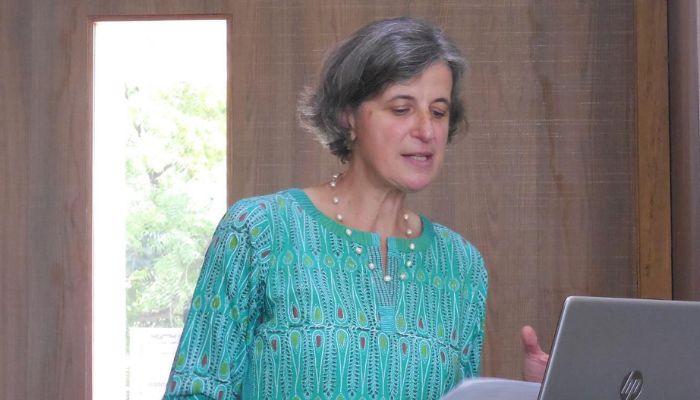
On 21st October, Francesca Orsini, a British academic known for her work on the Hindi language, was denied entry into India and deported from Delhi’s Indira Gandhi International Airport despite holding a valid five-year e-visa. As soon as she reached India, she was stopped by immigration officials and sent back to Hong Kong within hours.
The incident sparked outrage in some left-leaning academic and political circles, and obvious actors published op-eds and social media posts criticising the government for the deportation without specifying the reason. The BJP-ruled central government was hounded for an “anti-academic” stance based on ideology.
However, government sources later cleared the air, and reports emerged that Orsini was blacklisted in March 2025 itself for violating visa conditions. Her deportation, according to government sources, was a matter of routine enforcement, not ideological differences. But a deeper analysis of her ideology and thoughts about India and Hinduism, etc., needs to be scrutinised.
Government followed law, not ideology
The Ministry of Home Affairs has confirmed that Orsini had earlier visited India on a tourist visa, and during that visit, she engaged in unauthorised academic activity, which is a clear violation of visa norms. According to India’s immigration rules, tourist visas do not permit any form of professional work, research, or scholarly engagement. Official sources confirmed that this breach was the reason for her blacklisting. Once flagged, the system automatically denied her entry, irrespective of the validity of the visa.
The confirmation from the ministry made it clear that it was not a targeted action. There was no last-minute policy change, and no “political conspiracy”, as the left-leaning media houses and individuals have been claiming. It was just standard visa enforcement, which applies equally to any foreign national, regardless of profession or ideology. The fact that Orsini chose to ignore or sidestep these conditions is what led to her being denied entry.
During the research, OpIndia found that Orsini has a long history of anti-Hindu and anti-Indian establishment stands. Despite her history, she was allowed until March this year to visit India, which clearly shows that there was no ideological reason behind the ban.
Anti-CAA stance, targeting govt over Kashmir and academic posturing
Francesca Orsini is being projected as an apolitical scholar, which she is not. She was part of a group of academics who publicly condemned Indian police actions during the anti-CAA protests and accused the Government of India of sectarianism. Orsini has consistently aligned herself with left-liberal narratives critical of Indian policy and governance.
Coming to her views on Kashmir, in March 2016, she was among 150+ signatories worldwide who signed an open letter against the so-called “vilification” of pro-Naxal professor Nivedita Menon. At that time, Menon had faced a media furore after a JNU teach-in where she questioned India’s stance on Kashmir’s political status.
Orsini co-signed the solidarity statement and condemned the “vicious right-wing media campaign” branding Menon as “anti-national” for her views on Kashmir. The letter defended academics’ freedom to discuss Kashmir and urged JNU’s administration to protect her right to speak.
Apart from activism, Orsini has repeatedly shown her ideological tilt in her writings. For example, in a 2002 essay, she referred to the Ramayana and Mahabharata as “amoral” texts and contrasted them unfavourably with modern liberal literature. She highlighted with disapproval that figures like Bhagwan Ram could no longer be freely criticised in India of that time. Notably, Bharatiya Janata Party was the ruling party at the Centre under the NDA at that time.
In Orsini’s chapter titled ‘Na Turk Na Hindu’ in the book A Multilingual Nation: Translation and Language Dynamics in India, she criticised linguists for communalising languages through modern ideologies like the ‘Hindi-Hindu-Hindustan’ slogan. However, while raising alarms over this supposed communalisation, Orsini hypocritically constructed her own fictitious ‘Hindi-Hindu-Hindustan’ bogeyman by portraying the slogan as a purely modern, imposed nationalist fiction. She completely ignored the evidence of historical linguistic evolutions that aligned with cultural identities without erasing multilingualism and passed it off as objective critique.
She wrote, ‘Modern language ideologies firmly believe that languages “belong” to specific communities, be they ethnic, regional, or religious. These imagined communities, Benedict Anderson has taught us (1991), get simultaneously projected in the past, present, and future. In the late-nineteenth and early-twentieth centuries the slogan “Hindi-Hindu-Hindustan” projected Hindi (in the Nagari script) as the language of Hindus in north India “from the beginning”, urged contemporary north Indian Hindus to embrace it, and claimed that Hindi would become the national language of all Indians, explicitly coded as Hindus.’
She added, ‘This modern imagination forged a continuum of script-language-community in the face of long histories of multi-scriptural and multilingual practices in which languages have commonly been written in more than one script and people learnt more than one language and knew how to navigate a multilingual social world.’ With this narrative, she framed the slogan as a deliberate nationalist reordering of complex, plural linguistic realities.
Liberal outrage follows a familiar script
The moment her deportation hit headlines, the usual names rushed to outrage. What none of them addressed was the simple legal reality: Orsini violated visa rules and was treated like anyone else would be in such a case.
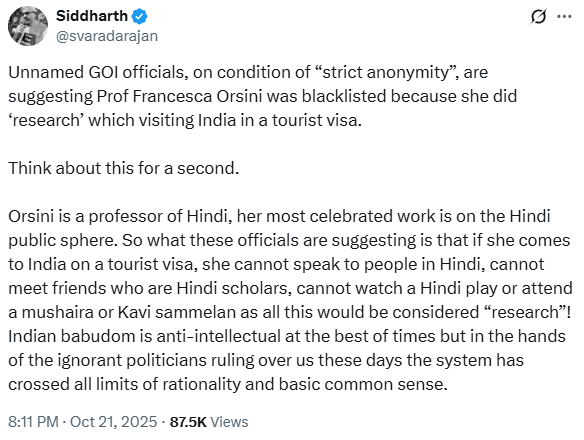
Siddharth Varadarajan, founding editor of The Wire, a propaganda-filled news portal that broke the news of her deportation, questioned why she was deported for doing research during her last visit. He claimed that since she is a professor of Hindi, why should she not speak to people in Hindi or meet friends who are Hindi scholars. While he was whitewashing the violation of visa norms, he conveniently omitted the fact that she had entered on a tourist visa, not a work visa, which is what she should have applied for if she intended to conduct any “research”.
Source: X
Journalist Kunal Purohit called it a “national shame” and claimed she has done “Hindi language than the petty-minded establishment that sees her as a threat”.
Francesca Orsini is a scholar who has done more for Hindi language than the petty-minded establishment that sees her as a threat.
For #HPop, I relied on her scholarship for the study of nationalist poetry.
Rajdeep Sardesai said, “IRONY: a govt that claims to promote Hindi deports a leading academic who has researched Hindi all her life!”
Story that caught the eye: globally renowned UK based scholar of Hindi deported. IRONY: a govt that claims to promote Hindi deports a leading academic who has researched Hindi all her life! https://t.co/YX3zEttuG3
Ramachandra Guha called the government “insecure, paranoid, and even stupid” for deporting her.
Professor Francesca Orsini is a great scholar of Indian literature, whose work has richly illuminated our understanding of our own cultural heritage. To deport her without reason is the mark of a government that is insecure, paranoid, and even stupid.https://t.co/j5Fz1uOphS
Propagandist, former journalist and TMC MP Sagarika Ghose wrote, “Shocking and sad. Francesca Orsini is a world renowned scholar of South Asian literature and Hindi who has been deported despite her valid visa. The narrow-minded and backward looking Narendra Modi regime is destroying the open-minded scholarship and excellence India has always stood for.”
Shocking and sad. Francesca Orsini is a world renowned scholar of South Asian literature and Hindi who has been deported despite her valid visa. The narrow-minded and backward looking @narendramodi regime is destroying the open-minded scholarship and excellence India has always… https://t.co/v5ezSCK5Ia
These reactions are not about protecting academic freedom, they are about pushing a narrative. A narrative that seeks to paint every immigration check, every enforcement of law, as an act of oppression. The outrage is selective, the facts ignored, and the intent clear, that is, to weaponise isolated incidents to vilify a government they politically oppose.
Not the first and not a special case
Orsini is not the only foreign scholar to face consequences for visa misuse or an anti-India stance. Filippo Osella and Nitasha Kaul were also denied entry in recent years after they were found to have violated Indian regulations. In all such cases, the enforcement has followed due process. Yet, every time, it is presented as part of a mythical campaign against dissent.
India, like any sovereign country, has the full right to enforce its immigration policies. It does not owe automatic entry to those who disregard the rules, regardless of whether they quote Sanskrit texts to twist their meanings or publish papers on Hindi fiction. That Orsini is a “respected academic” does not grant her a free pass to violate visa norms, enter under false pretences, and then claim victimhood.
Facts matter more than feelings
Francesca Orsini was not deported because of her criticism of CAA or her academic views on Hindu texts. She was deported because she allegedly broke the terms of her visa, plain and simple. The liberal outrage that followed was not based on the facts, but on a compulsive need to politicise administrative decisions. In the end, it is not the Indian government but its critics who are undermining due process by spinning a legal issue into an ideological spectacle.
The real question is not why Orsini was deported. It’s why her defenders think she should not be held to the same legal standards as everyone else.
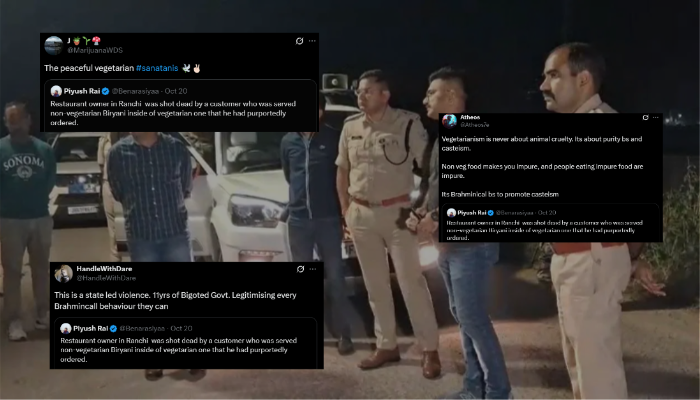
A 47-year-old restaurant owner named Vijay Nag was shot and killed when a vegetarian customer was allegedly given non-vegetarian food. The unfortunate incident took place at approximately 11:30 pm on 18th October. The victim was the proprietor of the Chowpatty restaurant situated on Kanke Road, in Ranchi of Jharkhand.
However, soon after the incident was reported in media, a raft of social media users, primarily the members of the Congress ecosystem, went in an overdrive to stereotype the entire Hindu community and paint it as a ‘Brahminical’ act perpetrated by ‘vegetarian supremacists’. Without delving into details of the matter, this cabal went about maligning the Hindu community, and by extension, blaming the BJP and the RSS, even though Jharkhand is ruled by an Opposition coalition.
The facts of the case are far murkier than the Congress ecosystem would have the public believe. The police press release in the matter reveals crucial details that were conveniently drowned out amid the noise of social media outrage.
Details of the case
The police have filed FIRs (First Information Reports) against four people at the Kanke and Pithoria police stations. Three people have been arrested and a search is ongoing for the fourth man named Amit Thakur.
दिनांक-19.10.25 को समय करीब 1-2 बजे पूर्वाहन में वरीय पुलिस अधीक्षक राँची को गुप्त सूचना प्राप्त हुई कि हिन्दपीढ़ी थाना अन्तर्गत छोटा तालाब के पास कुछ असमाजिक तत्व के द्वारा (अवैध मादक पदार्थ) ब्राउन शूगर की खरीद बिक्री किया जा रहा है। इस सूचना पर पुलिस अधीक्षक नगर के नियंत्रण… pic.twitter.com/H2txJoHBtU
Prashant Kumar Singh was apprehended on 19th October and action was taken to capture others, based on information obtained during his interrogation. The primary suspect named Abhishek Singh was en route in his car from Latehar to visit his family before fleeing with them from Ranchi. His vehicle sped past the Latehar checkpoint without halting, even after the personnel asked him to do so.
The in-charge of the Latehar police station pursued him and when Singh was passing through Cheri Manatu, he notified Deputy Superintendent of Police (DSP) headquarter-1 and Kanke Police Station in-charge. The officials then went to the route to try to stop Singh. He even exited the vehicle and ran while firing at the police officers.
Police had installed blockades at multiple locations and eventually surrounded him near the ITBP (Indo Tibetan Border Police) camp in the Kanke police station vicinity. Singh suffered two gunshot wounds to his foot and is receiving treatment at the Rajendra Institute of Medical Sciences (RIMS) in Ranchi.
VIDEO | Jharkhand: A 47-year-old restaurant owner in Ranchi was shot dead after a vegetarian customer was allegedly served non-veg biryani
Superintendent of Police (Rural), Praveen Pushkar says, "The accused claims that the entire matter was over a biryani. They had ordered veg… pic.twitter.com/YMFRNZxKIw
Harendra Singh who had provided him with firearms was also intending to leave the area through Pithoria. Police set up checkpoints there after receiving the intel and he was was caught in an Innova vehicle. Harendra was a former constable in the Jharkhand Police and had been suspended for the past five years.
The cops retrieved a locally manufactured pistol and three rounds of ammunition from Harendra along with Rs 2 lakh. He also admitted to possessing additional firearms concealed in his residence. A search was conducted at his home where one rifle, two pistols and bullets were discovered. It was revealed that he worked as a land dealer who employed his thugs and the firearms to unlawfully occupy land.
दिनांक-18.10.25 को रात्रि समय करीब 11:20 बजे सूचना प्राप्त हुई कि कांके रोड स्थित सेफ चौपाटी रेस्टोरेंट के मालिक विजय कुमार नाग को तीन अपराधियों द्वारा उनके रेस्टोरेंट में गोली मारकर हत्या कर दिया गया है जिस संबंध में वादी उत्कर्ष राज के लिखित आवेदन के आधार पर कांके थाना में… pic.twitter.com/Z2zz9b8Xe5
“We seized four pistols, 31 cartridges, a rifle, Rs 2 lakh in cash, two four-wheelers and four mobile phones from their possession. Our investigation is underway into the case,” Superintendent of Police (Rural) Praveen Pushkar remarked, according to PTI.
The two were arrested in the Kanke police station area following an exchange of gunfire at approximately 10:30 pm on 19th October. Singh unleashed bullets on the cops and was wounded due to the retaliatory fire. He acknowledged that Harendra supplied him with weapons. The latter is facing three pending cases in Argora, Gonda and Patan in Palamu. Singh, who resides in Aurangabad of Bihar also has a criminal history.
Background of the instance
The accused was outraged after discovering a bone inside the meal which led to a heated exchange between the two sides over phone. The issue escalated and while Nag was dining at the restaurant, he showed up in a car with his companions. Afterward, an intense argument broke out that resulted in pushing and shoving.
“In the middle of the scuffle, the customer pulled out a gun and shot him in the chest before fleeing the scene,” an officer informed, reported The Indian Express. After hearing a gunshot, locals rushed to the area and found Nag lying on the ground. He was immediately taken to the Rajendra Institute of Medical Sciences (RIMS) where the doctors declared him dead.
The family of the deceased demonstrated and demanded the arrest of all culprits within a period of 24 hours and threatened to start a large-scale protest. “Irate locals on Sunday morning blocked the Kanke-Pithoria Road for some time demanding action against the culprits. The blockade was later lifted after we assured them that the assailants would be nabbed soon,” remarked Kanke police station officer-in-charge Prakash Rajak.
Senior officials from the Kanke police station went to the crime scene and started barricading the area as well as examined CCTV footage in an effort to find the gunmen. Meanwhile, Congress MLA Suresh Kumar Baitha conveyed that the matter was not confined to biryani and some individuals have an interest in Nag’s property.
Hindus are terrorists, BJP-RSS is responsible: Islamist-Liberal gang spew venom on social media
The brutal murder of the restaurant owner was undeniably horrific, and the culprits must face the harshest punishment. Yet, instead of mourning the victim or standing with his grieving family, the Islamist–Liberal cabal pounced on the tragedy as an opportunity to vilify Hindus. Their instinct was not empathy but exploitation, turning a human tragedy into ammunition for their anti-Hindu propaganda.
Rather than demand justice, they saw the victim’s death as a convenient stage to spew hatred against the majority community and reinforce their tired “Hindu terror” narrative. What makes this worse is that the accused were not some hot-headed individuals acting in rage; police reports and even statements by a Congress leader indicate that they were seasoned criminals involved in land-grabbing, suggesting motives far murkier than mere personal enmity.
But, as always, this ecosystem never lets facts get in the way of its propaganda. The crime was cynically projected as a reflection of “Hindu violence” simply because both the accused and the victim happened to be Hindu, a grotesque distortion aimed at smearing the entire community. Yet, when similar incidents involve members of other faiths, the very same voices erupt in outrage at “stereotyping.” The hypocrisy is staggering, but sadly, not surprising.
A user asserted that the culprits were under the impression that Sanghis (a term referring to supporters of the Bharatiya Janata Party) would come to his aid after he claimed that the murder was orchestrated by terrorists. It is not difficult to deduce whom the person was referring to as terrorists in his tweet.
The account further claimed that it has become exceedingly easy to commit such crimes due to the current political system. They insinuated that the offenders are protected by those in power conveniently forgetting that the state has a Jharkhand Mukti Morcha (JMM)-led government.
What if this terror!st planned this murder? Order biryani when it comes shot down the owner saying I ordered veg biryani He knows sanghis will save him Too easy nowadays
An individual brought casteism and purity into the criminal matter. They maintained that non-vegetarian food is viewed as impure and even went to the extent of invoking the Brahminical mindset and blamed it for fostering casteism. Interestingly, attacking Hindus under the guise of Brahmin hatred is a common tactic of the Left-liberal faction and their Islamist associates.
Vegetarianism is never about animal cruelty. Its about purity bs and casteism.
Non veg food makes you impure, and people eating impure food are impure.
Another identified the crime as Brahminical behavior, following the same trend and attempted to accuse the Modi government of state-led violence, disregarding that the state is ruled by their preferred I.N.D.I. Alliance.
This is a state led violence. 11yrs of Bigoted Govt. Legitimising every Brahmincall behaviour they can https://t.co/J2tgIWV0fa
A member of this online ecosystem did not even attempt to hide their animosity with words and openly blamed Sanatanis for the killing. However, if anyone from the Hindu community dares to act similarly regarding adherents of other beliefs, they are instantly labelled bigots and the secular brigade goes after them without a moment’s delay.
A netizen, driven by their animosity toward the BJP-led central government, went so far as to blame it for an incident that actually took place in opposition-ruled Jharkhand, besides the fact that law and order is state subject.
This is a state led violence. 11yrs of Bigoted Govt. Legitimising every Brahmincall behaviour they can https://t.co/J2tgIWV0fa
Another individual went a step further, branding Hindus as terrorists, a remark that not only reeked of bias but also betrayed a shocking ignorance of the clear distinction between an act of murder and an act of terrorism. More importantly, while it is indeed unfair to generalize the Muslim community as terrorists, one cannot ignore the uncomfortable reality that numerous terror attacks and suicide bombings across the world have been carried out in the name of jihad.
On the other hand, when an offence is committed by a Hindu, it is not only projected as representative of the entire community but also exaggerated to the extent of labelling Hindus as “terrorists.” The irony and double standards are striking, reflecting a deep-seated animosity towards Hindus that has taken root in certain minds.
Left-leaning liberal politicians were quick to jump in, pinning the blame for the murder on the BJP and the RSS (Rashtriya Swayamsevak Sangh). TMC MP Jawhar Sircar went so far as to directly accuse both organizations of fostering “thuggery” behind the crime. It bears emphasizing, however, that no evidence has surfaced to suggest any link between the accused and either the BJP or the RSS.
What makes Sircar’s outburst particularly ironic is his silence on the rampant crimes in his own backyard, West Bengal, where incidents of violence, including rapes and attacks on Hindus allegedly perpetrated by ruling party workers, are disturbingly common. The hypocrisy and selective outrage are nothing short of staggering.
Vegetarians don't wish to kill animals– but killing humans is ok! 74 percent of Indians are non-vegetarian and yet have to put up with BJP/RSS supported Vegetarian Goondaism! pic.twitter.com/0hEnLMN42t
The reactions from Islamists and their liberal allies followed a familiar script: either blame all Hindus and casteism for the crime or somehow drag the BJP and RSS into it. The murder may well have had a darker, personal motive or perhaps it was something as trivial as a fight over chicken biryani. Yet, even such an incident, utterly unrelated to religion, has been weaponised to malign Hindus and vilify the BJP-RSS, merely because they are seen as unapologetically pro-Hindu organisations.
What’s worse, the culpability of the state government — whose inaction and crumbling law and order have enabled such heinous crimes is conveniently brushed aside. Instead, the narrative-builders rush to blame the BJP and RSS, in a desperate attempt to deflect attention from the failures of the opposition-ruled state.
This episode once again exposes how this entrenched cabal treats human tragedy as political capital. For them, corpses are not a cause for empathy but a means to demonize Hindus and discredit the saffron government. Their loud cries for “secularism” and “humanity” are nothing more than masks for their cynical, hate-driven agenda.
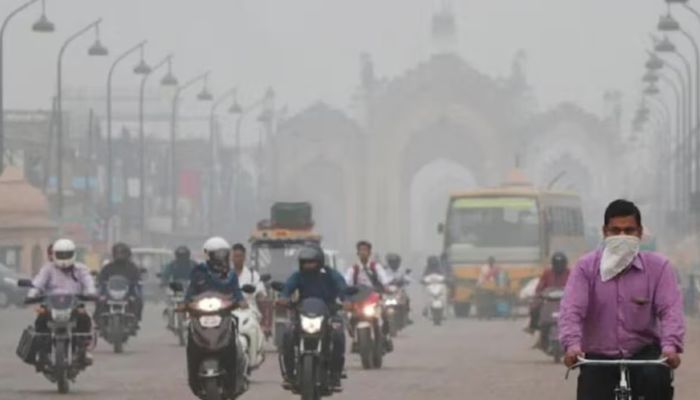
For years, Delhi’s Air Quality Index (AQI) has remained between the ‘very poor’ and ‘severe’ categories during Diwali, irrespective of whether firecrackers were banned, restricted, or allowed in the form of ‘green crackers’, as happened this year.
Diwali has become a ‘festival of ridicule’ for liberals and propagandists. Every year, they come out and blame Hindus for bursting fireworks, claiming it worsens the air quality. Rocky Singh, who got famous from a food show, wrote, “DELHI AIR POLLUTION WAS AT LETHAL LEVELS YESTERDAY”.
DELHI AIR POLLUTION WAS AT LETHAL LEVELS YESTERDAY
(Don’t get your undies in a twist loonies – this is a statement of fact-not political-not religious-not accusatory-not defensible – not hateful-not loving-not biased …)
Photographer Atul Kasbekar rote, “In the name of ‘religion’ people in north India are voluntarily destroying their health”.
In the name of ‘religion’ people in north India are voluntarily destroying their health Make it make sense pls
Yes sure, there are other factors like auto/ factory/ industry emissions adding to Delhi’s horrible air I’ve shot in Beijing in early 2000s and u couldn’t see three…
X user “The Protagonist” wrote, “F**k all of you pathetic imbeciles for making life miserable. FYI India accounts for about 46% of global asthma deaths, and roughly 200,000 people die each year in India from asthma,” while showing an image of asthma inhaler.
Post Diwali breakfast. Fuck all of you pathetic imbeciles for making life miserable.
FYI India accounts for about 46% of global asthma deaths, and roughly 200,000 people die each year in India from asthma. pic.twitter.com/0xsbrH9fYI
X user Jatin Gupta wrote, “Delhi is a city full of buffoons and idiots. The air is unbreathable now because some dimwits think burning crackers=Diwali. Just dumb. Plain Dumb.”
Old picture but same story. Delhi is a city full of buffoons and idiots. The air is unbreathable now because some dimwits think burning crackers=Diwali. Just dumb. Plain Dumb. Happy Diwali and happy Asthma pic.twitter.com/TvdJgDmfJg
Delhi AQI data reveals AQI remained same over years despite ban on firecrackers
According to the Central Pollution Control Board’s bulletin on 21st October, Delhi’s AQI was 351 compared to 345 on 20th October. OpIndia checked data since 2021 for the day before Diwali festivities and the following day.
In 2024, Diwali was celebrated on 31st October. On that day, the AQI was 328 and the next day, that is, on 1st November, the AQI was 339, as per CPCB respiratory data.
In 2023, Diwali was celebrated on 12th November. On that day, the AQI was 218 and the next day, that is, on 13th November, the AQI was 358.
In 2022, Diwali was celebrated on 24th October. On that day, the AQI was 312 and the next day, that is, on 25th October, the AQI was 302.
In 2021, Diwali was celebrated on 4th November. On that day, the AQI was 382 and the next day, that is, on 5th November, the AQI was 462.
Despite variations in enforcement, the data shows no significant improvement, which indicates that there are factors beyond Diwali celebrations that are primarily responsible for the city’s toxic air.
BJP blames AAP-led Punjab for worsening air
On 21st October, the Bharatiya Janata Party (BJP) accused the Aam Aadmi Party (AAP) government in Punjab of aggravating Delhi’s pollution through unchecked stubble burning incidents. BJP’s IT Cell chief Amit Malviya, in a post on X, said that farmers in Punjab set their paddy stubble ablaze during Diwali to pass it off as firecracker smoke and evade police action.
Don’t blame Deepawali for the poor air quality in Delhi-NCR.
Officials in Arvind Kejriwal–ruled Punjab have attributed the increase in farm fires to farmers setting paddy stubble ablaze during Diwali celebrations so that the fires could pass off as firecrackers being burst,… pic.twitter.com/Pfw9n0YFGR
He wrote, “Don’t blame Deepawali for the poor air quality in Delhi-NCR,” and added that AAP is effectively incentivising stubble burning to malign the Hindu festival.
What data says about stubble burning
According to the Indian Council of Agricultural Research’s (ICAR) Consortium for Research on Agroecosystem Monitoring and Modelling from Space (CREAMS) data, stubble burning incidents have increased substantially over the past few days. On 21st October, 268 stubble burning incidents were reported, out of which 62 were from Punjab, and Uttar Pradesh took the lead with 103 incidents.
Similarly, on 20th October, the number of incidents was 217, out of which 45 were from Punjab and 77 from Uttar Pradesh. On 19th October, Punjab reported 67 incidents and Uttar Pradesh reported 12. It is evident that stubble burning incidents have increased and farmers, not only in Punjab but also in Uttar Pradesh and other states, have contributed extensively to air pollution. Notably, the peak stubble burning season has only just begun, and it will get worse in the coming days if states fail to enforce regulations to stop stubble burning.
Though Punjab has shown fewer number of stubble burning incidents compared to UP this year, previous year data of stubble burning showed Punjab was the top state in stubble burning incidents. Furthermore, the “stubble burning season” has just begun and in coming days, Punjab may possibly surpass UP and other states.
The myth of ‘green Diwali’ and unchanged AQI levels
Over the years, data has painted a clear picture. Even when courts restricted firecrackers and Delhi promoted a “green Diwali”, pollution levels hardly shifted. The difference in AQI numbers is negligible.
Experts have also pointed to the coincidence of Diwali with the peak stubble burning season in Punjab and Haryana. The crop residue fires, combined with low wind speed and temperature inversion during October and November, trap pollutants in the atmosphere, worsening Delhi’s air. Even before Diwali, AQI levels tend to fall in the ‘poor’ category, indicating that the city’s pollution crisis is not caused solely by crackers.
There are hundreds, if not thousands, of messages on social media blaming Hindus and Diwali for the poor air quality. However, data narrates a different story. Instead of blaming the Hindu festival for pollution, it is necessary to examine the real cause behind the rising air pollution and falling air quality in the national capital. The Delhi government has planned to conduct cloud seeding between 24th and 26th October to bring down air pollution in Delhi. It will be interesting to see if artificial rain is going to help in curbing pollution as stubble burning incidents continue to rise across North India.
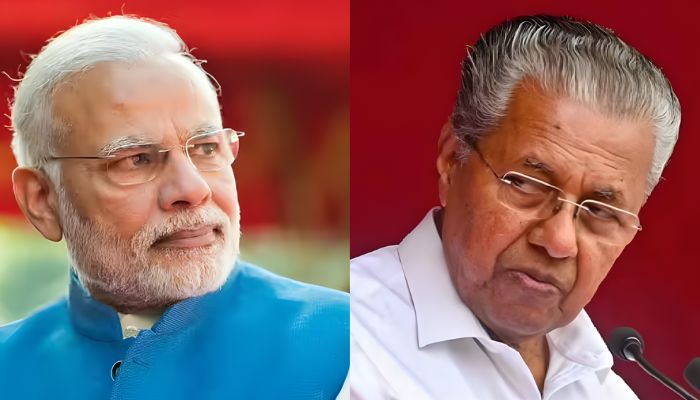
In a major development, the CPI(M)-led government of Kerala has finally agreed to join the Pradhan Mantri Schools for Rising India (PM SHRI) scheme of the Central Government. PM SHRI is a flagship initiative aimed at upgrading existing schools and strengthening the quality of education across the country. The decision of the Kerala government is a complete reversal from its earlier stand, as it had accused the Centre of attempting to “saffronise” education through the scheme.
Kerala’s earlier opposition to PM SHRI
For almost a year, the Government of Kerala had refused to sign the memorandum of understanding (MoU) needed to participate in the PM SHRI scheme. The state government claimed that the initiative, which is aligned with the National Education Policy (NEP) 2020, would undermine the state’s autonomy in the education sector. The Chief Minister of Kerala, Pinarayi Vijayan, had termed NEP “a danger to the nation”. Kerala’s Education Minister V Sivankutty alleged that NEP could lead to “central interference” in syllabus design.
As a result of the refusal by the state, the Centre decided to withhold Rs 1,000 crore in education funds meant for the state. Kerala and a couple of other states refused to sign the MoU, while the majority of the states and UTs have already signed it.
What led to the U-turn
On 19th October, Education Minister Sivankutty admitted that the state had no reason to stay away from the scheme meant for national development. He said, “Funds worth Rs 1,466 crore belong to our children. Many of our education-related expenses, including salaries of the teachers and student grants, depend on this support. The Centre’s funds belong to every citizen of the country.” He added that the government would take a “practical approach”.
ABVP’s role and student-led pressure
Notably, for months, various quarters had been pressuring the state government, including student bodies such as the Akhil Bharatiya Vidyarthi Parishad (ABVP), to join the PM SHRI scheme. ABVP held state-wide campaigns demanding Kerala’s inclusion in the scheme.
The student wing of the Bharatiya Janata Party (BJP), ABVP, had been at the forefront of the movement. They argued that the Left government’s ideological resistance was depriving students of central benefits. Its activists had submitted memoranda, organised protests, and even faced attacks during their campaigns.
ABVP’s Kerala State Secretary EU Eswaraprasad welcomed the state government’s decision and said, “This is a big victory for students who stood for educational progress. Around 336 schools in Kerala will benefit from PM SHRI, reaching standards comparable to Kendriya Vidyalayas.”
The fund freeze and its consequences
The Central Government runs an umbrella programme named Samagra Shiksha, under which states and UTs receive education funds that have been linked to the signing of the PM SHRI MoU. Since Kerala, West Bengal and Tamil Nadu were the only states that refused to sign, 2024-25 funds were not allocated to them. On the other hand, states including Madhya Pradesh, Uttar Pradesh, Rajasthan and others received thousands of crores under the same scheme.
Centre’s firm stand pays off
The Central Government stood firm on its stance that all states must align with the NEP and PM SHRI to ensure uniform national standards. By insisting on compliance before fund release, the Union Government reinforced accountability and avoided politically selective implementation of central schemes.
The Centre’s position on the PM SHRI and Samagra Shiksha funding issue was clarified in the Lok Sabha by the Union Education Minister. On 21st July, Dharmendra Pradhan, Education Minister of the Government of India, replied to a question jointly raised by Bapi Haldar and Kodikunnil Suresh regarding state-wise information on funds released, withheld, or delayed under Samagra Shiksha Abhiyan (SSA) and PM SHRI schemes between 2023 and 2025.
The MPs also asked about pending proposals for school upgradation in West Bengal’s Mathurapur constituency, the reasons behind the withholding of more than Rs 1,500 crore from the state, and whether such delays had affected teacher training and ICT programmes in Kerala.
In a detailed reply, Pradhan underlined that education falls under the Concurrent List of the Constitution of India and that the Centrally Sponsored Schemes (CSS) are implemented jointly with states that must meet certain fiscal and administrative conditions. He added that the release of funds by the Ministry is possible only after states fulfil requirements laid down by the Ministry of Finance, such as matching state share, audited accounts, and up-to-date utilisation certificates.
The minister reaffirmed that alignment with NEP 2020 is integral to both the Samagra Shiksha and PM SHRI frameworks. Furthermore, it was clarified that 33 out of 36 states and UTs have already signed the PM SHRI MoU, with West Bengal, Kerala and one more state (Tamil Nadu) pending.
According to the details provided by the Education Ministry, Kerala received Rs 141.66 crore under Samagra Shiksha in 2023–24 but no allocation was made in 2024-25 as the state had not signed the PM SHRI MoU. Similarly, Tamil Nadu received Rs 1,876 crore in 2023-24 but nothing in 2024-25.
In contrast, states that signed the MoU continued to receive full support. Uttar Pradesh received Rs 6,264.79 crore under SSA and Rs 246.86 crore under PM SHRI, while Madhya Pradesh got Rs 3,434.71 crore under SSA and Rs 145.32 crore under PM SHRI.
He said that the government has repeatedly urged non-signatory states to participate in PM SHRI so that their schools too can serve as models of NEP-driven excellence. Kerala’s decision to sign the MoU therefore reflects a larger acceptance of the idea that development cannot be held hostage to ideological bias.
Political posturing versus practical governance
While CPI leaders such as Binoy Viswam maintained their ideological objections, describing NEP as “reflecting the RSS agenda”, the state government appears to have accepted the practical necessity of cooperation with the Centre. Sivankutty clarified that Kerala would continue to uphold its own educational traditions while availing of central aid.
He stated that the funds would be utilised for essential activities such as textbook printing, exam preparation, student grants, hostel facilities for SC and ST students, and special education initiatives.
Failed attempt at confrontation
Earlier in May, the Kerala government had threatened to take legal action against the Central Government for withholding funds. At that time, the Kerala Government held meetings with the Tamil Nadu government to explore a joint front against NEP. However, the strategy did not yield any results.
Kerala’s earlier claim of already meeting PM SHRI goals
Despite its refusal, Kerala had often boasted of having already implemented key components of PM SHRI, citing the presence of 40,000 smart classrooms with broadband facilities across government and aided schools. Yet, without joining the scheme, the state had no access to central grants for further modernisation or teacher training.
Now, under the new agreement, over 260 to 336 schools in Kerala will be upgraded as PM SHRI model schools, joining 12,400 others across 670 districts in the country.
What is PM SHRI
The Pradhan Mantri Schools for Rising India (PM SHRI) is a flagship education initiative of the Central Government, announced by Finance Minister Nirmala Sitharaman in the Union Budget of 2022. The objective of the scheme is to transform existing government and government-aided schools across the country into model institutions of excellence. A total of 14,500 schools have been targeted under the programme, with at least two schools selected from every block in each district.
These schools are designed to play a leadership role for other government schools, serving as benchmarks of quality education in infrastructure, teaching standards, and learning outcomes. PM SHRI schools will showcase the successful implementation of every key objective outlined in the National Education Policy (NEP) 2020, making them exemplars of the policy in action.
The funding structure is shared, with the Centre contributing 60% and the states bearing 40% of the total expenditure. Each selected school will receive an average of Rs 1 crore annually for five years, aimed at improving physical infrastructure, digital learning facilities, and capacity building for teachers. The overall financial outlay for the scheme is approximately Rs 27,000 crore, making it one of India’s most ambitious education modernisation programmes.
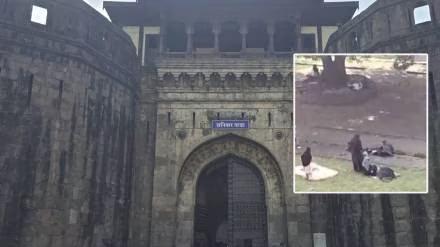
When three Muslim women were caught on video offering namaz inside the historic Shaniwar Wada Fort in Pune, it was initially brushed aside as an innocuous act of faith. But those familiar with India’s long history of cultural dilution and land encroachment saw it for what it truly was: a deliberate act of symbolism.
For Hindus, Shaniwar Wada is not just another monument. It is the beating heart of the Maratha Empire, built in 1732 by Bajirao I, the Peshwa who restored Hindu sovereignty across much of India. The fort stands as a civilizational reminder of a time when Bharat reclaimed its pride from centuries of foreign subjugation.
To offer namaz within its walls, therefore, is not merely an act of religious expression. It is a symbolic intrusion into a space that represents the Hindu civilizational ethos. And when BJP MP Medha Kulkarni responded by holding a shuddhikaran (purification) ritual and protest, it wasn’t political theatre as accused by the opposition parties. It was a cultural defence, an act of reclaiming what history has already sanctified.
Predictably, her detractors accused her of “communalising” the issue. But that framing misses the real point. The Shaniwar Wada namaz is not an isolated incident; it is part of a larger continuum of encroachment, one that begins with normalisation and ends with ownership.
The normalisation tactic: How devotion becomes dominion
Across India, the public offering of namaz on roads, in parks, on railway platforms, or in government compounds has grown steadily over the past two decades. Initially justified as a necessity due to a lack of mosques, these open-air prayers are now seen by many as exercises in visibility and claim-making.
The process typically unfolds predictably. It begins with namaz being offered in a public or non-Islamic space, justified as a temporary arrangement. As the act continues, it becomes routine, and society begins to accept it as part of the local landscape. Gradually, the repeated performance of namaz at the same location transforms into a claim of historical or religious significance. Finally, the Waqf Board steps in, citing this continuity to assert ownership of the land as Waqf property.
Once that happens, the transformation from faith to legal possession is complete. This pattern from temporary tolerance to permanent claim is now visible across multiple states, from Haryana and Uttar Pradesh to Karnataka and Madhya Pradesh. And it is precisely why what happened inside Shaniwar Wada must not be dismissed as trivial.
From Makhni to Srirangapatna: The expanding shadow of the Waqf Board
In Madhya Pradesh’s Makhni village, located in Raisen district, the Waqf Board issued notices claiming ownership of three acres of land, including private homes, farmlands, and even a village Shivling. Villagers who have lived there for generations were suddenly told that their land belonged to the Waqf. The Board’s justification was that the area was once a graveyard, allegedly donated by a man named Qadir Khan. No documentary proof was provided. The villagers have no record or even memory of such a person ever existing in their community.
Shockingly, the Waqf Board’s claim extended to state-owned land, despite official revenue documents showing clear government ownership. For locals, the inclusion of their Shivling in the list of claimed properties crossed every line of religious and cultural decency. The outrage in Raisen is a vivid reminder of how unchecked Waqf powers can destabilise entire communities.
Under the Waqf Act of 1995, once land is declared Waqf property, it becomes perpetual, inalienable, and immune to challenge in regular civil courts. Only a Waqf Tribunal, often composed of individuals aligned with or sympathetic to the Waqf establishment, can adjudicate such disputes. This asymmetry leaves ordinary citizens powerless against arbitrary claims.
The Makhni incident is not a rural anomaly. It is part of a nationwide pattern, and nowhere is that pattern more alarming than in Karnataka.
Karnataka: When even heritage belongs to Waqf
Earlier this year, a report published in the Star of Mysore revealed a stunning development: the Karnataka Waqf Board had laid claim to more than 70 properties in Srirangapatna taluk, including government-owned lands, ASI-protected monuments, and even Hindu temples.
Among the listed sites were the Tipu Armoury, a heritage monument under the Archaeological Survey of India; the Sri Chamarajendra Memorial Government Museum, a building belonging to the Department of Archaeology, Museums, and Heritage; the Chikkamma Chikkadevi Temple in Mahadevpura village; and even a government school in Chandagalu village. In addition, agricultural lands owned by local farmers were recorded as Waqf properties in official RTC (Record of Rights, Tenancy, and Crops) documents.
These claims followed a similar controversy in Vijaypura, where the Waqf Board attempted to take over 1,200 acres of farmland in Honwada village of Tikota taluk, declaring it as property of the Shah Aminuddin Dargah. Villagers pointed out that no such dargah had existed for centuries and that their families had owned the land for generations. Only after massive protests did the Karnataka government intervene, issuing a circular on November 9, 2024, ordering District Commissioners to withdraw all Waqf-related notices, reverse land mutations, and take disciplinary action against any official who had facilitated illegal encroachments.
That the Waqf Board could list ASI monuments, temples, museums, schools, and private farms as its property should alarm every citizen who values India’s civilizational integrity. It exposes how legal loopholes and bureaucratic complicity are being used to convert faith-based assertions into administrative facts.
The Shaniwar Wada connection: When history is rewritten by precedent
Seen in this light, the offering of namaz inside Shaniwarwada is not a random act; it is a symbolic precursor. Once a religious act is performed in a historically Hindu or state-protected space, it can later be invoked to claim “historic usage.” That is how soft encroachments evolve into hard claims.
If the Waqf Boards can list the Tipu Armoury or the Chikkamma Chikkadevi Temple as their property today, what stops similar claims tomorrow if religious rituals at Hindu monuments go unchallenged? Legally, under the current Waqf Act, such assertions can be made with minimal scrutiny. Culturally, they gain legitimacy if society continues to treat them as harmless acts of devotion.
That is why the Shaniwarwada namaz must be seen as an act of testing boundaries, a probe into how far such symbolic incursions can go without resistance.
Selective secularism and the erosion of heritage
India’s secular discourse has long operated on a one-way street. If Hindus were to conduct Hanuman Chalisa inside Haji Ali Dargah or Jama Masjid, outrage would erupt across leftwing cabals, and FIRs would follow within hours. Yet, when non-Hindu rituals are performed inside Hindu or national heritage sites, the same commentators appeal for calm and tolerance.
This selective secularism has allowed the gradual erosion of Hindu cultural spaces under the guise of inclusivity. The protests led by Medha Kulkarni and others in Pune were, therefore, not acts of intolerance but of preservation, a reminder that Hindu spaces are not open grounds for religious experimentation. “It is our duty to preserve Hindu culture and traditions,” Kulkarni declared. That sentiment echoes beyond Pune, from Makhni to Srirangapatna.
To its credit, the Government of India has begun addressing these distortions. The Waqf Amendment Bill, whose Joint Parliamentary Committee report was tabled in February 2025, seeks to make land declarations more transparent, introduce third-party audits, and curb arbitrary claims. But legislative reform alone cannot safeguard heritage. What is required is civilizational vigilance, the collective determination to protect spaces that define India’s identity.
Because civilisations rarely fall through invasion alone. They crumble when they surrender their cultural confidence, ritual by ritual, concession by concession. The namaz at Shaniwar Wada was not merely a breach of ASI rules; it was a psychological test of whether Hindus would once again stay silent as their heritage is slowly redefined.
The outrage in Pune suggests that silence is finally breaking. And that matters.
Because in the end, the Shaniwar Wada namaz was not a prayer. It was a precedent. And if the examples of Makhni and Srirangapatna are any guide, precedents, once ignored, have a way of turning into property deeds.
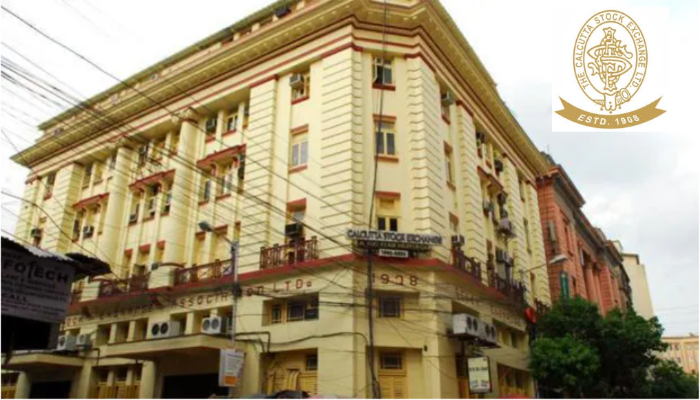
Once considered a contender to the Bombay Stock Exchange (BSE), the 117-year-old Calcutta Stock Exchange is reportedly nearing the end of its voluntary departure as a bourse. After years of legal and regulatory obstacles, it is going to celebrate its last Kali Puja and Diwali as a functioning stock market before permanently closing on 20th October.
The Securities and Exchange Board of India (SEBI), the market regulator, had already suspended trading at the CSE in 2013 due to non-compliance with regulatory standards. The exchange decided to completely shut down despite attempts over the last ten years to revive trading and even challenge SEBI’s ruling.
Although the exchange had previously intended to challenge SEBI orders in court, a favourable ruling was not possible until last year. The board of CSE made the decision to drop its pending cases in the Supreme Court and the Calcutta High Court in December 2024. The former then requested a voluntary departure.
CSE Chairman Deepankar Bose stated, “Approval has also been obtained from the shareholders vide EGM (Extraordinary General Meeting) dated 25th April 2025 relating to the exit of the stock exchange business. Accordingly, CSE submitted the exit application to SEBI, which has, in turn, appointed a valuation agency for undertaking the valuation of stock exchange which is in progress.”
CSE would remain a holding company if SEBI authorises the withdrawal but its subsidiary CSE Capital Markets Pvt Ltd (CCMPL) will continue to operate on the NSE (National Stock Exchange) and BSE. The sale of CSE’s three-acre EM Bypass property to the Srijan Group for Rs 253 crore has also been approved by the regulator and this will happen after SEBI grants his approval.
The regulator has also approved CSE’s plan to sell its three-acre EM Bypass property to Srijan Group for ₹253 crore, a transaction that will be completed after the exit is finalised.
End of an era of trading
CSE which was founded in 1908 was formerly a competitor of the Bombay Stock Exchange and a representation of Kolkata’s financial history as well as the hub of the Lyons Range.
The largest setback for CSE occurred in 2013, when SEBI chose to halt trading on the platform. The exchange violated important regulations which led to the outcome. It approched courts multiple times to counter the suspension. However, this resulted in financial strain and a decline in trade activity did not help either, particularly in the midst of the NSE and BSE trading boom.
One of the main causes of CSE’s downfall along with other factors including an actual loss of relevance, is the dominance of BSE and NSE. CSE started to lag behind especially following the Dot Com boom in the early 2000s, when the stock exchange found it difficult to adapt to a finance industry dominated by technology.
The revelation of the Ketan Parekh scam in 2001 dealt the last blow. Parekh who was a stockbroker by profession inflated the prices of a few stocks, referred to as K-10 stocks, by taking advantage of the exchange’s loopholes. It triggered stricter regulations and a sharp decline in investor confidence. CSE’s collapse was ultimately caused by the stock exchange’s incapacity to adhere to the rules over time.
“We began each day with a prayer to Goddess Lakshmi before trading till April 2013 when trading was suspended by the regulator. This Diwali feels like a farewell to that legacy,” veteran stockbroker Siddharth Thirani, reported The Times of India.
On 25th April, the formal proposal was approved by shareholders after being submitted to SEBI earlier on 18th February. Rajvanshi & Associate has been hired by SEBI to complete the same which is the last stage before exit approval is granted.
With 1,749 listed businesses and 650 registered members, the exchange “has played an important role in India’s capital markets,” according to chairman Bose’s FY25 report. During 2024-2025, he was paid Rs 5.9 lakh in director’s sitting fees.
With a one-time payment of Rs 20.95 crore and yearly savings of roughly Rs 10 crore, the exchange provided all employees with a Voluntary Retirement Scheme (VRS) in advance of the departure. While some staff were kept on contract for compliance tasks, all of them accepted the offer.
An era for India’s regional stock exchanges which used to be abuzz with activity until electronic platforms moved market concentration to Mumbai, is coming to an end with the exit of the CSE. Legacy organisations like CSE remain as symbols of financial history, reflecting the evolution of India’s capital markets through technology modernisation and regulatory strengthening.
“CSE has played an important role in India’s capital markets,” Chairman Deepankar Bose rightly summarised in the FY25 annual report.
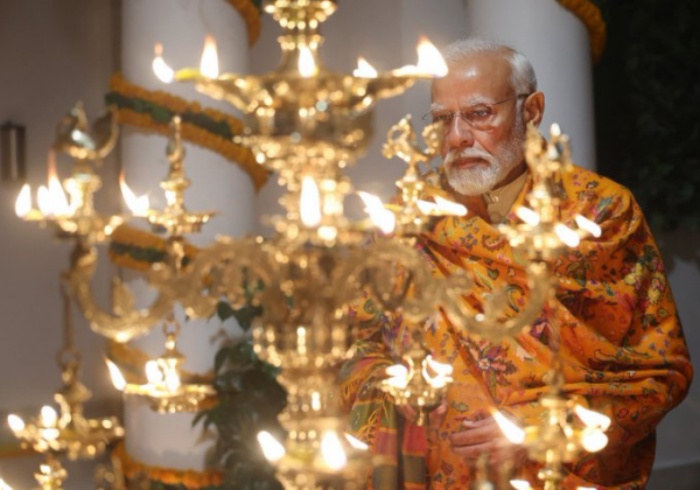
On the occasion of Deepavali, PM Modi has written a letter to fellow Indians, sharing his heartfelt wishes and marking some significant achievements of India as a nation.
This is the full text of the letter.
Dear fellow citizens,
I extend my heartfelt greetings to all of you on the auspicious occasion of Deepavali, a festival filled with energy and enthusiasm. This is the second Deepavali after the grand construction of the Ram Temple in Ayodhya. Lord Shri Ram teaches us to uphold righteousness and gives us the courage to fight injustice. We witnessed a living example of this a few months ago during Operation Sindoor, when Bharat not only upheld righteousness but also avenged injustice.
This Deepavali is particularly special because, for the first time, lamps will be lit in many districts across the country, including remote areas. These are the districts where Naxalism and Maoist terrorism have been eradicated from the root. In recent times, we have seen many individuals abandoning the path of violence and joining the mainstream of development, expressing faith in the Constitution of our country. This is a major achievement for the nation.
Amid these historic achievements, the country has also embarked on next-generation reforms in recent days. On the first day of Navratri, lower GST rates were implemented. During this “GST Bachat Utsav” (Savings Festival), citizens are saving thousands of crores of rupees.
In a world going through multiple crises, Bharat has emerged as a symbol of both stability and sensitivity. We are also on track to become the third-largest economy in the world in the near future.
In this journey of a “Viksit” (Developed) and “Aatmanirbhar Bharat” (self-reliant India), our primary responsibility as citizens is to fulfil our duties towards the nation.
Let us adopt “Swadeshi” (local products) and proudly say: “This is Swadeshi!” Let us promote the spirit of “Ek Bharat, Shreshtha Bharat”. Let us respect all languages. Let us maintain cleanliness. Let us prioritise our health. Let us reduce the use of oil in our food by 10% and embrace Yoga. All these efforts will rapidly move us towards a “Viksit Bharat”.
Deepavali also teaches us that when one lamp lights another, its light doesn’t diminish, it grows further. With the same spirit, let us light lamps of harmony, cooperation, and positivity in our society and surroundings this Deepavali.
Once again, wishing you all a very Happy Deepavali.
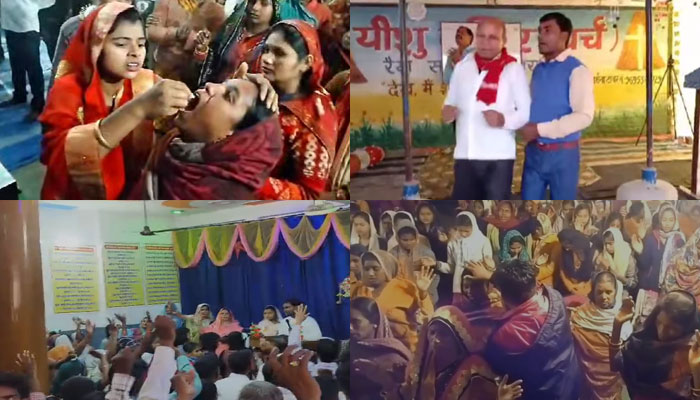
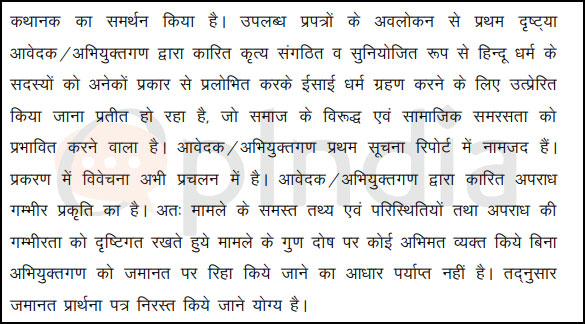
On 16th October, the Prayagraj District Court dismissed the bail application of 13 individuals accused of orchestrating an organised Christian conversion racket in Baudai village under Phulpur Police Station area of district Prayagraj in Uttar Pradesh. The order was passed by the Additional District Judge. The court found that the evidence on record prima facie suggested the involvement of the accused in attempts to unlawfully convert poor Hindus to Christianity through inducement, monetary incentives, job offers at missionary schools, and religious propaganda.
The accused have been identified as Sonu Kumar, Pankaj Saroj, Sachin, Anil, Ram Milan, Sona Devi, Aarti Devi, Shivani Yadav, Anjula, Rekha Devi, Sangeeta Saroj, Shivani Saroj, and Harishiv. They were booked under Sections 191(2), 352, 351(3), 299, and 196(1) of the Bharatiya Nyaya Sanhita (BNS) and Sections 3 and 5(1) of the Uttar Pradesh Prohibition of Unlawful Conversion of Religion Act, 2021, on the complaint of Shantanu Tiwari, co-convenor of Bajrang Dal, Phulpur, on 19th September.
Bajrang Dal leader exposed the racket
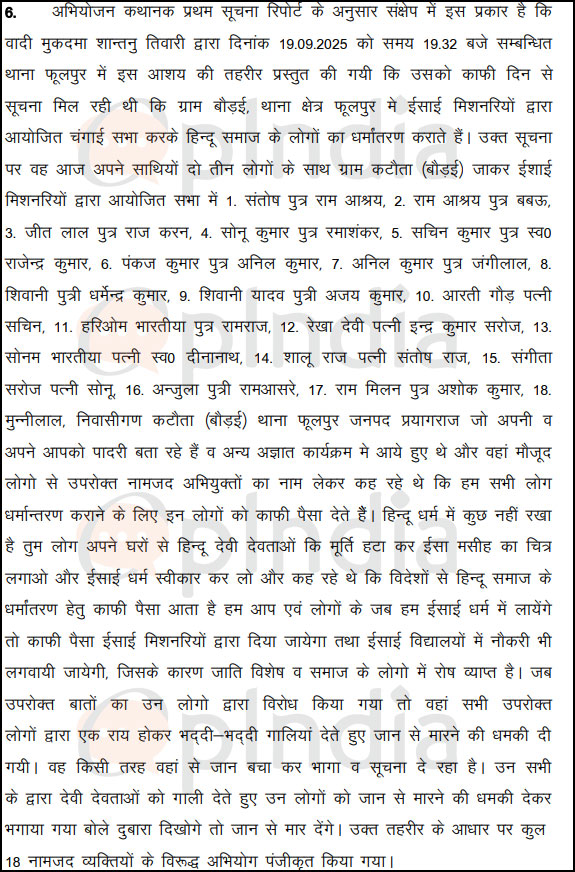
The case originated from a written complaint filed by Shantanu. According to the FIR, Shantanu had been receiving consistent reports that a group of individuals was conducting prayer meetings in Baudai village to convert Hindus to Christianity. On 19th September, he came to know about one such meeting happening in the village. He and his three fellow activists of Bajrang Dal went to the village to verify the information.
Source: Prayagraj District Court
On reaching the spot, Shantanu found a gathering of men and women engaged in a Christian-style prayer meeting, allegedly organised by the individuals introducing themselves as missionaries. One of them, Munnilal (also among the accused), was calling himself a pastor. When questioned, some attendees reportedly revealed that the accused received money for each Hindu they converted to Christianity and were motivated by foreign funding and missionary organisations.
Conversion tactics and false promises
The FIR noted that the accused were telling Hindus that there was “nothing in their religion” and that they should discard idols of Hindu Gods and Goddesses from their homes, replacing them with images of Jesus Christ. The accused allegedly promised them financial support and jobs in Christian missionary schools once they embraced Christianity.
Shantanu’s complaint further stated that when he and his associates objected to the ongoing activity, the accused verbally abused them and threatened to kill them if they returned. Following this confrontation, he immediately informed the Phulpur Police, which led to the registration of the case under stringent provisions of the anti-conversion law.
Court noted ‘prima facie evidence’ of organised conversion drive
In its order, the court rejected the bail plea and stated that the material on record indicated that the petitioners were actively participating in a planned effort to lure innocent and economically weaker Hindus into conversion by offering money and jobs. The judge noted that the crime was of a “serious nature” and that bail cannot be granted at this stage.
Source: Prayagraj District Court
While rejecting the bail plea, the court also observed that there were consistent statements from witnesses, including complainant Shantanu Tiwari and others, affirming that the accused were conducting regular meetings to promote conversion under the guise of prayer gatherings. The court rejected the defence argument that no actual conversion had taken place, stating that the intention, inducement, and preparatory acts were clearly established in the investigation papers.
Investigation and custody status
As bail has been denied, all 13 accused will remain in judicial custody. They were sent to custody on 21st September. The police informed the court that the investigation in the matter is underway to trace other individuals potentially connected to the conversion network and to identify sources of funding.
Recently, Shantanu filed another complaint in a similar matter in Phulpur leading to arrest of three individuals involved in luring Hindus to convert to Christianity on 18th October. The police has filed an FIR in that matter and an investigation is underway.