Home Blog Page 2491

Pervez Musharraf and his role in increasing Pakistan’s terror activities and hostility toward India

0

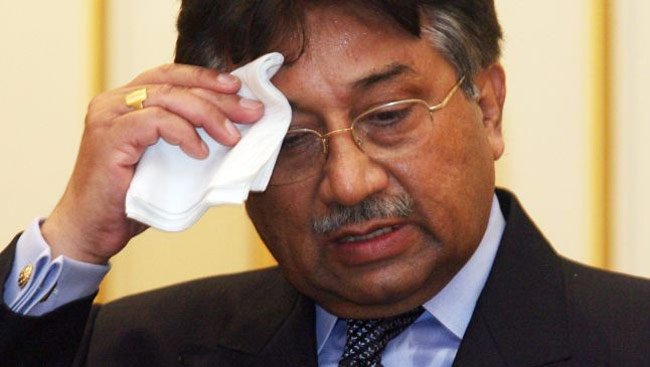
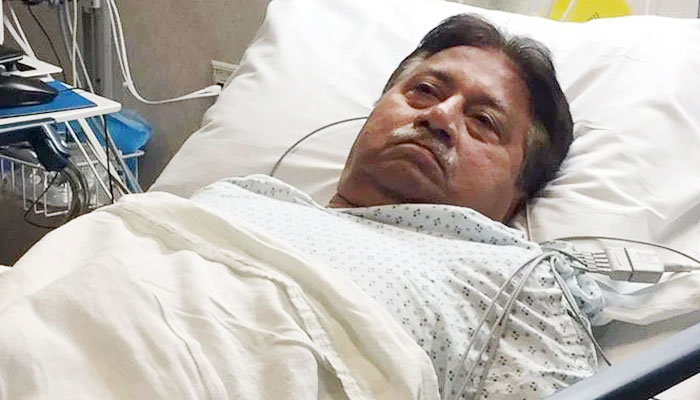
On February 5 (local time), former President and military dictator of Pakistan Pervez Musharraf died due to a heart attack while receiving treatment for his prolonged illness. Musharraf, who is infamously known for his role in instigating the Kargil war and the increase in terror activities in India, was suffering from amyloidosis. It is a rare disease that affects the connective tissues and organs in the body. Musharraf, who was 79 at the time of death, was suffering from abnormal functioning of multiple organs due to the build-up of an abnormal protein called amyloid.

The early life of Musharraf

Parvez Musharraf was born in August 1943 in Delhi, India. Following the partition at the end of British Rule, his family moved to Pakistan. For seven years, Musharraf was in Turkey as his father was posted as a civil servant in Ankara. In 1956, his family moved to Karachi. For his education, Musharraf attended Christian schools, before moving to the Royal College of Defence Studies in London for higher studies.

At the age of 18, Musharraf joined the Pakistan Military Academy. When war broke out between India and Pakistan in 1965, Musharraf was already a part of the Pakistan Army. He also participated in the 1971 war that led to Pakistan’s partition and the formation of Bangladesh.

Musharraf also served in the special service commando group of Pakistan’s armed forces. In October 1998, he was promoted to the rank of General and named Army Chief by then-Prime Minister Nawaz Sharif after the dismissal of General Jehangir Karamat.

Musharraf’s role in the Kargil war

Though the infiltration of Kargil started in 1999, it was not the first time Musharraf had floated the idea. When Musharraf was a Brigadier, he proposed the Kargil infiltration to then-Prime Minister Benazir Bhutto. However, she refuted the plans and things did not go the way Musharraf wanted. It is believed that a decade later, he played a key role in the 1999 Kashmir infiltration. The infiltration started early in 1999, however, it turned into a wrong strategic move for Pakistan leading to the Kargil war from May to July 1999.

The initial plan of the Pakistani Army was to capture as many posts as possible on the heights across LOC vacated by the Indian Army during the winter. Not to forget, the Kargil war started only a few months after the historic bilateral peace declaration between Indian PM Atal Bihari Vajpayee and Pakistan PM Nawaz Sharif.

From March 1999 to May 1999, Musharraf ordered the infiltration of Pakistani soldiers and terrorists in the Kargil district. When India discovered the infiltration, a full-scale war broke out in the region. Soon after the war began, Sharif decided to withdraw the support of the terrorists in July. It is believed that the pressure from the international community had become unbearable for the Pakistani government.

Sharif’s decision did not go well with the Pakistan Army and it is rumoured that the decision led to the coup soon after. The war officially ended on July 26, 1999.

On October 12, 1999, Mushraff was scheduled to return to Pakistan but Sharif attempted to prevent the plane carrying him from landing at Karachi airport. The attempts were foiled by the Pakistani Army which seized control of the airport. Sharif’s actions led to the forceful removal of his government by Musharraf. The Pakistan Army, under his leadership, seized control of the civilian government and on October 14, Musharraf passed an ordinance suspending the Constitution of Pakistan while serving as the Chief Executive of the country.

Musharraf’s role in terrorist activities in India

The Kargil war was not the only occasion when Musharraf played a role against India. In an interview in 2019, he admitted to training Kashmiris to wage a war against the Indian Army in Jammu and Kashmir, taking pride in these ‘Mujahideens’, touting them to be “Pakistan’s heroes’.

Terrorists like Osama bin Laden, Ayman al-Zawahiri, Jalaluddin Haqqani, and others were always considered to be “Pakistan’s heroes”, Musharraf confessed.

In the interview, he said, “In 1979, we had introduced religious militancy in Afghanistan to benefit Pakistan and to push the Soviets out of the country. We brought Mujahideen from all over the world, trained them, and supplied weapons. They were our heroes. Haqqani was our hero. Osama bin Laden was our hero. Then the environment was different but now it is different. Heroes have turned to villains.”

He added, “Kashmiris who came to Pakistan received a hero’s reception here. We used to train them and support them. We considered them Mujahideen who will fight with the Indian Army then various terrorist organisations like Lashkar-e-Taiba rose in this period. They were our heroes.”

Later, Musharraf said that the assassination attempt on his life back in 2003 on the Jhanda Chichi bridge was carried out by Jaish-e-Mohammad and hence, he always considered them as terrorists. He said that because of the terrain of the area back then, they had pressed the button late, and hence their assassination attempt had failed.

In 2018, in an interview with The Guardian, Musharraf admitted that the Inter-Services Intelligence (ISI) helped cultivate the Taliban to counter then-Afghanistan President, Hamid Karzai’s government, for harbouring officials thought to favour India. “We were looking for some groups to counter this Indian action against Pakistan,” Musharraf said, “That is where the intelligence work comes in. Intelligence being in contact with Taliban groups. They were in contact, and they should be.”

Musharraf always displayed his hate towards India although he claimed otherwise. He was also contemptuous of the favourable opinion towards India in western countries.

“India is the greatest democracy, promoter of human rights and democratic culture’? All bullshit,” he said, “There are no human rights. The religion itself is anti-human rights. In the rural areas, if even the shadow of an untouchable goes on a pandit, that man can be killed.”

The political life and death

In 2001, a referendum was held in Pakistan to determine if Musharraf can continue ruling the country. He won and his term was extended for five years. There were allegations that he got the voting rigged in his favour. In August 2008, he lost the elections and the ruling coalition agreed to launch impeachment proceedings against him.

In 2012, Musharraf tried to make a political comeback but got disqualified. He was then arrested and put under house arrest. He faced treason charges for an attempt to fire Supreme Court judges. In 2016, he was allowed to leave Pakistan on bail for medical treatment. After that, he did not return to Pakistan and died while receiving treatment for his ailment.
Pakadua Vivah in Bihar: Boy flees after a girl’s family allegedly gets him forcefully married to her in court, video goes viral

0

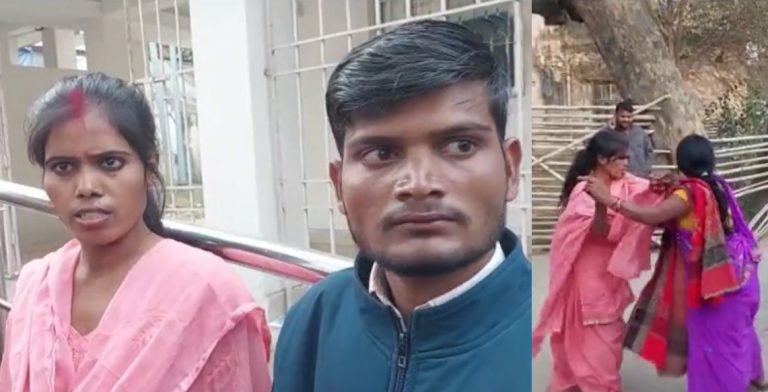
On Friday in Bihar, a family of a boy alleged that another family forcefully took him to a court and got him married to their daughter against his will, after spotting them talking to each other. While the girl maintains that they were in a relationship, the boy refused this and claimed that the wedding was conducted forcefully by forcing him to put sindoor on her forehead.

The case took place in the Nalanda district of Bihar. Gyani Kumar, son of Parshuram Paswan, resident of Mohini village had gone to Bihar Sharif with her sister as she was appearing for an examination. There he met the girl, Gudiya Kumari, daughter of Rajkumar Paswan of the village Mananki in the Rahui Thana district. According to the version of the girl’s side, Gyani had called Gudiya to meet.

As they were talking to each other, the girl’s family saw this, and immediately took the couple to court and got them married. The boy claimed that they forced him to put sindoor on the girl’s forehead, and they were declared married.

However, as soon as the boy’s family learned of this, they arrived at the scene and rejected the wedding, and stopped the further proceedings of the marriage. As a result, a ruckus started between the two families, with the boy’s mother pushing the girl away from her son.

A video of the incident has gone viral, where the boy, the girl and the boy’s mother are seen narrating their own versions of the story.

Talking to reporters at the spot, the boy’s mother said that when Gyani Kumar had reached the town along with his sister for her examination, the girl’s brother abducted him and got him forcefully married to Gudiya. She said that just because her son was talking to the girl does not mean that they were in a relationship. The mother Sangeeta Devi said that she is not happy with the marriage.

Gyani Kumar also repeated the same, saying that he was forcefully married by the girl’s family, and he didn’t have any relationship with the girl. He said that he knew the girl and they used to talk, but he didn’t want to marry her.

However, the girl Gudiya Kumari claimed that they were in a relationship for the last six months after they met on Facebook. She also said that the boy himself had proposed the marriage, after which both of them went to Bihar Sharif court and got married.

In the meanwhile, during the ruckus between the two sides near the court, the boy absconded from the spot. After that, both his family and the girl’s side launched a search for him.

The Police said that no complaint has been lodged in the matter so far. If and when any complaint is filed, appropriate action will be taken, the police said.

It is notable that such incidents of forced marriage or Pakadua Vivah keeps happening in Bihar, where powerful families of girls abduct earning boys and get them married forcefully. This ensures that they don’t have to pay a dowry to get a good son-in-law.

‘Ghanti’ for Budget, finding Hindenburg chief in a river: Ravish Kumar’s mental health a concern following his resignation from NDTV

The theatrics of Ravish Kumar know no bounds. Ever since the short-seller Hindenburg Research targeted the Adani Group and wiped out $100 billion of its investors in the process, the former ‘news anchor’ has been filled with a rarely seen enthusiasm.

Ravish has been the judge, jury and executioner during his stint at NDTV. Casting aspersions on the integrity of the Indian institutions, peddling a distorted image of India to the world, fear-mongering and obsessing over so-called ‘Godi media’ has been his forte.

Of late, Ravish Kumar’s shenanigans and cringe behaviour had netizens questioning the state of his mental health. On Saturday (February 4), the ‘news anchor’ went on a mission to find Nathan Anderson, the founder of Hindenburg Research, on the banks of the Hindon river.

Ravish Kumar, who mistakenly believes that he has a great sense of humour, yelled, “We are walking down the stairs to reach the banks of Hindon river. We are hoping to find the office of Hindenburg Research…Anderson, we are looking for you, but he is not coming in front of us.”

“Anderson, where are you? I am speaking in English and even then Anderson is now appearing before me. Anderson, Hindenburg near Hindon river…I am not finding Anderson here at all,” he continued with his hysterical behaviour.

On Thursday (February 2), the former NDTV news anchor went bonkers while virtue-signalling about the ‘ethics of journalism.’ He said, “India is now an off-record democracy and with only on-record, chaaploosi (unusually shrill, high pitch)…Write it down and keep it in your purse.”

However, none of his theatrics comes close to his vicious attempt to undermine a people-friendly budget presented by Nirmala Sitharaman in Parliament.

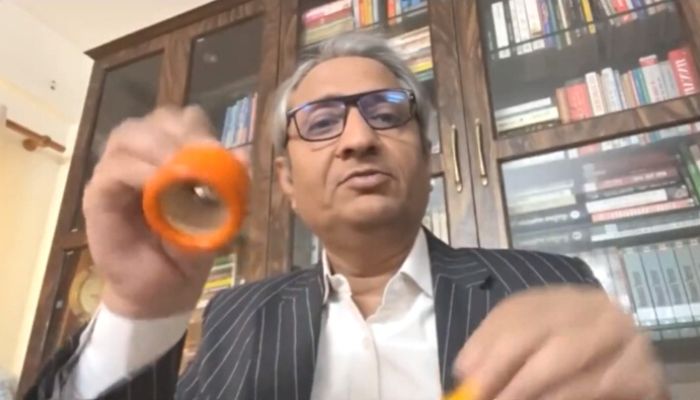
Well aware that the 2023 budget was crucial, Ravish Kumar went live on Facebook on the day the budget was presented to brainwash his viewers.

“I have brought something special for you guys – Ghanti (bells). See how I ring these two bells. Why am I doing this? Let me explain. The Budget is about to be presented and news channels have started their usual nonsense. I am ringing these bells to wake up,” he made a desperate attempt at humour.

“If you have a bell at your house, then, you also consider ringing it once. To lie to you, the Godi Media initially brought a bag of lies and now they are bringing the flying throne (udaan khatola) of lies,” Ravish Kumar exclaimed.

“They have left you hanging in the air. I am ringing these bells so that your gaze falls on the land underneath your feet… So I am starting this Facebook Live by ringing these two bells,” he added and then went on to talk about bells.

The delusional behaviour of Ravish Kumar intensifies

This is, however, not the first time when the former NDTV news anchor went bonkers on social media. In December last year, he claimed in an interview that Gautam Adani, the chairman and founder of the multinational conglomerate Adani Group, “spent thousands of crores to buy NDTV to silence him.”

In an interview with the BBC, Ravish Kumar imagined a scenario of him being in Lok Sabha and speaking in front of Prime Minister Narendra Modi.

Ravish Kumar’s display of narcissism became a source of entertainment on Twitter. Within no time, Twitter users started sharing funny jokes and memes with the hashtag #MainBhiRavish.

‘Deport Nihangs on temporary visa, ban Sikhs from carrying weapons’: Australian Hindus hand over demands to home minister

0

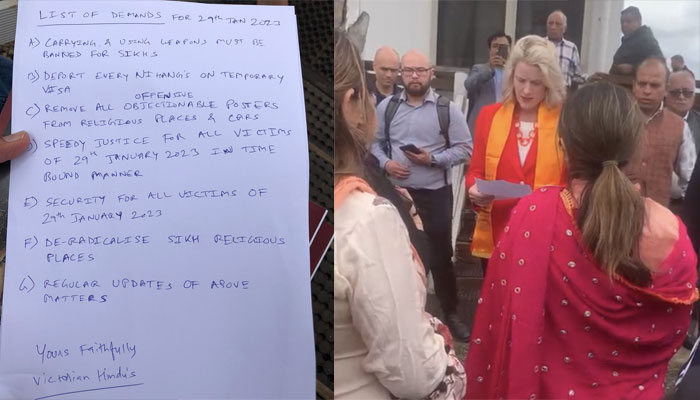
On February 5 (local time), Australian Hindus presented a list of demands to the Home Affairs Minister Clare O’ Neil who visited a Durga Temple in Melbourne ahead of the resumption of the Parliament. The demands were in the wake of attacks on Indians by pro-Khalistani elements with terror links in Melbourne.

Several incidents of attacks on Indians and Hindu temples by Khalistanis have taken place in Victoria state in Australia in recent times. The Khalistan supporters led by Sikhs for Justice are also organising so-called referendums for an independent Khalistan state in Indian Punjab. Against this backdrop, the Indian community handed over some demands to the home minister. They also demanded speedy justice for the victims of an incident on 29 January in Melbourne, when Khalistanis had clashed with Hindus.

The list of demands was as follows.

  1. Carrying and using weapons must be banned for Sikhs
  2. Deport every Nihang on a temporary visa
  3. Remove all Objectionable/Offensive posters from religious places and cars
  4. Speedy justice for all victims of the January 29, 2023 incident in a time-bound manner
  5. Security for all victims of the January 29, 2023 incident
  6. De-radicalise Sikh religious places
  7. Regular updates on the above matters

According to a Twitter user Savan_2011 who was present at the temple, the minister agreed to “seriously consider the demands.”

Assistant Minister For Foreign Affairs Tim Watts and Labor Federal member for Wills Peter Khalil accompanied MP Clare to the temple. In an official statement, Watts said, “Before the resumption of Parliament Clare O’Neil, Peter Khalil and I visited Sri Durga Temple to meet with committee members and listen to their perspectives – it’s the biggest Hindu temple in Melbourne’s west.. and maybe Australia!”

He added, “Our community is a place of incredible cultural and religious diversity. I’ve been privileged to visit Sri Durga many times over the years to celebrate festivals like Diwali and Holi which have become fixtures on Australia’s cultural calendar.”

Speaking about the attacks he said, “The vandalism of places of worship we’ve seen in the last few weeks is completely unacceptable in our multicultural and multi-faith country. We fully support Victorian police’s investigation of these hateful acts.”

Pro-Khalistanis attacked Indians protesting against the so-called Referendum 2020 in Melbourne

On January 29, several videos appeared on social media showing Indian Australians being attacked by Khalistanis with swords while carrying the Indian tricolour. Notably, the Khalistani terrorist outfit ‘Sikhs For Justice’, which has been banned by the Indian government, had announced that a referendum on Khalistan will take place on January 29 at Federation Square. On the same day, Indian Australians also organised a protest at the same venue against rising pro-Khalistan activities and attacks on Hindi temples in the country.

This led to a clash between the two groups, and some Khalistanis attacked some Indians. Australian Hindu Media informed that the police arrested a sword-yielding Khalistani at Federation Square during the Khalistan event.

Pakistan: North Nizamabad’s Assistant Commissioner gets abused for sharing ‘pride flags’; amidst his denial, his old posts with rainbow flag surface

0

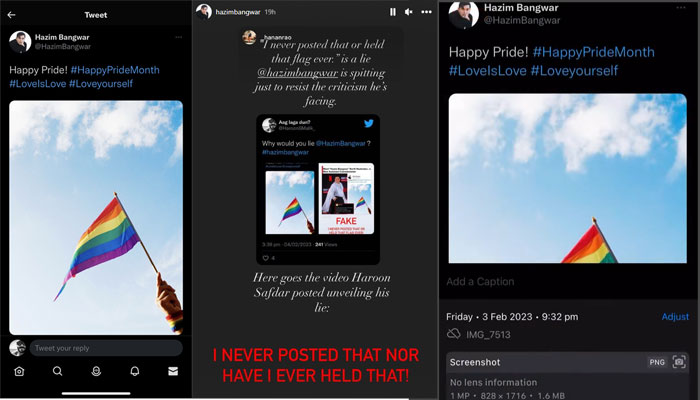
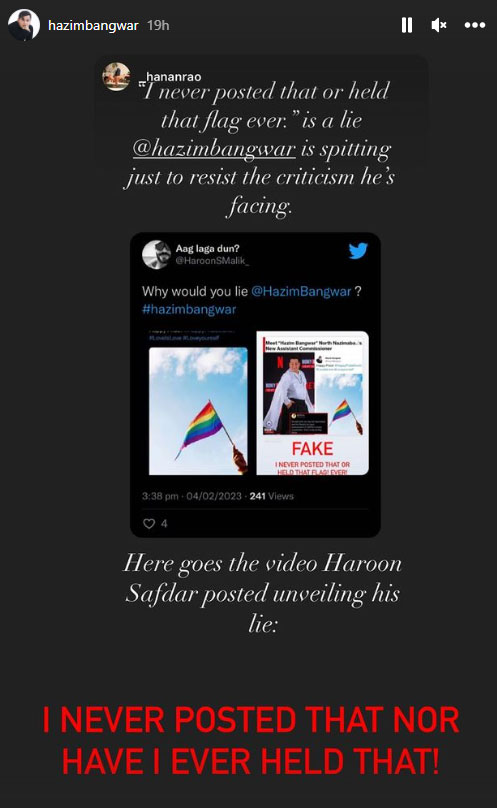
On February 3, netizens from Pakistan called out North Nizamabad’s new Assistant Commissioner Hazim Bangwar for putting up a pride flag on Twitter in 2018. Bangwar, however, has denied the allegations in an Instagram story. In the story he wrote, “I never posted that nor have I ever held that!!”.

Source: Instagram

While trying to remove himself from the controversy and prove that he did not post any such image or tweet, he accidentally shared a post by Instagram user _hananrao proving him wrong. Apparently, he thought the post was in his favour while it was exposing his lie.

Source: Instagram

On February 3, Twitter user Haroon S Malik (Instagram user _hananrao) shared an alleged screenshot of Bangwar’s tweet from 2018 in which he had shared a photograph of a pride flag and wrote, “Happy Pride! #HappyPrideMonth #LoveIsLove #Loveyourself”. When OpIndia tried to access the tweet or its archive, it was not found on Twitter.

On February 4, Malik alleged that Bangwar deleted the tweet that had sparked controversy to avoid the criticism he was facing.

Sharing a video of the screenshot in his gallery, Haroon questioned Bangwar why he had lied that he never held the flag. In the video, Haroon shows that the screenshot was taken on February 3, 2023.

The homophobic comments on Bangwar’s posts

Bangwar, who is a former singer and social media influencer, was recently appointed Assistant Commissioner in the North Nazimabad area of Pakistan. His appointment to the post created quite a buzz on Pakistan’s social media, with many taking a deep dive into Bangwar’s personal life and talking about his interests and ‘hobbies’.

Last week, Bangwar took to Twitter to share pictures from the office. “It is a privilege to serve you as your new Assistant Commissioner,” read the tweet.

Discussions on social media were stirred not by Bangwar’s appointment with the police but by the unconventional and patently feminine dressing sense reflected in his Instagram posts. Naturally, in a deeply conservative society such as Pakistan, where Islam is a state religion that regards gender fluidity as illegitimate, Bangwar’s demeanour came under attack from homophobic elements.

Bangwar’s nonconformist personality had the detractors unsettled as they left nasty homophobic comments on his pictures on Instagram. “Pura ka pura h*jda lagta he,” read a comment on a picture of Hazim Bangwar where he is seen wearing a Leopard print dress.

His posts were bombarded with homophobic comments. He was called “Khu*sy”, “Hi*ra” and more on his posts.

OpIndia could not independently verify if the accusations against Hazim Bangwar were true or not. However, the netizen who first shared the screenshot claims it was taken on February 3, 2023. The archive of any such tweet was not found.

Don’t mock the dead, unless the dead person is someone like Pervez Musharraf, then all memes are fine

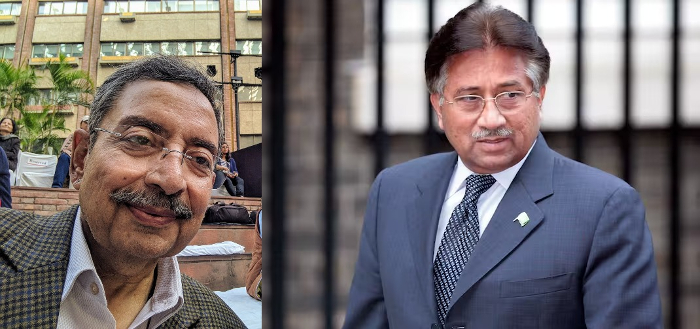
Senior journalist Vinod Dua, who was named in the MeToo campaign and accused of sexually harassing and stalking a filmmaker in 1989, once spoke about using flowery language for the dead to appear “politically correct”. In one of his videos, Dua had said that effusive obituaries pouring over after former PM Atal Bihari Vajpayee’s death was “hypocrisy” as no one spoke ill of the dead. 

“India’s former prime minister Atal Bihari Vajpayee died today. He was 93 years old at the time of his death. In our country, we have a habit of putting up pretenses after a person has passed away. They are suddenly exalted to the status of great men and such kinds of obituaries are shared saying that it is politically correct,” Dua said in his video for the leftist propaganda website The Wire. 

We remember the late Vinod Dua’s words today because some people are getting uncomfortable over all the jokes and memes mocking the death of former Pakistani dictator Pervez Musharraf.

While in general, I maintain that the dead should not be mocked, since they are no longer around to defend themselves. However, I feel we can make an exception in the case of someone like Pervez Musharraf since there is no defense that can explain his actions during his life.

In case any Indian has forgotten, Musharraf was the architect of the Kargil war in 1999 while he was heading the Pakistan Army. The Pakistan Army of course calls all the shots in the country. Later in the year, Musharraf executed a military coup to seize control of power (officially) in Pakistan and replaced the Nawaz Sharif government. Musharraf led Pakistan from 1999 to 2008 as the country’s President before leaving for London in disgrace.

Kargil war and the role of Musharraf in it

The Kargil war between India and Pakistan, which lasted from May 1999 to July 1999, resulted in the death of thousands. While the numbers remain disputed, as per the figures given by the Nawaz Sharif government, nearly 4,000 Pakistanis died in the conflict while over 500 Indian soldiers lost their lives in the line of duty.

Pervez Musharraf obviously disagreed with Nawaz Sharif’s government and said that only 357 Pakistani soldiers died in the war and over 1600 Indian soldiers died, however, not many bought Musharraf’s tall claims as Pakistan had to retreat from the battle lines.

In 1984, in response to the Pakistan Army’s intrusions into Kargil, India launched ‘Operation Meghdoot’ and took control of Siachen and its tributary glaciers. Musharraf, who was heading those failed Siachen missions for Pakistan, vowed to occupy Kargil in response, and that personal ambition of Musharraf was the main trigger for Pakistan’s misadventure in Kargil in 1999.

Musharraf was the leading strategist behind the Kargil war, as he ordered the infiltration of Indian territory as the Pakistani Army’s General. In fact, when the then-PM Nawaz Sharif ordered the retreat of Pakistan forces due to international pressure, everyone knew that a coup has become inevitable since General Musharraf disagreed with Sharif.

The personal ambition and ego of Musharraf led to the deaths of thousands, mostly Pakistanis, during the Kargil war but instead of reflecting on that, the megalomaniac engineered a coup to seize power for himself.

The failed Agra Summit due to Musharraf’s ego

Once Pervez Musharraf seized power in Pakistan, India had no option but to work with him when it came to dealing with cross-border tensions. Despite his role in engineering the Kargil war, India invited him to Agra to sort out the conflict, however, nothing was resolved, because nothing can be resolved with a dictator like Musharraf.

Musharraf left the summit in a huff, did not sign anything, and ignored Vajpayee’s peace overtures.

Musharraf executing murders in Pakistan

A Pakistani court charged Pervez Musharraf with murder in connection with the 2007 assassination of opposition leader and former prime minister Benazir Bhutto.

The indictment of Musharraf by a court in Rawalpindi marked the first time a former Pakistani military chief was charged with a crime. 

So, a man who always fought against India, started the Kargil war, and shamed India for trying to achieve peace has died. Why shouldn’t people mock the death of such a person?

Maharashtra: Man abducts two co-passengers in a train after his wife’s purse is stolen, holds them hostage in his house for 2 days

0

Recently, a man kidnapped two fellow passengers while travelling in a train and held them in captivity in Bhiwandi for two days. The man named Azhar Sheikh (27) kidnapped Sajid Ansari (21) and Sajjad (18) and kept them hostage accusing them of robbing his wife of her handbag while they were on Pawan Express that runs between Mumbai and Darbhanga. Sheikh had kept the two men hostage in his house in Bhiwandi.

Azhar Sheikh then demanded ₹ 50,000 in ransom from the relatives of the victims. When the relatives learnt about the incident, they alerted the Nagpada police. After that, the police filed a case and launched a probe. The police then rescued Ansari and Sajjad were rescued from Sheikh’s house, and the abductor was apprehended.

Azhar Shaikh, a power loom worker, is from Bihar, and he resides and works in Bhiwandi.

According to Kalyan GRP (Government Railway Police), Shaikh and his wife recently took the Pawan Express from Bihar to Kalyan. During the journey, the handbag of Azhar’s wife was stolen. The bag contained some important papers, according to Shaikh.

As of now, it wasn’t apparent if there was any information on the woman’s missing purse. ‘We’re currently waiting on more information about the situation’ the GRP official added.

Supporting terrorism and bad policies are to blame for Pakistan’s economic catastrophe: Report

0

The frightening situation in Pakistan is causing concern throughout the world, and serves as a warning of what happens to nations that foster extremism, support terrorism, lack growth and development strategies, and show complete contempt for the well-being of their average population. Such societies are destined to fall.

A confluence of decades of poor policy has led to Pakistan’s current economic disaster. It has devolved into a state at war with itself. Asian Lite observed that by patronizing and supporting militancy and extremism in the name of jihad, it has rarely prioritized long-term economic progress and instead displayed shortsightedness by conducting a war, either directly or through a proxy, with its neighbour.

In an effort to avert its approaching insolvency before it is too late, Pakistan is appealing to the International Monetary Fund (IMF) for a $7 billion bailout package. The IMF delegation’s visit to Pakistan would lead to challenging times. According to the study, Pakistan will need to adopt a variety of contentious austerity measures, such as large subsidy cuts and market reforms, in order to secure this loan.

The rating agency Moody’s underlined that the “country’s ability to afford its own debt is one of the weakest among the sovereigns” in a remark that was cited in the report.

Pakistan has committed to paying $15.5 billion in debt servicing by 2023. The research shows that Pakistan’s interest payment obligation for this year, which is 25% higher than in 2022, is equal to half of the nation’s gross domestic product. According to the assessment, the external debt has climbed from USD 66 billion in FY17 to USD 100 billion at this time.

Asian Lite highlighted a report from the United Nations Development Programme (UNDP) that stated that Pakistan is facing a debt of over USD 250 billion, much exceeding the carrying capability of the Pakistani state, and that it must repay a debt of USD 33 billion by 2023. The problem is getting worse due to the Pakistani Rupee’s (PKR) continuous decline, which has caused it to reach a record low of 267.48 against the dollar.

Millions of people in the country are being forced into poverty and malnutrition as a result of this severe economic setback, which also makes it impossible for the nation to import necessities. The decrease in the nation’s foreign exchange holdings is concerning. Its current foreign exchange holding of USD 3.67 billion, the lowest amount since 2014, is only enough to fund three weeks’ worth of imports.

According to the Asian Lite, a number of factors contributed to the deterioration of the crisis in Pakistan, including its sluggish GDP growth, the global economic drop in performance, increasing worldwide inflation brought on by the conflict in the Ukraine, the falling value of the Pakistani rupee, which made imports more expensive, and a devastating flood that affected over 33 million people.

The nation’s economy is presently in a recession as a result of its own actions, claims the report. Owing to the result of years of terrible policies that enabled terrorism and extremism. It has seldom placed a high priority on protracted economic goals and has shown shortsightedness by engaging in direct or indirect hostilities with India.

Innocent people and law enforcement personnel are being killed as a result of the emergence of terrorist organisations like Tehreek-e-Taliban Pakistan, which was supported by Pakistan’s army and intelligence agency ISI. The war is being waged against the Pakistani state itself.

Its myopic policy choices that led to excessive spending on non-developmental and financially unviable projects are blamed for the current economic crisis.

Pakistan’s fiscal and monetary policies have not undergone structural or economic reforms, and nepotism and graft corruption are rampant in the country’s economy.

Asia Cup 2023 likely to be moved out of Pakistan as the Indian team won’t travel to the country, final decision in March

On February 4, Asian Cricket Council (ACC) Chairman and Board of Control for Cricket in India (BCCI) secretary Jay Shah categorically told Pakistan Cricket Board (PCB) Chief Najam Sethi that Indian Cricket Team cannot travel to Pakistan for Asian Cup 2023 that is scheduled to take place in Pakistan. The matter of the upcoming Asia Cup was discussed in an ACC meeting held in Bahrain on Saturday. As a result of India refusing to travel to Pakistan, the tournament may be shifted out of Pakistan.

BCCI has said that India can’t participate in the Asia Cup in Pakistan as the government of India has not permitted the Indian team to travel to Pakistan. In the meeting of the Asian Cricket Council which was held in Bahrain on Saturday, the venue for the Asian Cup 2023 was not finalised. However, ACC confirmed that the tournament will be held in September 2023.

The meeting in Bahrain was attended by ACC chief Jay Shah, Pakistan Cricket Board chief Najam Sethi and representatives of the member nations. Five Asian cricket teams are part of the Asia cup: India, Sri Lanka, Pakistan, Bangladesh, and Afghanistan. Sri Lanka won the last Asian cup in 2022 held in UAE.

The final decision on if Pakistan will host the tournament or not will be taken in another meeting to be held in March 2023. In most probability, Asia Cup 2023 will be held at a neutral venue that will be decided next month around the International Cricket Council (ICC) meetings.

ACC said in a statement after the meeting, “the ACC had a constructive dialogue on the upcoming Asia Cup 2023. The Board agreed to continue discussions on operations, timelines and any other specifics with a view to ensuring the success of the tournament. An update on the matter would be taken on the next ACC Executive Board Meeting to be held in March 2023.” 

Reportedly, BCCI is confident that the tournament will be moved out of Pakistan. Sources say that the BCCI officials believe there is little to no chance of the Asia Cup being held in Pakistan.

ESPN Cricinfo reported that Sethi informed Shah that if the Indian team refuse to play in Pakistan, the Pakistani team will not consider playing in India for the Cricket World Cup 2023. Depending on the March 2023 meetings, the fate of the Asia Cup, World Cup and Champion’s Trophy (2025) will be decided. Two of the three tournaments are scheduled to take place in Pakistan and one in India. The final decision from the Pakistani side will be on the government.

Notably, Pakistan was isolated from hosting international tournaments since the attack on Sri Lanka’s team bus in Lahore in 2009. For the last three years, Pakistan has started hosting international tournaments but India is yet to visit the hostile neighbour. Over the years consistent terrorist activities from the other side of the border have been strictly dealt with by the Indian government by strategically isolating Pakistan on multiple fronts. Cricket tournaments between the two countries have been limited to ICC and ACC events. Notably, India’s cricket team has not played any match in Pakistan since 2008. Pakistani team visited India for the last time for T20 World Cup 2016.

Actually, Pakistan was to host the Asia Cup in 2020, but as India refused to travel to Pakistan at that time also, Pakistan said they were willing to let Sri Lanka host the tournament. Due to the Covid-19 pandemic, the 2020 tournament was postponed to 2021, to be held in Sri Lanka. But due to various reasons, including the clash of schedule with the World Test Championship in which India had qualified, the 2021 event was then postponed to 2022.

However, as Sri Lanka was hit by a massive financial crisis, it expressed its inability to host the tournament, and it was shifted to UAE. Giving away the right to host the tournament to Sri Lanka, Pakistan retained the right to host the Asia Cup in 2023. But now it is again in jeopardy with India refusing to visit the country.

The financial condition of Pakistan and Asia Cup hosting

Another aspect of the upcoming Asia Cup 2023 hosting is that in the last few months, the Pakistani rupee has fallen to an all-time low making it difficult for the PCB to pay for the Asia Cup. Currently, the Pakistani rupee is trading at over PKR 277 per USD and if the tournament is hosted in Pakistan, it will put a considerable hole in PCB’s pocket.

UAE may host Asia Cup

As per reports, three venues in the United Arab Emirates that are Dubai, Abu Dhabi and Sharjah could be selected for the Asia Cup 2023. Notably, even if the tournament shifts to a neutral location, Pakistan is expected to retain the hosting rights. Last year, Sri Lanka acted as hosts even though the tournament was held in UAE.

Meme fest erupts as ex-Pakistani Dictator and mastermind of Kargil War against India dies

Twitter was flooded with memes, jokes and happiness as former Pakistani President and the mastermind of the Kargil War that Pakistan waged against India in 1999, passed away in Dubai at the age of 79. It was Musharraf who encouraged infiltration in Kashmir and increased the cross-border terrorism.

That most Indians did not hold Musharraf, the person responsible for terror attacks on Indian soil and deaths of thousands of Indians, in high regards is no secret. Soon after the news of his demise poured in, Indian memers got to work and flooded social media with jokes on him.

The ‘bahut dukh hua vro’ meme which shows a shiba inu dog wearing a sad face mask but behind it being extremely elated was shared many times to express condolences on Musharraf’s passing.

Gifs which refer to Musharraf in not too high regard were also shared.

Some also shared various emotions they went through when they heard of Musharraf’s death.

Some even brought in the current economic crisis of Pakistan and said how Musharraf might have wished for death before such unprecedented crisis in Pakistan and it might have come true.

Netizens also pointed out how Musharraf’s death is not a sad news and called him a war criminal.

And yep, this didn’t happen either, and never will.

There is no love lost for Indians on news of Pervez Musharraf’s death, clearly.