A woman on Twitter, who had shared her story of feeling violated at a hospital during a medical procedure, was advised by journalist associated with Leftist propaganda website, The Wire, to not to use her privilege against a man she presumed to be from the lower class.
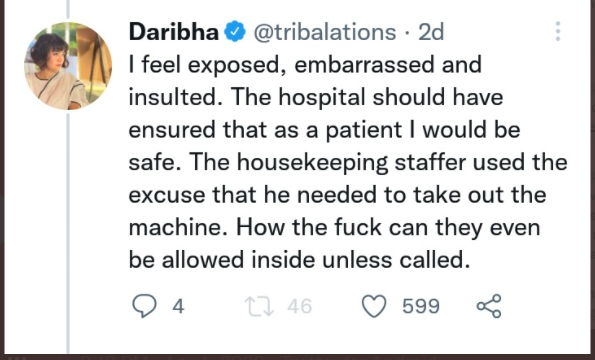
The issue stemmed from a Twitter thread by one Daribha Lyndem, in which she expressed her discomfort and frustration after going to a hospital for an ECG (Electrocardiogram) test and laying on the bed naked as a cleaning employee strolled into the trauma ward where the test was being performed.
In a subsequent tweet, she wrote, “I feel exposed, embarrassed and insulted. The hospital should have ensured that as a patient I would be safe. The housekeeping staffer used the excuse that he needed to take out the machine. How the fu** can they even be allowed inside unless called.”
The tweet.
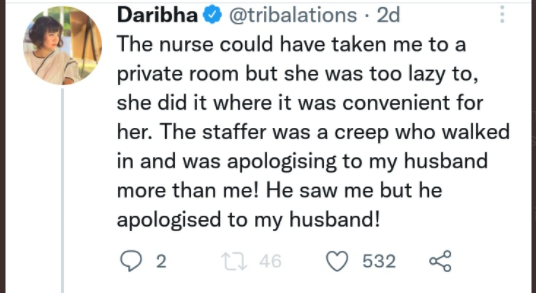
In another tweet in the thread, she further wrote, “The nurse could have taken me to a private room but she was too lazy to, she did it where it was convenient for her. The staffer was a creep who walked in and was apologising to my husband more than me! He saw me but he apologised to my husband!”
The tweet.
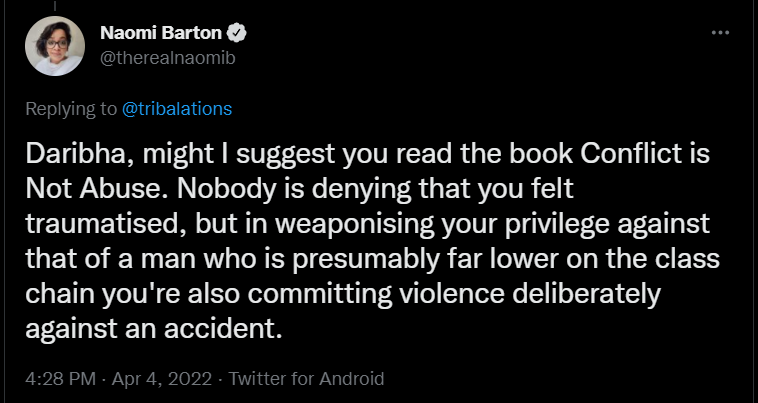
However, The Wire journalist then, posted a tweet telling Daribha that she was committing deliberate “violence” against an accident by “weaponizing” her privilege against that of a man who was likely far lower on the social ladder.
The Wire’s Naomi Barton’s tweet
In the tweet, Naomi wrote, “Daribha, might I suggest you read the book Conflict is Not Abuse. Nobody is denying that you felt traumatised, but in weaponising your privilege against that of a man who is presumably far lower on the class chain you’re also committing violence deliberately against an accident.”
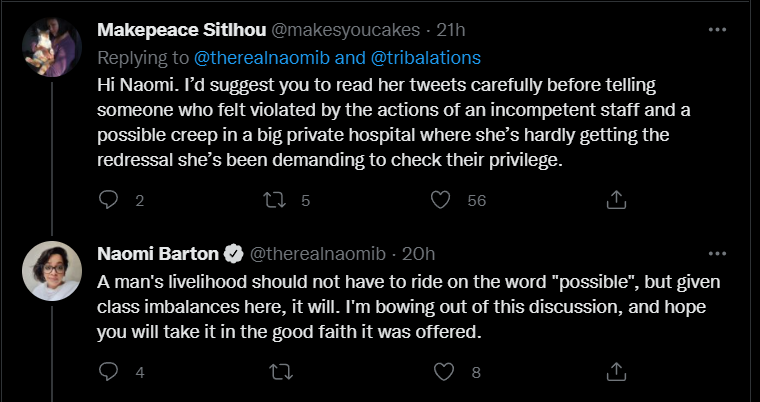
When a Twitter user requested her to relook the tweets before making any admonishing statements, she reiterated her point that it is all an attribute of class imbalances and one should not conclude for something that is “possible.”
The reply by The Wire’s Naomi Barton
It is worth noting that, while other people were sympathising with Daribha’s plight, The Wire’s Naomi Barton rushed in to play her “class imbalance” game, piling up on the victim rather than the perpetrator.
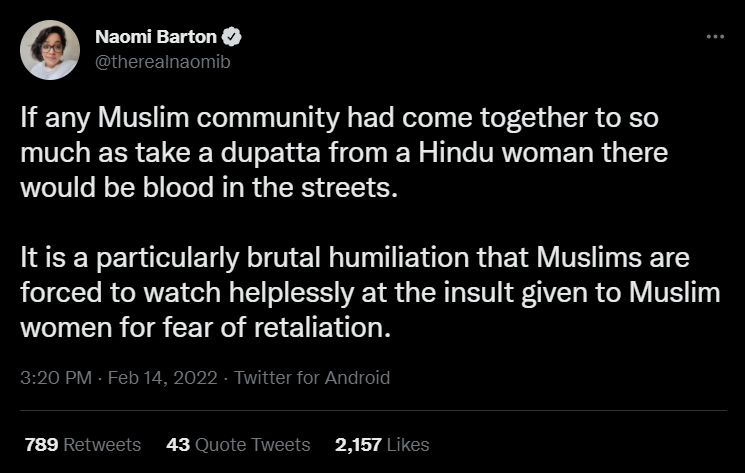
Recently, The Wire journalist appeared to have leveraged the hijab controversy to normalise violence against Hindus.
The tweet.
Barton had expressed that if a Muslim woman’s dupatta was taken away from her, the former would have swarmed to the streets, without thinking twice before sacrificing the blood of Muslims. Many people on social media saw this as an inflammatory Tweet intended to incite Muslims to respond with violence in response to the hijab controversy.
The Wire and its problematic stand on sexual harassment
In January 2018, a journalist at The Wire had revealed on Facebook how she was heckled and manhandled while covering a story. The Wire journalist Damayantee Dhar was covering a story in Ahmedabad on alleged caste discrimination when she was heckled and abused. The attackers as per her were Dalit men. She alleged that one Keval Rathod, advocate/dalit activist, kept screaming “Brahmanwad Manuwad media” and threatened her with an atrocities case.
However, what shook Dhar more was that when she narrated the ordeal to the Editors at The Wire, she was asked to let it go and accept it as a professional hazard. That if she filed and complaint or spoke about it, it would harm to “movement”. Some even tried to scare her saying that if she spoke up, she would invite counter complaints against herself.
In October 2018, their Consulting Editor Vinod Dua was accused of stalking and sexual abuse by filmmaker Nishtha Jain. Soon after, another filmmaker had accused him of inappropriate behaviour. Despite the accuser’s wishes that Dua be fired so that a fair investigation could take place, the Wire continued to have him as their Consulting Editor. In December 2018, Dua refused to face the woman who had accused him of molestation and the external committee that was set up to probe the allegations then dissolved itself in frustration as it was ‘unable to proceed further’ due to lack of unconditional consent.
Similarly, another journalist associated with The Wire, Akhil Kumar, who was accused of rape, was put back to work without offering any explanation. At least two women had accused Akhil Kumar of sexual assault and emotional harassment. However, The Wire had not issued any statement with regard to these allegations.
On April 5, the Central Ministry of Information and Broadcasting has blocked 22 Youtube Channels ad certain social media handles for spreading disinformation related to India’s national security and cooking up stories about India’s war with other powers of the world. The Ministry has taken this decision under its powers of IT Rules, 2021.
.@MIB_India blocks 22 YouTube channels for spreading disinformation related to India’s national security, foreign relations, and public order
18 Indian YouTube news channels blocked for the first time under IT Rules, 2021. 1/2
On Tuesday, The Press Information Bureau released a notice regarding the blockage of 22 Youtube channels, 1 Facebook account, 3 Twitter Accounts and 1 website which were continuously engaged in a misinformation campaign against India with malicious intent. The collective viewership of these channels was 260 crore.
According to the Ministry, these channels were engaged in an active fake news campaign against India and published fictitious reports of India participating in a war with other countries. Reports from these channels were being actively shared on social media when they selectively chose to write on subjects sensitive from the perspective of national security, India’s foreign relations, and public order.
In this action around 18 Indian Youtube Channels and 4 Pakistani YouTube Channels have been blocked by the Indian Government. The YouTube channels were used to post fake news and anti-India content on various subjects on the Indian Armed Forces, Jammu and Kashmir, etc. The social media accounts blocked in the action were being operated in a coordinated manner from Pakistan. “It was observed that a significant amount of false content published by these Indian YouTube channels related to the ongoing situation in Ukraine, and aimed at jeopardizing India’s foreign relations with other countries,” the press release says.
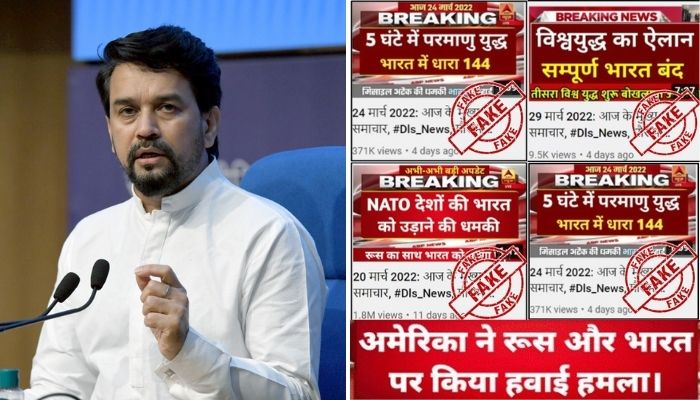
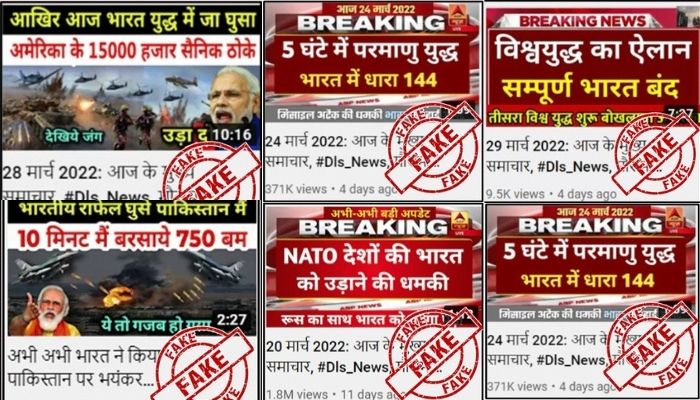
Snapshots of the Controversial video thumbnails posted by the blocked Youtube Channels
As noted in the press release, the blocked YouTube channels were using templates and identities of popular TV news channels, including images of the news anchors to mislead the viewers for being authentic. Among the channels blocked in the action include ARP News, AOP News, LDC News, SarkariBabu, SS ZONE Hindi, Online Khabar, and News23Hindi among others. Pakistani Twitter accounts namely Ghulam Nabi Madni, Dunya Mery Aagy and Haqeeqat TV were blocked.
“The Government of India remains committed to ensuring an authentic, trustworthy, and safe online news media environment, and thwart any attempts at undermining India’s sovereignty and integrity, national security, foreign relations, and public order,” the government stated.
In a major setback to the Aam Aadmi Party (AAP) which is striving to become an alternative to the BJP in the state of Gujarat, over 150 leaders and workers of the AAP have joined the BJP on Monday. Not only AAP, but Congress has also suffered in this turmoil as several members of Congress also shifted to BJP.
The massive exodus from AAP has happened in less than 48 hours after AAP chief Kejriwal returned to Delhi after his visit to Gujarat.
This is a day after AAP supremo Arvind Kejriwal and Punjab CM Bhagwant Mann returned from a two-day Gujarat tour. Gujarat BJP general secretary Pradeepsinh Vaghela welcoming the AAP members to BJP said that Arvind Kejriwal cannot fool the people of Gujarat. “Delhi CM and Punjab CM were yet to sit down for food after reaching home and many people of their party joined BJP. The blessings of the people of Gujarat are with the BJP”, he said.
“भाजपा है तो भरोसा है”
वडोदरा जिले के राजकीय एवं सामाजिक कार्यकर्ता भाजपा में शामिल हुए, सभी का भाजपा परिवार में स्वागत है । pic.twitter.com/uQIf0ToSqN
He also added that the members who have newly joined the party are important for the development of the state and that they should have faith in BJP. “Today you left AAP and Congress. They will say that you were of no use. But, I would like to say that you are very important for the development of Gujarat and are welcome to BJP. There is a BJP government in Gujarat for a long time because people have faith in us and in the leadership of PM Narendra Modi”, he stated.
As the state of Gujarat plans to vote later this year, AAP’s Arvind Kejriwal has shifted his focus to Gujarat after the party’s massive victory in Punjab. Kejriwal on April 2 visited the Sabarmati Ashram in Ahmedabad and participated in a roadshow that AAP had named the Tiranga Yatra. He also addressed the roadshow where he said that the BJP has been in power in Gujarat for 25 years but could not end corruption.
“I am not here to criticise any party. I have not come here to defeat the BJP. I have not come to defeat Congress. I have come to make Gujarat win. We have to make Gujarat and Gujaratis victorious. We have to end corruption in Gujarat,” he said.
27 साल राज के बाद भाजपा में अहंकार आ गया है। जनता की आवाज़ सुनना बंद कर दी। गुजरात को ऐसी सरकार चाहिए जो जनता की आवाज़ सुने
हमारा मक़सद भाजपा या कांग्रेस हराना नहीं। हमारा मक़सद देश जीतना चाहिए। गुजरात जीतना चाहिए। दिल्ली की तरह गुजरात में भी भ्रष्टाचार दूर हो, जनता के काम हो https://t.co/sn7lqfURwg
He also added that after ruling the state for 25 years, BJP had become arrogant and that the party had pledged not to listen to the public anymore. “They don’t listen to the people anymore. Give one chance to Aam Aadmi Party, as the people of Punjab did, the people of Delhi did. Give one chance to Aam Aadmi Party, if you don’t like us, change us the next time. Give one chance to Aam Aadmi Party, you will forget all parties,” he stated.
According to the reports, AAP members who joined BJP on Monday include joint secretary of AAP Gujarat Satish Makwana, former assembly seat candidate from Vadodara, Jayshriben Gohil, Niranjan Joshi, Pritesh Patel and many more. Meanwhile, Congress cadres Harivandan Patel, Bhikhabhai Tailor and Pravinbhai Patel also joined BJP. Legislative Assembly elections will be held in Gujarat in December 2022 to elect 182 members of the Gujarat Legislative Assembly.
The last few days have seen an intense debate over the validity of the imposition of the Islamic practice of halal on unsuspecting non-Muslims. While this debate is not new, like any other Islamist edict, it evoked polarising reactions from both, the proponents as well as the opponents of the said practice.
Social media websites were rife with posts that called for the popularisation of ‘jhatka’ meat in place of Halal, describing the latter as religiously discriminatory against non-Muslims. Calls for boycott of companies that promote Halal-certified products were made. Pharmaceutical company Himalaya found itself at the centre of a social media storm with the #BoycottHimalayaProducts hashtag trending on the microblogging app Twitter. This came after a social media post went viral with the ‘Halal policy’ of Himalaya.
Before long, apologists of Halal jumped in the fray, passionately defending the practice and proffering misleading and dishonest arguments to undermine legitimate concerns raised by the critics. Instead of discussing the problematic aspects of Halal certification and how it discriminated against non-Muslims, the supporters of Halal came up with meretricious arguments that Himalaya is being specifically targeted because it is a company controlled by Muslims and that are other organisations who adhere to Halal certification.
Still, others contended that organisations, by their nature, are profit-driven and since the Halal food industry is too big to be ignored, they comply with the requirements that are critical for their survival and penetration in markets where Halal certification is sine-qua-non.
While there is some merit in the argument that businesses are driven by profitability and market requirements, what the apologists studiously gloss over or rather try to paper over is the controversial aspects that entail the Halal practice.
What is Halal and how it is a religiously discriminatory practice?
Though its supporters try to downplay Halal as a mere dietary preference along the lines of vegetarian and non-vegetarian food, it is much more than that. It is explicitly religious discrimination, meted out against non-Muslims.
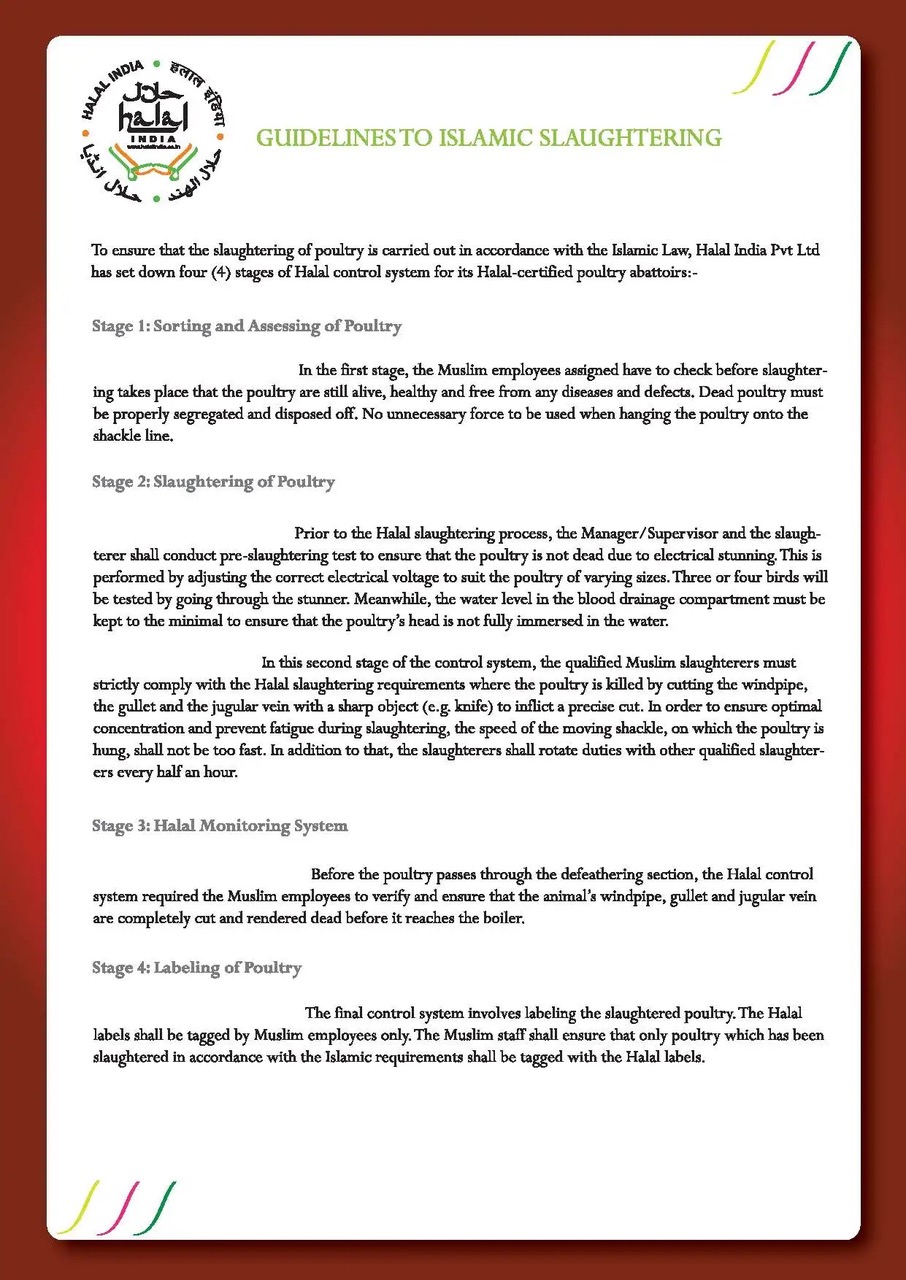
Halal can only be performed by a Muslim man. Thus, non-Muslims are automatically denied employment at a Halal firm. There are certain other conditions that must be fulfilled that make it quite clear that it is intrinsically an Islamic practice. Guidelines are available on the official website of a certification authority of Halal in India which makes it clear that non-Muslim employees cannot be employed in any part of the slaughtering process.
Guidelines to Islamic Slaughtering as per Halal India website
Throughout the document that lists the guidelines for Islamic slaughtering, care is taken to mention the religion of the employees involved. It makes it abundantly clear that only Muslim employees are allowed to participate in the entire process at every stage. Even the labelling of the meat can be done by Muslims only.
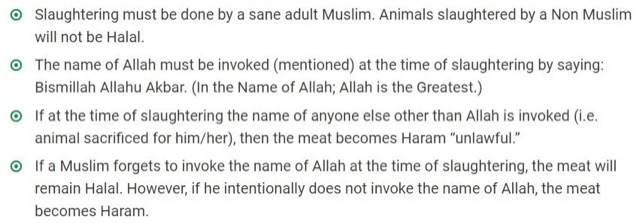
The Department of Halal Certification of the European Union makes it even more clear that employment opportunities at a Halal firm will be exclusively available to Muslims. It says, “Slaughtering must be done by a sane adult Muslim. Animals slaughtered by a Non-Muslim will not be Halal.” It states further, “The name of Allah must be invoked (mentioned) at the time of slaughtering by saying: Bismillah Allahu Akbar. (In the Name of Allah; Allah is the Greatest.) If at the time of slaughtering the name of anyone else other than Allah is invoked (i.e. animal sacrificed for him/her), then the meat becomes Haram “unlawful.”
Source: Department of Halal Certification EU
Thus, it’s quite apparent that when a person demands that he be served only Halal meat, he isn’t merely exercising a diet preference but he is also playing a part in deciding who is involved in the process of slaughtering the animal and labelling it. Furthermore, Muslims are barred by their scriptures from consuming non-halal food. Thus, when a Muslim specifically demands Halal meat, it’s an explicit instance of them demanding a service that can only be performed by Muslims. The obvious implication is that a Muslim denies service from a non-Muslim due to his religious identity.
In addition to this, Halal certification has gradually crept into other sectors as well and is not just limited to the meat industry alone. Even vegetarian products are now being issued Halal certificates, signifying how the Halal lobby is insidiously spreading its tentacles to businesses and sectors hitherto untouched.
Proponents of Halal turn a blind eye to its problematic aspects, deviously term opposition to it as “Islamophobic” and “bigoted”
In the light of these developments, the rumblings against the religiously discriminatory practice of Halal assume greater significance. The discontent among the public is not because an organisation’s higher leadership are followers of Islam, as the apologists would have us believe. Rather, it is against the very practice of imposing Halal-certified products on unsuspecting non-Muslims who are not obligated by their religion to comply with a decree that is patently discriminatory against adherents of other religions. At present, consumers who want to consume non-Halal meat or non-Halal products have limited options as companies and businesses continue to offer only Halal certified products, not providing an alternative to the consumers.
However, for the left-leaning liberals who have been enthusiastically supporting Halal, there exist no discrimination. They continue to cast opposition to Halal as religiously motivated, with many branding it ‘Islamophobic’—a trick that has been employed lately to suppress genuine criticism by referring to it as religious bigotry.
Earlier in March 2022, trusts of many temples in Karnataka ordered that only Hindu vendors will be allowed to set up stalls in the temple precincts for the upcoming annual festival. Many detractors, who are now passionately supporting Halal certification, had then deemed orders by temple trusts as discriminatory and prejudicial against the interests of non-Hindu shopkeepers.
However, the same breed of apologists of Islamism conveniently turns a blind eye to the religious discrimination that embodies Halal certification, which can be performed by Muslims only and the name of “Allah” is to be invoked at the time of slaughtering an animal. Therefore, no Hindu or non-Muslim can take part in such an exercise. But for the apologists, there is no discrimination as far as Halal certification is concerned. Such unabashed hypocrisy is why these “intellectuals” are seldom taken seriously and concerns raised by them are often flagged as motivated propaganda.
How Halal certification infringes upon the right of freedom of choice to consumers
Nevertheless, it is worth noting that the anti-halal movement that is taking root among the collective conscience of the country is not to oppose the Halal practice per se, but it is against the lack of choice offered to those who are not comfortable with products that are certified by a practice that is inherently discriminatory against their religion. The critics claim Halal certification can continue business-as-usual but organisations and governments must provide choices to the consumers who prefer ‘Jhatka’ meat or are simply uncomfortable patronising a practice that endorses discrimination against their co-religionists.
One of the reasons why Halal established its monopoly over the meat industry is because its supporters have been uncompromising in their demands to consume only Halal-certified products. By contrast, Hindus, Jews, Sikhs, Christians or for that matter any other non-Muslim is not religiously obligated to consume meat or use products that abide by a specific set of instructions. This is why ‘Jhatka’ did not become as popular as Halal because non-Muslims were not fully aware of the implications that Halal-certified products had on them and their general lack of concern about the type of meat they consumed.
This indifference towards the type of meat they consumed and laissez-faire attitude is what led organisations and businesses to focus on providing only Halal-certified products, doing away with the cost of maintaining a separate line of non-halal products. As a consequence, non-Muslims were, wittingly or unwittingly, enlisted in the process of perpetuating the discriminatory practice of Halal as organisations and businesses focused on maximising their profits by having to maintain only Halal-certified products and not ‘Jhatka’ meat or non-Halal products. This is one of the primary reasons why ‘Jhatka’ lost to Halal.
Why the anti-halal movement has to be people-driven for governments and businesses to take cognisance of
However, as the awareness about the true implications of Halal certification has risen, more and more people have joined the chorus demanding companies and businesses to offer choices to them instead of foisting Halal-certified products on them. Even so, the governments and organisations can do little as far as Halal certification or popularisation of Jhatka is concerned unless the intermittent outbursts of outrage on social media coalesce into a robust and sustainable movement, forcing them to reconsider their stand on the issue.
As such, in a democratic country with a free-market economy, changes in any domain of life, be it social or food consumption is brought about only by popular will and always driven by public demand. It is always the resilience and the determination of the people that compels governments, organisations and multinationals to reevaluate their existing outlook and accommodate the demands of the people.
Politicians, like businesses, would respond to such demands only when they see the electoral benefit in meeting the demand of the people (the demand is about the establishment and popularisation of Jhatka), just like businesses would respond to demands of ‘Jhatka’ or ‘non-Halal’ certified products when they see a potent market segment emerging that would provide them with sustainable profitability.
For the governments, businesses and organisations to take cognisance of the anti-halal campaign, the sporadic outbursts of outrage against Halal need to be consolidated into a sustained and robust people’s movement, uncompromising in its demands and immune to the vicissitudes of time. For it to bring a lasting change in the attitude of the government and businesses toward offering alternatives to Halal-certified products to consumers, the anti-halal movement cannot afford to remain confined to the realm of social media, it has to spiral out of the digital world into the real-life, unrelenting and ceaseless in its nature until its objectives are met.
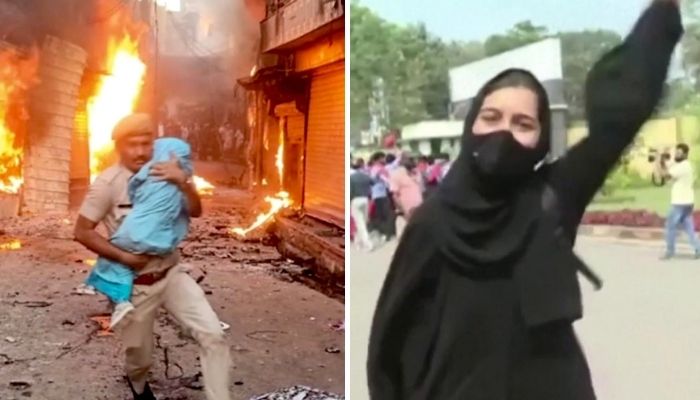
The jarring image of a constable running through the narrow alleys of Karauli with a child in his hand, in a backdrop burning in Islamist violence appeared on Indian Twitter. The image of the constable Netresh Sharma rescuing a child was posted by Shamli SSP Sukirti Madhav Mishra, while praising the cop who had saved the lives of two other women that day. It sent shockwaves everywhere when people pondered how drastically things sparked after stones were hurled from households at a Hindu Rally in Karauli’s Muslim-dominated neighbourhood.
“तम में प्रकाश हूँ, कठिन वक़्त की आस हूँ।” So proud of constable Netresh Sharma of Rajasthan Police for saving a precious life. This picture is in deed worth a thousand words.. pic.twitter.com/U2DMRE3EpR
— Sukirti Madhav Mishra (@SukirtiMadhav) April 4, 2022
On April 2, when Hindus across the world were celebrating their new year, religious tensions broke in Rajasthan’s Karauli when a motorcycle rally marking Nav Samvatsar passed through a Muslim Neighbourhood. Incidentally, 42 people including cops were injured in the communal violence that broke out when stones were targetted at the rally conducted by Hindus. Amidst all of this, when houses and vehicles were set on fire, Policemen like Netresh Sharma came as heroes to rescue the victims who were grappled in the communal outpour.
The next day, Rajasthan CM Ashok Gehlot called Sharma to congratulate him for his bravery. For this selfless act, in which he put his life in danger, Rajasthan Police decided to promote Netresh Sharma as a head constable. While Sharma rightfully received rounds of veneration on social media, his heroic persistence to save lives from Islamic mobs failed narrative setters in India to identify the superhero inside him. His recognition was restricted to certain nationalistic circles in India, while liberal media decided to look the other way. No graphics were made, interviews were published and op-eds were written to glorify him as a ‘symbol of resistance’.
Netresh Sharma’s courage did not remind us of Rao Satal Rathore, who in the 15th century, went out of the way to bring back 140 girls abducted by Afghans near the village of Mertia. Rao Satal is considered one of the greatest martyrs from his lineage, who fought for saving the lives of his subjects till his last breath. Netresh Sharma’s unparalleled bravery in rescuing people from a riot-torn ablaze neighbourhood is forgotten by media circles which are busy wrapped around the next-day news cycle.
It is upon people to choose their heroes, and preserve their stories as serve as hope for the future. Netresh Sharma ran through the burning alleys of Karauli as a hero without a cape, in a uniform. It is also upon us to note that no international media will take cognizance of the Karauli violence and Sharma’s selfless act. No Pulitzer will be won for the disturbing scenes that have been captured. It would be only foolish to expect placard-holding actor-cum-activists to make sweeping comments against a community for the blame. A similar feeling was expressed by netizens on social media…
— ˥¡HOW ∀ᴚʇOH˥∀W?? मोहिल मल्होत्रा?? (@TRULYMM8) April 4, 2022
A constable of Rajasthan Police Netresh Sharma saved a child from lsIamic Jihαd in Karauli. But his image will not go viral because his name is not Muskan Khan. #Rajasthan#Karauli CR- Ranveer… pic.twitter.com/EavG1jATaS
The reality of Hindus being victims does not hold much water against the trope of the ‘Dara-Hua-Musalmaan’ narrative efficiently peddled by forces hell-bent upon demeaning India as a totalitarian state. Hence, a burqa-clad Muskan Khan who shouts ‘Allahu Akbar’ slogan while being challenged by a group of Hindu students to wear the college uniform becomes a symbol of resistance. She is hailed as a feminist for standing up against the society that ‘has no right to tell her what to wear.’ Should it be convenient for us today to forget the life of Harsha, a Hindutva activist who was brutally murdered by elements that held direct radicalised assumptions of what Muskan apparently upheld?
Netresh Sharma’s story will be sidelined because there is no victim from the so-called minority community here. Telling his story should only serve the agenda of those, who do not wish to see this nation giving up on secular fundamentalism. While Hindu victims of violence are sufficiently brushed off the air, the stories of courage from the community are also not heralded. Today, the instream media acts as certifying agency granting victimization and lionization as per the convenience of the narrative. If a burqa-clad girl giving Jihadist slogans can be glorified for giving a tough fight to preserve some medieval-era ideals, Netresh Sharma, on the other side deserves a rightful place in the light of the day as a real-life hero who saved lives from enraged Islamism.
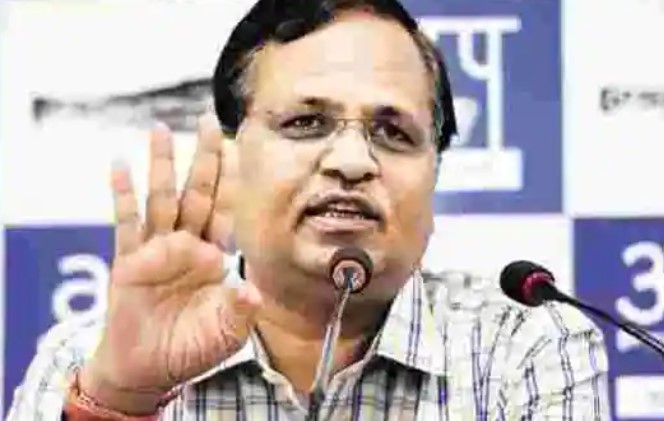
On Tuesday, April 5, the Enforcement Directorate provisionally attached immovable properties worth Rs. 4.81 crore owned by companies named Akinchan Developers Pvt. Ltd, Indo Metal Impex Pvt Ltd, and others under the PMLA, 2002. The action was taken in connection with the disproportionate asset and money laundering case registered against AAP minister Satyendra Jain, his wife Poonam Jain, and others.
The law enforcement agency shared the information about the same on its official Twitter handle.
ED has provisionally attached immovable properties worth Rs. 4.81 Crore belonging to M/s Akinchan Developers Pvt. Ltd. ,M/s Indo Metal impex Pvt Ltd & others under PMLA, 2002 in a disproportionate assets case of Satyendra Kumar Jain & others.
It may be recalled that on August 25, 2017, CBI had filed an FIR against Satyendra Jain in a money laundering case. The ED had registered a criminal case against the AAP leader based on this FIR which was lodged by the Central Bureau of Investigation (CBI) in which it had been alleged that Jain could not explain the source of funds received by four companies in which he was a shareholder.
Jain had reportedly floated or bought several shell companies in Delhi. He also laundered black money worth Rs 16.39 crore through 54 shell companies of three hawala operators of Kolkata. Satyendra Jain owned a large number of shares in companies named Prayas, Indo, and Akinchan. However, after becoming Minister in Kejriwal’s government, all his shares were transferred to his wife in 2015, as per reports.
We had earlier reported how after laundering of unaccounted cash and receipt of equivalent amounts in cheques through hawala operators and by using black money in the form of unaccounted cash, more than 200 bighas of agricultural land was bought in the names of companies acquired by Jain in the region close to the unorganized colonies located in Karala, Auchandi, Nizampur, Budhan, North and North-West area of Delhi.
These companies used to transfer cash payments to their Kolkata counterparts and these companies would later, under the ruse of buying shares, would route back the money to Jain by employing legal means. The companies have reportedly laundered money to the tune of Rs 16.39 crores from 2010 to 2014 to Satyendra Jain.
As per government sources, when prosecuted by the I-T Department, Jain surrendered black money in form of cash of Rs 16.39 crore under Income Disclosure Scheme (IDS) 2016 on Benami names of Vaibhav Jain and Ankush Jain.
In November 2019, the Home Ministry had approved the prosecution of Delhi minister Satyendra Jain in cases related to disproportionate assets and money laundering.
On April 5, the Allahabad High Court denied bail to Irfan Shaikh, alias Irfan Khan for his involvement in the illegal conversion of hearing and speech impaired students to Islam at the Sign Language Training and Research Centre in New Delhi. Shaikh was a government-appointed sign language interpreter at the institute.
The Police investigation revealed that he was allegedly a crucial link in the nationwide illegal conversation racket headed by Umar Gautam. Notably, Gautam, a convert himself, was arrested last year. He was head of the Islamic Dawah Centre, an organization allegedly involved in illegal conversions.
Allegedly, Irfan Shaikh, who was working as an Interpreter in Sign Language Training and Research Centre, New Delhi, played a constructive role in conversion of the students by persuading them in sign languages. Shaikh is also alleged to be a vital link of Gautam’s syndicate. pic.twitter.com/PjTqS7pMV9
Justice Ramesh Sinha and Justice Brij Raj Singh noted in the order, “Considering the facts and circumstances of the case, particularly the fact that the Investigating Officer, after due investigation, has found cogent and clinching evidence against the appellant that with the connivance of co-accused Umar Gautam and others, the appellant is involved in anti-national activities of conversion by misusing his official position while working in Sign Language Training and Research Centre, New Delhi as Interpreter, we do no find any good ground to grant bail to the appellant.”
In his appeal against the orders passed by Special Judge of NIA/ATS Additional District Sessions Judge Lucknow, he had claimed that he was falsely implicated in the case. He had also said that his name was not mentioned in the First Investigation Report. His counsel claimed that the trial Court had rejected bail based on conjectures and surmised without considering the statements of all the witnesses.
The court, however, noted that though his name was not in the FIR, his involvement surfaced based on statements of Rahul Bhola and Jahangir, co-accused in the case. “During the investigation, the Investigating Agency found that appellant- Irfan Khan had played an indispensable role in the conversion of hearing and speech impaired persons by misrepresentation, allurement and fraudulent means and has played a special role in persuading the hearing and speech impaired students in sign language,” the court said.
It also came out that students of the deaf and dumb school, namely, NOIDA Deaf Society have also been converted in illegal manner by practicing misrepresentation, allurement and fraudulent means.
In June 2021, it was reported that Uttar Pradesh Anti Terrorism Squad (ATS) had made multiple arrests, including Umar Gautam, Jahangir Qasmi and others, for their involvement in the mass conversion activities. ATS had initiated an investigation based on a tip that some anti-national and anti-social elements were involved in converting people to Islam at the behest of ISI and foreign organizations.
The investigating agencies found that Umar Gautam and his associates were running an organization named Islamic Dawah Centre with the aim of converting people to Islam, and they were receiving a huge cache of funds from foreign countries.
Irfan Shaikh had played an important role in converting hearing and speech impaired people to Islam by fraudulent means. A charge sheet was filed against the accused people, including Shaikh, under Sections 120B, 121A, 123, 153A, 153B, 295A, 298, 417 of the Indian Penal Code and Sections 3, 5 and 8 of Uttar Pradesh Prohibition of Unlawful Conversion of Religion Ordinance, (Act).
Today is the 115th birthday of freedom fighter and veteran leader Babu Jagjivan Ram. Jagjivan Ram, often known as Babuji, was a Dalit icon who battled for the rights of the disadvantaged.
Jagjivan Ram’s political career spanned a record 50 years. During the 1971 India-Pakistan war, he served as Minister Of defence. Between 1977 and 1979, Babu Jagjivan Ram was also the Deputy Prime Minister. Jagjivan Ram was also rumoured to have a shot at becoming the first Dalit Prime Minister. However, an incident happened after which his name was dropped.
The incident was an act of political revenge, in which intimate photographs of Jagjivan Ram’s son Suresh Ram in a compromising position with a 21-year-old Delhi University student were splashed over the centre spread of a magazine. The magazine known as Surya ran a two-page spread with naked images of his 46-year-old son, Suresh Ram, and a college student called Sushma Chaudhry.
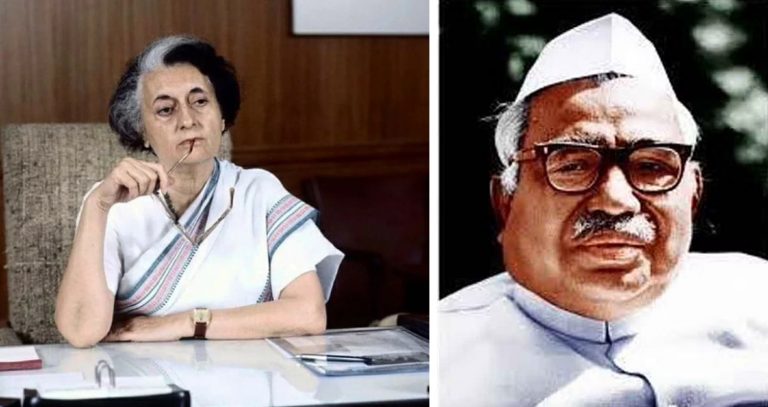
When Indira Gandhi was defeated in the 1977 Janata Party movement, Jagjivan Ram was widely regarded as the front-runner for the position of Prime Minister. Unfortunately, Jagjivan Ram had to shoulder the weight of the subsequent sex scandal involving his son, forcing him to pull back from the run.
However, the tragedy is more than just photos published in a magazine. Indira Gandhi’s daughter-in-law Maneka Gandhi was the editor of the magazine in which these images were published. It was India’s first major political sex scandal.
This scandal breaking at such a critical juncture in Jagjivan’s political career was nothing short of a conspiracy to derail his political career. Jagjivan had resigned from his 30-year stint as a Congress cabinet minister. He had left Congress and had a solid reputation as a capable administrator and seasoned politician. He then joined the Janata Dal-Secular, providing an alternative to Indira Gandhi. But this scandal resulted in the fallout of his political career.
Notably, former Lok Sabha Speaker and senior Congress leader Meira Kumar is the daughter of Babu Jagjivan Ram. She was the first female Lok Sabha speaker, serving from 2009 until 2014. She also got the candidacy of the United Progressive Alliance for the 2017 presidential election but lost to National Democratic Alliance candidate Ram Nath Kovind.
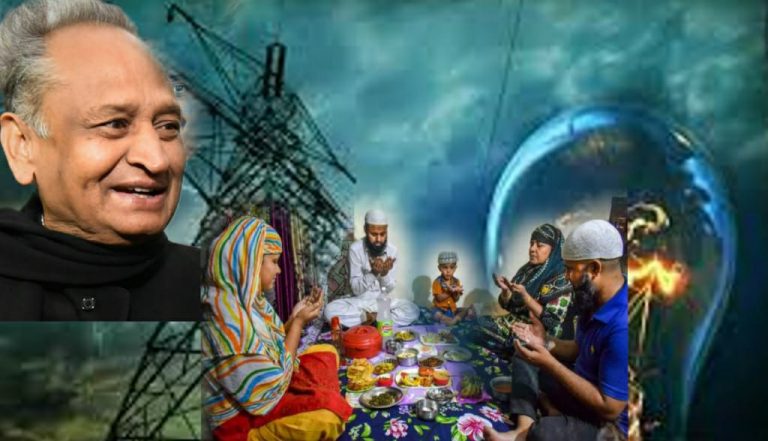
In the Islamic holy month of Ramzan, under Ashok Gehlot government, the state-run Jodhpur electricity distribution company has promised uninterrupted power supply to Muslim dominated areas.
Jodhpur Vidyut Vitran Nigam Limited, also popularly known as Jodhpur Discom has issued directives that there would not be any power cuts in any of the Muslim dominated areas in the state for the entire month of Ramzan.
The letter issued by Jodhpur Vidyut Vitran Nigam Limited dated April 1, 2022, has been doing the rounds on Twitter. Twitter user @8PMnoCM shared the copy of the letter issued by Jodhpur Vidyut Vitran Nigam Limited.
According to the letter issued by the Jodhpur electricity department, the month of Ramzan begins on April 4. People observing Roza should not be inconvenienced by the hot weather, so it should be ensured that all Muslim-dominated areas in Jodhpur, Pali, Sirohi, Barmer, Jaisalmer, Jalore, Bikaner, Churu, Hanumangarh, and Sriganganagar have uninterrupted power supply throughout the month of Ramzan.
OpIndia contacted Jodhpur Vidyut Vitran Nigam Limited to verify the letter’s authenticity. Mr KG Agarwal, the PA to the Managing Director of Jodhpur Discom confirmed that an order has, indeed, been issued by the MDs of Jodhpur, Jaipur and Ajmer Discoms to supply uninterrupted electricity to all the Muslim dominated regions falling under their respective areas.
Agarwal went on to say that the order was issued in response to a motion introduced in parliament by Congress MLA Zahida Khan. Following this, Rajasthan’s Congress-led government directed all three Discoms to ensure that there are no power outages in any Muslim-dominated region of the state during the entire month of Ramzan.
Rajasthan Congress leader Zahida Khan
Zahida Khan is a Member of the Rajasthan Legislative Assembly and a Minister of State in the Rajasthan government. She was elected as an MLA from Kaman, Rajasthan, twice- once in 2008 and again in 2018. She has also held the positions of Parliamentary Secretary and State Minister in the Government of Rajasthan. In October 2011, she was also named General Secretary of the All India Mahila Congress.
In February last year, Zahida Khan was booked for allegedly threatening and assaulting a local man in Jodhpur. The complainant had alleged that on January 31, 2021, when he was on the way to join the farmers’ agitation near the Haryana border, armed goons of the MLA started beating him up. He claimed that he was rescued by the locals and passersby. Zahida Khan had, however, refuted the allegations calling them “baseless and politically motivated.”
Zahida Khan is the same Congress leader, against whom a complaint was lodged with the Election Commission in 2019 after a video of her controversial speech in the Kaman region of Bharatpur district in Rajasthan which falls in the Mewat region had gone viral. In the video, she was heard playing thecaste and religion card by urging the Gujjars and the Muslims to come together to vote especially if they could ‘come together to rob’.
Khan had, however, dismissed the video and called it doctored. She said that the video is a conspiracy of her political rivals.
Zahida Khan’s husband Jalish Khan was the prime accused in the infamous Bharatpur gangrape case where a Dalit girl was allegedly raped by some men for about 15 days. Zahida Khan, who is a law graduate from the University of Delhi, had written a letter to the then Rajasthan Chief Minister of Rajasthan denying the allegations of rape against her husband. The rape survivor had also alleged that she was being threatened of dire consequences if she did not withdraw the case. She was also allegedly offered Rs 1 crore to ‘settle’ the case.
Allies and critics alike of the Black Lives Matter (BLM) have raised questions about the properties purchased by the leaders of BLM- Patrisse Cullors, Alicia Garza, and Melina Abdullah in California. They affirmed that the three had secretly purchased properties worth $6 million in the year 2020 in cash out of the money that was donated to the Black Lives Matter Global Network Foundation.
In October 2020, the foundation received total donations of $66.5 million during the protests after George Floyd’s death. Two weeks later, a man named Dyane Pascall bought a house and registered the document in his name. Pascall who is the financial manager for Janaya and Patrisse Consulting, a Limited Liability Company (LLC) run by Cullors and her spouse, further transferred the ownership of the house to an LLC established in Delaware by the law firm Perkins Coie.
The transaction was never recorded and the ultimate owner of the property was never disclosed. However, Cullors and other leaders of the organization had begun using the house for recording personal YouTube videos, staying overnight, and comforting themselves. They also looked after the maintenance of the property and paid for cleaning and security from their own pockets.
According to the reports, the house secretly purchased by three is more than 6,500 square feet and has half a dozen bedrooms and bathrooms, several fireplaces, a soundstage, a pool, and a bungalow. The real estate listings also mention that the property has parking for more than 20 cars.
The matter came to light when last year an article in the New York Post revealed that Cullors had purchased four homes worth $3 million in California and that there was a disturbing financial gap in the donations received by the Black Lives Matter Global Network Foundation. Cullors had then resigned from the position of the executive director of the foundation.
Somewhere around last year, the leaders had also organized a round table conference to mark the first anniversary of George Floyd’s murder. The three sat in the same expensive house and had recorded a video that they published on YouTube and later took it down. The three in the video were seen cornering the right-wing media machine and mentioned that they deliberately targeted the leaders, the movement, and the Black Lives Matter Global Network Foundation. After Cullors resigned, the leaders also said that the critics had instigated her to resign based on allegations of property purchase in California.
Meanwhile, none of the leaders acknowledged the purchase of this house. They said that the house which they internally call ‘campus’ was bought for the activities of the organization and that the house is part of the cultural arm of the organization. They also stated that the organization bought the Campus intending to provide dedicated space for Black creatives to launch content focused on abolition, healing, justice, activism, and politics.
However, the statement released by the organization in the case failed to mention that the house was bought for creative purposes and not for personal use. It also stated that the Foundation had always planned to disclose the legality of the house. Interestingly, the statement failed to explain if the house was purchased for creative purposes, then why little content has been produced in the last 17 months.
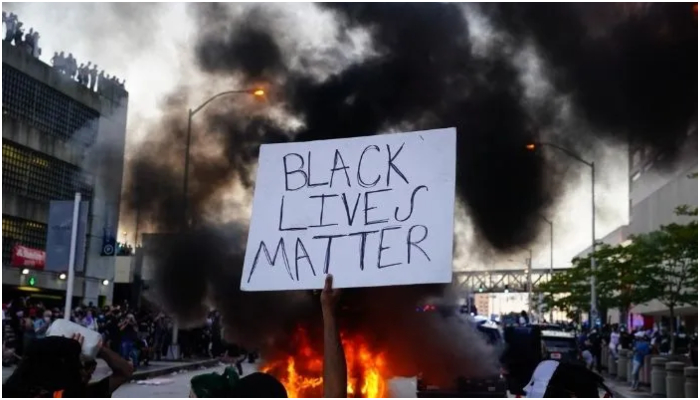
George Floyd Murder and violent BLM protests
On May 25 last year, a 46-year-old black man, George Floyd was murdered by a white police officer, Derek Chauvin, who knelt on the former’s neck for more than 8 minutes until his body became unresponsive. A shopkeeper had called the cops on Floyd for allegedly trying to pass a ‘potential counterfeit bill’. On being taken to the Hennepin County Medical Center, he was declared dead.
The incident provoked widespread protests, spearheaded by Black Lives Matter, and led to violent protests across several parts of the United States of America. The worst hit was Minneapolis, where the death of George Floyd took place. To pacify the situation, the cops resorted to firing tear gas and rubber bullets at the frenzied mob.
Many stores and boutiques were looted and destroyed by the violent rioters in various parts of the country. Windows of unmanned stores were broken. Home goods such as rugs and coffee makers were stolen and stores were set ablaze. The mob also breached the security and reached for the police precinct in the neighborhood where Floyd died. The building was set on fire by the unruly mob, amidst slogans demanding justice for the victim.