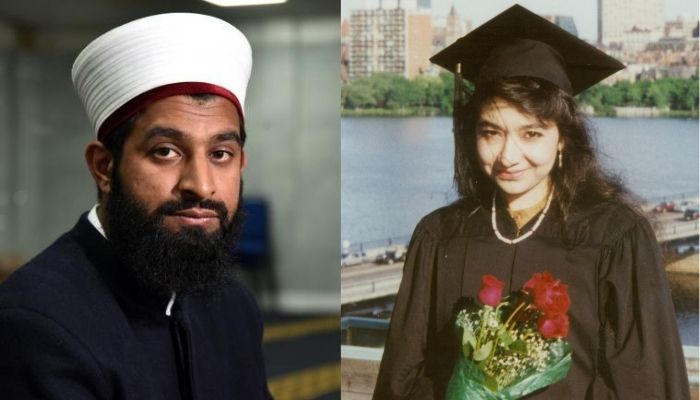
A radical Islamic cleric by the name of Muhammad Asim Hussain has been granted permission to operate a kindergarten for children by the education regulator in the United Kingdom, reported Daily Mail. This is despite the fact that Hussain had openly expressed his support for Pakistani Al-Qaeda terrorist Aafia Siddiqui and the murderer of former Pakistani Governor Salman Taseer.
As per reports, the Office for Standards in Education, Children’s Services and Skills (OFSTED) ignored his past record and gave a green signal to the cleric in January to start his nursery. Imam Muhammad Asim Hussain then took to Instagram to welcome the decision.
He wrote, “It all started with an idea around 4 years ago as part of my vision for Al-Hikam and today a huge milestone was reached. It wasn’t meant to be 4 years ago for a number of reasons but the idea never left my mind and last January after the podcast on the role of masjids in the 21st century, I began the process to set up an Islamic ethos based children’s nursery.”
The cleric added, “A lot of time, effort, money and resources has been invested in setting up the childcare setting and after a year of hard work, yesterday Ofsted granted us official registration to open ‘Little Wisdoms Nursery’ in Bradford at Al-Hikam. This is amazing news for our local community!”
The radical Imam informed that his ‘Little Wisdoms’ nursery will operate from Monday to Friday between 7:30 am and 3:30 pm. He emphasised that the nursery will initially enrol 3 to 4-year-olds before admitting 2-year-olds eventually. Hussain is the founder of Al-Hikam mosque. He was ousted from his role in 2019 over allegations of misconduct. He was reappointed in 2020.
Contentious views of Muhammad Asim Hussain
Daily Mail reported that Imam Hussain told his followers to attend an event in 2015 to express solidarity with Al-Qaeda terrorist Aafia Siddiqui. He had announced that the event would emphasise the supposed ‘injustice’ committed against the terrorist.
It must be mentioned that Aafia Siddiqui is currently serving an 86-year prison sentence for attacking US Army and FBI personnel in Afghanistan. In 2008, she was detained by Afghan authorities. According to the Department of Justice, they had found a number of items in her possession, including handwritten notes that mentioned a mass-casualty attack.
There was a list of various locations such as Plum Island, the Empire State Building, the Statue of Liberty, Wall Street, and the Brooklyn Bridge in the US, including in the items. According to DoJ, she was being held in an unsecured manner when she grabbed a rifle from US Army personnel and fired it at the officers interviewing her. An FBI agent and a US Army officer were injured.
In March 2016, Muhammad Asim Hussain lamented the execution of Mumtaz Qadri, the security guard who killed Pakistani Governor Salman Taseer in 2011 on charges of blasphemy. While calling it a ‘dark day in the history of Pakistan’, the Imam justified his actions by saying that Qadri was ‘martyred in the way of Allah’.
Ofsted alerted about the radical Islamist nature of the Imam
Executive director at the Counter Extremism Project, David Ibsen, had said, “Al-Hikam should not be permitted to educate young British citizens in its nursery when there is a track record of espousing objectionable and oppressive beliefs.”
While reacting to the article by The Daily Mail, Ofsted informed that they will re-examine the permission granted to Imam Muhammad Asim Hussain.
A spokesperson for the education regulator stated, “We have been alerted to these concerns and are looking into them. While we are unable to share information about individual providers, we take safeguarding concerns very seriously and consider all the information we receive.”
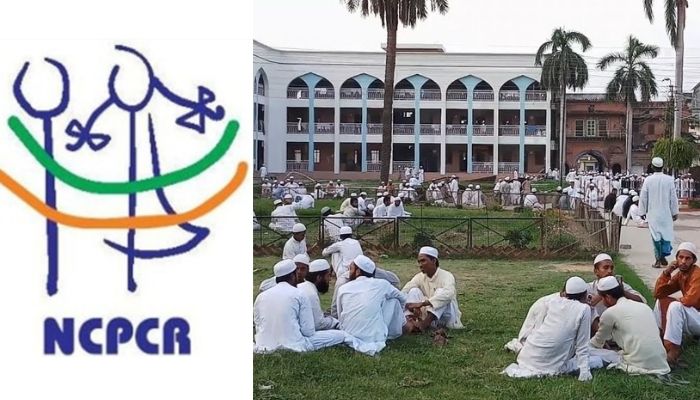
The National Commission for Protection of Child Rights (NCPCR) has written to the Saharanpur District Magistrate for initiating action against Darul-Uloom Deoband for issuing fatwas and making misleading statements on issues of child rights. The action came after a complaint was registered against the Islamic seminary about their questionable views on matters pertaining to children and their education in January.
In a notice issued to the District Magistrate of Saharanpur in UP, NCPCR has found that Darul Uloom Deoband has been issuing illegal and misleading fatwas, which are published on its website. The Saharanpur DM has been ordered to examine the website of Darul-Uloom Deoband and remove the content which contradicts the provisions of the law.
Earlier in a complaint filed against the Islamic seminary, it was alleged that unreasonable fatwas were published on Darul’s website pertaining to adopting a child, education in madrasas, school syllabi, etc.
Saharanpur DM directs Darul Uloom Deoband to shut down the website until probe ends into unlawful fatwas.
NCPCR chief @KanoongoPriyank shares his views on the development.
Taking cognizance of this complaint the Child rights body has cited a similar example stating, “In one of the fatwas (969/969/M=09/1436, Darul Uloom Deoband states that adopting a child is not unlawful but merely by adopting a child, the ruling of the real child shall not be applicable on him rather it shall be necessary to observe Shariah Purdah from him after he is mature. The adopted child shall get no share in the property and that the child shall not be an heir in any case,” In this case, the NCPCR has pointed out how this provision contradicts both the Hague Convention on Adoption and the Juvenile Justice Act, 2015.
Similar fatwas pointed out by the complainant concerning school book syllabus, college uniform, education of children in “un-Islamic atmosphere”, corporal punishment, etc, have been addressed by NCPCR in its order. Pointing out the dichotomy between personal fatwas and laws of the land, the NCPCR letter reads, “After examining the response to the queries, it is observed that the rights of children are blatantly disregarded. For instance, in one of the replies, it is said that teachers beating children is allowed however, corporal punishment in schools is prohibited under the RTE Act, 2009,”
The Child rights body plans to initiate action against Darul Uloom Deoband for violating provisions of the Constitution of India, Indian Penal Code, Juvenile Justice Act, 2015 and Right to Education Act, 2009. A report has been sought by the NCPCR from the Saharanpur DM in ten days. It is not for the first time that the bizarre content on Darul’s website has mired controversy. Earlier, The Deobandi school had audaciously answered questions concerning the legitimacy of female rights in Islam, a compilation of which can be read here.
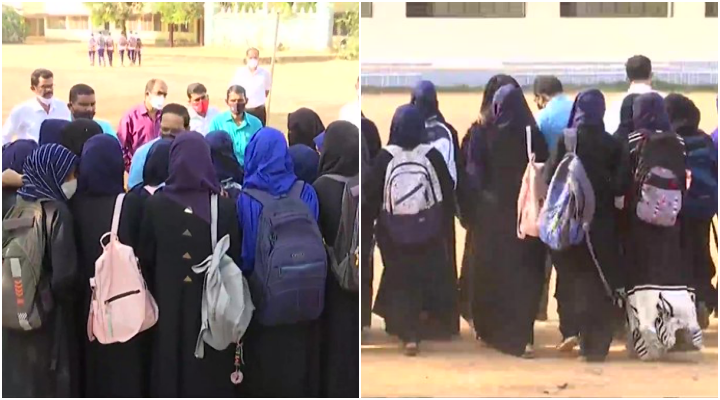
At the Kundapura govt PU College in Udupi, Karnataka, a decision has been made for Muslim girls who insist on sitting in class wearing hijab. Girls wearing hijab will be given a separate room by the college administration where they can sit as a result of this decision. However, they will be admitted to the class only if they remove their hijab and wear the mandatory uniform.
Mohandas Shenoy, the spokesperson for the PU College Development Committee, told the media that the 135-year-old college could no longer be publicly humiliated because of a frivolous controversy. Muslim girls who are protesting outside and wearing hijab will be given a separate room to sit in and study. However, they will only be allowed to join the regular classroom if they remove their hijab.
‘Latest visuals’ from the college shared by ANI showed some students wearing not ‘hijab’ but the full-body black burqa inside the campus.
Karnataka: Students wearing hijab allowed entry into the campus of Government PU College, Kundapura today but they will be seated in separate classrooms. Latest visuals from the campus. pic.twitter.com/rEE8HfVzR1
While speaking, Shenoy urged parents to support the college administration by fulfilling their responsibilities, and students to adhere to the institution’s dress code.
Notably, since the hijab controversy erupted at PU College in Udupi, Karnataka, the college has been the subject of frequent debate. The police had also apprehended two people from the area the day before. Rajab and Haji Abdul Majeed were the ones identified. Both of them had firearms retrieved by the authorities. Three more suspects are being sought by the Police.
The recent Hijab Controversy in Karnataka
The Hijab controversy, which started at a school in Udupi, Karnataka, has now spread across the state. On the morning of February 3, more than 20 hijab-wearing female students were prohibited from entering Bhandarkar College in Kundapur, Karnataka’s Udupi district. The PU College problem first came to light on January 2, 2022, when six Muslim female students insisted on wearing hijab in the classroom, in violation of the uniform rule.
Because the girls refused to remove their Hijabs, openly flouting the uniform mandate, numerous boys preferred to go around campus wearing saffron scarves in order to protest this. They were all denied entry because their clothes differed from the standard uniform permitted at the institution.
Since early January, the state has convened a committee to evaluate the matter and make a judgment on pre-university college uniforms across the state.
Minister debunks media reports
Earlier today, some media outlets had published reports claiming that the hijab/burqa-clad students were given a separate classroom. Karnataka Education Minister has stated that it was a misleading claim and the said students were only given a room as per courtesy since they have been sitting outside the campus.
He added that the college authorities had tried to convince the said students to follow the uniform rules and attend classes, but the students refused. The minister and the college authorities have clarified that the students will be allowed in classrooms only when they are in uniform.
Muslims had boycotted the Hindus prior to the Hijab dispute in the same area
The ironic part is that two months before this occurrence, Muslims in Udupi had boycotted Hindus. The fundamental reason for this was opposition to cow slaughter. According to sources, on October 1, 2021, Hindu Jagran Manch held a big demonstration against cattle theft and cow slaughter in Gangoli, Taluk. The event drew tens of thousands of people, including fishermen, seafood vendors, and women.
Following this, the Muslims in the vicinity banned the purchase of fish from Hindus at Gangoli market, and a few months later, the college conflict occurred. Now, Hindu girls have shown up at school wearing saffron scarves, saying that if Muslim students are allowed exemption from the college dress code, they will flout the rules too.
Ahead of the upcoming elections in 5 key Indian States of Goa, Manipur, Uttarakhand, Uttar Pradesh and Punjab, non-resident Indians (NRIs) have come out in support of the Bharatiya Janata Party (BJP).
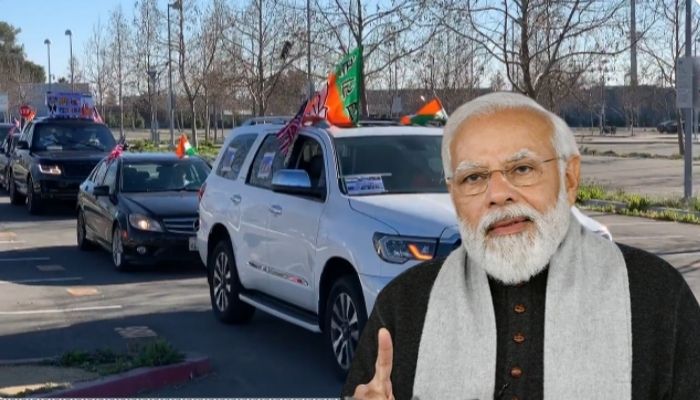
Activist Gaurav Patwardhan took to Twitter to share visuals of one such car rally in Silicon Valley in the United States. Several cars were decorated with posters of Prime Minister Narendra Modi and Uttar Pradesh Chief Minister Yogi Adityanath. They also carried BJP flags and Indian tricolour.
Another video of a mega rally in the Bay area of the United States was shared by Twitter handle ‘NRIs4Bharat’. The Twitter account informed that the rally was particularly in support of BJP for UP Assembly elections.
Mega rally in Bay area, USA in support of Yogi + Modi Ji!!
Earlier in November 2018, the ardent Indian-American supporters, popularly known as the U.S. chapter of the overseas friends of the BJP, lobbied for the BJP by campaigning over phone calls and through social media to get Modi re-elected in 2019.
Elections set to commence from February 10
On January 8 this year, the Election Commission of India (ECI) announced the dates for the Vidhan Sabha elections in 5 States, namely, Goa, Punjab, Manipur, Uttar Pradesh and Uttarakhand. While briefing the media, Chief Election Commissioner Sushil Chandra informed that the elections in the poll-bound States will commence from February 10, 2022, to March 7, 2022.
Elections in the State of Uttar Pradesh will be conducted in 7 phases, followed by Manipur with 2 phases. Elections in Goa, Uttarkhand and Punjab will be conducted in a single phase. The votes will be counted on March 10, 2022.
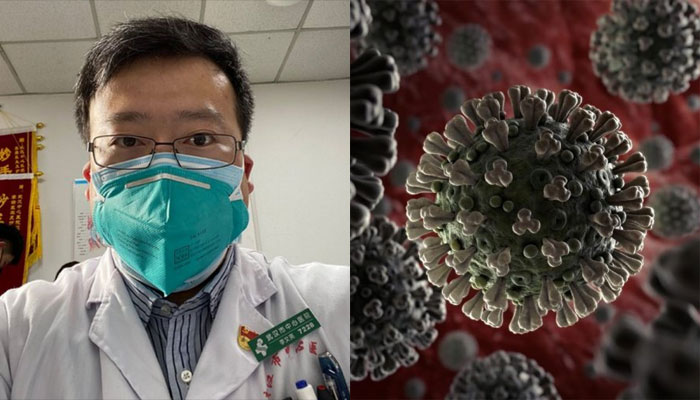
On February 7, 2020, Dr Li Wenliang, a 34-year-old doctor from Wuhan, died of a Covid-19 infection. He was a frontline health care worker at Wuhan Central Hospital, where he first noticed something was unusual about the sick people coming to the hospital for treatment.
The world hails Dr Wenliang as the whistleblower who warned the world about the deadly disease. Two years since his death, over 57 lakh people around the world have lost their lives due to the pandemic that started and was most probably ‘created’ in Wuhan.
The story of Dr Li Wenliang
Dr Li was an ophthalmologist at Wuhan Central Hospital. In December 2019, he noticed seven cases of virus infection that looked similar to SARS virus infection that led to the global epidemic in 2003. On December 30, he sent out a warning message to his fellow doctors in a chat group and warned them to wear protective clothing while treating patients. At that time, he was not aware that the virus was a completely new one.
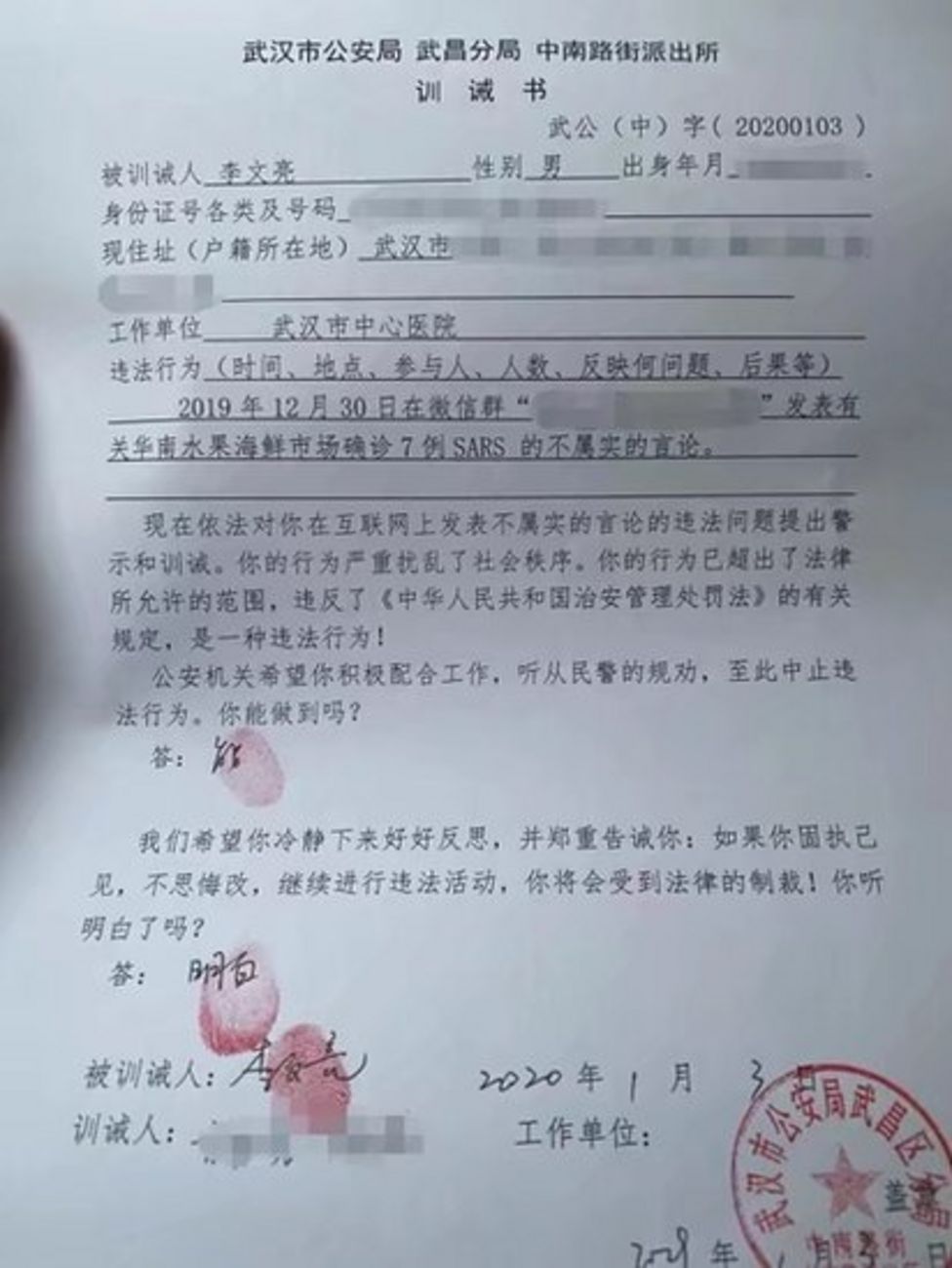
China is known for spying on its citizens. Dr Li was no different. Just four days after making the initial warning to the fellow doctors, Dr Li was summoned by the Public Security Bureau. He was accused of making false claims. Dr Li was forced to sign a letter accepting the accusations. In the letter, it was stated he “made false comments” that “severely disturbed the social order”. Reports suggest there were seven other people who were under investigation along with Dr Li for allegedly spreading rumours.
Chinese authorities were arresting people who raised concerns over the new illness
The letter read, “We solemnly warn you: If you keep being stubborn, with such impertinence, and continue this illegal activity, you will be brought to justice – is that understood?” Dr Li had written underneath “Yes, I do.” Later, the authorities had to apologise to Dr Li.
The letter Dr Li was forced to sign. Source: BBC
Just a week after his visit to Police, Dr Li treated a woman at the hospital who was infected with the new virus. On January 10, 2020, Dr Li posted on Weibo, informing he had started coughing. The next day, he was down with a fever. It took only two more days for his health to deteriorate further, and he was hospitalised.
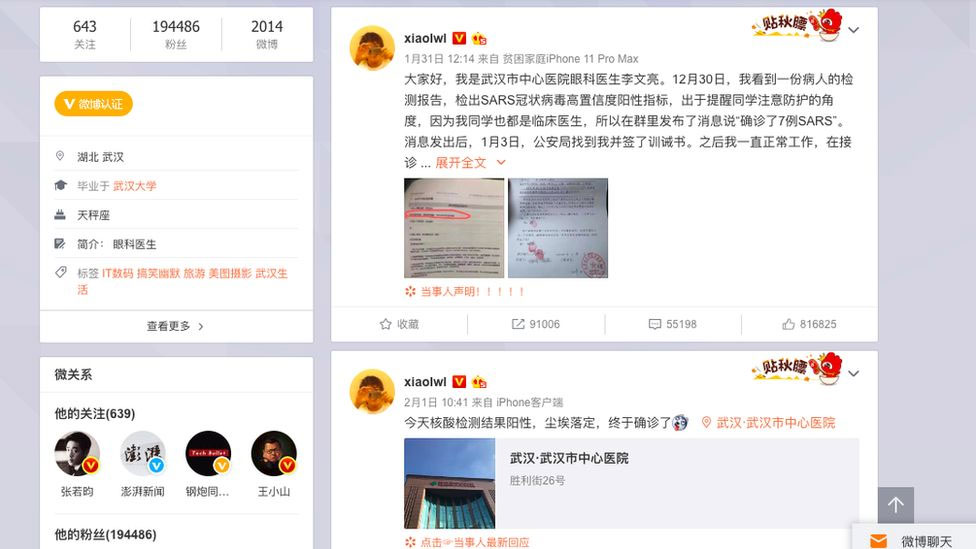
On January 30, 2020, he was diagnosed with Covid-19. On February 7, his body gave up, and he died of acute pneumonia, a complication caused by Covid-19 infection. In a post he wrote, “Today nucleic acid testing came back with a positive result, the dust has settled, finally diagnosed.”
When the Chinese government was not coming out clean about the deadly virus, Dr Li questioned the authorities on their silence in a social media post. He accused them of being silent on healthcare workers getting sick though he was hospitalized.
Dr Li questioning authorities why they were silent on healthcare workers and doctors getting sick. Source: BBC
The severe reaction by Chinese public
His death brought a wave of anger and grief to the Chinese social media site Weibo. There were two hashtags getting viral on social media in which the people of China were demanding freedom of speech and apology from the Wuhan government to Dr Li. However, the hashtags were censored by the Chinese government.
The confusion over his death
Chinese mouthpiece Global Times, People’s Daily and others reported Dr Li died on February 6. The People’s Daily published a tweet acknowledging Dr Li’s death. However, Global Times later clarified he had been put on ECMO (extra-corporeal membrane oxygenation) to keep his heart pumping and blood oxygenated without going through the lungs. It further added Dr Li was in critical condition. According to BBC’s report, the Chinese government had ordered the media outlets to change their reports to Dr Li under treatment.
China’s silence led to the pandemic
Dr Li became the face of freedom of speech in China, a country where the government censors everything that goes against the authorities. The people of China were not aware of what was happening, and the Chinese government kept mum to save its face in front of the world. World Health Organization also, directly and indirectly, failed to warn the world on time and trusted the Chinese version that Covid-19 was is not being spread from human to human.
WHO kept telling the world what China told them
Within weeks of his death, the world started to close down as people were contracting Covid-19 rapidly, and no one knew how to treat it. Today, after two years of Dr Li’s death, the world has reported over 39 crores cases of Covid-19. Over 57 lakh people have lost their lives to the deadly disease. The world has faced multiple waves of Covid-19. People died while waiting for treatment and gasping for oxygen. The United States has reported over 9 lakh deaths while India has reported over 5 lakh deaths, followed by Brazil, France and United Kingdom in the top five list. China, the country where it all started, is still mum about the actual status of the virus’s origin.
Serious inconsistencies have been found in the Asaduddin Owaisi attack incidence as described in the different versions of the story mentioned in two different FIRs. Shots were fired at AIMIM leader Asaduddin Owaisi in UP on February 3 when he was returning from Meerut after campaigning for the assembly elections in Uttar Pradesh. Two accused were arrested by the Uttar Pradesh police. Two FIRs were registered, one by Yamin who accompanied Owaisi, and the other one by the police themselves. The differences in the stories narrated by the complainant and the police are serious and may lead the case in an unknown direction. Meanwhile, Owaisi was offered Z security by the central government which he denied.
According to a report by Dainik Bhaskar, the differences appeared when the later version came to the picture that is when the police FIR was registered. At the very beginning, this incident was reported by Asaduddin Owaisi himself from his Twitter account wherein he claimed that his car was attacked, four rounds were fired near a toll plaza. He had also informed that he changed the car as the tire was punctured.
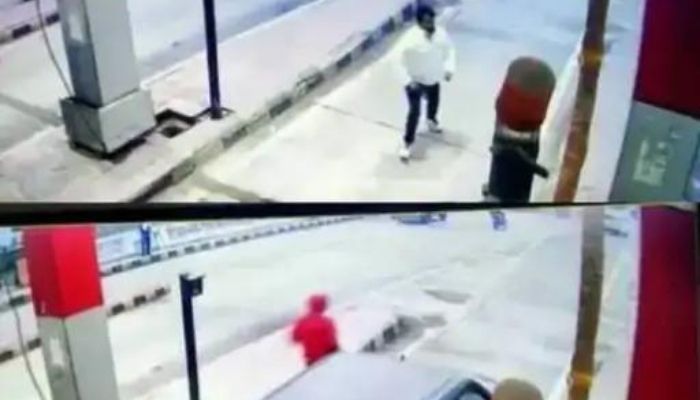
The CCTV footages from the toll plaza were obtained wherein it is seen that accused Shubham fired the first round. Sachin fired after him. In the footage obtained from both the cameras on the spot, it is clearly seen that the attackers were in front of the toll booth while Owaisi’s car was still behind the toll booth. At first, Shubham wearing a red hoodie is seen firing. Shubham was hit by a white car. This car is not that of Owaisi. After this, Sachin fires a few rounds on some other car that followed. Now, this car can be that of Owaisi. After firing, both of them ran away.
According to Owaisi, there were rounds fired before approaching the barrier. Listening to the noise he asked Yamin about what has happened. Yamin answered that they were being attacked. Owaisi said that a man wearing a red hoodie was firing at the car. Yamin hit the next car and speeded up their vehicle. After this, according to Owaisi, a man wearing a white hoodie fired a Fortuner car which followed Owaisi’s car.
Owaisi tweeted about the attack on 3rd February 2022 at 9 PM. He later shared a photo of the pistol allegedly found at the toll plaza. The pistol did not have ‘Kalava’ that is a sacred Hindu thread on it. The details of the incident shared by Owaisi are recorded in the FIR registered by Yamin on the same day at 9:35 PM.
The police FIR however tells a different version of the story. It was registered 12 hours later by police officer Abhinandan Pundir. In this FIR, it is said that Sachin was arrested at 11 PM and a pistol was also found with him. That pistol had Kalava tied on it. At 4 AM, Shubham was also arrested. A pistol was recovered from him too. Shubham was hiding his pistol in his sugarcane farm. Now the question arises, which pistol did Owaisi find at the toll plaza.
Also, the FIR says that both of them fired together. It also mentions that Owaisi had seen Sachin while firing and so he bent down which is why Sachin fired below. Interestingly, Sachin had also said that Owaisi bent down while Owaisi keeps claiming that he never bends before anyone except Allah.
Owaisi had also said that he knew of the attack after listening to the fire noise and after Yamin informed him. But the second FIR says that Owaisi had seen Sachin while firing.
According to the police FIR, Sachin operated his Facebook page as ‘Sachin Hindu’ and was willing to kill Owaisi due to his anti-Hindu speeches. To execute this, he was in contact with Arif of AIMIM who is contesting from Dhaulana. But in reality, both of them are good friends.
FIR lodged by Yamin mentions witnesses on the spot. But the police FIR does not name witnesses present on the spot. The police have cited the reason that no one was there as it was cold at that time.
As per the police FIR, the planning of this attack was going on since 22nd January. Sachin had also visited the campaign sites on the day of the attack but did not get a chance to attack. So he did it on the toll plaza. But there are three more patches between the toll plaza and the campaign program site where every vehicle has to slow down; in fact slower than the speed of the vehicle usually on any toll plaza. These places also did not have any CCTV. Then why did the attacker choose the toll plaza with CCTV surveillance?
The number of bullets fired does not match with the evidence and the information in the FIR. Shubham fired one round. He had 10 bullets out of which 9 are recovered. Sachin had 12 bullets. 7 were recovered, which means he fired five rounds. Owaisi’s vehicle has 2 dents. Where are the other three bullets? Even the police do not have an answer for this.
Maharashtra BJP Leader Kirit Somaiya has filed an FIR against eight Pune Shiv Sena politicians after being attacked by Shiv Sena goons in Pune Municipal Corporation yesterday. The Shivaji Nagar Police station in Pune has registered an FIR against eight Shiv Sena leaders including city President Sanjay More and seven others.
Former MP & BJP leader Kirit Somaiya attacked by Sonia Sena goons in broad daylight,
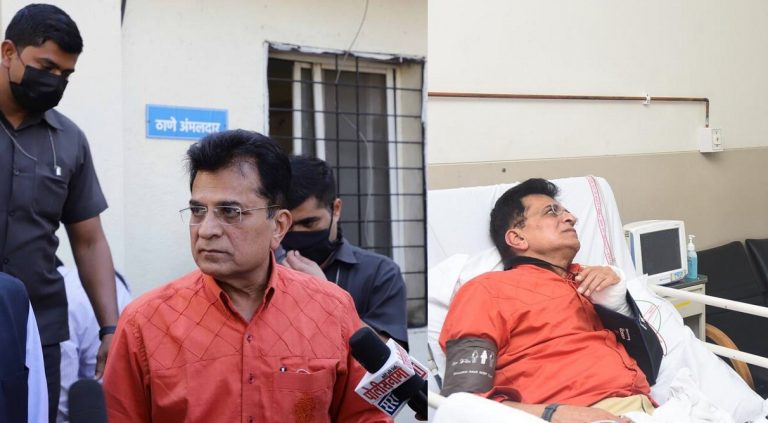
On February 05, Kirit Somaiya was attacked in the PMC office while he was in Pune to lodge an official complaint against Sanjay Raut’s aide Sujit Patkar in the case of Lifeline Hospital Management Services Scam worth Rs 100 crore during the Covid-19 pandemic. After being discharged from the Sancheti Hospital today, Somaiya claimed that the accused Shiv Sena all leaders will be arrested soon.
According to the FIR, Shiv Sena leaders including More, leader Chandan Salunke including Kiran Sali, Suraj Lokhande, Akash Shinde, Rupesh Pawar, Rajendra Shinde and Sunny Gavte have been named for the assault on the BJP leader. The case has been registered under Indian Penal Code sections 143, 147, 149, 341, 336, 337, 323, 504, 37(1) and 135.
8 Shivsena Leaders including Pune President Sanjay More to be arrested by Police for Assaulting Me. .
The BJP leader was in the city to expose Sujit Patkar’s links with Shiv Sena leader Sanjay Raut who is a business associate in a wine business run by his daughters. Kirit Somaiya has alleged that Sujeet Patkar’s fraud Company Lifeline Hospital Management Services got Rs. 100 Crore to open Covid Centres in Mumbai at Dahisar, Worli NSCI, Mahalaxmi Racecourse and Mulund.
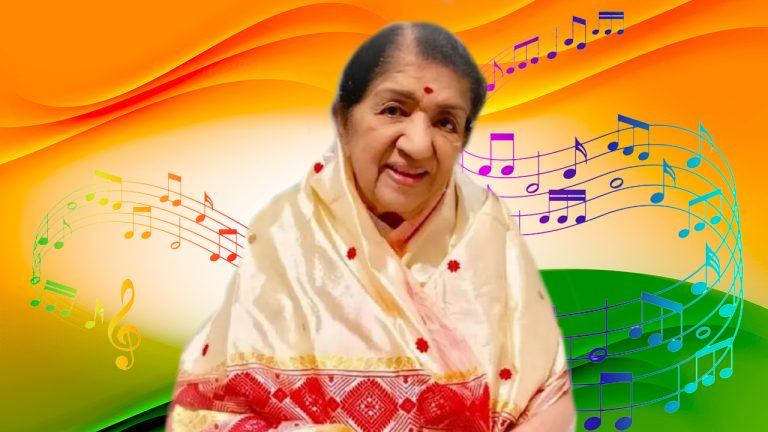
“The whole of India sings in the voice of Maharashtra, and that voice is of Lata Mangeshkar,” said veteran journalist P. K. Atre once, when asked about the musical contributions of the Mangeshkar family to the nation. When Lata Mangeshkar sang, her voice was the soul of the civilization speaking to a young nation. Through her training, she took the mantle of millennia-old practices in Classical music and tuned the ragas to popular songs in film music. A voice that stood for many a generation, she democratised music like no other, that her songs are hummed at any given moment in time. However, this article is an ode to one of the many facets of the legendary singer, talking about the patriotism which glided through her notes, and the nationalist dimensions of her musical excellency.
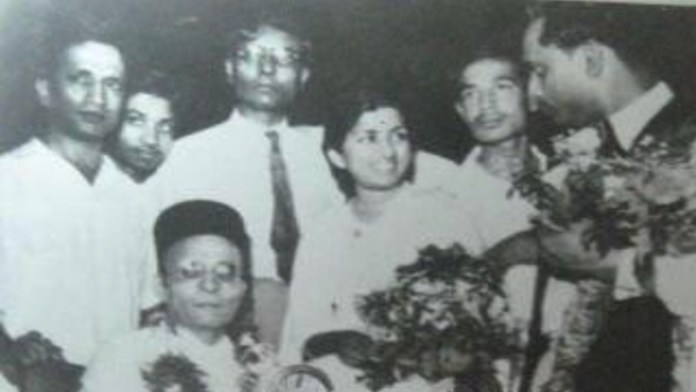
In the late 1950s, the liberation struggle for Goa from the Portuguese hands had stroke many fires. Many revolutionary groups including the Azad Gomantak Dal had started raiding administrative buildings and police stations set up by the Portuguese administration. Already in 1954, The Rashtriya Swayamsevak Sangh had joined hands with Goan fighters to liberate the islands of Nagar Haveli. The struggle for Goa needed monetary help to align different activities together in order to set up a coordinated attack. Legendary music composer Sudhir Phadke, who also happened to be an RSS Swayamsevak was to call Lata Didi for participating in a fund-raising concert for Goa in Pune.
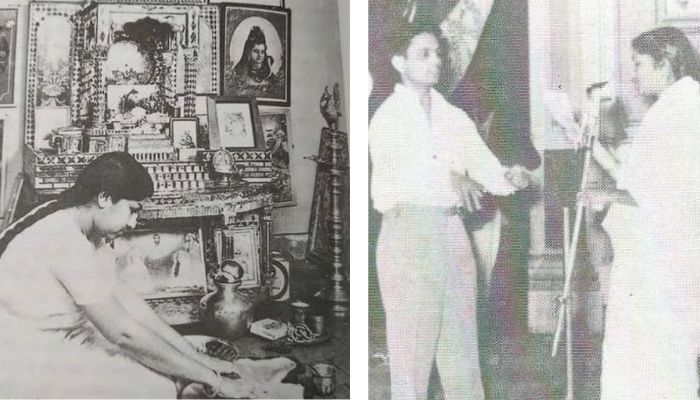
Left: Lata Mangeshkar praying the family deity of Mangeshi Shankara at her home. Right: Singing at a fundraising concert with Sudhir Phadke to help the liberation of Goa
Lata Mangeshkar readily accepted to sing for the nationalist cause, which was organised at Hirabaug in Pune in 1954-55. It is interesting to note that her roots trace back to Mangueshi, a small hamlet in the state where resides the Mangeshi Shiva – the family deity of the Mangeshkars. According to Lata Didi, it was Swatantryaveer Savarkar who instilled nationalism among her siblings when he used to visit her family frequently to meet her father Master Dinanath Mangeshkar. “When Sudhir Phadke (also called Babuji) approached me for this nationalist cause, raising funds for the activities of liberating Goa, I agreed immediately…I have no clue what was the amount raised by that concert, but I am glad that I could do my small bit for my Goa, the land of my ancestors, and my country, India,” she said while talking about the incident in an interview in 2015. While the sole purpose of the concert was to support the revolutionaries aiming to liberate Goa, she refused to charge even a single penny for the same.
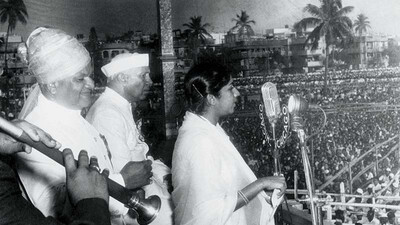
Lata Mangeshkar singing Ae Mere Watan Ke Logo in 1953, PM Nehru looks by
A similar episode in the life of Lata Mangeshkar was to repeat in 1962 when the nation met with another calamity of the Indo-China War. Here, “Ae Mere Watan Ke logon” was born out of an ode to the widows of martyred soldiers in the war against China. Performed by Lata Mangeshkar at Delhi’s National Stadium as a fundraiser for the bereaved families, the song was composed by C Ramachandra and written by Kavi Pradeep.
It was later on January 27, 1963, following the Republic Day ceremony at Delhi that Didi gave the same performance in front of President Dr S Radhakrishnan and Prime minister Jawaharlal Nehru. The memorable concert aches the hearts of true Indians even today, while it stands as a national song for remembrance of the martyred. The strange coincidence of the song being included in the Beating the Retreat ceremony this year on January 29, was a perfect ode from the nation indebted to the legendary singer who was battling with life for a month.
According to Lata Didi herself, her Nationalistic servitude was inspired by Veer Savarkar who happened to be a close associate of her father. Even after the death of Master Dinanath, a revered singer and theatre artist from the Marathi Natya sangeet fraternity, The Mangeshkar siblings held close ties with Savarkar who used to visit them frequently. “Tatya (Savarkar) was like a family member to us. His thoughts, poems and other literature was being thoroughly discussed and pondered over in our house” said Lata Mangeshkar in an interview along with her brother and music composer Pt. Hridaynath Mangeshkar with DD Sahyadri.
Lata Didi recalls in the interview of insisting her mother to allow accompanying her father Master Dinanath, to participate in a community feast at a Dalit neighbourhood organised by Savarkar. The Hindu Nationalist freedom fighter used to often organise such gatherings to bridge the gap between divided castes and communities on a community level. This was one of the first meetings of the girl who was to rise up becoming the nightingale of India with one of the biggest patriots of the motherland. The influence of Sawarkar on Lata Mangeshkar’s gayaki was to remain for a lifetime.
When young Lata grew up to be an established singer, she had once invited V. D. Savarkar to inaugurate her music album by visiting her residence in Mumbai. Aware of the controversies revolving around him, Savarkar initially declined the offer insisting that the music might not do well after being associated with him. “Even if it doesn’t fare well, I wish my album to be blessed by you” insisted Lata, following which Savarkar graced the function.
Lata Mangeshkar with Swatantryaveer Savarkar at a function in Mumbai
During Savarkar’s last days, Pune University had organised a chair to commemorate his contributions to literature. For this very programme, Pt. Hridaynath Mangeshkar tuned Savarakar’s timeless poems, Ne Majasi Ne, Parat MatrubhoomiLa (Oh Ocean, take me back to my motherland) and Jayostute Shri Mahanmangale (Victory to the Goddess of Freedom). The poems composed in pathbreaking tunes have been sung by the Mangeshkar siblings including Usha Mangeshkar and Meena Mangeshkar. While the renderings echo nationalist sentiments fiercely, it is through Lata Mangeshkar’s voice that the gentle innocence of an ’emotional’ Savarkar yearning for his nation is reflected.
Beyond this, what stands out while recalling the nationalism of Mangeshkar, was her rendition of Vande Mataram, India’s national song. Written by Bankim Chandra Chatterjee in his 1882 novel Anandmath, the song is an abstract ode to India as a motherland, personified as Hindu Goddess Durga. In 1952, when Hemant Kumar composed the verse in a fitting Raga Desh, it was Lata Mangeshkar’s voice that rendered the original offbeat composition with rigour.
On her passing away today, The Prime Minister has expressed his condolences and has recalled his prolonged association with the legendary singer. In 2013, she had also announced her endorsement for the then CM of Gujarat, Narendra Modi as the Prime Minister of India. Lata Mangeshkar through her philanthropic work, has set up many medical institutions in the name of her father across many cities in Maharashtra. For gracing the inauguration of two of such institutions, Ex-PM Atal Bihari Vajpayee and later Narendra Modi (as a Chief Minister of Gujrat) were invited by the Mangeshkar family wholeheartedly.
I consider it my honour that I have always received immense affection from Lata Didi. My interactions with her will remain unforgettable. I grieve with my fellow Indians on the passing away of Lata Didi. Spoke to her family and expressed condolences. Om Shanti.
It is also to be mentioned here that, Lata Mangeshkar will be cremated with state honours in the vicinity of the Shivaji statue at the Shivaji Park in Mumbai. Hearts will continue to beat in resonance with her rendition of Hey, Hindu Narsimha, Prabho Shivaji Raja! (All Hail Shivaji Raja, who rose as a Narsimha for the Hindus) – the very first Aarti of Chhatrapati Shivaji composed by Savarkar himself. From Shivaji Maharaj to Swatatryaveer Savarkar, from singing a bhajan for Advani’s Rath Yatra in 1992 to wishing Narendra Modi well for his tenure of heading the country, Lata Mangeshkar always stood out while unequivocally supporting everyone who fought for the cause of the nation. Her nationalism is although not of the political kind, but a thread that continues to run through her music.
Hyundai Motor India Pvt Limited on Sunday issued a statement after it got caught into a controversy for going on a blocking spree when Indians questioned its stand on the pro-terror social media post by its Pakistani counterpart.
In a statement, Hyundai India said that it has been committed to Indian market which has been its second home since over 25 years now and alleged that the ‘unsolicited’ social media post linking Hyundai Motor India ‘offends’ it commitment and service to India. The company said that they have zero tolerance policy for insensitive communication and ‘strongly condemned’ such view.
However, it is not yet clear why they blocked Indian citizens on Twitter for questioning its stand and asking for accountability on the contentious social media post by its Pakistani counterpart.
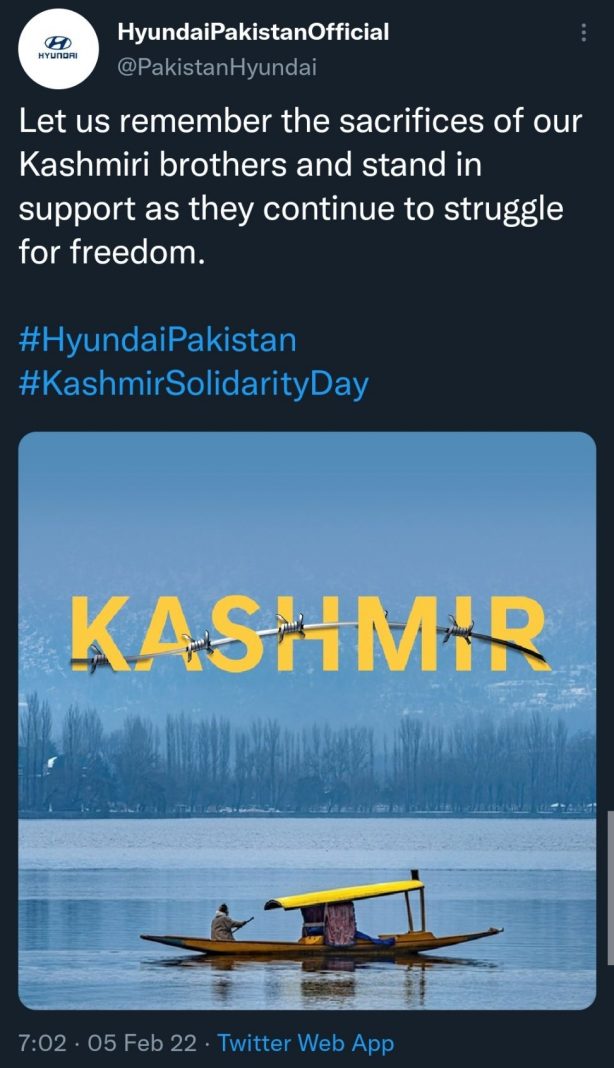
Pakistan Hyundai, Kia Pakistan post ‘Kashmir Solidarity Day’ posts
On February 5, 2022, Hyundai Pakistan as well as a dealer of Kia Motors in Pakistan shared posts on social media extending support to the Pakistan sponsored violence in Kashmir under the garb of ‘solidarity’ which is being celebrated as ‘Kashmir Solidarity Day’ every year on 5th February every year.
Hyundai Pakistan post
While Hyundai Pakistan has since deleted the tweet, Kia dealer’s page continues to show the post on their page.
Kia Motors dealer’s post
Kashmir Solidarity Day
Pakistan celebrates 5th February every year as ‘Kashmir Solidarity Day’ to extend support to the Kashmiri separatist movement which is funded and supported by the Pakistan state. It was launched by Nawaz Sharif as the Pakistani Prime Minister in 1991. Since then, anti-India groups and individuals and Pakistani dispensation have used the day to convince Kashmiris to incite violence. So-called solidarity ‘rallies’ are held in Kashmir illegally occupied by Pakistan. In fact, in 2007, terror organisation Lashker e Toiba chief Hafiz Saeed had also addressed one such ‘Kashmir solidarity rally’ on February 5.
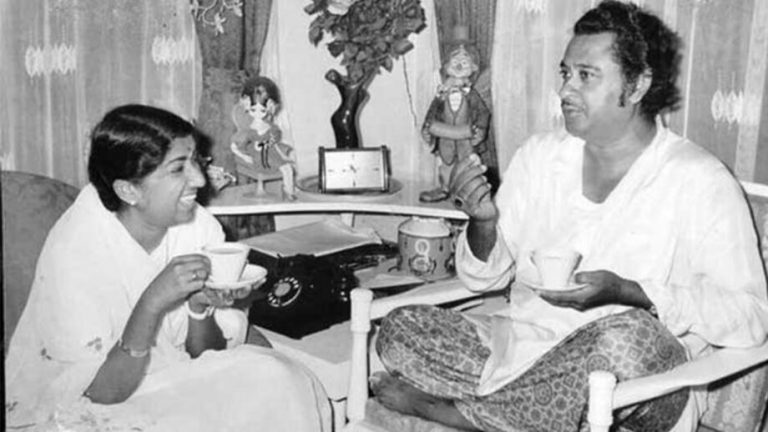
Lata Mangeshkar, who passed away at the age of 92 at Mumbai’s Breach Candy Hospital on Sunday, did an interview with Kishore Kumar for a New York-based Indian television program back in the 1970s. Kishore Kumar agreed to the interview only after knowing that it will be done by none other than Lata Mangeshkar. The story is a bit filmy.
The conversation took place in a room at the iconic Watergate Hotel in Washington, where many celebrities were also staying. Kishore, who was known for his antipathy to the press, had been convinced for the interview.
Lata was also scheduled to be interviewed that day, so she arrived early and finished her portion on time. Kishore arrived a little late. There he came to see Kiran Vairale, the interviewer. Suddenly he backed into the kitchenette of the apartment and did not come out from there. Something appeared to irritate him, but it was unclear what it was.
After a while, he stated that his only condition for leaving the kitchen was that he would not do the interview with anybody else, but that if Lata Mangeshkar did it, he would be fine.
Lata Mangeshkar then agreed to do the interview and Kishore Kumar came out of the kitchen soon after.
Here are some of the questions that were asked and answered during the interview:
Lata: How do you feel about performing on stage with me? Please, only the truth.
Kishore: It’s fantastic. I’m only worried about one thing: you’re so reserved, and I’m known for clowning about a lot, so I’m worried I’m upsetting you.
Lata: You see, I have the same problem; I can’t sing and go around all over the place.
Kishore: No, Lata, your personal style is ideal for you. The audience expects me to move around and dance because I was an actor before becoming a full-time singer, and I aim to give them double pleasure!
Lata: Do you think you’re happy right now?
Kishore: I’m overjoyed. By God’s grace, I have nothing I desire. If there is one thing I wish for, it is to return to Khandwa, Madhya Pradesh, my hometown.
Kishore Kumar used to sit in a Shamshan on a frequent basis. When Lata asked why so?
Kishore Kumar replied: ‘This is, after all, my last destination.
Among the thousands of memorable songs by Lata Mangeshkar, a large number of them were duets with Kishore Kumar. According to an analysis by Hindustan Times, the two legendary singers of the Hindi film industry had sung 348 songs together. This was the second-highest number of duet songs by Lata Mangeshkar with a male singer, she had sung the highest 450 songs with Muhammad Rafi, another legend.