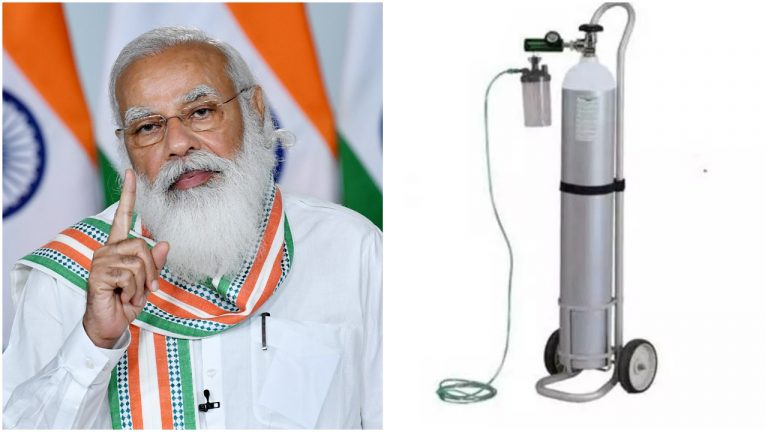
In a significant decision, the Modi government on Wednesday approved the procurement of 1,50,000 units of the ‘Oxycare’ system at the cost of Rs 322.5 crore. The Oxycare system is developed by the Defence Research and Development Organisation (DRDO).
Oxycare units were developed by the DRDO’s Bengaluru-based Defence Bio-Engineering and Electro Medical Laboratory (DEBEL) for soldiers posted at extreme high-altitude areas. The system aims to optimise the usage of oxygen based on the SpO2 reading of the patient and thus effectively increasing the utility of the oxygen cylinders.
“The intelligent configuration includes a system for automatic regulation of Oxygen through a Low Pressure Regulator, Electronic Control System and an SpO2 Probe in addition to the basic version,” the centre said.
The system comes in two variants – Manual and automatic. The Modi government has procured 1,00,000 manual and 50,000 automatic oxygen systems with non-rebreather (NRB) masks for immediate usage. The automatic system provides a suitable audio warning for various failure scenarios, including low SpO2 values and probe disconnections.
The non-rebreather masks are the face masks connected to a reservoir bag that allows a patient to intake only pure oxygen. A patient using an NRB mask is unable to inhale anything he or she exhales. A non-rebreather mask typically delivers 70 to 100% oxygen, thus increasing the consumption from a single-cylinder by 30 to 40%.
The DRDO has already transferred the technology to multiple industries in India for large-scale production of the Oxycare system. The Oxycare system developed by DRDO will lessen the workload of hospital staff by a large extent as the need for routine measurements, and manual adjustments of oxygen flow are not be needed.
Earlier on April 28, PM Modi had sanctioned the procurement of 1,00,000 portable oxygen concentrators. PM Modi had instructed that these concentrators should be procured on a war footing and sent to the states that have the highest case burden in the country.
On the same day, PM had also sanctioned 500 PSA (pressure swing absorption) oxygen plants from the PM CARES fund, in addition to 551 PSA plants that were sanctioned earlier.
Emmanuel Macron’s centrist ruling party has barred a hijab-wearing Muslim candidate from running in a local election after she was photographed in the hijab for an election campaign poster. Macron’s La Republique en Marche (LREM) clarified that in secular France, there should be no place for the overt display of religious symbols like the hijab on electoral campaign documents or electoral paraphernalia.
The poster where Muslim candidate appears wearing a hijab
“This woman will not be an en Marche candidate,” Stanislas Guerini, LREM’s general secretary, told RTL radio, referring to Sara Zemmahi, the barred hijabi candidate.
According to Reuters, an LREM official close to Guerini said that Zemmahi would be officially informed of the party’s decision in writing.
In the poster, Zemmahi is pictured wearing a white hijab, a religious symbol worn by Muslim women, standing alongside three other people. The words “Different, but united for you” on the flyer appear to be a message in favor of diversity.
The controversy broke out when opposition leader Jordan Bardella, number two in Marine Le Pen’s right-wing party, tweeted the image of the poster on Twitter, rhetorically asking, “Is this how you fight separatism?”
In response to this tweet, Stanislas Guerini demanded on Twitter itself for the flyer be withdrawn or the candidate Sara Zemmahi lose the party’s support.
Another LREM legislator, Roland Lescure, told Reuters: “It’s an explosive subject. Political Islam is a reality, it is a simmering threat in some neighborhoods and we have to be very firm.”
French soldiers warn, ‘Islamism will lead to civil war’
In a second warning to the French government, a group of presently serving French soldiers published an open letter in a conservative magazine warning the French President Macron of a brewing ‘civil war.’
The letter raised concerns over the survival of France, warning the President against the ‘concessions’ he made to Islamism despite being aware of the potential threat.
The letter, which received 76,461 anonymous signatures, comes ahead of the 2022 polls where Macron’s main opposition is said to be the right-wing leader Marine Le Pen.
An interactive poll conducted last week observed that 58% of French people agreed with the sentiments in the letter.
On Wednesday, the Israel Defence Forces carried out airstrikes against Palestinian terrorist hideouts inside Gaza after Islamic terrorist group Hamas launched massive rocket attacks targetting Israeli cities.
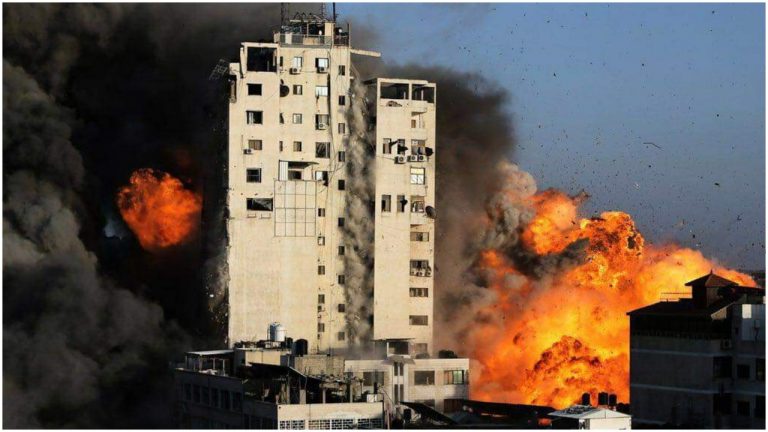
According to the reports, the Israel Defence Forces destroyed a 14-floor Al-Shorouk Tower in central Gaza City on Wednesday in a precision strike. This is the third such high-rise building to be destroyed by the IDF since the escalation of violence began on May 10, 2021.
Hamas terrorists reportedly used the high-rise buildings in Gaza to plan and carry out terror attacks against Israel. The Hamas used these buildings situated in the centre of the city to house its military intelligence officers and communicate tactical information.
Moments ago, IDF fighter jets struck a 14-story building in southern Gaza, which housed Hamas military intelligence offices & infrastructure used to communicate tactical-military information.
We warned civilians in the building & provided them sufficient time to evacuate. pic.twitter.com/lFT7ntbXzW
As attacks from Gaza intensified, killing more than 30 Israeli citizens, the IDF launched a precision airstrike to destroy the hideout. Prior to the strikes, the IDF had warned the residents and had also asked the local people to evacuate. Israel military said that they are targeting militants in Gaza in response to earlier rocket attacks.
Israel said they killed 16 members of the Hamas military wing in an airstrike on Gaza on Wednesday. Israel’s Shin Bet security service said the brigade commander for Gaza City was among the senior members of the Islamist terror group Hamas who had been killed in the airstrikes.
Here is a video of the airstrikes carried out by IDF on the multi-storey building that housed Hamas terrorists:
Israeli missile strikes have destroyed the 14 storey Shorouq tower in Gaza City – which was home for many media offices and is in a very densely populated area. pic.twitter.com/ccDaJR4Sbl
Earlier, Israel had carried out similar airstrikes on rocket launch sites, Hamas offices and the homes of Hamas leaders. Israeli officials said at least 41 Palestinian terrorists have been killed in the Gaza hostilities so far.
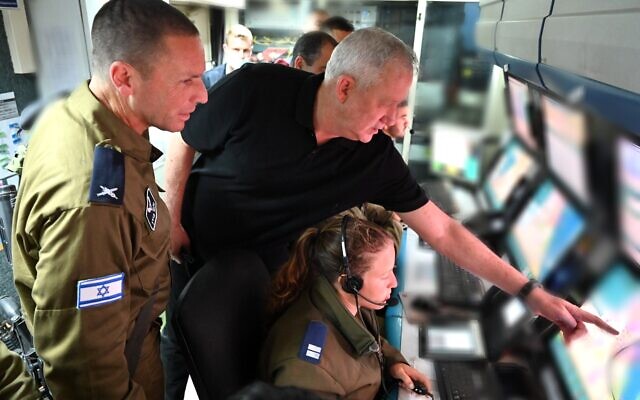
Following the airstrikes, Israeli Defence Minister Benny Gantz said the Israeli strikes were “just the beginning”.
“Terror organisations have been hit hard and will continue to be hit because of their decision to hit Israel. We’ll return peace and quiet for the long term,” he said.
Meanwhile, Israeli Prime Minister Benjamin Netanyahu has vowed to continue the offensive after Gaza terrorists unleashed a massive terror on Israel by launching a barrage of rockets at the densely populated Tel Aviv metropolitan. More than 130 rockets have been launched by Hamas on Wednesday in retaliation to anti-terror operations carried out by Israel.
The Israel-Palestine clashes:
The long-standing territorial-control issues between Israel and the pro-Palestinian forces have once again escalated, resulting in large scale violence and attacks. The court ruling of eviction of illegal Palestinian families from the Sheikh Jarrah neighbourhood in east Jerusalem has stoked tensions and sparked fresh violence in the region.
Prior to the latest exchange of fire, Israeli police were attacked by Palestinians inside the Al-Aqsa Mosque compound in Jerusalem on Sunday. The Israel police had come under severe attack by Palestinians, who pelted stones and unleashed heavy attacks on them inside the Al-Aqsa compound. More than 21 officers were wounded after attacks by Palestinians during the attacks on Monday.
Following the Israeli retaliation, the terror outfit Hamas escalated its attack on Israeli civilians by launching hundreds of rockets against Israel. At least five Israelis have been killed after Hamas launched hundreds of rockets from the Gaza Strip. In response to the rocket attacks, the Israeli army has struck some 140 targets in the coastal enclave after Hamas openly joined Palestinian terrorists to intensify the clashes between the two sides.
She tweeted that her country (Israel) is at war and she worries for her family and friends and the people of Israel. “This is a vicious cycle that has been going on for far too long. Israel deserves to live as a free and safe nation. Our neighbors deserve the same. I pray for the victims and their families. I pray for this unimaginable hostility to end, I pray for our leaders to find the solution so we can live side by side in peace,” she tweeted.
However, soon the ‘liberals’ and Islamists descended upon her timeline with angry, hateful tweets, accusing her of being a genocide enabler.
You’ll see it a lot in media, if you don’t acknowledge them enough and talk around them they are dehumanised, thus the suffering isn’t the suffering of human beings, it’s just an abstract group that people can disregard easier than they can dead men, women, and children.
Despite the fact that the Palestinian terrorists were attacking Israel with rockets and missiles, the Islamists accused Israel of ‘perpetrating a televised and documented ethnic cleansing’.
Israeli soldier turned Hollywood's Wonder Woman multimillionaire Gal Gadot sends meaningless thoughts and prayers as the Israeli apartheid regime she supports ethnically cleanses Palestinians and bombs Gazans in an open-air prison camp
Some ‘liberals’ also felt that her pray for peace for her country was ‘meaningless’.
if they only ever mention Palestinians to say ‘Hamas’ they either seriously require your guidance or you seriously require reevaluating who you allow in your circle
— Ayesha A. Siddiqi (@AyeshaASiddiqi) May 13, 2021
All this while choosing to overlook the terrorism inflicted by Hamas on Israeli people. Gadot served as a soldier in the Israel Defence Forces for two years before taking a plunge into modelling and acting.
In December 2020, Gadot had hailed the ‘Shaheen Bagh Dadi’ Bilkis Bano, who was one of the prominent faces in the anti-CAA protests which culminated into anti-Hindu riots in February 2020. Bilkis was a prominent part of the protests that were organized as India decided to give citizenship to religiously prosecuted people from neighbouring Islamic countries of Pakistan, Bangladesh and Afghanistan.
However, she soon deleted her Instagram story hailing Bilkis while the post continued to be up on her profile.
Israel-Palestine conflict
Conflict between Israel and Palestine escalated when Palestinian terror unit Hamas fired multiple rockets at Jerusalem, and the Israeli Defense Forces responding back in kind. The main reason behind the current conflict is the Sheikh Jarrah property dispute, a dispute which can lead to the evictions of around 300 Palestinians from the East Jerusalem neighborhood.
As the ferocious second wave of the coronavirus outbreak continues its relentless march across the country, taking precious lives in its wake, some individuals and media portals have resorted to vulture journalism, in their bid to discredit the Modi government.
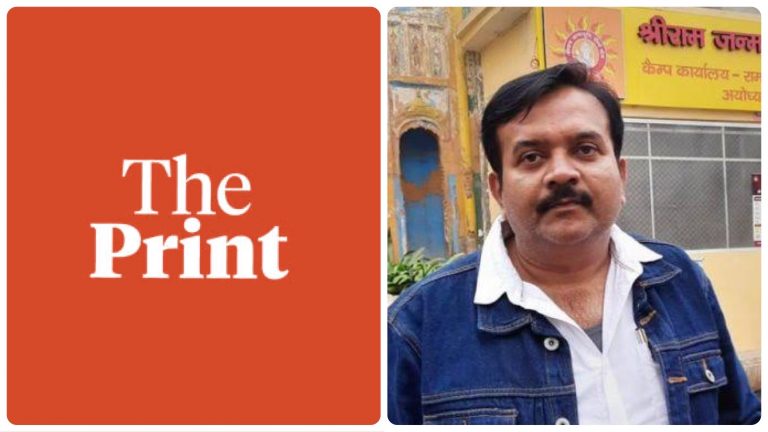
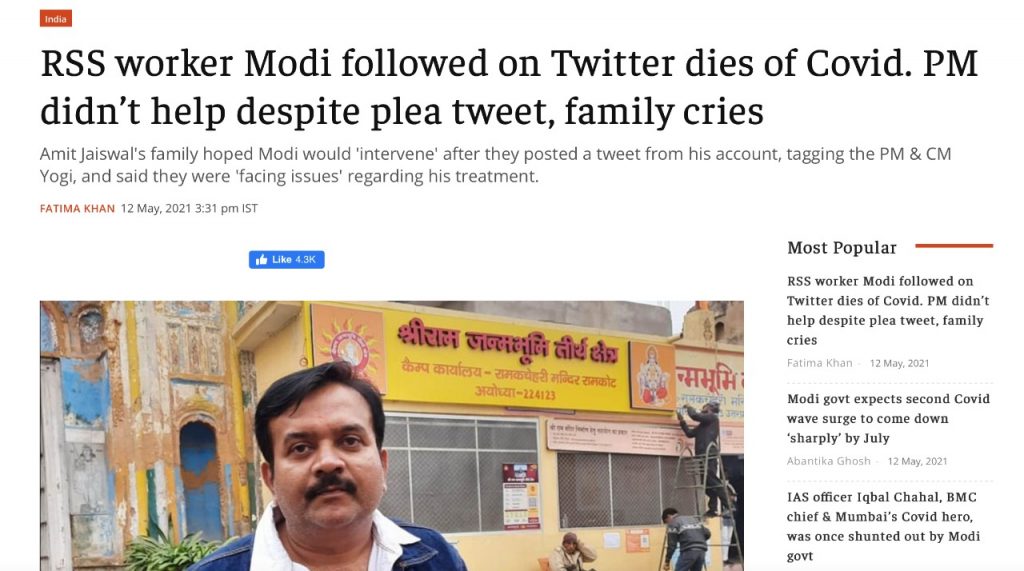
One such individual is the founder of the left-leaning media portal ThePrint, Shekhar Gupta, and his colleague Fatima Khan, who tried to exploit the death of an RSS worker to allege that the Modi government did not step in to help an RSS worker, who was infected with COVID-19 and had sought help on Twitter.
Source: The Print
The article penned by Khan and published on Shekhar Gupta’s ThePrint alleged that an RSS worker Amit Jaiswal, who was followed by PM Modi on Twitter was left in the lurch by the government in his battle against COVID-19. Citing his anguished family, who is still grieving the loss of their loved one, the article on ThePrint went on to assert that PM Modi and his government did not “intervene” to help one of their earnest supporters.
Twitter user Alok Bhatt busts propaganda busts ThePrint’s anti-Modi propaganda
This falsehood was decisively debunked by a Twitter user Alok Bhatt, a close associate of the deceased RSS worker Amit Jaiswal. Posting a string of tweets, Bhatt elaborated how the government and RSS workers went all out to help Amit, but unfortunately could not save his life.
In a scathing attack, Bhatt alleged that while Amit was killed by the coronavirus once, Shekhar Gupta and his portal ThePrint killed him again by sensationalising his death and trying to extract political mileage out of it. He accused ThePrint of running a one-sided story, without bothering to reconcile the facts or corroborate the claims with the hospital in which Amit was admitted.
The article on ThePrint alleges that Amit did not get a bed in Agra and therefore he had to get his mother admitted to a hospital in Mathura. Rubbishing this assertion, Bhatt revealed that Amit chose to admit his mother to the Niyati hospital because the hospital was one of his clients. Bhatt also has an audio recording of the conversation between Vikas Saraswat and Amit’s childhood friend Vipul Bansal to prove the claim.
He admitted his mother in Niyati & called Vipul @ 11pm & told him that he too is not feeling well; Vipul told him to come to Agra & offered to get a bed for him but Amit didnt & instead got himself admitted to Niyati only. Vipul called him again @ 2am & his sister confirmed it
After admitting his mother to the hospital, Bhatt says, Amit called his friend Vipul at 11 in the night and told him that he too is not feeling well. Vipul asked Amit to come down to Agra and offered to get a bed for him. However, Amit denied and instead got admitted to the Niyati hospital itself. Vipul called him again at 2 am and his sister, Sonu, confirmed that her brother is admitted to the same hospital.
Bhatt then added that Vipul could not speak to Amit as the latter’s phone was with his sister Sonu. After Sonu complained that the hospital was not briefing them, Vipul involved RSS Vibhag Pracharak as well as DM to ask the hospital to brief Amit’s family about his condition.
As Amit’s Jija wasn’t satisfied with the treatment, they got him discharged but as Amit’s saturation level fell to 50, he was readmitted into Niyati only. As Amit was to be brought to Agra, so @Vipul_ban had spoken to Agra CMO abt remdesivir as well.
Meanwhile, Amit’s brother-in-law was dissatisfied with the treatment and thought of shifting him to Agra. However, after he got Amit discharged, his oxygen saturation level perilously dropped to 50, following which he was admitted once again at the Niyati hospital. As Amit was to be brought to Agra, Vipul had already spoken to Agra CMO for arranging remdesivir injections.
After Amit was readmitted to the hospital, Bhatt contacted UP CM Yogi Adityanath’s office and sent them screenshots of Amit’s tweet. They swung into action and asked Bhatt to convey about meeting CMO.
However, by then Amit’s brother-in-law had also arranged the remdesivir injection and was given to both his mother as well as him. All through this, Amit was kept on ventilator support. The next day when urgent demand for plasma came up, RSS swayamsevak Rahul Kaushik arranged plasma for both mother and son.
But by then, Amit’s jija also arranged that injection and it was duly given to both his mother as well as him. All along this, Amit was on ventilator support after his readmission. Next day, demand for plasma was made & @kaushkrahul through @AjiHaaan arranged plasma for both
In addition, Vipul through Mathura DM also sent 10 cylinders of oxygen to Niyati hospital as they were running short of the lifesaving gas. Unfortunately, as Amit was critical and on ventilator support, his life could not be saved.
OpIndia contacted Vipul Bansal to seek more information on the revelations made by Alok Bhatt in his long Twitter thread. Vipul corroborated the claims, adding that the Sangh Parivar marshalled all the resources at its disposal to save Amit’s life. Vipul also mentioned that an RSS worker was deployed at the hospital round the clock to keep a check on Amit and his mother’s health and to provide any kind of assistance if needed.
There is another version too, where Jaiswal’s sister accepted that they did receive help from Jaiswal’s colleagues at the RSS. Sonu, who had just lost her brother, was perhaps emotionally drained and highly distressed. A person who has lost a loved one, is quite likely to say angry things in an emotional outburst. However, instead of giving a distressed family some space and letting them grieve the loss of a loved one, Gupta sends his vultures to settle political scores.
As can be seen, contrary to what ThePrint article would have us believe, the local RSS body, along with the Mathura and Agra administration, as well as the Yogi Adityanath government, steadfastly helped Amit in his fight against COVID-19. They arranged hospital, beds, oxygen, remdesivir injections, plasma etc. to assist Amit. Unfortunately, Amit’s health deteriorated and he could not be saved.
ThePrint, in their attempt to attack the Modi government, did not consider it important to corroborate the allegations made by the grieving family. Instead, the account of a grieving and traumatising family provided an opportunity to the left-leaning portal to peddle its anti-Modi propaganda. And it wasted no time in pouncing on the opportunity, showing callous disregard of journalistic ethics, and publishing unsubstantiated account to malign the Modi government.
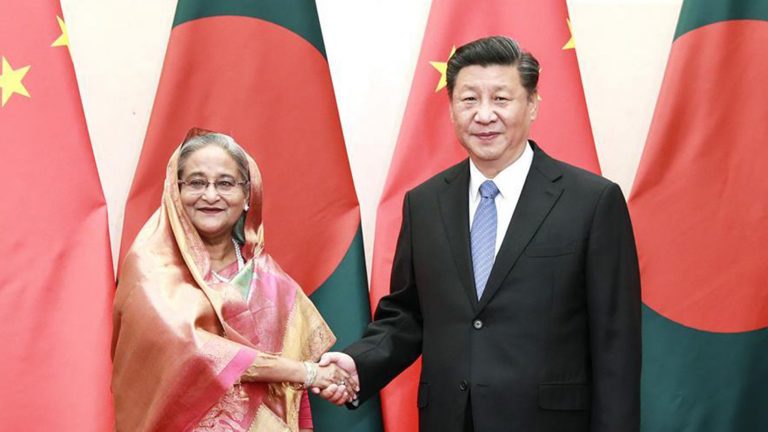
Bangladesh Foreign Minister Dr. AK Abdul Momen on Tuesday said that the country maintains an independent, non-aligned foreign policy that is in the best interest of the Bangladeshi people. This comment came in response to the Chinese ambassador to Bangladesh, who threatened Bangladesh with repercussions if it considered any sort of participation in the Indo-Pacific Quad.
“We’re an independent and sovereign state. We decide our foreign policy. But yes, any country can uphold its position,” Dr. Momen said on Tuesday.
Bangladesh also received diplomatic support from the U.S., who affirmed Bangladesh’s sovereignty to make foreign policy decisions for itself.
We’ve taken note of that statement from the PRC ambassador to Bangladesh. We respect Bangladesh’s sovereignty, & we respect Bangladesh’s right to make foreign policy decisions for itself: US Dept of State on news reports that China has warned Bangladesh against joining Quad. pic.twitter.com/S161lop54G
Chinese Ambassador to Dhaka Li Jiming had said that the bilateral ties between the two countries will be “substantially damaged” if the country engages with the four-nation grouping of biggest naval powers in the region, the United States, India, Australia, and Japan.
Interacting with Bangladeshi journalists in Dhaka, Jiming bluntly said, “We do not want any form of participation of Bangladesh in this alliance.” He also added that China views the Quad as a “military alliance aimed against China’s resurgence and its relationship with neighboring countries”. He further called the Quad—the Quadrilateral Security Dialogue— ”a narrow purposed geopolitical clique”.
The Chinese Ambassador said that Bangladesh would not draw any benefit from joining the Quad, and advised it to refrain from any sort of participation in the group. “History has proved again and again such partnership surely damages our neighbors’ own social, economic development, and people’s wellbeing,” Li said.
The Indo-Pacific Quad
The Quad is an informal strategic alliance comprising India, the United States, Australia, and Japan. Officially, the group was conceived as a forum to cooperate for safeguarding joint security and other interests in the Indo-Pacific region. However, lately, the arrangement is seen as a counter to China’s expansionist maneuvers, most importantly in the South China Sea and in the Greater Himalayan region. Therefore, China considers the Quad as an attempt by the concerned nations to clip its rising dominance and looks at the group as a possible “Asian NATO’ of the future.
India and China have been at loggerheads over the latter’s expansionist moves in the region along the LAC in Eastern Ladakh. Indian and Chinese troops were engaged in a months-long standoff along the border, which also resulted in clashes at the Galwan Valley where 20 Indian soldiers lost their lives. The discussions for de-escalation of troops since then are going at a painfully slow pace.
On the other hand, several littoral nations have complained of China’s rising hegemony in the South China Sea. Indonesia, the Philippines, Taiwan, Japan, and several other nations have reported incidents of intrusions by Chinese vessels.
Even as India grapples with the second wave of the coronavirus outbreak, the United Nations has raised the country’s growth forecast by 0.2 per cent to 7.5 per cent for the fiscal year 2021.
However, the UN cautioned that the growth outlook of India was “highly fragile” as it is the “new hotbed of the coronavirus outbreak”.
The World Economic Situation and Prospects (WESP) released on Tuesday estimated that the Indian economy would grow at 10.1 per cent in the calendar year 2022, nearly double the 5.9 per cent growth projections for the country in its January report.
With the forecast of 10.1 per cent in 2022, India will become the fastest-growing major economy in the world, moving past China, which is predicted to grow at 5.8 per cent, markedly slower than the 8.2 per cent growth estimates for the year 2021.
Dr Aurodeep Nandi of Nomura says the downturn in the economy due to coronavirus outbreak is fleeting and less severe
Meanwhile, with India currently in the throes of the resurgent coronavirus outbreak, the Nomura India Business Resumption Index (NIBRI) fell to 64.5 for the week ended May 9 from 69.7 the prior week (i.e., 35.5pp below pre-pandemic levels). The drop in the NIBRI could be attributed to the rolling state-wide lockdowns that are having a debilitating effect on the sequential growth.
However, Dr Aurodeep Nandi of Nomura is upbeat on India’s resilience, stating that the effect on the GDP this time around will be likely lesser than the previous year. In an interview with the ET Now, Nandi said that in the last year’s lockdown, India was down by about 55 per cent levels. However, this year, the slump is relatively less as the indices suggest that India is down by 35 per cent vis-a-vis pre-pandemic levels.
Elaborating on how the downturn in the economy due to the second wave of the COVID-19 outbreak will be limited, Nandi explained that the first wave brought with it an element of shock and surprise, which devastated the economy. However, in the second wave, he argues, the economy and the consumers have grown used to the pandemic. Therefore, the damage to the economy this time is likely limited, he said.
Moody’s slashes India’s growth forecast to 9.3 per cent for the current fiscal year
Additionally, Moody’s Investor Services on Tuesday lowered India’s growth forecast for the current financial year to 9.3 per cent, stating that the second wave of the coronavirus outbreak restricts economic recovery and poses a risk of longer-term scarring.
The US-based ratings agency had forecasted 13.7 per cent growth for India in the month of February.
“The surge of the virus, which has been driven by a highly contagious variant, has put significant strain on India’s healthcare system with hospitals overrun and medical supplies in short supply,” Moody’s said.
However, it added that the impact of the lockdowns induced by the second wave of the coronavirus outbreak is not going to be as severe as the first wave. In the first wave, strict nationwide lockdowns were imposed to curb the spread of the virus. But in the second wave, localised lockdowns are being imposed, with only those area affected by the contagion being locked under. Businesses and customers have also grown accustomed to this new normal, Moody’s said.
Just as India’s economy was limping back to normal, the country was hit by a second wave of the coronavirus outbreak in March 2021, this time with a more virulent strain of the virus, prompting states and cities to impose lockdowns and restrict public movement. As a result, the economy and the businesses took a hit as state and local government enforced localised lockdowns to curb the spread of the virus.
After more than 1000 rockets rained from the Gaza Strip on Central Israel on Tuesday, Prime Minister Benjamin Netanyahu declared that Hamas and Palestinian Islamic Jihad terror groups will have to “pay a dear price” for their attacks on Israeli civilians.
Israel has vowed to increase retaliatory attack to bring a ‘total long-term quiet’ before proceeding with any truce.
However, the Prime Minister of Israel warned that “this campaign will take time” and the Israelis must follow all safety instructions issued by authorities.
While delivering statements alongside Defense Minister Benny Gantz and IDF Chief of Staff Aviv Kohavi, Netanyahu blamed the Palestinian terror groups saying “Their blood is on their own hands.”
“We stand united in the face of a vile enemy. We all mourn the dead and pray for the wounded and stand behind the IDF forces,” the prime minister said after a day that resulted in three fatalities from the airstrike including the death of an Indian nurse.
Statement by Israel’s Defense Minister
Speaking after Netanyahu, Defense Minister Gantz said that the Israel Defense Forces keeps everyone safe, Jews and Arabs alike. He also called for calm between the two communities within the country.
However, the defence minister informed that retaliation will take place and that the IDF has identified “a great many targets in the pipeline” that it can yet strike in Gaza.
He added that the terror organizations “have been severely hit and will continue to be hit due to their reckless decision to fire at Israel.”
IDF Chief responds
IDF Chief Kohavi clarified that the Israeli military is only hitting hard the Palestinian terror groups in the enclave and has conducted over 500 targeted strikes in the past day and a half.
“We are determined to strike terror groups in the most serious way possible,” Kohavi reiterated.
The military confessed to having initially believed that Hamas, a terrorist organization dedicated to the destruction of the State of Israel, was not interested in a full-blown conflict with Israel at this time. However, that assessment changed over the past two days after the Palestinian terror groups clubbed two events- unrest in Jerusalem after Al-Aqsa attack and eviction of Palestinian families from Sheik Jarrah to attack Israel.
Speaking at the same event, Israels’ Internal Security Agency Shin Bet chief Nadav Argaman announced that “now is not the time for talking” after the terrorist organizations unleashed mindless violence
Attack on Israel
The Hamas terror group, which currently rules Gaza, claimed to have launched over 130 rockets at a time in a violent onslaught on Israel. According to Israeli forces, terrorists of Palestine Islamic Jihad are also launching rockets attacking Israel.
Israel has been kept engaged in retaliatory targeted airstrikes on terror base which resulted in the killing of two top Hamas leaders.
Giving an update, Netanyahu informed that the military has so far struck hundreds of targets in the Gaza Strip and assured that the raids will continue.
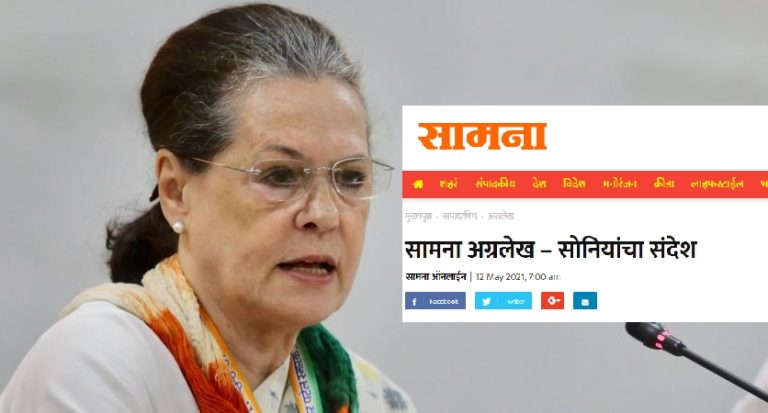
The Shiv Sena on Wednesday claimed that even though Maharashtra Congress leaders do not read its mouthpiece ‘Saamana’, the interim President Sonia Gandhi has ‘taken note’ of its article, which raised questions on the Congress party’s inability to defeat the incumbent government in Kerala, Assam, and drawing a nought in West Bengal.
An editorial published on Shiv Sena mouthpiece Saamana on Wednesday said that Sonia Gandhi had raised important issues of the party’s failure in the recently concluded elections in the meeting of the Congress Working Committee. The Marathi publication said Congress seems to be affected by the defeat in Assam, West Bengal and Kerala. Raising questions on the responsibility for the lack of grass-roots leadership in the Congress, the editorial said that all three chief ministers of Assam, Puducherry and West Bengal were once a part of the Congress fold.
Sena advised Congress to self introspect and emerge as the leader of all opposition parties in future.
The editorial came against the backdrop of a humiliating poll drubbing that Congress received at the hands of the incumbent BJP in Assam and the LDF in Kerala during the recently held Assembly polls in the two states. On the other hand, West Bengal saw a pitched battle between the BJP and the TMC, with Congress struggling to maintain its relevance. As a consequence, it could not win a single seat out of the total 292 assembly seats.
Significantly, Maharashtra Congress president Nana Patole had recently said that he has stopped reading ‘Saamana’ and does not take things published in the Sena mouthpiece seriously. The Congress leader had also suggested that Shiv Sena should stop commenting on his party and its leadership.
However, the editorial published on Wednesday said that Sonia Gandhi asked the same uncomfortable questions over the Congress party’s defeat in the assembly elections which were asked through an editorial in ‘Saamana’.
“If senior Congress leaders have read the Saamana editorial and gave their feedback from the grass-root level to Sonia Gandhi, it is good,” said Shiv Sena in its article.
The article also fawned over the former Congress president Rahul Gandhi, hailing him as a lone leader putting up a brave fight against the BJP despite the barrage of criticism levelled against him. “Rahul Gandhi is the commander-in-chief of the Congress party and his attacks on the government are very specific and to the point, ” the article said.
The article further added that Congress will have to fashion itself as a strong opposition party to fight the Modi government in future. It suggested Congress leave the Twitter world and get on the ground to connect with the people and restore their lost pride.
“At this time, all the opposition leaders to shun their Twitter existence and emerge on the political battleground. Coming to the ground doesn’t mean inviting crowds during the time of the pandemic, it means to question the government and hold it accountable,” the editorial said.
“The Congress party should take the lead in forging a united front of opposition political parties. Sonia Gandhi must be wanting to give the same message. She is still the Congress president and it is important to take note of her views,” it said.
A fresh wave of violence has descended upon the Abrahamic Holy Land, with Palestinian terror unit Hamas firing multiple rockets at Jerusalem, and the Israeli Defense Forces responding back in kind. The reasons for this new wave of violence are multi-faceted, with clashes between Palestinians and the Israeli Police exacerbating the situation. However, the main flashpoint behind the violence is the Sheikh Jarrah property dispute, a dispute which can lead to the evictions of around 300 Palestinians from the East Jerusalem neighborhood. It is of note that whereas West Jerusalem is primarily inhabited by Israeli Jews, Palestinian Arabs constitute the majority in East Jerusalem.
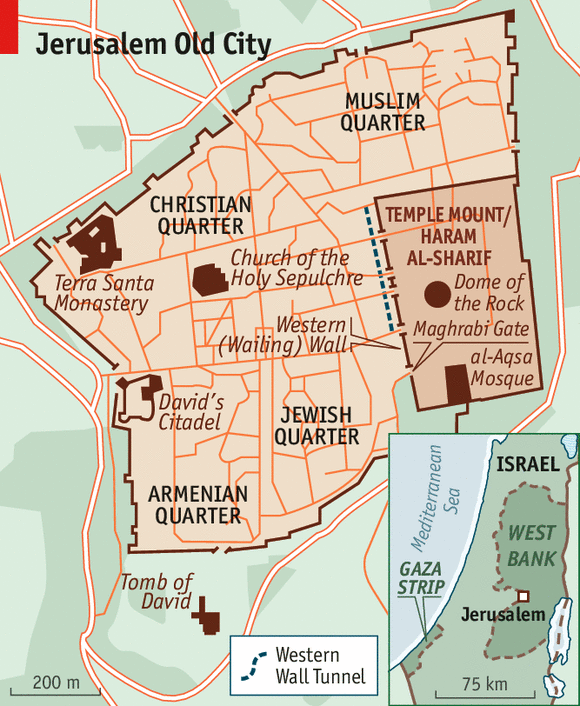
The map of Jerusalem old city with Christian, Jewish and Muslim areas marked, image via The Economist
Jewish landlords Vs Muslim tenants
The Sheikh Jarrah dispute is primarily a property dispute which involves several properties with tenants whose leases have expired and, in a few cases, squatters with no tenancy rights at all. These tenants, who are almost exclusively Palestinian, are facing a legal challenge from their landlords, who are the owners of the property, as has been established by multiple rulings in Israeli courts. The property owner/landlords, who are primarily Jewish, have pursued this litigation throughout the years and have won at every level of the Israel judicial system thus far. On May 10, the Israeli Supreme Court was supposed to rule on an appeal from the Sheikh Jarrah tenants against their landlords. However, this ruling has been delayed for at least 30 days in wake of the violent clashes between Palestinians and the Israeli Police.
Back in the 1870s when Jerusalem was under Ottoman rule, the Jewish community purchased the land of what is now Sheikh Jarrah, in order to live close to the supposed tomb of a Jewish High Priest dating back to antiquity. The Jewish community enjoyed uninterrupted ownership of Sheikh Jarrah till 1947. However, after the 1947 Arab-Israeli War, the Kingdom of Jordan occupied East Jerusalem, including Sheikh Jarrah.
Under Jordanian rule, Sheikh Jarrah was re-populated by Palestinian refugees, although the title and ownership of properties in Sheikh Jarrah were not handed over to the Palestinians. Eventually, Israel took over East Jerusalem from Jordan in 1967, and the Jewish community began to re-assert its ownership over Sheikh Jarrah. The ownership claim of the Israeli Jewish landlords of Sheikh Jarrah is not seriously disputed, at least in Israeli courts.
The leasehold rights of the Palestinian tenants of Sheikh Jarrah were presented to them in the 1950s by the Jordanian Custodian of Enemy Property. These lease holding rights of the tenants, which are not ownership rights, have been accepted by the Israeli courts. In 1982, the Israeli courts ruled in favor of adopting a settlement agreement between the leaseholders and the owners of the properties. This agreement established that the tenants had “protected leaseholds” under Israeli law (a status superior to ordinary leaseholds under Israeli, Jordanian, and British law) but that the owners still retained title ownership of the properties.
The Palestinian tenants continue to enjoy the benefits of these “protected leaseholds” to this day, marking more than fifty years of uninterrupted possession. Now that the Sheikh Jarrah leaseholds are expiring (either due to the natural expiration of leasing rights or serious breaches or terms of the lease), there is a renewed legal and moral debate contrasting the rights of the lease-holding tenants and the title-holding owners.
There was only one major interruption in the owner’s uninterrupted chain of ownership over SheikhJ arrah, that is the 1948-67 occupation of East Jerusalem by Jordan, with Sheik Jarrah properties held by the Jordanian Custodian of Enemy Property. During this 19-year occupation, Jordan denied Jews the right to exercise their property rights, which was explicitly discriminatory in nature.
After expelling all Jewish residents of East Jerusalem during its occupation, Jordan transferred custody over all Jewish-owned property to the Jordanian Custodian of Enemy Property. According to the British law on enemy property, on which the Jordanian law is based upon, Jordan’s sequestration of the enemy property only extinguished owners’ rights completely if the state seized title by eminent domain or if the Custodian transferred title to someone else. In the case of Sheikh Jarrah properties, the Custodian did not transfer the ownership of the properties to anyone else, instead of leasing some of the properties to Palestinian Arabs. Therefore, the original ownership rights in the case of the Sheikh Jarrah properties were not extinguished.
Jordan had not granted ownership rights to Arab tenants
After the Six-Day War of 1967 ended Jordan’s occupation of East Jerusalem, Israel passed legislation that upheld the private property rights of all ethnicities, including Palestinian Arabs who received the title from the Jordanian Custodian of Enemy Property. Ironically, if only Jordan had transferred the ownership rights of properties in Sheikh Jarrah to the Palestinian Arabs, instead of leasing them out, the Israeli law would respect and protect the resulting ownership rights.
The reason why the tenants in Sheikh Jarrah today lack ownership is not that Israel denies property rights to Palestinian Arabs, but, rather, because the government of Jordan declined to give the Palestinian Arabs title to the land that Jordan had seized.
For example, in a hypothetical situation, if Pakistan takes over Kashmir and expels all Kashmiri Pandits from their homes, declaring their houses to be enemy property, and then leases out these properties to fellow Pakistanis, it would not be legally incorrect to restore those properties to their original Kashmiri Pandit owners once India retakes it. Even if India recognizes the lease-holding and tenancy rights of non-citizens who were settled into Kashmiri Pandit homes by Pakistan in this hypothetical situation, India can restore the ownership rights of Kashmiri Pandits on their properties, allowing them to seek and collect rent from the tenants now occupying the property.
There are a lot of misconceptions in the Western media and international activists in general regarding the Sheikh Jarrah property dispute. From a strictly legal perspective, and relying on the various decisions of Israeli courts on this issue over the decades, it can be securely stated that the Palestinian tenants of Sheikh Jarrah do not possess ownership rights over the properties in question. However, the battle over Sheikh Jarrah is not strictly legal, carrying with it the baggage of more than 70 years of Israeli-Palestinian conflict. All eyes are now on the Israeli Supreme Court, which will announce a new date for the ruling on Sheikh Jarrah in the next 30 days.