Home Blog Page 5034

No more APMC monopoly, more choice, freedom for farmers to seek better prices for crops: All you need to know about the new bills by the Modi govt

One of the biggest factors plaguing the growth of agriculture sector in the country is the inability of the farmer to find a market and to get a fair price to his produce. To address the issue, the erstwhile governments of different states enacted the Agricultural Produce Market Regulation Acts (APMC Acts), which authorised them to set up and regulate marketing practices in wholesale markets. 

The objective of these markets was to ensure that farmers get a fair price for their produce. However, with each passing year, the APMCs turned out to be inefficient with increasing cartelisation of middlemen, ban on private players to enter the trade, increasing corruption etc.

Realising the inadequacies in the existing APMC acts of various states to offer a proper marketing mechanism for the farmers to sell their produce, the Narendra Modi government in 2014 had announced a unified National Agriculture Market (NAM). NAM is a pan-India electronic trading portal which seeks to connect existing APMCs and other market yards to create a unified national market for agricultural commodities.

Continuing the reform agenda, the Modi government has now introduced three more bills to promote much easier trade for the farm produce and to provide a competitive market for the producers outside the existing APMC system.

Three bills introduced by the Modi government

The three bills introduced by the Modi government in the current session of Parliament are: The Farmers Produce Trade and Commerce (Promotion and Facilitation) Bill, 2020, The Farmers (Empowerment and Protection) Agreement on Price Assurance and Farm Services Bill, 2020, and The Essential Commodities (Amendment) Bill, 2020.

Earlier, these reforms were announced as part of the third tranche of the economic package announced under Atma Nirbhar Bharat Abhiyan.

The new bills, when passed by the Parliament will give effect to the amendments proposed to the Essential Commodities Act and bring in two new central laws on trading and marketing of farm produce in the country.

The objective of the three proposed laws is to make way for creating the Modi government’s ambitious vision of ‘One India, One Agriculture Market’. The law intends to end the monopoly of Agriculture Produce Market Committees (APMCs) in carrying out the trade of farm produce in the country. 

The Farming Produce Trade and Commerce (Promotion and Facilitation) Bill, 2020:

The Farming Produce Trade and Commerce (Promotion and Facilitation) Bill, 2020 aims at creating additional trading opportunities outside the APMC market yards to help farmers get remunerative prices due to additional competition. Farmers can now sell their agricultural produce in a market of their choice at better prices.

  • The newly proposed law will allow intra-state and inter-state trade of farmers’ produce beyond the physical premises of APMC markets thus giving freedom for the farmers and traders to sell or purchase farm products anywhere.
  • The proposed law also provides buyers with the freedom to buy farmers’ produce outside the APMC markets without having any license or paying any fees to APMCs. 
  • The Bill prohibits state governments from levying any market fee, cess or levy on farmers, traders for the trade conducted on farmers’ produce conducted in an ‘outside trade area’.
  • Under the proposed law, electronic trading in transaction platform has been proposed for ensuring a seamless trade electronically. The proposed law also allows private individuals, FPOs and co-ops to set up electronic trading platforms in these areas.
  • There will also be a separate dispute resolution mechanism for the farmers.

The Farmers (Empowerment and Protection) Agreement on Price Assurance and Farm Services Bill, 2020:

The Farmers (Empowerment and Protection) Agreement on Price Assurance and Farm Services Bill, 2020 creates a framework for contract farming through an agreement between a farmer and a buyer prior to the production or rearing of any farm produce. 

  • The proposed law provides for a farming agreement between a farmer and a buyer prior to the production or rearing of any farm produce. The minimum period of an agreement will be one crop season or one production cycle of livestock. 
  • Under this legislation, farmers are empowered to directly engage with processors, wholesalers, aggregators, retailers exporters etc, thus eliminating intermediaries resulting in full realisation of the price for the farm produce.
  • The proposed law also states that the price of farming produce negotiated between the trader and the farmer should be mentioned in the agreement.
  • The buyer will be responsible for providing necessary means or inputs for good crop yield. Under the bill, it is the responsibility of the buyer to provide agricultural equipment to the farmer.
  • It provides for a three-level dispute settlement mechanism: the conciliation board, Sub-Divisional Magistrate and Appellate Authority.

The Essential Commodities (Amendment) Bill, 2020:

The amendments to the Essential Commodities Act, 1955 allows the central government to regulate the supply of certain food items only under extraordinary circumstances.

  • Under the legislation, the central government may regulate or prohibit the production, supply, distribution, trade, and commerce of such essential commodities.
  • The proposed bill provides for the central government to regulate the supply of certain food items including cereals, pulses, potatoes, onions, edible oilseeds, and oils, only under extraordinary circumstances.  
  • The legislation requires that imposition of any stock limit on agricultural produce must be based on price rise.
  • The bill amends the Essential Commodities Act to provide that stock limits for agricultural products can be imposed only when retail prices increase sharply and exempts value chain participants and exporters from any stock limit.  

Significance of the proposed laws:

  • The three historic legislation will unlock the overly regulated agricultural markets in the country.
  • The laws will provide more choices for the farmer and lessen the marketing costs for the farmers thus helping them to get better prices. It will also help farmers of regions with surplus produce to get better prices and consumers of regions with shortages, lower prices.
  • The laws will enable the farmer to make use of modern technology and better inputs to enhance their farm produce and its trade. It will reduce the cost of marketing and improve the income of farmers.
  • These new laws will encourage large companies, food processing firms, exporters, etc, to invest in the farm sector and source good-quality farm produce.
  • The announced amendment to the Essential Commodities Act is expected to help both farmers and consumers while bringing in price stability.
  • The proposed changes will also create a competitive market environment and prevents wastage of agri-produce that happens due to lack of storage facilities.

Many opposition parties, including the Congress, are opposing the bills. The Congress party, however, were once the proponents of the same reforms that are currently being introduced by the Modi government. Interestingly, in 2019, the Congress party under the leadership of Rahul Gandhi had themselves announced these reforms in their election manifesto.
Narcotics Control Bureau starts investigation into party hosted by Karan Johar: Report

0

The Narcotics Control Bureau (NCB) is investigating a video from a party hosted by filmmaker Karan Johar that went viral on social media, DNA has reported. The media outlet said that it has been informed by sources from the NCB regarding the same. It will be investigated whether the video is real or if it has been doctored. If the video is found to be real, then the investigation is likely to proceed forward.

Earlier, we had reported that the NCB may launch an investigation into the matter and Karan Johar may be summoned regarding the same. The DNA now confirms that an investigation into the matter has been launched. The video had featured Ranbir Kapoor, Ayan Mukherjee, Vicky Kaushal, Deepika Padukone, Arjun Kapoor, Malaika Arora, Shahid Kapoor, Varun Dhawan and others.

After the video had gone viral on social media, people on social media had alleged that the actors in the video were under the influence of drugs. Manjinder Singh Sirsa, national spokesperson of Akali Dal, too, had made the allegations. However, the claims were rubbished by most of the actors including Vicky Kaushal and Karan Johar.

Not too long ago, Bollywood actress Kangana Ranaut, who is spearheading a movement against drug mafia in the Bollywood, had dropped a bombshell by revealing that there were rumours that several Bollywood actors consumed drugs and were ‘cocaine addicts’. It was also reported that NCB officials are set to summon at least 25 prominent Bollywood stars in the drug investigations. The celebrities also include some ‘B-grade’ actors who have been accused of consuming and procuring drugs.

After recent spate of ‘Love Jihad’ cases, Yogi Adityanath govt may bring ordinance to check forced religious conversion: Report

Against the backdrop of a large number of religious conversions linked to ‘love jihad’ in the state, the UP government is likely to promulgate an ordinance against forced religious conversions.

“It is under the process and Acts and laws of other states are being studied and discussed before UP has its own law against religious conversions,” Times of India quoted a senior official privy to the development.

The action to curb religious conversions can be attributed to the recent cases of love jihads reported from across the state, particularly from Kanpur, where girls are being converted under the pretext of marriage. The issue was recently raised by RSS chief Mohan Bhagwat during his two-day visit to state-capital Lucknow.

As of now, eight states have anti-conversion laws, namely, Arunachal Pradesh, Odisha, Madhya Pradesh, Chhattisgarh, Jharkhand, Uttarakhand and Himachal Pradesh. The law was first enacted by Odisha in 1967, followed by Madhya Pradesh in 1968. According to a law department official, Uttar Pradesh could be the ninth one in the list of states with an anti-conversion law.

The law against religious conversions serves to prevent people from converting others, either by ‘allurements’, ‘force’ or ‘fraudulent’ means. The UP’s law would be similar in nature to the laws enacted by other states, making religious conversions arduous and complex, the source revealed.

Earlier this week, the Kanpur Police had formed an eight-member Special Investigation Team(SIT) to investigate the rising number of forced conversions done on the pretext of marriage. As many as 11 cases of ‘love jihad’ had come to light from the same district in the past one month.

Cases of love jihad in Uttar Pradesh on the rise

While cases of love jihad have been reported across the state, Uttar Pradesh’s Kanpur has been emerging as the epicentre of ‘organised love jihad’ cases. There have been several cases of forced conversions of women on the pretext of marriage reported from the city that it has fuelled suspicions about a new model of entrapping Hindu women gaining a foothold in the city.

Following the much-publicised Shalini Yadav case, another case of ‘love jihad’ had come to the fore. A Hindu family had lodged a complaint at the local police station in Govind Nagar, Kanpur, accusing a Muslim youth named Asif Shah alias Nafiz of brainwashing their daughter with the help of occult practices, physically abusing her, threatening and intimidating her to convert into Islam and marry her.

Similarly, one more ‘love jihad’ case was reported recently, where a 14-year-old Hindu girl was allegedly trapped by a Muslin youth pretending to be Hindu. The incident was reported in Kanpur’s Gopal Nagar. The victim’s family, with the help of Bajrang Dal State Secretary Ramji Tiwari, approached the police on Monday with a complaint and sought action against the accused- Fateh Khan alias Aryan Mehrotra.

After Coronavirus and the Bubonic plague alert, thousands infected by bacterial outbreak after factory leak in China: Details

0

According to reports, thousands of people have been found positive for a disease caused by bacteria in Gansu province in northwest China. The disease is said to be caused by a leak that happened at a pharmaceutical company last year.

The disease which is also known as Malta fever or Mediterranean fever is often caused by coming in contact with the livestock carrying the bacteria named brucella. No fatalities have occurred due to the disease as yet. The authorities have tested 21,847 people out of a total population of 2.9 million in Lanzhou, the capital city of Gansu province. Around 3,245 people have been infected with the disease as told by the Lanzhou Health Commission. The symptoms of the disease include headache, muscle pain, fever and fatigue. According to reports, some of the symptoms of the disease can turn chronic which may include arthritis or swelling in organs.

The human to human transmission of the disease is reportedly rare. The contamination mostly happens by consuming contaminated food and breathing in the bacteria.

How the Outbreak Happened

According to reports, there was a leak at the Zhongmu Lanzhou biological pharmaceutical factory between July and August last year. The factory used expired disinfectants and sanitizers while producing Brucella vaccines for animal use. Due to the use of expired disinfectants, the bacteria in the waste gas might not have been eliminated completely.

The contaminated waste gas formed aerosols containing the bacteria and leaked into the air. The outbreak was first reported at the Lanzhou Veterinary Research Institute in November. Students and faculty members were among the people infected at the Institute. The infection then spread to the northwestern parts of China.

The vaccine production license of the factory was revoked in January. The factory had issued a public apology in February this year and said that it had punished the eight people responsible for the incident. It assured to cooperate with the local authorities in the compensation programme for affected people.

In July this year, China had issued a warning regarding the spread of the deadly bubonic plague in Bayan Nur in Inner Mongolia Autonomous Region.

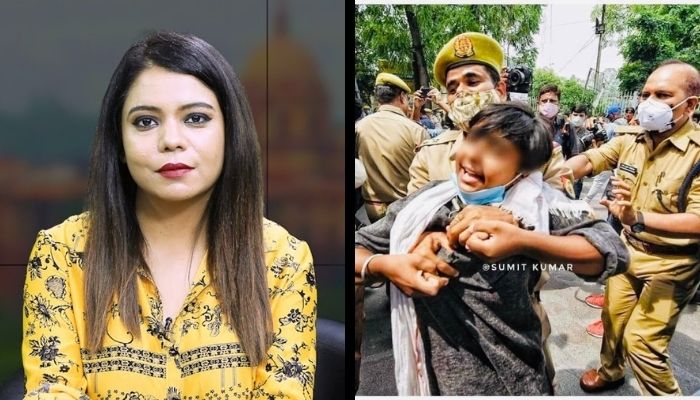
Journalist Rohini Singh claims woman protester was harassed by UP police, both the ‘victim’ and police deny the claim

On Friday, ‘journalist’ Rohini Singh took to Twitter to claim sexual harassment of female demonstrators at the hands of police personnel during protests over unemployment in Uttar Pradesh.

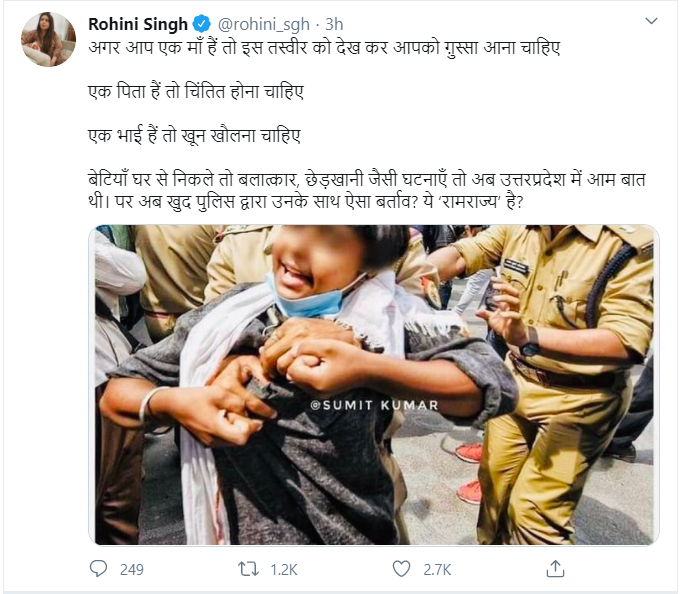
While sharing a picture of a female protestor being manhandled, she wrote, “If you are a mother, then, this picture should fill you with anger. If you are a father, then, this picture should worry you. If you are a brother, then, this picture should boil your blood.”

She further continued, “When girls step out of their house in UP, they are faced with eve-teasing and rape. But, they are being subjected to the same treatment by the police.” Invoking political connotations, Rohini Singh asked, “Is this ‘Ram Rajya’?”

But the ‘victim’ in the photo herself has denied the claims of Rohini Singh. The woman has has said that she was not harassed by police, and it was a case of mistaken identity.

Screengrab of the tweet by Rohini Singh

Female protestor refutes claims of ‘deliberate’ harassment

In a video shared by popular social media user Ankur Singh, the female protestor said, “My name is Kanchi Singh. We were protesting near Gate no. 1 of Lucknow university. I was made to sit in the police van just like other protestors.” Citing mistaken identity, Singh clarified, “They mistook me for a boy due to my dress and made me sit in the van.” Refuting claims of sexual harassment at the hands of the police personnel as alleged by Rohini Singh, she emphasised, “They did not do anything to me. Nothing was deliberate. The theory of ‘harassment’ is just misunderstanding.”

UP Police denies allegations of sexual harassment

In a statement, the Police Commissionerate Lucknow clarified, “We want to clarify that it was important to disperse the protestors in light of the law and order situation. Since the crowd was huge, it was difficult to distinguish between the genders on the basis of their outfit. By mistake, the female protestor was taken away by the police personnel, after mistaking her for a man. Even the female protestor has acknowledged the misunderstanding caused over the attire. The Police Commissionerate Lucknow respects women and expresses regret over the incident.”

Rohini Singh targets Gujarat government with fake news

This is not the first that the journalist has tried to target BJP State governments with misleading news stories. Earlier in May, Rohini Singh authored an article for ‘The Wire’, titled- “Behind Ahmedabad’s Ventilator Controversy, a Backstory of Connections to Top BJP Leaders” which alleged that the Narendra Modi government is procuring 5000 ventilators from a Rajkot based firm which has already been accused of supplying substandard breathing machines to the Ahmedabad’s largest COVID-19 hospital.

However, the Press Information Bureau of India took cognisance of the lies and deceit peddled by Ms Singh in The Wire. The official Twitter handle of PIB issued a tweet denouncing the article published on the leftist rag as fake. PIB claimed that the ventilators which Ms Singh is talking about in her article were not procured but were received as a donation. It further added that the quality of the ventilators, which is continuously being ridiculed in the article published on The Wire was in accordance with the required medical standards.

Disha Salian had both pre-fall and post-fall injuries: Forensics expert Dr Dinesh Rao

0

The mystery surrounding the deaths of actor Sushant Singh Rajput and his former manager Disha Salian, is growing murkier with each passing day as more and more revealing and incongruous details of the alleged suicide cases are coming to the fore, in sharp contrast to the Mumbai Police’s assertions. Disha Salian had died after falling from 14th floor of a building on 8th June, just a week before Sushant’s death. Although police have claimed that she killed herself, now a forensic expert has claimed that Disha had two set of injuries—one before the fall and another one upon her fall—implying that Disha’s death might be a homicide.

Disha Salian’s pre-fall injuries could lead to a possible case of homicide

Speaking at a debate on Republic TV, forensic expert Prof Dr Dinesh Rao revealed information about Disha’s case saying, “An important nugget of information I would like to add here is related to the pattern of injuries detected on Disha’s body. There were definitely two sets of injuries that I noticed. One of them being pre-fall injuries, and another set of injuries were obviously due to the fall from height. This needs to be investigated and it definitely leads to a possible case of homicide.”

The expert also added that either Disha was assaulted or tortured, or that might have been the reason she had tried to escape the assault. They can be resistance injuries from the attack, he added.

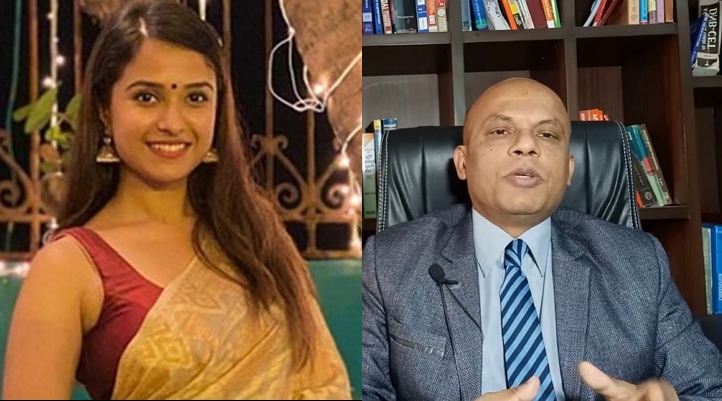
Dr. Dinesh Rao has been a Professor and Head of the Department of forensic medicine at The Oxford Medical College, Hospital & Research Centre, Bengaluru. He is a former Director and chief forensic pathologist in Kingston, Jamaica.

Disha fell to her death from the 14th floor of a Malad high-rise on the intervening night of June 8 and 9, with the Mumbai Police ruling it as suicide. Sushant was found dead at his Bandra residence on June 14 under mysterious circumstances. Three agencies–CBI, ED and NCB are currently probing different angles related to the death case of the late actor.

Nitesh Rane wrote a letter to Amit Shah seeking protection for Disha Salian’s

A few days back, BJP leader Nitesh Rane had raised suspicion over the death of Disha Salian, citing that Rohan Rai’s arrival at the spot 20-25 minutes after the incident was indicative of suspicious behaviour. Rane had written a letter to Union Home Minister Amit Shah, seeking security for Disha Salian’s fiance, Rohan Rai, claiming that his testimony might be vital in establishing the link between the deaths of Sushant Singh Rajput and Disha Salian. Rane had alleged that Rai had fled Mumbai and was wary of coming back, fearing pressure from “influential people”.

Viral video: How the family of a Hindu woman thrashed a Muslim man harassing her, and why the police arrested them all

0

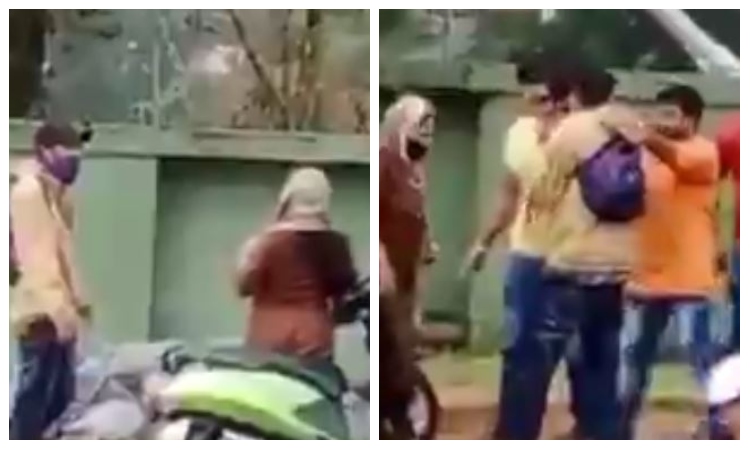
In a video which has now gone viral on social media, a woman is seen waiting for someone on her scooty parked on the roadside. Soon a youth approaches her. Suddenly, that youth is accosted by a few other men, who along with the woman, start thrashing him up. The woman is also seen using her slippers to beat up the youth. The incident had reportedly taken place in Madikeri, Kodagu district, Karnataka, on Thursday, where a Hindu woman allegedly beat up a Muslim youth for sending vulgar messages to her on social media.

According to a local newspaper, Kannada Prabha, police has arrested the Muslim youth on charges of harassment, levelled on him by the Hindu woman. Moreover, based on a counter-complaint, the woman along with 4 of her relatives have also been arrested for assaulting the youth.

In what transpired, a Muslim youth named Mohammad Munassir had been harassing a Hindu woman in Madikeri, Karnataka, by sending vulgar text messages to her. Tired of the constant badgering, the woman thought of teaching the youth a lesson.

She sweet-talked him into meeting her near the RTO office on Thursday, to which he willingly agreed. When the youth went to meet her, the woman, who was waiting at the designated spot along with her relatives, bashed up the youth. In the video, the enraged woman is also seen thrashing the youth with her slippers.

The Madikeri police arrested Mohammad Munnasir after the victim registered a complaint. Meanwhile, a counter-complaint had also been filed by the accused alleging that the family members of the lady thrashed him. Based on his complaint, the Madikeri police also arrested the woman and four others in the case.

NCRB data reveals that farmer suicides have been the lowest in India since 1995

0

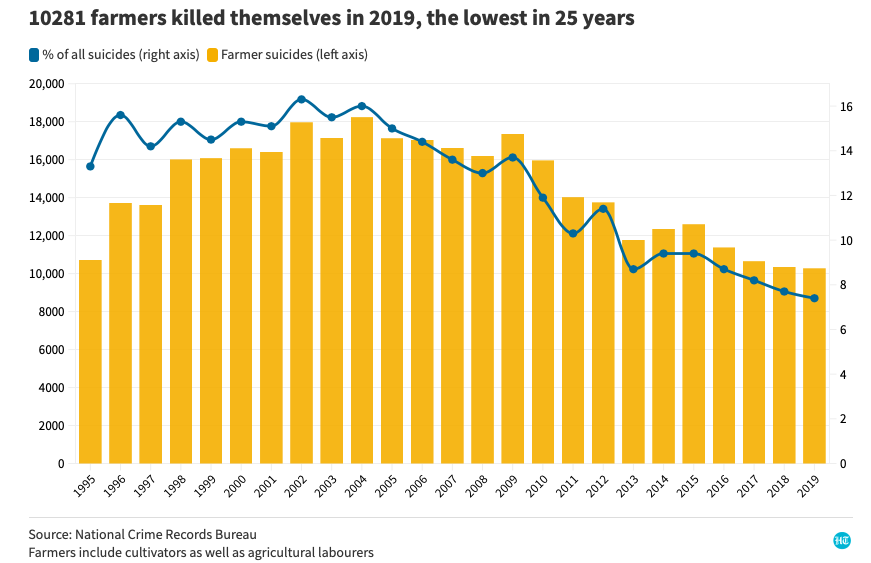
On September 1, the National Crime Records Bureau (NCRB) published the data on accidental deaths and suicides in India for the year 2019. As per the latest data [pdf], the farmer suicides in the country has been the lowest since 1995.

The NCRB report stated, “A total of 10,281 persons involved in farming sector (consisting of 5,957 farmers/cultivators and 4,324 agricultural labourers) have committed suicides during 2019…” In the same year, farmer suicides constituted 7.5% of the total suicides in the country.

Decline in farmer suicides since 2015: lowest since 1995

It is noteworthy to mention that the number of farmer suicides has been the lowest in the past 25 years. In 1995, a total of 10, 720 farmers had committed suicide. The number skyrocketed in 2004 with a total of 18,241 cases of suicide. Since 2015, there has been a downward trend in the number of farmers committing suicide. While the number was 12,602 in 2015, it fell to 11, 379 in 2016. The numbers continued to decline with 10,655 (2017), 10,349 (2018) and 10,281 (2019) deaths.

Year-on-year numbers of farmer suicides in NCRB data, image via Hindustan Times

Performance of States in preventing farmer suicides

The NCRB report noted, “Certain States/UTs namely, West Bengal, Bihar, Odisha, Uttarakhand, Manipur, Chandigarh, Daman & Diu, Delhi, UT, Lakshadweep, and Puducherry reported zero suicides of Farmers/Cultivators as well as Agricultural Labourers.” Having said that, the majority of farmer suicides took place in Maharashtra (38.2%), Karnataka (19.4%), Madhya Pradesh (7.8%), Andhra Pradesh (10%), Telangana (4.9%), and Chhattisgarh (4.9%).

Casualties higher among males than females

The report stated that out of 5,957 cultivators who committed suicide in 2019, only 394 were females. The remaining 5,563 people who killed themselves were males. “Out of 4,324 suicides committed by agricultural labourers during 2019, 3,749 were
male and 575 were female,” the report emphasised.

Meanwhile, the data stated that the total number of suicides in the country increased to 139,123 in 2019 from 1,34,516.

Rahul Gandhi opposes Agriculture reform by Modi govt, even though Congress had promised the same in election manifesto: Details

On Thursday, the Congress leader Rahul Gandhi launched a scathing attack against the Modi Government for introducing three bills in the Parliament that are related to the farm sectors reforms in the country.

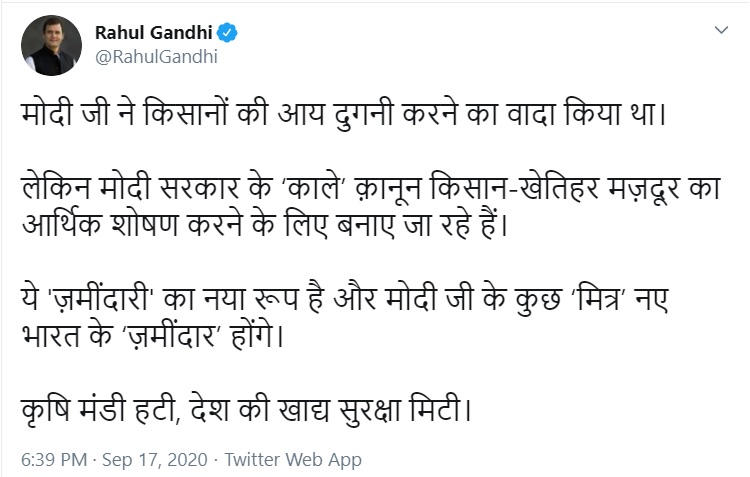
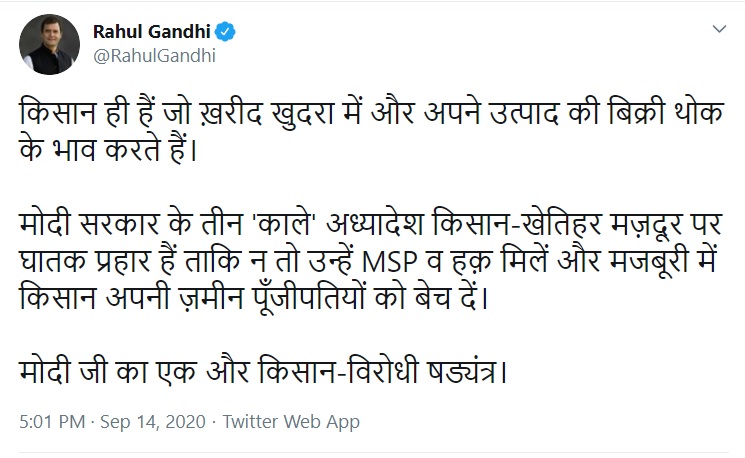
Taking to Twitter, the former Congress President, who is currently on his vacations, said that these ‘black laws’ of the Modi government are being introduced to economically exploit peasants and the agricultural labourers.

The Gandhi-scion claimed that the three bills, which aim to reform agricultural marketing in the country, is nothing but a new form of ‘Zamindari’ and some friends of Prime Minister Modi will be the ‘Zamindars’ of New India.

“Agriculture market has been reduced, food security of the country has been erased,” said Rahul Gandhi.

Interestingly, earlier this week, Rahul Gandhi had launched a similar attack against the Modi government claiming that three bills rolled out by the centre was ‘a fatal attack’ on peasant and agricultural labourers.

Farm sector and APMC reforms were part of Congress’ election manifesto

However, the Congress party’s protests against the Modi government over the issue of three agricultural reforms introduced in the Parliament has yet again exposed their hypocrisy.

In the ongoing Parliament session, the Modi government has introduced three bills – Farmers’ Produce Trade and Commerce (Promotion and Facilitation) Bill, Farmers (Empowerment and Protection) Agreement on Price Assurance and Farm Services Bill and Essential Commodities (Amendment) Bill, which seeks to bring notable reforms in the farm sector.

The Congress party, which is currently opposing the bill, were once the proponents of the same reforms that are currently being introduced by the Modi government. Interestingly, in 2019, the Congress party under the leadership of Rahul Gandhi had themselves announced these reforms in their election manifesto.

In the run-up to 2019 Lok Sabha elections, the Congress party had released an election manifesto, in which it was clearly stated that the Congress party if ever comes to power, would be repealing the Agricultural Produce Market Committees Act and make the trading in agricultural produce including exports and inter-state trade free from all restrictions.

Image Source: Congress Manifesto 2019/ DAAM – AGRICULTURE, FARMERS, AND FARM LABOUR

Interestingly, the first two bills introduced by the Modi government – Farmers’ Produce Trade and Commerce (Promotion and Facilitation) Bill, Farmers (Empowerment and Protection) Agreement on Price Assurance and Farm Services Bill seeks to introduce such reform in the APMCs making it easier for the farmers to sell their farm produce just as promised by the Congress party.

According to PRS India, the first bill seeks to provide for barrier-free trade of farmers’ produce outside the markets notified under the various state agricultural produce market laws. The second bill allows intra-state and inter-state trade of farmers’ produce beyond the physical premises of APMC markets.

Rahul Gandhi and Congress had promised to repeal Essential Commodities Act

Similarly, in its election manifesto, the Congress party had also promised to replace the Essential Commodities Act, 1955 and had claimed to bring a law that can be invoked only in the case of emergencies.

Image Source: Congress Manifesto 2019/ DAAM – AGRICULTURE, FARMERS, AND FARM LABOUR

However, the Congress party seems to have a problem with the Modi government bringing such a law that would replace the Essential Commodities Act, 1955. The Modi government has tabled the Essential Commodities (Amendment) Bill to amend the Essential Commodities Act, 1955. The new bill empowers the central government to control the production, supply, distribution, trade, and commerce in certain commodities. 

It is rather intriguing why the former Congress President Rahul Gandhi has been vehemently opposing the same reforms that were promised by his own party not long ago.

Congress leader responds to a parody account, hurls insults at journalist Anjana Om Kashyap

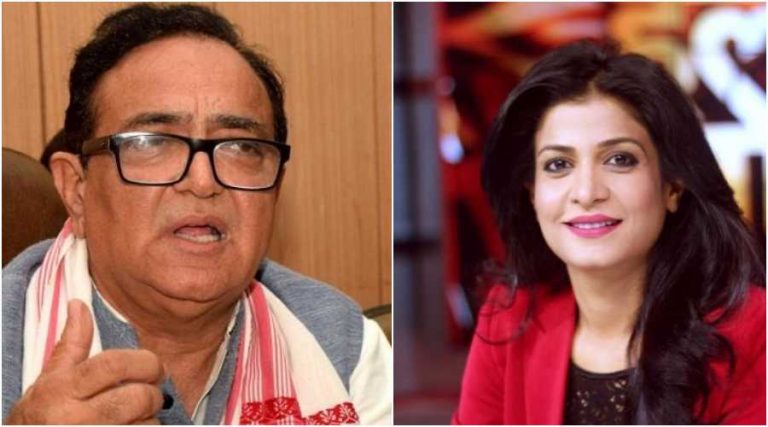
In his hurry to distribute certificates to media of his choice, Congress leader and former Haryana Minister Captain Ajay Singh Yadav was seen using derogatory words against journalist Anjana Om Kashyap, mistaking a parody account as her’s.

Congress leader responds to a parody account

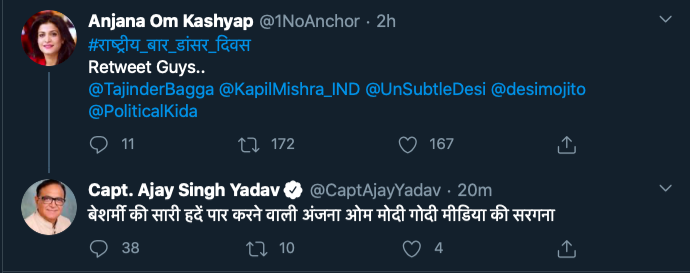
In what transpired, a parody account with the display image and name of Journalist Anjana Om Kashyap had posted a tweet saying that today is “National Bar Dancer Day”. The Congress leader, for some unfathomable reasons, seems to have got upset with the term ‘Bar Dancer’.

Ajay Singh Yadav did not even pause to see that the parody account declares in its bio that it is parody, and has 60 followers. He shot out an angry response declaring that journalist Anjana Om Kashyap of Aaj Tak has ‘crossed all the limits of shamelessness’

It is not clear why the Congress leader got upset with the term ‘bar dancer’ or why he seemed to think that usage of the term ‘bar dancer’ means shamelessness.

Congress leader hurls insults at journalist Anjana Om Kashyap

Responding to the parody account’s tweet asking to trend ‘National Bar Dancer Diwas’, the Congress leader and former minister stated, “Anjana Om has crossed all the limits of shamelessness. She is the leader of Modi’s ‘Godi’ media. Godi media is a term widely used by pro-Congress media persons and opposition leaders against journalists and media houses who don’t toe the Congress line.

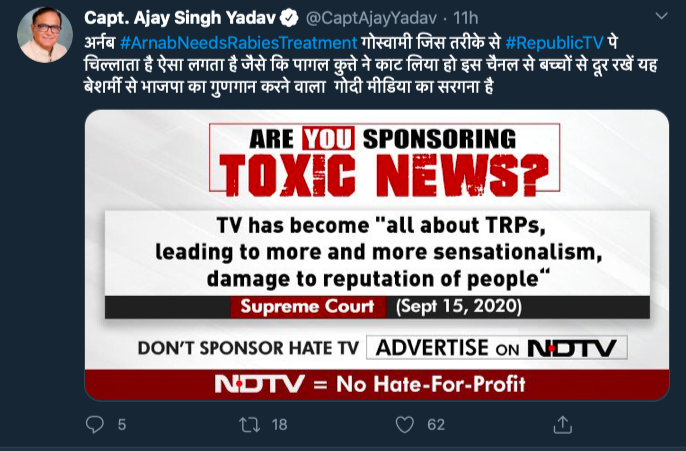
Interestingly, the Congress leader, in his previous tweet, was seen using expletives and derogatory words against Republic TV’s Arnab Goswami. He had shared an NDTV campaign image calling (ironically) not to sponsor ads on other news channels and pay to NDTV only.

Ajay Singh Yadav’s tweet using derogatory words against Arnab and promoting NDTV

At the time of the report’s publication, Ajay Singh Yadav had not taken down his tweet in response to the parody account which he had thought as journalist Anjana Om Kashyap’s. A number of Twitter users had even pointed it out to him but the tweet was still there.