Home Blog Page 5270

Dog Meat Ban in Nagaland incites accusation of ‘cultural imperialism’, ‘food fascism’, shows how liberal imperialism can deepen fault-lines in the country

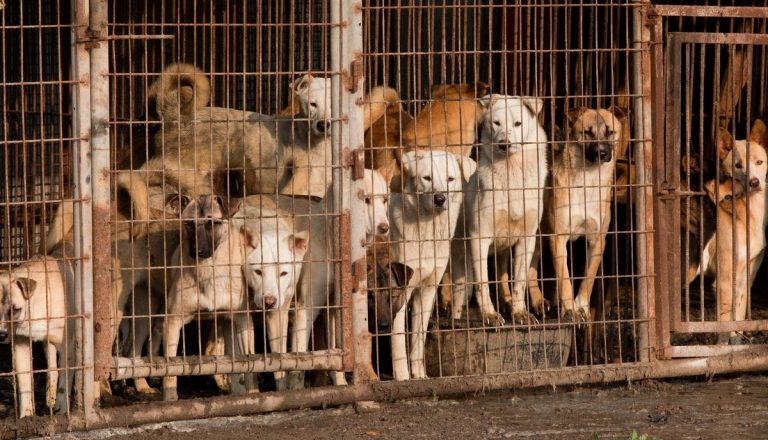
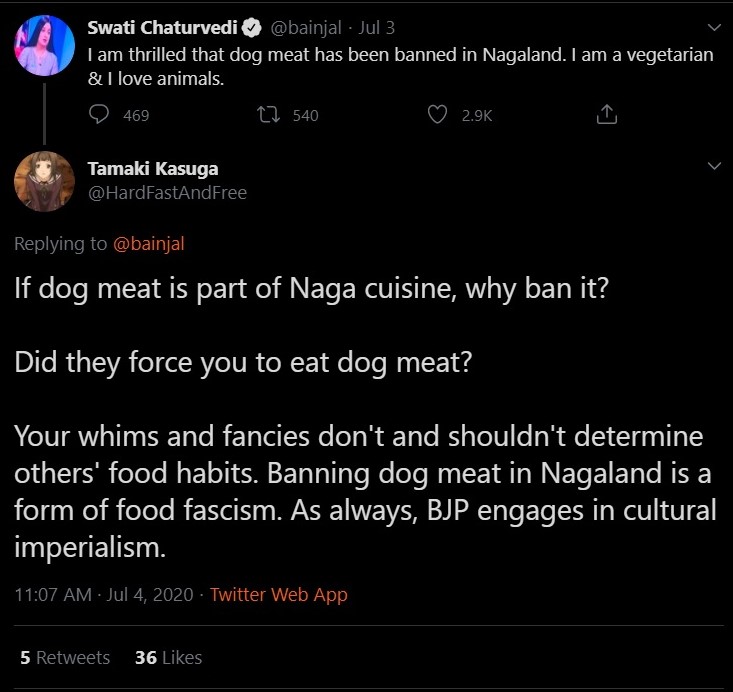
The ban on dog meat in Nagaland has sparked cultural anxieties in the northeastern state and other states in the region. The Nagaland cabinet took the decision following outrage on social media after pictures of dogs allegedly being transported to the state went viral. Nagas on social media have alleged that it is a form of cultural imperialism that has been forced on the state against its will despite the fact that the decision was taken by the democratically elected government of Nagaland. They also accuse that this was done without consulting the people of the state.

Efforts are also underway to turn this into a Northeasterner versus ‘Mainlander’ issue despite the fact that the final decision was taken by the Nagaland Cabinet. It only goes on to highlight the fact that the decision has the potential to escalate into something much uglier. Some on social media have claimed that “they are imposing mainland food habits based on caste forcibly on us.”
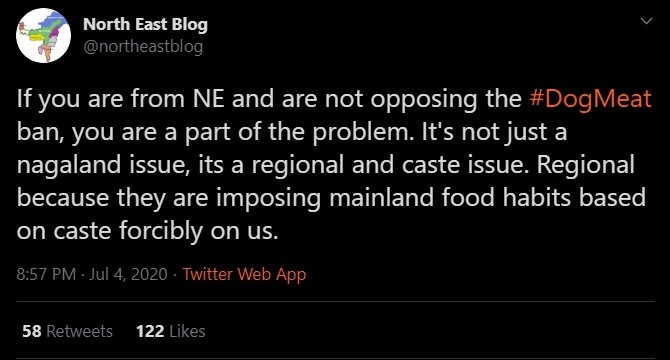
Image Credit: Twitter

Others have claimed that the North East is not some ‘colony’ where ‘touchy vegetarians’ or ‘hypocritical meat eaters’ from the ‘mainland’ could impose their own culture.
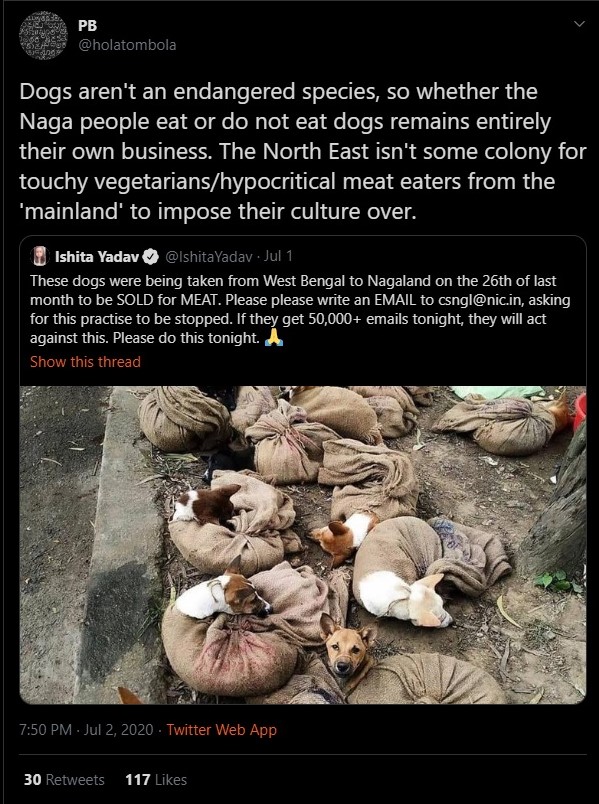
Image Credit: Twitter

One individual claimed that it was ‘racism’ in the form of ‘food authoritarianism’. However, he was countered by another person who pointed out that no other North-Eastern state had banned dog meat. He said, “Why blame the outsider for imperialism when the people who banned the sale of dog meat were locals elected by Nagas themselves”.
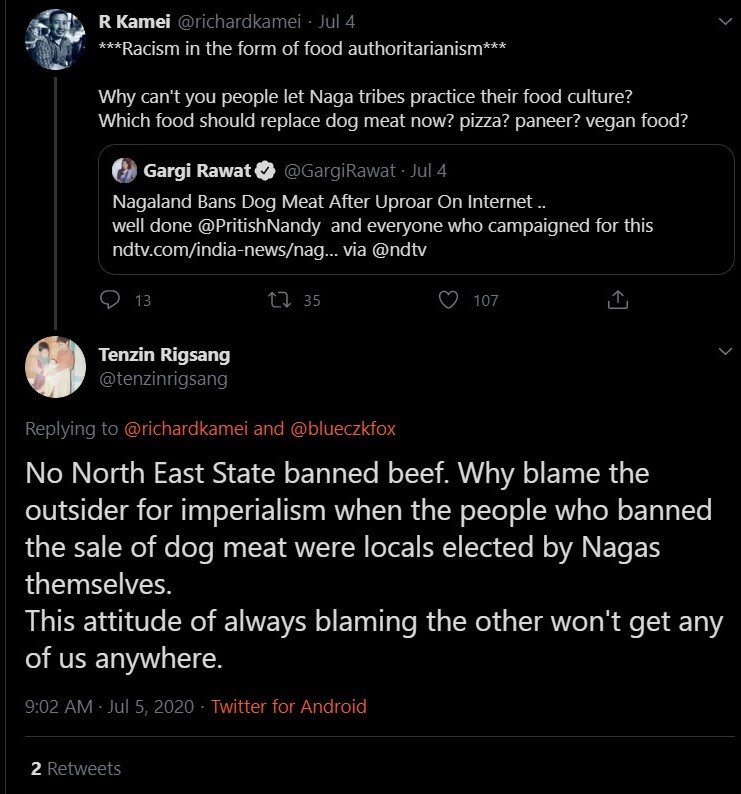
Image Credit: Twitter

Cries of ‘food fascism’ and ‘cultural imperialism’ have been growing steadily. The BJP is also facing stark criticism for the same. Maneka Gandhi has been particularly active in the whole affair, as she has been in a host of such contentious issues.
Source: Twitter

Richard Kamei from Tata Institute of Social Sciences wrote in an article for East Mojo, “The concern towards dog for its meat consumption is hypocritical with crocodile tears while they attribute Naga tribes to be cruel and disgusting for dog meat consumption.” He added in the article, “This is a classic case of cultural imperialism and racism in the name of showing love for animals. The inability to acknowledge and accept cultural difference is now new and has subjected thousands of them to racism.”

Kamei also says, “The ‘dog meat ban’ should not be seen in isolation from beef ban.” Throughout all of this, he conveniently forgets to mention that the ban on dog meat was a consequence of liberal imperialism and an independent decision of the Nagaland Cabinet. It has nothing to do with racism at all. He is a PhD candidate at Tata Institute of Social Sciences, Mumbai. Moreover, the people who campaigned for dog meat ban are actually opponents of any ban on beef in the country. These people had actually supported people’s right to eat beef during debates on beef ban in the past, hence it is illogical to link the dog meat ban with any plan to extend the ban on beef to Nagaland.

It further highlights how liberal imperialism has the potential to exacerbate existing fault-lines within the country. For instance, the ban on Jallikattu in Tamil Nadu was used by fringe elements to foment divisions between Tamilians and the rest of the country. A similar ploy appears to be underway with regards to the ban on dog meat.

Liberal imperialism has become a great cause for concern in recent times. For instance, the controversy surrounding Sabarimala and the consequent violence that erupted in Kerala following attempts to desecrate the Temple was entirely a calamity that was the product of liberal imperialism.

Recently, there have also been attacks on the tradition of Temple Elephants where animal rights groups have attempted to rob Temples of their Elephants which has the intended effect of Elephants losing the only families they have known. Of course, these issues are quite different from a ban on dog meat but they are also a product of the same imperialist mindset of liberals.

The eventual fallout of the decision remains to be seen but it cannot be ignored that the dog meat ban could lead to enmity between Nagas and ‘mainlanders’, a consequence that could have been entirely avoided if liberals knew to not transcend their limits. Many people in Nagaland already believe they are neglected by the mainland, which had resulted in the separatist movement that is thriving in the state for decades. Such actions only add fuel to such separatist feelings. It also demonstrates that people’s supposed right to eat anything they want is far more threatened by liberal imperialists than Gaurakshaks.

The entire controversy also demonstrates that the liberal philosophy has very little to do with principles and only concerns itself with power. Liberals were only far too eager to withdraw their support towards the freedom to eat whatever one wishes when it suited their own purpose.
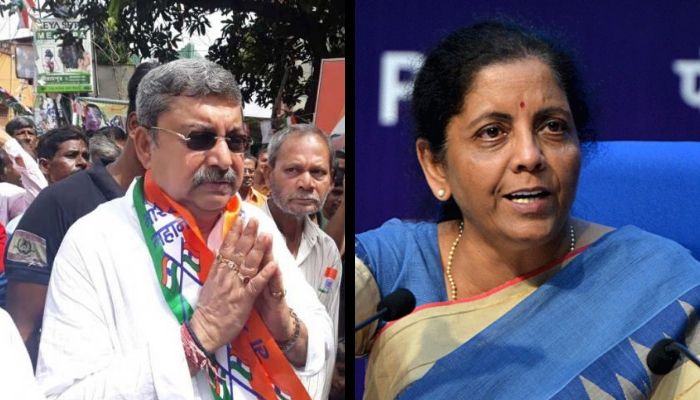
TMC MP Kalyan Banerjee compares finance minister Nirmala Sitharaman to ‘Kaali Naagin’

In a bid to mock Finance Minister Nirmala Sitharaman for the government’s economic policies, Trinamool Congress (TMC) politician Kalyan Banerjee made disparaging comments about her at a rally in Bankura in West Bengal on Saturday.

He said, “Kaala naginir chubal khaya jamon manush mara jai, temni Nirmala Sitharaman er chubal khaya Bharatvarshar er manush ektu ektu morche (Just like a black venomous snake, Nirmala Sitharaman is killing people every day in India).” Kalyan Banerjee further added, “Don’t you have any shame for razing Indian economy to the ground? You must resign and go back to Andhra Pradesh. She is the most useless Finance Minister of the world.”

The Trinamool leader was addressing a protest rally against rising fuel prices and the proposed privately run passengers on Indian Railways network, where he also demanded the resignation of the finance minister. Banerjee also termed Nirmala Sitharaman as the worst finance minister in the world.

BJP slams TMC leader for his derogatory comments

Bharatiya Janata Party spokesman Sambit Patra called out the TMC leader for his derogatory comments against Finance Minister Nirmala Sitharaman. “This is highly condemnable. The comment has been made in a state where Goddess Kali is worshipped in every household. The remark is not only racist but also misogynist,” Sambit Patra was quoted as saying.

West Bengal BJP Chief Dilip Ghosh said, “We don’t give much importance to such comments, they are uttering such nonsense out of frustration.” He said that Mamata Banerjee has lost control over her party leaders, who are now uttering nonsense out of frustration.

Men in blue: See how the ODI jerseys for Team India have evolved since 1985

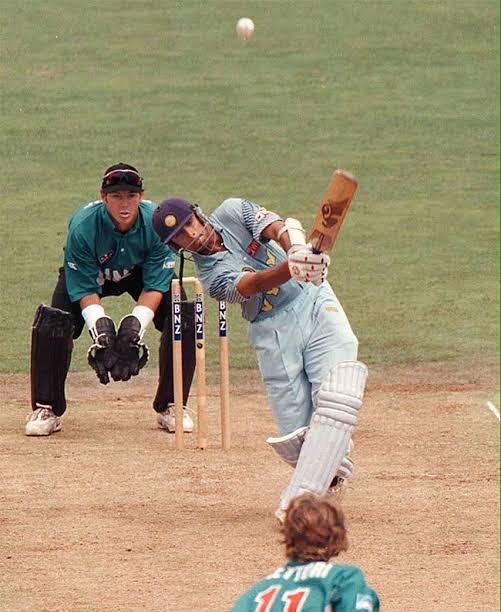
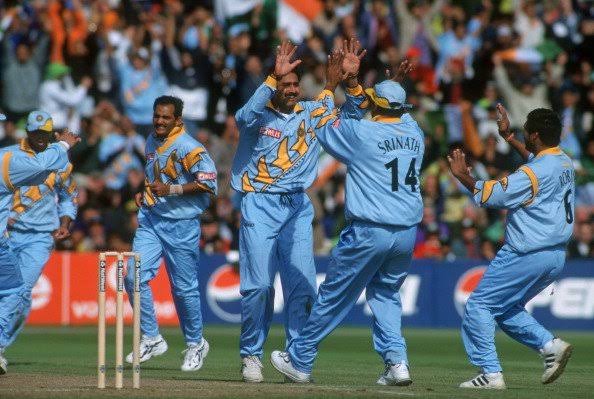
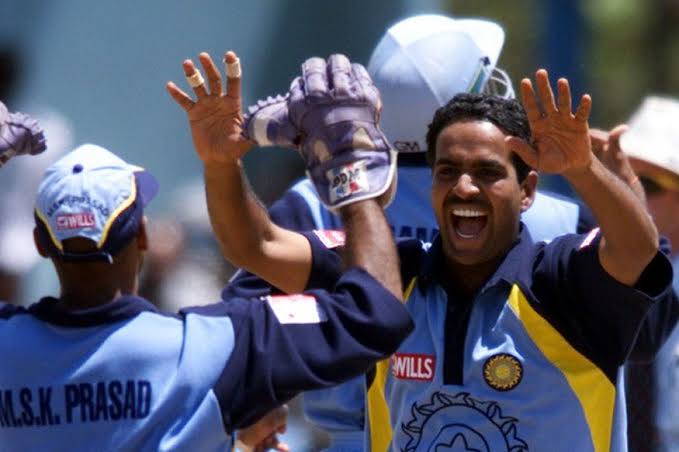
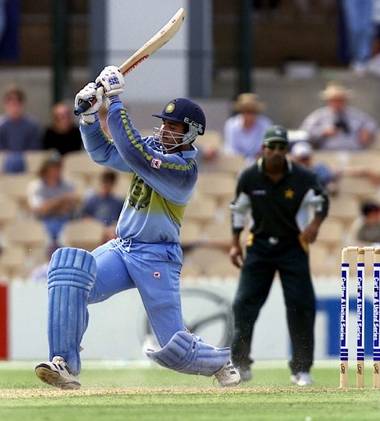
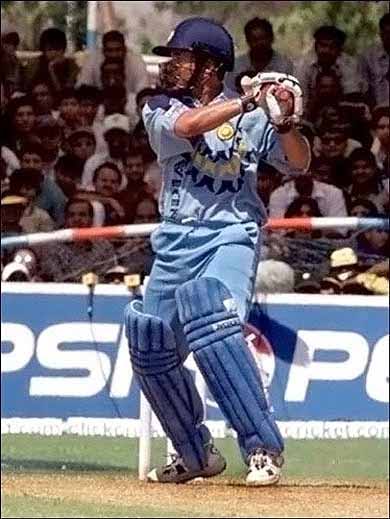
As an Indian cricket fan, do you remember all the Indian Jerseys donned by the cricketers in ODIs? Here we are trying to show you all the jerseys Indian players worn since 1985.

India played its first day-night match in 1980-81 against Australia. The jersey was quite similar to the one Indians worn in Champions Trophy, 1985. A good pic is not available so we are putting the entire highlight of the match and then will proceed with the jersey pics.

India’s first day-night match – against Australia in 1980-81

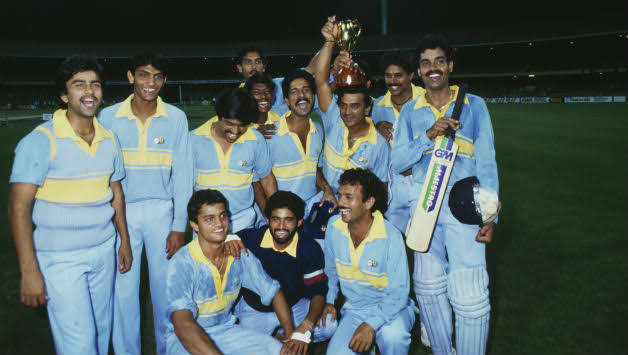
1985: Benson & Hedges World Championship. Shastri won an Audi, India’s biggest ODI win in 80s after the World Cup.

1985 Team India

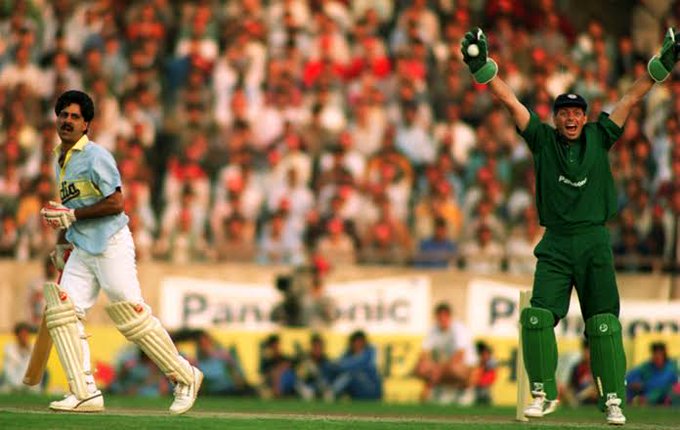
1991: Third ODI between India v South Africa at New Delhi. First time in Indian cricket history when 2 batsmen scored hundreds in the same ODI. This was also South Africa’s comeback series in International Cricket.

1991 India vs South Africa

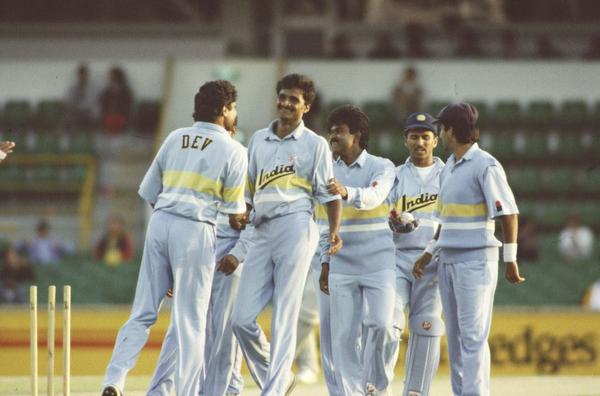
1991-92: Benson & Hedges World Series. India qualified for the final but lost both the finals against Australia. Tendulkar became the first Indian to score 400+ runs in a tournament/series (ODI).

Early 90s.

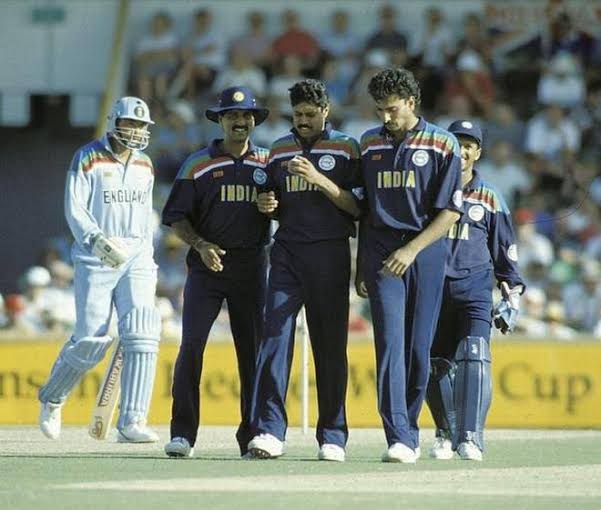
1992: The First World Cup in Colors. India won only 2 games, against Pakistan and Zimbabwe, placed 7th in points table just above Lanka and Zimbabwe.

1992 World Cup

1992-93: The first 7 match ODI Series India became the first team to visit South Africa after their comeback, lost the series 2-5.

1990s

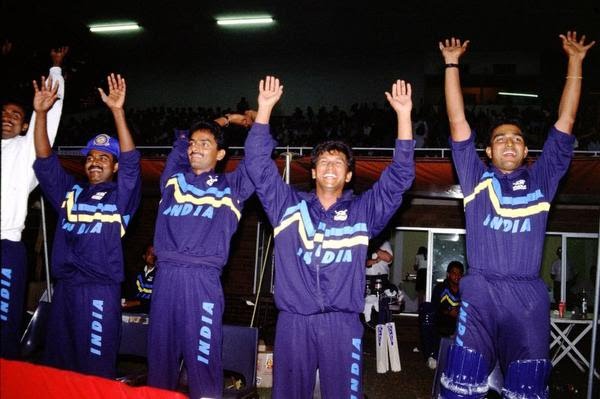
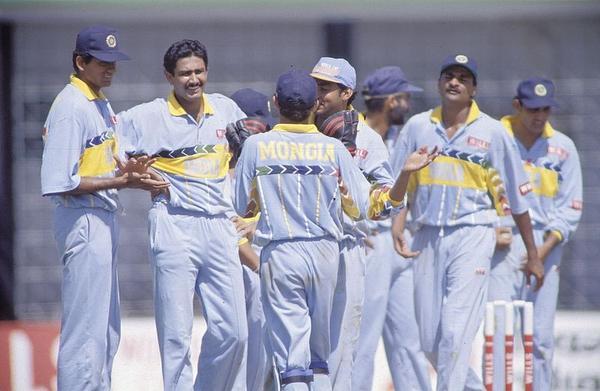
1993: Hero Cup. India’s first tournament played in floodlights. The 5 nation tournament was originally had 6 teams but Pakistan was excluded due to political reasons. India won the cup.

Team India in 1993

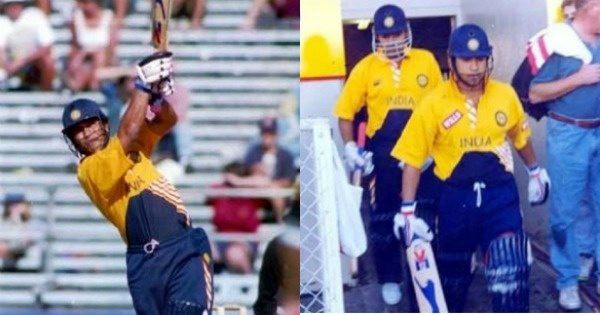
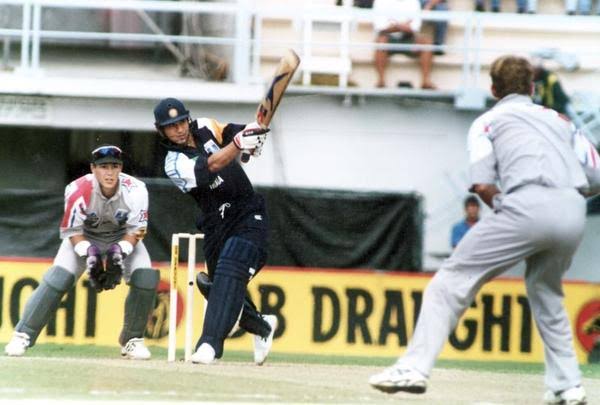
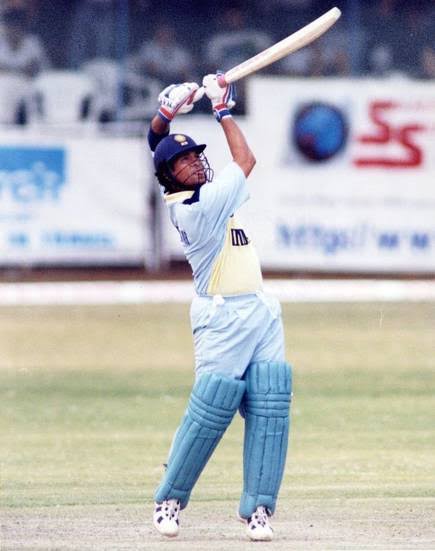
1994: 4 match ODI series against New Zealand. Tendulkar’s first series as an Opener.

Tendulkar’s first series as an opener

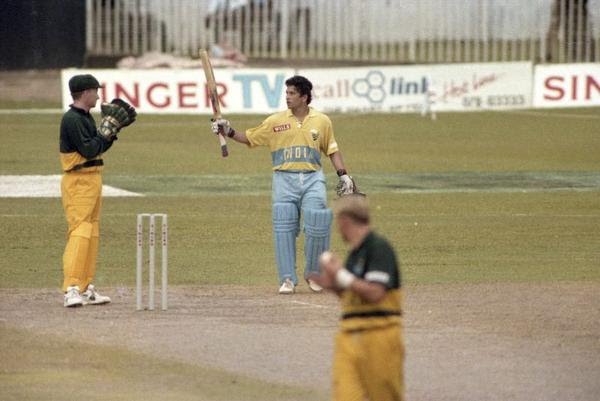
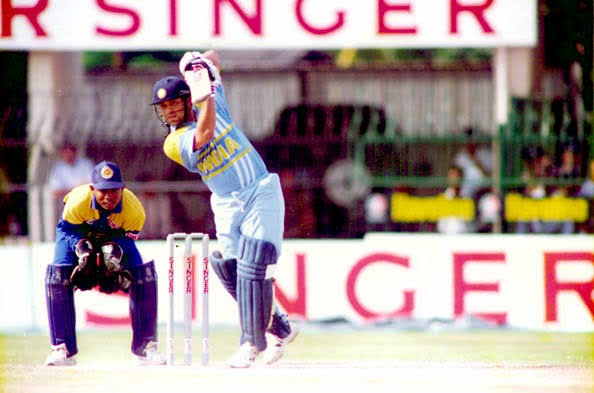
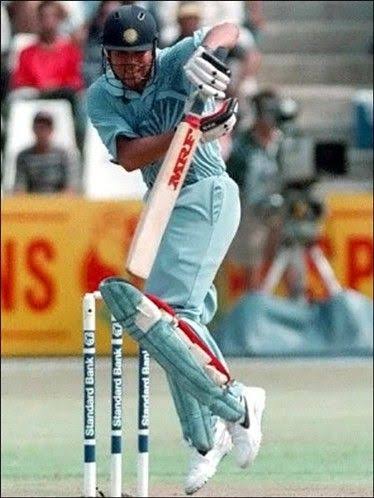
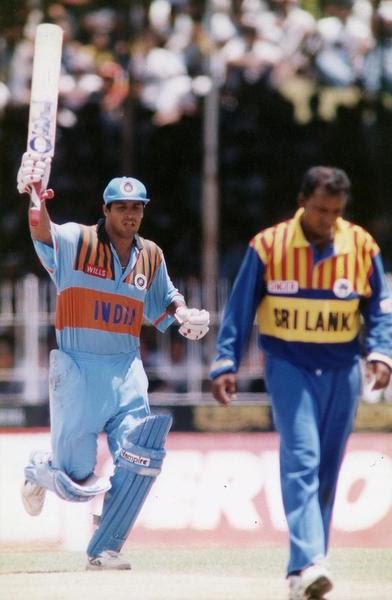
1994: The Singer Cup in Sri Lanka. Tendulkar’s first ODI hundred, Prabhakar accused Kapil of match-fixing, Shastri’s first tournament as a commentator.

Singer Cup

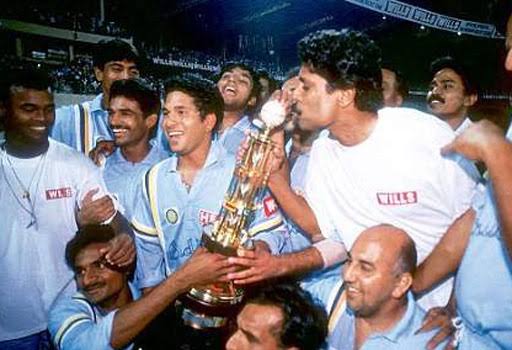
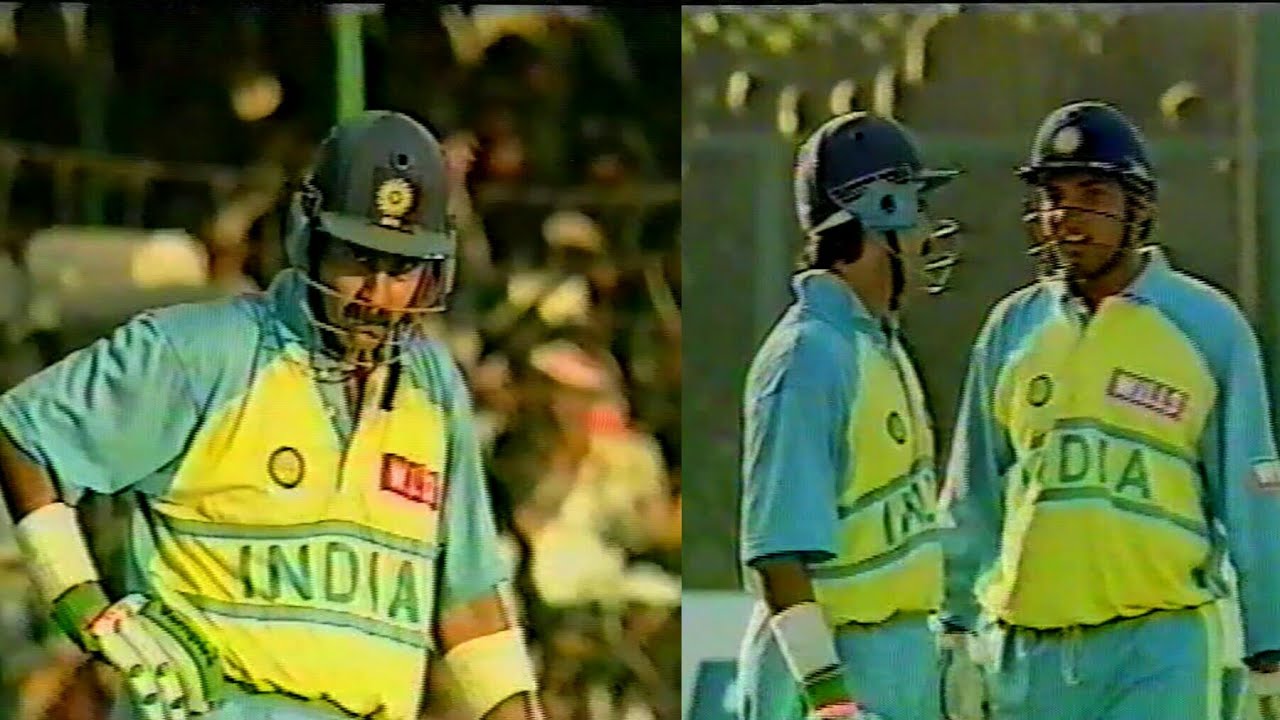
1994: Wills World Series. Tendulkar’s last series without a helmet while batting. India won the tri-series, Prabhakar/ Mongia were dropped in between the series for playing slow in Kanpur, Dravid’s first-time selection in the Indian team, Kapil announced retirement during the series.

World Series in 1994

1995: The Centenary Cup in New Zealand. India won only one game – against Australia, and Warne, as usual, was expensive – 61 runs in 10 overs, and wicket-less.

1995 Team India

1996: World Cup. India’s reached the semis for the third time, probably for the first time both the highest scorer (Tendulkar 523 runs) and wicket-taker (Kumble 15 wickets) were from the same team.

1996 Cricket World Cup

1996: Singer series. Tendulkar’s first series as captain. Youngest Indian ODI captain, first Indian captain to score a hundred on debut match as captain.

1996 Singer Series

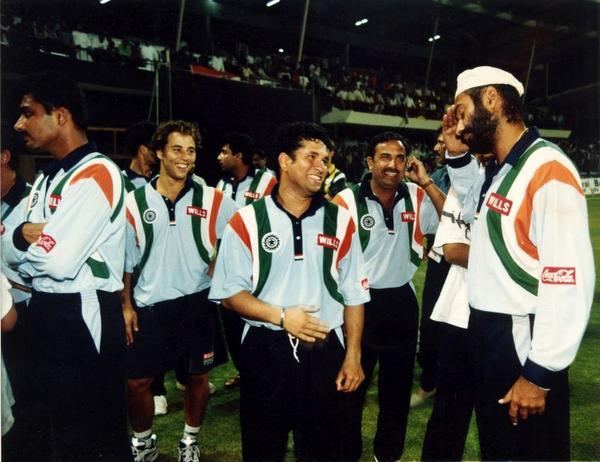
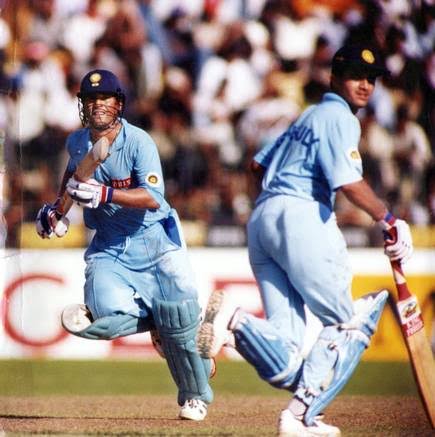
1996: Titan Cup. Tendulkar’s first win as captain. Tendulkar and Ganguly opened for the first time together and added a hundred run partnership in their first match.

Sachin’s first win as Captain

1997: Tri-series in South Africa. Lost all the games against South Africa, against Zimbabwe – won 1, lost 1, tied 1

1997 Tri-Series

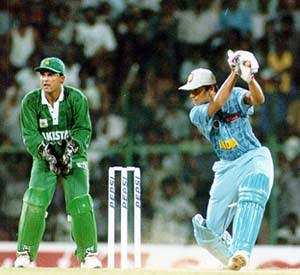
1997: Independence Cup in India. The tournament started even before the hosts left the Caribbean shores. Dravid scored his maiden ODI hundred in Chennai, in the same match Anwar smashed 194.

1997 Independence Cup

1997: India in Sri Lanka for bilateral series. Lost the series 0-3. Robin Singh scored his maiden ODI hundred in a wash out game which was replayed.

1997 bilateral series

1997: Quadrangle series in Sharjah. Tendulkar’s last series as Captain (first term). India lost all matches. Surprisingly England won the series under a new young captain – Adam Hollioake.

1997 – when India lost all matches.

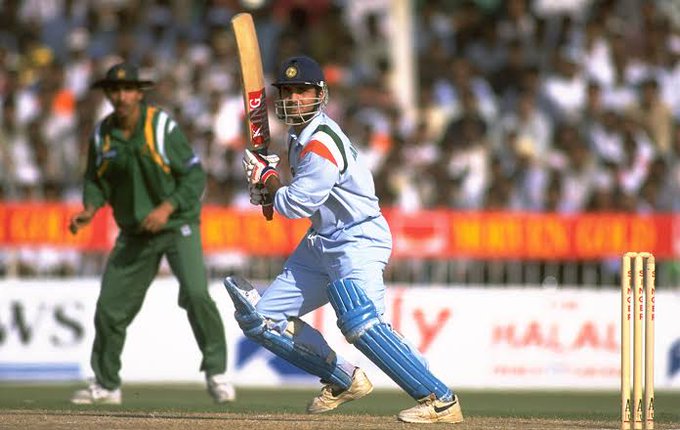
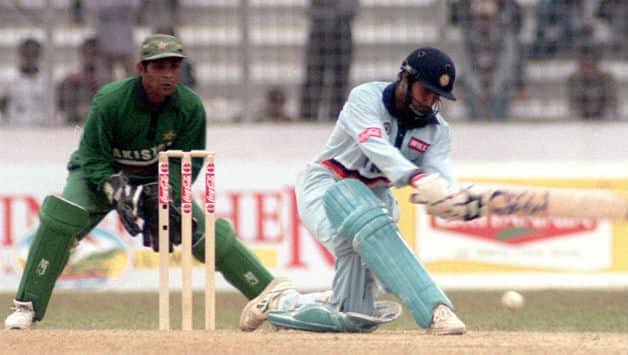
1998: Independence Cup in Bangladesh. The best of three finals in Asia. India and Pakistan played against each other 4 times in space of 1 week. India chased down 300+ score in the third final with the help of Ganguly-Robin Singh’s partnership. Kanitkar’s four made him famous.

1998 Independence cup

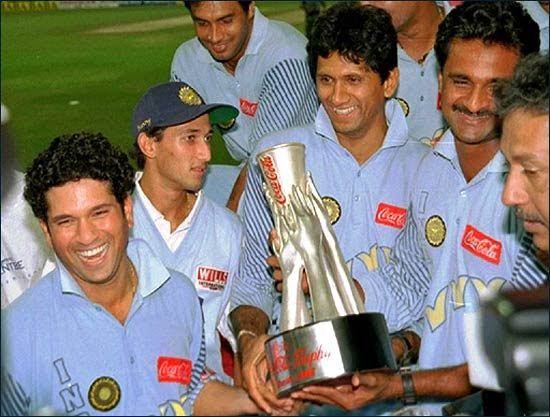
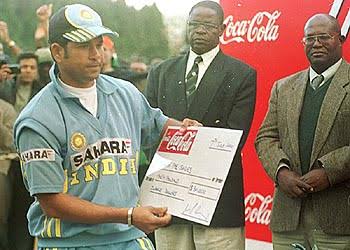
1998: The famous Coca-cola cup in Sharjah. Do I have to say anything else? The picture sums up everything.

1998 Coca-Cola cup

1998: Tri-series in India. The matches started around 4pm to save the players from the heat. Kenya and Bangladesh were the other two teams. India lost to Kenya at Gwalior but went on to win the finals at Kolkata’s Eden Gardens.

1998 Tri-Series

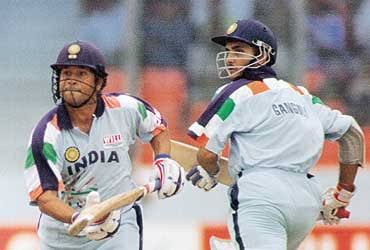
1998: Independence Cup in Sri Lanka. India won the final as Tendulkar-Ganguly added 252 runs for the first wicket in the finals. Lele said in Tehlka tapes that Gaekwad got a call from a bookie that match is fixed, but Tendulkar-Ganguly assured him that they will win the match.

1998: Bilateral series in Zimbabwe. India won the series 2-1 but the most important stat of the series was Tendulkar breaking Haynes record of most ODI hundreds.

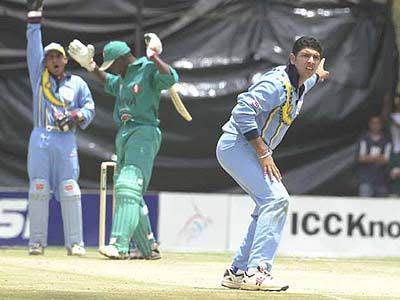
1998: ICC Knock out tournament. India won the quarter-final against Australia, Tendulkar became the first batsman to score 3 consecutive ODI hundreds against Australia. But lost the final Semi-final against West Indies. South Africa won the final – their only major ICC win.

1998: Coca-cola Champions Trophy. India’s fifth title of 1998. Tendulkar smashed hundred in 4 finals. Scored 1894 runs with 9 centuries at 65.31 with strike rate of 102.15. A record still stays with the master.

1999: Bilateral series in New Zealand. A comeback series for Rahul Dravid. Dravid smashed 123 in the first ODI and then went on to score 309 runs in the series. The most by any batsman on either side.

1999: World Cup Not a great world cup as India lost crucial matches and Tendulkar lost his father. Both Ganguly and Dravid had a good outing. Both scored their first World Cup Hundred. Dravid went on to become the highest run-scorer of the tournament.

1999: Aiwa triangular series in Sri Lanka. India won just one game in the tournament, it was the last league game of the series (against Sri Lanka). They also played tri-series in Singapore in same jersey (lost the finals against West Indies).

1999: LG Cup in Nairobi. Sunil Joshi bowled one of the most economical spell of ODI history: 10-6-6-5. India lost the finals against South Africa.

2000: Carlton and United Series in Australia. Another disastrous series for India. Won only one match out of right. Ganguly became the first Indian to score an ODI hundred on Australian soil. 1 against Australia at Melbourne 1 against Pakistan at Adelaide.

2000: Bilateral series against South Africa. The series is famous for fixing, Cronje and co were caught after the series.

2000: ICC Knock Out Tournament. India reached the finals again but couldn’t win. Debut series for Zaheer and Yuvraj. New Zealand won their first major ICC event.

2001: Bilateral series against Australia. Tendulkar became the first player to reach 10,000 runs milestone. He also took his 100th ODI Wicket in the series.

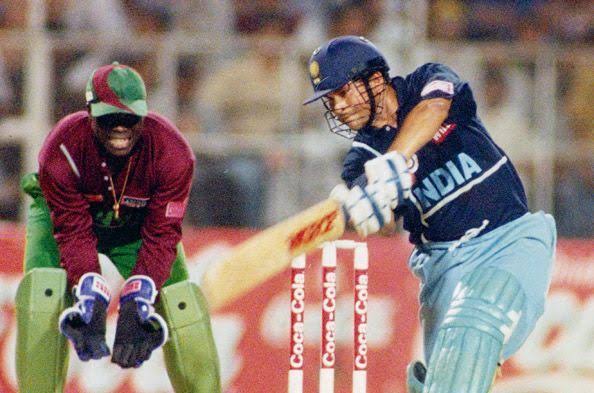
2001: Coca-cola Cup. Again lost in the finals, against West Indies this time.

2001: Triangular series in Sri Lanka. Sehwag got a chance to open in Tendulkar’s absence and scored his maiden ODI hundred in this tournament.

2001: Tri-series in South Africa. Same story in the finals.

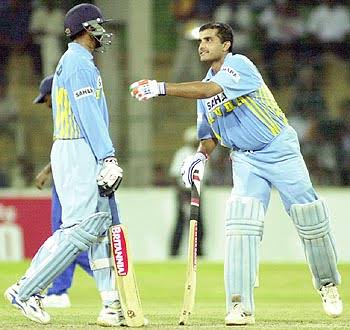
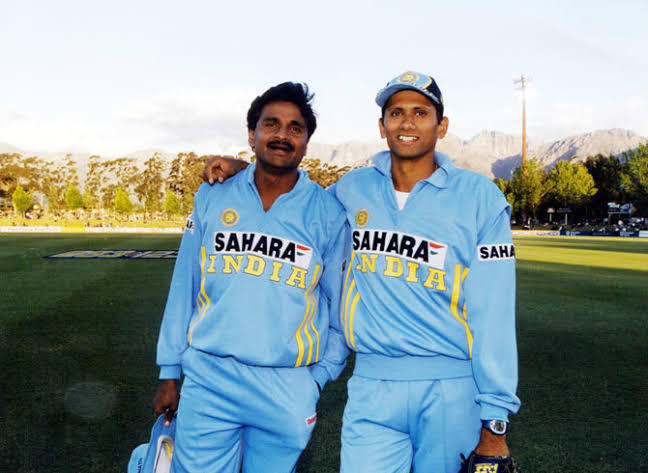
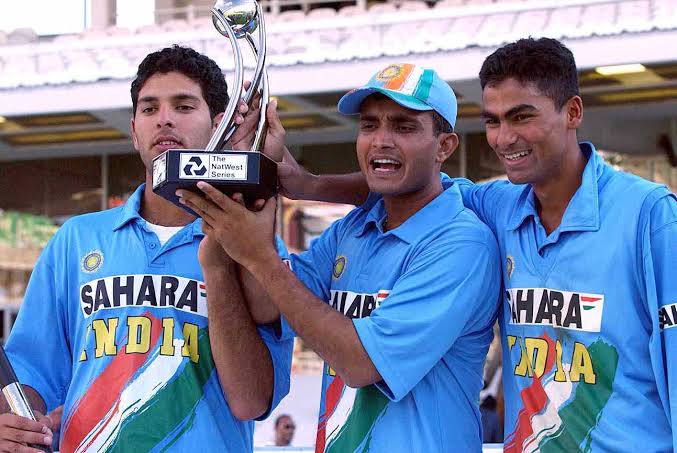
2002: NatWest series. Finally a permanent Jersey. India won the cup, the NATWEST Series and this jersey continued till February 2007.

2002: ICC Champions Trophy. The Sahara name and Indian Flag missing due to sponsors’ clause controversy. The title was shared between India and Sri Lanka because of rain and stupid ICC rules for rain-affected matches.

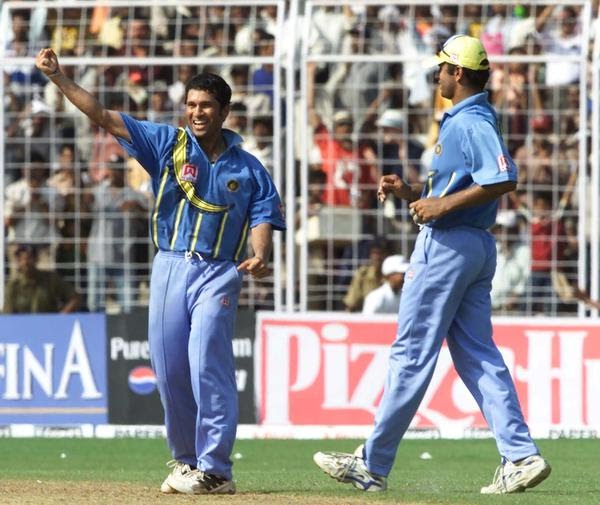
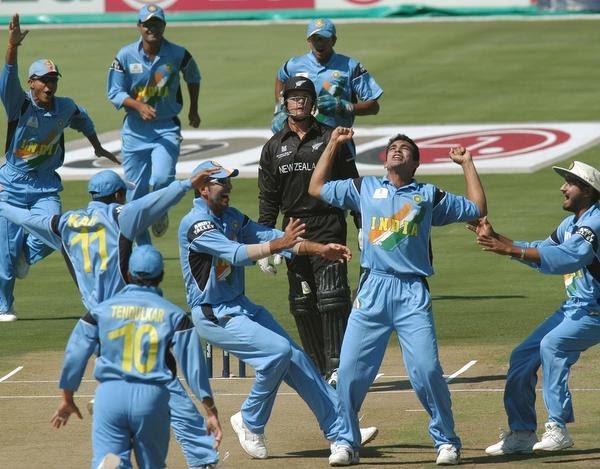
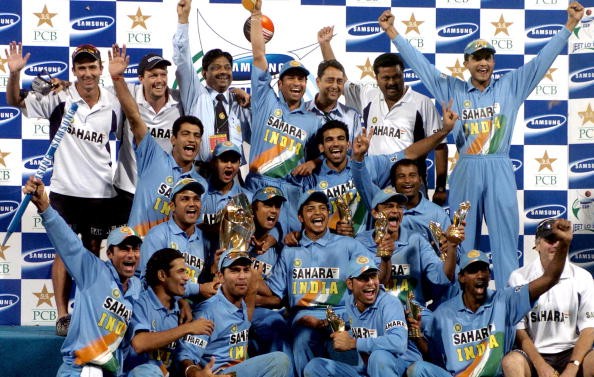
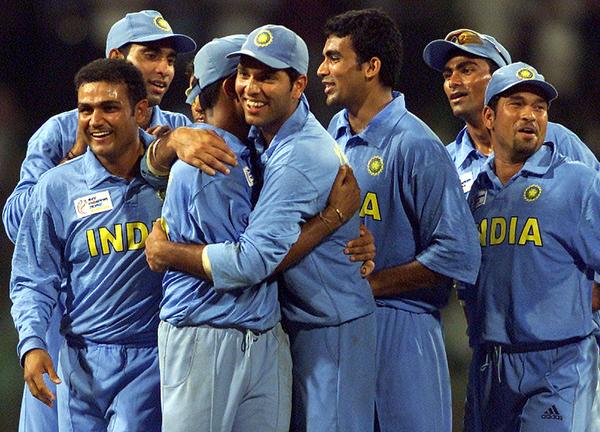
2003: World Cup. Favorite jersey of many Indians. India reached the finals of the World Cup. Look at the joy on the faces of Indian players 🙂

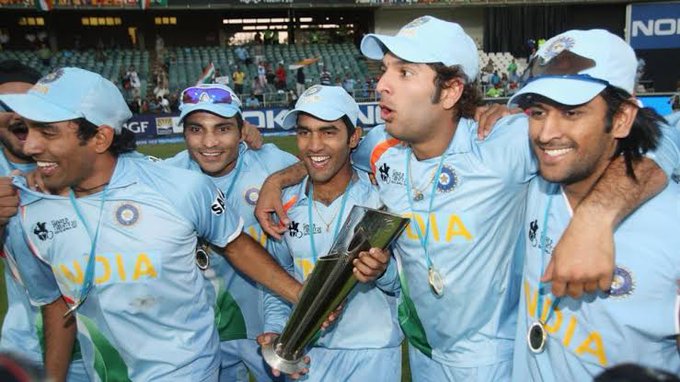
2007: World Cup and WT20. The Nike Jersey – out of World Cup in the first round but won the WT20. Also, India won the first triangular series in Australia (2008). Stayed with the Indian Team till 2009.

2009: Bilateral series in New Zealand. The dark shade jersey was part of Indian team till 2010. Tendulkar scored ODI’s first double hundred in Gwalior.

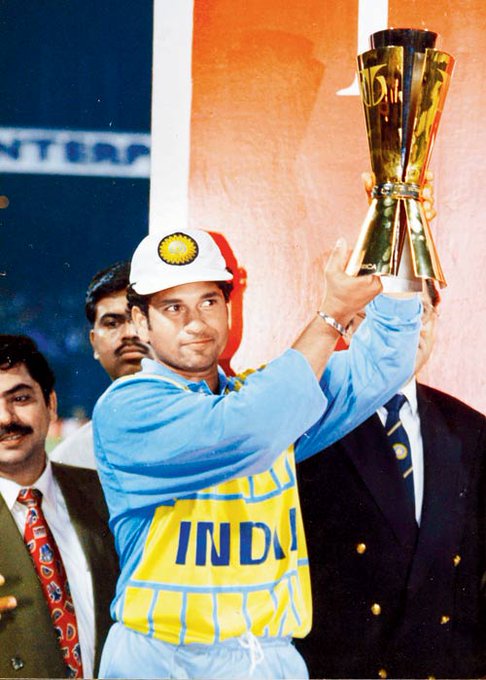
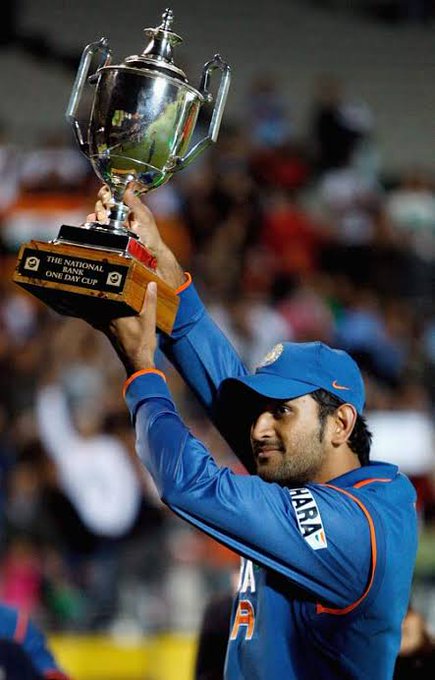
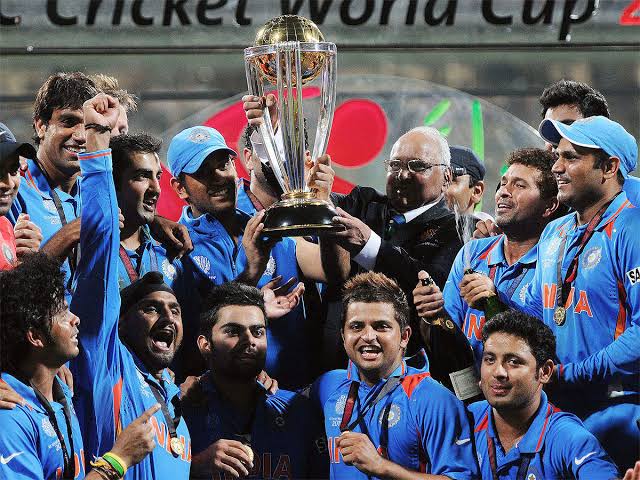
2011: World Cup. The Winner! A dream comes true for Tendulkar and many, Dhoni’s six to win the cup is probably the most memorable memory for Indian fans since Lord’s 1983.

Rest of the jerseys we have seen more than often. So which one is your favorite? Do let us know.

Meghalaya: Local Bengali youths attacked brutally in suspected hate crime, police warn against breaching communal peace

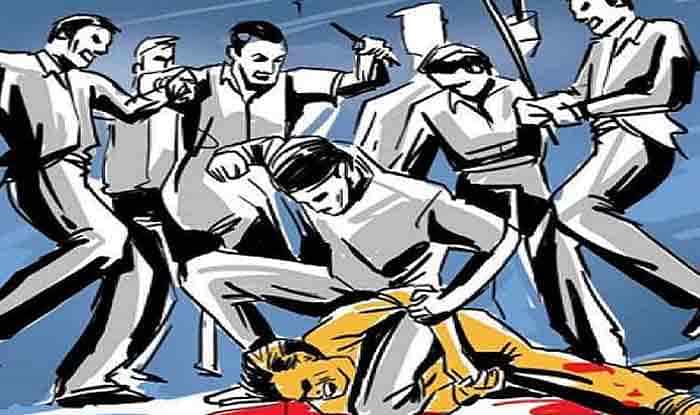
Six non-tribal youths were injured grievously in Meghalaya on Friday after they were attacked by unidentified goons. The incident occurred after the boys, all between the age of 20 and 24, went to play basketball at Lawsohtun block VI in Shillong. They were attacked by a group of around 20 individuals armed with iron rods and sticks.

The injured Bengali youth have been identified as Arindam Deb, Subharshi Das Purkayastha, Saptarshi Das Purkayastha, Binak Deb, Bishal Ghosh, and Prittish Deb. The incident occurred at around noon on Friday. The police on reaching the spot after receiving information spotted two of the boys who had managed to escape the basketball court.

11 people have been arrested in connection with the case. A criminal case no. 71(07)20 under sections 326/307/506/34 of the IPC has been registered at the Laban Police Station. 3 suspects were nabbed by police on Friday and the rest 8 suspects were picked up yesterday, according to a statement issued by Meghalaya police.
GK. langrai, Assistant Inspector General of Police (A) said, “The police team on seeing the condition of both these youth immediately rushed them to Woodland Hospital for medical assistance and the other four victims were also taken to the same hospital for medical treatment.”
Further investigation into the matter has been initiated. The Police has also sought information from the local populace regarding the crime. They have assured individuals of complete secrecy in the event of passing the police any information. As per reports, it is suspected to be a hate crime against the youth who belong to the minority Bengali Hindu community in the state.

Patricia Mukhim, an eminent journalist from Meghalaya, said while addressing Chief Minister Conrad Sangma, “Conrad Sangma CM Meghalaya, what happened yesterday at Lawsohtun where some non-tribal youth playing Basketball were assaulted with lethal weapons and are now in hospital, is unacceptable in a state with a Government and a functional police force.”

She proceeded to add, “The attackers, allegedly tribal boys with masks on and should be immediately booked. This continued attack on non-tribals in Meghalaya whose ancestors have lived here for decades, some having come here since the British period is reprehensible to say the least. The fact that such attackers and trouble mongers since 1979 have never been arrested and if arrested never penalised according to law suggests that Meghalaya has been a failed state for a long time now.”

She stated, “Why should our non-tribal brethren continue to live in perpetual fear in their own state? Those born and brought up here have as much right to call Meghalaya their state as the indigenous tribal does.” Some of the injured suffered injuries to their limbs while others sustained head injuries. They have been discharged after receiving treatment at the Woodland Hospital.

Non-tribals in tribal dominant states in North-East such as Meghalaya suffer immense discrimination and are often the victims of hate crimes. The Meghalaya Police has issued stern warnings against breaching communal peace and promised that “stringent action as per relevant provisions of law will be taken against them”.

Chief Minister Sangma has also issued a statement regarding the same through social media. He said, “I strongly condemn the assault on 5 boys yesterday in Lawsohtun, Shillong. An assault on any citizen of the State irrespective of background or community will not be tolerated. Perpetrators of such heinous crimes will be charged by law. Action will be taken.”

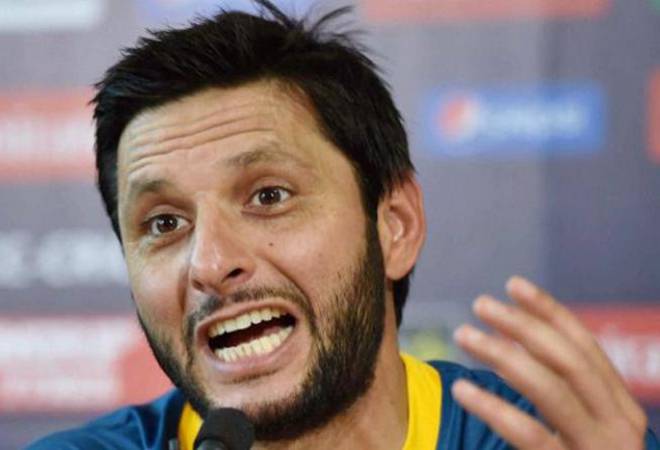
Shahid Afridi makes another controversial statement, says Indian cricket team used to ask forgiveness from Pakistan team after getting badly defeated

Another controversial statement by Shahid Afridi has brought a sour taste for the cricket fans. Former Pakistani cricket captain Shahid Afridi has claimed Pakistan dominated the Indian cricket team and beat them so much that they would seek forgiveness from Pakistan. The infamous Pakistani cricketer has created controversies on several occasions because of his statement against India, especially when he talks about Kashmir.

Afridi was giving an interview after recovering from Covid-19. He said, “I have always enjoyed India. Unhe to theek-thaak mara hai humne. Itna mara hai unhe ki match ke baad maafiyan mangi hai unhone.” (We’ve thrashed them a lot. I believe we’ve beaten them so much that they used to ask us for forgiveness after the match). He added that he enjoyed playing against India and Australia as these are good teams and players have to play under pressure. Going and performing under such conditions is a big thing. During the interview, Afridi said that his most memorable inning was 141 against India in India.

History of India-Pakistan cricket matches

Pakistan leads India in ODIs with 73-55, but Pakistan won most of them in the 1980s. Out of 52 matches during that period, India managed to win ten while Pakistan won 23 matches. During the 90s, the ratio stayed at 28-18. During the 2000s, India led with 25-23 and between 2010 and 2020, India won 10 matches while Pakistan managed to win only 4. It has to be noted that India has won all the world cup matches between India and Pakistan.

Shahid Afridi and his uncontrolled blabbering against India

Shahid Afridi in 2016 had claimed that many fans in India shower love at him. During the recent interview, he mentioned that during the visit, when he made the statement, he was also the ambassador for Pakistan, and it was a political statement. He sarcastically said, “it was for intelligent people.”

During his visit to Pakistan Occupied Kashmir, Shahid Afridi made anti-India and anti-Modi comments that raised several eyebrows. In the aftermath, Yuvraj and Harbhajan, who posted videos to support his NGO had to come forward and apologize for supporting him. In February, he said that the relationship between India and Pakistan would not improve until Modi is in power. In a viral video, he used abusive language against Hinduism and Hindu traditions and said he once smashed the TV when he saw his child doing ‘aarti’ while watching a show.

Interestingly, even after recovering from a deadly disease like Covid-19, he tried to paint it as if there is nothing to be afraid. He said that he does not understand why people are locked inside. While doctors across the globe are trying to find a cure and vaccine for the coronavirus, he urged people not to be scared of the disease.

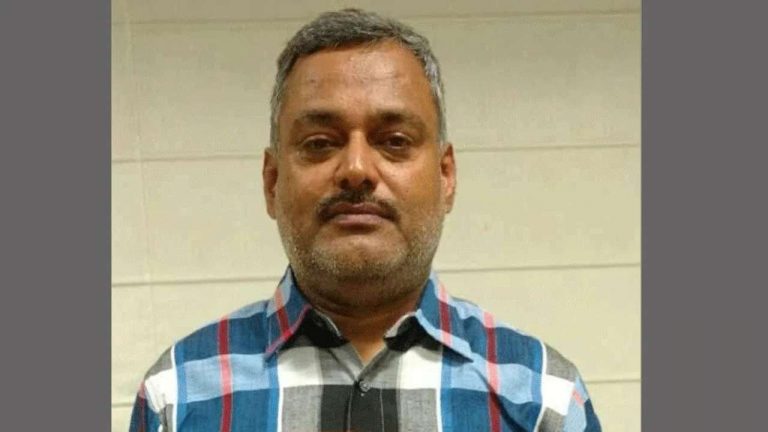
Police suspect Vikas Dubey was tipped off by a police insider, power in the village was cut before the raid: Report

The Kanpur police have reportedly questioned a lineworker who had disconnected the power line of the village when police had come to arrest the hardened criminal Vikas Dubey. On interrogation, he revealed that the electricity supply was cut off on the orders of a caller from the Chaubepur police station.

As per the report, the phone number that was used to call the man belonged to a policeman. The power supply was disconnected for about an hour. Reportedly, the officer had initially called the Rauslabad Power Station, followed by Shivli Power House. As per reports, the cops are investigating whether the power supply was disconnected to benefit Vikas Dubey or cause him inconvenience to ease the arrest.

According to a report by Jagran, when the cops reached the village, there was no electricity. Interestingly, the village has an uninterrupted electric supply at night. However, a solar light was burning outside Dubey’s house. 8 police personnel are being suspected of leaking information about the raid to Dubey. They include two constables, a head constable, four sepoys, and a home guard. Their numbers were found on the contact list of two phones that were recovered from the house of Vikas Dubey.

SP denies police complicity

While all have claimed to be innocent, the phone numbers of about 24 police officers from in and around Kanpur were discovered from the seized cell phones. 8 of them are reportedly posted in Chaubepur and Shivrajpur police stations. A senior officer had informed that the accused cops would be booked under the law if they were found guilty. The Kanpur police are now investigating the minute details in the case. However, Superintendent of Police Brajesh Kumar Srivastava denied allegations of involvement of any police officer in informing Vikas Dubey of the raid at his house. Cops have arrested the Sub-divisional officer and another employee of the substation in connection to the case.

Aide of Vikas Dubey arrested

The Kanpur police had reportedly arrested an aide of gangster Vikas Dubey in Kalyanpur in Uttar Pradesh, following an encounter on Saturday night. The accomplice has been identified as one Daya Shankar Agnihotri. He informed that Dubey had received a call from the cops before they came to arrest him. He added that Dubey had called around 25-30 people and had fired shots at the police. In his defence, Agnihotri said, “I was locked inside the house at the time of encounter. Therefore, I saw nothing.” Dubey has been on the run from the law enforcement authorities.

Vikas Dubey sets up an ambush, kills 8 policemen

In a shocking incident, eight police personnel, including Deputy SP Devendra Mishra, were killed and six cops were injured in Uttar Pradesh’s Kanpur during a police raid to nab a hardened criminal and murderer Vikas Dubey’s house on July 2 late night. According to the reports, a team of Uttar Pradesh had gone to raid an area in search of criminal Vikas Dubey in Chaubepur in Kanpur.  The raid was carried out at 1 am on the intervening night of July 2-3 in Bithoor area in Chaubepur. As the police team reached the spot, they were ambushed by Dubey’s men who were prepared with arms on the roof of a building and continuously shot at them. Shockingly, the criminals had already stationed a JCB machine on the road to block the police team. UP police have informed that the operation is still going on and forensic teams are at the spot.

Gujarat: Man who had impersonated as a govt employee and hurled shoe at minister appointed as vice president of state unit by AAP

The Aam Aadmi Party has appointed controversial leader Gopal Italia as the vice-president of Aam Aadmi Party’s (AAP) Gujarat unit. The 31-year-old leader, who has various criminal cases against him, had joined the party recently.

According to the reports, Gopal Italia, who was earlier associated with Hardik Patel’s Patidar Anamat Andolan Samiti (PAAS), had joined Aam Aadmi recently in the virtual presence of senior national party leader and minister in Delhi government, Gopal Rai.

The controversial leader had claimed that he had joined the AAP as it was a party of educated leaders.

“Only an educated leadership can give a new direction to the political system. I want the AAP’s vision of governance that has been implemented in Delhi, to be implemented in Gujarat. It is a vision where quality education and health amenities are available to people free of cost. I also have a vision of a corruption-free system. I want people to elect a government on the basis of such basic issues. And to achieve those goals, I have joined the AAP,” said Italia.

Cases against Italia

Gopal Italia came to limelight in 2017 after he had impersonated as a government employee and called up Deputy Chief Minister Nitin Patel to complain about the inefficient prohibition law in the state.

The phone call had become viral on social media, following which Italia also faced a criminal case of impersonation. During the call, he had identified himself as an LRD jawan by mistake.

Again in 2017, he had stoked a massive controversy after he had hurled a shoe at Minister of State for Home Pradeepsinh Jadeja, accusing him of corruption in Gujarat. The incident had occurred outside the Gujarat assembly where Jadeja was about to address media persons. Following the incident, Italia, who was a clerk in the revenue department was dismissed from service for violation of service rules.

Later, Italia who is known to be vocal against both BJP and the Congress, joined the Patidar Anamat Andolan Samiti (PAAS), a social organisation, led by Hardik Patel and worked with it for next two years.

Gopal Italia is also facing a number of criminal cases against him in Gujarat. However, he maintains that all the cases are political in nature.

After joining AAP, Gopal Italia had said, “I am proud to have chosen the AAP. We will create our own unique identity instead of going for a ready made identity (of two established political parties in Gujarat). I have chosen a path of struggle.”

Italia also added that AAP was planning big for the upcoming by-elections to eight assembly seats and general elections of local bodies, scheduled to be held later this year. He claimed that the AAP will give a model where educated youth will get maximum chance and platform for good governance-oriented politics.

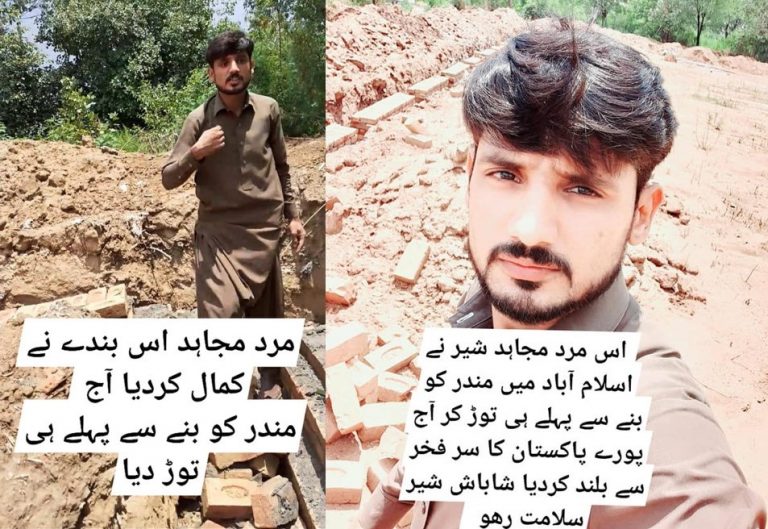
Meet Malik Shani Awan, the Pakistani youth who demolished wall of temple in Islamabad. ‘Allah wishes, I will not let a temple be constructed here,’ he says

Hindus in Islamabad, Pakistan have decided to halt the construction of what was to be the first Hindu Temple in the city in decades after the boundary wall was demolished by Islamic extremists. Hardline extremists had been opposing the construction of the Temple and eventually, some of them took the matter in their own hands.

As it turns out, one of the individuals who demolished the boundary wall went so far as to record the whole thing and post the video on Facebook. He was quite obviously proud of his actions and demonstrated remarkable religious intolerance, as has been the hallmark of Islamic extremists, while engaging in the vile act of barbarism. He has been identified as one Malik Shani Awan.

Malik Shani Awan invoked the name of Allah while demolishing the boundary wall of the Temple to Shri Krishna that was to be constructed. For greater effect, he added music to the whole thing to make the video more entertaining. The lyrics of the song said something along the lines of “I have not let my children suffer… I am Pakistan.”

His Facebook profile says that he is from Islamabad but lives in Rawalpindi. Malik Shani Awan claims to work for a Pakistani news channel, 99News. In another post, he even expressed his gratitude towards fellow Pakistanis who were overwhelmingly supportive of his actions.

Malik Shani Awan also posted a video after he reached the spot with his friends. He expressed his gratitude towards Allah for stopping the construction of the said Temple. The video was shot before he began razing the Temple.

His Facebook profile is littered with posts demanding that the constructed of the Temple be stopped. From his profile, it appears obvious that Malik Shani Awan is a highly radicalised individual but judging from the great support he has received on the platform, it appears that such radical views and opinions are the norm and not an exception in the Islamic State of Pakistan.

Yesterday, he had vowed that he will never let a temple be constructed there.

The construction of the Temple has faced stiff opposition from Muslims in Pakistan ever since Hindus declared their intent of building their place of worship. The Pakistani Government had declared that it will consult the Islamic Ideology Council on the matter and proceeded to halt the construction of the Temple citing legal reasons.

There are also other Hinduphobic and Hindu-hating posts on his Facebook post where Lord Hanuman is referred to as ‘bandar’.

on 2nd July, he had urged true Muslims to prove their Muslimness by not letting a temple be constructed there.

Atrocities on religious minorities in Pakistan

Pakistani Hindus suffer greatly at the hands of their Muslim tormentors in Pakistan. It is far too common for Muslims to abduct Hindu women and marry them off after forcefully converting them to Islam. Even the Courts and governments provide no respite to the beleaguered Hindus as these forced marriages are legitimised by Courts, to the great distress of parents who have nowhere to seek remedy.

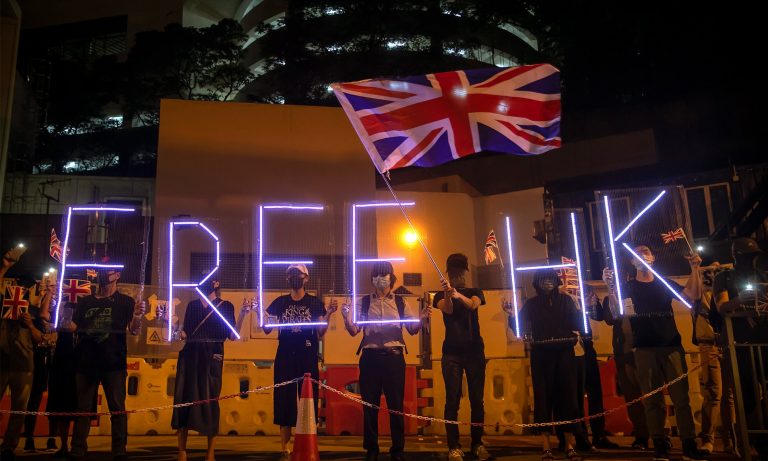
Britain makes CAA like offer to HongKongers persecuted by China

China is an authoritarian state where everyone lives in constant fear of the government. Some groups more than others. These would be the people of Hong Kong (who know what democracy feels like), the people of Tibet (who are mostly Buddhist) and the Uighur people (who are mostly Muslim).

This week, the British government made a choice. They would extend a helping hand to the besieged Hong Kongers by offering them UK citizenship.

UK made citizenship offer to Hong Kongers

The terms offered are extremely favorable. The residents of Hong Kong would immediately be welcome to live and work in the UK. After a period of five years, they would be eligible to apply for citizenship.

The British government explained its reasoning thus:

“This is a special, bespoke, set of arrangements developed for the unique circumstances we face and in light of our historic commitment to the people of Hong Kong.“

As an Indian who has witnessed the absurdity of the recent anti-CAA protests, I am not sure I understand. A special bespoke set of arrangements made by a country to help a group of people towards whom they feel a historic commitment?

I’m sorry. I thought modern democratic countries are not allowed to do that. Why does Britain feel a commitment to the people Hong Kong but not to every group of persecuted people everywhere? For example, what about the Uzbek minority facing persecution in Kyrghystan? Why is the British govt being so anti-Uzbek? Is a wave of anti-Uzbek sentiment sweeping the UK?

Is the UK creating two classes of citizens? Has this new UK citizenship policy reduced British citizens of Uzbek descent into second class citizens in their own country? Now, that’s disturbing.

And what about the heavily persecuted, mostly Muslim, Uighur minority in China? Why no UK citizenship for them? That’s Islamophobia! Does anybody in the UK know about Faiz’s famous poem dehumanizing idol worshipers? Better sing that quickly so that dignity of all people can be restored.

Of course I am being sarcastic. Because I understand. The UK can do what it wants. We the brown people of India, especially Hindus, do not have a right to feel historic commitments and moral obligations to anyone. The global elite will decide for us.

So the UK can flaunt its colonial history and show off its generosity to its former subjects in Hong Kong. If we point out that we have a several thousand year old connection to Hindus, Buddhists, Sikhs and Jains across the Indian subcontinent, then we are Nazis.

For over a year now, we have been struggling to explain a simple principle of self-determination to the world. Like every other country, the people of India can choose who to give asylum in our country. This will be determined by historic and cultural connections as well as diplomatic and strategic interests of the Govt of India. While we can feel sympathy for persecuted people anywhere, we absolutely do have a sovereign right to give preference to those with a deep historic connection to the land of Bharat and its ancient culture.

The British today are extending a helping hand today because China has broken the commitments it made to the UK as well as the people of Hong Kong when the city state was returned to China in 1997. Could anybody argue that Pakistan has actually kept its commitments under the Nehru-Liaquat pact of 1950?

Now there will be apologists who will say the UK isn’t applying a religious test to their new citizenship measure towards Hong Kong. Well, of course not. Because the persecution that Hong Kong faces has nothing to do with religion. On the other hand, Hindu, Sikh, Buddhist and Jain minorities in Pakistan face persecution precisely because of their religion.

And they ask: What about Ahmadiya and Shia Muslims in Pakistan, for instance? Again, let us repeat the most fundamental point. Just because a law does not contain special provisions for every conceivable disadvantaged group does not make it discriminatory.

In fact, India’s own National Commission for minorities has a list of six specific religious groups that are considered minorities: Muslims, Christians, Sikhs, Buddhists, Parsis and Jains. Why only these six? Why not other religions such as Judaism or Confucianism or Taoism? But very few would argue that the Indian state is anti-Jewish because our government does not recognize them as a minority group. In fact, even Jains were not included as a religious minority until the last days of the UPA govt in early 2014. Do you remember large scale street protests condemning the UPA govt for being anti-Jain and/or anti-Jewish?

Because at the time, people had a common sense understanding of two basic principles:

(1) Making special arrangements for one group of disadvantaged people is not “discriminatory” simply because there aren’t measures for every other disadvantaged group of people everywhere else on the planet.

(2) A sovereign country can decide its asylum laws based on its history, culture, diplomatic and strategic interests.

The entire free world accepts these principles. Britain is just the latest example of this. Which is why nobody is protesting their common sense humanitarian decision to help the people of Hong Kong.

Even the anti-CAA crowd understands these principles. But like someone who is pretending to be asleep, we cannot wake them up. It is for the rest of us to understand that the anti-CAA protests (riots) had nothing to do with secularism or humanity. The protests (riots) were about a naked anti-Hindu agenda. That’s all there was to them. Period.

In a viral clip from 2002, Field Marshal Sam Maneckshaw says how Pakistanis hailed professionalism of Indian Armed Forces: Watch video

An old video of Field Marshal Sam Manekshaw, one of India’s greatest war heroes, has gone viral on the internet in which he narrates how the Pakistani Prisoner of Wars of the 1971 India-Pakistan war had hailed the professionalism of the Indian Army following Indian victory in the war that liberated Bangladesh from Pakistan.

Speaking at an interview in 2002, Field Marshal Manekshaw revealed how he was royally welcomed in Pakistan after the 1971 India-Pakistan war and treated him with respect for the professionalism Indian Army had displayed during the Bangladesh Liberation war.

Sharing an anecdote, Sam Jamshedji Manekshaw recalled about an incident in Lahore at Governor’s House when the Governor of the Punjab province had asked him for a favour. The former Chief of Indian Army added that the Governor wanted him to meet the staff and shake hands with them, who were all waiting out for the Indian war hero.

“They were all lined up. The 11th man took the turban off and put it at my feet. So I picked it up and gave it to him, asking why did you (Pakistani staffer) do this?” said Field Marshal Manekshaw in his interview.

The Retired General said that a Pakistani staffer revealed how the Indian general had saved his family. The Pakistani staffer at the Governor’s residence said that five of his sons were PoWs of the 1971 war, who were treated with a lot of respect despite being Pakistani soldiers.

According to the staffer, as narrated by Sam Manekshaw, the Pakistan PoWs were given Quran to read, made to sleep on cots in barracks, broke bread with fellow Indian soldiers.

Read- India’s missing 54: The 54 ‘Abhinandans’ who never came home from Pakistan

“We will never believe Hindus are bad,” the Pakistan staffer at the Governor’s house said to Field Marshal Sam Manekshaw in reaction to the professionalism displayed by the Indian Forces in the 1971 India-Pakistan despite fighting a rogue army like Pakistan.

In the interview, the former COAS also said how he had to face severe problems back in the country following his visit to Pakistan. He added that the bureaucrats, ministers complained against him stating that he treated Pakistani soldiers just like he treated his sons-in-law. Even, the then Prime Minister Indira Gandhi had called for a cabinet meeting to the issue.

Field Marshal Manekshaw said that he explained to Mrs Gandhi, stating that they were soldiers, who ‘fought and fought extremely well and lost’.